What you’ll take away
- A solid, one of its flat faces and an outline from a named view are different things.
- Cones, cylinders and balls can share circular end outlines under the stated drawing rule.
- A square side outline belongs in the rectangle group when using inclusive classification.
- The three clues identify A only within the six declared candidates.
- Projected area and a visible outer boundary do not establish a solid’s volume or every inside feature.
A circle on the page can belong to several solids
Imagine a vegetable picture book with a small mystery. One page shows a circle and asks, “Which model made this outline?” A carrot-inspired cone, a courgette-inspired cylinder and a ball-shaped turnip model are waiting on the next page. Could the circle belong to more than one of them? Yes. With the viewing rule we will use, all three kinds can make a circular end outline.
The picture is flat, but the model it represents has depth. A drawing from one direction does not show every feature. Mathematics teaching guidance from NCETM asks readers to consider how a three-dimensional object can be represented from a different viewpoint. [1] Our mystery puts that idea to work: first name the view, then ask what the outline actually tells you.
Explore the drawings with a grown-up. Everything can stay on one uncut sheet: point to the letters, describe a shape, or write a clue. The vegetables are story inspirations, not objects to collect, cut or taste. There is no need for photographs, uploads or personal details. We will use six invented model cards so that every answer can be explained from information already on the page.
A circular projection does not uniquely specify a three-dimensional solid. Under the orthographic conventions defined below, a right circular cone, a right circular cylinder and a solid ball can share the same circular end outline. The inverse question therefore needs more information than the outline's shape class.
NCETM distinguishes a three-dimensional object from a drawing made from a particular viewpoint. [1] We develop that distinction using an original finite set of six vegetable-inspired models. Their exact dimensions, orientations and projection rules are stipulated. No real vegetable, photograph, physical solid or child response was measured. The mathematical question is which candidates satisfy a stated set of clues, not how accurately a real food can be recognized.
The Easy mode supports shared reading; this mode supplies the coordinate construction and limits of the inference. The activity uses only private discussion or marks on an uncut sheet with a grown-up. It does not require food handling, cutouts, loose objects, camera use, uploads or a record of a child's identity. A successful answer will explain the declared model and the information retained by its views.
Give the solid, its face and its picture different names
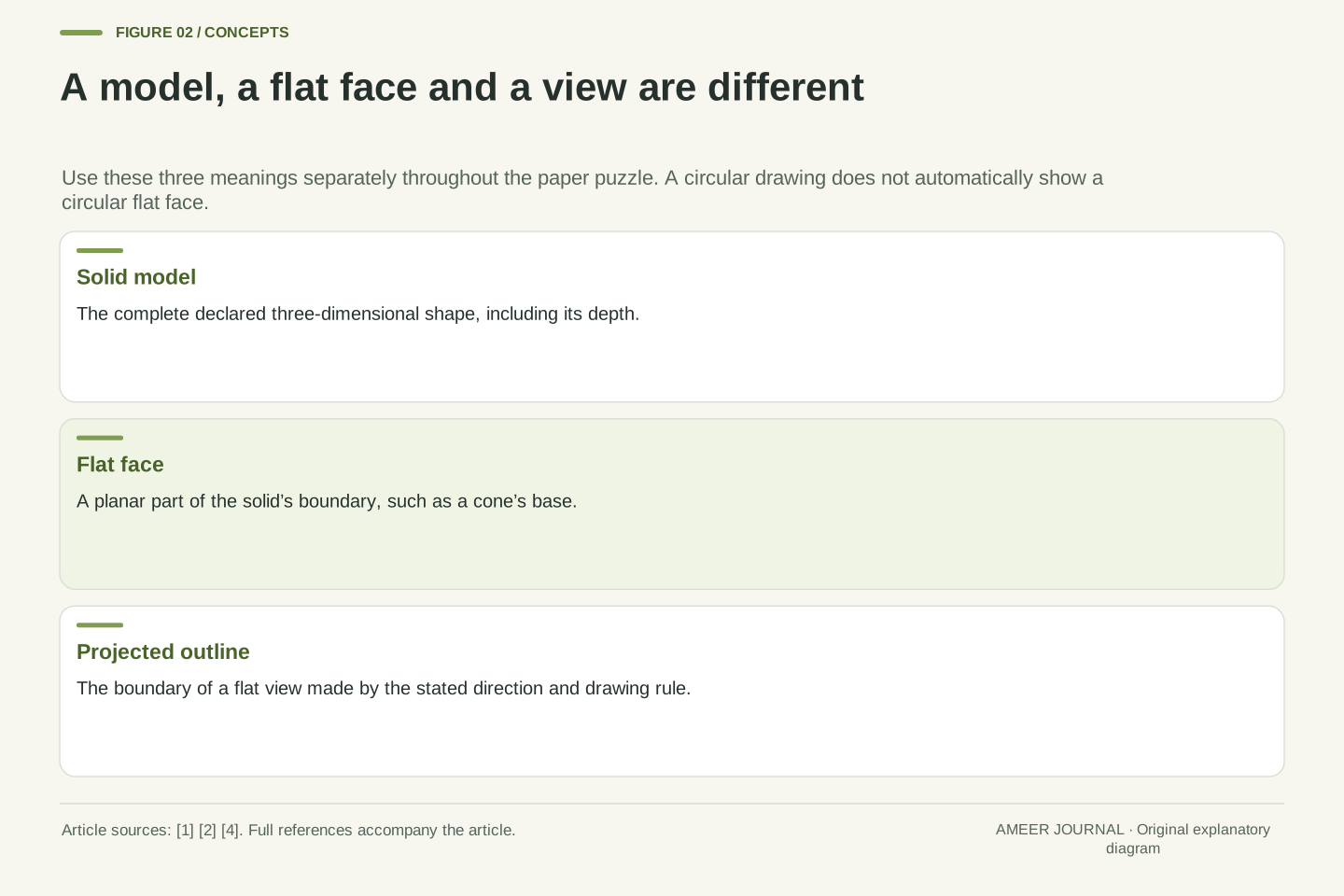
A solid shape has three-dimensional extent. A flat drawing is a representation of it. A flat face is different again: it is a flat part of a solid's outside boundary. Keeping those words separate helps us avoid calling every circle in a picture a face. Oak National Academy describes cones, cylinders and spheres using their flat faces and curved surfaces. [2]
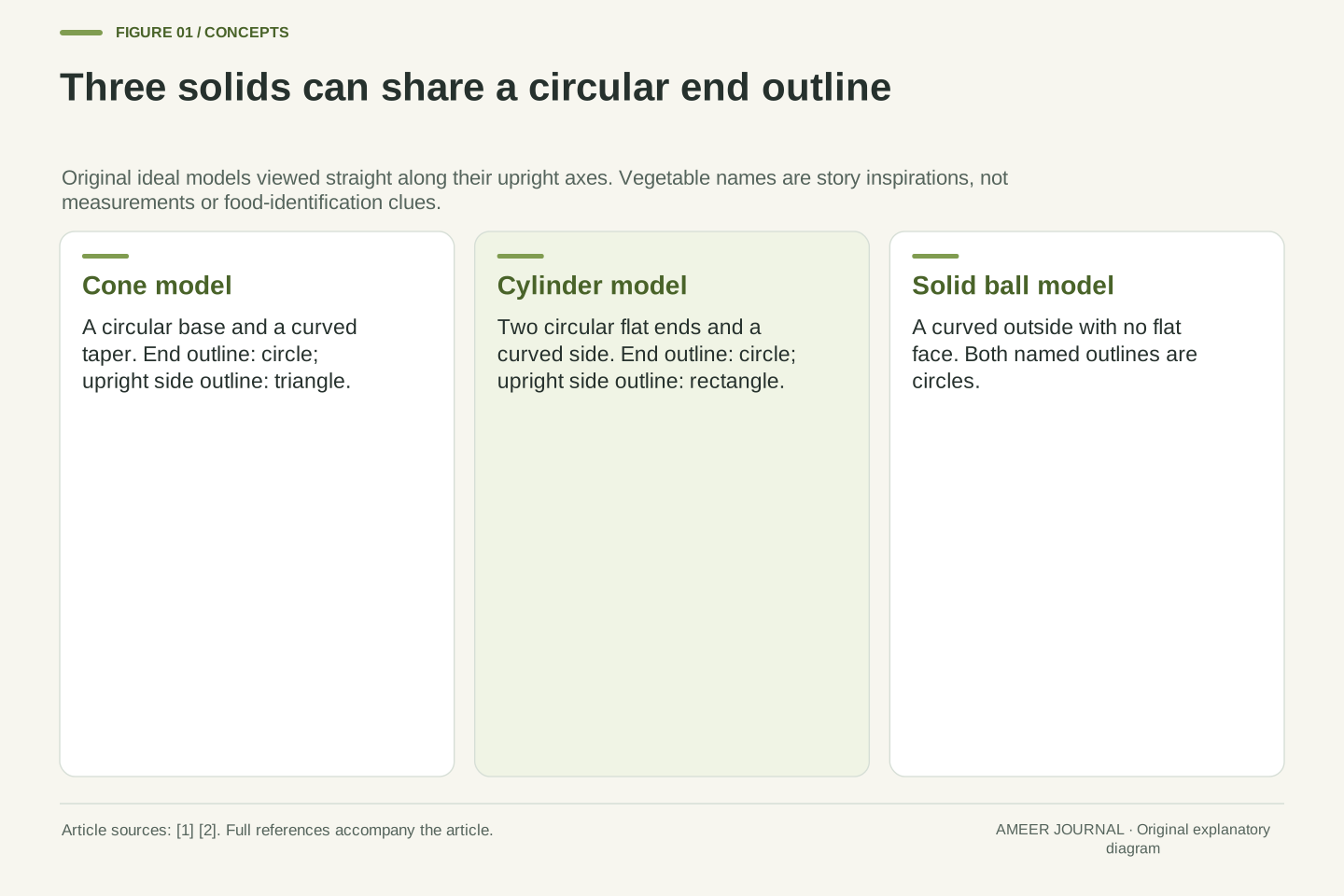
Our cone has one flat circular base and a curved surface that narrows to a point. Our cylinder has two flat circular ends and a curved surface joining them. Our ball-shaped model has a curved outside surface and no flat face. “Ball-shaped” is useful everyday language; the mathematical name for its outside surface is a sphere.
The vegetable names help us imagine the models, but the model rules do the mathematical work. A real carrot need not be a perfect cone, and a real turnip need not be a perfect ball. We are choosing neat shapes for a drawing puzzle. Colour, taste, plant parts and whether something is safe to eat are not clues in this puzzle.
The examples distinguish a three-dimensional filled model, its boundary surfaces and a two-dimensional representation. We use “flat face” explicitly: the cone has one circular planar base, the cylinder two circular planar ends, and the ball no planar face. Oak's elementary shape descriptions supply those distinctions. [2] We do not need to adopt a universal convention for counting curved edges.
More precisely, the spherical example is a solid ball; its boundary is a sphere. This matters when describing projected regions, because the model includes an interior while its named spherical surface describes the boundary. The cone and cylinder are right circular forms with positive radius and height. Their axes will be vertical, and the cone's apex will lie directly above its base centre.
Carrot, courgette and turnip are narrative associations, not anatomical classifications or claims that produce has exact geometric form. NCETM encourages selecting representation shapes through relevant properties. [1] Here the chosen properties are declared in advance, so shape reasoning does not depend on food colour or recognition. A model name cannot establish plant identity, nutritional content, volume of edible material or permission to taste anything.
Name the direction before comparing two outlines
For our end view, imagine looking straight down the upright model's axis. For our side view, imagine looking straight across at it. The view uses parallel lines: parts farther away do not shrink. This is a simple mathematical drawing rule, not a claim about every photograph. We also leave out shading, hidden lines and extra markings.
An outline is the boundary of the flat region made by this rule. We can shade inside that boundary on the page, even though we are describing a three-dimensional model. From the end, our cone, cylinder and ball give circles. From the side, the upright cone gives a triangle, the cylinder a rectangle, and the ball another circle. NPTEL's drawing lesson also shows a rectangular front outline for a cylinder. [3]
Keep the model upright while comparing these named views. If someone chooses a slanting direction, they have changed a rule and may obtain a different outline. Saying “the view from the side” is useful only when both readers agree which side and which drawing convention they mean. The direction label belongs beside the picture.
Let z measure vertical position, with x and y horizontal. The end or top projection maps (x, y, z) to (x, y). The side projection maps it to (x, z). These are orthographic maps with parallel viewing directions, not perspective-camera models. We retain only the filled projected region and its outer boundary, without shading, internal edges or hidden-line conventions.
For a cylinder, x²+y²≤r² and 0≤z≤h. Its top projection is a disk of radius r; its side projection is the rectangle −r≤x≤r, 0≤z≤h. Every point in that rectangle has a representative with y=0, and the cylinder inequality permits no wider x value. This proves the projected region, rather than guessing it from a pictorial sketch.
NPTEL explicitly distinguishes a cylinder's rectangular front boundary from extra lines used for internal features. [3] NCETM likewise treats viewpoint as relevant to representation. [1] Our axes and omitted information remain part of every later clue. Rotating the solid or using a different projection changes the problem and cannot silently be treated as the same observation.
Meet six cards with deliberately different dimensions
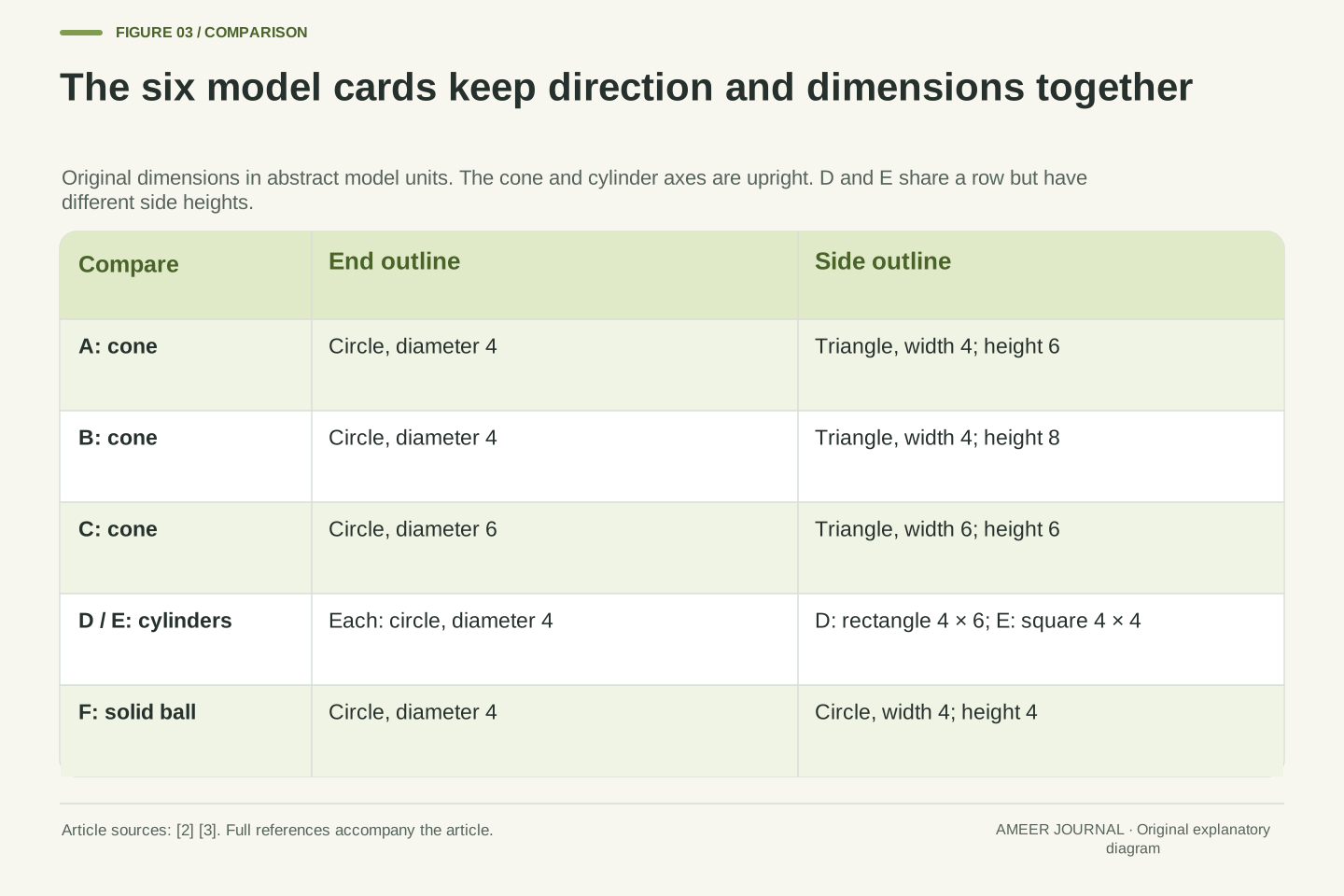
Our cards use model units. The numbers are exact clues for the puzzle, not measurements of real vegetables. Radius means the distance from the centre of a circular base to its rim. Diameter goes all the way across through the centre, so it is twice the radius. Height measures from the bottom to the top of the upright model.
Cards A, B and C are cones. A has radius two and height six; B has radius two and height eight; C has radius three and height six. Cards D and E are cylinders. D has radius two and height six; E has radius two and height four. Card F is a ball of radius two, so its full height is four.
The end circles therefore have diameters four, four, six, four, four and four, in letter order. The side views preserve each model's stated height. A and B have the same end circle but different heights; A and C have the same height but different widths. These differences give us clues that the word “circle” alone could not supply.
Define the candidates as follows, in abstract model units: A is a cone with (r,h)=(2,6), B a cone (2,8), C a cone (3,6), D a cylinder (2,6), E a cylinder (2,4), and F a solid ball of radius 2. The ball's centre is at z=2, so its lowest and highest points are at z=0 and z=4. None of these numbers describes measured produce.
For each cone, x²+y²≤[r(1−z/h)]² with 0≤z≤h. The side region is |x|≤r(1−z/h): an isosceles triangle of base width 2r and height h. Its top region is the radius-r disk, because the base at z=0 supplies that entire disk and no higher section extends outside it.
For F, x²+y²+(z−2)²≤4. The side region is x²+(z−2)²≤4 and the top region is x²+y²≤4. Choosing y=0 or z=2, respectively, shows that both disks are fully represented. Thus end diameters are 4,4,6,4,4,4, while side widths and heights follow exactly from the stated model equations.
A sorting rule tells you which similarity matters
First sort the cards by the shape of their side outline. The triangular group contains A, B and C. The rectangular group contains D and E. The circular group contains F. That gives groups of three, two and one. You can write the letters in three spaces on the same page rather than cutting out separate cards.
E needs a careful look. Its side view is four units wide and four units high, so the rectangle is a square. A square is also a rectangle: it has the required four right angles, with the extra property that all four sides are equal. New Zealand's mathematics guidance explicitly includes squares within rectangles. [4] E therefore belongs in our rectangular group.
Now change the question to “Which cards have circular end outlines?” All six belong together. Neither sorting has changed a cone into a cylinder. We changed the property we were comparing. A good group label says “triangular side outline” or “circular end outline,” so another reader knows which feature made the cards belong.
Sorting by side-outline class gives the partition {A,B,C}, {D,E}, {F}, with cardinalities 3,2,1. Sorting by end-outline class gives one six-element class, because every candidate has a circular end boundary. These are different functions on the same candidate set; neither classification changes the underlying solids.
The E projection is a 4-by-4 square. We use inclusive rectangle classification, so E remains in the rectangular class with D. The New Zealand resource states that squares form a subset of rectangles, and NCETM cautions against recognizing only familiar brick-like rectangles. [4][1] Calling E square adds information; it does not negate its membership in the broader class.
Size and shape class also remain separate. C's larger end disk has the same circular shape class as A's smaller one. A sorting criterion based on diameter would separate C, while the criterion based on circularity would not. Stating the criterion makes the grouping reproducible and prevents colour, a vegetable nickname or the order of the cards from quietly replacing the intended geometric property.
A rectangle in the view need not be a rectangular face
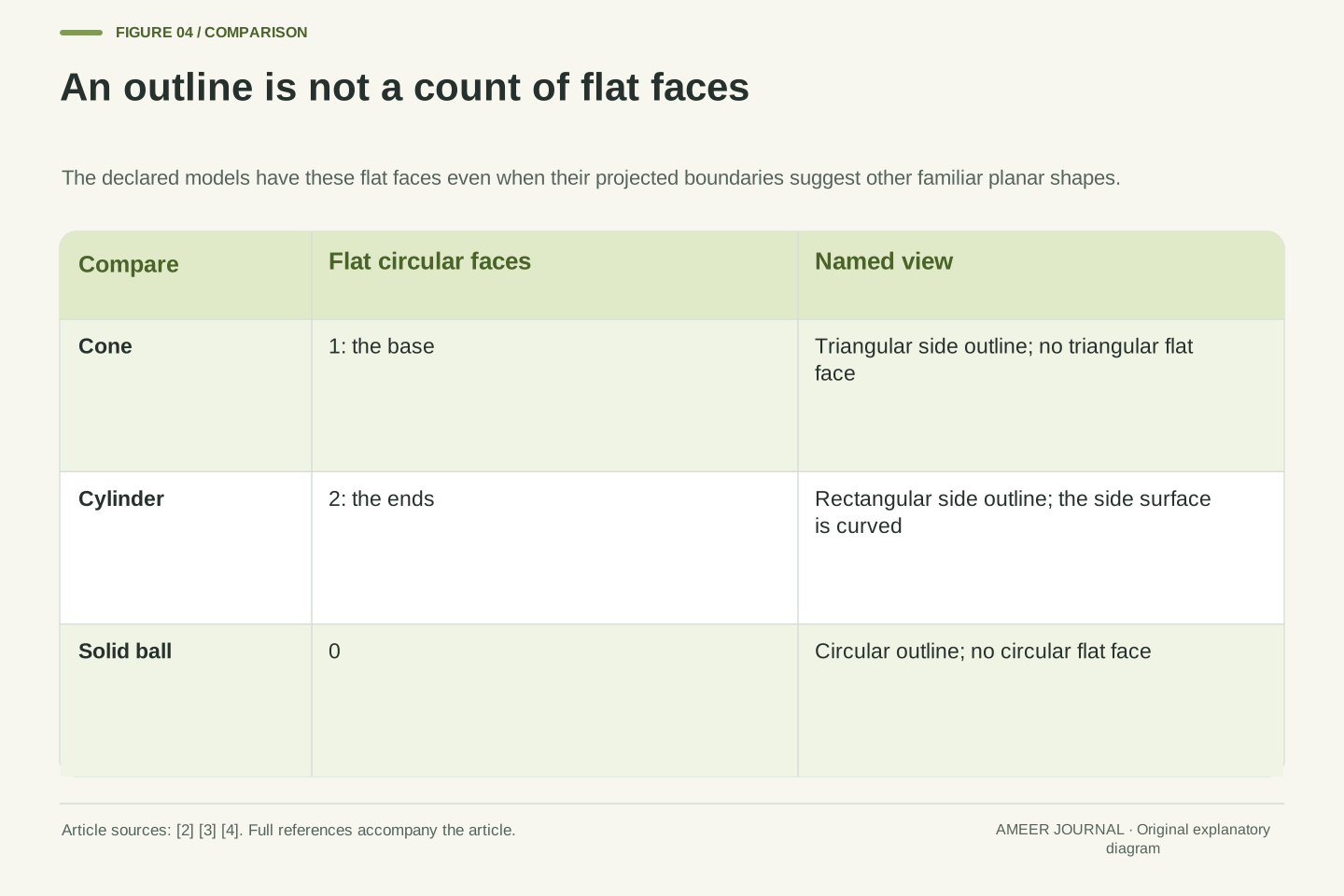
Look at D's rectangular side outline. Does that mean the cylinder has a rectangular flat face facing us? No. Its side surface curves around, even though the drawing's outside boundary is a rectangle. The New Zealand guidance makes this distinction between a cylinder's curved wrapping surface and a flat rectangle. [4] A picture can describe the boundary of a view without showing a flat face of that shape.
The ball provides another example. F has a circular outline from the end and from the side, yet its outside has no flat circular face. The cone is different again: its circular base is a real flat face of the model, but its triangular side outline is not a triangular flat face. Oak's shape properties help separate those cases. [2]
The triangle's corners do not give the cone three pointed apices, either. Only its top point is the cone's apex. The two bottom corners belong to the boundary of this particular drawing. Before naming a face or a point on a solid, ask whether you are describing the model itself or a feature that appeared in its flat outline.
Projection is not face extraction. A point in a side-view region records that at least one model point maps to that position; it does not say that the region is an actual planar patch of the solid. The cylinder's rectangular side projection combines positions from different depths. Its lateral boundary remains curved, as the New Zealand guidance emphasizes. [4]
The face counts therefore cannot be read directly from the number or shape of projected regions. A cone has one circular planar base, a cylinder two circular planar ends, and a ball none. [2] Nevertheless, their end projections are all disks. Conversely, the cone's triangular side region does not supply a triangular planar face, and the cylinder's rectangular side region does not supply a rectangular planar face.
The same distinction applies to prominent points. The cone's side outline has three planar vertices, but the two base extremities are not additional cone apices. They arise from the chosen projection boundary. This avoids importing the corners of a silhouette into the solid's topology. Our explanation needs only the apex and explicitly flat faces, without resolving every school convention for curved edges.
Three clues narrow the six cards to one
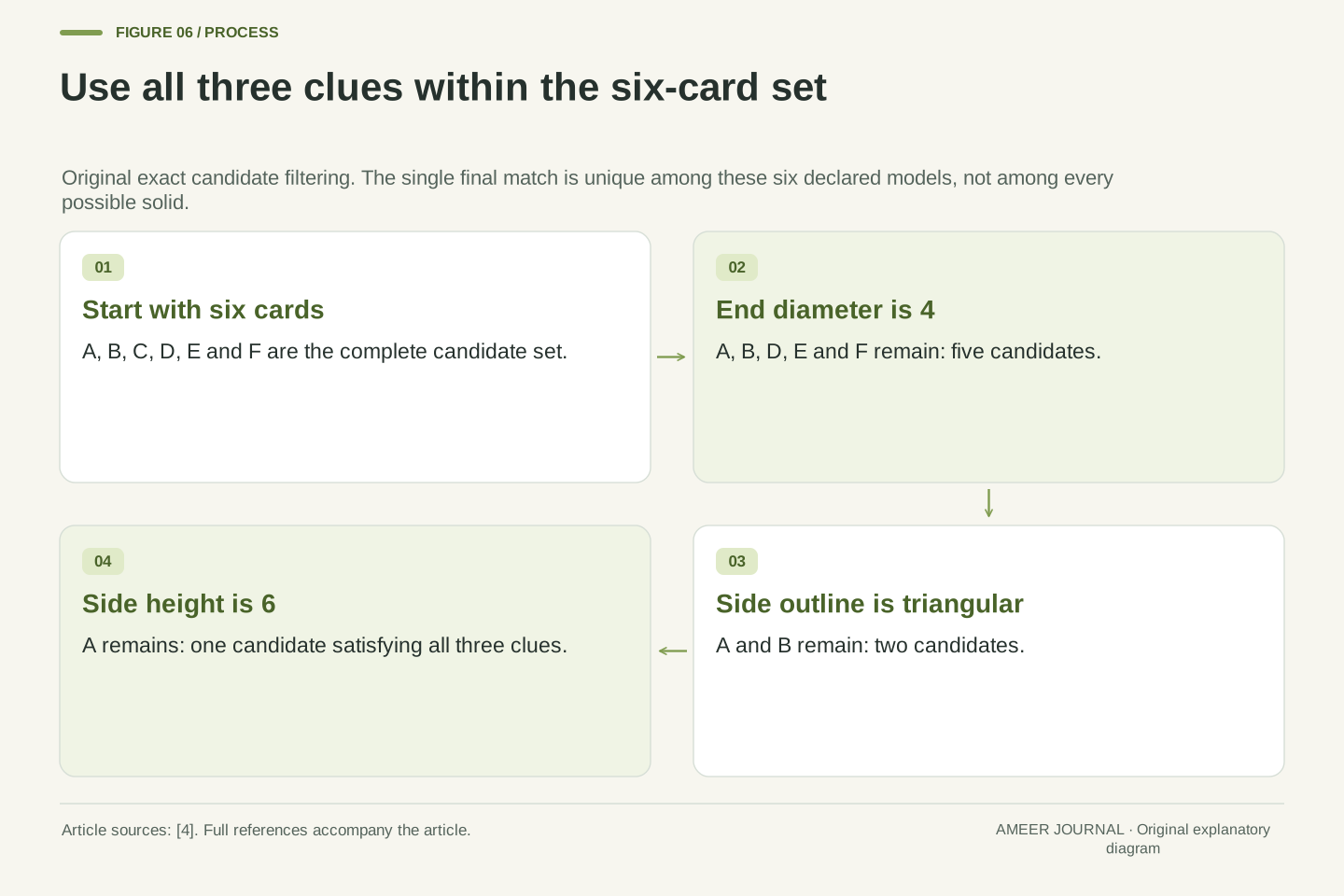
A grown-up can now describe one mystery card using three clues. The first clue is “Its circular end outline is four units across.” A, B, D, E and F stay in the group. C leaves, because its end diameter is six. Five cards remain, so the first clue does not yet identify the model.
The second clue is “Its side outline is triangular.” Only A and B remain from those five. D and E have rectangular side views, and F has a circular one. The third clue is “Its side outline is six units high.” A fits; B is eight units high. The candidate count has changed from six to five to two to one.
Notice what made the final answer possible. “It is a circle” was too broad. “It has a triangular side view” narrowed the kind of model, but two different cones still fitted. The supplied width and height separated them. Our answer is “A, among these six cards,” followed by the clues it satisfies. Explaining the reason is part of the answer.
Let the candidate set be S={A,B,C,D,E,F}. Define C₁ as the diameter-four end-view condition. Then S∩C₁={A,B,D,E,F}. Define C₂ as a triangular side region; intersecting again gives {A,B}. Define C₃ as side height six; the final intersection is {A}. The successive cardinalities are exactly 6,5,2,1.
This is finite candidate elimination using stipulated exact attributes. No probability is attached to a card, and no visual classifier has estimated a diameter or height. The dimensions are supplied labels in the mathematical construction. A rough hand-drawn circle can illustrate the idea, but its apparent size does not override a labelled value or become a measured datum.
The process reflects classification through shared properties, as described by the New Zealand resource. [4] Its conclusion is limited to membership in this declared set. Reporting only “the solid must be A” would conceal that scope. The precise result is that A is the unique supplied candidate satisfying all three conditions under the named projections and model definitions.
Changing the clue order can change the intermediate group
Try a different order without changing the clues. Begin with “triangular side outline” and “six units high.” A and C remain. Both cones are that tall, while B is taller. Then use “four units across in the end view.” C leaves because its diameter is six. We reach A again, but we passed through a different group.
That is useful when explaining a solution to someone else. One reader might notice width first; another might notice height. Both can be right if every clue is applied consistently. We do not need to insist on one guessing order. We need to check that the surviving card matches all the information.
There is also a boundary around the conclusion. The page offered only six candidates. An extra, differently designed solid might share some outlines with A. The puzzle has not proved that every possible object in the world can be identified from those clues. It has proved something smaller and exact: among the listed models, only A remains.
Starting with side triangularity and height six gives {A,C}; imposing end diameter four then yields {A}. The final set is unchanged because intersection of these fixed conditions is commutative. Intermediate set sizes and membership can differ when the predicates are reordered, so identical conclusions do not imply identical reasoning paths.
The scope also depends on S. If more models are admitted, the same conjunction may no longer identify a unique element. A pair of projected outer regions is not a general theorem of three-dimensional reconstruction. The New Zealand resource warns that representations can leave unseen features ambiguous. [4] Our finite enumeration supplies a controlled example of what complete candidate information permits.
Keep deductive filtering separate from observational uncertainty. The card register gives exact geometric attributes, whereas estimating dimensions from an uncalibrated photograph would introduce scale, direction and measurement questions absent here. The exercise demonstrates intersection of declared constraints. It does not establish recognition accuracy, a child's general mastery or the reliability of identifying real vegetables from a photograph.
The same width and height can enclose different flat areas
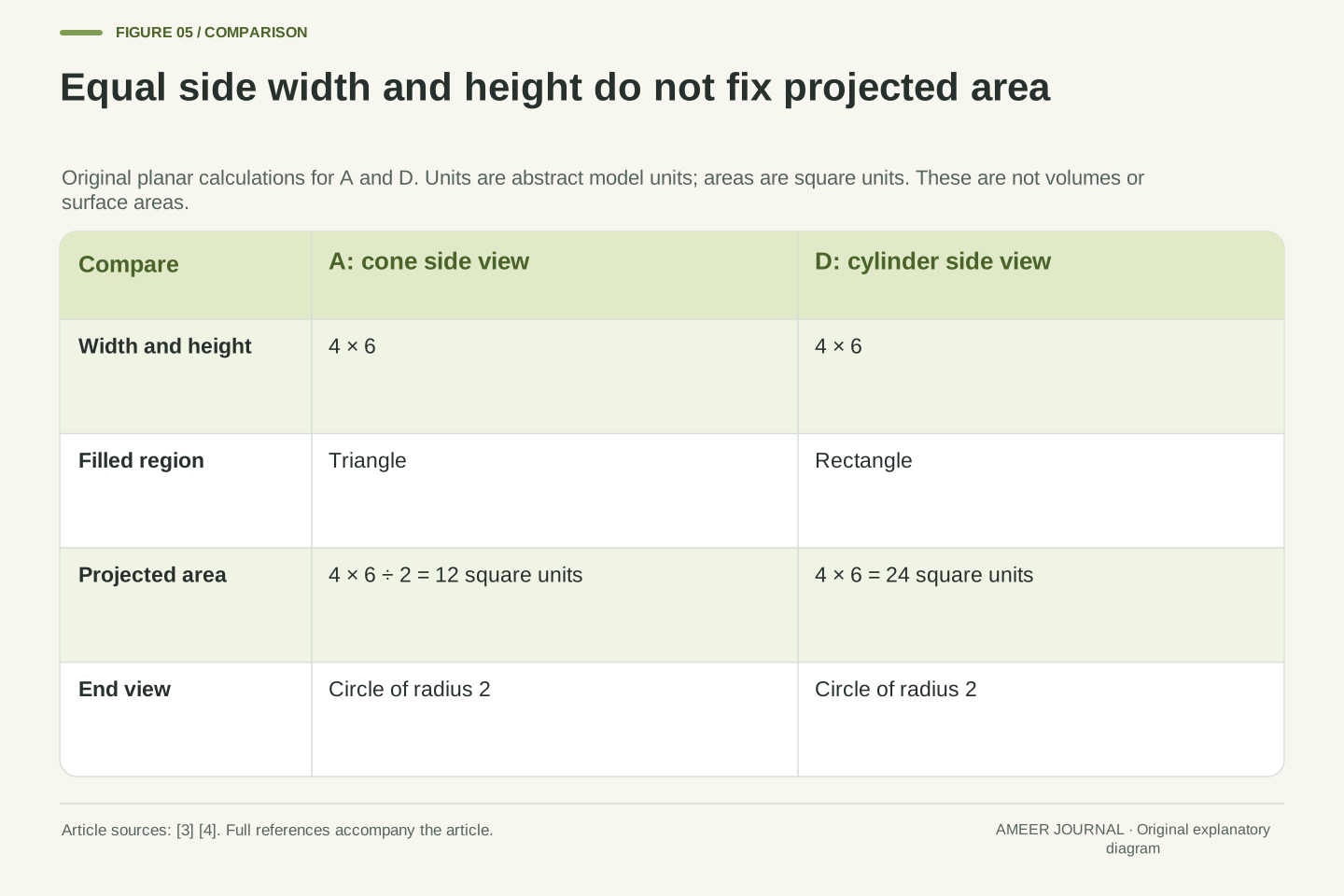
Compare A's side triangle with D's side rectangle. Both are four units wide and six units high. They fit the same width-and-height frame, but they do not cover the same amount of the page. The triangle narrows towards its top point; the rectangle stays four units wide all the way up.
The rectangle's area is four times six, which gives twenty-four square units. A triangle with the same base and height covers half that area, giving twelve square units. You can label those two results beside the drawings. The calculation describes filled flat regions in our chosen views. It does not tell us how much material a real vegetable contains.
From the end, A and D have equal circles because both have radius two. Equal end outlines can therefore accompany unequal side areas. Even equal side width and height were not enough to make the side regions identical. When someone says two drawings are “the same size,” ask which size they mean: width, height, area, or the whole outline.
A and D share the side bounding box [−2,2]×[0,6]. The cone's projected triangular region has area (4×6)/2=12 square model units; the cylinder's projected rectangle has area 4×6=24. The ratio is one half despite identical maximum width and height. Bounding dimensions do not determine the filled area without a shape specification.
Both top regions are radius-two disks, with area πr²=4π square units. Thus equal top projected area does not imply equal side projected area. These calculations follow from the original coordinate construction; they are not values reported for vegetables or measurements taken from the illustrations. A resized display also does not change the labelled model dimensions.
Projected area is distinct from volume and from the surface area of the solid. In particular, the cylinder's rectangular side projection is not its curved lateral surface laid flat. The New Zealand distinction between that curved surface and a flat representation supports the need to name the quantity. [4] We make no mass, nutrition or food-quantity inference from either of these planar areas.
Finish with a sentence that names the model and the view
Give a reading partner one of the six letters and ask them to describe two things: the solid model and its outline from a named direction. For D, a useful answer is, “The model is a cylinder. Its side outline is a rectangle, and its end outline is a circle.” Then ask whether that side rectangle is a flat face. The explanation should keep the drawing and the curved surface separate.
You can also invent a clue using the existing card facts. “A circular end view of diameter four” leaves five possibilities. Adding the triangular side view leaves two. Adding height six leaves A. Write the remaining letters after each clue so the reasoning is visible. There is no need for a timed challenge or a score about who learns fastest.
The question to carry into another picture book is simple: “Am I naming the solid, a flat face, or an outline from this view?” Those labels can be different while all being correct. A careful description tells your partner which one you mean and which information the picture has supplied.
A complete explanation records four items: candidate model, named projection, observed or supplied property, and remaining alternatives. For D, “cylinder; side projection; rectangular region” states a representation fact. “Two circular planar faces” states a property of the solid. The two statements are compatible, but neither should be silently substituted for the other.
For the clue exercise, preserve the candidate register and the exact conditions alongside the intermediate sets. That makes the 6→5→2→1 elimination reproducible and reveals which additional condition changes the answer. A second ordering can produce {A,C} before {A} while using the same final conjunction. The activity is explanation through stated properties, consistent with the classification guidance. [4]
The final distinction is between information supplied by a model definition and information retained in a view. The former gives our solids their dimensions and interiors; the latter can discard depth, internal features or distinctions between candidates. Naming both is enough to turn a familiar vegetable-inspired picture into a precise geometry question without treating a silhouette as a complete account of an object.
Sources & further reading
Explore the references behind this guide. External pages may change after our review.
- Shape and Space | NCETMNational Centre for Excellence in the Teaching of Mathematics · Accessed 7 Nov 2026
- Lesson: Describe and name 3D shapes | Oak National AcademyOak National Academy · Accessed 7 Nov 2026
- Lecture 16: Orthographic projections—conventions and projections of simple solids, page 2NPTEL / engineering drawing course · Accessed 7 Nov 2026
- Classification of three-dimensional shapesNew Zealand Ministry of Education / Tāhūrangi · Accessed 7 Nov 2026
Article updated 7 Nov 2026.