What you’ll take away
- A matching puzzle must state its allowed moves and corresponding point labels.
- Planar slides and turns preserve the labelled journey around a nondegenerate triangle; a reflection reverses it.
- A half-turn differs from one line reflection, even when one corner happens to agree.
- Correct traversal direction alone does not prove a match: the side lengths must also fit.
- A symmetric unmarked outline can hide a transformation that distinct corner labels would reveal.
Ask which moves the matching game allows
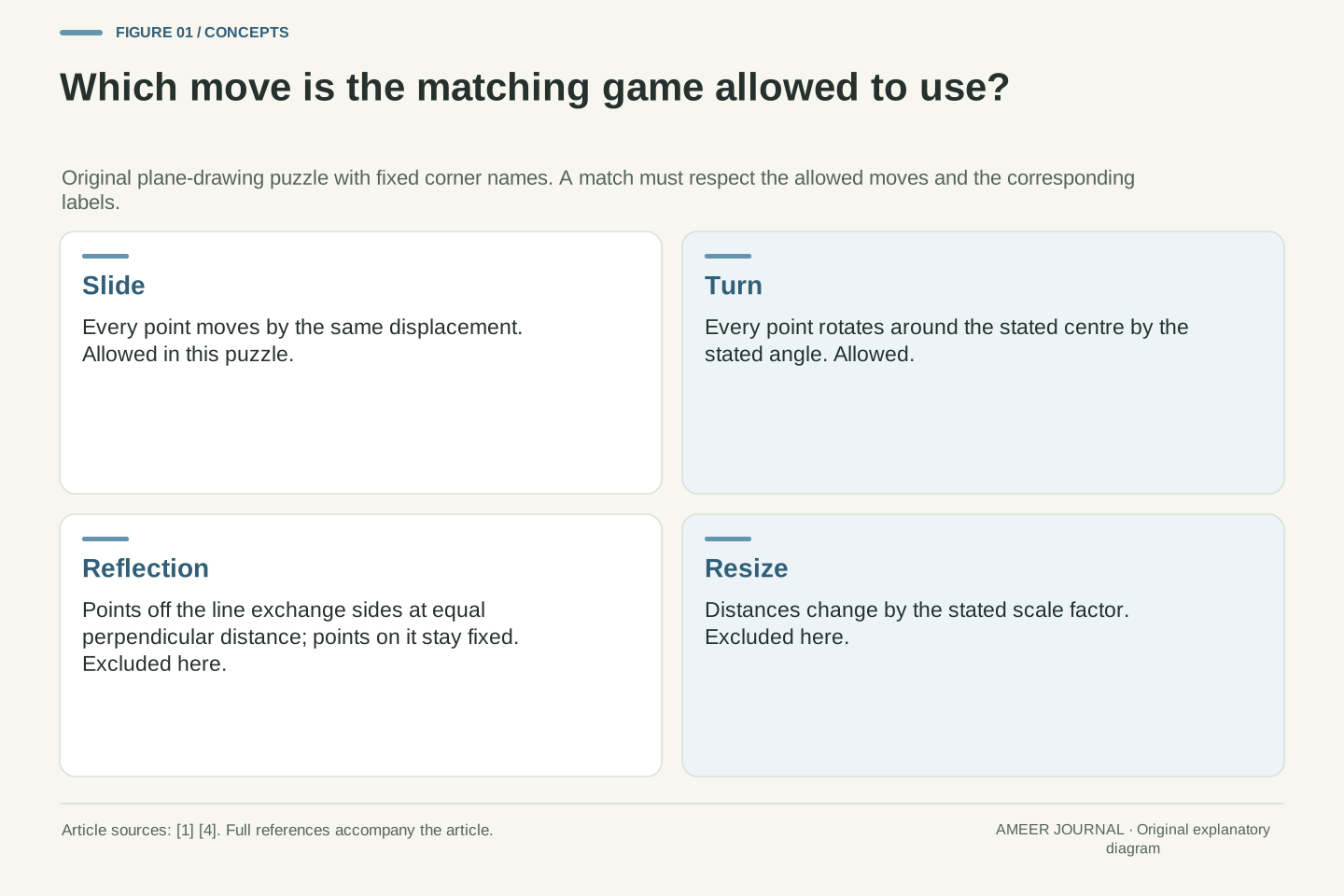
Two drawings look like the same triangle, but they point in different directions. Can they match? Before answering, ask for the rules. May you slide a drawing? Turn it? Make a mirror image? Make it bigger? The word “match” can hide several different questions, so our paper game will say exactly what is allowed.
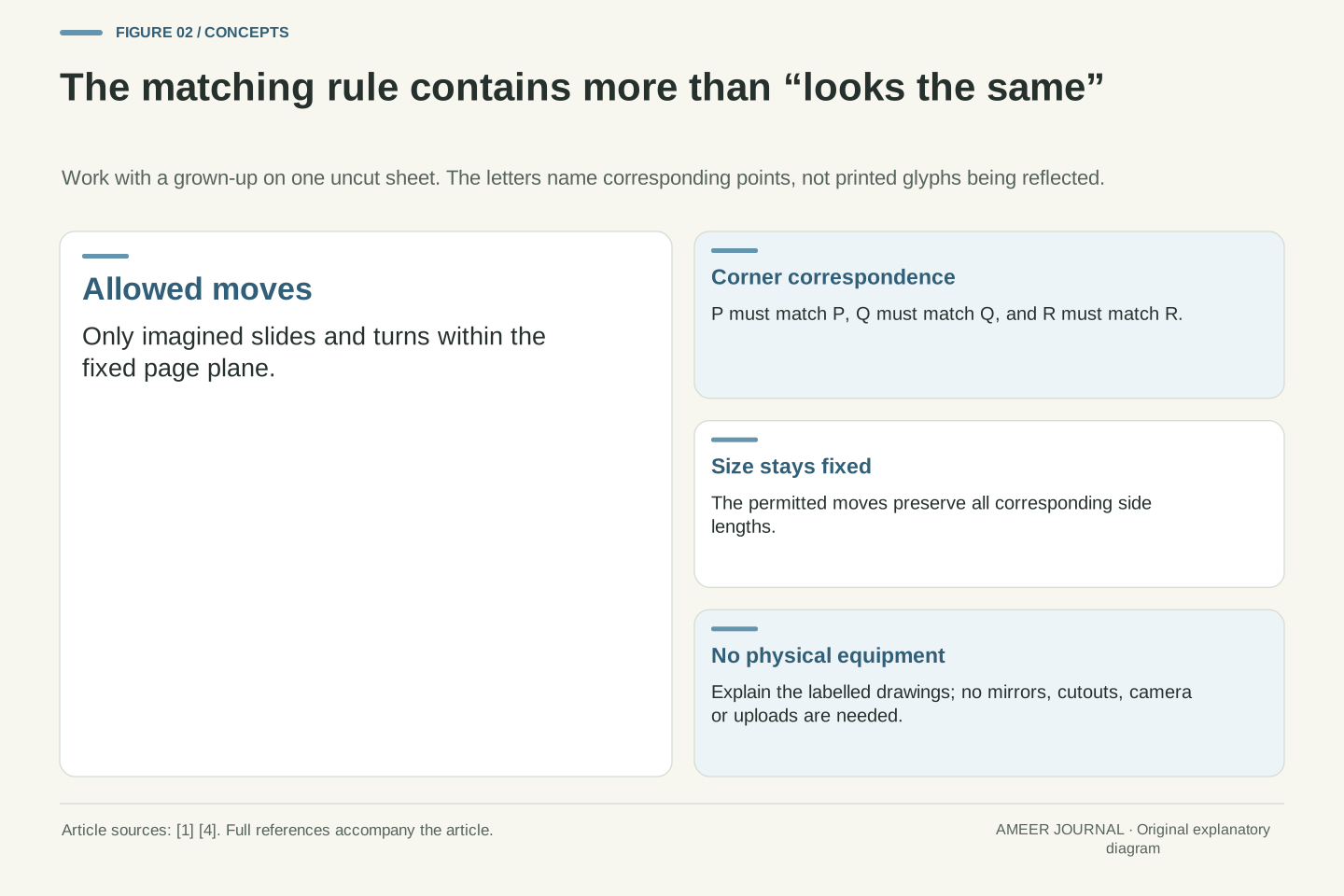
We allow imagined slides and turns within the flat page. We keep the triangle's corner names attached: P must match P, Q must match Q, and R must match R. We do not change the drawing's size or make a mirror image unless a later question specifically allows that move. Oak's definition of congruent shapes includes reflection as well as turns and slides, so our game has a narrower rule than that mathematical word. [4]
Work with a grown-up using the diagrams and one uncut sheet. You can point to the corners, describe a move or draw its result. No cutout, mirror, photograph or upload is needed, and nobody needs to turn the sheet over. These are invented drawings with exact clues, not a timed contest or a test of how clever someone is.
A matching task needs an equivalence rule. This article permits planar translations and rotations while preserving corresponding vertex identities. Reflection and resizing are excluded unless explicitly introduced. Congruence is broader: Oak's definition permits reflection along with rotation and translation. [4] Failure under our restricted move set therefore does not imply that two triangles are noncongruent.
The construction uses one labelled, nondegenerate scalene triangle and several exact transformed copies. P, Q and R name corresponding points; they are not printed glyphs whose own letter shapes are being mirrored. The original coordinates and transformation rules determine the results. No photograph, physical movement or child's response was measured.
The Easy mode supports discussion with a grown-up, while this mode supplies coordinate and orientation checks. All activity stays in private discussion or marks on an uncut sheet. Physical flipping, cutouts, mirrors, camera use and personal-data collection are unnecessary. The reader question is which information proves that a proposed planar match obeys the stated rules, and which familiar-looking similarities are insufficient.
A slide, a turn and a reflection have different instructions
A slide moves every point by the same amount in the same direction. If P moves two spaces right and three up, Q and R must do exactly that too. A turn needs a centre, an amount and a direction. A quarter-turn is ninety degrees; a half-turn is one hundred and eighty degrees. Clockwise follows a clock's hands, while counterclockwise goes the other way. [1]
A reflection uses a line. A point off that line goes to the opposite side, the same perpendicular distance away. A point already on the line stays where it is. Think of this as a drawing instruction; you do not need a real mirror. Illustrative Mathematics describes these moves through what happens to each point, which helps us keep the whole shape together. [1]
“Turn the triangle” is therefore incomplete. Around which point, by how much, and which way? “Make a reflection” also needs the line. Precise instructions let two people produce the same intended drawing, even if their pencil sketches are not perfectly neat.
A translation has the form v↦v+t, using the same displacement t for every point. A rotation specifies a centre, angle and direction. A reflection specifies a line and preserves equal perpendicular distance while exchanging its sides; points on the line are fixed. These pointwise definitions follow the IM glossary and the New Zealand transformation guidance. [1][2]
Use Cartesian page coordinates throughout: x increases to the right and y upwards. This convention matters when interpreting positive turns and clockwise traversal. A screen coordinate system that increases downward would require a corresponding sign adjustment; it is not the coordinate system of our examples.
Also separate facing direction from traversal sense. A quarter-turn can make a drawing face another direction on the page while preserving the clockwise or counterclockwise order of its labelled boundary. We will define that order using P→Q→R→P. Saying simply that “orientation changed” can otherwise confuse a visible turn with the reversal caused by reflection. The named centre or line and the corresponding points make the intended transformation precise.
Give the starting triangle three exact corner positions
Our starting drawing is triangle A. Its corners are P at (1,1), Q at (5,1), and R at (2,3). The first number tells you the position across the page; the second tells you the position up it. All units are imaginary grid units. A grown-up can help mark the three positions and join them in the order P, Q, R, P.
From P to Q, the line goes four units to the right. R is two units above that horizontal base and one unit to the right of P. The triangle therefore has a base of four and a height of two. Its flat area is half of four times two: four square units. The three sides have different lengths, so it is a scalene triangle.
Follow the corner names around the edge: P to Q, then R, then back to P. This journey goes counterclockwise in our coordinate picture. Keep the letters in that order when comparing later drawings. Changing the order in which you read the letters would change the question instead of moving the triangle.
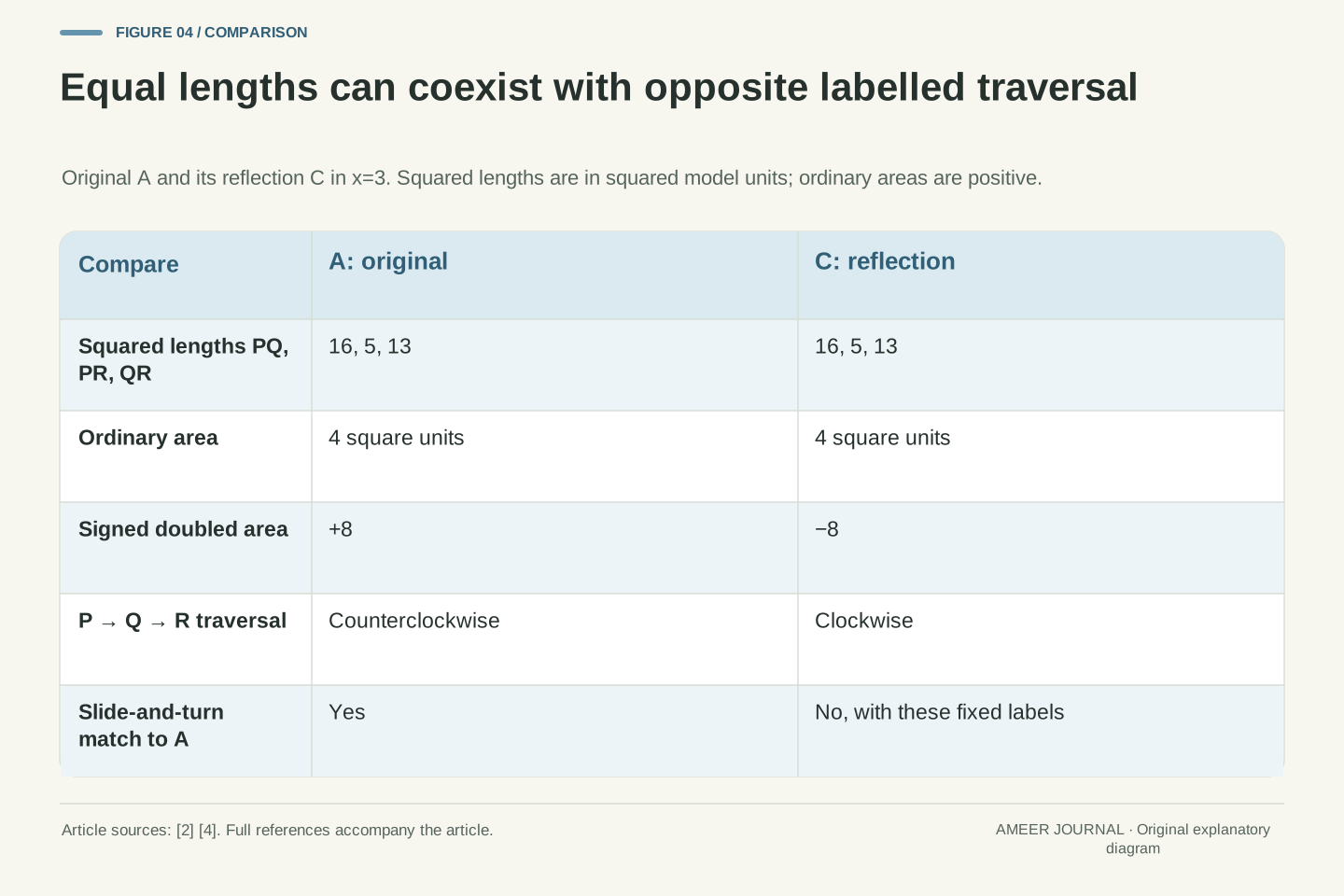
Set P=(1,1), Q=(5,1), R=(2,3). The difference vectors are Q−P=(4,0), R−P=(1,2), and R−Q=(−3,2). Their squared lengths are PQ²=16, PR²=5 and QR²=13. All three are distinct, so the triangle is scalene. The units are arbitrary exact model units, not measurements extracted from a rendered illustration. Squared lengths keep the comparison exact without decimal rounding. The actual side lengths are 4, √5 and √13 units. Because lengths are nonnegative, equal squared lengths imply equal lengths. A square-unit label on a squared distance does not turn that quantity into the filled area of the triangle; the area requires its own calculation.
The horizontal base has length 4 and the perpendicular height is 2, giving area 4 square units. Define the signed doubled area D=(Qx−Px)(Ry−Py)−(Qy−Py)(Rx−Px). Here D=4×2−0×1=8. Its positive sign records counterclockwise traversal in the chosen x-right, y-up convention; the ordinary area is |D|/2.
The source material emphasizes corresponding points and preserved lengths under rigid transformations. [1][2] Our exact values provide an original test case for those ideas. They also make the inference auditable: a proposed image must respect the specified P, Q and R correspondence, not merely resemble a triangle of roughly similar proportions.
Two permitted moves produce different-looking matches
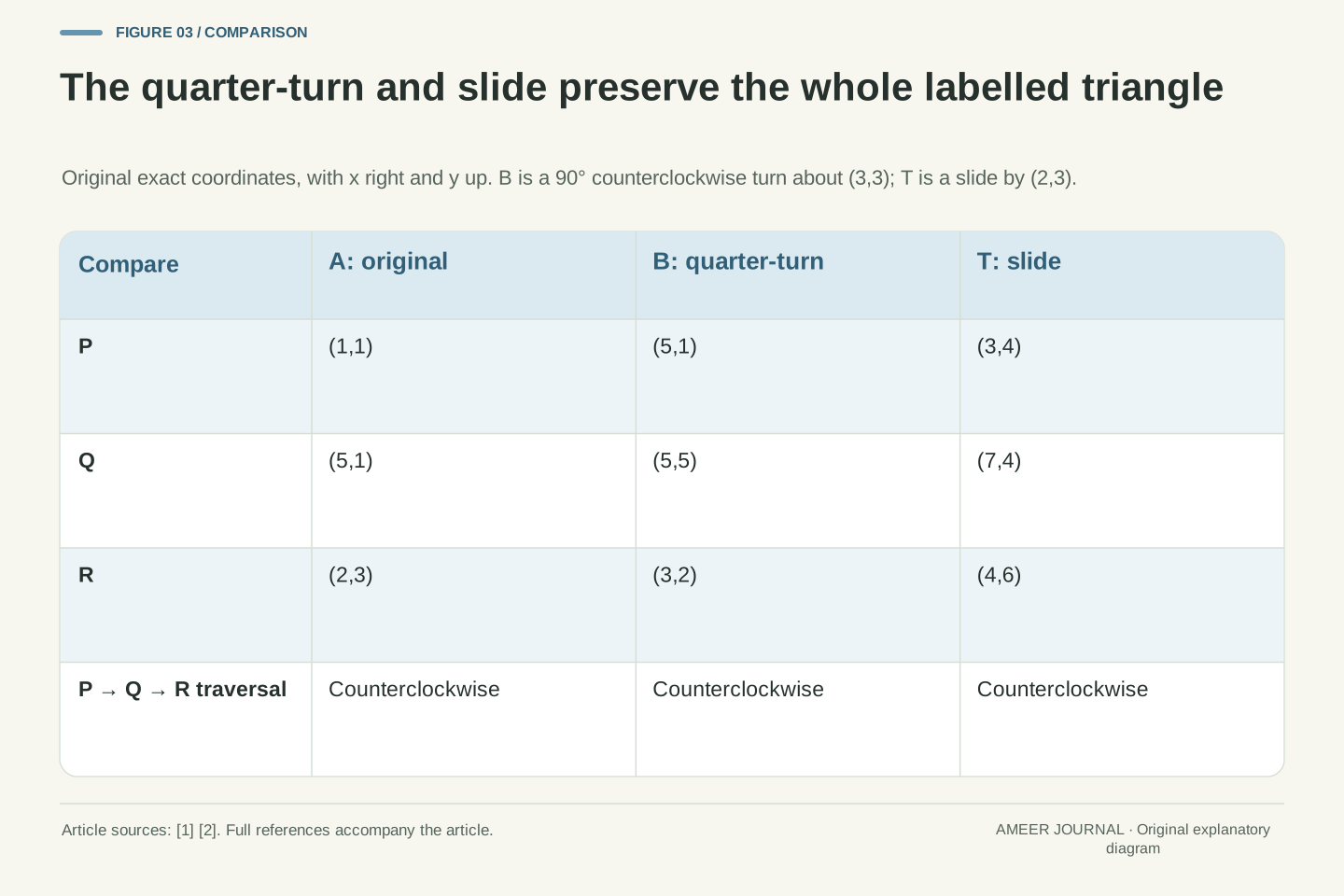
First make drawing T by sliding A two units right and three units up. P moves to (3,4), Q to (7,4), and R to (4,6). The whole triangle moves together. Its side lengths and area stay the same, and the journey through P, Q and R still goes counterclockwise.
Now make drawing B with a quarter-turn counterclockwise around the centre O at (3,3). P goes to (5,1), Q to (5,5), and R to (3,2). The four-unit base now stands vertically, but it has not become a different length. Every point has turned through the same angle around the same centre, as required by a rotation. [1]
T and B look different from A in their positions and facing directions. Both are still permitted matches in our game. The useful explanation names the move, rather than saying that a triangle must keep its base at the bottom to be the same shape. NCETM cautions against defining shapes only by familiar orientations. [3]
The translation T(x,y)=(x+2,y+3) sends the vertices to P=(3,4), Q=(7,4), R=(4,6). Subtracting any pair cancels the translation vector, so all squared side lengths remain 16,5,13, and D remains 8. This is a direct permitted move from the original triangle.
For B, translate the rotation centre O=(3,3) to the origin, apply a counterclockwise quarter-turn (u,v)↦(−v,u), then restore the centre. The resulting rule is B(x,y)=(6−y,x), producing P=(5,1), Q=(5,5), R=(3,2). The squared distances of P,Q,R from O are respectively 8,8,1 before and after the turn, and every radius turns through the same angle. [2]
The transformed difference vectors yield the same side lengths and D=8. Equal distance to a centre alone would not specify the correct rotation, because it leaves the angular position unresolved. The angle and direction complete the instruction. A different facing direction therefore coexists with preserved labelled traversal sense, rather than contradicting it.
The mirror drawing keeps lengths but reverses the corner journey
Drawing C reflects A across the vertical line x=3. This line is halfway between P at x=1 and its new position at x=5. Q moves from x=5 to x=1, and R moves from x=2 to x=4. Their heights stay the same, giving P=(5,1), Q=(1,1), and R=(4,3).
Every corresponding corner stays the same distance from the reflection line, on the other side. The side lengths and flat area also stay unchanged. The New Zealand guidance describes these preserved lengths, angles and areas for reflections. [2] C has not stretched, shrunk or stopped being a triangle.
But follow P to Q to R and back to P. The journey now goes clockwise. That is different from the counterclockwise journey in A, B and T. A mirror drawing can therefore preserve size while reversing the labelled order around the edge. This is the clue that will separate a reflection from the slides and turns our game allows.
Reflection in x=3 is C(x,y)=(6−x,y). The resulting vertices are P=(5,1), Q=(1,1), R=(4,3). Their perpendicular distances from x=3 remain 2,2,1. Each original/image pair has the line as its perpendicular bisector, except a point on the line would coincide with its own image. [1][2]
For C, Q−P=(−4,0) and R−P=(−1,2), so the signed doubled area is D=−8. The ordinary area remains 4 and the corresponding squared side lengths remain 16,5,13. This explicitly separates preserved metric properties from reversed boundary traversal.
The negative sign concerns the fixed ordering P,Q,R. It does not mean a negative ordinary area or a broken triangle. Nor does it claim that the reflected figure is noncongruent: reflection is included in the congruence definition. [4] The question is whether C can be reached while obeying the more restrictive slide-and-turn rule. Its reversed traversal supplies the decisive obstruction.
Why trying more turns cannot fix the reversed order
You might try turning C again and again, hoping that one position will finally match A with all the corner names in place. A turn can move the starting corner to a new position, but it keeps the order of the journey around the triangle. A slide also keeps that order. Combining more of those two moves will not turn a clockwise labelled journey into a counterclockwise one.
That gives a reason stronger than “I tried a few turns and none worked.” A and C have opposite journey directions, while every allowed move preserves the direction. C therefore cannot match A under our rules. If we allow a reflection as well, that obstacle disappears: C was made by reflecting A in the first place.
Be careful with the wording of the result. Say, “This mirror copy needs a move our game does not allow.” Do not say, “It has different side lengths” or “It is not congruent.” Both would confuse a rule about permitted moves with the geometric properties that reflection preserves.
The obstruction can be proved for arbitrary finite sequences of planar rotations and translations, not only quarter-turn attempts. Translation cancels from the two difference vectors defining D. A proper two-dimensional rotation has matrix [[c,−s],[s,c]], where c²+s²=1, so its determinant is +1. Applying it to both vectors leaves their determinant, and therefore D, unchanged.
A line reflection has determinant −1 and reverses D. Thus all images of A obtained solely by the permitted moves retain D=8, while C has D=−8. The distinct values exclude a correspondence-preserving match. Nondegeneracy matters: for collinear points D would be zero and its sign would not supply this test.
This is an original algebraic derivation of the restriction, consistent with the source definitions and invariants. [1][2] It does not contradict congruence, which admits orientation-reversing isometries such as reflection. [4] It also does not make the sign test sufficient for every match; matching scale and geometry still matter, as the later enlarged example demonstrates.
A half-turn and one reflection can agree at one corner only
What if we turn A halfway around instead? Use the same centre O=(3,3). The half-turn drawing H has P=(5,5), Q=(1,5), and R=(4,3). Compare it with C: the reflected drawing had P=(5,1), Q=(1,1), and R=(4,3).
R lands in the same place in both drawings. That single agreement might look promising, but P and Q are at different heights. The drawings are not the same labelled result. We must compare all three corresponding corners, rather than stopping when one point happens to coincide.
H also keeps the counterclockwise journey, as a turn should. C has the clockwise journey of the reflection. The half-turn is a permitted match to A, while C still requires reflection. The numbers show why “turn it upside down” and “make its mirror image” cannot be treated as interchangeable instructions in this example.
The half-turn about O=(3,3) is H(x,y)=(6−x,6−y). It gives P=(5,5), Q=(1,5), R=(4,3). Reflection C changes only the horizontal component relative to its vertical line, giving P=(5,1), Q=(1,1), R=(4,3). Hence H(R)=C(R) but H(P)≠C(P) and H(Q)≠C(Q).
The shared R position occurs because R lies on the horizontal line y=3 through the centre; reversing that component leaves it unchanged. One corresponding-point coincidence cannot identify a transformation on the entire triangle. The different P and Q positions explicitly reject equality of the two labelled images.
H has linear part −I in two dimensions, whose determinant is +1, and it preserves D=8. The reflection's linear part has determinant −1 and gives D=−8. The New Zealand guidance states the origin-centred half-turn rule; translating to and from O gives our stated construction. [2] This distinction concerns a planar turn, not physically lifting or flipping a sheet.
The correct corner order is only one part of a match
Make one more drawing, E, by doubling every distance from P in A. P stays at (1,1), Q moves to (9,1), and R moves to (3,5). The new triangle still has the same general proportions and the same counterclockwise corner journey. But its base is now eight units long instead of four.
A slide or turn cannot double a side length, so E does not fit our rules either. Its height is four instead of two, and its area is half of eight times four: sixteen square units. Doubling both lengths has made the area four times as large, not twice as large.
This gives us two different reasons a proposed match can fail. C keeps the lengths but reverses the labelled journey. E keeps the journey direction but changes the lengths. Check both instead of treating either clue as the whole answer. A good matching explanation says what was preserved and what the permitted moves could not change.
Dilation by factor 2 about P=(1,1) gives E(x,y)=(2x−1,2y−1), with P=(1,1), Q=(9,1), R=(3,5). The corresponding squared lengths become 64,20,52: four times their original values. The side lengths themselves double. This is enlargement, not a distance-preserving rotation or translation. [4]
The signed doubled area becomes D=32, so its sign remains positive while its magnitude quadruples. Ordinary area is 16 square units, compared with 4 for A. This is a concrete counterexample to treating agreement of traversal sense as a sufficient rigid-match criterion.
The contrast with C is useful. C preserves all pairwise distances but reverses the label traversal; E preserves traversal sense but changes distances. The two failures diagnose different violated conditions. For the specified noncollinear triangle, a genuine permitted match must respect the corresponding geometry and the orientation-preserving rule. No visual resemblance, colour match or equal number of corners can replace those conditions.
A symmetric outline can hide which move happened
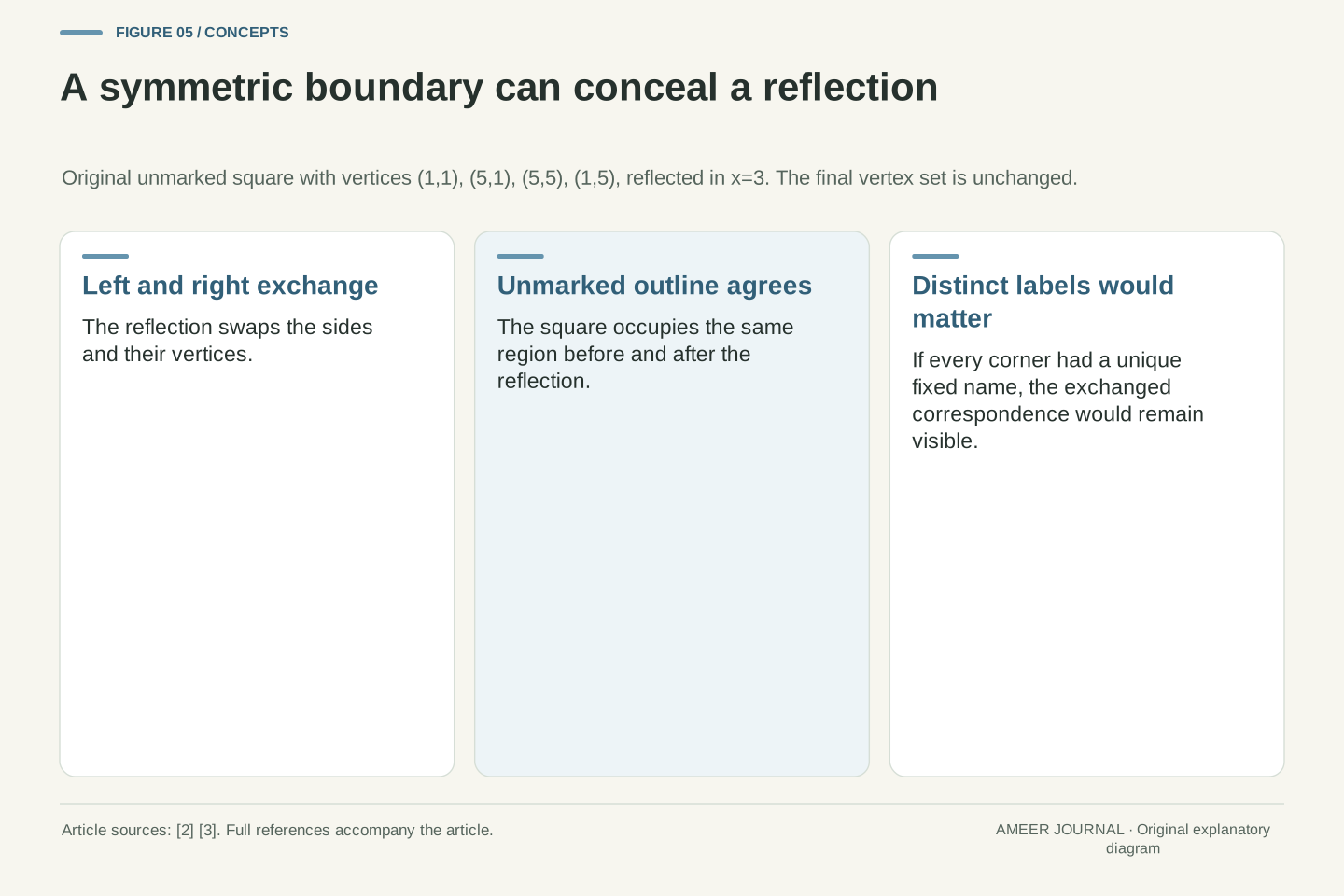
Now imagine a different drawing: a plain square with corners at (1,1), (5,1), (5,5), and (1,5). Do not give its corners different labels. Reflect this square across x=3. The left and right sides exchange places, but the final unmarked outline occupies exactly the same square as before.
This does not undo our triangle result. We changed the information being tracked. The triangle had three named corners that had to match their corresponding names. The plain square has an outline that is symmetric about the reflection line. Its appearance alone does not reveal whether we reflected it or left it in place.
If every square corner had its own fixed name, exchanging corners would matter again. That is why labels and markings belong in a matching rule. The New Zealand resource treats symmetry as a shape mapping onto itself under a transformation. [2] A familiar outline can stay the same even though particular points have exchanged positions.
Take the unlabelled vertex set S={(1,1),(5,1),(5,5),(1,5)}. Applying C(x,y)=(6−x,y) gives the same set S. The filled square and its boundary therefore coincide with their reflected images. Set equality here ignores which original vertex went to which destination.
There is no contradiction with the determinant argument. That argument preserves the ordering and correspondence of a specified noncollinear triple. Removing distinct labels permits a permutation of vertices, so the observable boundary can conceal an orientation-reversing operation. Reflection symmetry is precisely such a self-coincidence for the underlying figure, as discussed in the transformation resource. [2]
This also cautions against inferring the history of an image solely from its final outline. A symmetric figure can admit several transformations with indistinguishable unmarked results. If a puzzle includes letters, colours or a distinctive mark, those features must be included in the matching data. Shape class, unlabelled region and fully labelled figure are different objects of comparison, even on the same page.
Two particular reflections can combine into a turn
Return to A and reflect it across x=3 to make C. Then reflect that result across the horizontal line y=3. P moves from (5,1) to (5,5), Q from (1,1) to (1,5), and R stays at (4,3), because it lies on the second reflection line.
Those are exactly the positions in H, our half-turn drawing. The first reflection reversed the labelled journey; the second reversed it again. The final journey is counterclockwise, and the complete result agrees with one permitted half-turn around the crossing point of these two lines.
These two lines meet at a right angle, which is part of the example. We have not said that every pair of reflections makes a half-turn. The useful lesson is that the sequence of instructions matters, and two reversals can have a different overall effect from one. You can check that claim using the supplied corner positions without making or moving a mirror.
Let Fx(x,y)=(6−x,y) reflect in the vertical line x=3, and Fy(x,y)=(x,6−y) reflect in the horizontal line y=3. Their stated composition is Fy(Fx(x,y))=(6−x,6−y)=H(x,y). Evaluating it at all three original vertices gives the same P,Q,R positions as the half-turn.
Each reflection has determinant −1; their product has determinant +1. In this construction the two intersecting mirror lines are perpendicular, and their intersection is O=(3,3). The coordinate calculation identifies the complete composite map rather than merely observing that traversal sense returned to its original value.
The conclusion is intentionally scoped to these two lines. Different relationships between mirror lines can produce different composites, so “two reflections” alone is not a full transformation description. Our example separates allowed final mappings from a particular intermediate construction: H can be performed directly as a permitted half-turn even though we have also described it using two individual reflections outside the original game rule.
Describe a match with the rules and the corresponding corners
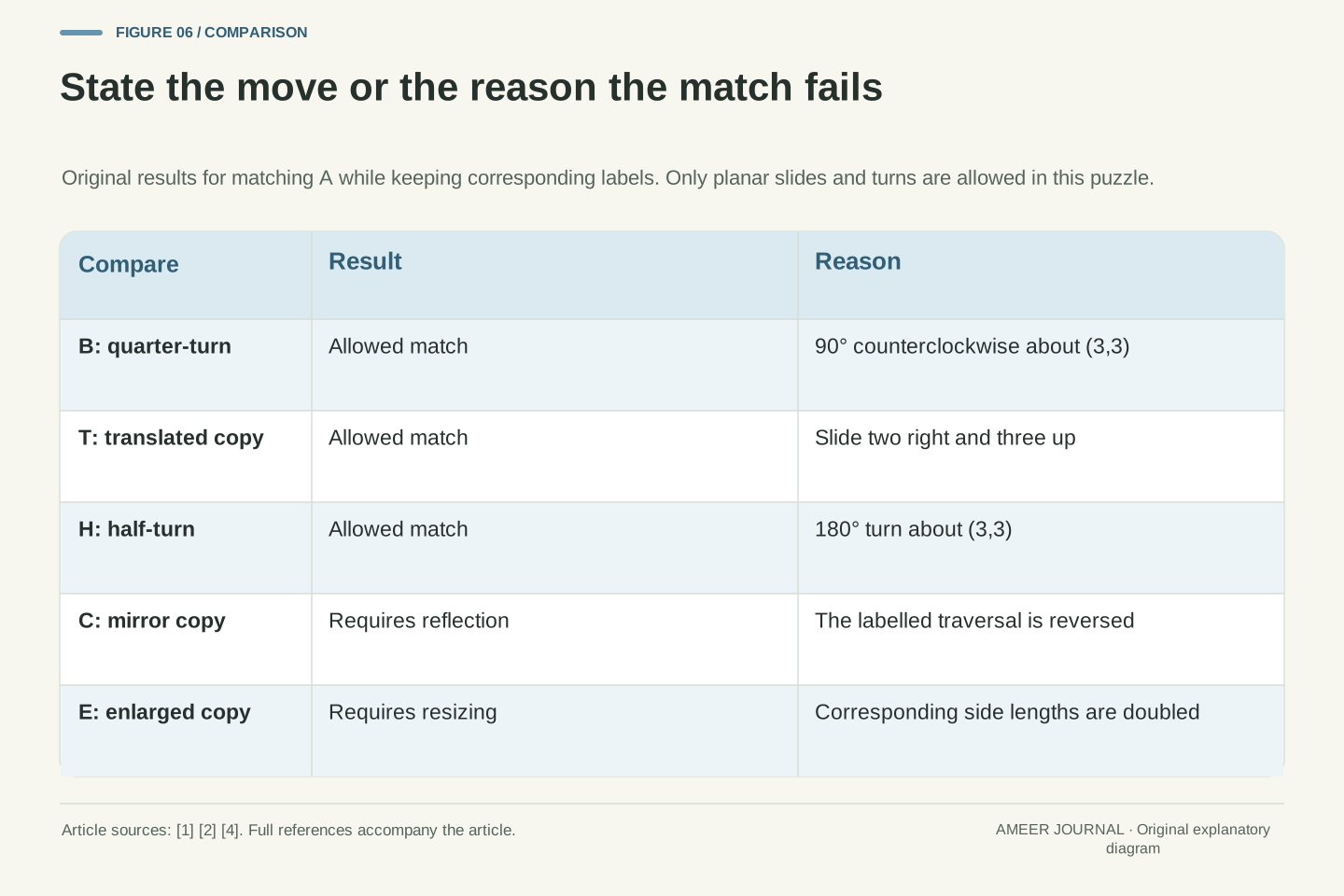
A reading partner can choose B, T, C, H or E and ask, “Does it match A using only slides and turns?” B, T and H do. For B, name the quarter-turn around (3,3); for T, name the slide two right and three up; for H, name the half-turn around (3,3).
C needs a reflection because its corner journey is reversed. E needs a size change because its side lengths are doubled. Neither answer means the drawing is a bad triangle. Each answer describes whether the proposed copy obeys this particular matching rule. If the rules change, repeat the reasoning under the new rules.
Finish with two questions: “Which corners must correspond?” and “Which moves are allowed?” They turn a vague resemblance puzzle into something you can explain. You may use the exact labels and numbers, or describe the moves aloud with a grown-up. The important part of the answer is the connection between the stated rule and the evidence on the page.
Under corresponding labels and planar rotations/translations only, A matches B, T and H by the explicit constructions already given. It fails to match C because signed orientation is reversed, and fails to match E because distances differ. Those decisions rely on exact model data, not on guessing from a rendered image or reporting attempts that were never made.
A complete report states the permitted move set, the vertex correspondence and either a valid construction or an invariant that rules it out. Congruence may admit C through reflection, while our narrower puzzle does not. [4] The symmetric square demonstrates why removing identifying marks changes the comparison, and the two-reflection construction shows why intermediate operations and the resulting mapping must be described separately.
The broader reading habit is to attach a meaning to “same shape” before using it as an answer. A shape category can survive a turn, an unmarked region can hide a reflection, and a labelled figure can preserve or reverse its traversal. Precise move descriptions and corresponding-point reasoning, emphasized by the teaching sources, let those statements coexist without confusion. [1][3]
Sources & further reading
Explore the references behind this guide. External pages may change after our review.
- Illustrative Mathematics | Kendall HuntIllustrative Mathematics / Kendall Hunt · Accessed 7 Nov 2026
- TransformationsNew Zealand Ministry of Education / Tāhūrangi · Accessed 7 Nov 2026
- Shape and Space | NCETMNational Centre for Excellence in the Teaching of Mathematics · Accessed 7 Nov 2026
- Lesson: Checking understanding of congruence | Oak National AcademyOak National Academy · Accessed 7 Nov 2026
Article updated 7 Nov 2026.