What you’ll take away
- Rearranging the same members can change a picture’s width without changing its count.
- Count each named member once while using the number words in order, starting at one.
- A correct final numeral can hide a repeated member and a skipped member.
- The number of groups, visits or label memberships can differ from the number of distinct marks.
- Equal counts do not by themselves mean identical members.
A longer row can still contain the same eight marks
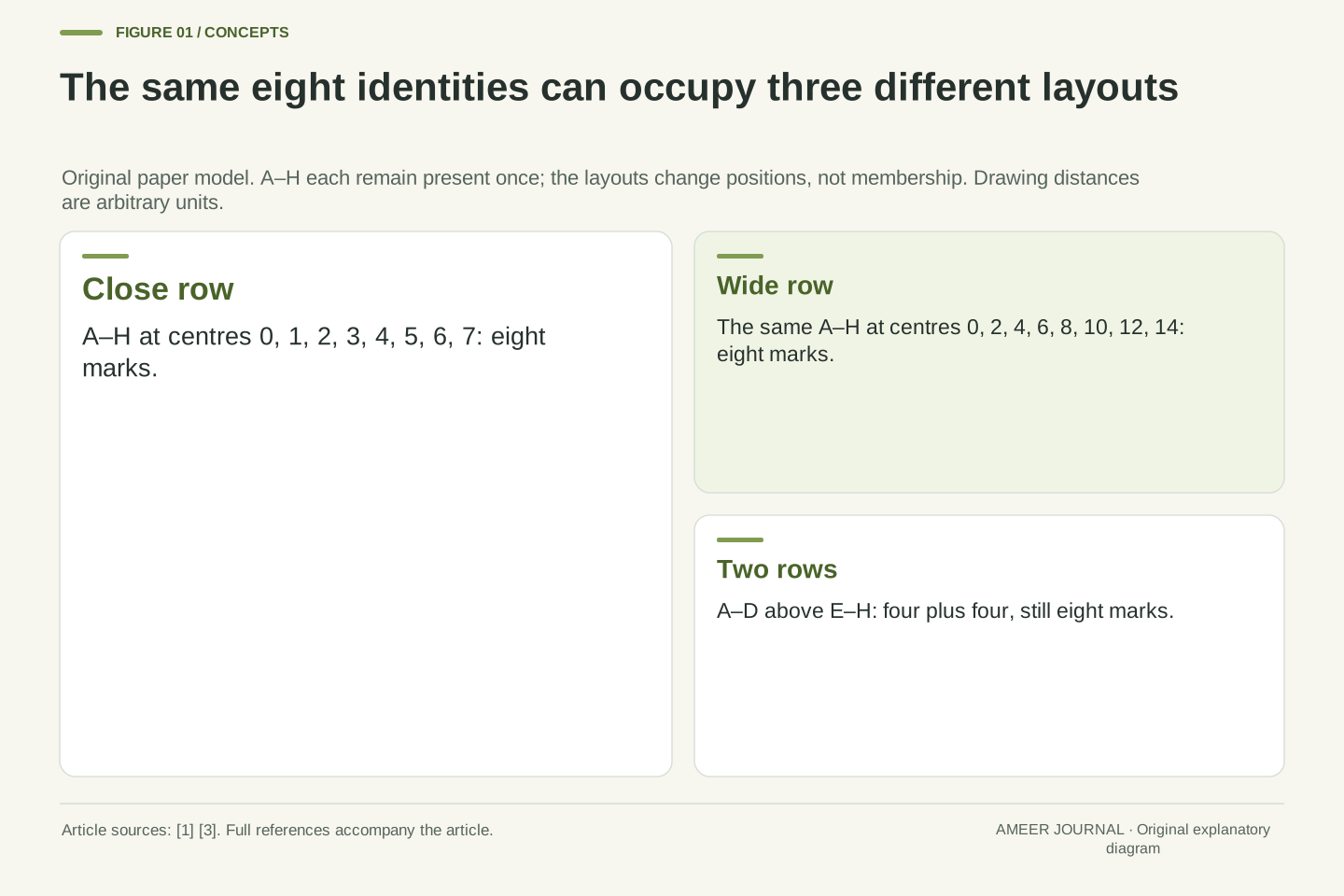
Imagine eight large marks on a page, with the letters A to H helping us tell them apart. Put them close together in your imagination, then spread the same eight marks into a longer row. Has the number changed? The row takes up more room from end to end, but A, B, C, D, E, F, G and H are still there. NCETM explains this counting idea: rearranging a collection leaves its number unchanged when nothing is added or taken away [1]. The useful question is what happened to the members, not just how wide the picture became.
This is a quiet counting game for a child and a grown-up reading together. You can follow the named marks on the page, point to the illustrations, or make your own large marks on an uncut sheet. There are no loose counters to collect, no cutting and no timed score. The letters belong to imaginary marks, not people, and nothing needs to be photographed or submitted. We will change the layout, the counting route and the group labels separately, so each puzzle has one clear question to answer.
Cardinality is the number of members in a collection. A change in spatial arrangement can preserve cardinality while changing distances, rows or occupied extent. NCETM explicitly distinguishes rearrangement from adding or removing objects, and the New Zealand Ministry of Education resource identifies layout, size and colour as changes that can leave the count invariant [1][3]. Our original collection contains eight distinct drawn identities, A–H. Its layout is an attribute of those identities, not the rule determining membership.
The examples are finite paper constructions for adult-supported reading, with no observation of a child or claim about developmental readiness. The Easy mode describes the same cases in everyday language; this mode makes the counting conditions and set boundaries explicit. Readers use the page or optional marks on uncut paper, without loose materials, cameras, accounts or uploads. Keeping the eight identities fixed lets us ask separately whether a change affects their positions, their enumeration, their grouping or the collection itself. Those questions can have different answers even when a final numeral happens to agree.
Say what counts as one thing before counting
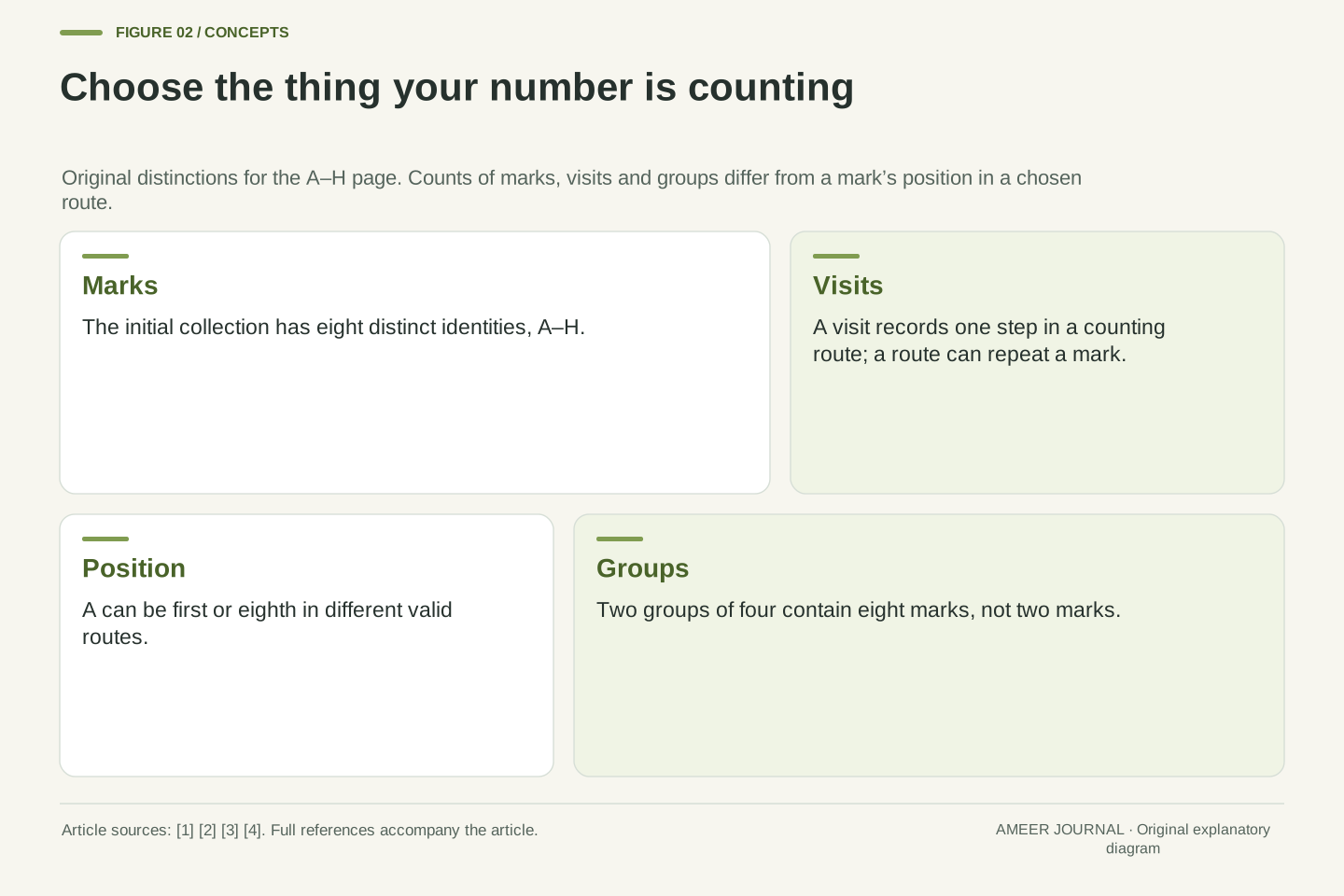
Our first rule is to count the eight named marks. A letter is a name for a mark, not an extra member beside it. A line drawn around several marks would be a group boundary, not another mark to add. If A were drawn larger than B, they would still contribute one mark each. NCETM distinguishes the number of things from their physical sizes [4]. Saying the unit aloud helps: “I am counting marks” is a clearer start than looking at a busy picture and immediately saying a number.
Now imagine putting A, B, C and D inside one drawn group and E, F, G and H inside another. There are two groups and eight marks. Both answers can be right because they count different things. The Stanford counting guide calls attention to abstraction: unlike items can still be considered together as a collection [2]. Our marks do not need matching colours or sizes to belong to the named set. What matters is the question we chose and whether every thing included by that question is accounted for.
Define the initial collection S={A,B,C,D,E,F,G,H}, with each symbol denoting one distinct mark. Counting symbols printed inside a mark, outline segments, spaces or surrounding groups would require a different collection. The counting unit should therefore precede the procedure. NCETM's comparison guidance separates numerosity from object size [4], while Stanford's retained abstraction definition permits dissimilar items to form a counted collection [2]. Neither principle requires all members to look identical.
A grouping introduces a second level of objects. The partition {A,B,C,D}/{E,F,G,H} has two groups, each containing four members, while the underlying set still has cardinality eight. Group cardinality and member cardinality are both legitimate quantities; substituting one for the other changes the question. Our labels retain identity across layouts, but two different collections can also have the same cardinality. Equality of count alone does not establish equal size, matching appearance or identical membership. Those stronger statements require their own comparison rule and evidence.
Give each mark one visit and each visit one number word
For a careful count, visit A, then B, C, D, E, F, G and H. Start with “one” and say the next number word at each visit: one, two, three, four, five, six, seven, eight. Each mark gets one visit, and each visit gets one word. The New Zealand teaching resource describes this as one-to-one correspondence [3]. You can point slowly at each named mark if that helps you keep your place, but pointing is only a way to track the visits; it is not an extra thing being counted.
There is another rule inside that little routine: the number words keep their usual order. Saying “one, two, four” while visiting A, B and C skips a word even though the marks themselves were visited once. Saying “one, two, three” while visiting A, B and B repeats a mark even though the words were in order. These are different slips. A grown-up can read either pretend route slowly and ask what changed. We are checking a written counting plan, not judging how quickly anyone can recite it.
A valid enumeration associates each member of S with exactly one position in a visit sequence. Attach the conventional number words one through eight to those positions, starting at one. The New Zealand description separates one-to-one correspondence from the stable order of number names [3]. Both conditions matter: an injective visit assignment alone does not ensure correct number words, and a correct spoken sequence alone does not ensure complete, non-repeated coverage of the collection.
For example, visiting A,B,C while saying one,two,four violates the number-sequence condition. Visiting A,B,B while saying one,two,three violates the object-assignment condition. Neither example needs a prediction about how a particular child would behave. They are declared strings whose properties can be inspected directly. A tracking aid should make the assignment visible without changing its unit: a check mark records a visit, but the original question still counts the named objects. This distinction also prevents marks added for bookkeeping from accidentally entering the collection being enumerated.
The last number describes the collection, not a permanent name for one mark
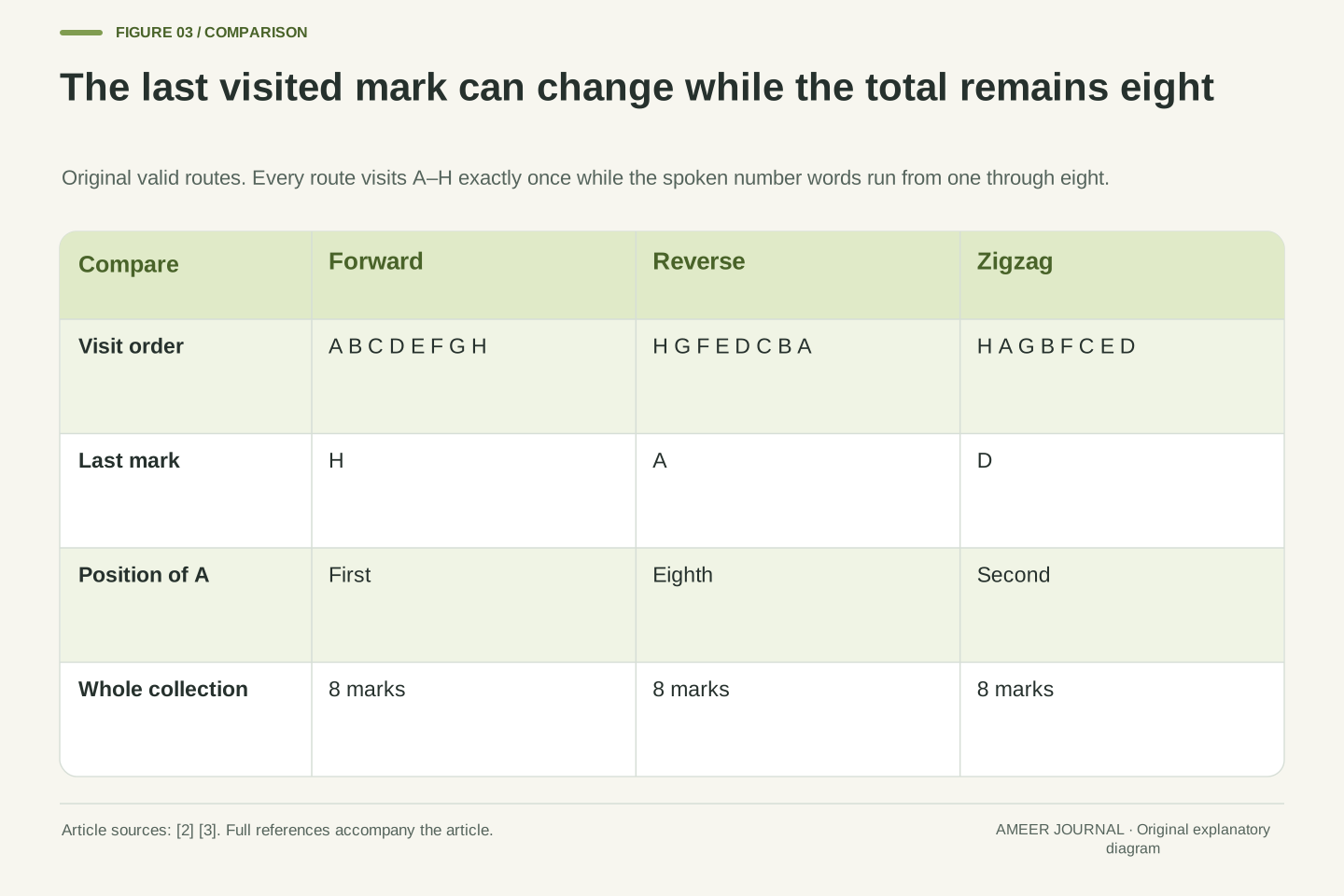
After the complete A-to-H count, “eight” tells us how many marks are in the whole collection. It does not mean H owns the number eight forever. Try another route: H, G, F, E, D, C, B, A. Use the same number words, starting at one. This time A receives the last word, eight, and the collection still contains eight marks. The last-number idea is called cardinality, and changing the order of the objects without changing the total is called order irrelevance [2][3].
A third route is H, A, G, B, F, C, E, D. Check against the original A–H list that every letter appears once. D is last this time; A is second. In the first route A was first, and in the reversed route A was eighth. Those positions changed because the route changed. The total did not. You can answer two questions separately: “Which mark did we visit last?” and “How many marks did we count?” Different last marks can belong to equally careful counts of the same collection.
Under one-to-one coverage and the conventional sequence beginning at one, the last number word gives the collection's cardinality. The New Zealand source states these prerequisites explicitly [3]. Stanford separately names cardinality and order irrelevance [2]. An ordinal position belongs to a selected enumeration, whereas cardinality belongs to the set. Treating an object's temporary counting position as its intrinsic number would confuse these roles and make a harmless change of traversal appear to change the objects.
The three permutations used here are ABCDEFGH, HGFEDCBA and HAGBFCED. Each contains every member of S exactly once. Their final members are H, A and D respectively, and A occupies positions one, eight and two. In every case the final spoken number is eight. These results follow from checking the explicit sequences, without a random-order or performance assumption. The argument permits arbitrary visit order only while the coverage and number-word conditions remain intact; order irrelevance does not excuse repetitions, omissions or an altered numerical sequence.
Count the marks separately from the spaces between them
Give the close row imaginary centre positions 0, 1, 2, 3, 4, 5, 6 and 7 along a drawing ruler. The distance from the first centre to the last is seven drawing units. Now use positions 0, 2, 4, 6, 8, 10, 12 and 14 for the same named marks. The end-to-end centre distance becomes fourteen units, but there are still eight positions holding eight marks. These are invented drawing coordinates, not measurements you need to take. A bigger distance does not create another member.
There are seven spaces between neighbouring marks in either row. In the wider row each of those spaces is larger. Counting the spaces would answer a different question from counting the marks, just as counting groups did earlier. You could also arrange A–D above E–H to make two rows of four. NCETM describes recognizing an unchanged amount after rearrangement [1]. Our letters provide a direct check: each old member is still present once, even when a single long row has become a much shorter two-row picture.
Assign compact-row centres x_i=i and wide-row centres x_i=2i for i=0,…,7, with unchanged identities A–H. The centre spans are 7−0=7 and 14−0=14 arbitrary drawing units. Both layouts have eight occupied positions and seven consecutive gaps. The mapping changes coordinates while preserving a one-to-one correspondence between the original and final marks. This is a concrete instance of the layout invariance described by NCETM and the New Zealand resource [1][3].
The centre span is deliberately distinguished from the outer width of inked marks, which would also require their sizes. No outer-area or density result is inferred. A two-row layout with four centres per row likewise preserves eight members, although it has a different horizontal extent. Position data can help describe a layout, but count depends on the specified occupied identities. If an illustration concealed marks or made their identities ambiguous, that would be an information limitation; it would not justify treating visible row length as a substitute counting rule.
A spoken eight can hide two mistakes that cancel
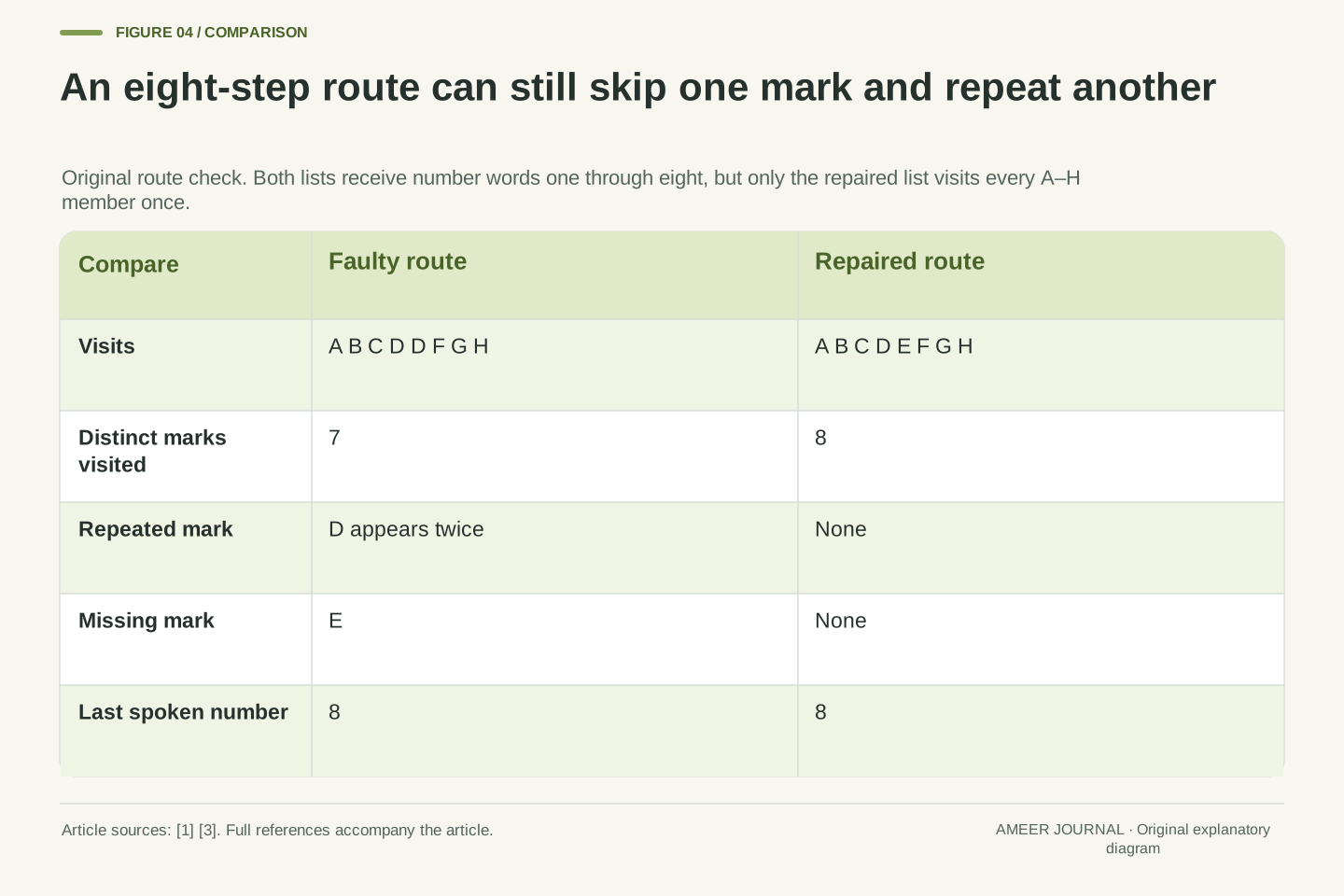
Read this pretend route carefully: A, B, C, D, D, F, G, H. There are eight visits, so someone saying one number per visit could finish with “eight.” But D appears twice and E never appears. The ending matches the number of marks by accident. The route did not count each member once. NCETM lists both missing an object and counting an object twice among the counting difficulties to notice [1]. Our written example puts the two slips together so the final answer alone cannot reveal them.
Repair the route by replacing the second D with E. It becomes A, B, C, D, E, F, G, H. The final spoken number is still eight, but now the visits give a reason to trust it. A helpful question is “Can we find every letter once?” rather than only “What number did we say last?” There is no need to hurry or remember the whole route at once. The grown-up and child can compare the two written lists and point to the one missing letter and the repeated letter.
Consider the visit list ABCDDFGH with conventional labels 1,…,8. Its length is eight, but its set of distinct visited identities is {A,B,C,D,F,G,H}, of size seven. D has multiplicity two and E has multiplicity zero. Therefore the visit-to-member assignment is not a bijection onto S. The final word eight happens to equal |S| because the extra D visit numerically offsets the omitted E visit. This is not a valid application of the cardinality principle's prerequisites [3].
The corrected sequence ABCDEFGH has the same length and final word, but now every member has multiplicity one. Checking only the scalar result would fail to distinguish the procedures; checking the assignments exposes the difference. The example is a finite counterexample to the claim that a correct final numeral proves a correct enumeration. It is not a statistical estimate of counting mistakes or an assessment instrument. Its useful lesson is procedural: retain enough of the route to tell whether the stated count arose from complete, non-repeated coverage.
Match one mark to one partner to compare two collections
Imagine another collection named P, Q, R, S, T, U, V and W. Pair A with P, B with Q, and continue until H is paired with W. Every mark on each side has exactly one partner. The collections contain the same number, even though their names are different and one row could be much wider. NCETM describes one-to-one matching as a way to check that groups have equal numbers [4]. The pairing explains the comparison without asking which picture looks larger.
Now add a new mark I to the A-to-H side while leaving the other side alone. Keep the same eight pairs. I has no partner, so that side now has one extra mark: nine compared with eight. With a different pairing, another letter might be left over, but one would still be unmatched. This is about the amount of available partners, not a special property of I. If you draw connecting lines on paper, a crossing between lines is not a new partner or an extra mark.
The partner collection consists of the eight distinct identities P,Q,R,S,T,U,V,W. Pair them with the original collection using (A,P),(B,Q),(C,R),(D,S),(E,T),(F,U),(G,V),(H,W). Every left and right identity occurs in exactly one pair. This definition fixes the matching without relying on aligned rows or equal spacing. The resulting bijection demonstrates equal finite cardinality, the mathematical relation behind NCETM's one-to-one comparison guidance [4].
Adding a new left identity I without changing the right collection produces nine left members and eight right members. The retained matching leaves I unmatched; another one-to-one matching could leave a different left identity unmatched, but cannot cover all nine using only eight distinct partners. The count comparison concerns matching capacity, not geometric line length or intersection count. Equal cardinality of the original collections did not make their identities equal, and stretching either layout would change neither the existence of the pairing nor the extra member after addition.
More groups can contain fewer marks
Return to the original eight marks. One grouping puts A, B, C, D together and E, F, G, H together. That makes two groups of four. Another grouping puts A, B together, C, D, E together, and F, G, H together. That makes three groups with two, three and three marks. Both groupings contain all eight marks exactly once. Changing from two groups to three groups has changed the boundaries, not added another mark. This is why the question should say whether it wants groups or their members.
For a separate puzzle, imagine two groups containing five marks each and compare them with three groups containing three marks each. The first collection has five plus five, or ten marks. The second has three plus three plus three, or nine. Three is more groups than two, yet nine is fewer marks than ten. These are new imaginary collections, not a rearrangement of A–H. Grouping is useful when the sizes are known, but the number of groups by itself leaves out information needed to find the total.
The two partitions of S have block sizes (4,4) and (2,3,3). Each partition is exhaustive and pairwise disjoint: every original identity belongs to one block and no identity belongs to two. Consequently, summing block sizes gives 4+4=8 or 2+3+3=8. The group count changes from two to three, while the member count is invariant. The New Zealand resource explicitly distinguishes rearrangement into parts from additions and removals [3]; these particular partitions are original constructions.
A separate comparison uses two disjoint five-member groups versus three disjoint three-member groups. Their totals are 2×5=10 and 3×3=9. Ordering group counts therefore need not order member counts when block sizes differ. These collections are separate from the eight-mark fixture, so their totals should not be interpreted as another partition of S. Summation requires the relevant member counts and a clear accounting boundary. When groups overlap, adding their sizes counts memberships rather than necessarily counting distinct objects; the final category puzzle makes that distinction explicit.
Moving, adding and replacing are different changes
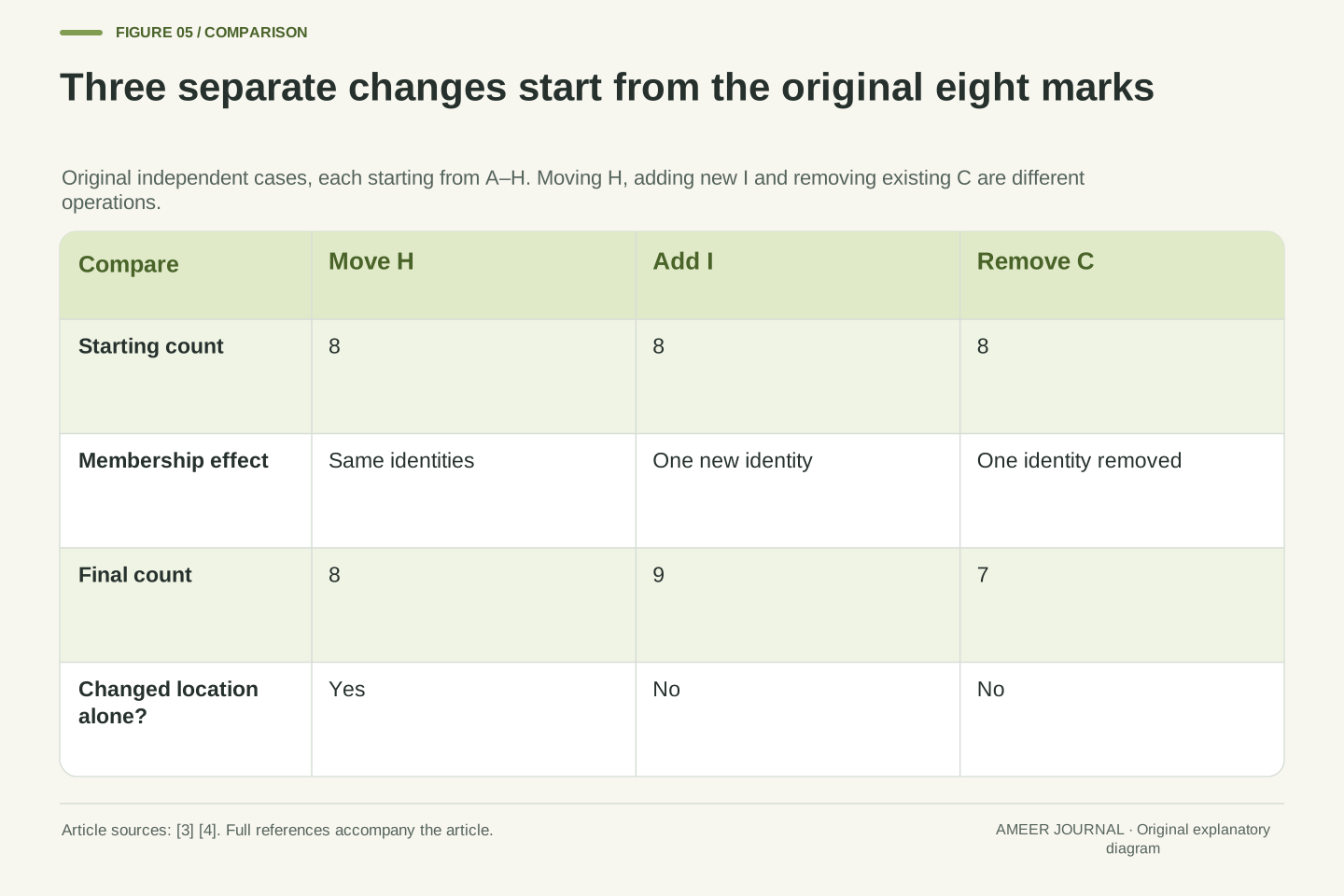
Start from A–H again and consider three separate changes. Move H to a different place: there are still eight marks. Add a new mark I: there are now nine. Remove C: there are now seven. Each change starts from the original eight; the three instructions are not a single sequence. NCETM explains the one-more and one-less relationship between neighbouring counting numbers [4]. It helps us predict a new total when we know exactly what was added or taken away, rather than guessing from how the new picture looks.
Now try a different, two-step story. Add I to the original eight, making nine, and then remove C, leaving eight. The total has returned to eight, but the members have changed: I is present and C is absent. Saying “the same number” does not always mean “the same marks.” If every mark were removed, the collection would be empty and its count would be zero. Naming the operation makes each answer understandable, including the cases where a changed collection ends with a familiar total.
Three independent transformations of S illustrate different operations. Relocating H preserves S and its cardinality eight. Adjoining a new identity I gives S∪{I}, of size nine. Removing the existing identity C gives S\{C}, of size seven. The conditions new and existing are material: naming an already included identity again would not add a new set member. The one-more/one-less relationship is described in the official counting and comparison resources [3][4].
For the separate sequential construction, first adjoin I and then remove C. The final set is {A,B,D,E,F,G,H,I}, again of size eight, but it is not equal to S. Equality of cardinality is weaker than equality of membership. This example also shows why merely comparing before-and-after totals cannot establish that nothing changed. Removing all eight identities would instead produce the empty set, of cardinality zero. These are exact finite operations; they do not require an inference from a picture's apparent area or a record of an actual physical activity.
One mark can qualify for two labels without becoming two marks
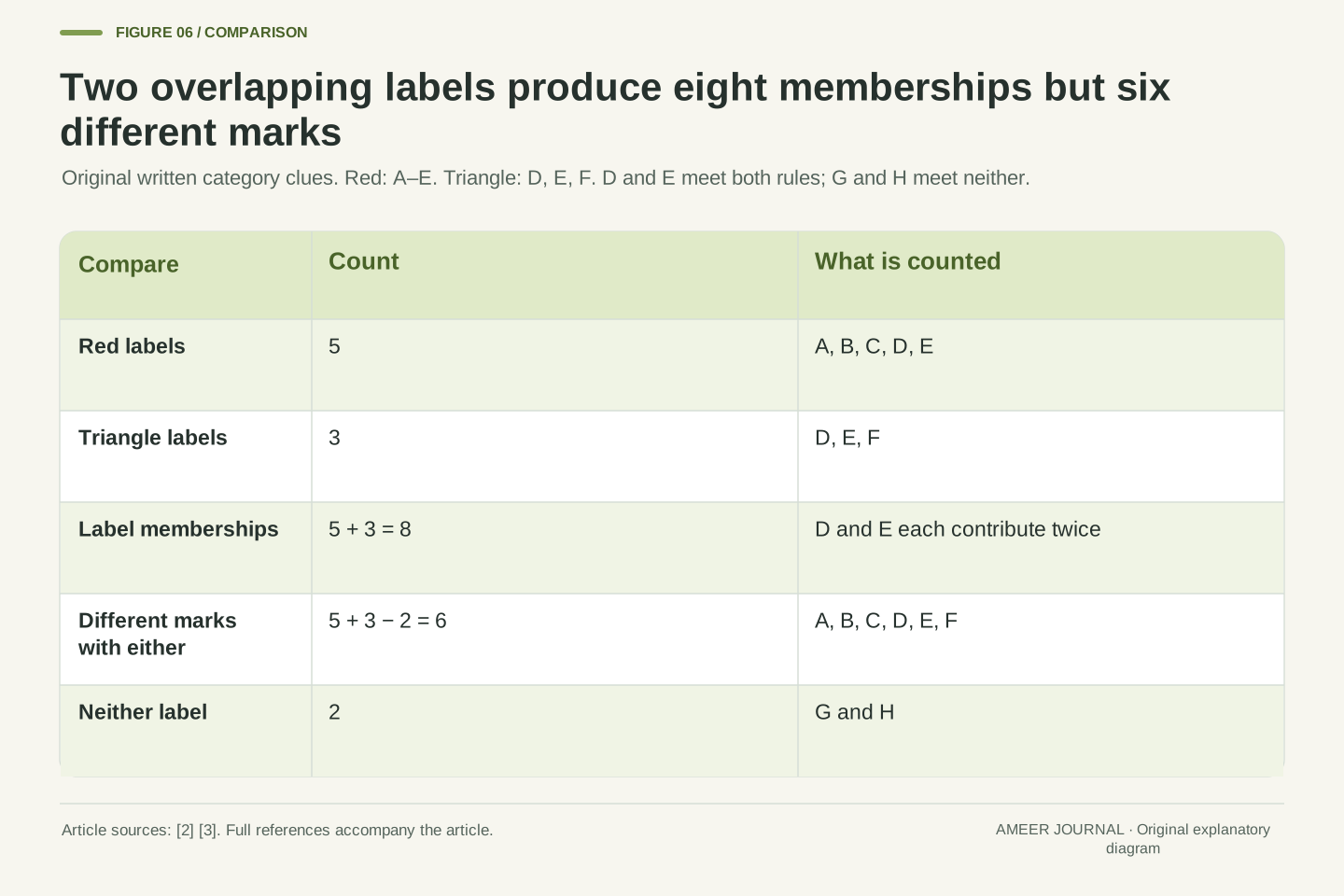
Give our original marks some pretend category labels. A, B, C, D and E have a red label, making five red-labelled marks. D, E and F have a triangle label, making three triangle-labelled marks. These labels are supplied as written clues; you do not need to judge a colour on a screen. How many different marks have either label? List them: A, B, C, D, E and F. There are six. D and E each meet both rules, but each is still one mark in the collection.
Adding five and three gives eight label memberships. It counts D once in the red group and again in the triangle group, and does the same to E. To count different marks with at least one label, remove those two extra counts: five plus three minus two equals six. G and H have neither label in this story. This puzzle differs from the earlier groups, where every mark belonged to just one group. A useful reply names what eight and six count, instead of treating one of the two numbers as meaningless.
The original attribute construction defines R={A,B,C,D,E} and K={D,E,F} within S. Their sizes are five and three, but their intersection is {D,E}, of size two. Direct enumeration gives R∪K={A,B,C,D,E,F}, of size six, and S\(R∪K)={G,H}, of size two. The category names are stipulated properties, not visual classifications or claims about the printed diagram. Stanford's abstraction principle provides the broad collection context [2]; the sets and arithmetic here are independently constructed.
Summing |R|+|K| counts eight memberships, because D and E each contribute twice. Distinct-member counting instead gives |R∪K|=|R|+|K|−|R∩K|=5+3−2=6. The subtraction removes one extra contribution for each overlapping identity. This is an exact two-set accounting relation, not a probability or a statement that category labels change the number of underlying marks. The earlier partition sums needed no overlap subtraction because their blocks were disjoint. Naming whether the target is memberships or unique members prevents an apparently conflicting answer from becoming a counting dispute.
Finish with a reason someone else can follow
Ask a grown-up to read three short puzzle descriptions with you. First, A–H are spread into a longer row and nothing is added: the answer is still eight marks. Second, a new I appears beside the same eight: there are nine. Third, the route A, B, C, D, D, F, G, H ends with the spoken word eight: the total is familiar, but the route needs repair. You can explain each result by naming the unchanged members, the new member, or the missing E and repeated D.
Choose whichever question is interesting and leave the others for another time. A useful counting explanation can be short: “I counted marks, visited each one once, started at one and ended at eight.” For a comparison, explain the partners; for groups, explain their sizes and whether they overlap. The education sources distinguish these counting ideas rather than reducing them to how long a row looks [1][3][4]. You do not need a fast answer or a photograph of your work. The page has done its job when the reason behind the number becomes easier to see.
A concise verification record can name the collection, unit, visit rule and operation being compared. For the unchanged-layout case, identify the bijection between the same eight identities. For addition, state that I was absent and is now included. For the faulty route, preserve the multiplicities that reveal omitted E and repeated D. The conclusion then follows from explicit conditions rather than an attractive final numeral. This applies the source distinctions among one-to-one correspondence, stable order, cardinality and comparison [1][3][4].
The final questions are optional, untimed discussion prompts, not an assessment of a child's age, speed or ability. A grown-up can read the routes and help keep the written identities visible without collecting personal information. The more technical extensions remain explanations of the same drawings: order changes positions, layout changes distances, partitions change group boundaries, and membership operations can change the set. Distinguishing these quantities makes agreement and disagreement interpretable. Eight can be a valid member count, a visit-list length or a label-membership count; the surrounding rule tells a reader which one is meant.
Sources & further reading
Explore the references behind this guide. External pages may change after our review.
- Cardinality and Counting | NCETMNational Centre for Excellence in the Teaching of Mathematics · Accessed 7 Nov 2026
- The Why and What of Counting - DREMEStanford University DREME / Linda M. Platas · Accessed 7 Nov 2026
- Learning to count - Counting one-to-oneNew Zealand Ministry of Education / Tāhūrangi · Accessed 7 Nov 2026
- Comparison | NCETMNational Centre for Excellence in the Teaching of Mathematics · Accessed 7 Nov 2026
Article updated 7 Nov 2026.