What you’ll take away
- Light supplies energy; carbon dioxide and water supply material for the photosynthesis summary.
- The net equation balances each kind of atom even though its molecule count changes.
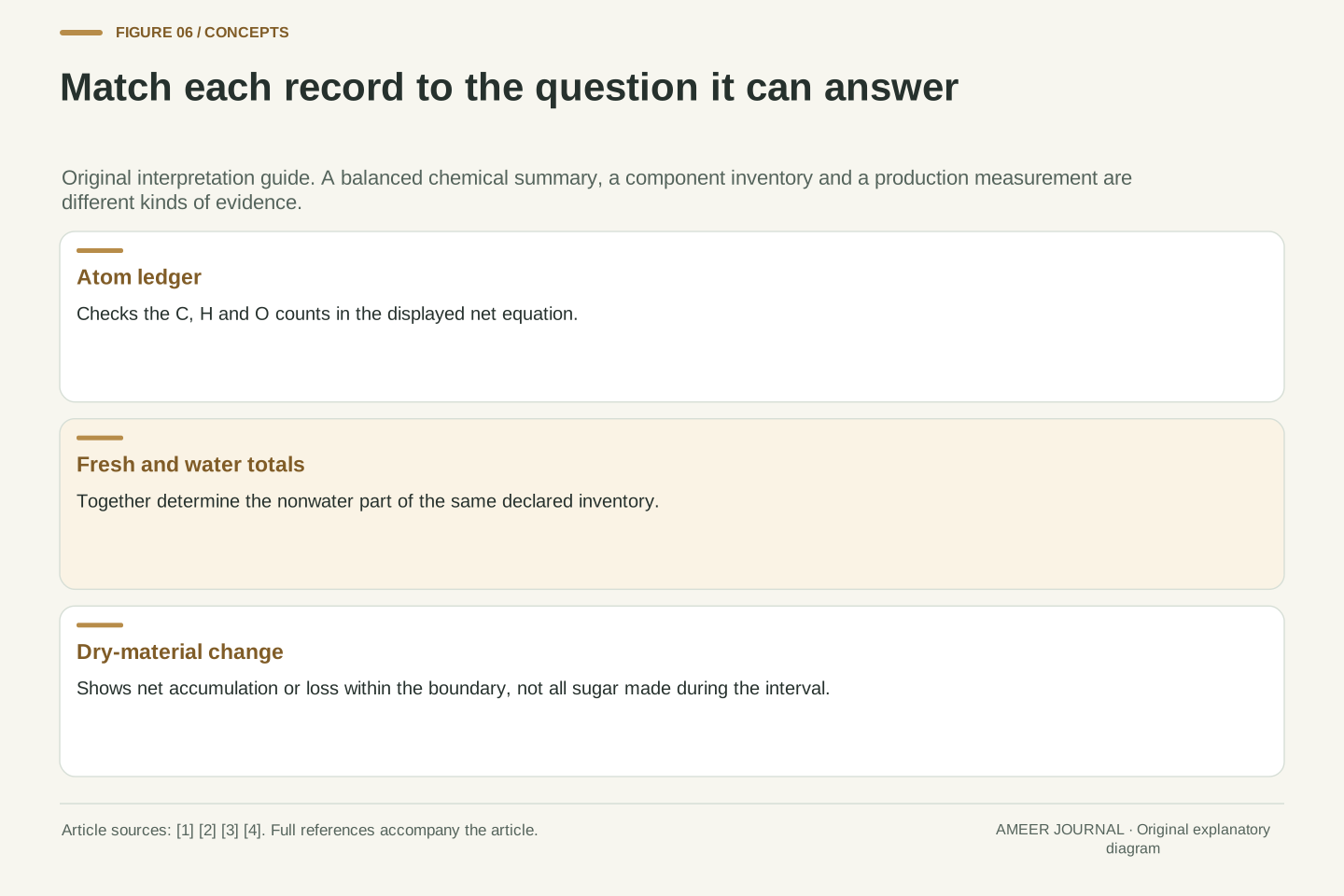
- Fresh mass includes water and nonwater material, so a larger total does not reveal both parts.
- The same ten-gram fresh increase can accompany no dry change, a dry increase or a dry decrease in our invented records.
- Net dry-material change does not measure all the sugar made or moved during the interval.
A heavier group of leaves can hide a surprising change
Imagine a record for a group of leaves. At the beginning its mass is 100 grams. Later the record says 110 grams. Ten grams more sounds like a simple growth story, but what supplied the extra mass? Was it water, newly accumulated material, or a mixture of changes? A green leaf contains water as well as other substances, and it exchanges material with the rest of the plant and the air [3][4]. The total alone does not tell us how those parts changed.
This is a drawing and reading investigation for a child and a grown-up. All the numbers below belong to invented records, not measured plants. Read the illustrations together or draw large labels on an uncut sheet of paper. There is no need to collect leaves, handle plants or soil, weigh anything, dry anything, use heat, or photograph and submit work. We will first ask where leaf material comes from, then solve a puzzle in which three different endings all have the same total mass.
Fresh plant mass includes water and nonwater constituents. A change in their sum does not uniquely determine a change in either component. OpenStax distinguishes water from dry mass, while OSU describes the vascular and gas-exchange pathways connecting leaves with their surroundings [3][4]. Our reader question concerns this accounting ambiguity: how can a greater fresh mass coexist with unchanged, increased or reduced dry material, even though photosynthesis can supply organic compounds?
The exercise defines an imaginary, consistently bounded group of leaves with an initial fresh mass of 100 g and later alternatives of 110 g. All component values are stipulated, not biological measurements, growth predictions or species averages. Adult-supported reading and optional large marks on uncut paper are the only activities. No plant handling, collection, weighing, drying, heating, food, soil, cameras or uploads are involved. The technical mode explains the same constructions using explicit atom counts, additive mass accounting and limits on inference.
Light energy and building material do different jobs
Green leaves can use light energy with carbon dioxide and water to make carbohydrates, a group that includes sugars. This process is photosynthesis [1][2]. Carbon dioxide is a gas in the air. Although we cannot see its individual molecules, they contain matter, including carbon atoms that can become part of the plant's organic compounds. Water is matter too. Light supplies energy for the process; it is not a packet of carbon atoms that gets counted as another ingredient in our drawing.
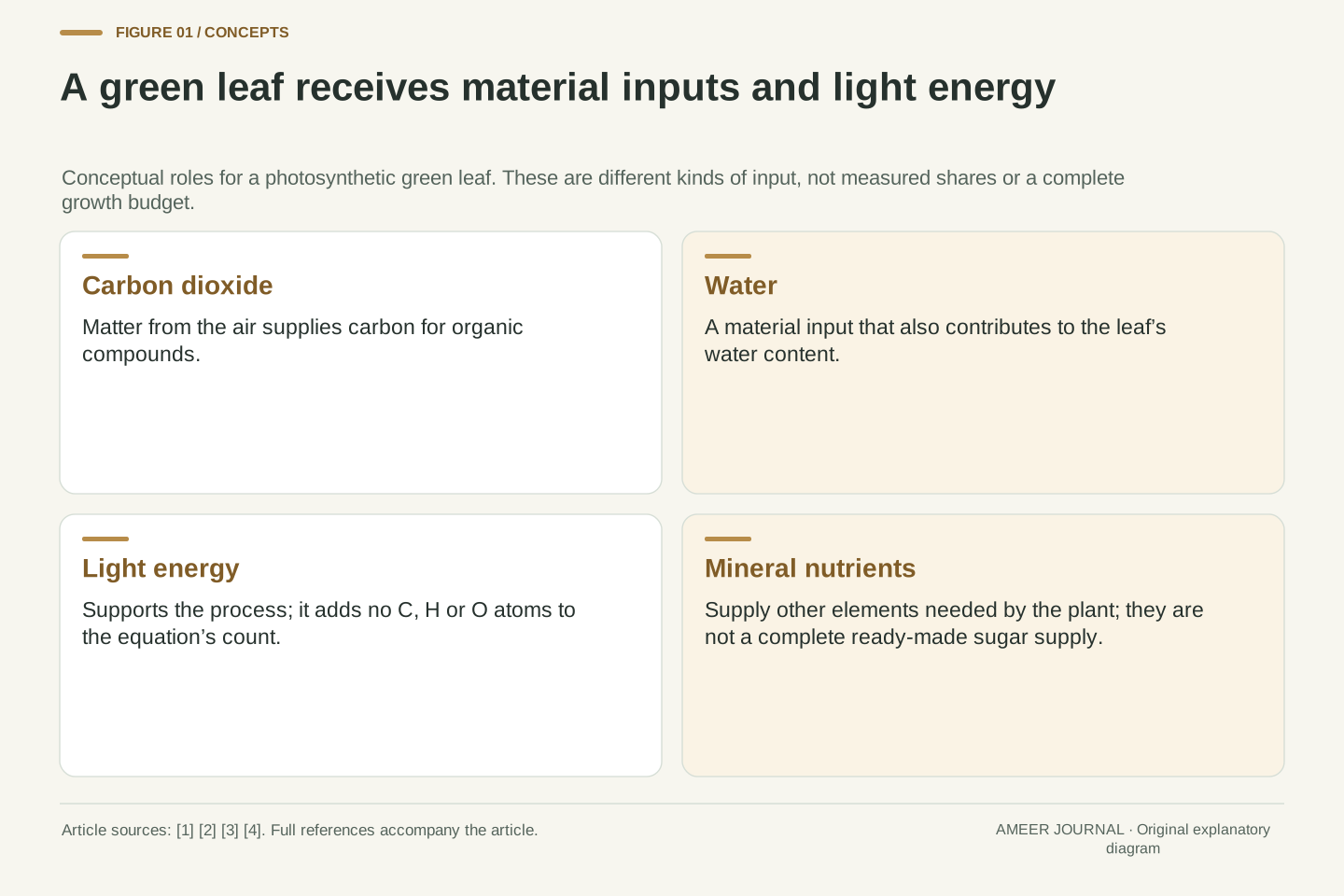
Give four headings to your page: carbon dioxide, water, light energy and mineral nutrients. The first two supply material for the familiar photosynthesis summary. The third identifies an energy input. Mineral nutrients supply other elements that plants need [3]. Keeping the headings separate prevents two mistakes: treating sunlight as another molecule in the atom count, and imagining that soil already contains all the finished sugar a green leaf needs. Roots and leaves have connected jobs, but their inputs are not interchangeable.
In a photosynthetic green leaf, light energy supports biochemical conversion of carbon dioxide and water into carbohydrate products and precursors [1][2]. Atmospheric CO2 supplies the carbon incorporated through carbon fixation. Light has an energetic role rather than a carbon, hydrogen or oxygen atom inventory in the chemical equation. The distinction is between material composition and energy transfer, not a claim that light is unimportant to synthesis.
Mineral acquisition is another material input. Plants require elements beyond those displayed in the simplified carbohydrate equation; roots can absorb water and dissolved mineral nutrients [3][4]. Consequently, neither soil minerals nor photosynthetic sugar should be treated as a complete description of every constituent in a leaf. Our four-heading diagram separates CO2, water, light energy and mineral nutrients by role. It does not assign universal percentages to their contributions or infer a plant's whole dry composition from the three-element sugar formula.
A leaf has connections to the air and the rest of the plant
A leaf is not a sealed green bag. Small openings called stomata help regulate gas exchange, and water can leave through the leaf as water vapour [1][3]. Water arriving from the roots travels through the plant's transport tissues. Other transport tissues carry substances such as sugars between plant parts [4]. These connections mean material can arrive, leave or be changed inside a leaf while its total mass is being compared at two times. Those exchanges matter.
On a simple plant drawing, label one connection from the air with carbon dioxide, another from the roots with water, and another along the plant with transported sugars. Put light energy beside the leaf as a different kind of input. The arrows show roles, not measured amounts or one-way rules for every condition. You have not drawn every cell or every possible exchange. What the picture explains is why looking only at the leaf's outer edge cannot tell us where all its material came from or went.
Stomata regulate exchange between the leaf and surrounding air, while vascular tissues connect the leaf to other organs. Xylem conducts water and dissolved minerals; phloem carries substances including sugars [1][3][4]. These pathways make a leaf an open system. Its inventory at a particular time reflects exchanges across its boundary as well as transformations within that boundary. The direction and magnitude of these exchanges are not supplied by an outline drawing.
The schematic therefore distinguishes an air–leaf connection, a root–leaf water pathway and transport of photosynthetic products within the plant. It is not a quantified flow network or a universal statement about transport direction in every tissue. A leaf boundary also differs from a whole-plant boundary: material transferred between two organs can alter one organ's inventory without representing new material entering the entire plant. This boundary distinction will matter when interpreting the later dry-material totals. A mass difference at the leaf-group level is not automatically a measure of the whole plant's production.
A compact equation is a summary of many steps
A common photosynthesis summary says that six carbon dioxide molecules and six water molecules correspond to one glucose molecule and six oxygen molecules, with light providing energy [1][2]. Glucose is one kind of sugar. The short written form is 6 CO2 + 6 H2O → C6H12O6 + 6 O2. A grown-up can read the symbols with you: C means carbon, H hydrogen and O oxygen. A small number beside a letter tells us how many of that kind of atom are in the molecule.
The arrow does not mean six gas molecules and six water molecules suddenly jump together in one simple step. OpenStax explains that photosynthesis has many stages and produces smaller carbohydrate precursors that can be used to form sugars [1]. Our equation leaves those intermediate stages out. We will use it to check the atoms in the written summary. It is not a complete picture of a leaf, a recipe for making sugar at home, or a way to calculate growth from the sunlight in a picture.
Use the conventional net carbohydrate summary 6 CO2 + 6 H2O → C6H12O6 + 6 O2, with light energy indicated separately [1][2]. Coefficients multiply whole molecular formulas, whereas subscripts specify elemental composition within a molecule. The expression is a net stoichiometric summary, not a single elementary reaction or a complete inventory of all participating biochemical intermediates. The water term is the net amount in this compact representation.
OpenStax explicitly describes the multistep process and the three-carbon precursor G3P, from which carbohydrates can be formed [1]. A glucose-equivalent summary therefore should not be read as a claim that a leaf directly emits one completed glucose molecule whenever twelve substrate molecules meet. It also does not track the mechanistic origin of each individual oxygen atom or specify a reaction rate. For this paper exercise, its purpose is narrower: compare the elemental totals represented on the two sides while keeping the energy input distinct from the chemical formulas.
The atoms balance even though the number of molecules changes
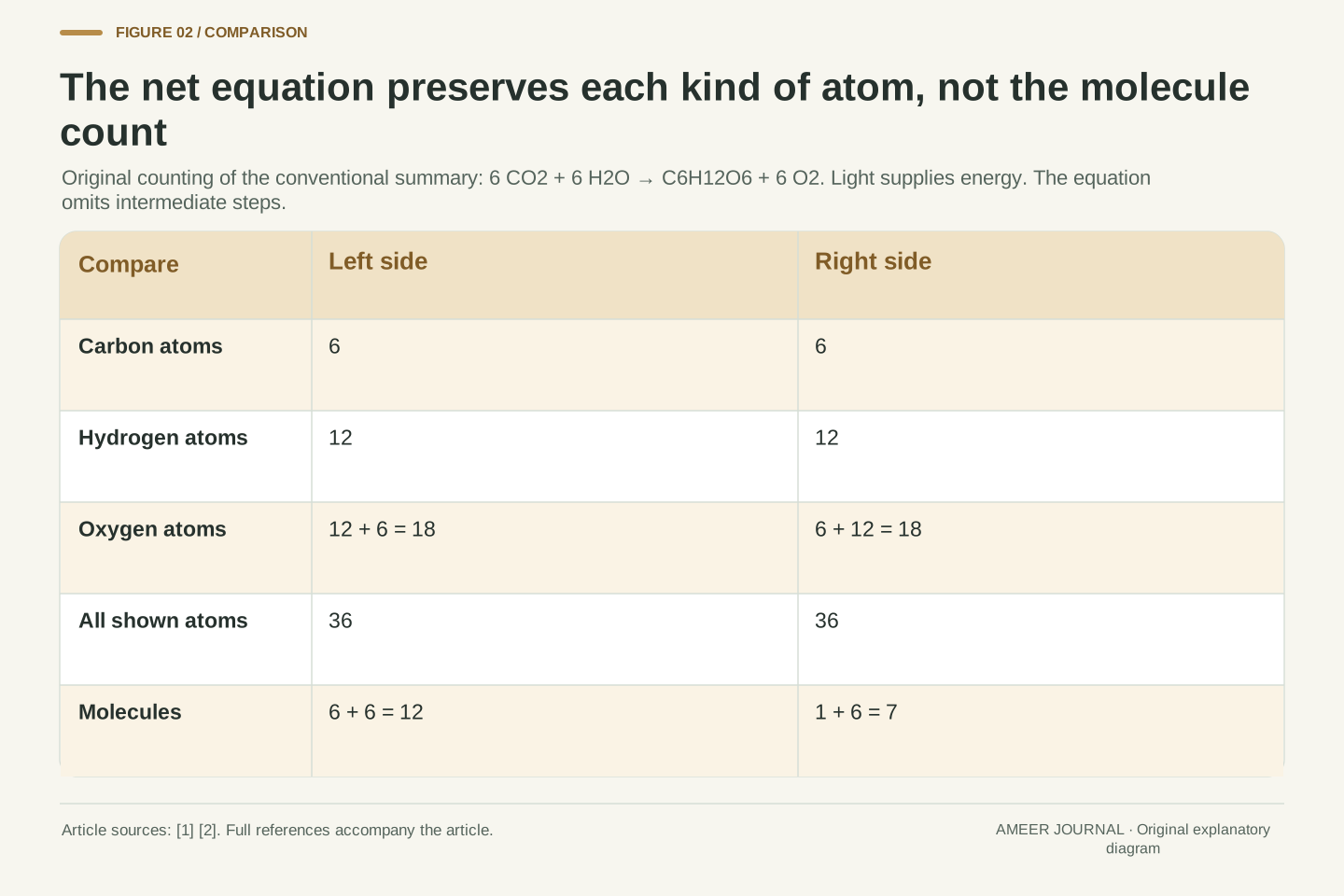
Count the carbon atoms first. Six carbon dioxide molecules contain six carbon atoms. The glucose formula on the other side also contains six. Next count hydrogen: six water molecules contain twelve hydrogen atoms, matching the twelve in glucose. Oxygen needs two additions. On the left there are twelve oxygen atoms in carbon dioxide and six in water, making eighteen. On the right there are six in glucose and twelve in the six oxygen molecules, again eighteen.
Both sides therefore contain six carbon, twelve hydrogen and eighteen oxygen atoms: thirty-six atoms in total. But the molecule count is different. The left side has twelve molecules; the right side has seven, because one large glucose molecule sits beside six oxygen molecules. You can draw labelled groups on paper without moving or cutting anything. The number of groups changed while the counts of each kind of atom stayed the same. Checking only the number of molecules would miss the important balance.
Represent the elemental composition in the order (C,H,O). The reactant total is 6(1,0,2)+6(0,2,1)=(6,12,18). The product total is (6,12,6)+6(0,0,2)=(6,12,18). This independently derived ledger balances each element separately. Summing the three entries gives 36 represented atoms on either side, but equality of the total alone would be a weaker check than preserving each elemental count. As an error check, replacing the six product O2 molecules with five would leave only sixteen product oxygen atoms. Carbon and hydrogen would still match, but the oxygen ledger would fail.
The corresponding molecular totals are 6+6=12 and 1+6=7. A glucose molecule contains 24 atoms, while the six oxygen molecules together contain 12, recovering the 36-atom product total. Molecular count is not the conserved quantity in this rearrangement. These calculations concern the displayed net equation, not an observed microscopic event. They neither assign labels tracing individual oxygen atoms through the mechanism nor imply that the fresh mass of an open leaf must remain constant. Material can cross the leaf's boundary while chemical transformations conserve elemental atoms.
A sugar equation does not list everything a leaf needs
Our glucose formula contains carbon, hydrogen and oxygen. Does that mean a leaf needs only those three elements? No. The formula describes one kind of molecule, while a leaf contains many kinds of substances. For example, nitrogen is part of proteins and other plant compounds, and roots absorb dissolved mineral nutrients [3][4]. A drawing that explains one process can be useful without being a complete list of everything needed to build and maintain the living plant.
Try a label puzzle: point to the letters C, H and O in the sugar formula, then ask where an N label would fit in that particular formula. It does not belong there. That tells us glucose contains no nitrogen atoms; it does not tell us that the leaf contains none. The same distinction applies to sunlight. Light helps supply energy, but its importance does not turn it into an extra chemical element. Our picture must name the molecule or the whole leaf before we decide what its labels describe.
The net carbohydrate equation includes only carbon, hydrogen and oxygen, whereas leaf composition includes compounds requiring other elements. OpenStax identifies nitrogen as a constituent of proteins and nucleic acids and describes additional mineral requirements [3]. OSU describes roots absorbing dissolved minerals and their transport through vascular tissues [4]. Therefore an inventory of the elements in glucose cannot be promoted into a complete elemental inventory of plant tissue.
This is a change of reference object: the formula C6H12O6 describes one molecular species, while the leaf contains a mixture of compounds and water. Nitrogen's absence from that formula establishes its absence from that molecule, not from the tissue. The inference needs no assumed percentage of nitrogen or universal plant composition. It also explains why the later dry-material column must include more than sugar. Carbon fixation, water supply and mineral acquisition contribute different material roles; the concise photosynthesis summary does not eliminate the other requirements of a living leaf.
Separate the water from the rest of the mass record
Return to the imaginary group of leaves. Our starting record divides its 100 grams into 80 grams of water and 20 grams of everything else. We will call the second part dry material: the material counted when water is excluded. OpenStax uses dry mass to distinguish plant constituents from water [3]. The numbers here are chosen for easy arithmetic. They are not a rule saying that every leaf has the same water content. Grams are the common mass unit in each column.
Write 80 g + 20 g = 100 g beside the first record. The dry part includes more than sugar: plant tissue contains different organic compounds and mineral constituents [3]. So twenty grams of dry material is not a measurement of twenty grams of sugar. The page gives us both component amounts directly. We are not finding them by drying a leaf, and the word dry does not ask anyone to use an oven, heater or other equipment. It is the name of a column in our invented account.
Define the simplified component identity F=W+D, where F is fresh mass, W is water mass and D is all nonwater material within the declared leaf-group boundary. The initial values are F0=100 g, W0=80 g and D0=20 g. This partition uses the conceptual distinction between fresh composition and water-excluded dry material [3]. It is an exact stipulation for the exercise rather than an operational laboratory method. Every term in this identity has mass units.
D is not restricted to carbohydrates, elemental carbon or newly synthesized sugar. Organic structural and metabolic constituents and mineral components all belong to the nonwater inventory [3]. No fixed biological composition is inferred from the chosen 80/20 split. Likewise, the ledger supplies component values without implying that the same living tissue was destructively measured twice. The accounting task requires only that each record uses the same named boundary and definitions. That lets us compare component changes without importing an unstated measurement procedure or a species-specific water fraction.
Three different endings all reach one hundred and ten grams
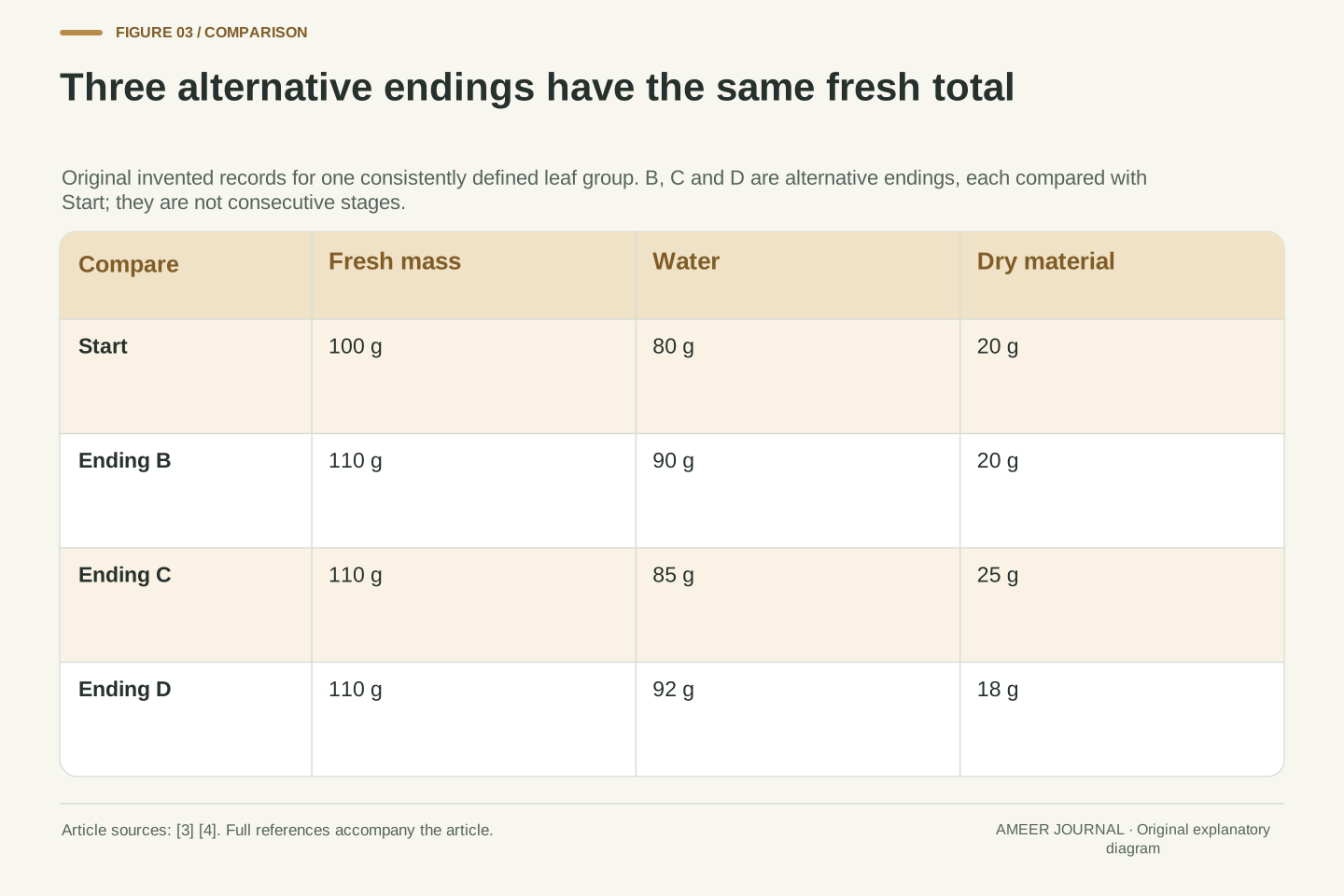
Consider three alternative endings, each starting from the original record. Ending B has 90 grams of water and 20 grams of dry material. Its total is 110 grams. The water increased by ten grams, while the dry material stayed the same. Ending C has 85 grams of water and 25 grams of dry material. It also totals 110 grams, but this time both parts increased by five grams. For each ending, check the two amounts by adding them before comparing them with the start.
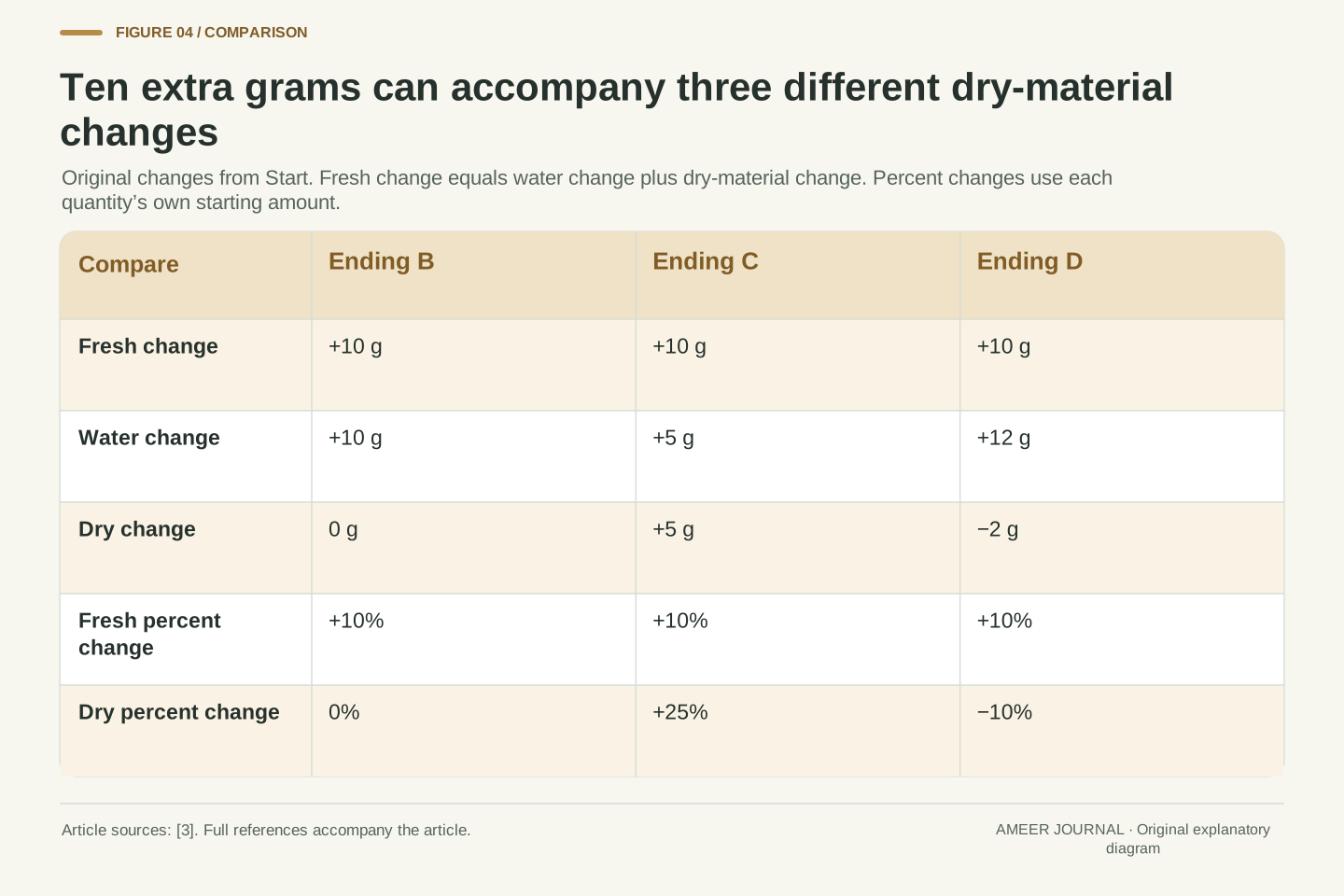
Ending D is the surprise: 92 grams of water and 18 grams of dry material. Ninety-two plus eighteen is still 110. Compared with the start, water increased by twelve grams while dry material decreased by two. All three endings are ten grams heavier, yet their dry parts are unchanged, larger and smaller. They are alternative stories, not three stages of one plant. Knowing only the starting and final totals cannot choose among them; the missing water information matters.
The three independent final inventories are B=(F,W,D)=(110,90,20) g, C=(110,85,25) g and D=(110,92,18) g. Relative to the common initial inventory, their component changes are respectively (ΔW,ΔD)=(10,0), (5,5) and (12,−2) g. In every case ΔF=ΔW+ΔD=10 g. The fresh total supplies one equation for two component values. Providing the water amount selects the corresponding dry amount; providing only their sum leaves several partitions possible. The leaf group keeps the same accounting boundary in each alternative.
These alternatives are an explicit counterexample to inferring the sign of dry-material change from a positive fresh-mass change alone. They satisfy the same observed total while differing in the hidden partition. The labels B, C and D name alternative records, not a chronological series, and no probability is assigned to them. Ending D is arithmetically compatible with a heavier leaf group because its added water exceeds its reduced nonwater component. This does not diagnose a real plant's condition; it establishes which information the stipulated total does and does not determine.
A percentage needs the name of the part being compared
The fresh total rose from 100 to 110 grams in every ending. Ten extra grams compared with the starting hundred is a ten-percent increase in fresh mass. Now look at ending C's dry part. It rose from twenty to twenty-five grams. The increase is five grams, which is one-quarter of the starting twenty: a twenty-five-percent increase in dry material. Ten percent and twenty-five percent both describe the same ending, but they answer different questions.
Ending B has no change in dry material, even though its fresh mass increased. Ending D loses two of its starting twenty grams of dry material, a one-tenth decrease. When a sentence says that a plant gained ten percent, ask ten percent of what. A percentage about the whole fresh record is not automatically the same percentage about its water, dry material, sugar or carbon. The name of the quantity and its starting amount belong beside the calculation.
All alternatives have relative fresh-mass change ΔF/F0=10/100=0.10. Their relative dry-material changes are ΔD/D0=0/20=0 for B, 5/20=0.25 for C and −2/20=−0.10 for D. The denominators differ because fresh mass and dry material have different initial inventories. These fractions describe changes in selected quantities, not the final water fraction of the tissue. Multiplying a fraction by one hundred expresses it as a percentage without changing its reference quantity.
For example, C's final dry-material share would be D1/F1=25/110=5/22, approximately 22.73 percent. That is distinct from its 25-percent dry-material increase. The former compares two components at the final time; the latter compares a change with an initial component. An unlabelled percentage can therefore obscure both the chosen quantity and the time reference. No percentage in this invented example is a claim about sugar concentration, carbon content, nutritional value, plant health or the rate of photosynthesis.
A range of water amounts gives a range of possible dry amounts
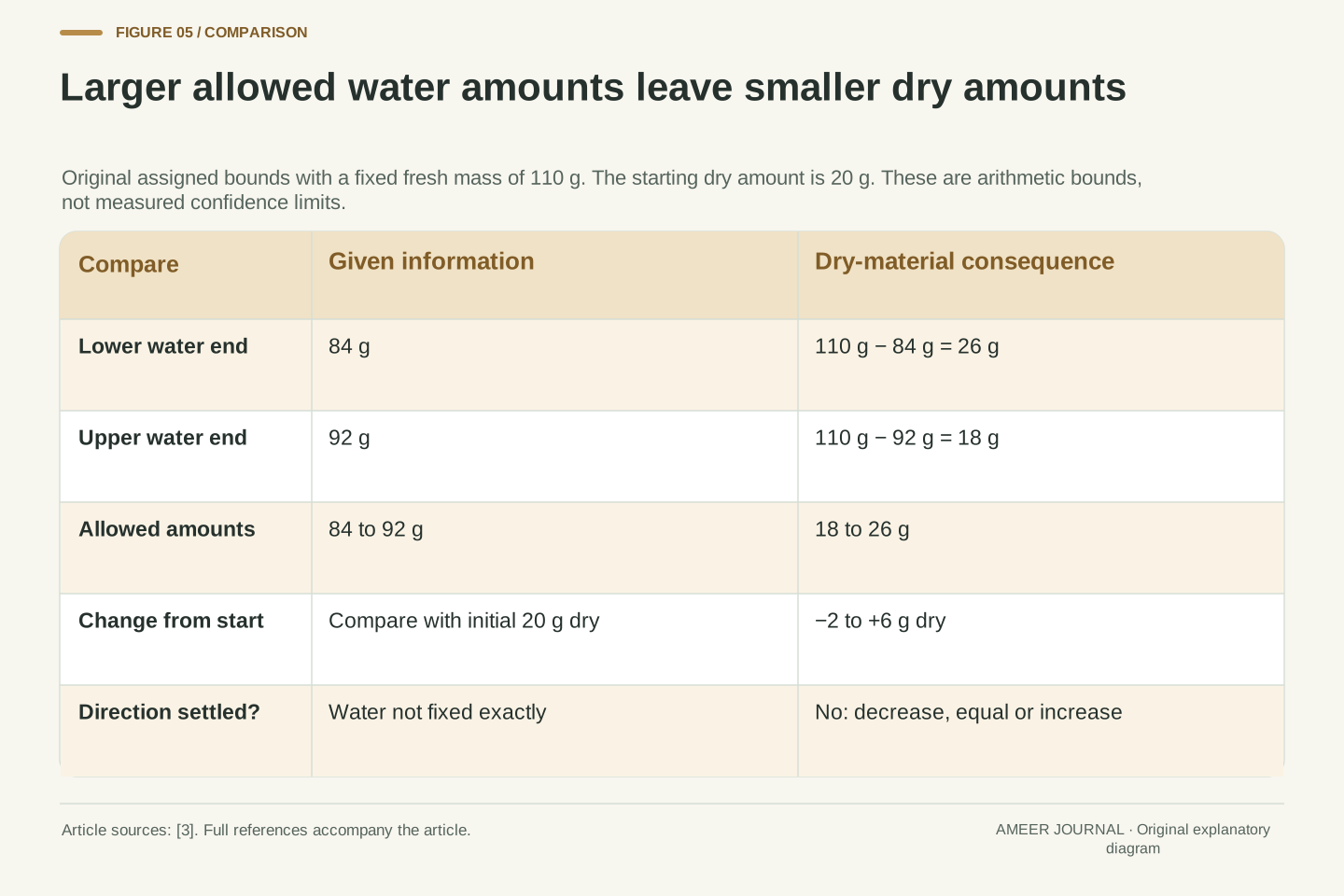
Suppose another version of the final record gives only part of the answer. Its fresh total is exactly 110 grams, and its water amount is stated to be somewhere from 84 to 92 grams. If water is 84 grams, the remaining dry material is 110 minus 84, or 26 grams. If water is 92 grams, the remaining dry material is eighteen grams. More of the same total assigned to water leaves less assigned to the other part. Both parts must still add to the fixed total.
The possible dry amounts therefore run from eighteen to twenty-six grams. The original dry amount was twenty, which sits inside that range. The record permits a decrease, no change or an increase; it does not settle which occurred. These are bounds supplied by the puzzle, not a measured confidence range. A grown-up can cover the answers and ask which end belongs with the larger water amount. Reversing the order of those endpoints is the main reasoning step.
Hold F1=110 g exact and stipulate W1∈[84,92] g. Since D1=F1−W1 is decreasing in W1, the compatible dry-material interval is [110−92,110−84]=[18,26] g. The order of the water endpoints reverses under subtraction. Relative to D0=20 g, the change interval is ΔD∈[−2,6] g. Every allowed water value determines exactly one dry value under this identity. In particular, W1=90 g produces D1=20 g, retaining the original dry inventory while meeting the greater fresh total.
Zero lies within the change interval, so these bounds alone do not determine whether dry material accumulated. They also do not assign equal likelihood to every allowed value. This is a deterministic information constraint supplied by the exercise, not a confidence interval, instrument specification or inference from repeated measurements. If a later stipulated water value were 90 g, the same identity would select D1=20 g. The calculation shows exactly what additional component information resolves, while leaving the biological pathways producing that inventory unspecified.
Accumulated dry material is not a photosynthesis counter
Even ending C's five extra grams of dry material do not tell us that this group of leaves made exactly five grams of sugar. Sugars and other materials can move within a plant, and leaves use compounds as part of their living processes [2][4]. Some material may remain in the leaves, while some may be transported elsewhere. The final stock and the amount made during an interval are different questions. A leaf is a working part of that connected system.
An unchanged dry amount also does not mean nothing happened. Think of a written account that begins with twenty marks, adds five and removes five. It finishes with twenty, although two changes occurred. That separate mark example explains the arithmetic of a net result; it is not a measured leaf process. To understand actual photosynthesis, we would need evidence about the relevant exchanges and transformations. A before-and-after mass record gives one useful difference, but it does not reveal every event between its two entries.
D1−D0 is a net inventory change within the chosen boundary. It does not isolate gross carbohydrate synthesis, imported compounds, exported photosynthates, metabolic consumption or changes in mineral inventory. The documented transport pathways and use of photosynthetic products provide biological reasons for keeping those quantities distinct [2][4]. A leaf-level inventory also cannot be substituted for a whole-plant carbon balance. The boundary matters.
A separate abstract mark ledger illustrates the logic without assigning biological fluxes: a stock of 20 marks plus 5 added marks minus 5 removed marks ends at 20. Zero net change does not establish zero activity. Conversely, a positive dry-material change is not automatically an equal mass of locally synthesized glucose. The exercise deliberately supplies no durations, exchange rates, elemental composition measurements or reaction yields for the leaf records. Thus neither a gross production amount nor a photosynthetic rate can be recovered from their component totals alone.
Give each drawing the conclusion it can actually support
Try three short explanations with your grown-up. In the initial atom drawing, both sides have six carbon, twelve hydrogen and eighteen oxygen atoms, even though their molecule counts differ. In ending D, the group becomes ten grams heavier because twelve extra grams of water outweigh a two-gram decrease in dry material. In the bounded record, eighteen to twenty-six grams is a range of possible dry amounts, so its direction of change is still undecided.
Finish by connecting the two halves of the story. Photosynthesis explains how a green leaf uses light energy and material inputs to form carbohydrates [1][2]. The mass records ask how much water and other material are present at particular times. One drawing explains a chemical summary; the other compares inventories. You can keep the page private and stop after whichever puzzle interests you. A careful answer names the thing being counted or weighed and says what the available information supports.
The completed explanation should preserve three separate levels. The net equation supports elemental accounting for the displayed chemical terms. The exact component records support F=W+D and their corresponding changes and ratios. The bounded record supports an interval obtained by a decreasing affine transformation. None of those constructions supplies an observed plant growth curve or a direct measurement of photosynthetic production during a specified interval.
Matter from air, water and mineral inputs and energy from light have distinct roles in the biological context [1][2][3]. Material exchange across the leaf boundary adds another distinction between production and accumulation [4]. Keeping these roles visible prevents a correct sum from becoming an unsupported biological conclusion. The optional untimed questions are for shared reading, not an assessment of a child's ability or an invitation to send data. The useful result is a precise explanation: the same fresh-mass increase can be compatible with several different component histories.
Sources & further reading
Explore the references behind this guide. External pages may change after our review.
- 8.1 Overview of Photosynthesis — Biology 2eOpenStax / Rice University · Accessed 7 Nov 2026
- What is PhotosynthesisSmithsonian Science Education Center · Accessed 7 Nov 2026
- 31.1 Nutritional Requirements of Plants — Biology 2eOpenStax / Rice University · Accessed 7 Nov 2026
- Vegetative plant partsOregon State University Extension Service · Accessed 6 Nov 2026
Article updated 7 Nov 2026.