What you’ll take away
- A rainbow depends on light, droplets and the viewer’s position; it is not a fixed coloured bridge.
- A chosen viewing angle describes possible directions and does not establish one droplet distance.
- The original map selects A, C and E for one viewer and B, C and F for the other.
- Different complete selections can overlap; the shared point C meets both model circle conditions.
- A geometric direction, a colour band and a visible arc require their own stated conditions.
Two people can share the weather without sharing every contributing drop
Two friends in a drawing point towards what looks like the same rainbow. They can agree that its red band is outside and that a cloud covers part of the arc. Yet the light reaching their eyes need not come from the same complete collection of raindrops. A rainbow is an appearance produced by light, droplets and a viewer’s position; it is not a coloured bridge fixed at one address. NOAA makes this dependence on the viewer part of its explanation [1].
We will explore that idea with an invented map containing six labelled points. It has an interesting answer: the two viewers choose different groups, but one point belongs to both. Read with a grown-up, and use large marks on an uncut sheet if you want to follow the puzzle. Everything stays on the page. There is no need for real water, outdoor observation, looking at the Sun, optical equipment or a photograph. The Technical button gives your helper the geometry behind the same story.
The reader question concerns the identities of contributing droplet locations, rather than whether nearby observers use the same everyday name for an atmospheric event. NOAA describes a rainbow as an optical phenomenon dependent on illumination, atmospheric droplets and the observer’s position [1]. Two nearby viewers can see similar angular arcs while receiving light along different sets of paths. Similar appearance does not imply that the complete sets of contributing positions are identical.
Our original model fixes parallel sunlight, two point observers and six candidate locations in one plane. A chosen viewing-angle condition selects three candidates for each observer, with one shared candidate. This establishes a geometric possibility, not a count of photons or a measured pair of rainbows. The optional activity is private, untimed, adult-supported reading and marks on uncut paper. No physical experiment, Sun viewing, outdoor search, tool use, camera or upload is involved. Technical calculations support the adult reader rather than setting an assessment for a child.
The primary light path bends, reflects and bends again
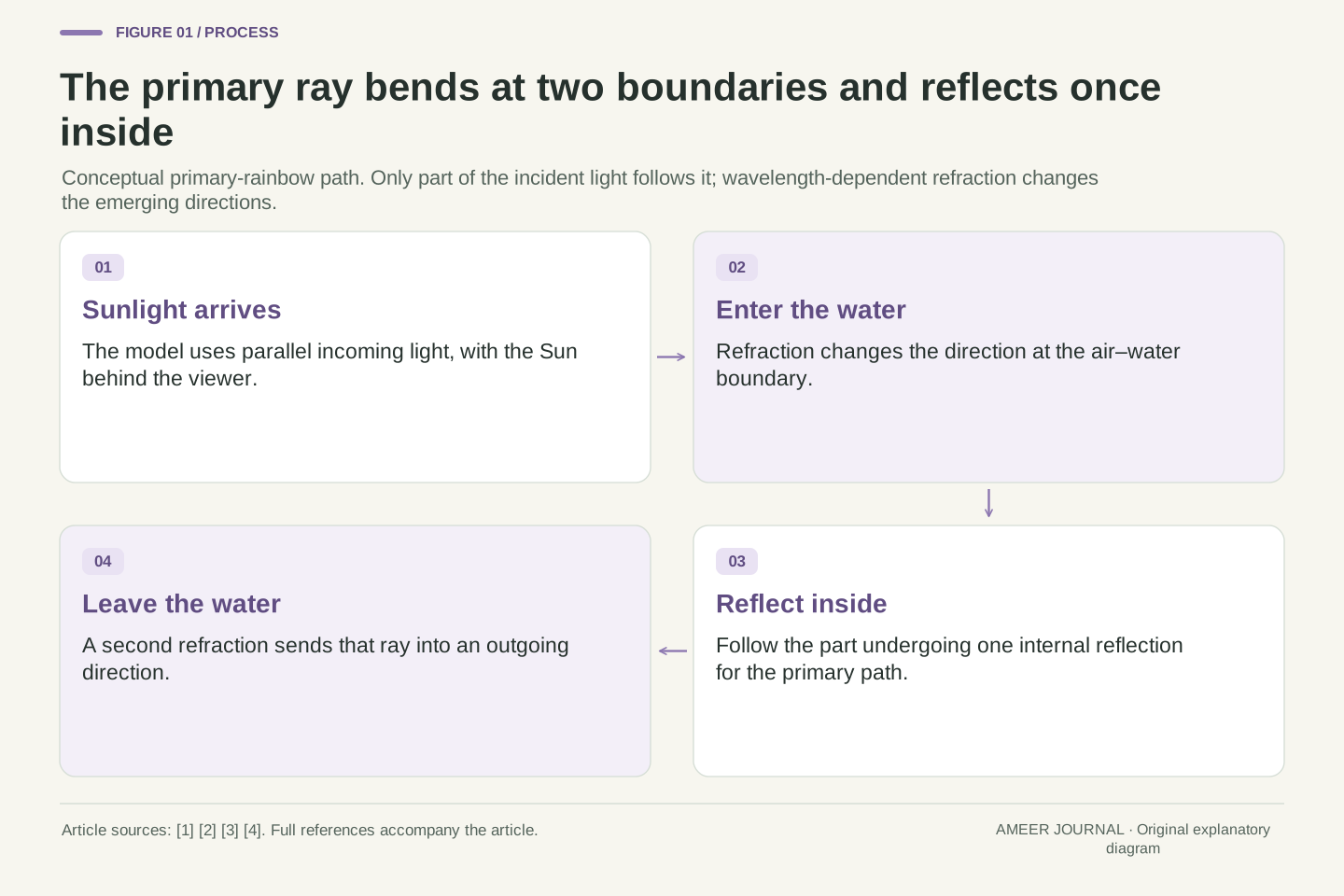
Sunlight contains a range of wavelengths. At a water droplet’s surface, some light changes direction as it enters the water. This bending is called refraction. Follow the part that reflects once at the inside surface, then bends again as it leaves towards a viewer. That is the path used in the ordinary primary-rainbow explanation. Not all light entering the drop follows this route: some passes out on other paths. The Met Office and National Weather Service describe these separate stages [2][3].
Different wavelengths bend by different amounts, so the directions of the emerging colours differ [1][4]. The reflection is one part of the journey; it is not a little paintbrush that adds colours to clear water. A secondary rainbow involves a second internal reflection and has a different arrangement [1][3]. Our puzzle follows only one chosen direction associated with the primary bow. Keeping that choice fixed lets us change the viewer without quietly changing which kind of light path we are studying.
Use the geometrical-optics description of a primary ray: refraction at the air–water boundary, one internal reflection and refraction at the water–air boundary [2][3]. The relevant reflected fraction is only part of the incident light. Nothing in our construction assumes that all incident energy returns to an observer, or that the internal reflection must be total. A primary-ray direction is one feature of the full distribution of emerging rays.
Wavelength-dependent refraction provides the dispersion that separates the colour directions [1][4]. The secondary-bow path has two internal reflections, but its different geometry is outside the fixed primary condition used below [3]. This distinction matters because a diagram can otherwise mix an entry angle, an internal ray angle and an observer’s viewing angle under the same number. We will define our angle at the observer before doing any arithmetic. The point-location puzzle does not model the detailed intensity, finite size or wave effects of real droplets.
Measure the viewing angle from the direction opposite the Sun
In the usual primary-rainbow arrangement, the Sun is behind the viewer and illuminated droplets are ahead [1][2]. In our drawing, extend an imaginary line straight away from the Sun through the viewer. This is the centre direction for the model. The direction opposite the Sun is called the antisolar direction. It is a direction from the viewer, not a special painted spot on a cloud that everyone must use as their centre.
Now imagine turning from that centre direction towards a point on the outer bow. An introductory explanation gives about forty-two degrees for red light [4]. We choose exactly forty-two degrees as a rule for our mathematical picture. This chosen value makes the example definite; real colour bands do not have one universal, perfectly sharp boundary. The angle is between two lines starting at the viewer: the centre line and the line towards a candidate drop. It is not an angle measured inside the drop.
Adopt an ideal parallel solar beam and define a forward axis from each observer in the direction opposite the Sun. This observer-relative antisolar axis formalizes the cited Sun-behind, droplets-ahead arrangement [1][2]. The angular coordinate θ is the angle between that axis and the observer-to-candidate vector. It is distinct from an incidence angle measured against a droplet’s local surface normal, or from the total deviation along the light’s refracted and reflected path.
Set θ=42° exactly within the original model, using the introductory red-angle value as motivation [4]. The equality is a declared construction parameter, not a claim that every physical red wavelength has precisely that rainbow angle. Parallel incident sunlight makes the two model axes parallel even though their starting points differ. We will first keep their forward positions equal and translate one observer sideways. This isolates the effect of changing the viewpoint from changes in sunlight direction, selected angle or candidate locations.
A circle of directions becomes a cone of possible positions
Hold the centre line steady and imagine all the directions that make the chosen angle with it. A direction can point above, below, left or right of that line. Turning all the way around gives a circle of directions. The lines extending along those directions form a cone, with its tip at the viewer. This is a geometric way to organize the possible paths; it does not put a solid cone into the sky.
Slice that imaginary cone with a flat plane facing the viewer and square to the centre line. The slice is a circle. A candidate point on the circle meets the angle rule. That is only one condition: real droplets also need suitable illumination and an unobstructed path, and there may be no droplets along part of the circle. NOAA and the Met Office explain why a full circle is possible while only part is often visible [1][2]. A missing arc is not proof that the circle-of-directions idea has failed.
A fixed polar angle around an axis defines a right circular cone. For an observer at the origin with forward coordinate x and transverse coordinates u,v, its forward surface satisfies √(u²+v²)=x tan θ, with x>0. This equation is our geometric deduction from the explicitly fixed viewing angle. Intersecting the cone with the perpendicular plane x=L gives u²+v²=(L tan θ)², a circle centered where the axis meets that plane.
The cone is a set of candidate directions and positions, not a material surface. Its circle section does not imply an opaque screen, a single distance for the whole real bow or guaranteed visibility of every listed point. Actual illuminated droplet availability and obstruction remain separate. The sources describe conditional full-circle appearances and incomplete visible arcs [1][2][3]. We therefore keep geometric membership distinct from brightness: a point passing our angular test qualifies for the model’s selection, without being declared a measured bright droplet.
The same angle can fit a nearer or a farther circle
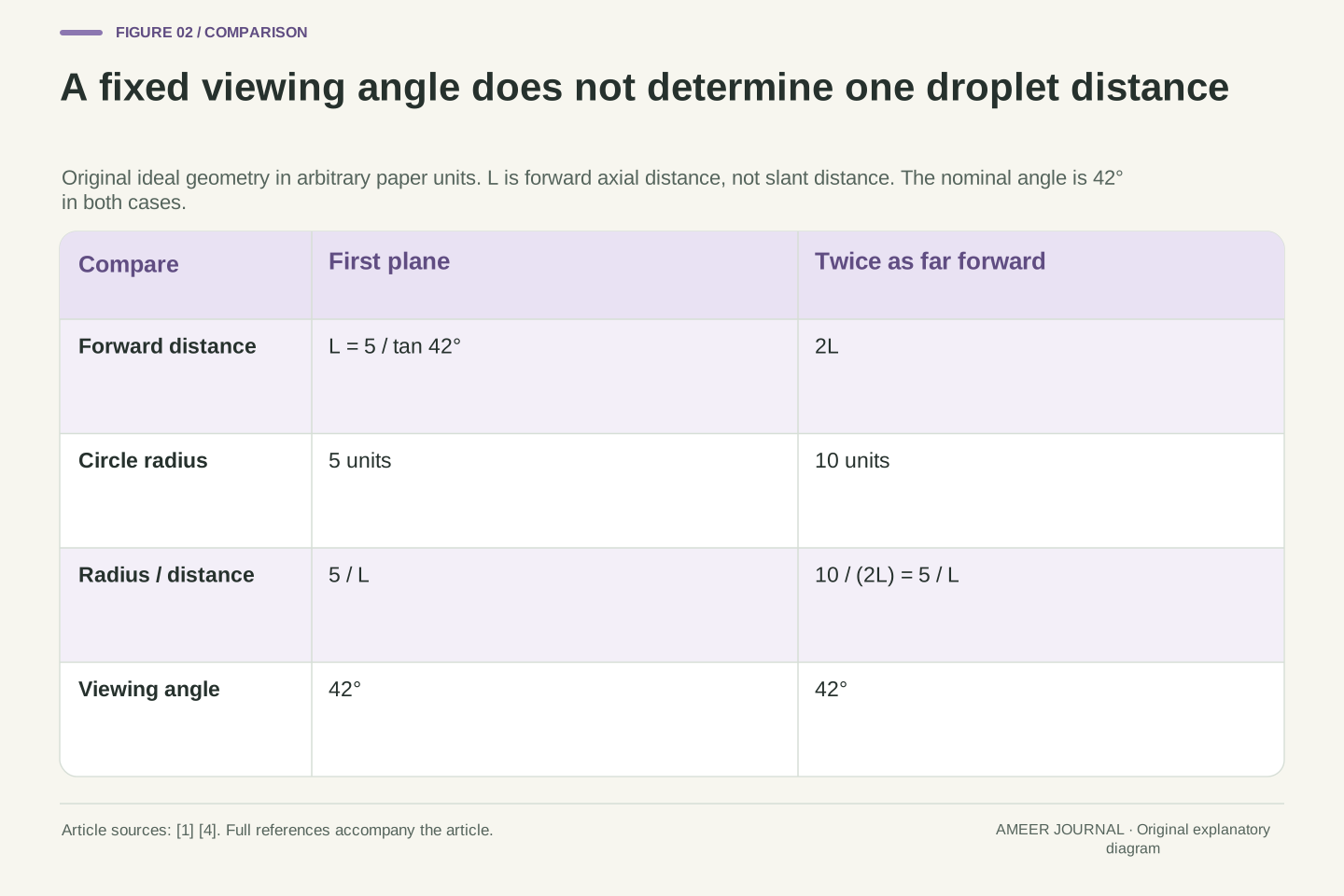
Our first paper circle will have a radius of five units. The units are just lengths in the imagined map, not metres measured in a rain shower. Its forward distance is chosen so that a line from the viewer to the circle meets the forty-two-degree rule. If we place another plane twice as far forward, its matching circle has a radius of ten units. Both circles give the viewer the same angular radius.
This explains why the apparent size of a rainbow does not announce one distance to it. Nearer and farther candidate droplets can lie along matching directions. A coloured arc that seems to touch a distant hill does not, from that appearance alone, tell us that its light came from the hill [1]. The comparison is like two different-sized hoops lining up from one viewing point, except our circles are mathematical slices through possible light directions. We have not built hoops or located actual raindrops.
Let R denote transverse radius in a plane whose axial distance from the observer is L. The model gives R=L tan θ. Axial distance is measured along the centre line; it is not the slant distance from the observer to a point on the circle. For θ=42° and R=5 arbitrary units, choose L=5/tan 42°, approximately 5.5531 units. The corresponding slant distance is √(L²+25), but it is not the denominator in R/L.
Replacing (L,R) by (2L,2R) preserves R/L and therefore preserves θ. The second plane has radius 10 without changing the angular radius. This scale freedom is the original reason our angle condition cannot identify a unique droplet distance. It is consistent with the observer-dependent optical appearance described by NOAA [1]. The example establishes geometric nonuniqueness; it supplies neither a measured cloud location nor a probability distribution over distances, and it does not require a real bow to occupy one flat circular ring.
Give the two viewers a shared map with six fixed points
Use a flat map with a horizontal coordinate and a vertical coordinate. The first centre is at (0,0), and the second is six units to its right, at (6,0). Give each circle a radius of five. Both are sections at the same forward distance from their corresponding viewer. The centres differ because the viewers stand sideways from one another in the imagined geometry. The light direction and the chosen angle stay fixed.
Place six imaginary candidate drops on the map: A at (−5,0), B at (11,0), C at (3,4), D at (3,0), E at (0,5) and F at (6,5). The first number tells how far right to go from the map’s origin; a negative number means left. The second tells how far up. These labels name fixed points so we can compare membership carefully. We will not move a point just because another viewer starts using the map. The map is an original puzzle, not a photograph or a plan for an experiment.
Place O₁=(0,0,0) and O₂=(0,6,0) in coordinates (x,u,v), and put all six candidates in the common plane x=L=5/tan 42°. Their transverse coordinates are A=(−5,0), B=(11,0), C=(3,4), D=(3,0), E=(0,5) and F=(6,5). Both observers have the same axial distance L from this plane and parallel +x axes. Hence their nominal-angle circles have equal radius 5 and transverse centers (0,0) and (6,0).
Only u,v are shown in the paper map; the shared x coordinate has been specified separately. This avoids treating a flat drawing as a complete three-dimensional scene without stating its depth. Candidate coordinates are held fixed while the reference centre changes. The numerical values are arbitrary and exact within the construction, whereas the choice of nominal optical angle is an idealization motivated by the introductory rainbow description [4]. No cardinality of the six-point set is interpreted as a real droplet density or light intensity.
The first circle selects A, C and E
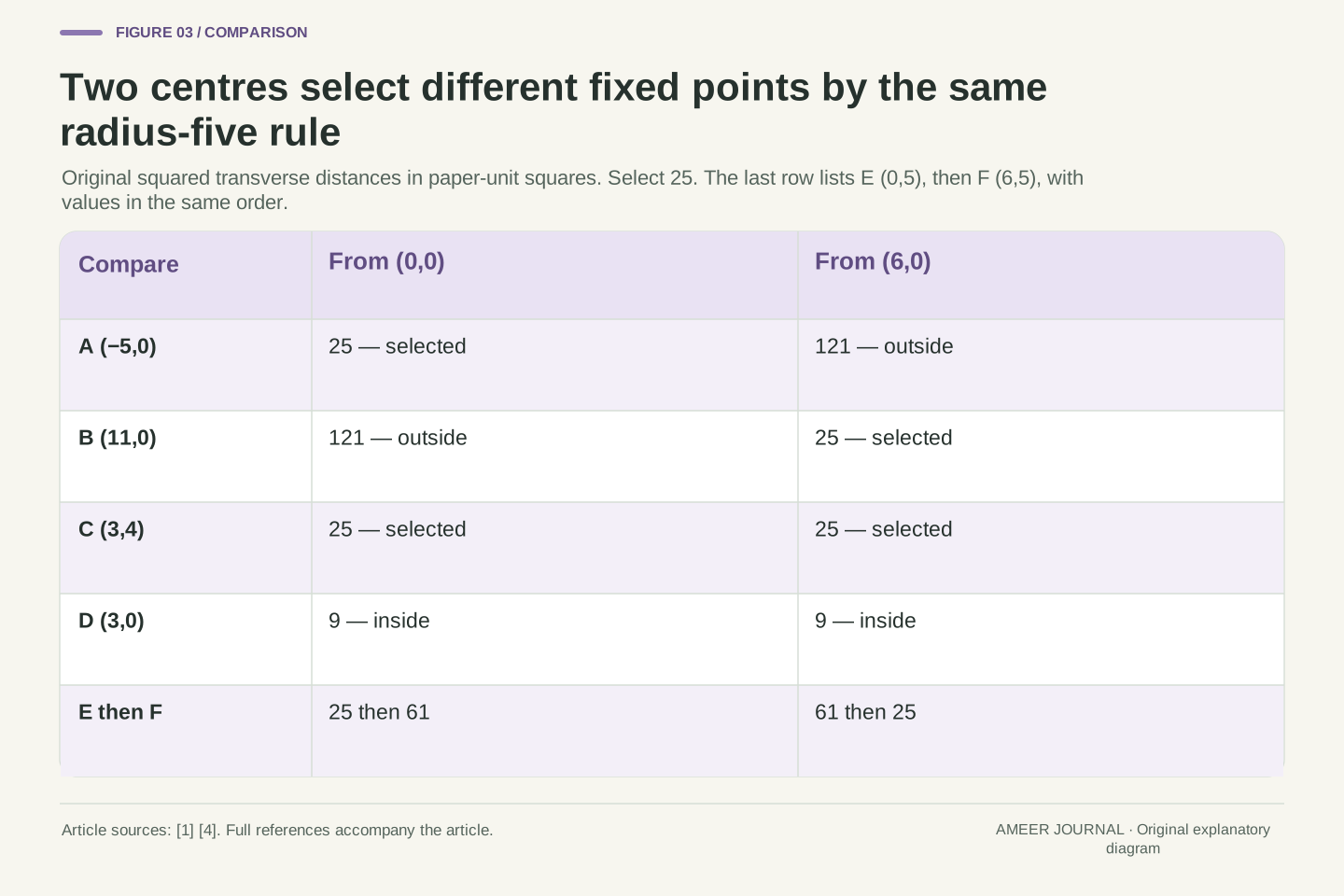
Start at the first centre, (0,0). Point A is five units to the left, and E is five units above, so both sit on its radius-five circle. Point C is three units right and four up. The familiar three–four–five right triangle puts C five units from the centre too. If that triangle is new, your grown-up can follow the squared-distance calculation in the other reading mode.
Now check the remaining points. D is only three units from the first centre, so it lies inside the circle. B is eleven units away, outside it. F is six units right and five up, making it farther than five units from the centre. The first selection is therefore A, C and E. Selection means that a point meets our chosen viewing-angle condition. D being inside this circle does not mean a real droplet there could never send any light; it means it does not meet this particular outer-direction rule.
For O₁, use the squared transverse distance q₁=u²+v² and select q₁=25. The six values, in A through F order, are 25,121,25,9,25,61. Thus S₁={A,C,E}. The calculation for C is 3²+4²=25, so no approximate square root is needed to determine membership. D has q₁=9 and is inside; B and F have values greater than 25 and are outside.
These are distances in the section plane, measured from the axis intersection. The actual observer-to-point distance also includes L². The construction is valid because L is common and fixed: selecting transverse radius 5 selects θ=atan(5/L)=42°. We are not substituting transverse radius for slant distance in an optical formula. Also, exclusion concerns only the stipulated nominal cone. It is not a statement that excluded points emit no other rays, cannot contribute to an inner direction, or are necessarily dark in a real atmosphere.
The second circle uses the same points from a different centre
Switch to the second centre, (6,0), while leaving every labelled point where it was. B is now five units to the right, and F is five units above. C is three units left and four up, so the same three–four–five triangle puts it on this circle as well. The second selection is B, C and F. The direction towards the Sun has not changed; the starting point for the viewing geometry has.
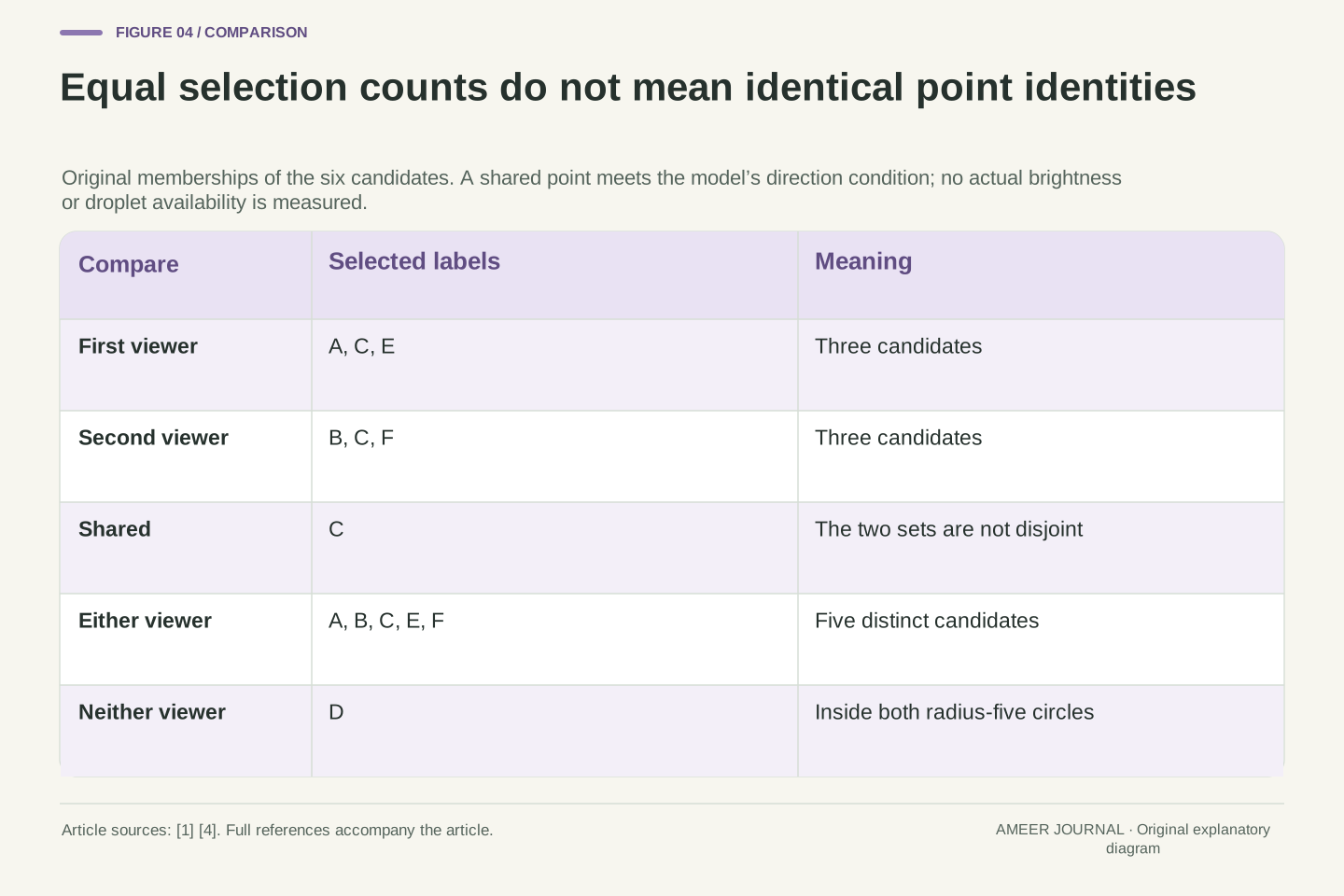
The two selections contain three labels each, but they are not the same collection. A and E belong only to the first selection. B and F belong only to the second. C appears in both, and D appears in neither. Equal counts did not tell us equal membership. This is why saying that two people see similarly sized arcs is different from saying every contributing drop is shared. We can compare the labels directly instead of relying on how similar the two drawings look.
For O₂, the transverse squared distance is q₂=(u−6)²+v². In A through F order the values are 121,25,25,9,61,25, giving S₂={B,C,F}. Translating the centre changes u to u−6 in this expression; it does not translate the stored candidate coordinates. The unchanged plane distance and radius preserve the same nominal viewing angle for both observers.
The sets have equal cardinality, |S₁|=|S₂|=3, but unequal membership. Their intersection is {C}, their union is {A,B,C,E,F}, and D belongs to neither. This finite example separates an aggregate count from the identity of its members. In the physical interpretation, nearby observers can receive primary-bow light along different paths while sharing the same weather conditions and parallel incident sunlight [1][2]. Our exact selection results remain conditional on the stated ideal geometry rather than a prediction of how many real drops either person sees.
Different selections do not have to be completely separate
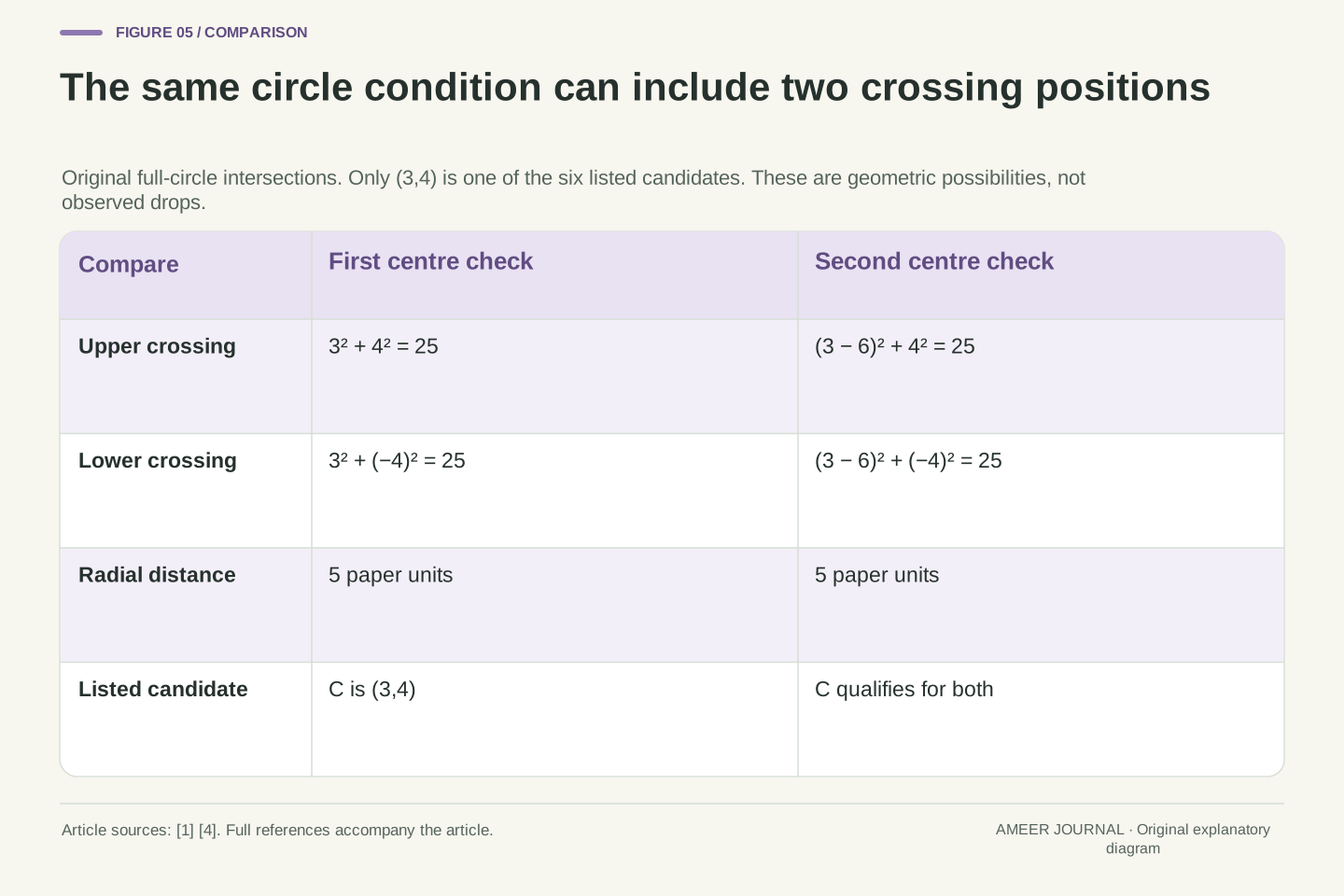
It is tempting to turn the story into a stronger rule: nobody can ever receive rainbow light from the same drop as somebody else. Our map does not support that rule. C lies on both circles. From either centre, its sideways difference has size three and its upward difference has size four. The distance is five for both. The two circles cross at C even though neither circle is identical to the other.
There is a second crossing at (3,−4), below the horizontal centre line, but that point was not included among our six candidates. Circle crossings and the selected labels are different lists. The example shows how a shared position is possible within the ideal angle model. It does not promise that real droplets, sunlight and clear paths are available at either crossing. A careful answer can say that the complete sets differ without claiming that they must share nothing at all.
Solve the two full section equations: u²+v²=25 and (u−6)²+v²=25. Subtracting them gives 12u=36, hence u=3. Substitution gives v²=16, so the two intersections are (3,4) and (3,−4). Only the first is included in our candidate set as C. This explicitly proves that the two model cones can share locations in the chosen plane even though their vertices and complete surfaces differ.
The conclusion is limited but useful: unequal full selection sets need not be disjoint. It does not assert that every pair of observers has shared contributing drops or that a geometric intersection guarantees visible intensity. Different separations, available droplet populations, illumination and obstructions can change the actual result. The sources’ observer-dependent account motivates comparing positions [1]; the circle-intersection result is our own conditional derivation. It corrects an overstrong interpretation of the everyday phrase that each person has their own rainbow without denying its underlying viewpoint dependence.
Changing the colour direction changes the circle’s radius
The primary bow places red on the outside and shorter-wavelength colours towards the inside [1][3]. Outside means farther from the centre direction. At the top of an arc that also means higher, but outside is the better word for understanding the whole circle. Different parts of the same band can lie above or beside its centre; their common feature is their angular distance from it.
The ASU introduction uses about forty-two degrees for red and forty for a blue direction [4]. These are rounded teaching values, not exact boundaries between colour names. In our picture, an inner angle of forty degrees would make a smaller circle in the same plane than the forty-two-degree circle. We would have to check the six points again for that different rule. Also, the rainbow has a continuous range of hues, not seven sharply separated bins; the Met Office explains why the familiar seven names are a useful convention [2].
At fixed L, the section radius R=L tan θ increases with θ over the acute angles used here. Thus a larger angular radius gives an outer band. The cited descriptions place primary red outside shorter-wavelength inner colours [1][3]. The ASU source rounds an introductory red direction to 42° and a blue direction to 40° [4]; these examples do not identify a universal exact angle for every wavelength within a named colour.
As a separate model comparison, retaining L=5/tan 42° while replacing θ by 40° gives R≈4.6596 units instead of 5. The difference in angular cards is two degrees, but the radius ratio is tan 40°/tan 42°, not 40/42. We do not relabel the original six-point selection as a result for this new circle. Nor do these two cards divide the spectrum into physical bins. The Met Office describes the continuous range of hues behind the conventional colour list [2]. Precise optical calculations would require more specific wavelength and droplet assumptions than this introduction supplies.
A higher Sun lowers the model’s upper edge
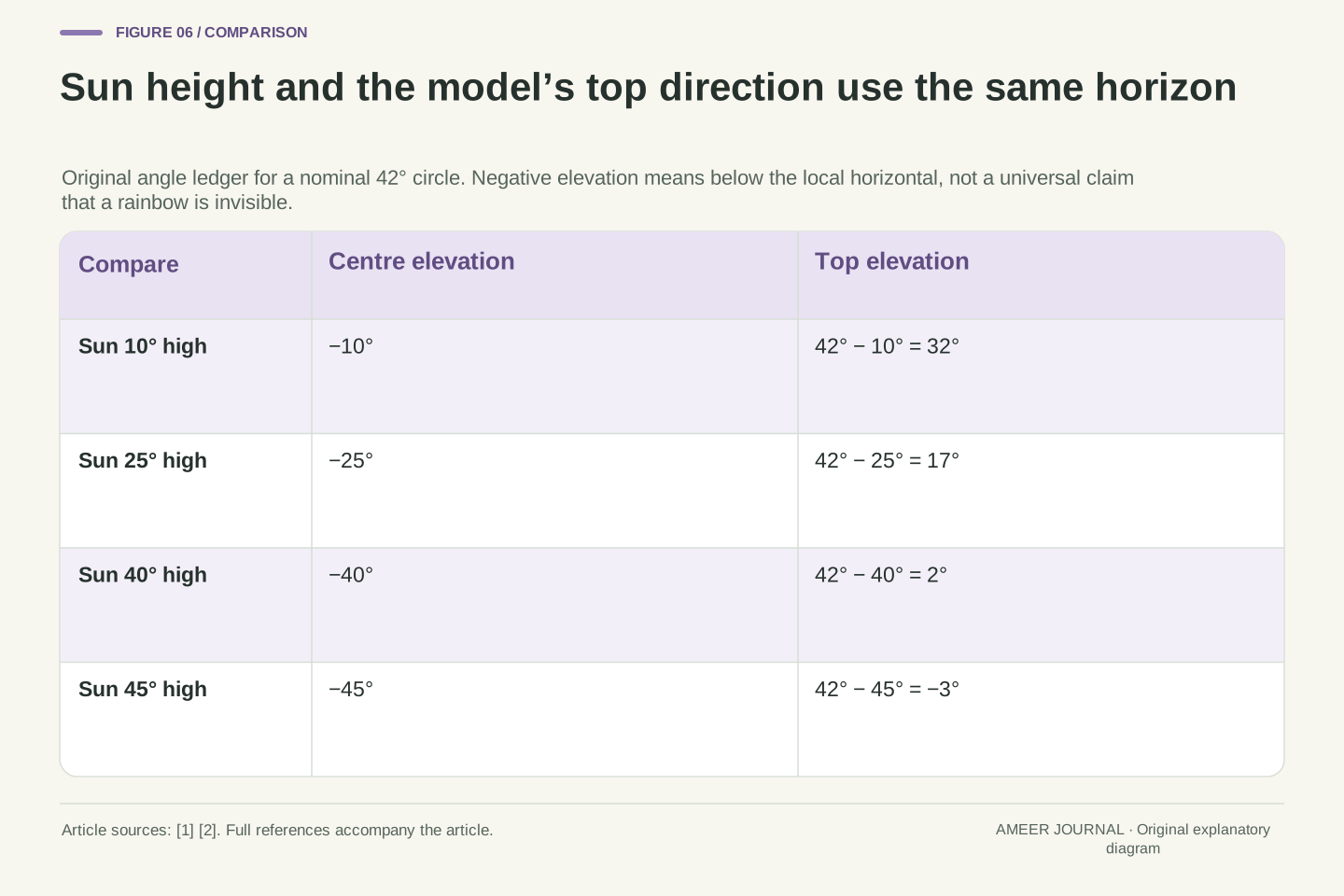
Return to the whole circle of directions. If the Sun’s drawn position is ten degrees above a level horizon, the opposite centre direction is ten degrees below it. Moving forty-two degrees upward from that centre puts the model’s top at thirty-two degrees above the horizon. With the Sun at twenty-five degrees, the top is seventeen degrees high. At forty degrees, only two degrees remain above the horizontal line.
For a drawn Sun at forty-five degrees, the same subtraction puts the top three degrees below the horizontal. That means none of this chosen circle rises above that line. It does not mean rainbows are forbidden everywhere under those conditions. An elevated viewer may have illuminated droplets and unobstructed sight lines below their local horizontal; the sources describe full-circle possibilities from elevated viewpoints [1][2]. Clouds, land and the available droplets still matter. These are paper angle cases, not instructions to find or measure the Sun.
In a separate ideal altitude construction, let solar elevation be h above the observer’s local horizontal. The antisolar axis then has elevation −h. The highest direction on a nominal 42° circle is in the vertical plane through the axis and has elevation 42°−h. For h=10°,25°,40°,45°, the top elevations are 32°,17°,2°,−3° respectively. This follows from the defined angular geometry, without reusing the earlier flat candidate coordinates as if the axis had not rotated.
A negative top elevation means that the entire chosen circle is below the local horizontal. It is not a universal visibility prohibition: the observer’s elevation, ground profile, illuminated droplets and obstructions determine which downward directions can remain accessible. NOAA and the Met Office explicitly describe elevated full-circle appearances [1][2]. Our altitude ledger does not include a particular landscape or cloud cover and therefore cannot forecast a visible arc. It distinguishes an angular position relative to a reference plane from the separate question of whether a ray can reach the observer.
Finish by naming the viewer, the rule and the shared evidence
Try explaining the map in three sentences. The first circle selects A, C and E. The second selects B, C and F. Their lists differ, but C is shared. Then add why: moving the viewer changes the centre from which the same angle rule is applied. None of the six points had to move for that change to happen. Your grown-up can help read the coordinates, and you can stop whenever the puzzle has answered your question.
Now reconnect the map to the weather explanation. Sunlight bending and reflecting through illuminated drops can produce the primary bow [1][2][3]. The viewer determines which directions lead from those drops towards their eyes. Our circles are slices through those possible directions, not the rainbow’s physical rim. Two people can enjoy the same weather event and agree about its appearance while receiving different selections of light. Keeping that distinction also leaves room for the shared positions that the original geometry permits.
The completed argument contains three separate results. Fixed-angle geometry produces observer-centered cones and circular perpendicular sections. Translating the observer changes the membership of a fixed candidate set. Different memberships can overlap, as the exact intersections demonstrate. The real-light mechanism supplies the physical context [1][2][3], while the finite coordinates and set calculations are original explanatory constructions rather than retrieved observational data.
A useful final explanation states which observer, angle, plane and candidate identities are being compared. If the question changes to colour, distance or visible arc height, the relevant assumptions and quantities must change explicitly too. The same angular appearance cannot supply a unique drop distance, and a point on a geometric cone does not alone establish brightness. This preserves the intended lesson without turning a familiar phrase into an absolute rule: nearby people need not receive rainbow light from identical complete collections of droplets, even though their selections can have something in common.
Sources & further reading
Explore the references behind this guide. External pages may change after our review.
- What Causes a Rainbow? | NESDIS | National Environmental Satellite, Data, and Information ServiceNOAA / NESDIS · Accessed 7 Nov 2026
- Rainbows: optical wonders - Met OfficeMet Office · Accessed 7 Nov 2026
- How Do Rainbows Form?NOAA / National Weather Service Flagstaff · Accessed 7 Nov 2026
- How Rainbows Work | Ask A BiologistArizona State University / Ask A Biologist · Accessed 7 Nov 2026
Article updated 7 Nov 2026.