What you’ll take away
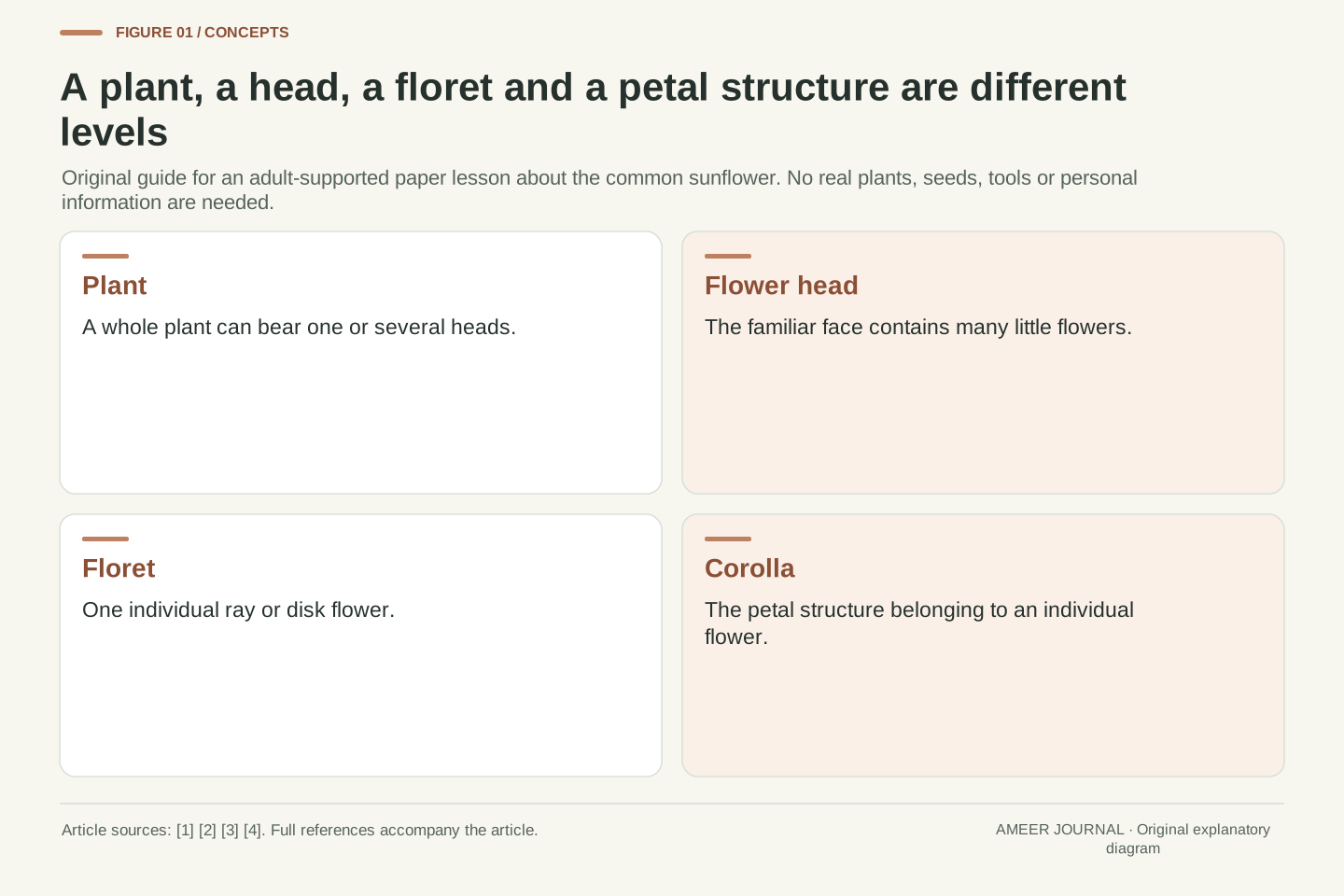
- A sunflower head contains individual ray and disk florets; it is a group of flowers.
- The conspicuous ray strap and the lobes of a disk corolla are petal structures belonging to individual florets.
- The same number of rays can accompany different numbers of disk florets and different flower totals.
- Green bracts, florets, whole heads and whole plants are different structures to identify.
- A drawing of flowers does not by itself establish mature-seed outcomes or the number of plants.
One familiar face is a group of little flowers
A sunflower drawing often looks like one flower with a dark middle and a ring of yellow petals. Look more closely at what those parts represent. The familiar face is a flower head: a tightly arranged group of little flowers. Botanists call each little flower a floret. The central dots in a careful diagram can represent individual flowers, rather than spots on one enormous flower [2][3].
We will explore the common sunflower, Helianthus annuus, using drawings and a reading partner. An adult can help with the longer words. Keep this activity on an uncut page: no real flowers, seeds, loose pieces or tools are needed. There is nothing to taste or collect, and no photograph or personal information to share. Our small counting diagrams deliberately contain fewer florets than a real head usually has. They are made-up teaching pictures, not measurements. Their purpose is to help us tell a whole head, an individual flower and a flower part apart.
The familiar sunflower face is an inflorescence, specifically a head containing many individual florets. Common sunflower, Helianthus annuus, provides a useful example because its outer ray florets and central disk florets look different [2][4]. Calling the whole display a flower in everyday speech is understandable, but treating that everyday label as an anatomical count hides the individual flowers within it.
This adult-supported lesson distinguishes organizational levels: plant, head, floret and parts within a floret. Its original paper models are deliberately reduced and completely labeled; they are not botanical counts from specimens or photographs. All assigned florets are visible in those models. Learning remains private and uses an uncut page, without plant handling, real seeds, dissection, tools, tasting or data collection. Technical mode develops the same relationships more precisely. It does not turn the activity into a laboratory exercise or assume that a child can identify hidden organs in an unlabeled real flower.
Ray flowers and disk flowers have different shapes
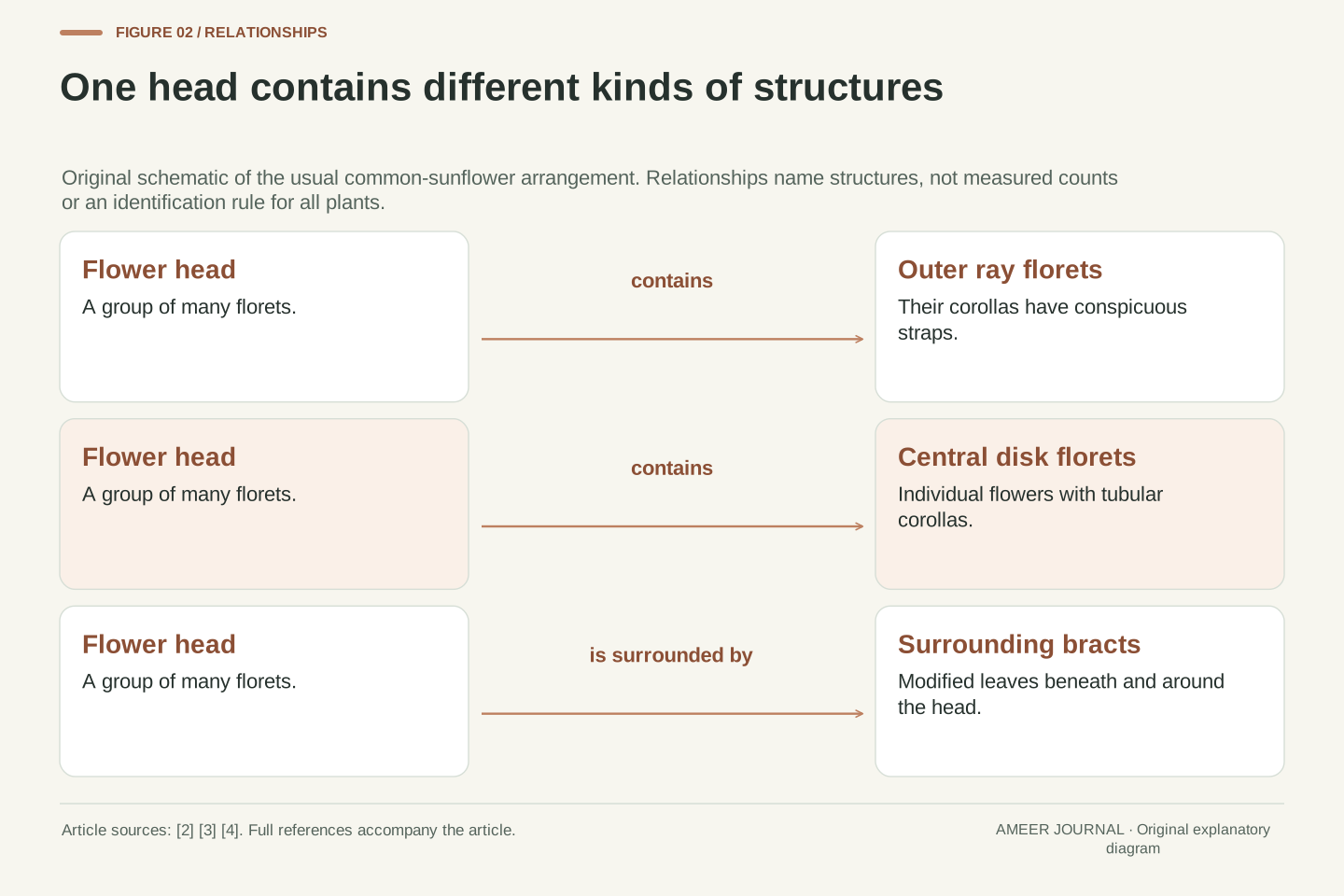
In the usual common-sunflower arrangement, the outer flowers have a long, flat-looking yellow part pointing away from the centre. These are ray florets. The central flowers are much smaller-looking tubular flowers called disk florets. Some sources spell the same word disc. Ray florets surround the central disk florets, so the head combines two flower forms in one display [1][2][4].
The size and position of the visible parts can fool our eyes. A long yellow ray is easy to notice, while many central florets fit into a small area. Being easy to see does not make the ray the only flower present. Imagine a drawing with the word ray beside an outer flower and disk beside a central one. Point to both labels before counting. The labels identify the represented structures; colour alone is not a rule for identifying every plant. Cultivated sunflowers can have different colours and shapes, so our example needs its name and arrangement.
Ray and disk denote floret forms, not a distinction between real flowers and decorative non-flower objects. In the usual radiate head of common sunflower, peripheral ray florets have conspicuous ligulate corollas, while the central disk florets have smaller tubular corollas [2][3][4]. The word corolla names the petal structure of an individual flower. Disc and disk are spelling variants in the cited descriptions.
The whole central region and an individual disk floret must remain distinct. A diagram may show one region containing many separate tubular corollas; it is not one giant central flower surrounded by ordinary petals. Likewise, visual prominence does not establish numerical abundance. Our later schematics label every represented floret explicitly, so their counts do not rely on estimating tiny structures from an image. Species and cultivar context still matters. NC State describes cultivated variation in colour and form [1]; the usual ray-around-disk arrangement is the chosen biological example, not a universal image-classification rule.
The long yellow strap belongs to one flower
The part that looks like a single sunflower petal is more complicated than it first appears. A ray floret has petals joined together into a corolla, with a conspicuous part extending to one side. The flat, strap-like part is called a ligule [2][3]. We can say yellow ray in a simple conversation, but a careful diagram distinguishes that visible petal structure from the whole little flower it belongs to.
Joining petal parts does not join several complete flowers into one ray. Those are different relationships. In our paper explanation, place a small outline around one ray floret, then label its long strap as part of its corolla. Do this only on a drawing; nothing needs pulling apart. The usual common-sunflower ray florets described in the sources are often sterile, so they are not a reliable seed counter [2]. Sterile here concerns reproduction. It does not mean that the structure stops being a flower or becomes a leaf instead.
A ray floret’s conspicuous strap is a ligule associated with its fused corolla. Geneseo describes the ray’s enlarged petal structure as composed of fused parts, and the museum account distinguishes an asymmetric strap-like extension from the more radially arranged disk corolla [2][3]. The visible ligule is therefore not a synonym for every structure of the whole floret, even when a simplified drawing represents the floret chiefly by that strap.
Keep the two kinds of grouping separate: petal fusion within one corolla and aggregation of multiple florets within one head. They operate at different anatomical levels. The common-sunflower account describes ray flowers as often sterile [2], but the family-level source allows other reproductive arrangements [3]. Thus the lesson does not declare every ray flower in every daisy-family plant sterile. Within the usual sunflower example, the absence of a reproductive function does not alter the ray floret’s identity as a flower. It limits what its presence can establish about later seed production.
Five petal lobes can belong to one disk flower
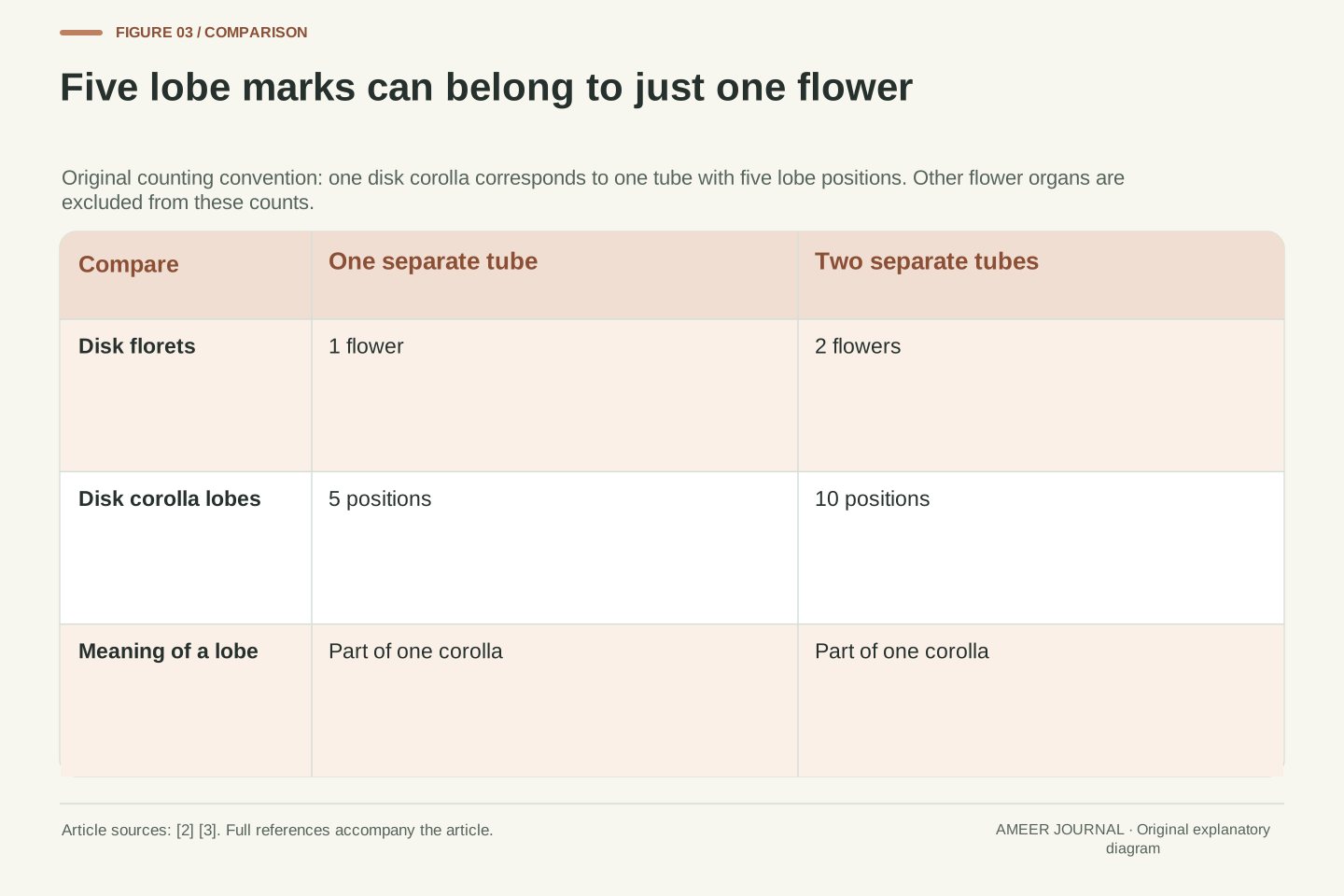
Now zoom in on one central disk floret in the drawing. The usual complete disk flower has five petals joined into a tube [3]. At the tube’s opening, the petal ends can be shown as five small lobes. Five lobes do not mean five separate flowers. They are parts of the corolla of the single floret we chose to examine.
Ask a reading partner to draw one small tube with five marks around its opening and write one floret beneath it. Next to it, draw two separate tubes, each with its own five marks. The second picture represents two florets and ten lobe marks. Both counts are useful, but they count different things. Our marks are a diagram convention, not a claim that every detail is visible without magnification. The flower also contains structures beyond its petals [2][3]. A simple picture leaves some of those out to make one relationship clear, so its caption should say what it shows.
The museum’s description of a complete disk flower specifies five petals fused into a tubular corolla, with anthers and a stigma as separate structures within or emerging through that arrangement [3]. A five-lobed corolla remains one petal whorl associated with one floret. Its lobes are not five independently organized flowers, and the corolla alone is not the complete inventory of the floret’s organs.
For the original schematic, assign five lobe positions to every represented disk corolla. One such tube gives one disk floret and five lobe positions; two give two florets and ten positions. This is an explicit mapping between diagram levels, not a method for inferring counts from an unclear photograph. The count of lobe positions is five times the disk-floret count only because the drawing rule fixes that correspondence and includes each assigned corolla once. Ray-floret structures are not added to this particular lobe total. Stating that boundary prevents a number about disk corollas from being mistaken for a total of every petal part in the head.
The green pieces beneath the head have another name
A careful side-view drawing can show green, leaf-like pieces beneath and around the flower head. These are bracts. Bracts are modified leaves, and Cornell describes overlapping green bracts beneath the common sunflower’s head [3][4]. They are not another set of yellow rays waiting to be counted. The head contains flowers while also having supporting and surrounding structures of other kinds.
On a paper side view, label the green pointed pieces bracts and label the long outer corollas rays. Use words or different line patterns if colours are difficult to distinguish. Do not make green mean bract everywhere in nature: a diagram key tells us what a particular mark represents. A green triangle drawn by an artist is not enough evidence on its own. This distinction also explains why changing views can help. A front view emphasizes the ray-and-disk arrangement; a side view can show the surrounding bracts more clearly. Neither view adds a new flower merely by revealing another part.
The head’s surrounding involucral bracts are modified leaves, distinct from the corollas of its constituent florets [3]. Cornell describes rows of overlapping green bracts beneath the common-sunflower head [4]. Their proximity to the flowers does not make them petals, and a whole-head outline should not be treated as a boundary enclosing only floral organs of one individual flower.
The paper model uses a named side view to separate bracts from the ray corollas. Labels and line conventions carry the interpretation; colour or a pointed shape is not a general diagnostic rule. Avoid identifying the entire green surround as the sepals of one enormous flower, which would collapse the head level into the floret level. A different viewing direction changes which structures are exposed in the illustration without changing their biological identities. This is a reason to preserve the view and the label key when comparing drawings, rather than assuming every newly visible outline represents an additional flower.
A head is not the whole plant
There is another level above the flower head: the plant that bears it. We often see drawings of one tall sunflower stem with one large head. That is a useful picture of some forms, but it is not a rule for every common sunflower. The sources describe branching plants and plants with several heads, as well as cultivated forms with a large main head [1][2][4].
Imagine two different head drawings called A and B. We have not drawn their stems yet. An adult can sketch one pretend plant with branches leading to both heads. That gives one plant and two heads. A second sketch can put A on one plant and B on another. That gives two plants and still two heads. The head drawings alone did not tell us which arrangement to choose. This is another reason to name the thing being counted. Plants, heads and the individual florets inside heads are connected, but their totals need not be the same.
Plant architecture introduces another organizational boundary. Common sunflower can bear multiple heads on branches; the cited accounts contrast branching wild forms with certain cultivated forms dominated by a large main head [1][2][4]. The lesson does not convert those descriptions into a universal one-plant/one-stem/one-head correspondence. A displayed head is part of a plant, not evidence that the whole plant has been shown.
In the original model, A and B designate two distinct head drawings whose stem connections are initially unspecified. Arrangement one assigns both to plant P1. Arrangement two assigns A to P1 and B to P2. Both arrangements retain two heads, while the plant counts are one and two. No probability is assigned to either arrangement, and neither is a record of a real specimen. The comparison shows exactly which information is missing: connections between heads and plants. Adding those connections answers a different question from counting florets within either head.
The same yellow-ray count can hide different flower totals
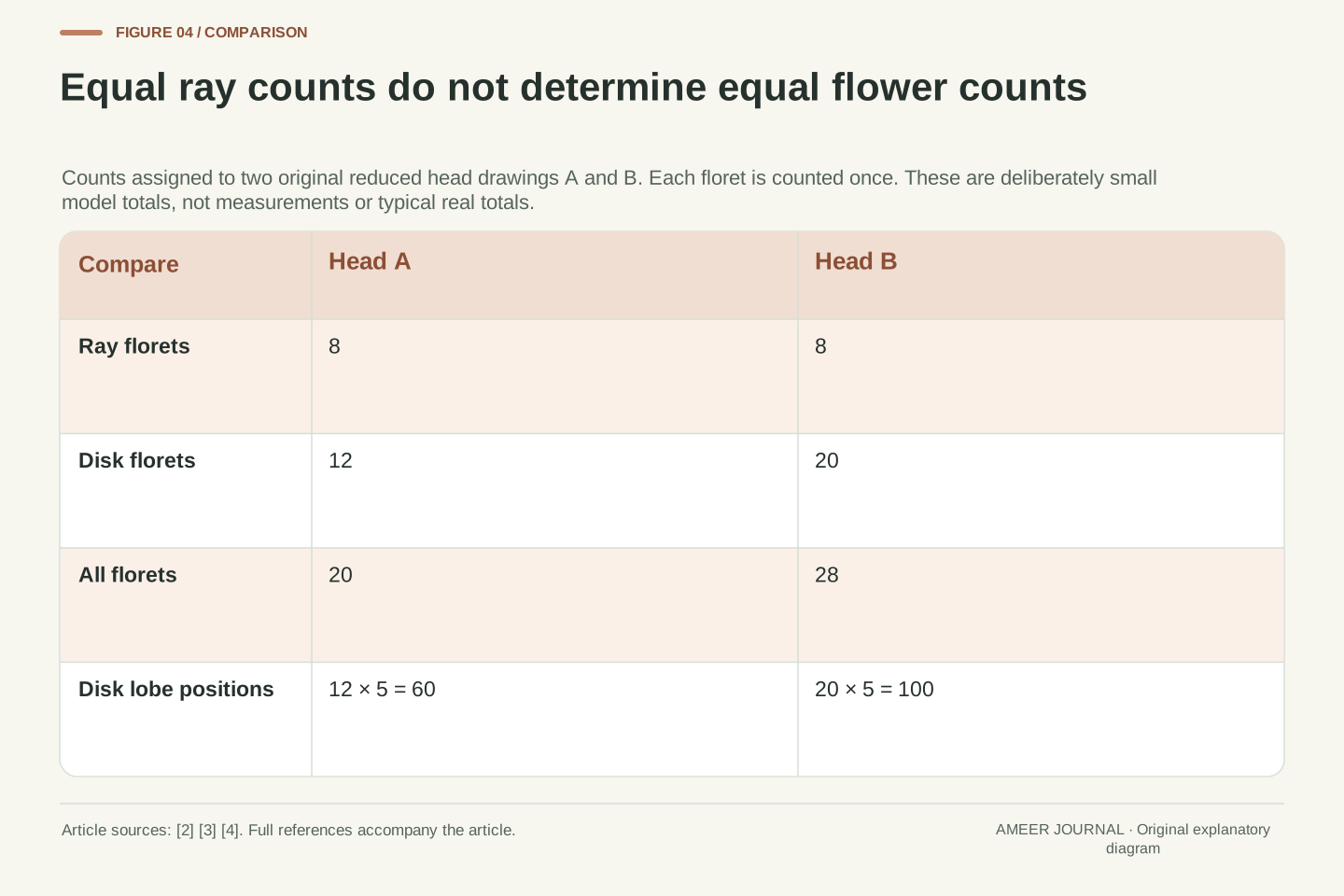
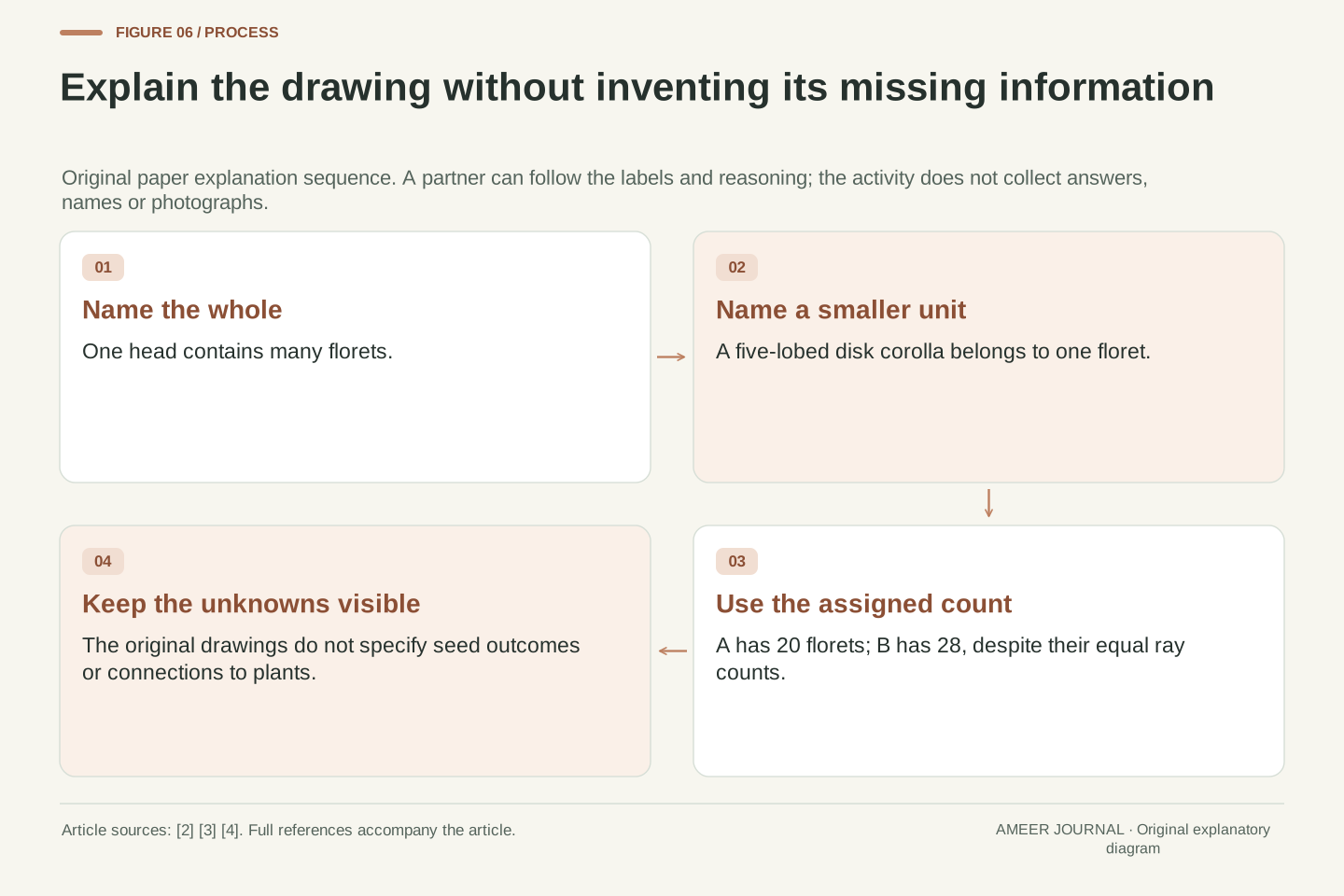
Give our two head drawings exact labels. Drawing A has eight ray florets and twelve disk florets. Drawing B has eight ray florets and twenty disk florets. Every assigned floret is shown once. These small numbers make the paper puzzle manageable; they are not typical counts for real sunflower heads. Both drawings have eight rays, but A contains twenty florets altogether and B contains twenty-eight. Counting only the rays misses the difference in their central flowers.
B has eight more florets than A, even though the ray counts match. Across the two distinct heads there are forty-eight florets. Now change the question to the five-lobed disk-corolla marks described earlier. A has twelve groups of five, or sixty lobe positions; B has twenty groups of five, or one hundred. Those larger numbers still do not count flowers. We have changed the unit from whole disk florets to parts of their corollas. Say the unit after each answer so a partner can tell which question you solved.
Assign disjoint identities to every represented floret: A has 8 rays and 12 disks, while B has 8 rays and 20 disks. Each drawing is a distinct head, with no hidden or repeated assigned florets. Total counts are 8+12=20 and 8+20=28. Equal ray counts therefore coexist with unequal total-floret counts. Their difference is 8, and their combined count is 48. The deliberately reduced schematics are not estimates for actual common-sunflower heads.
Under the separate five-lobes-per-disk-corolla convention, the lobe-position totals are 5×12=60 and 5×20=100, or 160 combined. These include disk corollas only, not ray corolla parts or bracts. The mapping keeps anatomical units distinct: summing floret identities counts flowers, while multiplying disk identities by five counts assigned lobe positions. Neither operation supplies a mature-seed total. The original model demonstrates the missing information in a ray-only count without relying on a real photograph, an assumed typical floret number or a claim that more visible yellow area means more flowers.
The little flowers do not all develop at once
A sunflower head is not a collection of identical flowers all doing the same thing at the same moment. The central disk florets generally mature from the outside toward the centre [2]. A labeled drawing can therefore show older outer florets, flowers at another stage farther inward, and younger central buds. Looking only at the currently obvious open flowers would answer a different question from counting every floret represented in the head.
There is also a sequence within an individual disk flower. Geneseo describes the anthers presenting pollen before the stigma pushes up through the ring of anthers [2]. The anthers and stigma are different flower structures, and their appearance can change as that flower develops. This does not mean that a new flower has been added whenever a different part becomes noticeable. Nor does a visible stigma or an insect visit prove that a mature seed will result. Our diagrams explain structures and stages; they do not record successful reproduction or give a day-by-day schedule for a real plant.
Development introduces time without changing the organizational units. Common-sunflower disk florets generally mature centripetally, from the outside of the disk inward [2]. A head can consequently contain florets at different stages. A count restricted to a visible flowering stage is not automatically the count of all florets in that head. The stage criterion would need to be defined before interpreting such a number.
Within an individual disk floret, the cited account describes earlier anther maturation and pollen presentation followed by stigma emergence through the anther ring [2]. This sequence concerns changing structures of one floret, rather than replacement by additional florets. It does not establish exact durations for every cultivar or observation. It also supplies no mature-seed outcome merely from visible pollen, stigma position or an insect visit. The paper lesson deliberately makes no reproductive success observations. Its narrower use of developmental evidence is to explain why appearance, the number of presently conspicuous flowers and the complete set of flower identities can differ.
A sunflower seed can be inside a small dry fruit
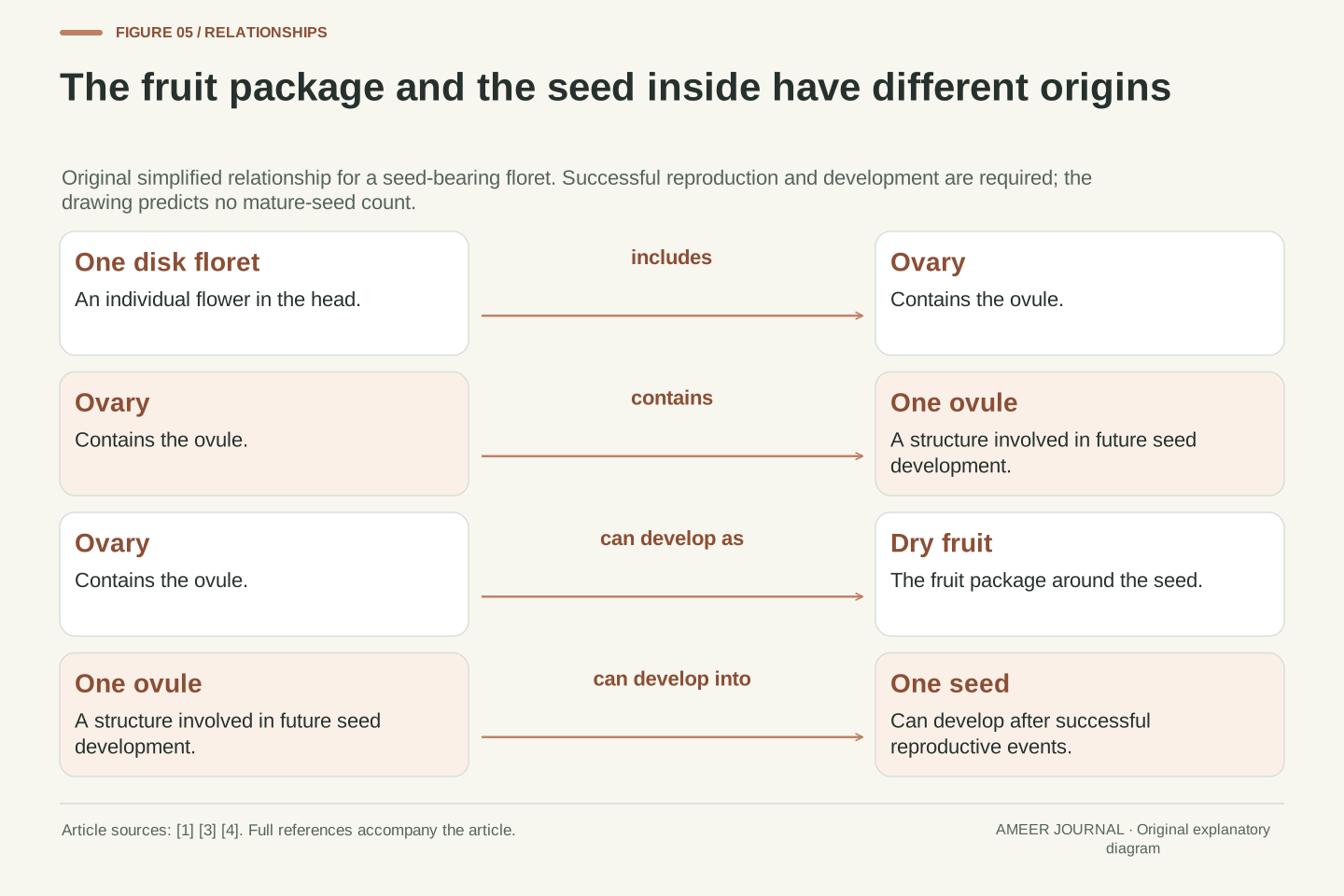
The word seed has another everyday shortcut hidden inside it. The familiar outer package commonly called a sunflower seed includes a small dry fruit around the seed. Cornell describes the seed as enclosed in that fruit, while NC State calls the fruit a cypsela [1][4]. The covering and the seed inside are connected parts, but they are not the same structure. We can understand their relationship from a labeled picture without opening or handling anything.
In the flower-family account, a flower with the relevant female structures has an ovary containing one ovule. After successful reproductive and developmental events, that ovule can become one seed within the developing fruit [3]. This is why counting the large outer rays cannot tell us the number of mature seeds. Our drawing A has twelve assigned disk florets, but the drawing gives no later development results. It does not promise twelve mature seeds. A potential place for a seed and an observed mature seed are different pieces of information.
Keep ovary, ovule, fruit and seed distinct. The family-level anatomical account describes one ovule within the ovary of a functionally female floret, with successful fertilization leading toward a single seed in a dry fruit [3]. Cornell calls the sunflower fruit an achene, while NC State uses cypsela [1][4]. The terminology differs in those references, but both preserve the essential distinction between the dry fruit package and its seed.
The lesson does not infer a mature-seed count from the number of rays or even from the number of disk-floret symbols. Reproductive and subsequent developmental outcomes are unspecified in the original model. A’s 12 assigned disks therefore do not establish exactly 12 mature seeds. The usual sterile ray condition and the potential seed-bearing role of disk florets belong to the scoped sunflower example [2], not a universal rule for every family member. No fruit is opened and no real seed is used; the diagram relates the structures and leaves actual successful seed development explicitly unobserved.
Sort six statements by what the drawings actually tell you
Try a word game with a reading partner. Use three headings on the same page: supported, contradicted and not decided by the drawing. Here are the first three statements: “A and B have equal ray counts”; “A and B have equal total flower counts”; and “B has eight more florets than A.” The assigned numbers support the first and third statements. They contradict the second, because twenty and twenty-eight are different totals.
Now try three more: “One five-lobed disk corolla is five separate flowers”; “A will produce exactly twelve mature seeds”; and “The two heads belong to two different plants.” The first conflicts with our drawing rule: five lobes belong to one floret. The other two are not decided. No seed-development outcome or stem connection was supplied. We finish with two statements in each group. Not decided is a useful answer, not a mistake. It identifies what the picture has left out and prevents us from pretending that a missing fact was already observed.
Classify six original propositions relative to the fully specified paper model, not to an imagined photograph. Equal ray cardinality is supported because 8=8. Equal total-floret cardinality is contradicted because 20≠28. A difference of eight florets in B’s favor is supported because 28−20=8. These judgments follow directly from the assigned identities and counts; they do not require a population estimate.
The proposition that one five-lobed disk corolla comprises five complete flowers is contradicted by the declared anatomical representation. Exactly twelve mature seeds from A is not determined because developmental outcomes are absent. Two distinct plants is not determined because the original head drawings omit stem connections, allowing both arrangements already described. The result is two supported, two contradicted and two undetermined statements. These are categories of information, not probabilities or scores from children. A partner can justify each classification by naming the supplied premise or the missing fact, rather than guessing what answer the author intended.
Keep the sunflower example separate from a rule about every daisy
Sunflowers belong to the daisy family, also called Asteraceae. Sharing a family does not make every head identical. The museum account explains that a family member’s head may have only ray flowers, only disk flowers, or both [3]. The usual common-sunflower arrangement we studied is therefore one important example. It is not a promise that every flower head in a park will match the same drawing.
Even cultivated common sunflowers can look different. NC State describes forms with different colours and double flower heads [1]. Our small A and B diagrams were designed to display a clear ray-and-disk distinction, so they should not become a test for identifying an unknown plant. A useful next question for a diagram is which plant and form its labels describe. That keeps the lesson accurate when another illustration looks unfamiliar. We can understand one well-labeled example thoroughly without pretending its colours, counts and reproductive roles apply to every member of a large family.
Asteraceae describes a broader group than the particular common-sunflower morphology used here. The museum account permits heads with ray florets only, disk florets only, or both, and permits different reproductive conditions among florets [3]. Consequently, neither a two-form head nor ray sterility should be promoted to an invariant of the entire family. The article’s ray/disk organization is a scoped example, not a family-wide identification algorithm.
Cultivated variation adds another reason to preserve the subject. NC State lists differently coloured and double-flowered common-sunflower forms [1]. Those records support variation without establishing a fixed count or developmental mechanism for every cultivar. Our models deliberately retain the ordinary distinction needed for the counting problem and supply their own reduced counts. Applying their arithmetic to another diagram requires that diagram’s own labels and membership rules. No classification of a wild plant, edible structure or unknown specimen follows from recognizing yellow straps or a dark centre in an illustration.
Finish with a sentence that names the right level
A useful explanation can begin: “This is one sunflower head containing many individual flowers.” Then identify a ray floret and a disk floret. If a drawing enlarges one disk corolla, explain that its five lobes are parts of one flower. If it shows the green surround, use the word bracts. Each sentence keeps the whole group separate from the structures belonging to its members.
For our assigned pictures, a fuller caption could say: “A has eight rays and twelve disks, so it represents twenty florets. B has the same ray count but twenty disks, so it represents twenty-eight. The drawing does not report mature seeds or show whether the two heads share one plant.” Ask a partner which words explain the numbers and which words mark a limit. You do not need a perfect picture to give a careful explanation. Clear labels and the right counting unit let a small paper model show why one familiar sunflower face can contain many little flowers.
A complete caption should identify the depicted level and the representation rule. The whole head is an inflorescence; each assigned ray or disk symbol represents one floret; five marked lobes belong to one assigned disk corolla; the surrounding bracts are modified leaves rather than additional florets [2][3][4]. An enlarged inset changes drawing scale and detail, not the identity or number of represented flowers.
For models A and B, retain the exact membership counts and their boundary: 20 and 28 florets across two distinct heads, 48 combined, with disk-corolla lobe positions counted separately. Preserve the unspecified stem connections and reproductive outcomes instead of completing them by imagination. These qualifications are part of the explanation, not extra obstacles to learning it. The paper exercise links a concrete biological organization to a disciplined reading of a diagram: name the structure, identify what one symbol means, calculate only the requested quantity and leave unsupported outcomes open.
Sources & further reading
Explore the references behind this guide. External pages may change after our review.
- Helianthus annuus — North Carolina Extension Gardener Plant ToolboxNorth Carolina State Extension · Accessed 7 Nov 2026
- Sunflower: Helianthus annuus — Inanimate LifeSUNY Geneseo / Milne Open Textbooks · Accessed 7 Nov 2026
- Asteraceae or Compositae (sunflower family)Arizona-Sonora Desert Museum / Mark A. Dimmitt · Accessed 7 Nov 2026
- Common sunflower — Cornell CALSCornell University College of Agriculture and Life Sciences · Accessed 7 Nov 2026
Article updated 7 Nov 2026.