What you’ll take away
- Name the visible feature, original group and observation date before interpreting a sprout count.
- New observations today differ from the total number of distinct records that have met the rule so far.
- In the original day-six diary, eight of twelve records show a first root and four of twelve show a shoot above the drawn surface.
- Not observed by a cutoff and unreadable are different states; neither proves that a seed is dead.
- A simple root marker does not replace a normal-seedling assessment or predict a real seed group’s future.
Eight sprouts is the beginning of a question
Imagine a seed diary with twelve little drawings labelled A to L. On day six, eight drawings have a mark saying that a tiny root has appeared. Is eight a lot? Before answering, ask what the mark means, how many seed drawings were in the diary at the start, and which day the report describes. Eight out of twelve by day six tells a clearer story than the number eight on its own. A different starting number or a different observation rule could change the meaning.
This is a private paper detective game for a child and a grown-up reading together. The dates and seed records are invented. You can point at this page or make large marks on an uncut sheet; there is no need for real seeds, water, soil, tools or collecting plants. The letters identify imaginary seeds, not people, and nothing needs to be photographed or uploaded. University plant guides describe different signs of germination and seedling development [1][2]. We will use their biology to ask better questions about a simple made-up diary.
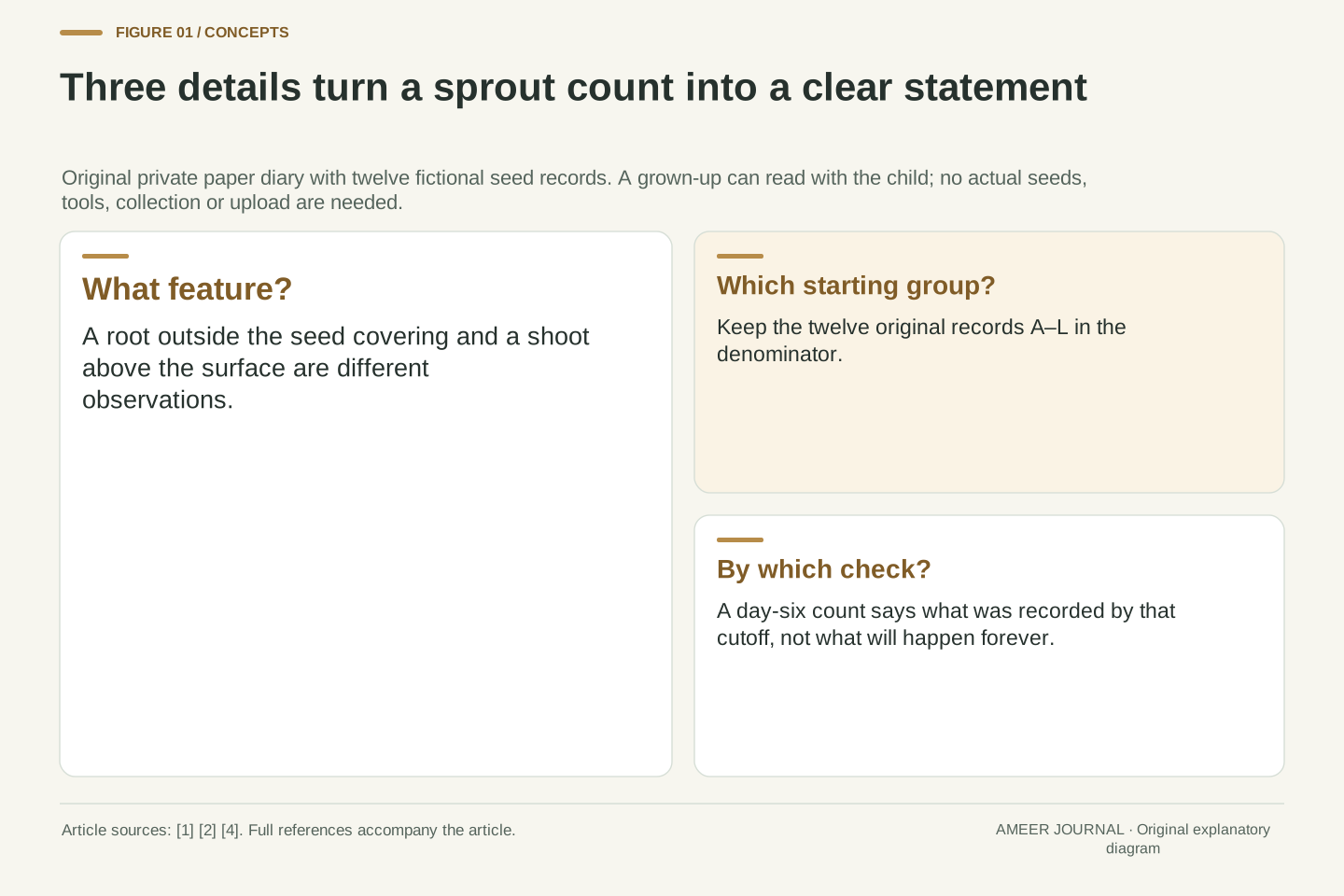
A germination-related count is interpretable only after defining the counted event, cohort and observation cutoff. The original activity uses twelve fictional seed identifiers, A–L, and separate records for visible root emergence and shoot appearance above a drawn surface. Its day-six root count is eight. That count is a finite description of the supplied records, not a representative sample, a species-specific growth prediction or a measured germination result.
The Easy mode supports a child reading with an adult; this Technical mode makes the counting rules explicit for the same activity. Both use only the page or marks on uncut paper, with no seed handling, apparatus, personal information or online submission. UMN describes radicle emergence as an observable germination marker, while NC State distinguishes germination and field emergence [1][2]. Those distinctions motivate the two record types. The activity's goal is to retain the criterion, starting denominator and date when turning a count into a statement, rather than attaching a biological conclusion to a bare number.
The first visible root belongs to a larger growing process
A seed contains a young plant called an embryo inside a covering. Stored resources can support its early growth. As germination gets under way, the embryo's activity increases and parts of the young plant begin to grow. The first small root is called the radicle. UMN describes its appearance outside the seed covering as one sign that is often used when observing germination [1]. A small root mark in our diary stands for that particular visible event, not for every change happening inside a seed.
Water entering a seed is part of the process, but a seed getting bigger after taking up water does not by itself prove that a living embryo is growing [1]. NC State also describes supporting tissues that supply resources during early development [2]. This explains why a first root and a later leafy seedling are connected stages without being the same observation. Our drawings do not ask you to open a seed or test one. They help you name the feature that a record claims to show before you start counting it.
The seed includes an embryo, a covering and, typically, stored resources that support establishment. NC State identifies the embryonic root and shoot alongside supporting tissues such as cotyledons and endosperm [2]. UMN explains the activation of metabolic pathways and embryo growth during germination, including early water uptake, or imbibition [1]. These biological events are related, but they are not interchangeable observational endpoints.
For this diary, define R as the first recorded appearance of the radicle outside the seed covering. The radicle is the embryonic root. UMN explicitly treats its emergence as a common observable measure, while warning that water uptake alone does not demonstrate a living, growing seed [1]. The event R therefore records a declared visible feature rather than every internal germination process. It also does not establish that all structures needed for a normal seedling will subsequently develop. That stronger assessment requires a different criterion, which we return to after completing the paper counts.
A root outside a seed is different from a shoot above the surface
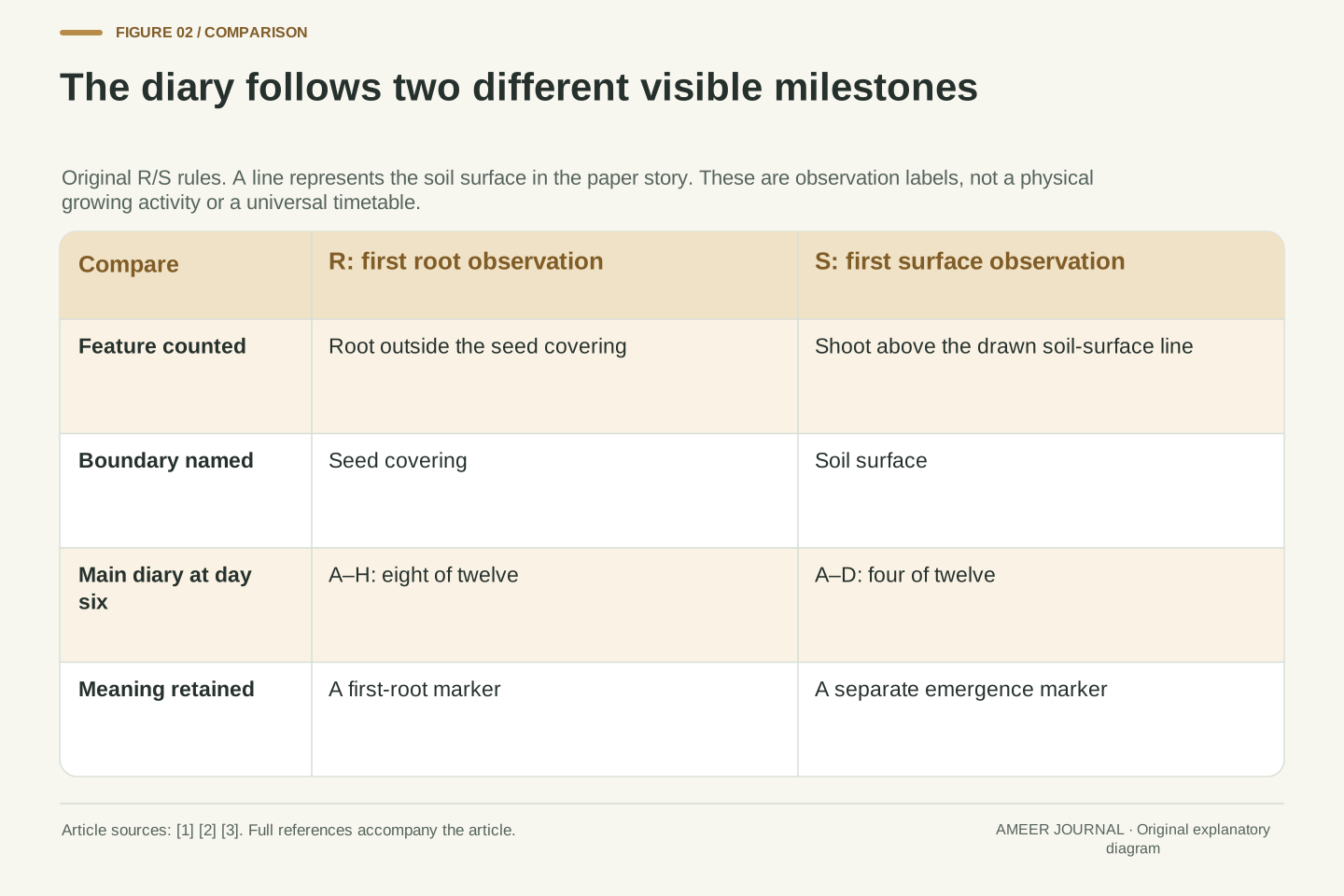
Our diary has two kinds of marks. An R mark means that a root has been recorded outside the seed covering. An S mark means that the shoot has been recorded above a line representing the soil surface. The line is part of the imaginary picture. A root can already have appeared while the shoot has not yet reached that line. NC State calls the shoot's protrusion from soil field emergence [2]. Counting R and counting S therefore answer different questions, even when the diary contains the same seeds.
Plants also differ in how their young seed leaves, called cotyledons, are positioned during emergence. UMN contrasts examples in which that part comes above the soil with examples in which it stays below [1]. So “I can see two seed leaves above ground” would not be a fair rule for every kind of seedling. We will stick to the two rules printed in our diary. The assigned dates describe this story only; they do not tell you how many days every bean, pea or other plant takes to grow.
Define S separately as the first observation of the seedling shoot above the drawn soil-surface reference. NC State describes field emergence as the seedling shoot protruding from soil, distinguishing it from the germination processes and normal-structure assessment [2]. R and S therefore refer to different boundaries: the seed covering and the soil surface. In the supplied record, every S event follows the corresponding R event, but that ordering is a property of this constructed diary rather than a universal claim about all observation protocols.
Cotyledon position provides another reason to specify the feature. UMN distinguishes epigeal emergence, with the cotyledonary node above ground after establishment, from hypogeal emergence, with that node below ground [1]. Its bean and pea examples illustrate differing patterns. We do not transfer their images or video timings into this activity. The original R/S record abstracts two named observations and assigns dates explicitly; it neither identifies a species nor replaces a biological growth description with a single undifferentiated sprout label.
Keep every imaginary seed in the diary
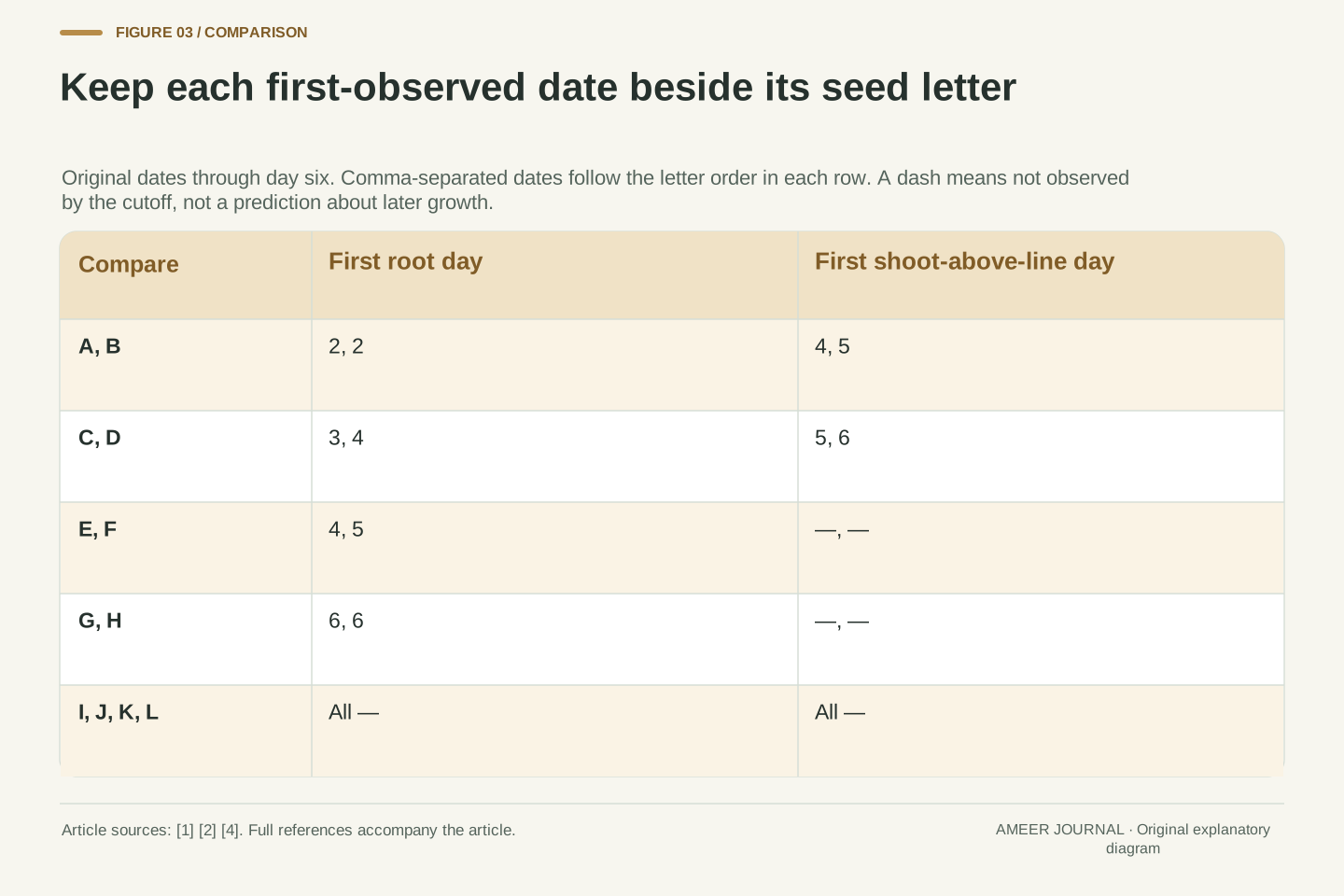
Read the first-root dates in pairs. A and B first receive R marks on day two. C receives one on day three. D and E receive theirs on day four, F on day five, and G and H on day six. I, J, K and L have no R mark recorded by the end of day six. That is eight named records with the mark and four without it at the cutoff. The letters make it possible to follow a particular record instead of counting an unfamiliar drawing again.
The S dates are different: A first crosses the drawn surface on day four, B and C on day five, and D on day six. E through L have no S observation by day six. Keep all twelve records in the starting group, including those without a mark. Iowa State explains a germination percentage using the number germinated divided by the number tested [4]. In our paper version, the matching idea is the number meeting our chosen rule divided by the twelve records we started with. Removing the quiet rows would change the question.
The fixed cohort is N = 12 with identifiers A–L. The recorded first-R dates are A:2, B:2, C:3, D:4, E:4, F:5, G:6 and H:6. I–L have no R observation through the day-six cutoff. The first-S dates are A:4, B:5, C:5 and D:6; E–L have no S observation by that cutoff. A missing event date in this complete fictional diary means not observed by day six, not that the record was lost.
These identifiers preserve individual membership across checks. Each first-event date belongs to one seed record, and no record joins or leaves the cohort. Iowa State's count-over-tested-count explanation provides the fraction principle [4]; here the denominator is the stipulated twelve-record cohort. The supplied dates are descriptive inputs, not outputs of a biological model. In particular, the absence of an R or S date supplies no later outcome, and the root criterion does not silently become a normal-seedling criterion when a percentage is calculated.
New today and seen by today are different counts
On day four, two records receive their first R mark: D and E. But five records have received an R mark by then: A, B, C, D and E. Both answers are right. Two answers “How many new ones today?” Five answers “How many different ones so far?” You can check by pointing to the letters. A and B do not become two new seeds every time their earlier marks are shown in another day's diary entry.
From day two through day six, the new-root counts are 2, 1, 2, 1 and 2. Adding them gives eight different records. The running totals are 2, 3, 5, 6 and 8. Adding those totals gives 24, but it counts some of the same seeds repeatedly. For example, A appears in every running total from day two onward. Twenty-four is not the number of seeds that met the rule in a twelve-seed diary. Use the final running total, or add the new counts once each, depending on how the information is written.
Let n(t) count records whose first-R observation is on day t, and G(t) count records whose first-R observation is no later than t. For days two through six, n = (2,1,2,1,2) while G = (2,3,5,6,8). The defining relation is G(t) = Σ n(u) for u≤t. In particular, n(4)=2 and G(4)=5. The cumulative record refers to having met the criterion by a date, not to a fresh count of new events on every date.
Summing the daily increments yields Σn(t)=8. Summing the cumulative entries instead yields 24 because each earlier event contributes repeatedly: A and B appear five times each, C four times, D and E three times each, F twice, and G and H once each. Those appearances sum to 24, but the distinct identifiers remain eight. Dividing that repeated total by twelve would produce 200 percent, which is not the cumulative fraction meeting this single first-event criterion. The error lies in aggregating repeated memberships as if they were different seeds.
Day six can have eight root records and four surface records
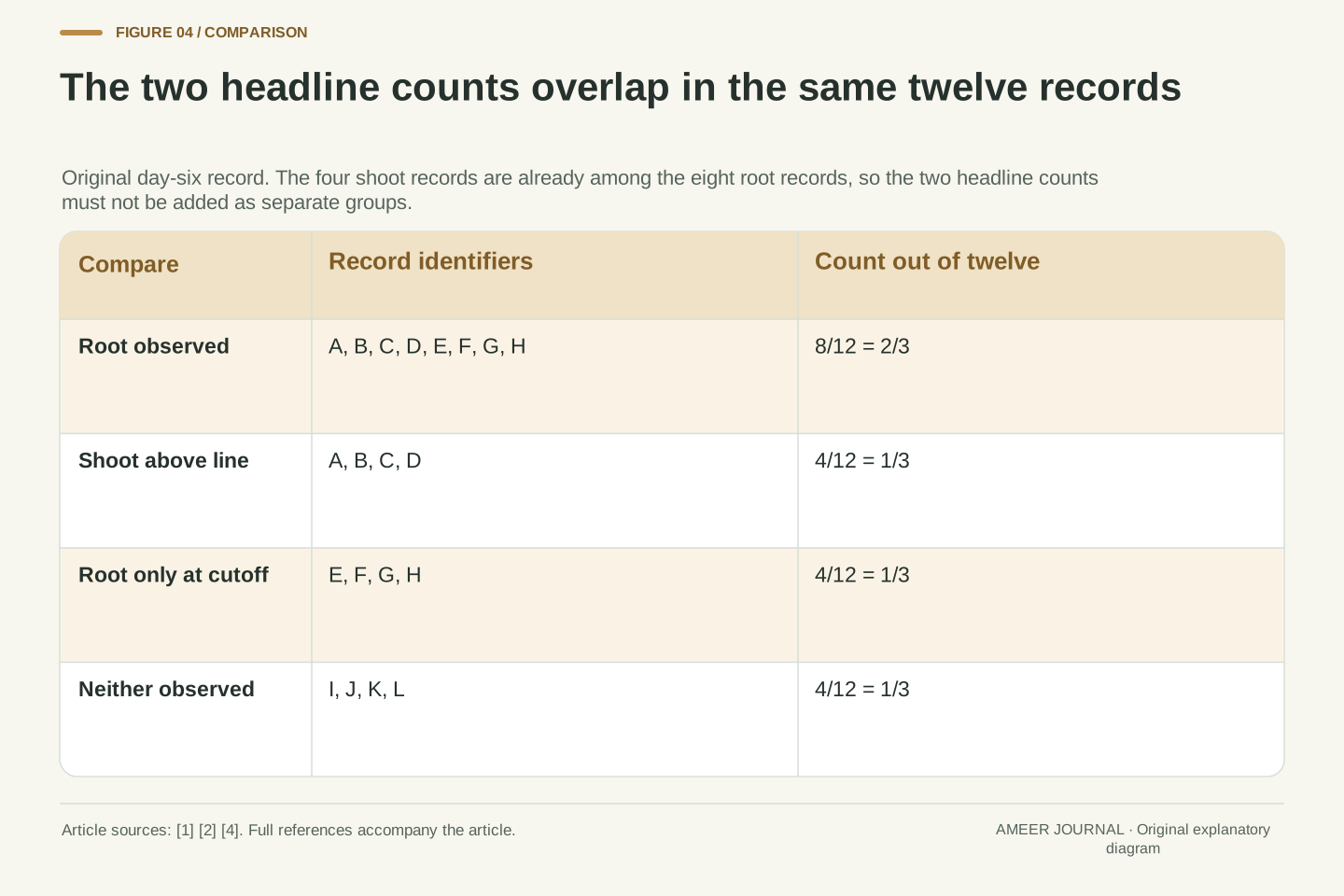
At the day-six cutoff, A through H have R marks, giving eight out of twelve, or two thirds. Only A through D have S marks, giving four out of twelve, or one third. The diary does not disagree with itself. It records two milestones. E, F, G and H have a first-root observation but no above-surface shoot observation yet. I, J, K and L have neither observation by that date. Together, those three non-overlapping groups contain all twelve records.
Be careful when adding the two headline counts. The four S records are already among the eight R records. Eight plus four would count A, B, C and D twice. If the question is “How many records have at least one of these marks?”, the answer is eight in this diary. If the question is “How many have both?”, the answer is four. The biological distinction between a root leaving the seed and a shoot emerging from soil explains why naming the observed feature matters [1][2].
At t=6, the cumulative root set is R6={A,B,C,D,E,F,G,H}, while the surface-emergence set is S6={A,B,C,D}. Thus |R6|/12=8/12=2/3 and |S6|/12=4/12=1/3. The overlap has four records, R6 minus S6 has four, and the complement of their union has four. The partition into both, root-only and neither therefore gives 4+4+4=12. These are exact properties of the supplied record.
The two marginal counts cannot be added as disjoint groups because S6 is contained in R6 here. Their union has 8+4−4=8 records and their intersection has four. This is a counting consequence of the specific diary, not a proof that every possible measurement of root and shoot appearance must produce nested sets. The botanical sources distinguish the relevant features [1][2]; the original record establishes which fictional seeds have which features at the chosen cutoff. Changing that criterion or cutoff requires recalculating the corresponding set.
Not observed by day six is different from never
Imagine that each diary check happens at the same time every day and correctly records the drawn features. C has no visible-root mark at the day-two check and has one at the day-three check. We know the change happened after the earlier check and by the later one. We do not know its exact moment. The number three labels the first check that found it. It is not a stopwatch reading for the start of every internal change in the seed.
Likewise, no R mark for I through L by day six does not tell us that those seeds could never grow. A real seed's development depends on its condition and environment. Dormancy can prevent a viable seed from germinating until additional requirements are met [1][2]. But the absence of a mark does not prove dormancy either. Our diary simply leaves the later outcome unknown. A careful sentence says what was seen and when, without turning a short observation window into a final story about the seed's life.
Assume complete, correct observations at matched daily times. For C, absence at t=2 and presence at t=3 places the visible R event in the interval (2,3]. Its first-observed date is three, while the exact time within that interval is unresolved. No inference is made about the onset of internal metabolism before the visible criterion. Observation schedules and biological event times are therefore different parts of the record.
The four unobserved R events at day six have no supplied later date. Viability means potential to germinate, whereas dormancy concerns nongermination in viable seed; NC State makes those distinctions [2]. UMN also discusses dormancy and differing requirements [1]. Absence within the recorded window identifies neither nonviability nor dormancy and supplies no guarantee of eventual germination. The diary's finite statement is narrower: no R observation for those four identifiers by the cutoff. Preserving that limit avoids replacing an unresolved future with an unsupported biological diagnosis.
A smaller sprout count can be a larger share
Try a separate paper comparison. Group Red has eight records meeting the same rule out of twelve. Group Blue has six out of eight. Red has the larger raw count because eight is more than six. Blue has the larger share: six out of eight is three quarters, while eight out of twelve is two thirds. With a grown-up, compare the fractions using twenty-four equal places on a drawing. Two thirds covers sixteen of those places, while three quarters covers eighteen.
The different answers are not a trick. “Which group has more?” and “Which group has a larger fraction?” ask about different quantities. Iowa State's fraction rule keeps the starting total visible [4]. Nothing in this imaginary comparison tells us why the groups differ, whether a treatment helped, or how a future group would behave. We have supplied only counts and totals at a common cutoff under one rule. The careful conclusion is that Red has more matching records and Blue has the larger matching fraction in this constructed example.
In a separate invented comparison, group A has 8/12=2/3 meeting the criterion, while group B has 6/8=3/4. The raw counts satisfy 8>6, but the fractions satisfy 2/3<3/4. Expressed over a common denominator, they are 16/24 and 18/24. Their difference is 1/12, or 8⅓ percentage points. The comparison assumes the same stated observation criterion and cutoff; otherwise even this descriptive fraction comparison would change its meaning.
The arithmetic follows the count-over-original-total principle [4]. It does not establish a treatment effect, seed-lot quality, vigor, sampling uncertainty or a population probability. NC State distinguishes vigor from a germination count under specified conditions [2], providing another reason not to let the larger fraction stand in for every possible performance claim. No random sampling or intervention was performed. These original counts demonstrate a denominator effect: more matching records in absolute terms can coexist with a smaller share of the group being considered.
An unreadable row needs its own label
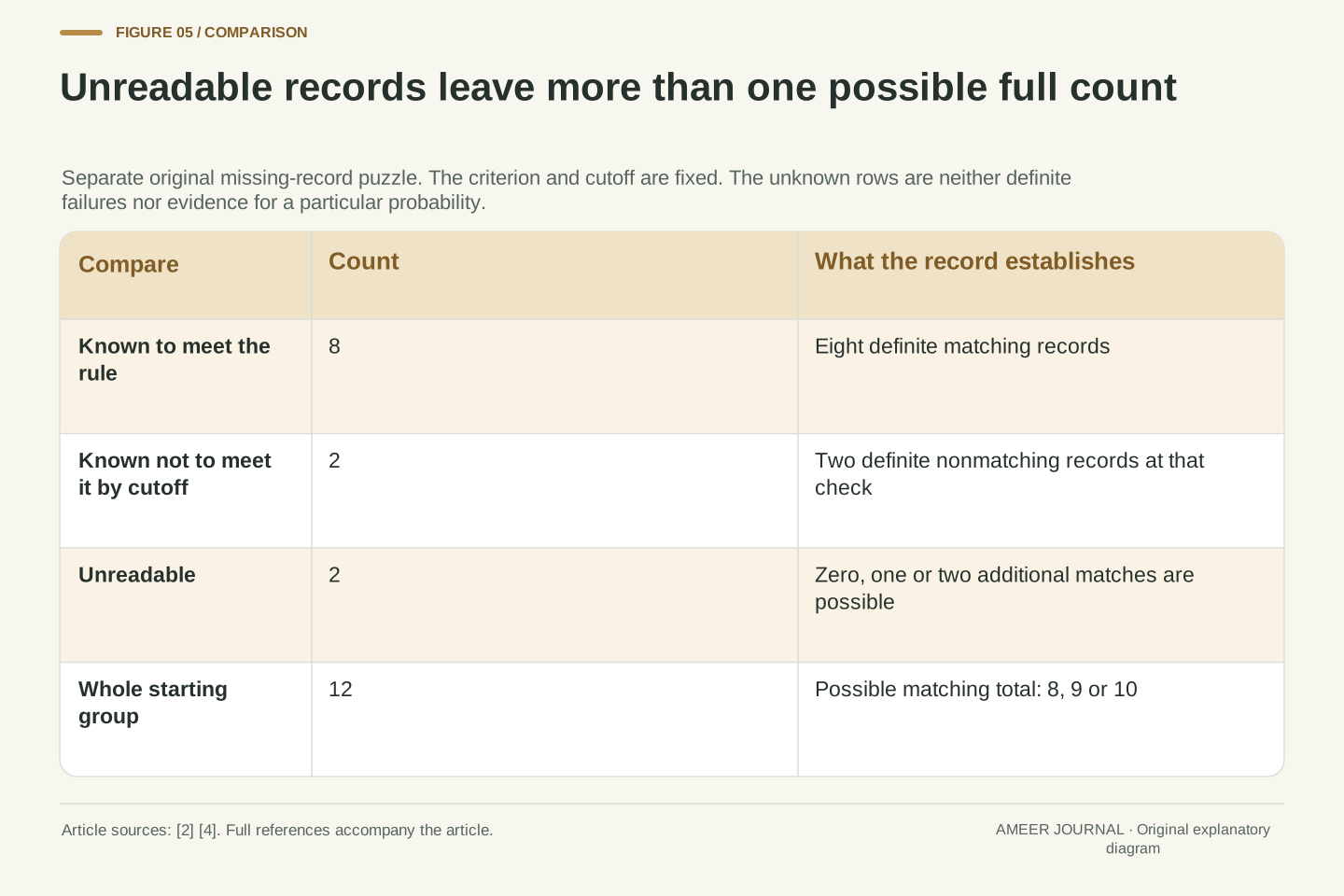
Here is a new puzzle with a different twelve-record sheet. Eight rows clearly say that the chosen root rule was met. Two clearly say it was not met by the cutoff. The last two rows cannot be read. Do not turn those unreadable rows into two definite no answers. They might add zero, one or two matching records. The full twelve-record count could therefore be eight, nine or ten. The page does not contain enough information to choose one of those totals.
Among the ten readable rows, eight meet the rule, so eight out of ten is a correct description of that smaller readable group. It is not automatically the fraction for all twelve. Those are different denominators. In the earlier main diary, every row was readable and an empty event date meant “not observed by day six.” In this separate puzzle, the unknown rows have genuinely missing information. Giving unknown its own mark keeps the two situations apart and makes it clear which question the available evidence can answer.
Define a separate twelve-record dataset with eight known positive records, two known negative records at the cutoff and two unresolved records. Under the stipulated binary criterion, the full-cohort count can be 8, 9 or 10. The corresponding fractions are 2/3, 3/4 and 5/6. The interval from 8/12 to 10/12 expresses logical possibilities allowed by these missing records; it is not a statistical confidence interval or a probability assignment.
Restricting to readable records gives 8/10=0.8, or 80 percent. That conditional descriptive fraction does not identify the full-cohort fraction. Treating both unknowns as failures or silently excluding them would impose an additional rule not supplied by the record. The main diary's complete observations and this puzzle's unreadable rows must also remain distinct. The count-over-total principle [4] requires naming which total is being used; it cannot recover missing statuses. No assumption about why the records are missing is introduced here.
A first-root mark is not every kind of germination test
A seed guide may use the word germination while asking for more than our little R mark. The University of Florida's plant-propagation teaching material describes standard germination in terms of seeds producing normal seedlings under suitable test conditions [3]. NC State likewise explains that necessary seedling structures matter [2]. Our diary does not examine all those structures. Its eight R records mean eight first-root observations by day six under our rule, not eight seedlings that passed an official assessment.
A timing number needs a label too. The eight first-root dates add to 32: 2 + 2 + 3 + 4 + 4 + 5 + 6 + 6. Dividing by eight gives an average first-observed day of four for those eight records. It does not give the average for all twelve, because four event dates are still unknown. A percentage, an average date and a judgement about a normal seedling each answer a different question. Keeping the name of the question beside the number helps the reader use it fairly.
UMN uses radicle emergence as a common observable germination measure [1]. By contrast, the UF-led teaching module describes standard germination as the percentage producing normal seedlings under optimal conditions, and NC State discusses the necessary seedling structures [2][3]. These source-specific descriptions must not be collapsed into one endpoint. The original R criterion is deliberately narrower. The article neither reproduces an official protocol nor makes a current certification or legal-labeling claim.
Timing summaries require equally explicit selection. For the eight observed R dates, the sum is 32 days and the arithmetic mean is 32/8=4 days. This is the mean first-observed date among the eight records with an event by the cutoff. It is not an all-cohort germination time, an exact mean biological onset time, or a growth-speed measurement. The unresolved event dates for I–L and the daily observation intervals remain relevant. A precise arithmetic result cannot enlarge the set of observations or replace the event definition on which it depends.
Build a sentence that another reader can check
Invite your reading partner to ask four diary questions. How many first-root marks were new on day four? Two: D and E. How many different records had a root mark by then? Five: A through E. How many had a shoot above the line by day six? Four: A through D. How many records were in the starting group for every one of those questions? Twelve. Take time to point to the relevant letters; there is no race and no need to compare readers' scores.
Now make one complete sentence: “By the day-six check, eight of the twelve imaginary seed records had shown a root outside the seed covering.” It names the date, count, starting total and feature. A second sentence can say that four of twelve had shown a shoot above the drawn surface. For the missing-row puzzle, add that two statuses are unknown. Your page can stay with you. A good plant detective does more than find a number: they show what was counted, what the record supports, and which questions still need information.
A reproducible statement identifies the cohort, criterion, numerator and cutoff. For the main record, report that eight of twelve fictional seed records met R by the day-six observation, and four of twelve met S. For day four, distinguish the two new R events from the five cumulative R events. The identifiers allow another reader to reproduce each count directly, while the separately stated event definitions keep the biological interpretation attached to the data [1][2].
An adult reading partner can use the questions without collecting a child's name, location, photograph or performance history. The activity consists entirely of reading, pointing or making marks on uncut paper; the provided diary is complete enough to solve it. Preserve the separate status of the comparison groups and missing-record puzzle rather than treating them as one experiment. The useful result is a disciplined observation sentence: a dated fraction with a named feature and an honest account of what remains unresolved, rather than a percentage that appears to explain every part of seed development.

Sources & further reading
Explore the references behind this guide. External pages may change after our review.
- 2.2 Introduction to Seed Germination – The Science of PlantsUniversity of Minnesota Libraries Publishing · Accessed 7 Nov 2026
- Seed and Seed Quality | NC State Extension PublicationsNC State Extension · Accessed 7 Nov 2026
- Seed Technology and Testing, Standard Germination TestUniversity of Florida / University of Kentucky / Texas A&M University plant propagation teaching project · Accessed 7 Nov 2026
- How to Store Seeds and Test Germination Rates | Yard and GardenIowa State University Extension and Outreach · Accessed 7 Nov 2026
Article updated 7 Nov 2026.