What you’ll take away
- An eye site can contain a cluster of buds; a bud and a later developed sprout are different units.
- The original inventory has five eyes and eleven bud symbols, with no assigned future growth outcome.
- Dormancy and apical dominance describe growth states, not the disappearance of eye sites.
- Physiological age depends on more than elapsed calendar time.
- The two paper records each have three terminal tips, but their tuber-bud origins number one and three.
- Name the structure and state being counted before interpreting a total or forecasting growth.
Five eyes does not promise five future sprouts
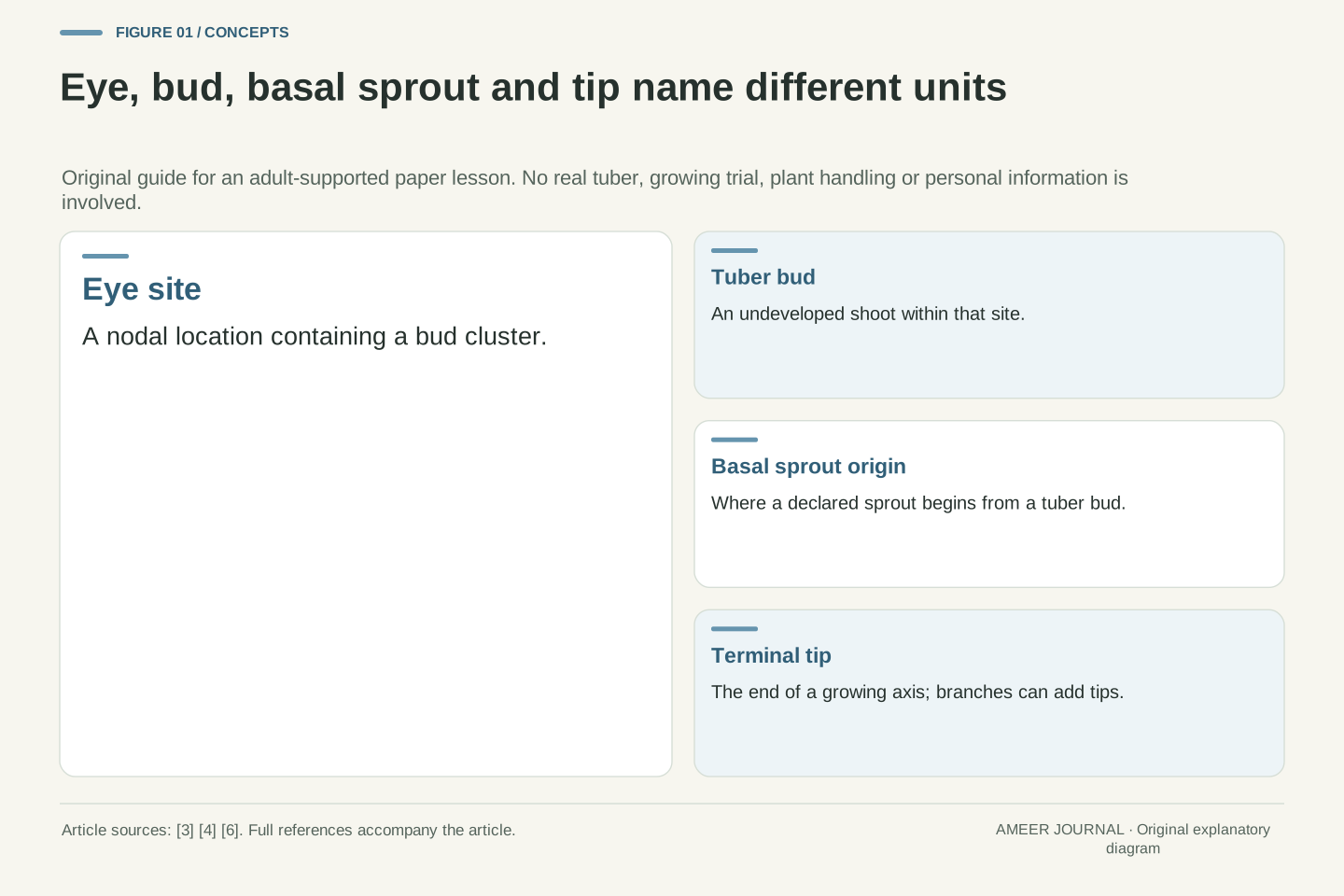
A potato drawing has five eyes. Does that mean it has five buds, or that it will grow five sprouts? Neither answer follows from the eye count alone. An eye is a site that can contain a cluster of buds. A bud is an undeveloped shoot, while a visible sprout is a later growth state. Those are different things to count [3][4].
Our first drawing gives five eye sites eleven separate bud labels. Later, we will compare two imaginary growth drawings that each have three tips, although their sprouts connect back to different numbers of tuber buds. The puzzle is to keep the larger groups, smaller structures and later growth patterns separate. There is no real sprouting trial behind these assigned drawings.
Read with an adult and use the on-screen illustrations or an uncut sheet of paper. No potatoes, other plants, seeds, tools, water collection, heating, chemicals, cooking or tasting are needed. Nothing is submitted or shared. The lesson is about what a labelled picture and a biological description let us say, including what they cannot predict.
Potato eye sites, buds contained within those sites, developed basal sprouts and terminal tips are distinct counting units. Oregon State describes the eye as a nodal site with a cluster of buds [3]. CFIA relates future stem production to eye number and physiological age [4]. Neither description establishes an unconditional one-eye/one-bud/one-sprout correspondence.
The original fixture specifies five eye groups containing eleven uniquely labelled tuber-bud symbols, followed by two separate, explicitly invented branching records. It is a finite structural exercise, not a plant experiment, population estimate or growth model. The biological explanation introduces dormancy, apical dominance and physiological age only to explain why anatomical presence does not by itself determine a future count [6][7].
An adult supports private reading, pointing or drawing on uncut paper. No specimens, planting, sprout manipulation, heating, chemical treatment, food handling, accounts, names, locations or photographs are involved. The article does not infer food safety or viability of an unknown tuber. Its main question is which structural unit and growth state a reported number actually describes.
Place the eye on the right plant structure
The potato tuber is a swollen underground stem. It develops with an underground stem branch commonly called a stolon [1][4]. Its eyes belong to the tuber’s nodal organization: nodes are places on a stem associated with leaves or buds. This short piece of anatomy explains why we are discussing shoot buds on a tuber, rather than treating every surface mark as an eye.
In our illustrations, the labels supply that identity. We do not identify an unknown object from its outline or ask anyone to inspect real plant material. A bud label names a known structure in the teaching diagram. A dot without a key would not tell us whether it represented a bud, a scar or something else.
The expression seed potato can also cause confusion. It may refer to a vegetative tuber used in farming, rather than a botanical seed from a fruit [4]. Our diagrams concern buds on a stem tuber. They are not a seed-germination diary, and they do not give a schedule for growing a new plant.
A potato tuber is modified stem tissue formed by swelling of an underground stem branch, commonly termed a stolon [1][4]. Its nodal eyes belong to that stem organization. This provides the anatomical setting for the count problem, without repeating a full root-versus-stem classification exercise. The argument assumes the object is already identified as a potato tuber.
Each symbol in our fixture is assigned a structure by its label. No image-recognition rule converts arbitrary surface marks into nodes or buds. In particular, an unlabelled bump is not sufficient evidence of a bud, and the drawing is not an inventory of all tissues in a real tuber. The assigned boundaries exist to make the eye–bud relation inspectable.
Seed potato is a vegetative agricultural term in the cited species description, distinct from true botanical seed [4]. Therefore the word seed does not make these tuber-bud records equivalent to seed-germination observations. We track neither the radicle emerging from an embryo nor a cohort’s germination dates. The counted structures are specifically nodal eye sites and their contained tuber buds.
One eye site can contain more than one bud
The little sites called eyes are the potato’s nodal places. Oregon State’s account explains that an eye contains a cluster of buds [3]. A bud is an undeveloped shoot. It is a small organized growing structure, not simply an empty hole. CFIA also describes the eyes with their buds and scale-leaf scars, connecting them to the tuber’s stem organization [4].
Keep three ideas separate: the eye site, the individual buds within that site, and a shoot that develops later. Counting a site once does not tell you how many buds it contains. Counting buds also does not tell you how many shoots will develop. Those are different questions, and the last one needs information about later growth and conditions.
Our inventory drawing uses an outlined group for each eye and smaller labelled symbols for its buds. The outlines are a teaching key, not a claim that a real potato has neat circles around its eyes. They let us see the two counting levels clearly. An adult can point to a group first, then to the smaller symbols within it.
An eye is a nodal site bearing a bud cluster, rather than necessarily one individual bud [3]. CFIA describes axillary buds and associated scale-leaf scars on the tuber surface [4]. These morphological relationships support stem identity. An eye should not be interpreted as a sensory organ, a mere depression or a universal one-to-one synonym for a single future shoot.
The bud is an undeveloped shoot structure; the extension account describes a vegetative bud as a short stem with embryonic leaves [3]. That definition is anatomical. It does not guarantee that every small constituent structure will be visible in a schematic drawing, nor that every bud will initiate visible growth under unspecified conditions. The site, its contained buds and later developed shoots remain distinct units.
Our fixture represents each eye by a group boundary and each bud by a unique internal symbol. These boundaries are graphic devices, not additional plant tissues. A containment relation associates each symbol with one eye in the model. The counts that follow are therefore exact properties of a labelled finite drawing, with no claim that the assigned bud numbers are typical of potato cultivars.
Five groups and eleven symbols answer different questions
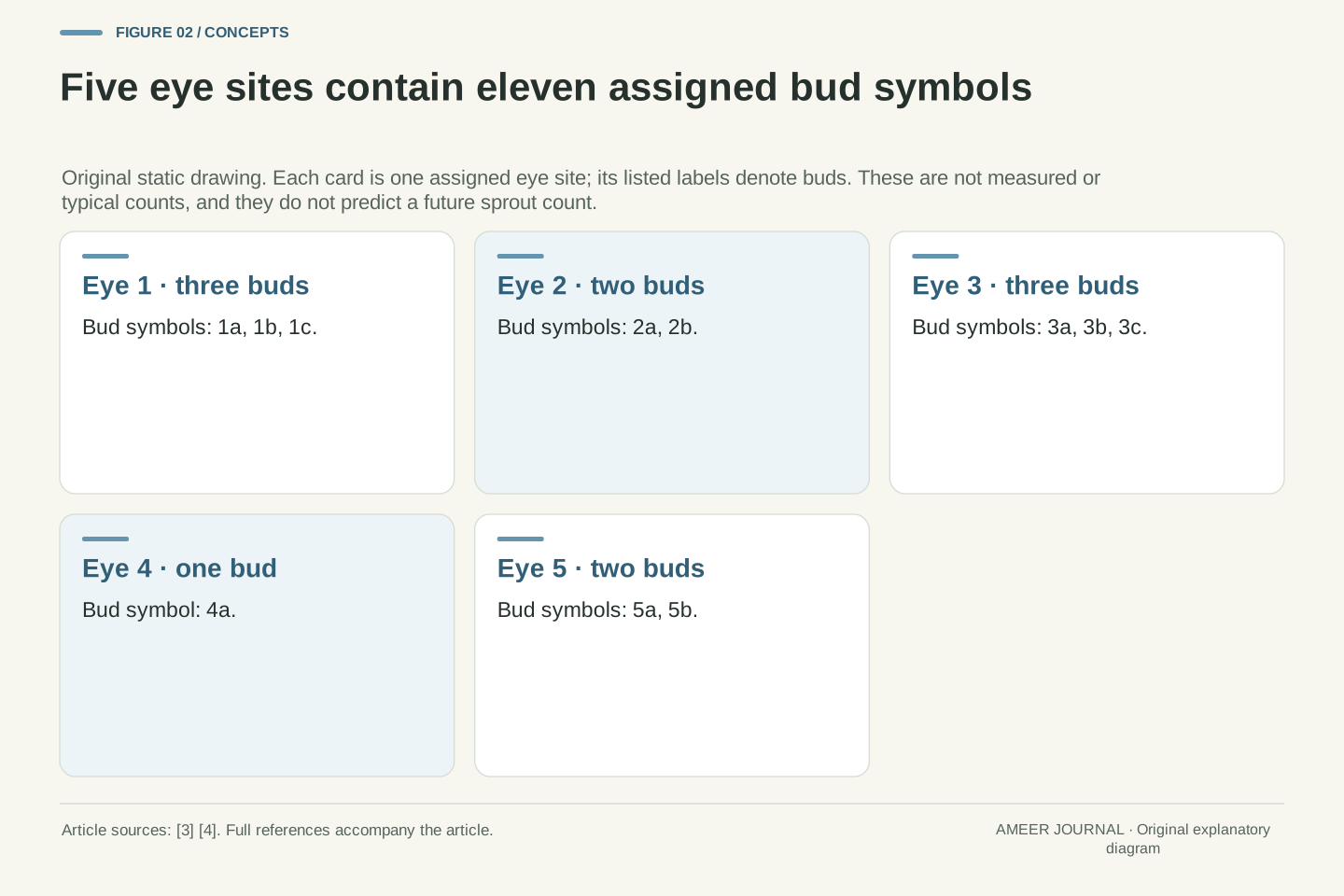
Give the drawing five eye sites, named Eye 1 through Eye 5. Put three bud symbols in Eye 1, two in Eye 2, three in Eye 3, one in Eye 4 and two in Eye 5. These are numbers chosen for this lesson. They are not a rule for the number of buds in a potato eye.
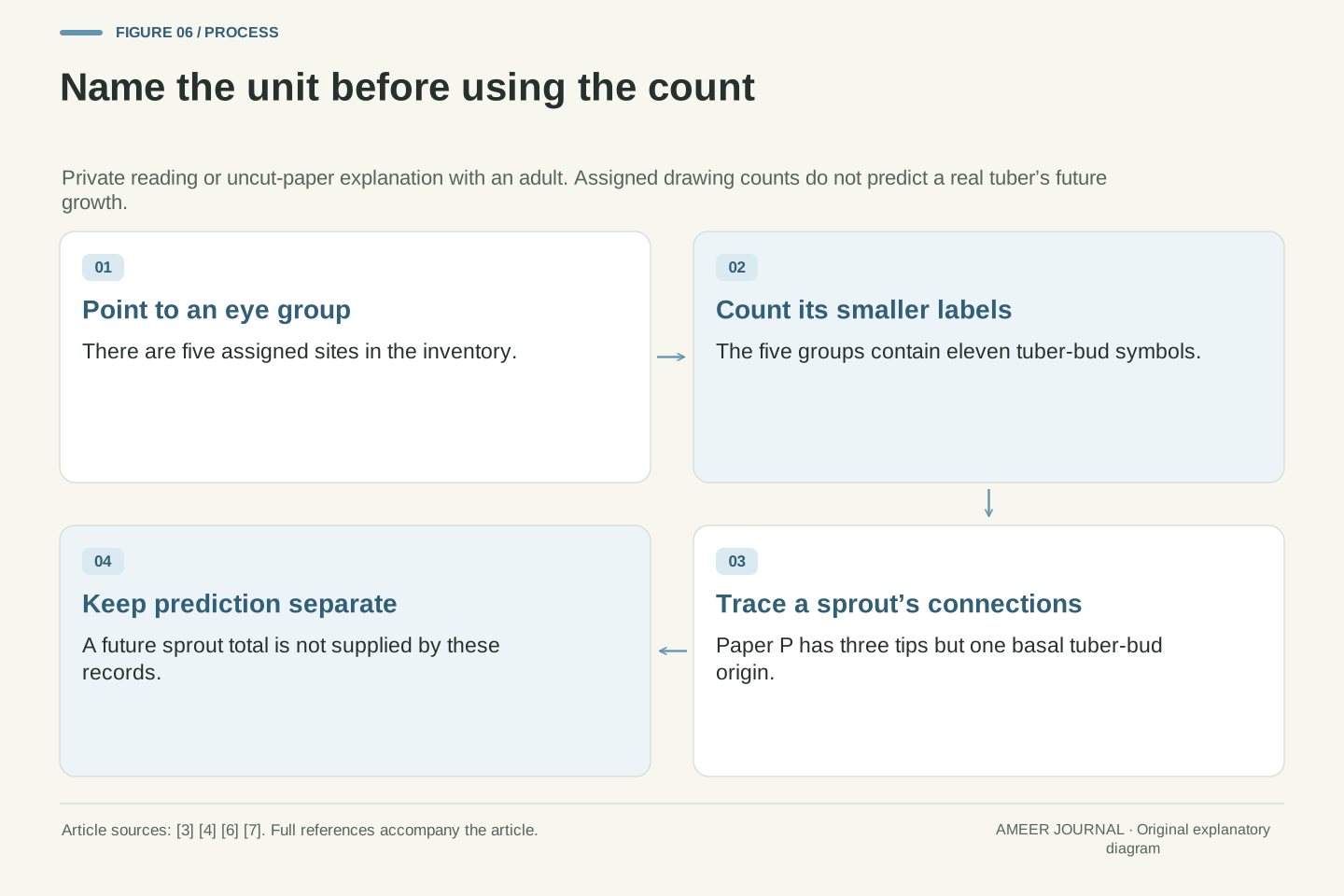
If the question is how many eyes, count the five group labels once each. If the question is how many buds, add the symbols inside the groups: 3 + 2 + 3 + 1 + 2 = 11. The drawing contains five eye sites and eleven bud symbols. Calling the eleven symbols eleven eyes would mix up the smaller structures with their containing sites.
An adult can also show the average: eleven symbols divided among five sites gives 2.2 symbols per site. No eye in the drawing contains a fraction of a bud. The average summarizes unequal whole-number groups. It does not replace their individual counts, and none of these numbers predicts how many shoots a real potato will grow.
Define five distinct eye groups E₁ through E₅ with cardinalities (3,2,3,1,2). Each bud symbol has a unique identifier and belongs to exactly one group. The union therefore contains 3+2+3+1+2=11 symbols, while the set of eye groups has cardinality five. The two totals refer to different levels of the stipulated containment structure.
The arithmetic mean group size is 11/5=2.2 symbols per eye. This exact mean does not imply fractional buds, equal group sizes or an empirical average across potato plants. For example, Eye 4 still contains one symbol and Eye 1 still contains three. Averaging has summarized the displayed group sizes without altering any group’s membership.
The biological evidence supports distinguishing an eye site from its clustered buds [3][4]; it does not supply these five assigned sizes. Nor is a one-to-one mapping from bud symbols to eventual shoots part of the fixture. The exercise is a static nested count, not a dated sprouting record, a propagation trial, an estimate of bud viability or a model of stem-number outcomes.
A structure can be present before it visibly grows
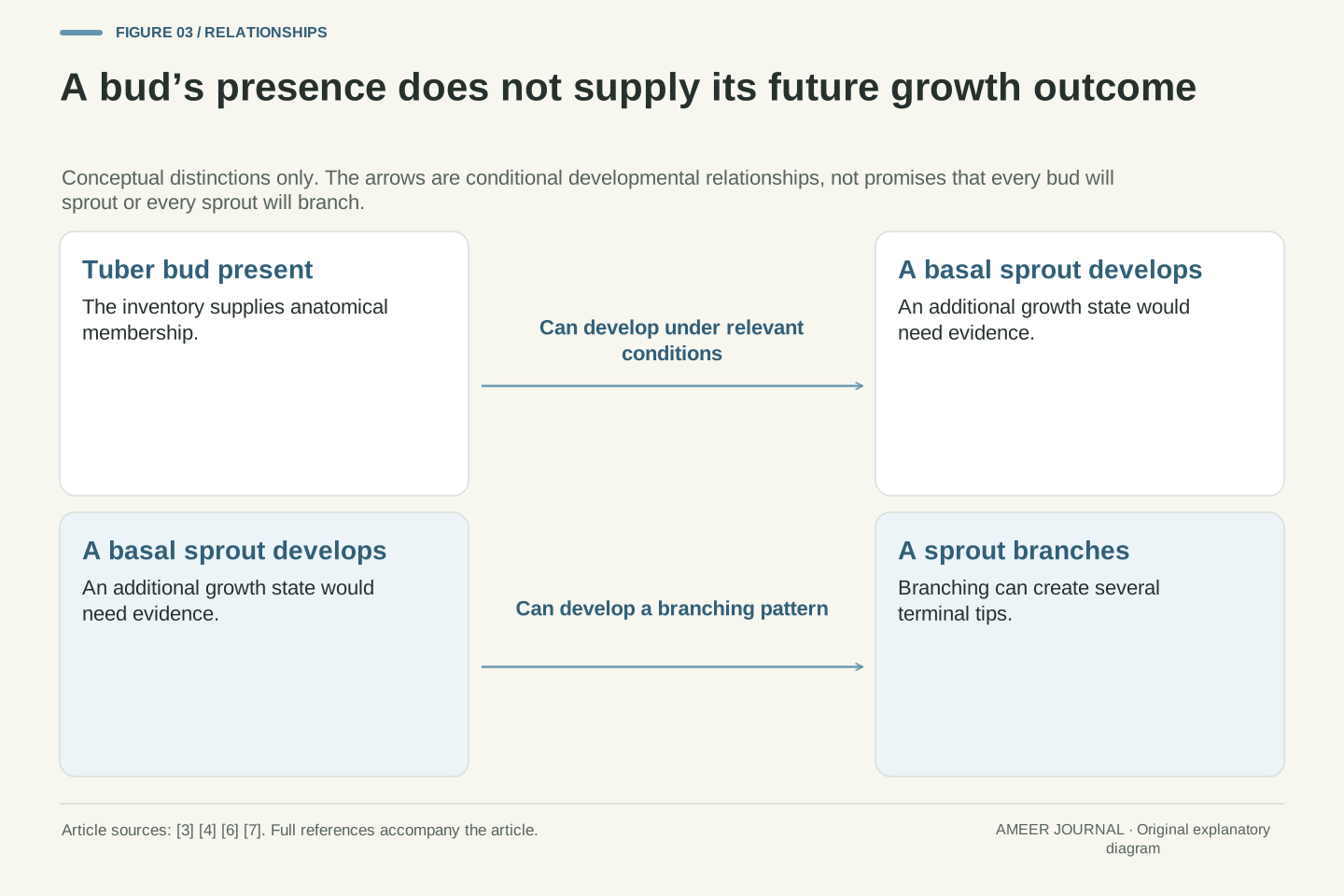
Our five groups tell us where eleven bud symbols belong. They do not include any instruction saying which buds grow. A bud can be present while no elongated sprout is shown. A drawing that labels a bud is describing a structure; a drawing of its developing sprout describes an additional state. The extra state needs its own information.
This is a real distinction in potato biology, not just a rule for our pictures. The sources describe a dormant period and later sprouting patterns [6][7]. They also describe different numbers of stems from tubers of different physiological ages [4][6]. Counting eye sites does not supply all those missing conditions or tell us which particular buds will develop.
Suppose the label beneath the first drawing says only five eyes, eleven buds. The accurate answer to how many future sprouts is not specified. That does not mean zero sprouts will ever appear, or that every bud must eventually sprout. It means the current record contains no future outcome. We can give exact structural counts and still leave a later growth question unanswered.
Let the inventory specify the membership of tuber buds in eye sites. That inventory does not define an activation function assigning a future growth outcome to each bud. A visible basal sprout requires a developmental state beyond the statement that a bud exists. The fixture therefore supports exact eye and bud cardinalities while leaving future sprout count unspecified.
The retained biological sources provide concrete reasons to preserve that separation: dormancy, differing sprouting patterns and physiological-age effects [4][6][7]. They do not provide a deterministic mapping from our invented eleven-symbol inventory to a later observed count. No bud-viability assessment, environment, developmental history or observation outcome is supplied for an actual tuber.
Unknown is consequently an epistemic status of this record, not a biological verdict of zero growth or eventual universal growth. Nor do we establish a universal numerical upper bound from the eleven drawn tuber buds: subsequent branch buds and growth structures would require their own definitions. A prediction needs a specified outcome unit and evidence about the process connecting it to the initial inventory.
Dormancy is more than an empty growth picture
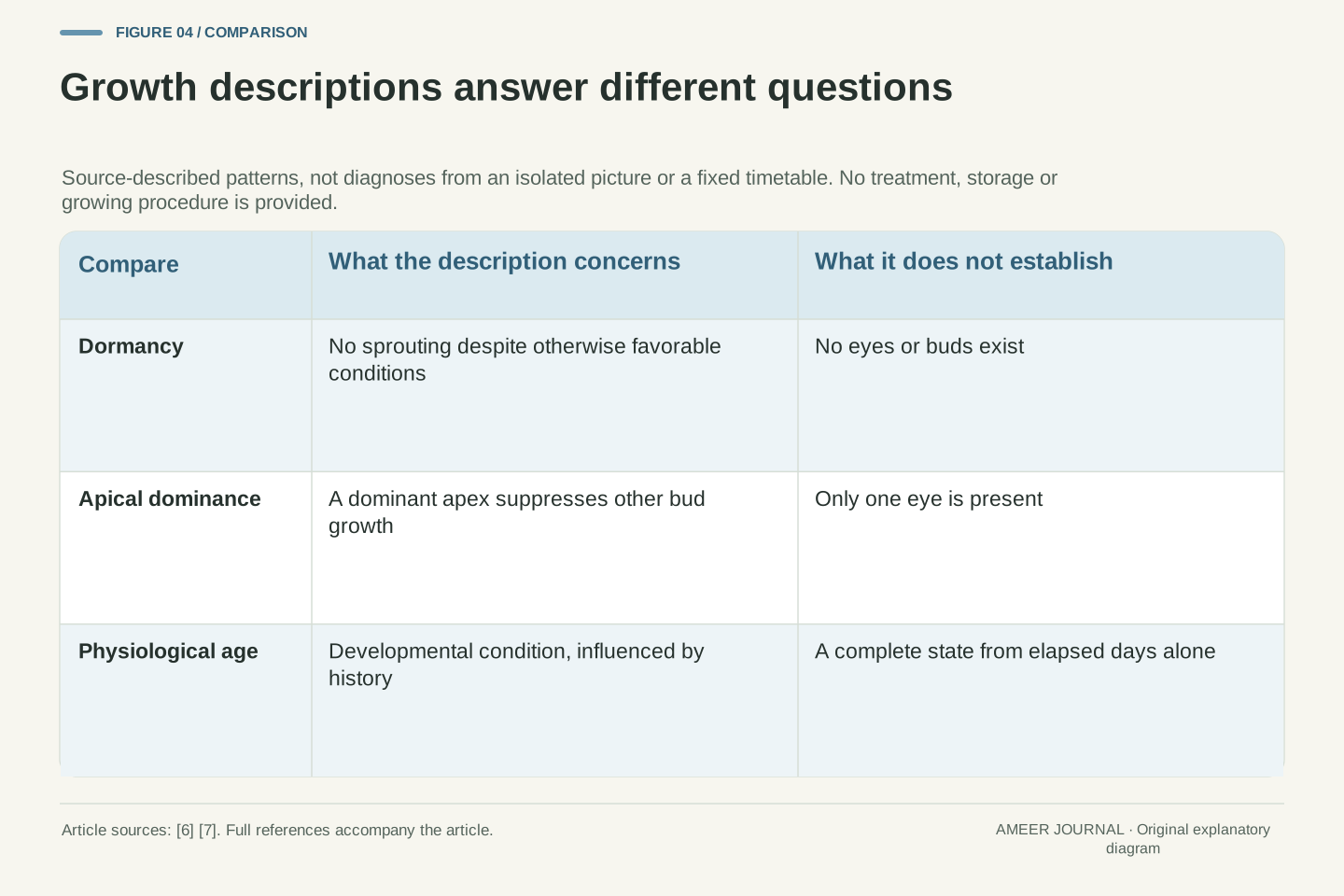
During the dormant period described by the sources, a potato tuber does not sprout even under conditions that would otherwise favor sprouting [6][7]. Its buds have not stopped being buds. Dormancy concerns their growth state, so the presence of eyes and buds does not require a visible sprout at that moment.
Use two different kinds of label in a paper explanation. Five eye sites names the structure drawn. Dormant names a biological state, if that state has actually been established. Neither label is a substitute for the other. A dormant tuber can still have the nodal structures discussed earlier; the word does not mean those structures have disappeared.
But do not diagnose dormancy from any picture showing no sprout. The picture may simply omit growth information, and a real situation could require other evidence. Our inventory drawing supplies no diagnosis at all. We are learning what the source’s term means, not testing whether a real potato is dormant, alive, healthy or ready to grow. There is no waiting experiment or fixed number of days in the activity.
The cited descriptions characterize innate or deep dormancy by failure to sprout even under otherwise favorable conditions [6][7]. This is a physiological state, distinct from the morphological presence of a meristem or eye. The article uses that defining contrast without adopting a complete hormonal mechanism, a universal dormancy duration or a method for inducing its release.
The implication is one-way: an established dormant state can explain lack of sprouting, but lack of a sprout in an unspecified picture does not establish dormancy. A growth observation, environmental limitation, missing information and an anatomical label are not interchangeable kinds of evidence. Our static inventory supplies only the anatomical labels and assigned group sizes.
No claim about viability or diagnosis of an actual tuber follows. The sources’ numerical storage conditions, chemical interventions and crop-management procedures are excluded from the lesson. We also avoid turning a historical description of an ageing assay into a claim that a single method is universally definitive today. The retained point is simply that a bud’s presence and its active elongation can be separated biologically.
One growing sprout does not mean only one eye exists
A second pattern is apical dominance. Nebraska’s extension description explains how a dominant growing eye or sprout can suppress sprouting from other eyes. INRAE also describes a phase with a single sprout at the tuber’s bud end [6][7]. The other eye sites have not been erased from the tuber just because one sprout is most noticeable.
This differs from the dormant state. In the dominance example, some growth is already occurring while other potential growth is suppressed. Later patterns can include several sprouts. The descriptions help explain why the number of visible sprouts can change without our first eye count having been a count of future shoots.
The word can matters. These are biological patterns, not a promise that every potato follows one identical timetable or that every picture with one sprout proves apical dominance. A diagram may show one sprout while leaving the rest of the object or its history unspecified. Keep the explanatory pattern separate from diagnosing a particular specimen, and do not turn it into instructions for changing how a potato grows.
Apical dominance describes inhibition of other bud growth associated with a dominant apex. In the tuber-level pattern described by Nebraska and INRAE, an apical sprout is prominent while sprouting from other eyes is suppressed [6][7]. This preserves a crucial distinction between the number of eye sites present and the number of elongating sprouts observed.
The pattern is not equivalent to innate dormancy of the tuber as described in the preceding section: growth is already expressed at the dominant location. The sources describe subsequent multiple-sprouting patterns as physiological state changes. We use the morphological distinction without asserting that a single hormone alone determines every outcome or that the documented stages form a universal clock.
A one-sprout image is insufficient by itself to identify the mechanism. Complete object coverage, developmental context and other evidence would be needed for a real interpretation. Nor does a pattern observed at the tuber level tell us whether every bud within one eye is equally active. The original drawing retains those smaller bud identities rather than collapsing the whole site into its most visible growth.
Physiological age is not just a date on a calendar
Two potato tubers can have spent the same number of days on a calendar without being in identical growth states. Nebraska’s description distinguishes physiological ageing from time alone and discusses the effects of variety and environmental history [6]. Physiological age is about the tuber’s developmental condition, rather than merely a birthday written beside it.
CFIA’s biology account says that stem number depends on both eye number and physiological age [4]. That gives a concrete reason not to replace a future stem count with an eye count. Even if two labelled drawings share five eyes, the drawings have not told us enough about later growth to promise five matching stems in both cases.
For this paper lesson, an adult can write same elapsed time above two unnamed tuber records. Then leave physiological condition as not supplied. The exercise does not claim the conditions are necessarily different; it shows that equality of one recorded quantity has not established equality of the other. We are not giving a storage recipe, estimating an age score or asking anyone to wait for real sprouts.
Physiological age summarizes developmental condition and responses rather than chronological elapsed time alone. The Nebraska source identifies genetic and environmental contributions, while CFIA relates stem production to eye number and physiological age [4][6]. These statements justify treating age information as a separate variable; they do not provide a calibrated predictor for the invented inventory.
The article does not equate different sources’ complete stage-counting conventions or impose one universal starting point for ageing. It also does not adopt the historical extension document’s heat-accumulation model, threshold temperature, assay procedure or market recommendations. Those would require additional operational context and are unnecessary to the eye-count question.
In the original paired records, equal elapsed time is the sole shared age-related datum. It neither establishes equal physiological state nor proves unequal state. Likewise, equal eye count leaves potential growth outcomes underdetermined. The useful conclusion is about insufficiency of the supplied variables, rather than a numerical correction factor or a claim that every same-age pair must develop differently.
A branch tip is not a new sprout base on the tuber
A growing sprout can branch. Nebraska’s account describes branching of sprouts as another growth pattern [6]. Once branches are present, counting the ends of the growth is different from counting the places where sprouts begin at the tuber. Several visible tips can belong to a connected growth structure with one basal origin.
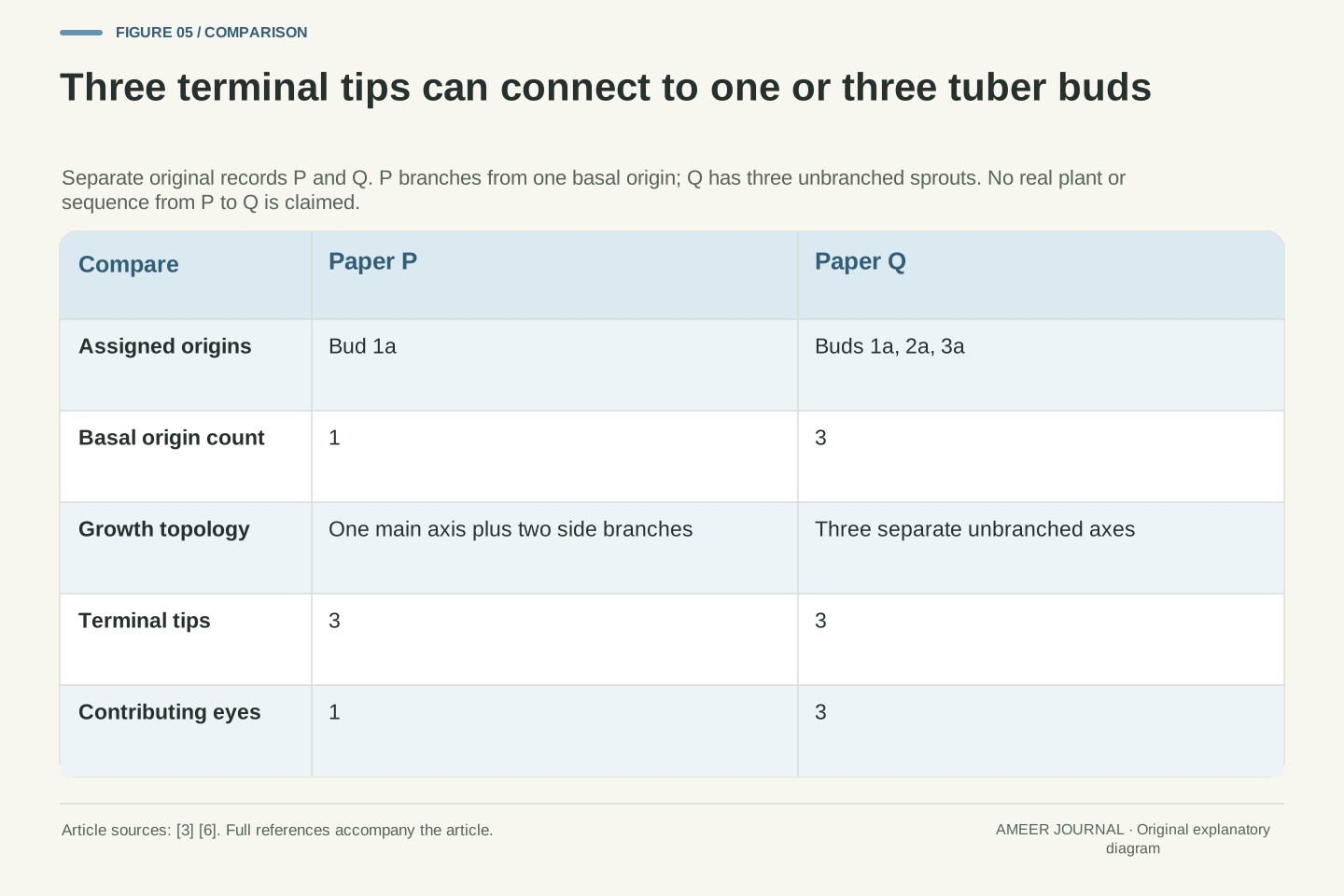
Our invented Paper P makes that distinction explicit. One basal sprout starts from bud 1a. Its main axis continues to one terminal tip, and two side branches each end at another tip. The drawing therefore has three terminal tips but only one labelled tuber-bud origin. The branches do not add new eyes to the original five-eye inventory.
The side branches have their own developmental structures on the growing shoot. They are not extra members secretly added to the eleven tuber-bud symbols. Trace the connections before counting: one tuber bud leads to one basal sprout in this declared drawing, and the later branch pattern gives three tips. Paper P illustrates a distinction; it predicts no real tuber’s shape.
Sprout branching introduces a second hierarchy beyond eye-site containment. Nebraska describes branching as a physiological growth pattern [6]. A terminal tip is not identical to an independent basal sprout origin at the tuber. Counts can diverge because branching occurs after an axis has originated, rather than requiring a new tuber eye for every terminal tip.
Define original record P with one declared tuber-bud origin, 1a. Its basal sprout continues along a main axis to tip P1 and bears two side axes ending at P2 and P3. Thus terminal-tip count is three, basal tuber-bud-origin count is one, and contributing eye-site count is one. The graph is stipulated and contains no measured lengths or time intervals.
Branch buds associated with the new shoot are outside the original eleven-symbol tuber-bud inventory. Keeping that boundary explicit prevents double use of the word bud from inflating the initial count. We do not infer a universal relation between total buds, branches and stems. The finite graph establishes only the three named counts for its supplied origin and branching topology.
Two drawings can have three tips for different reasons
Now compare Paper Q. It has three separate, unbranched basal sprouts, starting from buds 1a, 2a and 3a. Each sprout has one terminal tip. Paper Q therefore has three tips and three tuber-bud origins, spread across three labelled eyes. All these connections are supplied in the drawing rather than discovered in an experiment.
Paper P also had three tips, but only one tuber-bud origin and one contributing eye. The tip totals match while the origins differ. If someone reported only three tips, we could not choose between these two diagrams from that total alone. The missing information is how the tips connect back to the tuber.
This comparison does not say that Paper Q must follow Paper P later, or that they are two measured potatoes. They are separate possible teaching records with different assigned connections. Read the base labels and branches to distinguish them. Equal totals can describe different structures, and the appropriate explanation depends on which structure the question asks us to count.
Define independent record Q with basal origins at tuber buds 1a, 2a and 3a, one unbranched axis per origin and one terminal tip per axis. Q has three terminal tips, three basal tuber-bud origins and three contributing eye sites. It uses three of the already labelled buds; no typical biological frequency or growth outcome is assigned.
P and Q therefore share terminal-tip cardinality three while differing in origin cardinality, one versus three. The map from a complete connection graph to its terminal-tip total is many-to-one on this two-record fixture. That total cannot uniquely reconstruct basal-origin count. Reading the additional topology resolves the ambiguity, whereas repeating the same tip count does not.
This is a counterexample within stipulated paper records, not a fitted model of potato branching. The source supports the biological distinction between sprout origins and later branching [6], while every identifier and numerical count is original. No sequential transition from P to Q is claimed, and no direct comparison of cultivar performance, physiological-age scores or future crop productivity follows.
Give the number a unit and keep the future question open
An adult can ask four short questions about the paper records. How many eye sites are in the inventory? Five. How many tuber-bud symbols are inside them? Eleven. How many terminal tips are in Paper P? Three. How many labelled tuber-bud origins does Paper P have? One. Each answer is exact because its counting unit is stated.
Then ask a different question: how many sprouts will a real potato with five eyes produce? Our paper records cannot answer it. Dormancy, growth regulation and physiological condition explain why the structural count is not a complete forecast [4][6][7]. They do not turn our imaginary records into measurements of a particular plant.
Finish by connecting one explanation to one clue. Point to the eye group when saying eye, to an internal label when saying tuber bud, and to the end of an axis when saying tip. Trace back to the tuber when counting basal origins. This can remain a private conversation with no scores or uploads. The useful skill is keeping a visible total attached to the structure and growth state it actually describes.
A precise record names both the counting unit and the represented state. The assigned inventory yields five eye sites and eleven tuber buds. Record P yields three terminal tips from one basal tuber-bud origin; Q yields three tips from three origins. These statements are mutually consistent because their denominators of description and containment boundaries differ.
The biological sources establish that dormant, dominant, multiple-sprouting and branching patterns need not collapse into a single structural count [4][6][7]. They do not establish a probability distribution or a future growth map for our finite symbols. A real observation would require its own identity, state, coverage and measurement definition; this lesson supplies none of those for an actual specimen.
An adult-supported paper explanation can therefore separate anatomy, observed or stipulated growth, and prediction. The child can follow labels and connections without collecting plants or submitting information. The final conclusion is specific: neither eye count nor terminal-tip count alone determines all the smaller structures or earlier origins associated with it, and neither alone promises a future sprout total.
Sources & further reading
Explore the references behind this guide. External pages may change after our review.
- 1.3 Plant Parts we Eat – The Science of PlantsUniversity of Minnesota Libraries, The Science of Plants · Accessed 7 Nov 2026
- Vegetative plant parts | OSU Extension ServiceOregon State University Extension · Accessed 7 Nov 2026
- The Biology of Solanum tuberosum (L.) (Potatoes) - inspection.canada.caCanadian Food Inspection Agency · Accessed 7 Nov 2026
- Potato Tuber Aging in Storage (G2269)University of Nebraska–Lincoln Extension · Accessed 7 Nov 2026
- Potato - Sprouting disorders due to physiological ageINRAE, Ephytia Potato · Accessed 7 Nov 2026
Article updated 7 Nov 2026.