What you’ll take away
- A short pattern beginning can fit more than one rule; say which rule the question supplies or allows.
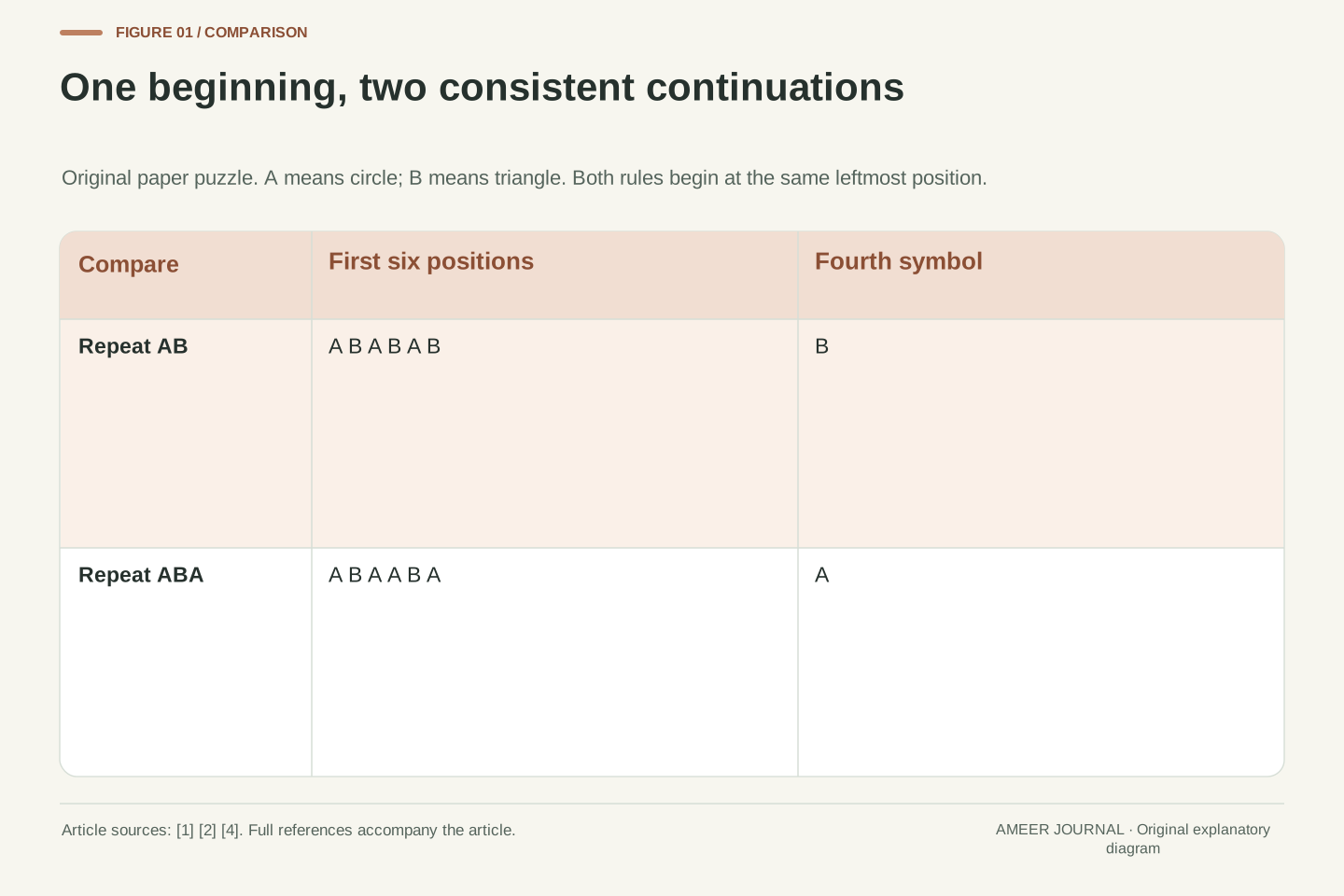
- Repeating AB and repeating ABA agree for three positions but predict different fourth symbols.
- Repeating ABAB can describe the same sequence as repeating AB, while AB is the smaller unit.
- For ABB starting with A at position 1, the first ten symbols contain four As and six Bs.
- Explain a continuation from its rule and starting point, rather than treating a few visible terms as a guarantee.
What comes next depends on what the rule says
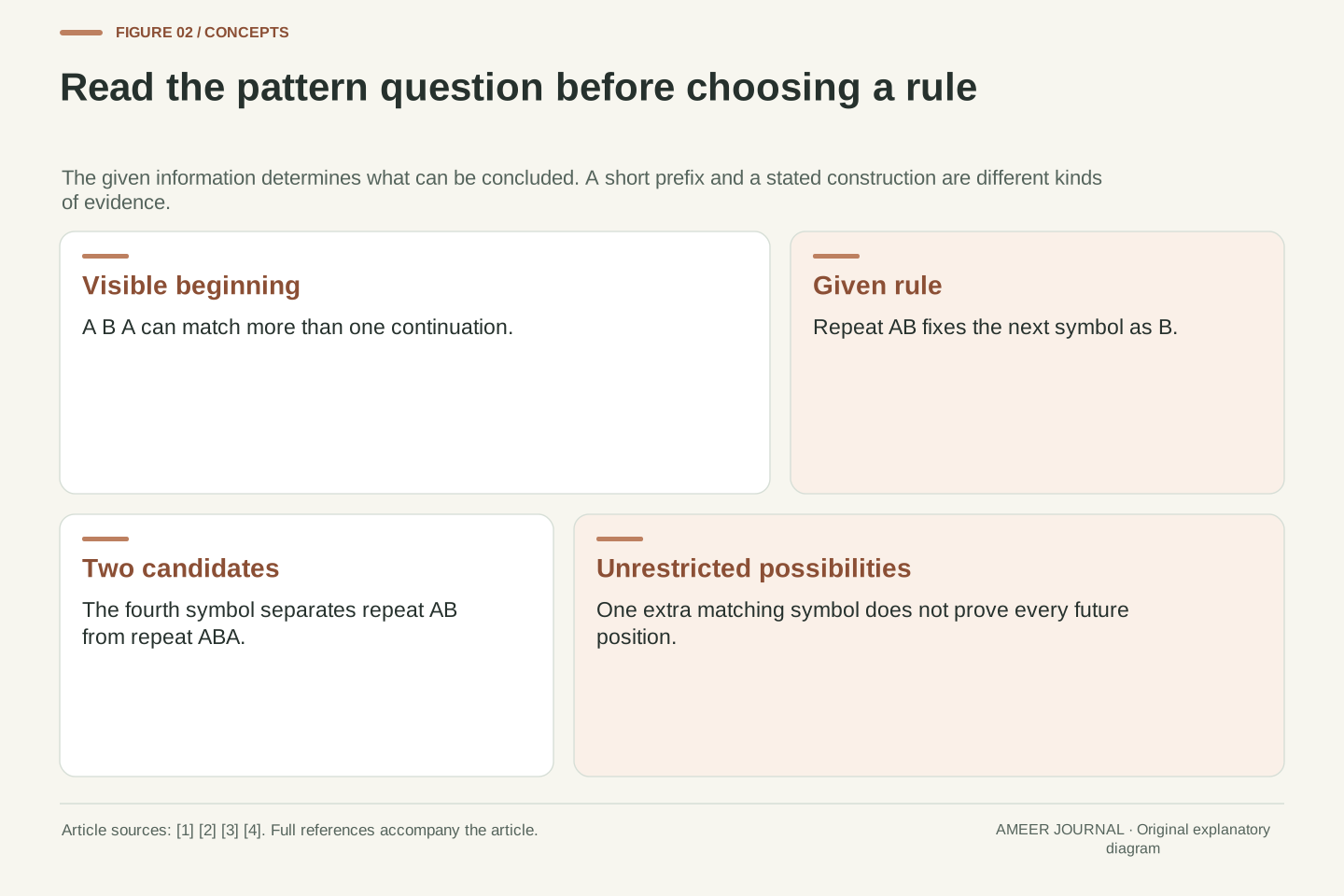
Look at three drawn shapes: circle, triangle, circle. What comes next? A triangle is a sensible answer if the rule is 'keep repeating circle, triangle'. But a circle is also sensible if the rule is 'keep repeating circle, triangle, circle'. Both rules fit the three shapes you have seen. They disagree about the fourth. The picture alone has left out a useful piece of information: how its maker intends the pattern to continue.
This article is a paper puzzle to read with a grown-up. You can point at the examples or draw them on one sheet; no loose objects, cutting, accounts or submitted answers are needed. We will compare clearly written rules, explain their predictions and check our counts. Educational guidance encourages children to describe a repeating unit and to explain why a pattern continues as it does [1][3][4]. NZCER also explicitly uses tasks where different rules continue a number pattern [2]. The aim here is to give a reason for an answer, including recognizing when more than one answer fits the information supplied.
A finite sequence of observations does not necessarily specify a unique continuation. Our original prefix circle, triangle, circle is consistent with at least two simple periodic rules: repeat the two-symbol unit circle–triangle, or repeat the three-symbol unit circle–triangle–circle. The fourth symbol differs. This is a concrete counterexample to assuming that a short displayed beginning determines one inevitable next item.
The activity uses adult-supported paper diagrams. We distinguish a rule supplied as part of a question from a rule inferred from examples. NCETM emphasizes identifying and describing repeat units, NZCER explicitly invites different continuation rules, and NRICH distinguishes noticing a pattern from explaining why a generalization is justified [1][2][3][4]. Technical mode introduces precise terms such as prefix, position and unit while keeping the same examples as Easy mode. No learning score or developmental diagnosis follows from a child's response. The purpose is to make the mathematical contract visible: what is given, which rule is being considered, and what that rule actually determines.
Give each repeating unit its own written rule
Let A mean a circle and B mean a triangle. These letters are shortcuts, not extra shapes. Rule One says: start at the left and repeat the unit AB. Its first six positions are A, B, A, B, A, B. Rule Two says: start at the left and repeat the unit ABA. Its first six positions are A, B, A, A, B, A. The first three positions match. At the join between Rule Two's first and second units, two A shapes sit beside each other.
That double A is allowed. A pattern does not have to alternate between different shapes every time. NCETM discusses repeating units with repeated symbols and warns against treating adjacent matching items as proof that something is not a pattern [1]. Draw a small bracket under each complete unit: AB, then AB, then AB for Rule One; ABA, then ABA for Rule Two. The brackets reveal the rule's structure. They are annotations below the sequence, not additional items to count. Reading one whole bracketed group at a time makes the different joins easier to explain.
Encode circle as A and triangle as B using a fixed one-to-one mapping. Under Rule One, the repeated word is AB; under Rule Two, it is ABA. From the same leftmost origin, the six-position prefixes are ABABAB and ABAABA. Their common prefix has length three. Position four is B under the first rule and A under the second, while the second rule also contains adjacent A symbols at a unit boundary.
Adjacent equality is compatible with periodic structure. A rule specifies the whole unit, not a requirement that every neighbouring pair differ. This accords with NCETM's progression beyond alternating patterns and its discussion of misconceptions about repeated symbols [1]. Brackets can show segmentation into complete units, but they are not members of the sequence. The distinction matters when counting: ABABAB contains six positions, not six positions plus three bracket marks. The representation also establishes an origin and reading direction. Without those, the same cyclic unit can be written starting at a different point, which changes the visible first symbol even though the underlying repeating arrangement is related.
A new shape can separate two candidate rules
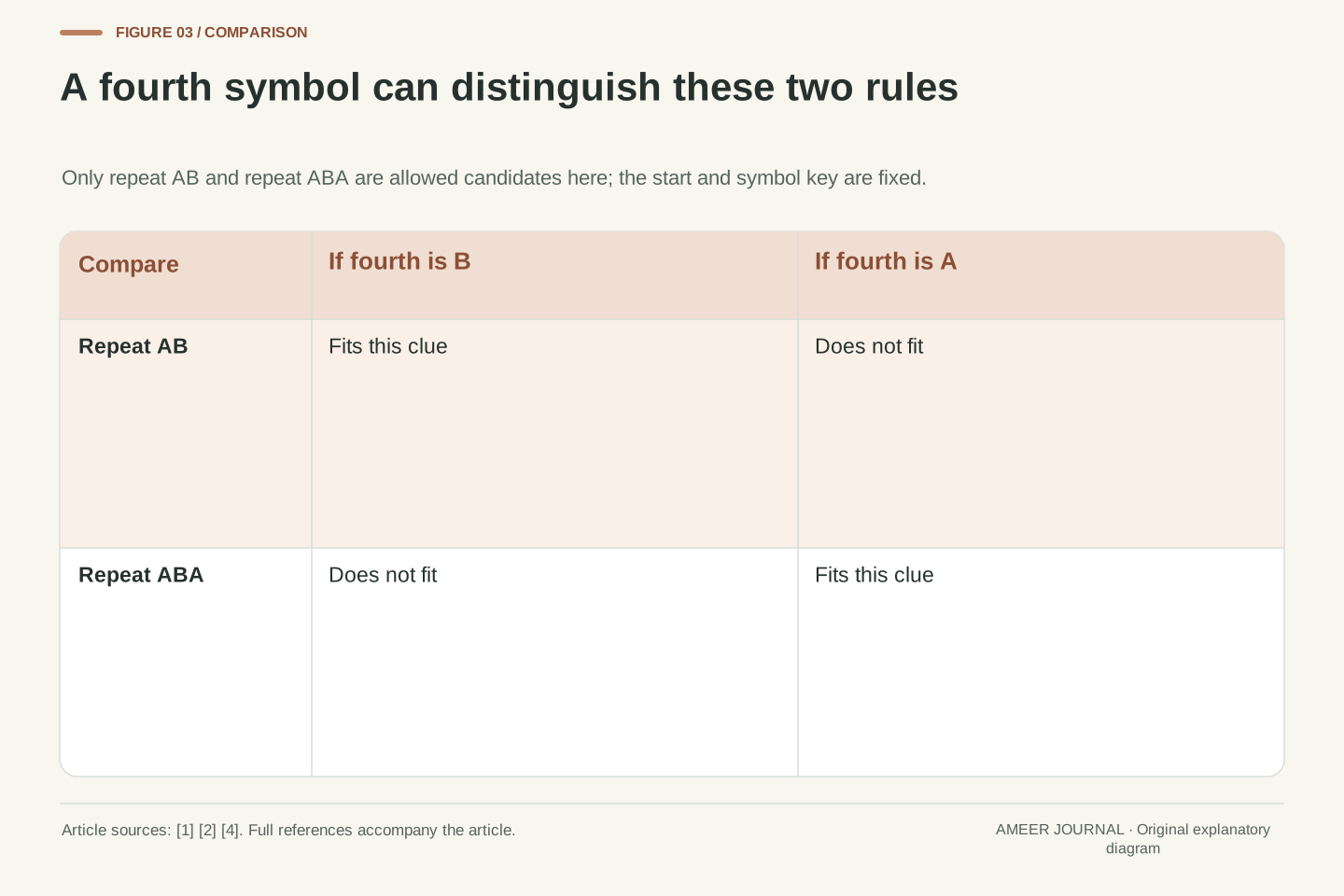
Suppose a grown-up says that exactly one of our two written rules was used. You already see A, B, A. Ask to see the fourth position. If it is B, Rule One fits and Rule Two does not. If it is A, Rule Two fits and Rule One does not. This works because we calculated a place where the two candidates disagree. Asking about a position where they both predict the same thing would not separate them.
Now remove the promise that only those two rules are possible. Seeing A, B, A, B still does not prove that AB repeats forever. Another rule might agree for a longer beginning before doing something different. The new clue settles our two-rule puzzle, not every pattern anyone could invent. This does not make ordinary classroom questions pointless. A question may name the unit, show its construction or tell you which kinds of rule to consider. Those details give the missing constraint. NRICH's guidance asks learners to connect a general rule to the structure producing the pattern [4], which is stronger than treating a few matching examples as a guarantee.
Restrict the candidate set to {repeat AB, repeat ABA}, with a shared origin and fixed symbol mapping. Position four is a discriminating observation because the candidates predict different values there. Observing B eliminates repeat ABA; observing A eliminates repeat AB. This is conditional identification within a specified class. It does not require a probability model or imply that either candidate was initially more likely.
Without that restricted class, additional matching terms provide further constraints but do not establish one unrestricted infinite continuation. For example, a rule can match an alternating prefix and change later under an explicitly stated condition. That possibility is logically different from the intended rule of a well-specified task. NRICH emphasizes explaining how the pattern's generating structure supports generalization [4]. A supplied construction or repeat instruction gives a reason for future terms; merely observing a finite prefix does not provide the same information. The lesson therefore preserves both useful activities: infer among named candidates when that is the task, and apply a given rule when the task supplies one.
Different descriptions can produce the same full pattern
There is another surprise. Compare 'repeat AB' with 'repeat ABAB', starting at the same place. The first gives AB, AB, AB and so on. The second gives ABAB, ABAB and so on. Both produce the same alternating sequence. We changed the size of the group named in the instruction, but we did not change the shapes appearing at any position. Different words in a rule do not always mean different results.
For this declared alternating pattern, AB is the smallest repeating unit. A single A cannot reproduce the B positions, and a single B cannot reproduce the A positions. The two-symbol unit does work. ABAB also works as a larger repeat block because it contains two copies of AB. NCETM calls attention to the smallest unit of repeat rather than listing the entire visible pattern [1]. If a question specifically asks for the smallest unit, AB answers it more precisely than ABAB. If it simply asks for a block that can be repeated, both can describe this same sequence when the start is kept fixed.
Compare periodic descriptions based on words u=AB and v=ABAB. Since v is exactly two concatenated copies of u, indefinitely repeating v generates the same position-by-position sequence as repeating u from the same origin. This is a structural equivalence, not a conclusion obtained only by checking the first few terms. Replacing one larger block with its two constituent smaller blocks explains why the agreement continues.
AB is the minimal period word for the specified alternating sequence. Its period cannot be one because two different symbols occur, and period two is sufficient by construction. ABAB is a valid nonminimal repeat block. NCETM's emphasis on the smallest repeat unit supports that distinction [1], while NRICH illustrates why apparently different descriptions may express equivalent mathematical structure [4]. The learner should therefore avoid both errors: treating two matching short beginnings as necessarily the same sequence, and treating differently worded rules as necessarily different sequences. Compare what the rules generate and why, then use the exact kind of unit requested by the question.
Two numbers can fit an adding rule or a doubling rule
Now consider a number beginning: 5, 10. Rule Add says to start at 5 and add 5 each time. Its next values are 15, 20 and 25. Rule Double says to start at 5 and multiply the previous value by 2 each time. Its next values are 20, 40 and 80. Both reach 10 from 5, so the first two numbers do not separate the rules. The third value does: it is 15 under Rule Add and 20 under Rule Double.
Work through the instructions one step at a time. Adding 5 means the same increase each time, not adding the position number. Doubling means two times the previous value, not adding 2. The words tell you which calculation to perform. These are our own examples of the different-rule idea used in NZCER's assessment material [2]. A rule must explain the given beginning as well as its continuation. If someone proposes 'add 3 each time' starting from 5, the second number would be 8, so that proposal does not fit our displayed 5, 10 beginning.
Define an additive sequence by initial value a1=5 and recurrence a(n+1)=a(n)+5. Define a multiplicative sequence by b1=5 and b(n+1)=2b(n). Their first five terms are respectively 5,10,15,20,25 and 5,10,20,40,80. Both share the length-two prefix 5,10, but differ at the next position. These original calculations make the abstract different-rule instruction concrete [2].
The initial value is part of each definition. The recurrence alone specifies how to move from one value to the next, but different starting values would produce different sequences. Likewise, 'add' and 'double' identify different operations, even when their first transition happens to coincide. A candidate rule must be consistent with all supplied values; it cannot justify only the new term while contradicting an earlier one. This gives a direct rejection check for the proposed rule start at 5 and add 3: its second value is 8, not 10. The example compares declared algorithms, without claiming that two observed numbers determine which process produced them.
Count complete units and then the leftover positions
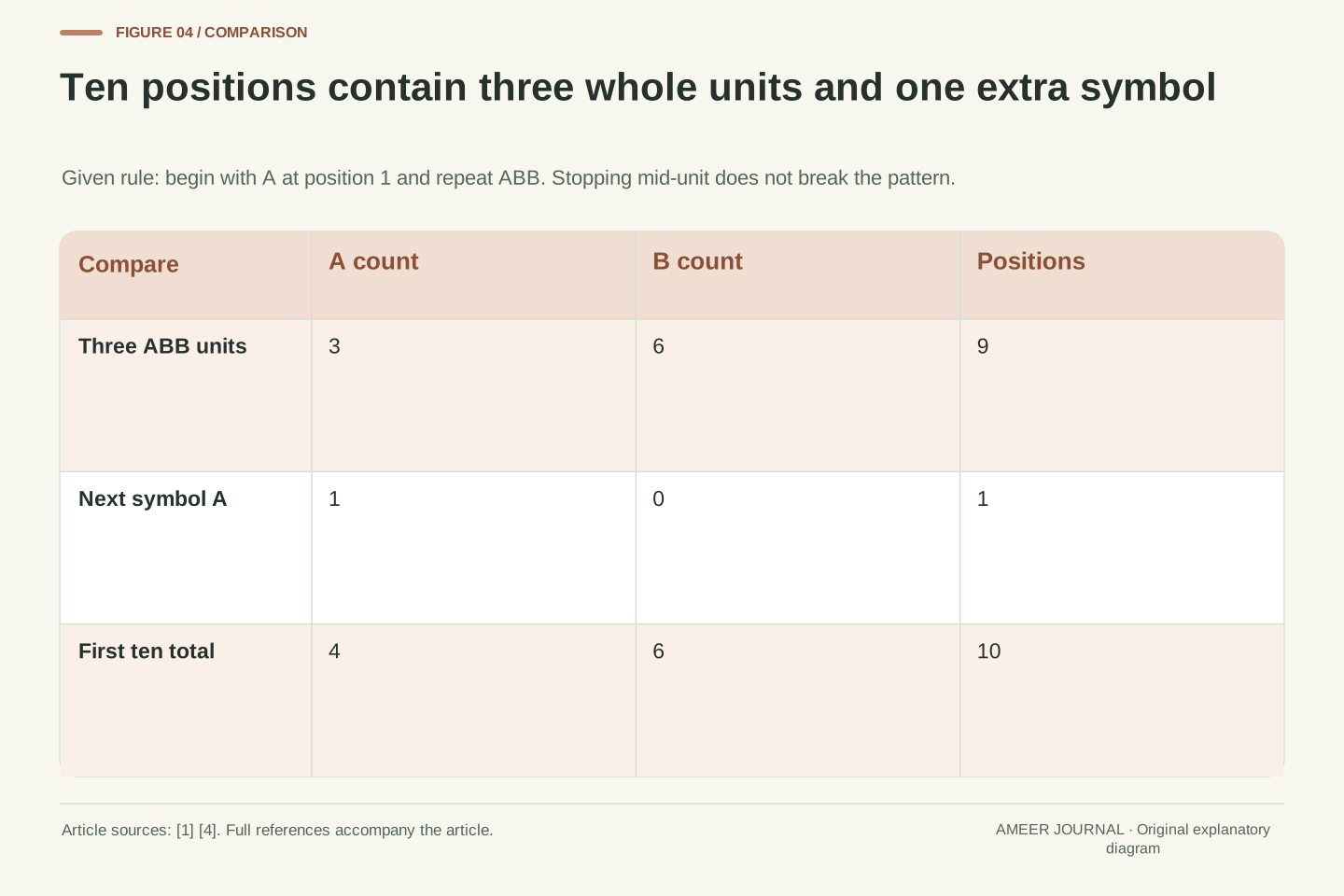
Use a new given rule: begin with A at position 1 and repeat ABB. The first nine positions are three whole units: ABB, ABB, ABB. Each unit contains one A and two B symbols. Three units therefore contain three A symbols and six B symbols. Position 10 begins the next unit, so it is A. Across the first ten positions, the totals are four A symbols and six B symbols. Four plus six checks that every position has been counted once.
This method answers a distant-position question without guessing from the last shape. Ten positions contain three complete groups of three, with one position left over: 10=3×3+1. That leftover position is the first symbol of the next unit. The beginning and the unit both matter. If the rule had started at a different point in the cycle, the tenth symbol could change. NCETM discusses patterns that stop partway through a unit and the connection between available spaces and repeat-unit size [1]. Stopping at position 10 does not break the rule; it simply leaves the visible final unit unfinished.
Specify the unit ABB, origin at position one, and first symbol A. Positions 1–9 form three complete units, each contributing one A and two Bs. Position ten is the first position of the fourth unit. Hence the ten-position prefix is ABBABBABBA, with counts A=4 and B=6. The sum is ten, providing a separate total-count check.
The division 10=3×3+1 describes three complete units and one leftover symbol in the ten-symbol prefix. That leftover is the first symbol of the next ABB unit. A separate calculation locates any positive position n: its unit slot is one plus the remainder after dividing n−1 by three. At n=10, dividing nine by three leaves remainder zero, so the slot is 1+0=1. Both methods identify the same A at position ten. This calculation depends on the declared phase of the pattern: shifting the origin changes which unit slot corresponds to a numbered position. NCETM explicitly discusses extending patterns that end mid-unit and relating the space count to the repeat unit [1]. A finite display need not contain an integer number of complete units to be a valid prefix. Confusing the display length with the unit length would obscure that distinction. The construction supplies the general rule; the arithmetic locates a position within it.
An error is a mismatch to the stated rule
Keep the given rule 'start at position 1 and repeat ABB'. Imagine the first six positions written as A, B, B, A, blank, B. What belongs in the blank at position 5? The first three positions form one ABB unit. Positions 4, 5 and 6 form the next, so the missing entry is B. You can also read from the start while saying 'A, B, B' repeatedly. Both methods should agree.
Suppose a drawing instead has A, B, B, A, A, B. With our stated rule, its fifth entry is a mismatch and should be B. Without a stated rule, that six-symbol row is not automatically wrong; it might belong to another intended pattern. This is why a repair question needs to tell the learner what arrangement it is trying to preserve. NCETM recommends tracking a pattern from its beginning and checking a correction after making it [1]. After filling the blank, read all six positions again. Checking only the repaired spot can miss a shifted count or another mismatch earlier in the row.
A missing-entry problem becomes determinate when the generation rule and positional alignment are supplied. Under the rule repeat ABB from position one, position five has within-unit index two, so it contains B. The partially specified row A,B,B,A,blank,B is consistent with that solution. Grouping into two triples or tracing the recurring three-slot state yields the same result.
The row A,B,B,A,A,B violates that declared rule at position five. Calling it an error is a relational statement: it disagrees with the specified pattern contract. It is not an intrinsic claim that this finite string cannot occur in any pattern. Another rule could intentionally generate it. NCETM's guidance on detecting and correcting pattern errors includes tracking from the start and checking the proposed fix [1]. Those steps preserve alignment, which matters as much as recognizing the symbols. This framing also makes an adult's question fair: first establish the intended rule, then ask which entry conflicts with it. Otherwise, a learner may supply a different consistent rule while appearing to miss an unstated expectation.
Change the drawings while keeping the structure
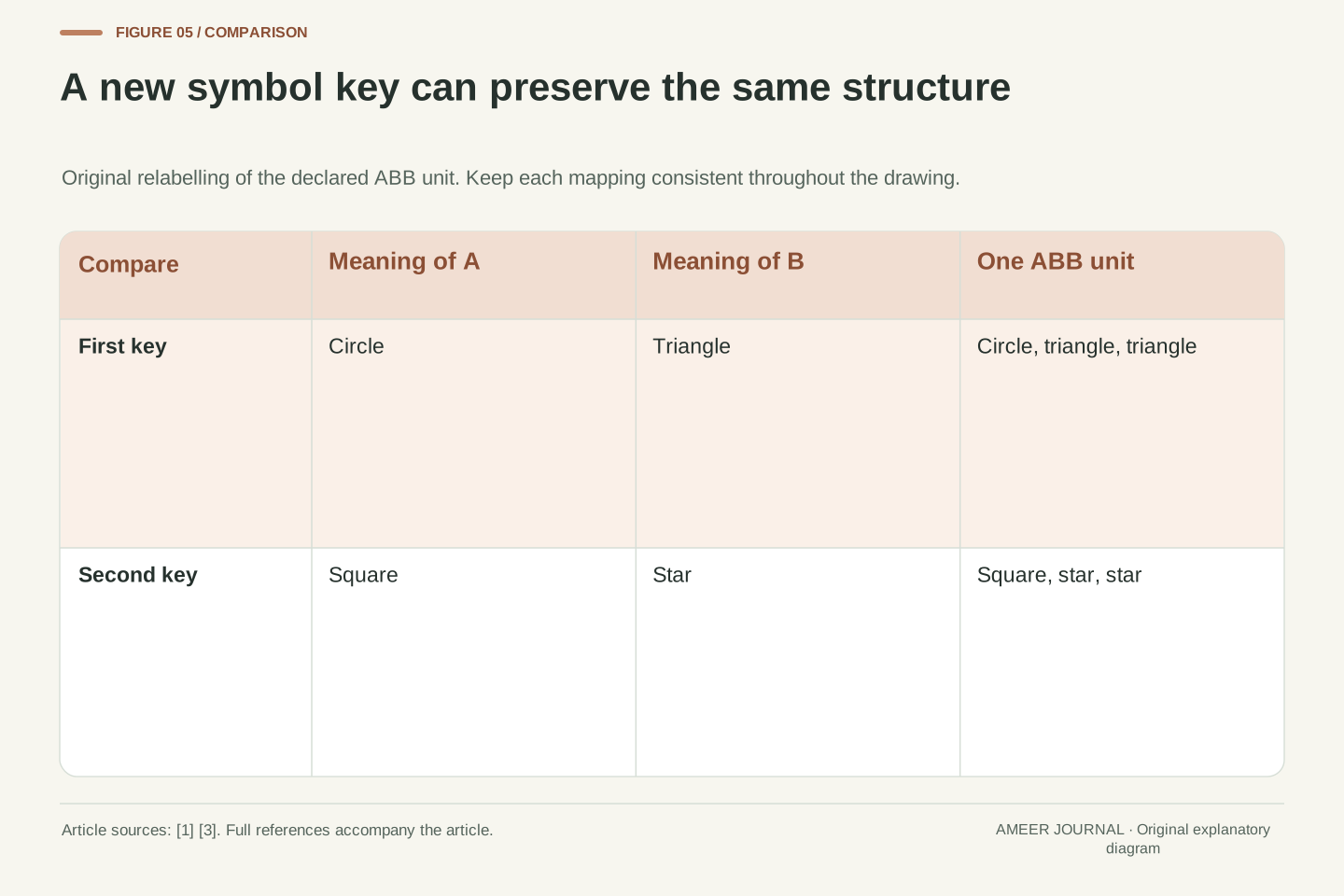
Let A be a circle and B a triangle in our ABB pattern. One unit is circle, triangle, triangle. Now choose a different key: A is a square and B is a star. The unit becomes square, star, star. The shapes change, but the one-first-symbol-then-two-second-symbols structure stays the same. This is why the letters are helpful: they describe the relationship without requiring one particular set of pictures [1].
Keep the new key consistent. If A becomes a square in one place and a star in another, the translation no longer follows the promised mapping. Also say which feature matters. A large circle and a small circle could count as the same symbol in a shape-only pattern, or as different symbols in a size pattern. Neither choice is automatically wrong; the instruction must say what is being tracked. NCETM describes patterns using different features and representations [1], and NRICH connects representations with seeing underlying structure [3]. A clear key lets someone else follow your pattern without guessing which visual details are important.
A one-to-one relabelling can preserve sequence structure. Map A to circle and B to triangle, then use a new map A to square and B to star. In each representation, ABB retains the same equality relations between positions: the second and third symbols match one another, and differ from the first. NCETM explicitly connects symbolic pattern codes with reproducing the same structure in another medium [1].
The coding must preserve the features the task treats as distinct. Mapping both A and B to one undifferentiated dot would erase the visible distinction and could make a three-slot structure appear constant. That is a change in information, not merely a fresh illustration. Conversely, introducing decorative size differences does not alter a shape-only code unless size is part of the rule. NRICH emphasizes representations that expose underlying mathematical structure [3]. A useful legend therefore identifies the chosen symbols and relevant attributes. This allows the learner to distinguish changes in appearance, changes in coding and changes in the actual order of the represented sequence.
Write instructions that another reader can follow
A clear pattern instruction needs a starting point and a repeat or change rule. For a picture sequence, 'begin at the left with A and repeat ABB' is enough for our examples. For a number sequence, 'start at 5 and add 5 to the previous number each time' supplies both the beginning and the operation. 'Make it bigger' is less helpful because it leaves many choices: bigger by how much, or multiplied by what? The reader should not need to discover a secret instruction while trying to apply it.
Ask a grown-up to follow your written rule for a few positions. Compare the result with yours and explain any difference. If you disagree, check the starting point, reading direction, symbol key and rule wording. This is an explanation activity, not a test of who guesses fastest. NRICH asks learners to explain why a general rule belongs to the situation [4]. For our repeated blocks, the reason is built into the instruction: every new complete unit copies the same ordered group. That connection is what supports continuing the pattern, rather than a belief that several earlier matches force the future.
A reproducible generation contract states the initial condition, reading convention and update operation. For a periodic symbol sequence, specify the unit and phase. For a recurrence, specify the initial value and how each later value is obtained. A phrase such as 'increases' constrains a sequence but does not uniquely generate it; constant addition, multiplication and many other processes can all satisfy that description.
The distinction between a generating instruction and an observed regularity explains why some generalizations are justified. If every new block is defined to copy ABB, later complete blocks have that structure by construction. If a few displayed groups merely look like ABB, further justification is needed before claiming the hidden producer must continue that way. NRICH's discussion of generalization stresses linking the mathematical rule to the structure that generates the situation [4]. In our activity, a second reader following the same precise instruction provides a useful clarity check. Agreement across a few generated positions checks the instruction's application; the stated construction, rather than the finite sample alone, explains the intended continuation.
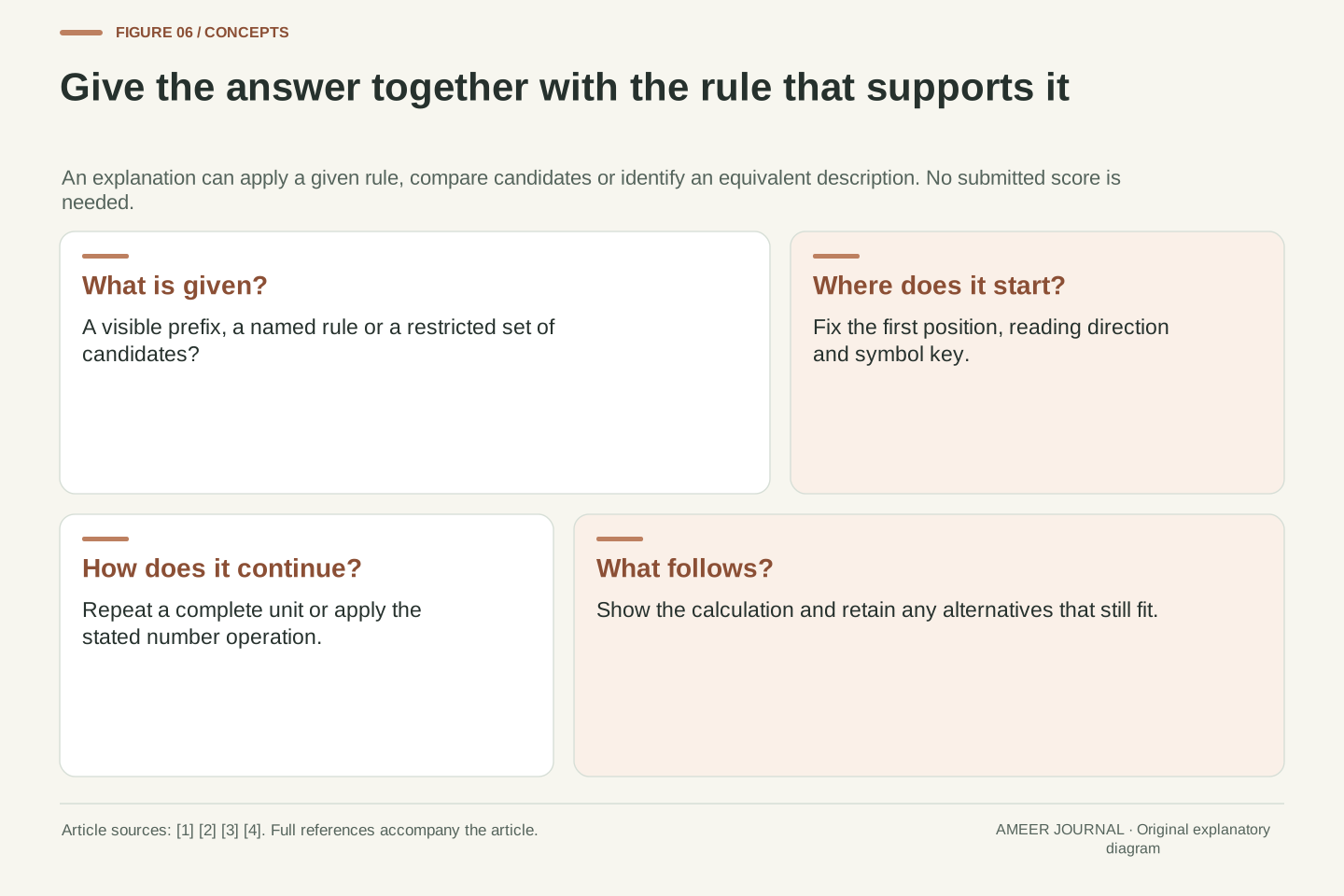
Answer the question that was actually given
Try these final questions. With only A, B, A and no rule, must the fourth symbol be B? No: repeating ABA would put A there. With the instruction 'repeat AB from the left', what is fourth? B, because the rule now supplies the missing information. For the stated ABB pattern beginning with A, what is tenth? A: three full units use nine places, then the next unit starts. The answers change because the information in the questions changes.
One more: do 'repeat AB' and 'repeat ABAB' necessarily describe different sequences? No. Starting together, they produce the same alternating symbols, though AB is the smaller unit. These examples give you a way to explain a pattern answer. Name the information you were given, state the rule you used and show how it fits. If another candidate still fits, say so. Pattern work can involve following a rule, comparing possible rules or finding a compact description. Recognizing which task you have been asked to do makes the answer clearer—and makes a reasonable alternative an opportunity to discuss the mathematics [1][2][3][4].
The final distinctions can be checked with the original examples. Prefix ABA alone admits both repeat AB and repeat ABA. Adding the declared rule repeat AB determines the fourth symbol as B. Under the separately specified ABB rule with position one equal to A, the tenth symbol is A and the first ten counts are four As and six Bs. Under the additive and doubling rules beginning at 5, the third values are respectively 15 and 20.
A valid explanation should preserve whether the rule was supplied or inferred. It should also distinguish a genuinely different continuation from an equivalent description such as repeating ABAB instead of AB. These distinctions connect the educational guidance on repeat units, alternative rules and structural explanations [1][2][3][4]. They do not require treating every ordinary exercise as an unlimited guessing game. A well-written task narrows its intended rule class or gives a construction; a learner then reasons within it. When the task leaves alternatives open, recognizing that limit is a mathematical result. The key achievement is to connect each answer to the exact assumptions that make it follow.
Sources & further reading
Explore the references behind this guide. External pages may change after our review.
- Pattern | NCETMNational Centre for Excellence in the Teaching of Mathematics · Accessed 6 Nov 2026
- Different rules | Assessment Resource BanksNew Zealand Council for Educational Research / Assessment Resource Banks · Accessed 6 Nov 2026
- Pattern SniffingUniversity of Cambridge / NRICH · Accessed 6 Nov 2026
- Go Forth and GeneraliseUniversity of Cambridge / NRICH · Accessed 6 Nov 2026
Article updated 6 Nov 2026.