What you’ll take away
- Read the two facing pole labels: like poles repel and unlike poles attract in the stated bar arrangement.
- An ordinary soft-iron object can be attracted to either pole through an induced magnetic response.
- Two attraction cases in a four-case list do not establish how likely a real encounter is.
- A two-clue mystery works only when the same unknown end and the named candidate set are preserved.
- Diagram arrows need a legend; their size does not measure force without an explicit scale.
A pull is a clue, but what does it prove?
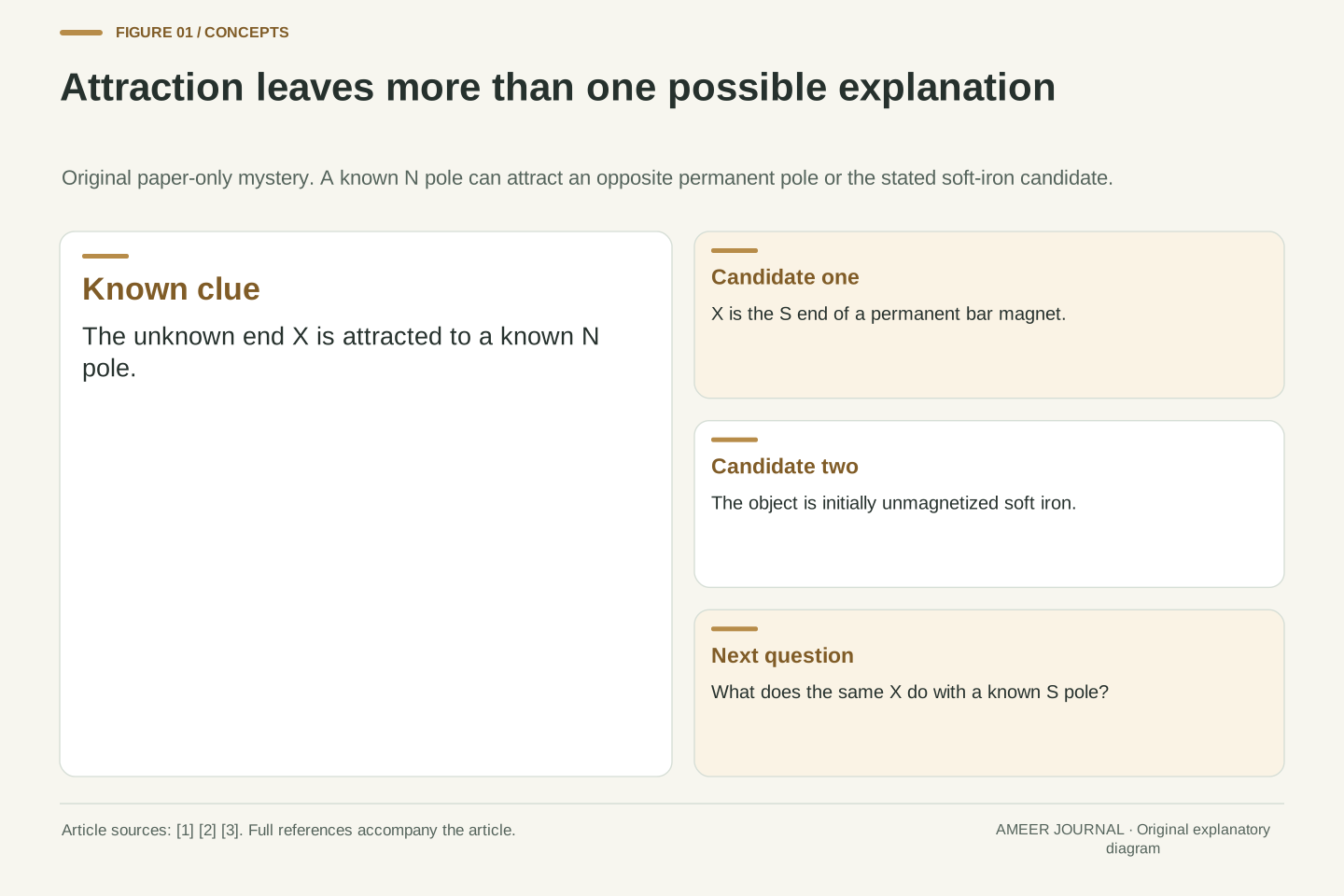
A picture shows an unknown object being pulled towards the north end of a magnet. Is the unknown object definitely another permanent magnet? It is tempting to say yes. But there is another possibility: an ordinary iron object can also be attracted to that end. NASA's introductory explanation distinguishes attraction between opposite magnet poles from attraction caused when a nearby magnet temporarily magnetizes iron [1]. A good magnet detective needs to keep both explanations open until the picture gives more information.
This is a drawing puzzle to read with a grown-up. You can point at the diagrams or draw the examples on one sheet of paper. You do not need real magnets, metal objects, batteries or any equipment. We will imagine straight bars with their ends facing each other, and keep their directions fixed while predicting a push or pull. Our mystery has a small, named set of possible answers. Learning to use that set carefully is the game: first predict what each possibility would do, then decide which possibilities agree with a clue. No speed, score or personal information is needed.
Attraction is an observation that may fit more than one explanation. In the restricted setting used here, a known permanent bar magnet can attract the opposite pole of another permanent bar or an initially unmagnetized soft-iron object. The latter response involves induced magnetization rather than proving that the object already retained its own permanent pole arrangement [1]. Distinguishing those cases is an early example of reasoning from evidence without claiming more than the evidence supports.
The activity uses diagrams only, with adult reading support. Each bar pair is pictured end to end, with its orientation held fixed; a predicted force does not include subsequent turning or motion. The mystery candidates will be stated explicitly. Real magnets, loose objects, electrical equipment and hands-on material tests are outside the activity. Technical mode adds the meanings of induction, material response and a restricted hypothesis set, while retaining the same puzzle and answer as Easy mode. The purpose is not to memorize a long list of magnetic objects. It is to connect a prediction to a rule, then distinguish that prediction from identifying an unknown object.
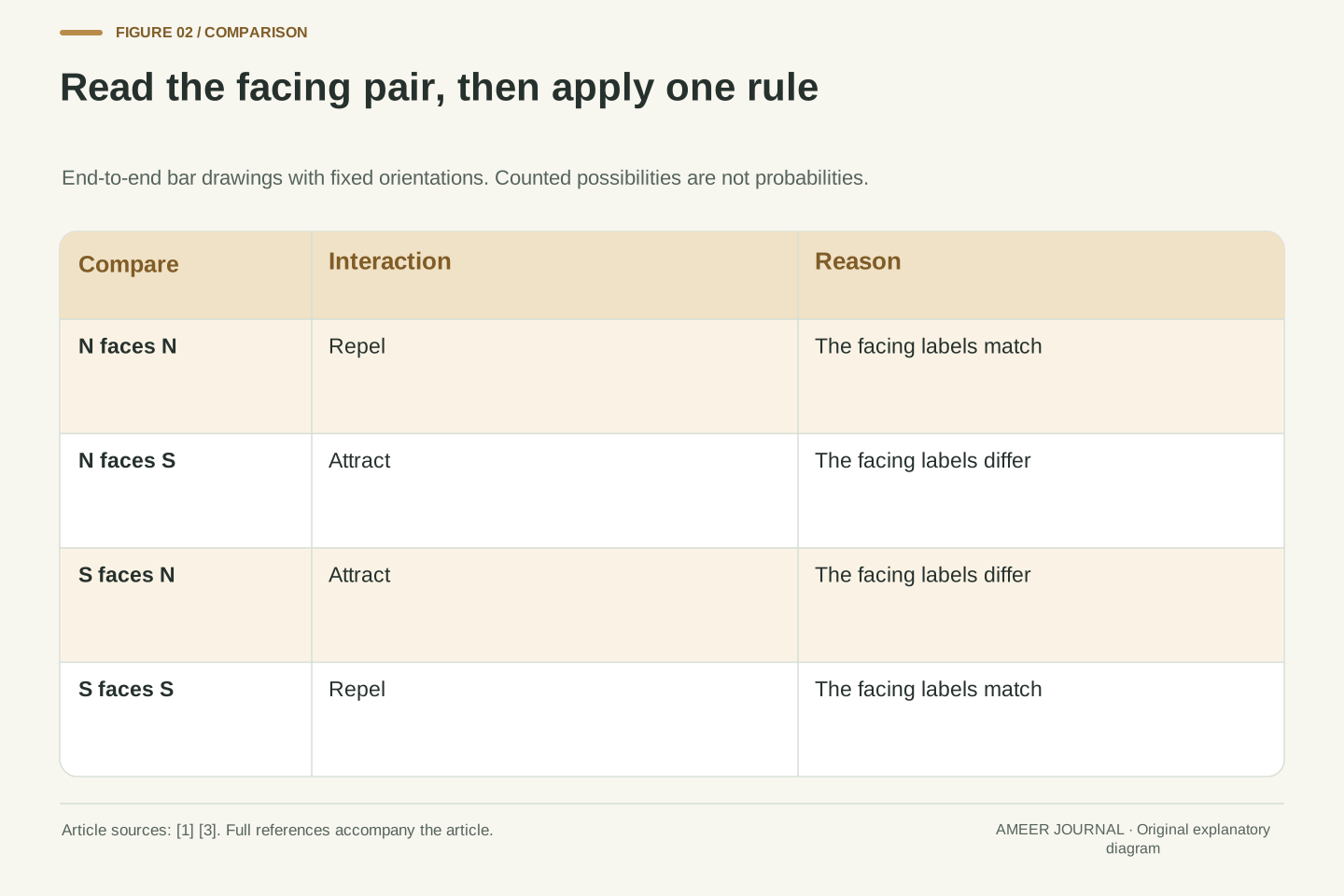
Read the two ends that face the gap
An ordinary bar magnet has a north-seeking end and a south-seeking end, often shortened to N and S [1][3]. In our pictures, the important ends are the two nearest the gap between the bars. If those ends have the same letter, the bars push apart: this is repulsion. If they have different letters, they pull together: this is attraction. Read the letters at the gap before looking at the far ends. That small habit stops a common mistake when two long bars appear in a busy picture.
Imagine a left bar whose right-hand end is N, and a right bar whose left-hand end is S. The facing pair is N–S, so the predicted interaction is attraction. The other two ends still belong to their bars, but they are not the pair named in this question. Colour can help a drawing stay clear, yet red and blue are not the scientific rule. A black-and-white picture with readable N and S labels works too. The labels name magnetic poles; they do not mean positive and negative electric charge.
The familiar pole rule applies to our specified end-to-end geometry: like facing poles repel and unlike facing poles attract [1][3]. North-seeking and south-seeking are magnetic pole names. We abbreviate them as N and S without treating them as electric charge signs. An ordinary complete bar has both poles, so a drawing must distinguish the whole bar from the particular end involved in a comparison.
Define the facing pair in left-to-right order: first the pole on the left bar nearest the gap, then the pole on the right bar nearest the gap. Thus N–S and S–N describe different labelled arrangements but the same attraction outcome. The colour scheme is merely a visual convention. Recolouring a correctly labelled diagram does not alter its physical prediction. Conversely, changing a facing label while leaving the outcome unchanged may make the diagram inconsistent. This is why reading the two adjacent labels is more reliable than recalling a coloured image. The prediction concerns the interaction along the bar-pair arrangement; it is not a calculation for arbitrary orientations or a map of every point in the magnetic field.
List all four pairs before making a guess
There are two choices for the facing end on the left: N or S. For each choice, there are two choices on the right. That gives four ordered pairs: N–N, N–S, S–N and S–S. Apply the same rule to each pair. N–N repels. N–S attracts. S–N attracts. S–S repels. The list contains two attraction cases and two repulsion cases. You can check completeness by keeping the left letter N for the first two entries, then changing it to S for the last two.
This is a count of possibilities, not a prediction that half of every real collection of pictures must show attraction. Someone might draw N–N five times and never draw the other pairs. To say how likely a result is, we would need to know how the pictures were chosen. Here we simply know that our list includes each ordered pair once. If a grown-up hides the outcome column with a hand, you can explain each answer from the letters. Saying 'the letters match' or 'the letters differ' gives a reason that works throughout the table [1][3].
The complete ordered set is {NN, NS, SN, SS}. It has 2×2=4 members because each facing position independently allows either of two labels. The pole rule maps NN and SS to repulsion, and NS and SN to attraction [1][3]. Keeping order makes the enumeration transparent: the first coordinate identifies the left-facing end and the second identifies the right-facing end. Combining NS and SN into one unordered case would change the counting question.
There are two members of each outcome class, but cardinality alone does not establish a probability distribution. A half-and-half probability would require an additional selection rule that treats these four cases equally, or another justified distribution with that outcome. We specify no random selection here. This distinction is useful even for a simple diagram exercise: a complete catalogue of allowed cases is different from a record of how frequently someone encounters them. The learner can verify each row without guessing from the pattern of earlier answers. If the row order changes, the rule still produces the same prediction for each labelled pair.
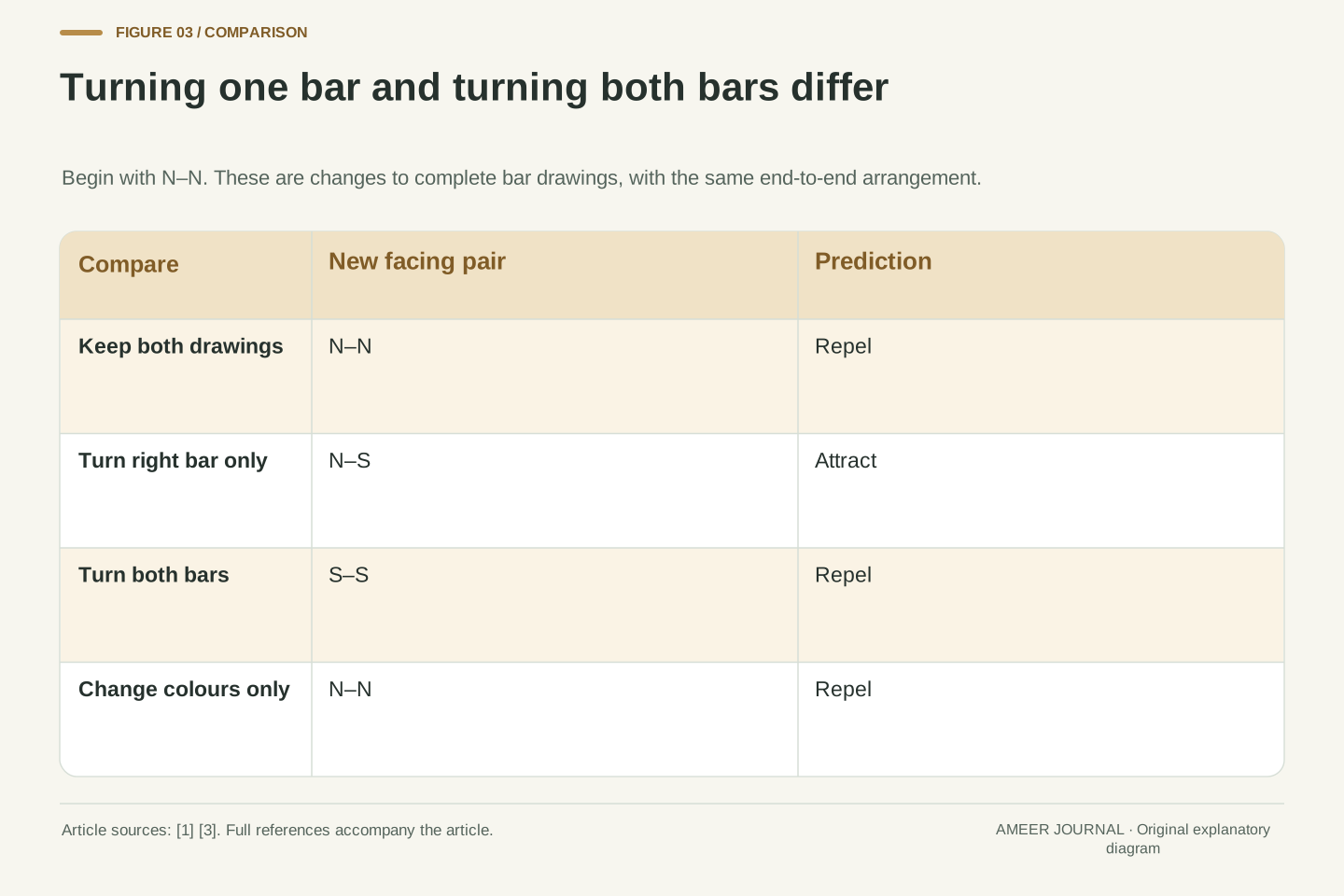
Turning a drawn bar changes which pole faces the other
Start with a drawing whose facing pair is N–N. It predicts repulsion. Now redraw only the right bar turned end for end, so its other end faces the gap. That end is S. The pair has become N–S, and the prediction changes to attraction [1][3]. We changed the direction of one whole bar, not the meaning of the letters. Its N end did not become a different kind of pole simply because the bar was turned.
Try the opposite starting case in your drawing: N–S attracts. Redraw the right bar the other way round, keeping the left bar unchanged. The facing pair becomes N–N and repels. Then ask a different question: what if both whole bars were redrawn turned end for end? Starting from N–N, the pair becomes S–S. The letters change, but the outcome remains repulsion because they still match. These are useful checks on the rule. 'Something turned' is not enough information by itself; say which bar turned and read the new facing pair.
An end-for-end rotation of one drawn bar exchanges which of its poles occupies the facing position. In the pair notation, turning the right bar changes NN to NS, or NS to NN; similarly, SN becomes SS and SS becomes SN. Each single-bar change switches between equal and unequal labels, and therefore between the two interaction classes under the stated geometry [1][3]. This is a discrete diagram operation, not an account of the forces during an actual rotation.
Turning both bars exchanges N with S in both positions. NN becomes SS and NS becomes SN. The outcome then stays within its original class: like remains like, and unlike remains unlike. A learner can use this as a consistency check rather than remembering four unrelated answers. It also separates a change in a drawing's appearance from a change in the relevant relationship. Repainting the bars changes neither label, whereas turning one bar changes one facing label. These operations can look equally noticeable on a page while having different consequences for the prediction.
Iron can be attracted without starting as a permanent magnet
Now replace the right-hand magnet drawing with an object labelled 'initially unmagnetized soft iron'. Soft iron here means iron that can respond readily to a nearby magnet. It does not mean a soft material to squeeze. A nearby N pole can attract this object, and a nearby S pole can attract it too. The magnet affects the iron's magnetic arrangement, producing an induced response [1][3]. That explains why an attraction picture alone did not solve our opening mystery.
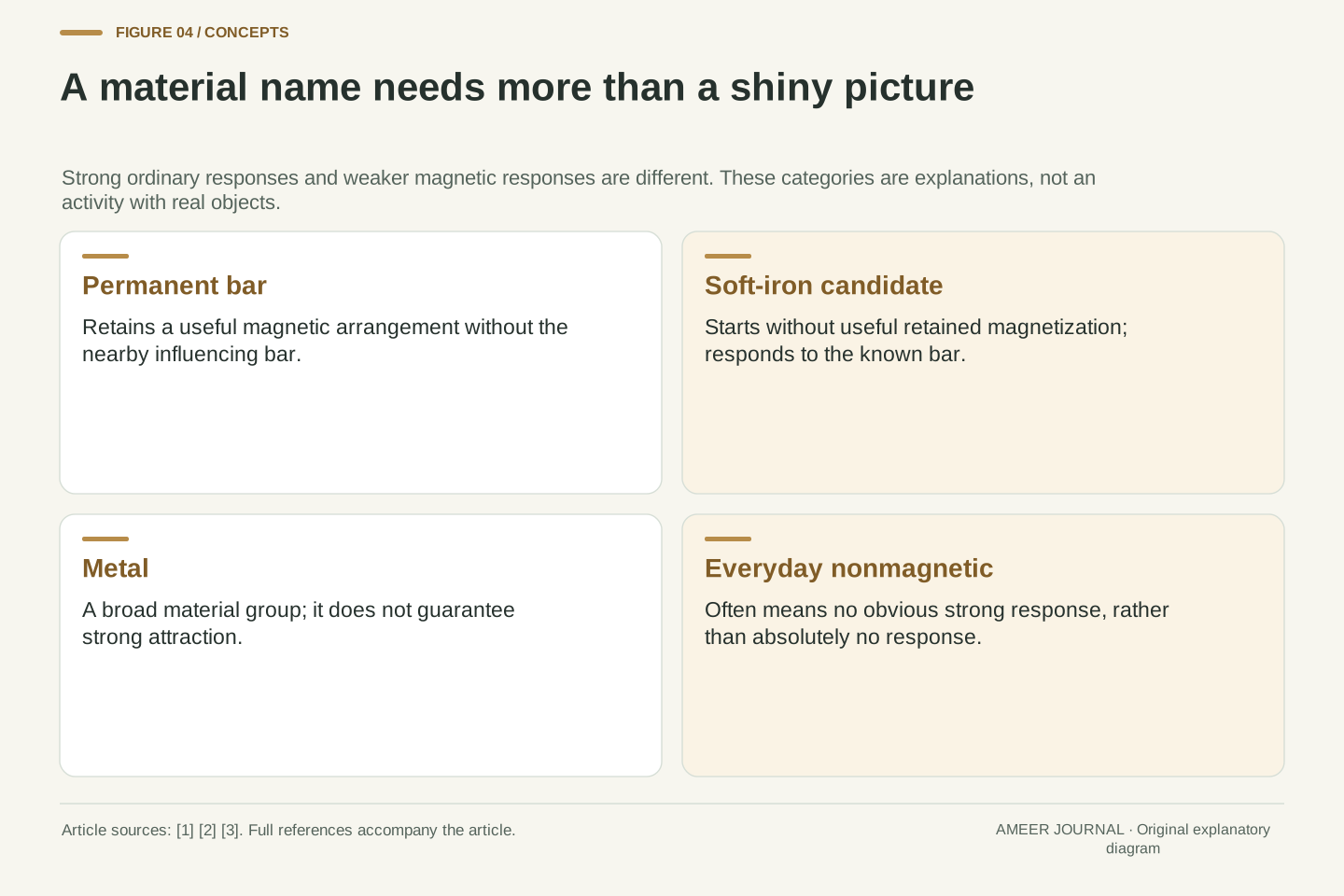
A permanent magnet keeps a useful magnetic arrangement after the magnet used to influence it is no longer nearby. Permanent does not mean impossible to change or guaranteed to last forever. Material properties and magnetic history matter [2]. Our soft-iron puzzle object is different: it begins without a useful retained pole arrangement, and its response follows the nearby magnet. Do not silently give it a fixed N label just because it is attracted once. We are comparing two kinds of explanation—an already magnetized bar and an object responding to the field—not calling every attracted object a permanent magnet.
Induced magnetization is a change in a material's magnetic state in response to an applied field. NASA describes ordinary iron objects near a magnet acquiring an arrangement that produces attraction to either pole [1]. In our simplified soft-iron case, the object starts without useful net retained magnetization and is readily magnetized by the known bar. 'Soft' is a magnetic-material description here, not a claim about how the object feels.
Permanent-magnet behaviour involves useful remanence: magnetization retained after the external magnetizing field is removed. The University of Minnesota distinguishes collective magnetic ordering, domains and magnetic history, including retention and dependence on material state [2]. Those distinctions prevent two overstatements. A material capable of strong magnetization is not necessarily an already magnetized permanent object, and every piece of iron does not have identical retention. Our puzzle deliberately assumes the temporary-response case for its soft-iron candidate. It does not teach that all iron instantly loses every trace of magnetization whenever another magnet moves away. The attraction rule is applied within that stated material model.
Shiny, metallic and magnetic are different descriptions
A drawing of a shiny object does not tell you whether a nearby ordinary magnet would pull it strongly. Metal is a broad material group. Iron, nickel, cobalt and many of their alloys are familiar examples with strong magnetic behaviour under ordinary conditions, but that does not make every metal behave the same way [2]. An alloy is a material made by combining elements, usually including a metal. Changing what a material contains and how it is arranged can change its response.
There is another useful wording choice. In everyday lessons, 'nonmagnetic' often means that a material does not show the strong, obvious attraction being discussed. Scientists can describe much weaker magnetic responses too [2]. So a quiet-looking picture is not proof of absolutely no magnetic response. Nor does the word iron in a mineral's description guarantee the same behaviour as our soft-iron object. For this puzzle, use the supplied material label and its stated rule. Appearance, colour and a general name such as metal cannot replace that information.
Everyday classification usually emphasizes strong, easily noticed responses. The University of Minnesota distinguishes ferromagnetic and ferrimagnetic behaviour from much weaker responses often informally called nonmagnetic [2]. Iron, nickel and cobalt, together with many alloys, provide common strong-response examples; this is not a claim that those are the only magnetic substances or that every alloy containing them behaves identically. Magnetic behaviour depends on more than a shiny surface or membership in the broad category metal.
The distinction also applies within iron-containing materials. The same source describes iron-bearing minerals with weak paramagnetic responses and explains that collective organization of magnetic moments matters [2]. We therefore do not infer a whole object's response merely from one element's presence. A visible lack of movement would be an even weaker basis for declaring zero magnetic response, because a force and an object's motion are not identical observations. For the written exercise, the label 'initially unmagnetized soft iron' supplies a specific idealized behaviour. That explicit label is more informative than an unlabeled grey shape that the reader is expected to identify by appearance.
An arrow needs a meaning before it becomes evidence
Magnetic interaction can happen across a gap; the bars do not need to touch for the predicted attraction or repulsion [1][3]. We describe magnetic influence using the idea of a magnetic field. The gap in a picture is not a string joining the objects, and the field is not a hidden solid arm. It gives us a way to describe magnetic conditions around the objects.
If you add arrows to your paper drawing, write a small key: 'arrows show the predicted push or pull on each bar'. For attraction, the arrows on the two bars point towards one another. For repulsion, they point away. These are force-direction arrows, not a complete drawing of magnetic field lines. An arrow's length also needs a rule before it can represent strength. Our pictures do not give one. A long arrow chosen to fit a page cannot prove a stronger magnet. A held bar could experience a force without actually moving, so an arrow showing force should not automatically be read as a recorded journey.
A magnetic field describes magnetic conditions in space; it is not a material connector between the two bars [1][3]. In this lesson, we use the field concept only to explain why contact is unnecessary and why the iron candidate can respond to a nearby magnet. We do not calculate a field map, field gradient or force magnitude. Those require more information about geometry and magnetic state than our pole labels provide.
Diagram conventions must distinguish force vectors from field-line conventions. An arrow placed on a bar and labelled 'predicted force' indicates an interaction direction for that bar in the stated arrangement. It does not automatically identify the direction of the magnetic field at every nearby point. Nor is its drawn length a calibrated magnitude unless a scale explicitly says so. Actual motion would also depend on constraints and other forces. Keeping the legend precise avoids a chain of unsupported inferences: an attractive drawing is not a measured strength comparison, a trajectory record or a complete field representation. A simple symbol is useful when its meaning stays narrower than those extra claims.
Solve the mystery with two named clues
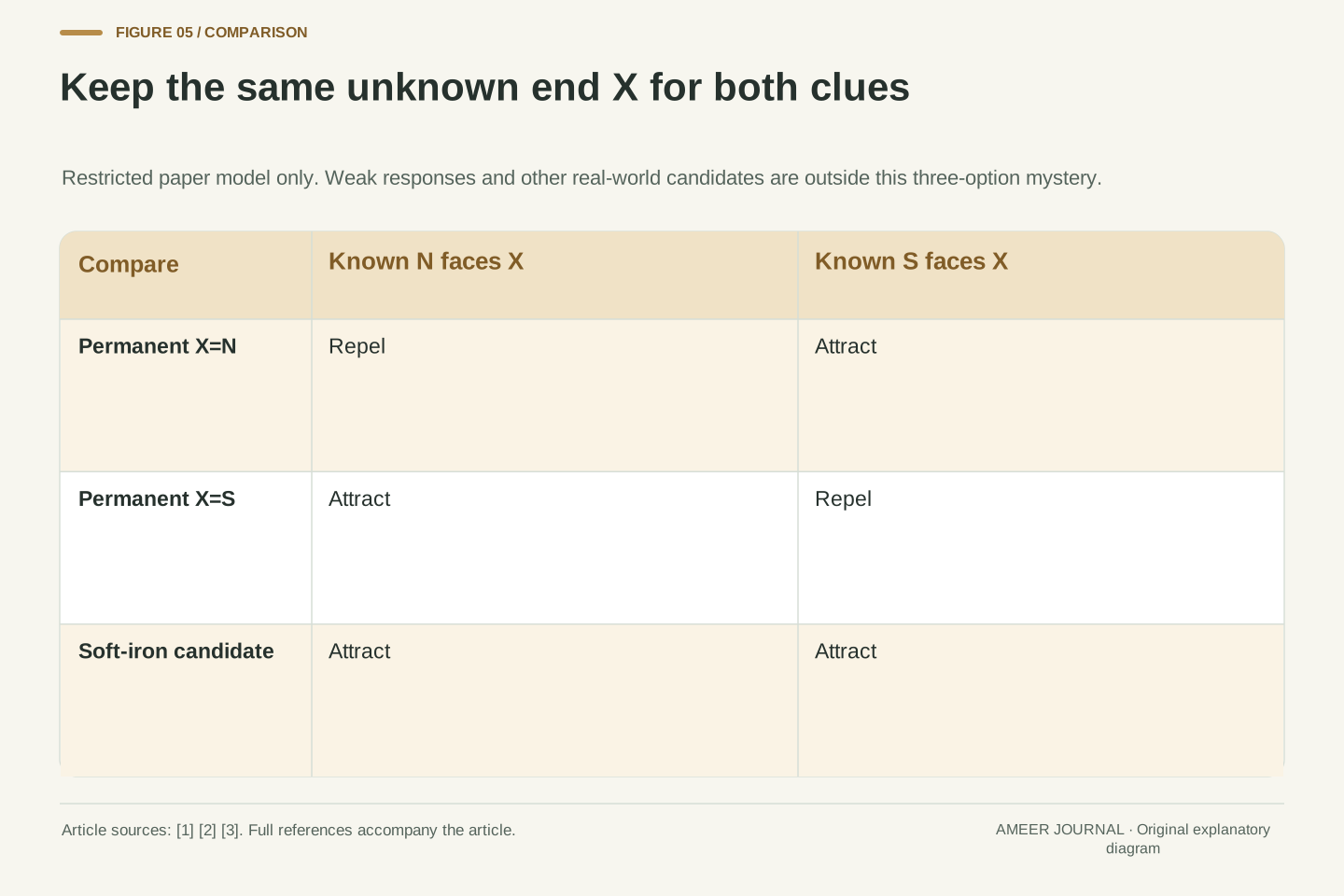
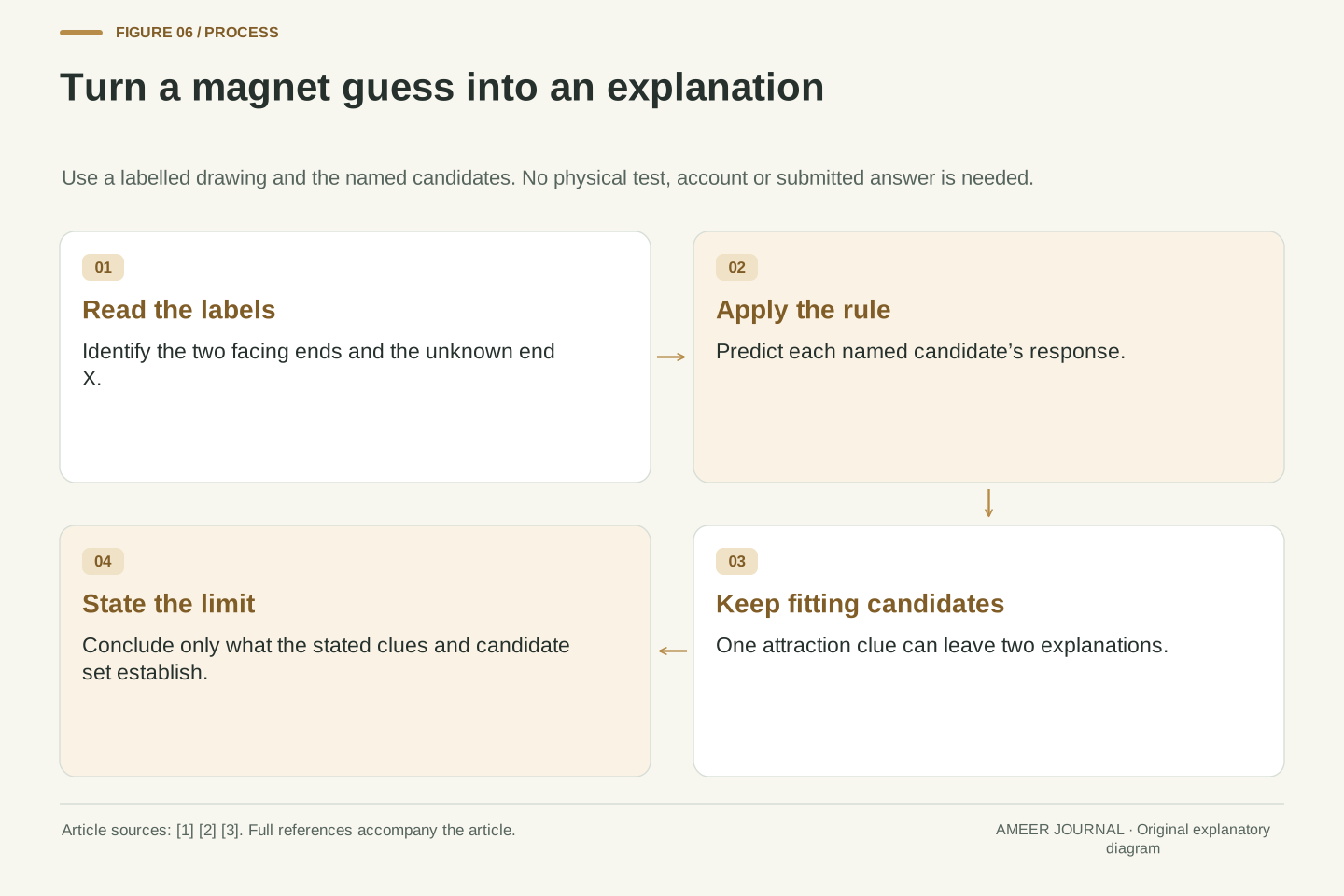
Our unknown object's facing end is called X. There are exactly three allowed candidates in this puzzle: a permanent bar with X=N, a permanent bar with X=S, or our initially unmagnetized soft-iron object. Clue one says that the known N pole attracts X. The X=N bar would repel, so it does not fit. The X=S bar and the soft-iron object both fit. Two candidates remain. That does not make either answer certain, and it does not tell us that they are equally likely.
Clue two keeps the same end X facing the gap but changes the known facing pole to S. Suppose the drawing again says attraction. A permanent X=S bar would repel S, whereas the soft-iron candidate is attracted to either known pole [1][3]. Only the soft-iron candidate fits both clues in our list. If clue two had instead shown repulsion, the X=S bar would fit. The useful discovery is the reasoning: one clue can leave alternatives open, while another clue chosen to separate those alternatives can make the puzzle decidable.
Define three hypotheses: HN is a permanent bar with facing end X=N; HS is a permanent bar with X=S; HI is the stated initially unmagnetized soft-iron object. Their predicted responses to a known N pole are respectively repel, attract and attract. Their responses to a known S pole, while keeping X fixed, are attract, repel and attract [1][3]. The table is generated from the earlier pole and induction rules, not from collected observations.
An attraction clue with known N eliminates HN but leaves HS and HI. A second attraction clue with known S eliminates HS, leaving HI within the defined candidate set. If the second clue is repulsion, HS remains instead. This is conditional identification: it depends on the candidate list, geometry and idealized responses. It is not a universal claim that repulsion proves a permanent magnet in every scientific situation. Weak material responses, including diamagnetic behaviour, make that broader rule unsuitable [2]. Here the alternatives are deliberately limited so the learner can track exactly which evidence rules each one out.
Keep the unknown end fixed while changing the clue
Why did we keep X facing the gap for both clues? Because changing the known pole and secretly turning the unknown bar would ask a different question. Imagine X=S on a permanent bar. A known N attracts it. If the next drawing turns both bars, the known S would now face the unknown bar's N end and attract again. Two attractions could then come from a permanent magnet. Our mystery avoided that confusion by keeping the same unknown end in place.
Mark a small X beside that end in both drawings, and describe the single change: 'the known facing pole changes from N to S'. Keep the gap and drawn arrangement the same as well. This helps the comparison express the intended rule. It still does not measure a force. If someone asks which bar is stronger, the puzzle does not contain the needed strength information. Answering 'the drawing does not tell us' is useful when you can say what is missing. It is more precise than inventing a conclusion from the size or colour of a shape.
The two-clue argument requires an invariant identity for the tested unknown end. If the unknown bar is also rotated between comparisons, HS can produce attraction twice: first its S end faces known N, then its N end faces known S. The observed outcome sequence alone would no longer distinguish it from the temporary-response candidate. Naming X and preserving it therefore carries real logical work in the puzzle.
A controlled paper comparison changes the known facing pole while holding the unknown end, end-to-end geometry and other stipulated conditions fixed. The learner can annotate that change directly instead of relying on an unspoken visual assumption. This models a basic evidence skill without requiring a physical experiment. It also distinguishes categorical predictions from quantitative ones. The rule predicts attract or repel for the listed candidates; it does not rank magnetic strength, compute a distance law or assign a force from bar size. Any such question would need an additional model and information. Identifying that boundary is part of reading the diagram accurately.
Give the answer together with its reason
Here are three final questions to discuss. First, what happens when two drawn S ends face each other? They repel because the labels match. Second, an unknown object is attracted by a known N pole: must it be a permanent magnet with S facing? No. Our soft-iron candidate could also fit. Third, what makes the two-clue answer useful? The same end X is kept fixed, the known pole changes, and the possible candidates were named before the clues were applied.
Now explain one answer in your own words or with a labelled drawing. Begin with what is given, say which rule you use, and finish with what follows. A grown-up can ask, 'Could another allowed candidate fit that clue?' This turns a correct guess into an explanation. The same habit also helps with other science pictures: read their labels, check what changed and separate a useful clue from a complete answer. For magnets, the key distinction is especially clear. Opposite poles can attract, and iron can be attracted through an induced response. A detective needs enough information to tell those stories apart [1][2][3].
A complete explanation has three parts: a specified arrangement, an applicable rule and a conclusion limited to what follows. For SS, the arrangement has like facing poles, the rule is like-pole repulsion, and the outcome is repel. For attraction to known N, the candidate set admits both HS and HI, so unique identification does not follow. For attraction to both known poles with X fixed, only HI matches the restricted response table.
An adult can assess the explanation by asking which assumption would change the answer, rather than by requiring advanced vocabulary. Rotating X, adding other material candidates or replacing force direction with an uncalibrated strength claim each changes the problem. These distinctions connect the pole rules to the broader material account: magnetic response is not identical across materials, induction is different from retained magnetization, and a picture needs defined symbols [1][2][3]. The learner leaves with a method for interpreting evidence, not a promise that a short table identifies every real object. Keeping alternatives visible until a discriminating clue arrives is the central reasoning skill.
Sources & further reading
Explore the references behind this guide. External pages may change after our review.
- Magnetic FieldsNASA Goddard / David P. Stern and Mauricio Peredo, archived education · Accessed 6 Nov 2026
- 2. Classes of Magnetic Materials | College of Science and EngineeringUniversity of Minnesota / Institute for Rock Magnetism · Accessed 6 Nov 2026
- Lesson: Magnetic poles | Oak National AcademyOak National Academy · Accessed 6 Nov 2026
Article updated 6 Nov 2026.