What you’ll take away
- Buoyancy is an upward force; a sinking object can still experience it.
- Steady floating in the stated model requires buoyancy to balance weight.
- A hollow watertight shape can exclude more water without changing the mass or density of its material.
- Count the actual displaced water separately from the hull’s maximum available displacement.
- A paper calculation does not establish that a real boat is stable, watertight or safe to load.
Draw two shapes made from the same amount of material
Picture a compact lump and a little hollow hull, the outside shell of a boat. Our drawings say they contain exactly the same amount of the same imaginary material. Nothing has been added or removed. Could the lump sink while the hull has a way to float? Yes, under the right conditions. The difference can come from how much water each shape keeps out of the space it occupies. NOAA and university teaching resources use this connection between shape and displaced water to explain why a boat can float even when its material is denser than water. [1][2][3]
This is a paper puzzle to read or draw with a grown-up. Everything stays on the page: we do not need real water, boats, loose weights, cutting tools or a visit to a pond. Our make-believe water is still, and the hull is watertight, upright and stable. We leave out waves and other kinds of support. Those are rules for this small model, not promises about a real boat. The aim is to follow two questions: how much weight pulls down, and how much upward push the displaced water provides. Guessing from the picture's colour or from “heavy things sink” will miss some of the clues.
The question is whether reshaping a fixed amount of material can change its flotation condition without changing the material's density. It can, if the new geometry excludes a larger volume of water while retaining sufficient watertight volume for equilibrium. The relevant comparison is between total weight and the weight of displaced fluid, not between two objects' material names alone. NOAA, the University of Waikato's teaching resource and OpenStax describe the connection between hull geometry, displacement and average density. [1][2][3]
All numerical cases below are original analytical drawings. Adult support can help a child read the labels and explain the inference; no physical water activity or personal information is required. The model assumes still liquid, a rigid unchanged-volume material, and a watertight hull that can remain upright and stable. There is no bottom, hand, tether or other support. Surface tension, air buoyancy and the mass of air inside the open hull are neglected. These conditions isolate vertical buoyancy and weight; they do not establish the stability or carrying safety of an actual vessel. Each conclusion remains tied to the given mass, liquid density and available water-excluding volume.
A floating object still has weight
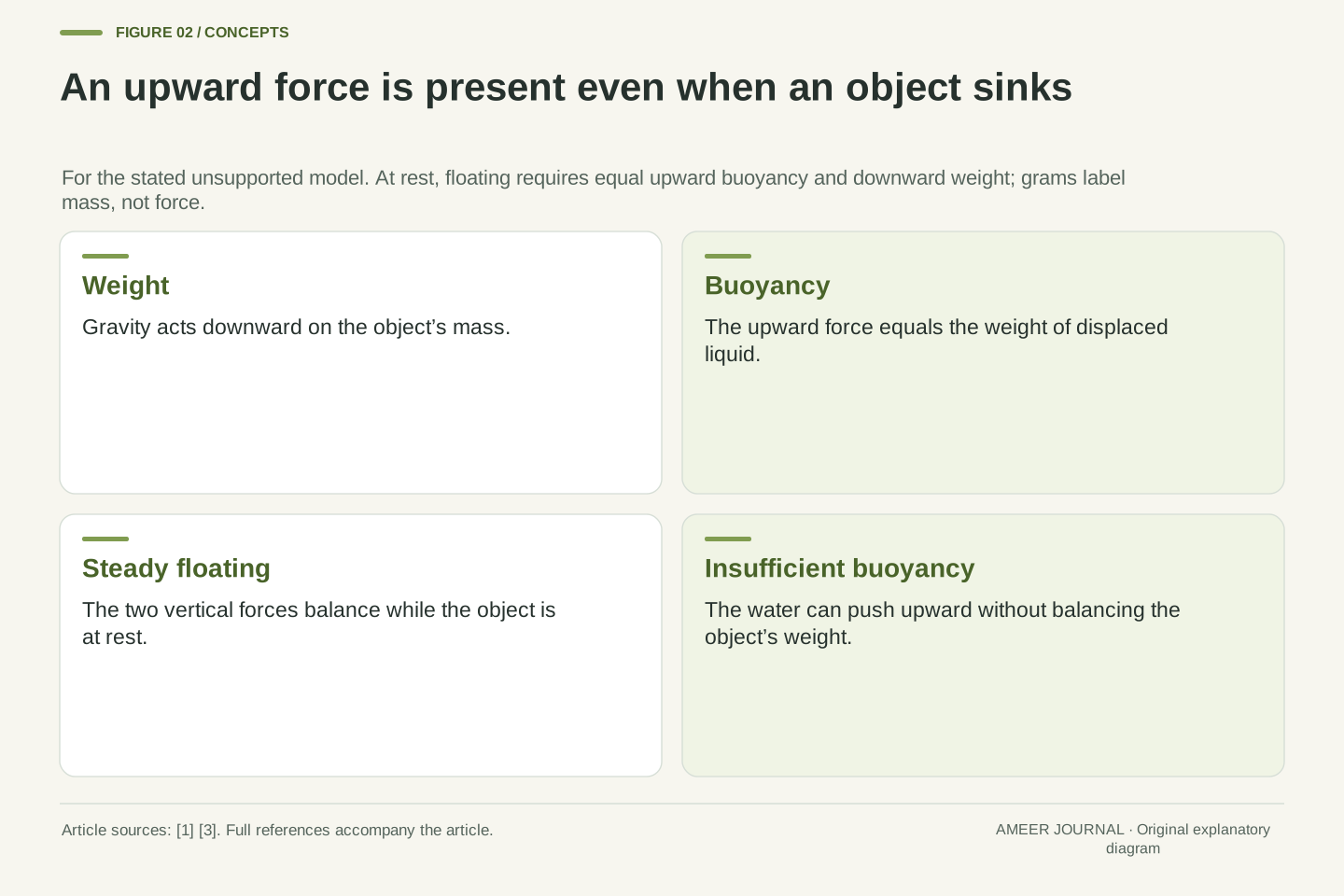
Gravity pulls our drawn object downward. That pull is its weight. The water exerts an upward force called buoyancy, or upthrust. An object floating steadily at rest has these forces balanced in our model. It has not lost its weight, and the water has not stopped pushing. There is a downward force and an equally large upward force. OpenStax explains the distinction between an upward force that is greater than weight, smaller than weight, or equal to it. [3]
If the upward force is too small when an object is released, weight wins the initial comparison and the object begins moving downward. That does not mean the water gives it no upward force at all. A sinking object can still experience buoyancy. [3] Keep another pair of words separate: mass and weight. We will label mass in grams, such as 30 g. Weight is the force due to gravity acting on that mass. In this puzzle, all objects and displaced water share the same gravity, so comparing their masses is a convenient way to compare their weights. A grown-up can help draw two labelled arrows, but their lengths should represent the stated forces rather than simply decorate the picture.
For an unsupported object in the stated vertical equilibrium, FB=W, where FB is the upward buoyant force and W=mg is downward weight. Mass is measured in grams or kilograms, whereas force is measured in newtons. Equal masses at the same gravitational acceleration have equal weights, which justifies the mass comparisons used in Easy mode. It does not make a gram a unit of force. The force-balance distinction is explicit in OpenStax's treatment. [3]
Take upward as positive. With only the two modeled forces, the net vertical force is FB−mg. A positive value implies upward acceleration, a negative value downward acceleration, and zero gives no vertical acceleration at that moment. To describe an object stationary at the surface, we also specify that it is at rest. Once motion develops, fluid drag and other dynamics can matter; our initial-force comparison is not a prediction of sinking speed. The existence of buoyancy does not therefore guarantee floating, and balanced vertical forces alone do not guarantee rotational stability. Those are distinct questions. Our upright stable-hull assumption allows the paper lesson to focus on whether the required displaced volume is available before water reaches the rim.
Count the water whose place the object takes
Displaced water is the water pushed out of the space occupied by the submerged part of an object. It does not mean all the water touching the object, and it does not mean all the water in a lake. Imagine removing the object from a still-water drawing. Which space below the waterline could water now fill? That helps identify the volume the object had kept out. Archimedes' principle connects this displaced water to buoyancy: the upward force equals the weight of the displaced water. [1][3]
For a solid lump under the surface, the displaced volume is the lump's volume. For a dry hollow hull, the outside shape can keep water out of some interior space as well. The hull's walls matter because they separate that space from the water. The air inside an open boat does not need a sealed lid for this to happen; the sides need to keep water from entering in the situation being considered. As a floating hull sits lower, more of its water-excluding shape lies below the surface, so it displaces more water. Only the submerged part counts at that moment. The part above the waterline may provide room for a later increase, but it is not already displacing water.
Archimedes' relation is FB=ρfluid g Vdisp, where Vdisp is the volume of fluid excluded by the immersed object or hull. The pressure field in a still fluid produces the resultant upward force; deeper regions experience greater hydrostatic pressure. [3] The displaced-fluid interpretation avoids needing to add every local surface force separately. It also explains why the relevant volume is immersed, water-excluding volume rather than the entire outer envelope above and below the surface.
For a fully submerged rigid solid, Vdisp cannot increase beyond the solid's fixed volume merely because it goes farther down in the ideal incompressible liquid. For a partly immersed watertight hull, increasing immersion can increase Vdisp while the interior remains dry. Its opening and geometry limit how far that assumption can be extended. Water entering the hull changes the earlier dry-system boundary and must be accounted for; one cannot continue crediting flooded space as excluded water. We will specify the available displacement directly instead of inventing an unprovided hull profile. No claim about percentage of height or waterline position will be inferred from a volume percentage alone.
The compact lump cannot move enough water aside
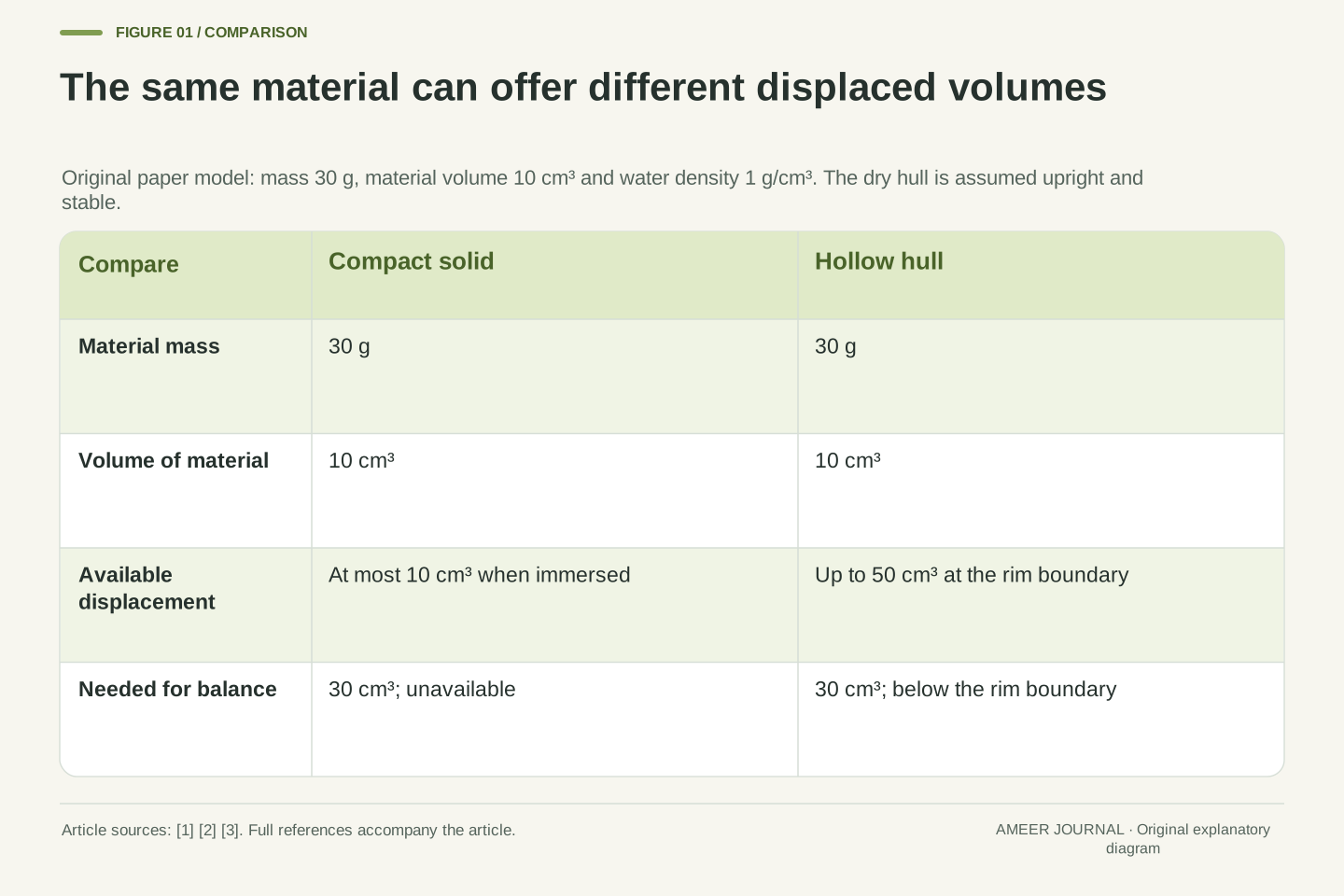
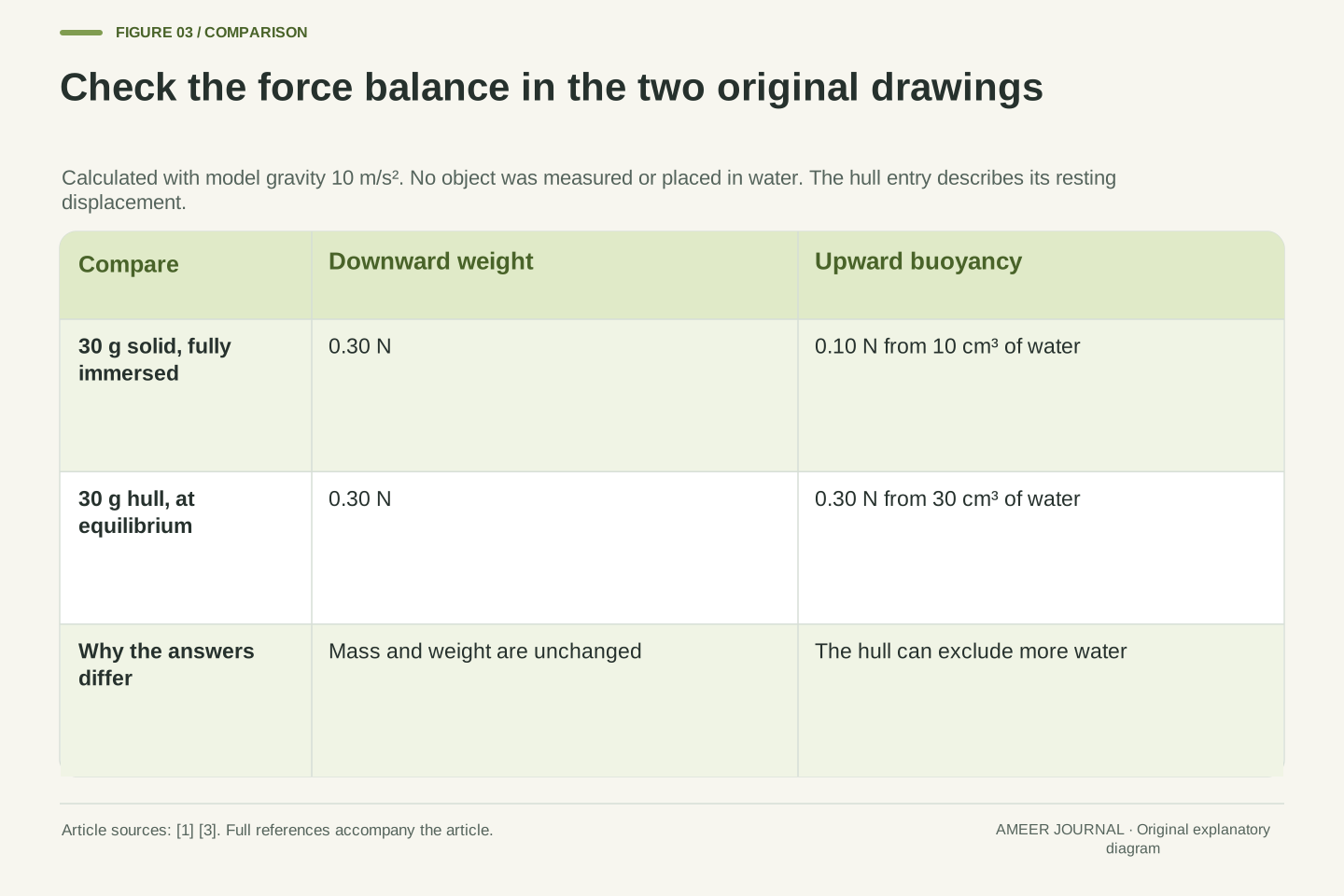
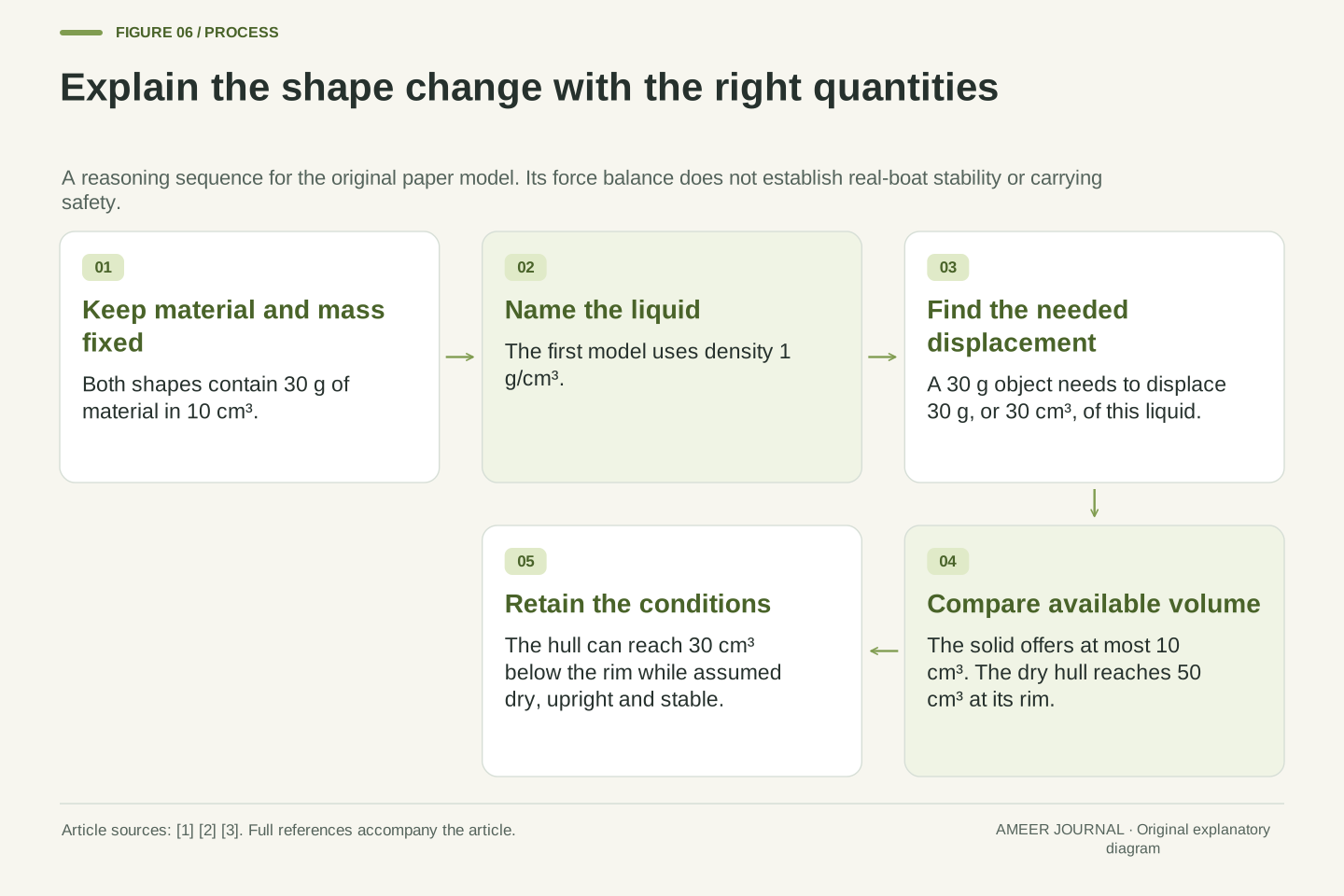
Our first card says: mass 30 g, solid volume 10 cubic centimetres. A cubic centimetre is the space in a cube one centimetre along each edge. For easy arithmetic, our model water has a mass of exactly 1 g for each cubic centimetre. That value is a rule for this calculation. When the entire lump is below the surface, it displaces 10 cubic centimetres of water, whose mass is 10 g.
The upward force equals the weight of those 10 g of water. The lump's downward weight belongs to 30 g of material. The upward force is therefore too small to balance the downward force. [1][3] The card predicts that the lump cannot float unsupported in this model, even when fully submerged. Notice what the explanation uses: both its mass and the volume of water it can displace. Saying only “30 g is heavy” would not have established the result. Going deeper cannot make this fixed-volume lump push aside 30 cubic centimetres instead of 10 under our assumptions. The water still provides some upward force, but there is no partly submerged position at which this lump can obtain the required buoyancy.
Let the solid have m=30 g=0.030 kg and material volume Vmat=10 cm³. Use the stipulated water density ρw=1 g/cm³=1000 kg/m³ and, for the force calculation, g=10 m/s². Its weight is 0.030×10=0.30 N. At full immersion, the displaced mass is ρwVmat=10 g=0.010 kg, giving a buoyant force of 0.10 N. The initial net force under these assumptions is 0.20 N downward.
The material density is 30/10=3 g/cm³, greater than the stipulated liquid density. Full immersion already supplies the maximum displaced volume available to this rigid solid. Partial immersion supplies less, so no unsupported surface equilibrium exists. This is a model-based force comparison, not a measurement of a real material or a claim about its terminal velocity. Pressure can increase with depth while the net Archimedean force on a fixed volume in a constant-density fluid remains ρw g Vmat. The larger pressure contributions do not create arbitrarily increasing buoyancy simply because the object is deeper. The same force relation explains why the water supports part of the weight while failing to support all of it. [3]
A hollow shape changes the available displacement
Now the second card uses the same 30 g of material, still occupying 10 cubic centimetres as material. This time it forms a watertight hull with an open top. The drawing gives one extra fact: the hull can keep 50 cubic centimetres of water out before the waterline reaches its rim. The number 50 describes the hull's outside water-excluding shape, not 50 cubic centimetres of new material. We have not made the material itself lighter.
To balance a 30 g hull in our model water, the displaced water must also have a mass of 30 g. That requires 30 cubic centimetres of displacement. The hull can reach that amount before its 50-cubic-centimetre rim boundary, so a floating balance is available under our stated assumptions. [1][2][3] At that balance it displaces 30, not 50, cubic centimetres. The larger number describes available room to displace more if the hull sits lower. This is why the two cards can have different answers even with the same material and mass. The compact lump offers at most 10 cubic centimetres; the hollow shape can offer the 30 needed for balance while remaining dry and upright in the model.
Keep m=30 g and Vmat=10 cm³, but stipulate a watertight hull with maximum upright displacement Vrim=50 cm³ at rim level. Neglecting air mass, reshaping has not changed the material mass or its volume. For unsupported equilibrium, ρw g Vdisp=mg, so Vdisp=m/ρw=30 cm³. Because 30<50, the required vertical balance occurs below the stipulated rim-displacement boundary if the assumed stable upright geometry permits the stated displacement progression.
This construction distinguishes a volume limit from the volume actually displaced at equilibrium. Crediting the full 50 cm³ while retaining the unloaded 30 g mass would give FB=0.50 N versus W=0.30 N, an unbalanced state under the toy assumptions, rather than the unloaded resting condition. The equilibrium value is FB=0.30 N at 30 cm³. Shape has changed the amount of external water the object can exclude for the same material content. [2][3] The calculation assumes that the hull is watertight and stable; it does not derive those properties from mass and maximum volume. A geometry that tips or admits water can fail those assumptions even if its nominal volume would otherwise be sufficient.
Name the volume before saying “less dense”
Density compares mass with volume. But which volume do you mean? Our imaginary material has 30 g in 10 cubic centimetres, so its density is 3 g per cubic centimetre in both shapes. Making a hull has not changed the material into a different substance. The thin walls still contain the same material. The whole hollow shape, however, includes space that its walls can keep water out of. That larger volume changes the comparison for the entire hull. [2][3]
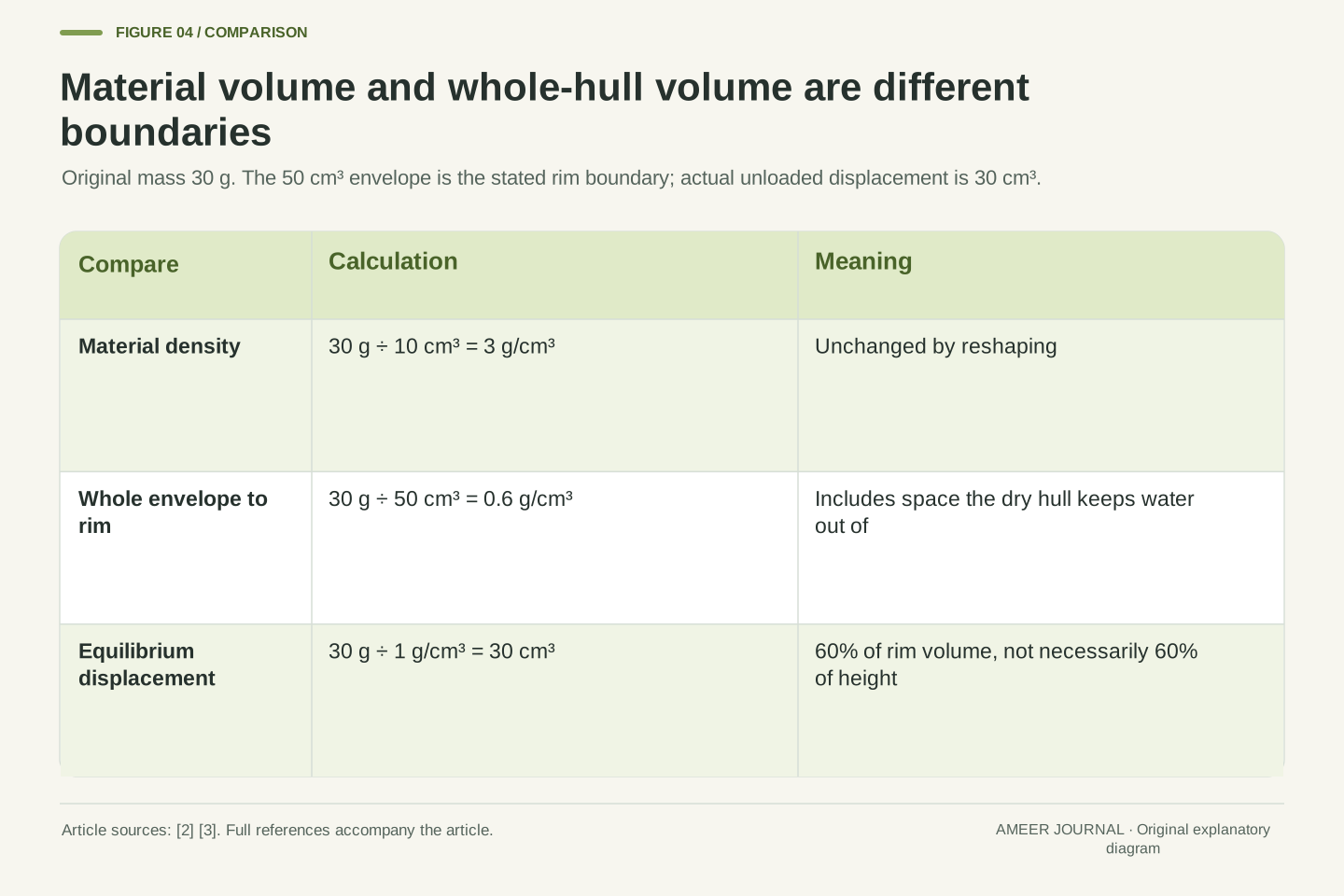
Using the hull's 50-cubic-centimetre outside volume up to the rim, the 30 g mass works out to 0.6 g per cubic centimetre of that whole envelope. This is a different calculation from the material's density of 3. Both can be correct because they divide by different volumes. At the floating position, only 30 cubic centimetres of the envelope are below the waterline. That is 60% of the stated volume up to the rim, but it does not automatically mean 60% of the hull's height. A hull that widens toward the top does not gain the same volume with every equal step downward. Keep the drawing's labels precise instead of changing their meaning halfway through the explanation.
The unchanged material density is ρmat=m/Vmat=30/10=3 g/cm³. A whole-envelope comparison using the stipulated volume to the rim gives ρenvelope=m/Vrim=30/50=0.6 g/cm³, neglecting air mass. The latter boundary includes space occupied by air while the hull is dry. It is not the density of the wall material. OpenStax and the Waikato resource distinguish the average object or system from its constituent material when explaining hollow shapes. [2][3]
At the unloaded equilibrium, Vdisp/Vrim=30/50=0.6. This volume ratio is compatible with the density ratio ρenvelope/ρw for the stated envelope, but it is not a universal draft-to-height ratio. Converting volume to a waterline height requires the hull's geometry. Nor should m/Vdisp=1 g/cm³ at equilibrium be reported as a change in material density: that ratio deliberately divides object mass by displaced-fluid volume, which the equilibrium condition forces to match fluid density. The exercise is about choosing consistent system boundaries. Saying merely “shape lowers density” is incomplete unless the explanation names the whole-system volume that changed and distinguishes it from the material volume that did not.
Add a drawn cargo label and repeat the comparison
Give the hull a drawn cargo card labelled 15 g. Its total mass becomes 30+15=45 g. In our model water, equilibrium now needs 45 cubic centimetres of displacement. That is more than the unloaded 30, so the hull must sit lower to push aside the extra water. It is still below the stated 50-cubic-centimetre rim boundary. The paper model allows the required balance, assuming the hull stays upright, dry and stable.
Now replace that card with one labelled 25 g. The total is 55 g, requiring 55 cubic centimetres of displaced water. The dry hull cannot provide that amount before its rim reaches the waterline. It therefore has no dry floating balance within the stated model. [2][3] A 20 g card would put the total exactly at 50 g and the waterline at the rim boundary. That is a mathematical edge case with no clearance above the water; it is not a safe carrying allowance. These are picture calculations, not rules for loading real boats. Their lesson is that added mass requires more displaced water, and a shape's useful water-excluding space cannot be increased simply by wishing that the upward force were larger.
For cargo mass mc, equilibrium requires Vdisp=(30+mc)/ρw when masses are in grams and ρw is in g/cm³. At mc=15 g, the total is 45 g and Vdisp=45 cm³. The upward and downward forces would each be 0.45 N under g=10 m/s². At mc=25 g, the total is 55 g and the required 55 cm³ exceeds Vrim=50 cm³. The maximum buoyancy at that boundary is 0.50 N, below the 0.55 N weight.
At mc=20 g the equation gives Vdisp=Vrim=50 cm³. The rim reaches the liquid surface in the ideal geometry, leaving no freeboard, or vertical clearance to the opening. It is a boundary of the dry-hull assumption rather than a practical load recommendation. Dynamic disturbances, stability, leakage, structural behavior and real loading rules are not represented. The useful analytical conclusion is narrower: below the volume boundary a vertical balance may exist under our stipulated conditions, while above it the required dry equilibrium cannot exist. The increased displacement of loaded versus unloaded ships is explained in the source material, but every cargo value and limit here is original and hypothetical. [2][3]
The liquid is part of the puzzle too
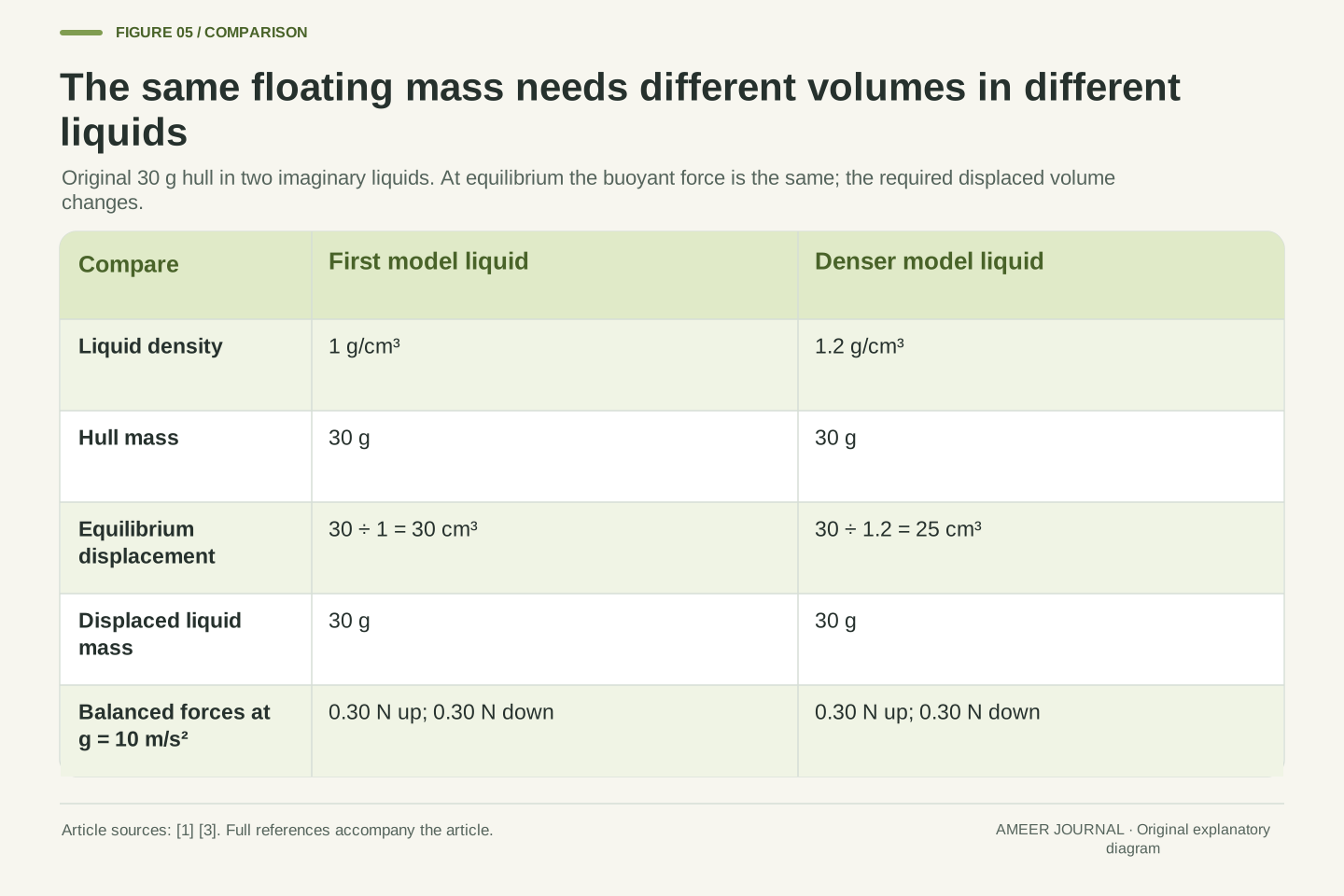
Until now we have used water with an assumed mass of 1 g per cubic centimetre. Buoyancy also depends on the density of the liquid, not just on the object. [1][3] Imagine a separate drawing in which the liquid card instead says 1.2 g per cubic centimetre. We are not naming a drink or asking anyone to mix a liquid. It is simply a new number in the paper model. Keep the unloaded hull's mass at 30 g.
In this denser model liquid, 25 cubic centimetres has a mass of 25×1.2=30 g. Displacing that amount provides the weight balance the hull needs. It therefore needs only 25 cubic centimetres of displacement, compared with 30 in the first liquid. The hull can sit higher in the same assumed upright geometry. Its mass has not decreased, and the material has not changed. Each displaced cubic centimetre now belongs to a larger mass of liquid. This is another reason “big” or “heavy” alone cannot settle a floating question. Name the object, its available displacement and the liquid. Changing any of those inputs can change the outcome, even when a drawing of the object looks exactly the same.
The equilibrium relation Vdisp=m/ρfluid makes liquid density an explicit input. Replace the stipulated ρw=1 g/cm³ with a hypothetical ρ*=1.2 g/cm³, keeping m=30 g. The required volume becomes V*=30/1.2=25 cm³. The displaced mass remains ρ*V*=30 g, so the buoyant force still balances the unchanged 0.30 N weight. The force did not need to become larger at equilibrium; a smaller displaced volume now provides the same force.
For the same upright hull with immersion increasing monotonically with displaced volume, the smaller equilibrium volume corresponds to less immersion. No numerical height change can be derived without its volume-versus-depth geometry. The chosen density is not asserted to be typical seawater, and the first density was an exact model input rather than an environmental measurement. NOAA identifies both displaced volume and fluid density as contributors to buoyancy. [1] Keeping them separate prevents a misleading explanation in which floating higher is attributed to a lost object mass or in which greater liquid density is assumed to imply permanently unbalanced upward force at a new resting position. Equilibrium again requires equal opposing vertical forces.
Solve three paper cards and explain the missing clue
Try three new cards with a grown-up, using the first model water again. Card A shows a solid object with mass 20 g and total volume 8 cubic centimetres. Card B shows an upright, stable, watertight hull with mass 20 g and a rim-displacement limit of 25 cubic centimetres. Card C shows the same kind of hull and the same 25-cubic-centimetre limit, but its mass label is missing. Decide what each card lets you conclude before reading the next paragraph. You can point to the numbers or circle them on a private drawing.
Card A can displace at most 8 g of this water, so it cannot balance its 20 g mass. Card B needs 20 cubic centimetres, which is below its 25-cubic-centimetre boundary, so the assumed model permits a dry floating balance. Card C has too little information: its missing mass could make the needed displacement smaller or larger than 25. Asking for the mass is a better answer than guessing from colour or picture size. The teaching literature identifies weight-only and size-only explanations as common misconceptions. [2] Our cards supply the specific clues needed to replace those guesses with reasoning. No score, name, photograph or uploaded result is needed to complete the puzzle.
The three original cards test whether the learner preserves the model's necessary inputs. With ρw=1 g/cm³, Card A's m=20 g and solid volume 8 cm³ give FB,max=0.08 N and W=0.20 N under the chosen gravity. Its full-immersion buoyancy is insufficient. Card B's m=20 g and Vrim=25 cm³ give Veq=20 cm³<Vrim, allowing a dry vertical equilibrium under the stated upright, stable assumptions. These conclusions compare supported quantities, not visual features of an illustration.
Card C provides Vrim=25 cm³ without m. It cannot support a unique answer: masses below, at and above 25 g lead to different relationships with the rim boundary in this liquid. “Insufficient information” identifies a missing physical input rather than a failure to calculate. The exercise is original; it does not reproduce the cited sources' assessment items. It responds to the teaching resource's documented misconceptions that equal weight must imply equal behavior, or that size alone determines floating. [2] Adult discussion can ask which assumption changed between cards and which remained fixed. All responses remain on the page, preserving the scope as a private paper-based learning activity.
Explain what changed without changing the material
Return to the first two drawings and give a complete explanation in your own words. The lump and hull each contain 30 g of the same material. The material still occupies 10 cubic centimetres. The compact lump can push aside only 10 cubic centimetres of our model water even when fully underwater, so its upward force is too small. The dry hull's outside shape can keep enough water out to displace 30 cubic centimetres before the rim reaches the surface. At that position, the opposing forces balance.
That explanation says what changed: the available water-excluding shape. It also says what did not: the material and its mass. A floating hull is partly in the liquid; it does not need to sit entirely above it. A sinking object can receive buoyancy without receiving enough to balance its weight. [2][3] Finally, remember the conditions printed beside the drawing. A leaking, tipping or moving object introduces questions this quiet, upright model did not answer. A useful science explanation joins the rule, the numbers and the conditions. The point is not to guess that every boat-shaped thing floats, but to show why this particular shape has a balance available that the compact shape does not.
The central inference is a change in feasible displacement at fixed material properties. The solid has m=30 g, Vmat=10 cm³ and FB,max=0.10 N, below W=0.30 N. The dry hull retains m and Vmat but has Vrim=50 cm³; its required Veq=30 cm³ lies below that boundary. At Veq, FB=W=0.30 N. The material density remains 3 g/cm³ throughout. The whole-envelope density and actual immersed volume answer different questions and remain separately labelled.
The argument is sufficient for the declared vertical-equilibrium comparison, not for every physical aspect of flotation. Hull stability, water entry, deformation, surface forces and motion can change the relevant system or forces. Those exclusions are part of the model's definition, not findings from an experiment. Archimedes' principle provides the displaced-fluid weight relation, while the original numerical cards expose the consequences and limits of applying it. [1][3] A clear explanation therefore names the conserved mass, the volume boundary that changed, the liquid density and the force condition being tested. That structure transfers to a new drawing without treating material names, size, colour or a familiar boat silhouette as substitutes for the required physical information.
Sources & further reading
Explore the references behind this guide. External pages may change after our review.
- Boat Building Challenge - Discover Your WorldNOAA Ocean Service · Accessed 6 Nov 2026
- Building Science Concepts: Floating and sinkingScience Learning Hub / University of Waikato, from New Zealand Ministry of Education science notes · Accessed 6 Nov 2026
- 14.4 Archimedes’ Principle and Buoyancy - University Physics Volume 1 | OpenStaxOpenStax / Rice University · Accessed 6 Nov 2026
Article updated 6 Nov 2026.