What you’ll take away
- A banana pseudostem is assembled from overlapping leaf sheaths; it is distinct from the true axis inside it.
- A lateral sucker develops from the underground stem as a distinct shoot. It is not the old fruiting shoot restarting.
- The connected mat can continue while an individual fruiting shoot finishes. These statements follow different biological units.
- The labelled snapshots and twelve-fruit bunch are invented teaching records, not schedules, yield measurements or survival guarantees.
A finished shoot does not have to be the end of the plant
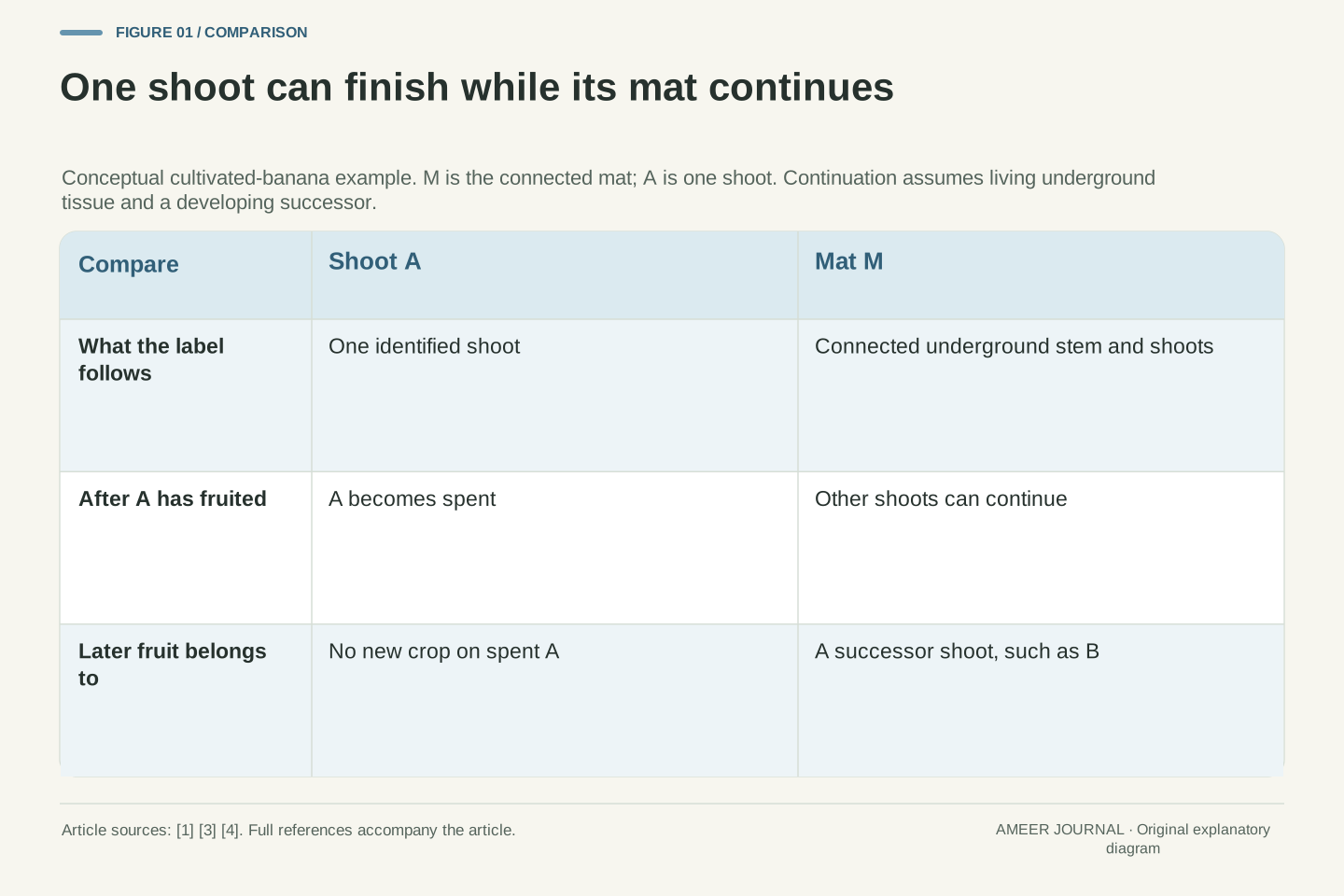
Imagine a banana plant with one tall, fruit-bearing shoot and a smaller leafy shoot beside it. After the tall shoot has fruited, that shoot finishes its life. Yet the connected plant can continue through the younger shoot. How can both statements be true? The clue is that we have named two different things: one shoot and the larger connected group. Banana specialists call that group a mat. It includes the underground stem and its shoots. A mat can persist while individual fruiting shoots finish and other shoots develop. [1][3][4]
We will follow two invented shoots, A and B, without growing or handling a real banana plant. Read with a grown-up and use the pictures on this screen or an uncut sheet of paper. The letters help us keep track of which shoot a sentence describes. A will not secretly turn into B when the picture changes. First we will locate the plant parts. Then we will follow the flowering route inside A and the separate route that produces B beside it. That difference solves the apparent puzzle.
Cultivated bananas combine a once-fruiting shoot with persistence through lateral shoots arising from an underground stem. The horticultural unit called a mat includes the rhizome, a fruit-bearing shoot or shoots, and suckers at other stages. [1] Texas A&M states that the shoot that has borne fruit will not produce again, while FAO's simplified account describes replacement by another sucker. [3][4] These descriptions are compatible when the fruiting shoot is distinguished from the continuing mat.
The original teaching record below labels two shoots A and B and a connected mat M. The labels preserve identity across stipulated stages; they do not represent measured plants, a growth simulation or a production schedule. The main task is to distinguish three relationships: overlapping leaf sheaths form a pseudostem, a true flowering axis develops within that structure, and a separate lateral shoot originates from the rhizome. The optional activity is adult-supported reading or drawing on uncut paper. No specimens or physical propagation procedures are needed to inspect those relationships.
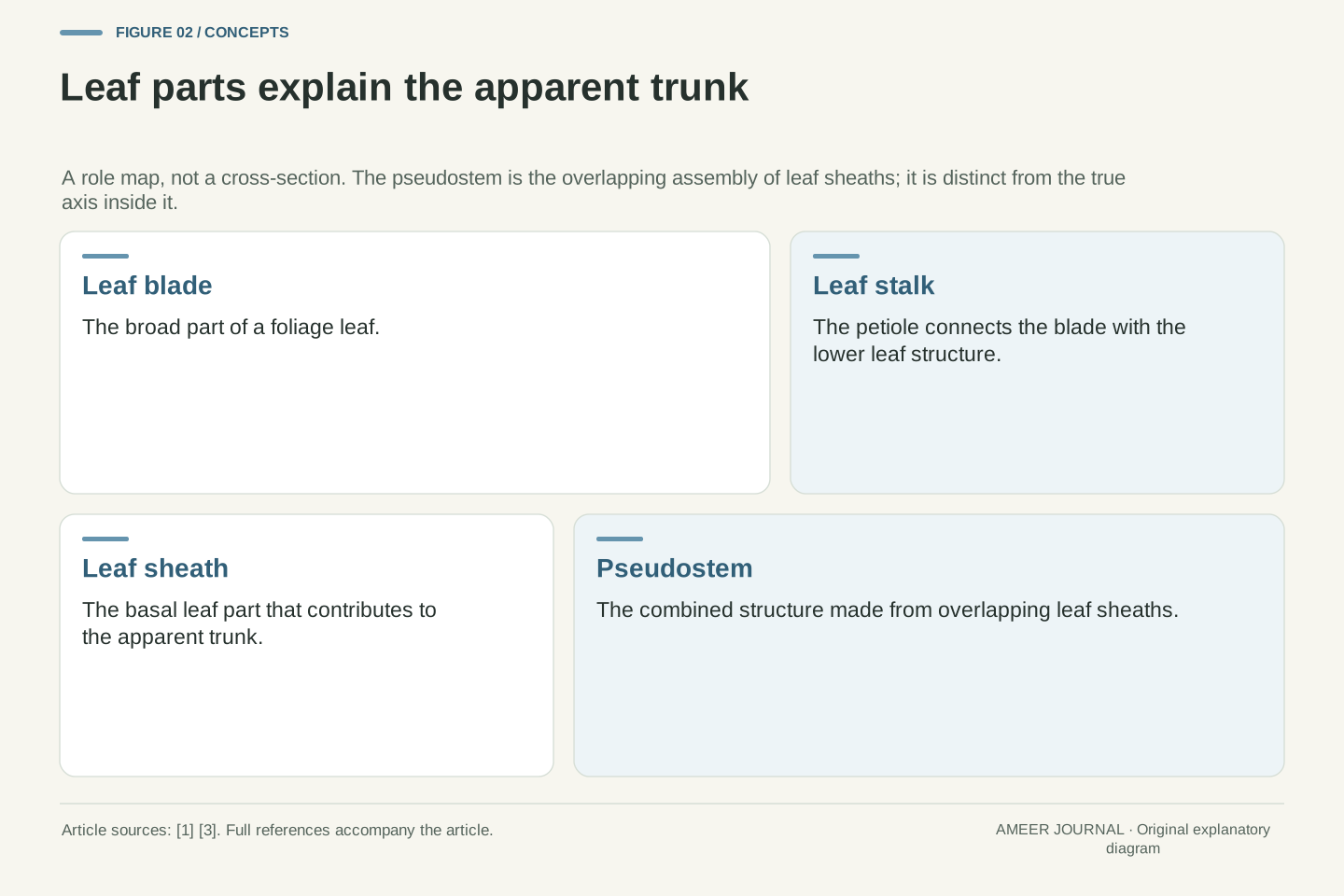
The apparent trunk is assembled from leaf bases
A banana's tall trunklike structure has a special name: pseudostem. Pseudo means false in this name, but the structure is real. It is made from tightly overlapping leaf sheaths, the lower parts of leaves. A leaf also has a stalk, called a petiole, and a broad blade. Many leaf bases together form the apparent trunk. The description is different from a wooden tree trunk, even though both can hold leaves high above the ground. [1][3]
In a labelled drawing, follow one leaf from its broad blade toward its stalk and sheath. Then notice that the pseudostem contains sheaths from several leaves. One label describes a part of a leaf; another describes the combined structure. Do not count every sheath as a separate banana plant, or assume the whole apparent trunk is one giant leaf. This is a relationship between parts and their arrangement. Our role map is deliberately simple and does not show every tissue or the exact shape of a section through the plant.
The pseudostem is a compact assemblage of overlapping leaf sheaths, rather than the plant's woody trunk or a synonym for its internal true stem. [1][3] A foliage leaf has a sheath, petiole and blade; the sheath contributes to the external trunklike structure while the blade spreads away from it. [1] Thus, organ identity and visible outline must be separated. A column-shaped structure is not necessarily one continuous stem organ simply because its silhouette resembles a tree trunk.
The figure maps these relationships without claiming to be an anatomical cross-section. Individual sheaths belong to leaves, and their overlapping arrangement constitutes the pseudostem. The true axis discussed later occupies a different structural role within that arrangement. If a drawing uses the same colour for every elongated part, it can accidentally hide this distinction. Keep the sheath assembly and the internal axis separately labelled. That does not require memorizing every leaf term; it requires retaining which structure is made from which parts when following the flowering route.
The underground stem connects the story
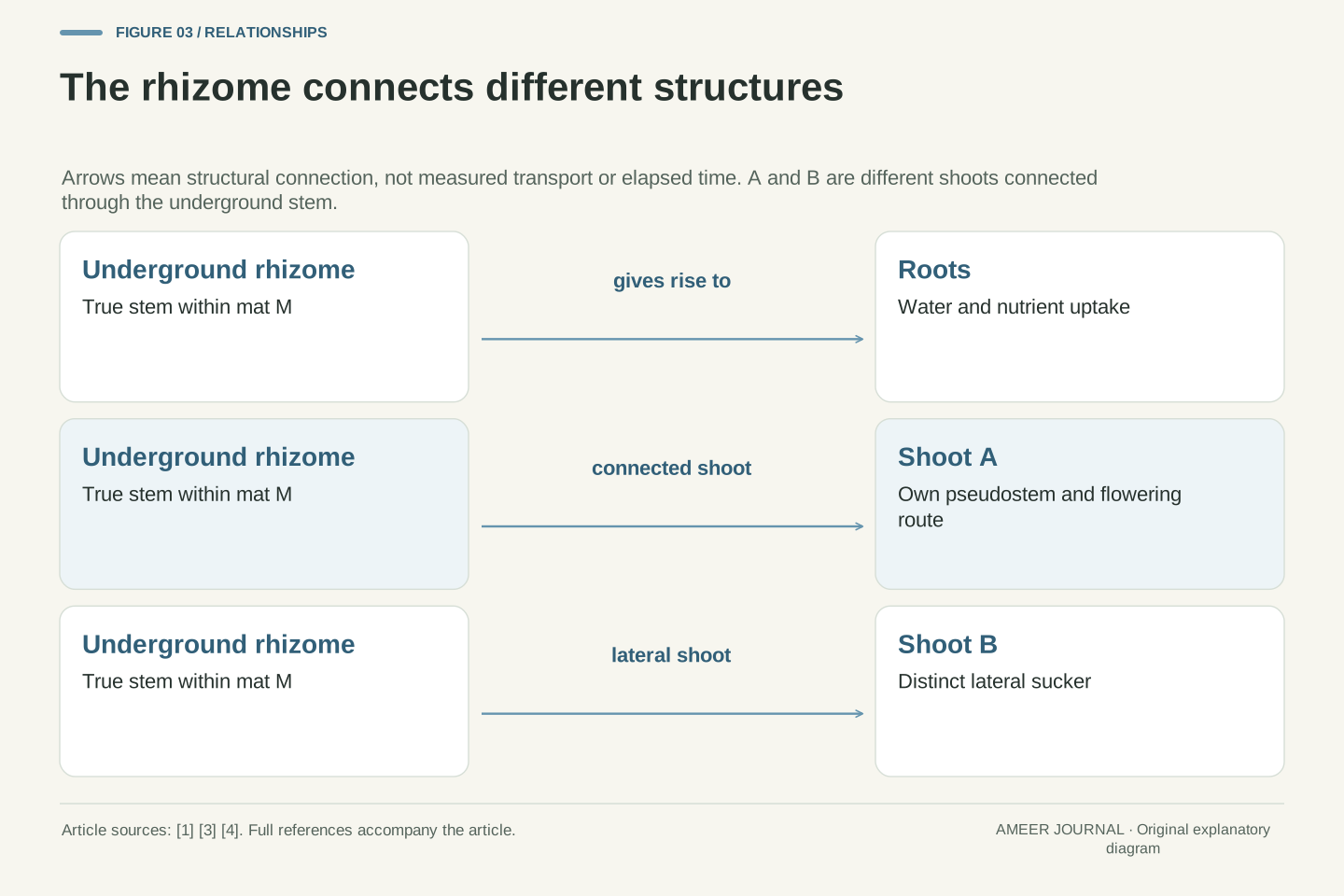
Below the ground is a stem structure called a rhizome. You may also meet the word corm in banana-growing descriptions. ProMusa uses rhizome and discusses why the names differ; Texas A&M uses corm. [1][3] For this article, underground stem is the useful shared idea. This part gives rise to roots and to new lateral shoots called suckers. Roots and the underground stem are different structures, even though both can be hidden by soil. The roots take up water and nutrients. [1]
Draw a ground line and place the underground stem below it. Connect roots downward and labelled shoots upward. These lines mean that the parts are connected; they are not a map of water-flow speed. Put A beside one shoot and B beside another. The drawing now gives us a place to trace B's origin. B is not a leaf growing out of A's banana bunch. Nor is B the same old apparent trunk wearing a new label. It is another shoot connected through the underground stem.
The rhizome is true stem tissue below ground, producing roots and lateral shoots. Root uptake and shoot development therefore belong to different organ systems connected through it. [1] Horticultural sources also call the banana underground organ a corm. [3] ProMusa explicitly prefers rhizome and distinguishes its morphology from the stricter corm category. [1] Using underground stem here avoids pretending that those two technical categories are interchangeable for every plant.
In the schematic, the ground line is a location reference and the connecting lines represent structural attachment. They do not quantify transport, prove identical ages or locate every meristem at anatomical scale. The useful topology places A and B on a common underground system while keeping their above-ground identities separate. A root is not relabelled as the successor shoot, and the flowering stalk of A is not used as B's point of origin. These distinctions remain meaningful even when the real structures are too complex to draw in full.
Flowering inside a shoot differs from making a shoot beside it
A growing point is a region where new plant structures develop. In the banana description, an apical growing point changes from producing leaf structures to producing flower structures. The true axis then extends upward inside the pseudostem, carrying the developing inflorescence, the flower-bearing structure. Eventually it emerges at the top. [1][3] Follow that route through shoot A in the picture. The surrounding leaf sheaths and the axis inside them should keep different labels throughout the explanation.
Now follow B's route. A sucker develops from a lateral bud on the rhizome. Lateral means at the side. [1] This is a branch in the plant's development, not the flowering axis of A taking a detour and becoming another apparent trunk. The two routes can be shown together because they belong to the same connected mat. One explains how an existing shoot reaches flowering; the other explains where a distinct successor shoot comes from. Drawing just one circular arrow around the whole plant would hide the difference we need.
ProMusa describes a vegetative-to-floral transition at the rhizome's apical meristem, followed by development of the aerial axis carrying the inflorescence upward within the pseudostem. [1] Texas A&M describes the eventual emergence of a terminal inflorescence. [3] This is a change in development along an existing shoot axis. It should not be drawn as the leaf-sheath assembly itself transforming wholesale into a flower cluster; the surrounding pseudostem and the internal true axis are distinct structures.
A sucker, by contrast, originates from a lateral bud on the rhizome. [1] The two paths differ in origin and identity: apical floral development continues the reproductive path of A, whereas lateral development establishes another shoot B. Their shared attachment does not make them one interchangeable axis. The diagram can represent these paths without specifying the precise moment each tissue changes, the length of the internal stalk, or a molecular cause of later shoot senescence. The anatomical distinction explains the succession route; it does not provide a complete physiology of death.
Keep the letter A attached to the same shoot
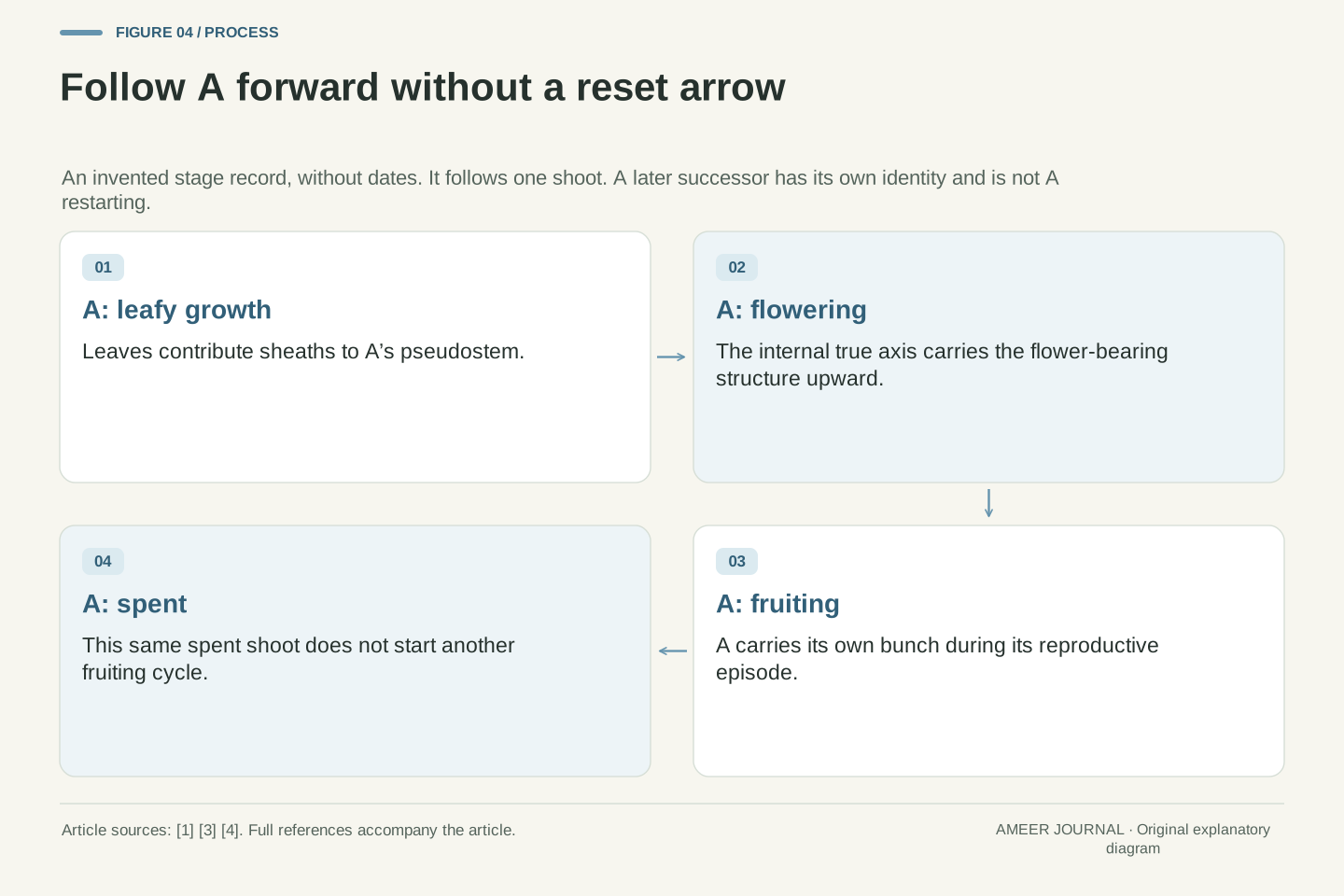
Our first invented record has four labelled stages for A: leafy growth, flowering, fruiting, and spent shoot. The arrows move forward through A's story. They do not give dates or say how long each stage lasts. The source accounts explain that a banana fruiting shoot dies down after its reproductive cycle and does not make another crop on that same spent shoot. [1][3][4] Keep the final A visible as a faded label so that a later B cannot be mistaken for A returning.
Suppose someone draws an arrow from spent A back to leafy A. That new arrow makes a new claim: the same shoot begins its fruiting cycle again. It is not supported by the account we are following. Repair the picture by leaving A's path finished and adding B's separate path from the underground stem. This is more than a spelling correction. The location of the arrow decides which structure is said to continue. A plant story can have repeated fruit production across shoots without sending an individual spent shoot around the same loop.
Define the original A record as an ordered sequence: A-vegetative, A-flowering, A-fruiting, A-spent. These are stipulated descriptive states, not a fitted time series. The source-supported restriction is that the spent fruiting shoot does not renew fruit production as that same shoot. [1][3][4] An identity label remains A even when its state changes. Replacing the final state with a new letter would conceal the very distinction the model is intended to make.
Within this record, a directed edge from A-spent to A-vegetative would assert a reset of the same shoot's reproductive history. That is the specific erroneous edge we reject. A path for B can instead share the continuing mat while retaining its own origin and state sequence. The model does not claim that every plant follows our four drawings with no intermediate stages. Its limited purpose is to prevent recurrence at the mat level from being represented as renewed fruiting of a spent individual shoot. A sequence of similar-looking shoots is not one shoot repeatedly restarted.
A successor can already be present while A fruits
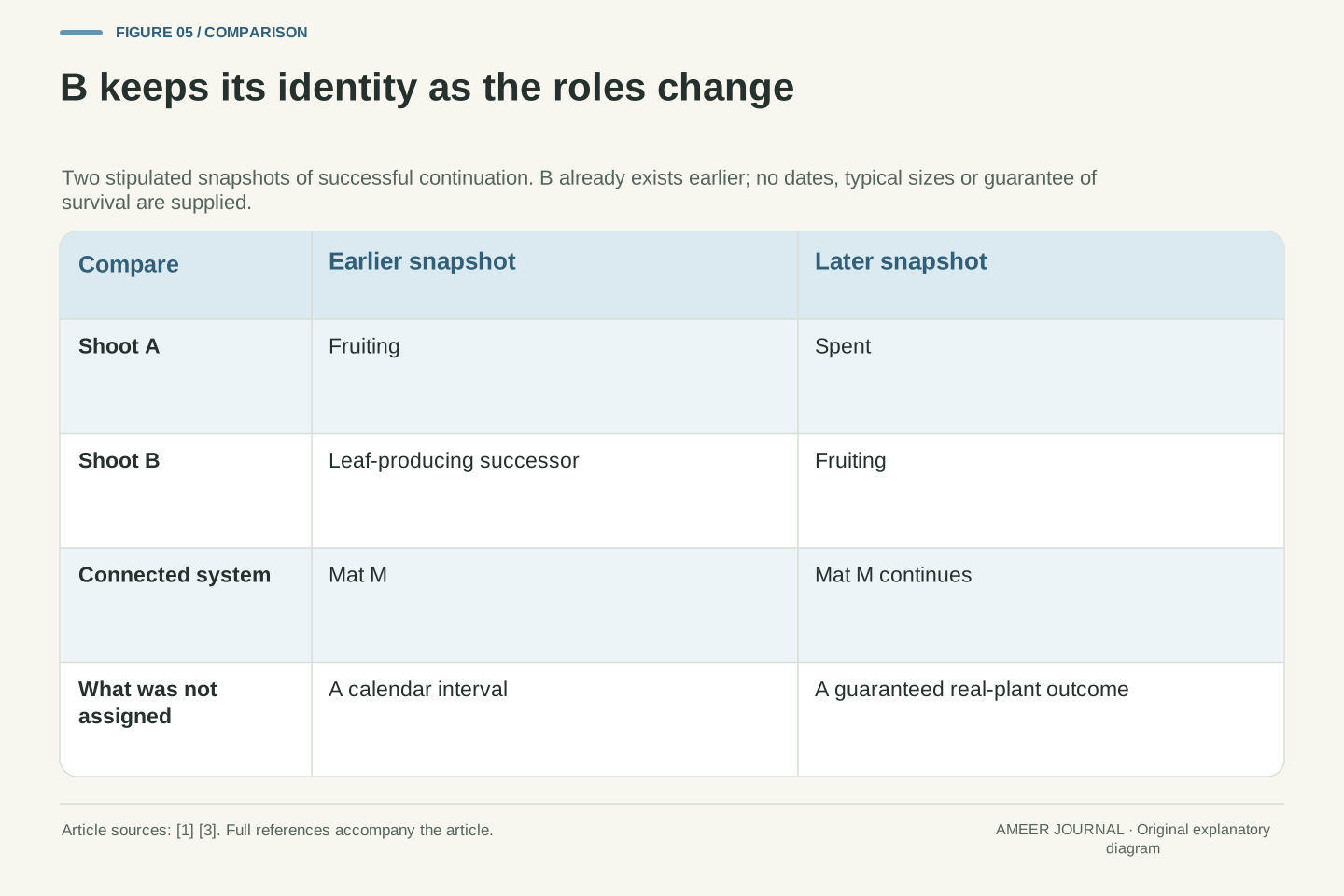
In our earlier snapshot, A bears fruit while B is a smaller leafy shoot. In our later snapshot, A is spent and B bears fruit. Both snapshots keep the label M for the connected mat. This is an invented, successful continuation story. It follows the source description of suckers taking over and of mats containing shoots at different stages. [1][3] We have not assigned a month, height, harvest weight or probability to either snapshot.
Notice that B was already present in the earlier picture. Our story therefore does not require A's death to create B. The later fruit belongs to B's own shoot, although B is connected to the continuing underground system. This matters when describing a photograph pair: saying the plant has bananas again can be reasonable, while saying this same spent trunk fruited again would change the claim. To choose between those sentences, the labels and connections matter. A similar position in two pictures is not enough to keep the identity of an individual shoot established.
The two-snapshot fixture specifies an earlier state with A fruiting and B vegetative, and a later state with A spent and B fruiting. Mat label M persists, and B has the same identity in both snapshots. Mixed-age mats and lateral successor development are supported by the horticultural descriptions. [1][3] The fixture is conditional: it assumes that the relevant underground system remains living and B develops successfully. It does not estimate how often such an outcome occurs.
Because B is already included earlier, A's death is not its origin event in this model. The record separates coexistence, succession and causation. A later reproductive role for B does not establish that senescence of A alone triggered B's growth, nor does it establish a waiting interval between them. Texas A&M qualifies flowering time by variety and weather. [3] Our diagrams therefore show ordered relationships without exporting a regional timetable. This is enough to identify the successor while leaving causal physiology and environmental timing outside the stipulated record.
Perennial describes the continuing mat
A perennial plant can persist across growing seasons. Banana is described as a perennial herb because shoots from the underground stem continue the plant after a fruiting shoot finishes. [1] Herb is a botanical description here; it does not mean that the plant is small or a kitchen seasoning. The important question is which living structure our sentence follows. A sentence about A's fruiting history and a sentence about M's continuation can have different endings without contradicting each other.
Try completing two statements with your grown-up: A has finished its fruiting story; M continues through B in this model. Point to the matching labels as you speak. Do not stretch the second statement into a promise that M lives forever, that every sucker succeeds, or that every bit of underground tissue stays unchanged. Our later snapshot simply supplies a living connection and a developing successor. The identity label helps organize the explanation; it is not a measurement of every cell or a guarantee about any real banana plant.
Perennial persistence and once-only fruiting apply at different levels of the account. ProMusa describes banana as perennial because lateral suckers continue development into fruit-bearing shoots, while the individual fruit-bearing axis dies down. [1] The mat is the connected horticultural unit; A and B are separately identified shoots within it. Thus, persistence of M does not logically require persistence of the reproductive capacity of A.
The label M also does not assert material identity of every tissue across time. It records continuity of the connected system under the assumptions of our example. Likewise, the presence of a lateral bud does not guarantee that every potential shoot will survive, reach flowering or do so on an identical schedule. The source notes cultivar variation in sucker production, and the regional account qualifies developmental timing. [1][3] These qualifications leave the central explanation intact: a continuing plant can contain a succession of shoots with distinct reproductive histories. They prevent that explanation from becoming an unconditional survival or yield prediction.
Fruiting once does not mean making one banana
The word once describes a shoot's fruiting episode, not the number of bananas it contains. A bunch includes fruit arranged in groups called hands. The individual fruits are sometimes called fingers. [1][3] These names form a useful hierarchy: the bunch contains groups, and each group contains fruits. They do not turn the hands into separate shoots or give every fruit its own independent pseudostem.
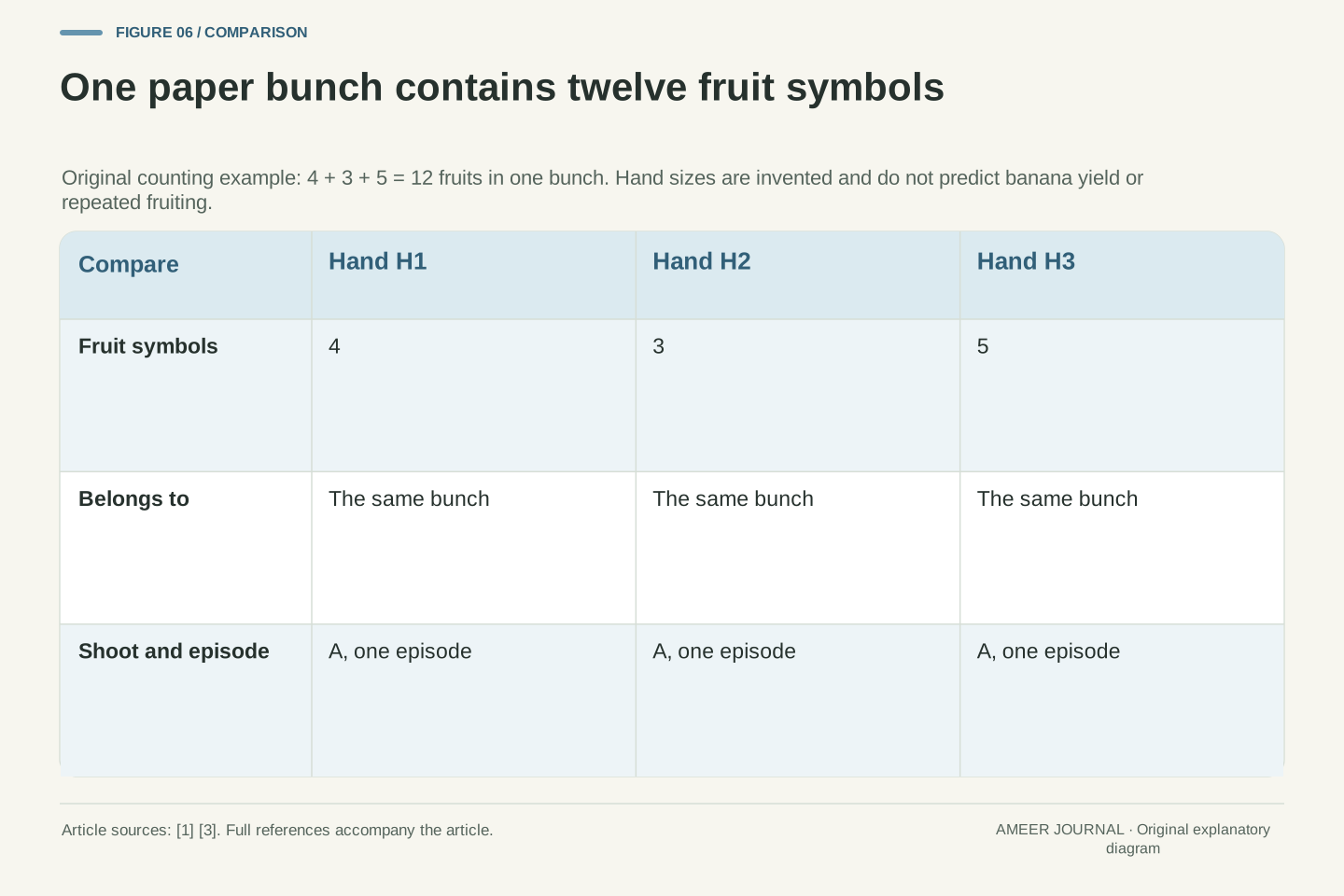
Our paper bunch has three invented hands, H1, H2 and H3. H1 contains four fruit symbols, H2 contains three, and H3 contains five. There are twelve fruit symbols altogether because 4 + 3 + 5 = 12. All twelve belong to one drawn bunch assigned to A's single fruiting episode. These numbers were chosen for the picture; they are not typical yield figures. If you moved the twelve symbols into different hand groups, the fruit total could stay twelve while the grouping changed. Neither arrangement would show A completing twelve separate fruiting cycles.
A bunch is the whole fruit grouping, with hands corresponding to groups of fruits; individual fruits are often called fingers. [1] Texas A&M describes the flower groups from which fruit-bearing hands develop. [3] A statement about a shoot fruiting once therefore must not be interpreted as a statement that the shoot produces exactly one fruit. The counted unit in the life-history statement is a reproductive episode of the shoot, not an individual ovary-derived fruit.
The original finite fixture assigns hand cardinalities 4, 3 and 5 to H1, H2 and H3. Their sum is 12 fruits in one represented bunch. Each fruit symbol belongs to exactly one of those hands, so no symbol is counted twice. This is a vocabulary and containment exercise, not a distribution of measured fruit numbers or an estimate of crop performance. Relabelling each fruit as a separate fruiting event would confuse membership within the displayed bunch with temporal recurrence of the shoot. The diagram supplies no such recurrence, regardless of how many fruit symbols it contains.
Repair the arrow that changes the story
Look at a deliberately mistaken sentence: after A finishes, B is A starting over. Replace it with a sentence that preserves both labels: after A's fruiting story finishes, the connected mat can continue through B's own development. [1][4] Now draw two rows, one for A and one for B. Keep the underground connection visible beside them. A's flowering and fruit belong on A's row; B's later flowering and fruit belong on B's row.
Use an arrow along a row for a later stage of the same shoot. Use a connection to the underground stem to show where a lateral shoot belongs. Those two marks answer different questions. A stage arrow asks what happens next to this shoot. A structural connection asks what is attached to what. If every line is treated as the same kind of arrow, the picture may accidentally say that roots turn into fruit or that a spent pseudostem becomes its neighbour. Adding a short label to each connection keeps the botanical explanation readable.
The repair distinguishes a temporal relation from an attachment relation. Temporal edges connect successive states of A or successive states of B. Structural links connect their origins to the rhizome within M. The supported succession account uses both relations, but neither should be substituted for the other. [1][4] In particular, a common attachment does not establish A = B, and a later fruiting state of B is not a second fruiting state of A.
This is a small typed graph in the technical sense: each relation carries a meaning that limits the inferences it supports. The teaching fixture checks that A's sequence is forward only, B has its own sequence, and both labelled shoots belong to the stated mat. The false reset edge would violate the selected shoot history even if the drawing remained visually neat. The correction concerns the biological assertion encoded by the line. It does not require a new measurement, a photograph classifier or a claim that our simplified graph contains every branch and organ of a real plant.
Explain the continuation and keep its limits
Return to the first puzzle. The apparent trunk is a bundle of leaf sheaths. Inside one shoot, a true axis develops toward flowering. Beside that shoot, a lateral sucker can develop from the underground stem. The fruiting shoot can finish while the connected mat continues through that other shoot. [1][3][4] The explanation works because it keeps the parts, paths and identities separate. It does not need the old fruiting shoot to become young again.
Choose one figure and explain it aloud with your grown-up. You can stop after naming A, B and their underground connection, or add the words pseudostem and rhizome if they help. A useful final question is: does this arrow show the same shoot later, or a different shoot connected to the mat? Our drawings answer that structural question. They do not tell you when a particular plant will fruit, whether it will survive, or how to care for it. There is no score, photograph or information to submit; the labels already provide the material for the activity.
The supported mechanism is architectural and developmental: leaf sheaths form the pseudostem, an internal true axis carries the terminal reproductive structure, and lateral rhizome buds give rise to distinct successor shoots. [1][3] A mat can therefore persist through shoot succession without renewed fruiting of its spent shoot. [1][4] This resolves the apparent contradiction between perennial continuation and the end of one reproductive axis.
The account does not explain every physiological cause of senescence, establish the age of an unlabelled shoot, or predict a universal harvest interval. Our state order, persistent mat label and successful B development are declared properties of the example, not conclusions drawn from an anonymous photograph. No numerical probability was attached to them. The adult-supported exercise asks readers to trace named structures and assess what their connecting arrows claim. A complete explanation should identify both the continued unit and the finished unit, then stop where the diagram lacks evidence. That is enough to understand the banana's succession pattern without turning a reading activity into horticultural advice.
Sources & further reading
Explore the references behind this guide. External pages may change after our review.
- Morphology of banana plant | Improving the understanding of bananaProMusa / Alliance of Bioversity International and CIAT · Accessed 7 Nov 2026
- Banana - Fruit & Nut Resources Fruit & Nut ResourcesTexas A&M AgriLife Extension · Accessed 7 Nov 2026
- BananasFood and Agriculture Organization of the United Nations · Accessed 7 Nov 2026
Article updated 7 Nov 2026.