What you’ll take away
- A Thread network carries traffic; a Matter fabric establishes an operational trust context. Their counts need not match.
- A border router, controller and commissioner perform different roles even when one product combines them.
- Independent-fabric multi-admin can add credentials while preserving an existing network connection; an extra app alone does not establish enrollment.
- Reachability, authenticated identity, permission and supported functionality are separate parts of a successful control relationship.
- Separate fabric identities can affect the same physical light, without guaranteeing identical app displays or every product’s offline features.
A second control app does not automatically mean a second radio network
Imagine a smart bulb that already works through one home-control app. You want a second app to control the same bulb. Does it need another wireless network, another router or a second copy of the light? Those questions mix together different parts of the system. Matter provides an IP-based way for compatible devices to communicate; it is not itself the name of a particular radio connection [1][5]. Its multi-admin capability can give a device membership in more than one independent Matter fabric, meaning more than one trust relationship [2][6].
Our example uses one fictional bulb, one existing Thread network and two compatible control systems, called A and B. We assume that an authorized, supported process adds the bulb to B's fabric while leaving its Thread connection unchanged. The important change is in the bulb's credentials and administration, not its number of radios or physical light outputs. This is a worked explanation of the documented independent-fabric approach, not a test of two commercial apps. We will follow the connection, the identities and the permissions separately to see what each can establish.
The number of application interfaces visible to a user is not a count of transport networks or Matter security domains. Matter's operational communication uses IPv6, while its fabric model defines relationships among nodes that share operational trust [1][2]. The Connectivity Standards Alliance likewise describes Matter as an IP-based protocol [5]. A second control interface can therefore involve a new authorization relationship without requiring a second radio network. The exact relationship depends on how the relevant systems implement administration.
Consider a hypothetical single-node Thread bulb L, already commissioned onto fabric A. A supported independent-fabric multi-admin flow adds fabric B, with a distinct root of trust, while preserving L's network connection. Google and Nordic document the underlying multiple-fabric capability [2][6]. This article analyzes that stipulated configuration, not a particular ecosystem pairing. Its scope is the distinction among transport membership, operational identity, permissions and the controlled application state. Neither compatibility of arbitrary products nor successful operation follows merely from drawing the topology; each requires the relevant implementation and operating conditions.
Keep the network, the fabric and the app in separate columns
The Thread network carries traffic. A Matter fabric supplies a security context in which devices can identify one another. The app is an interface through which a person may request control. These descriptions overlap in the finished experience, but they do not name the same object. A fabric can include devices on different IPv6 networks, and multiple fabrics can coexist on a device [2][6]. In our example, the bulb uses Thread while the controllers reach it from another local IP network through a Thread border router [4].
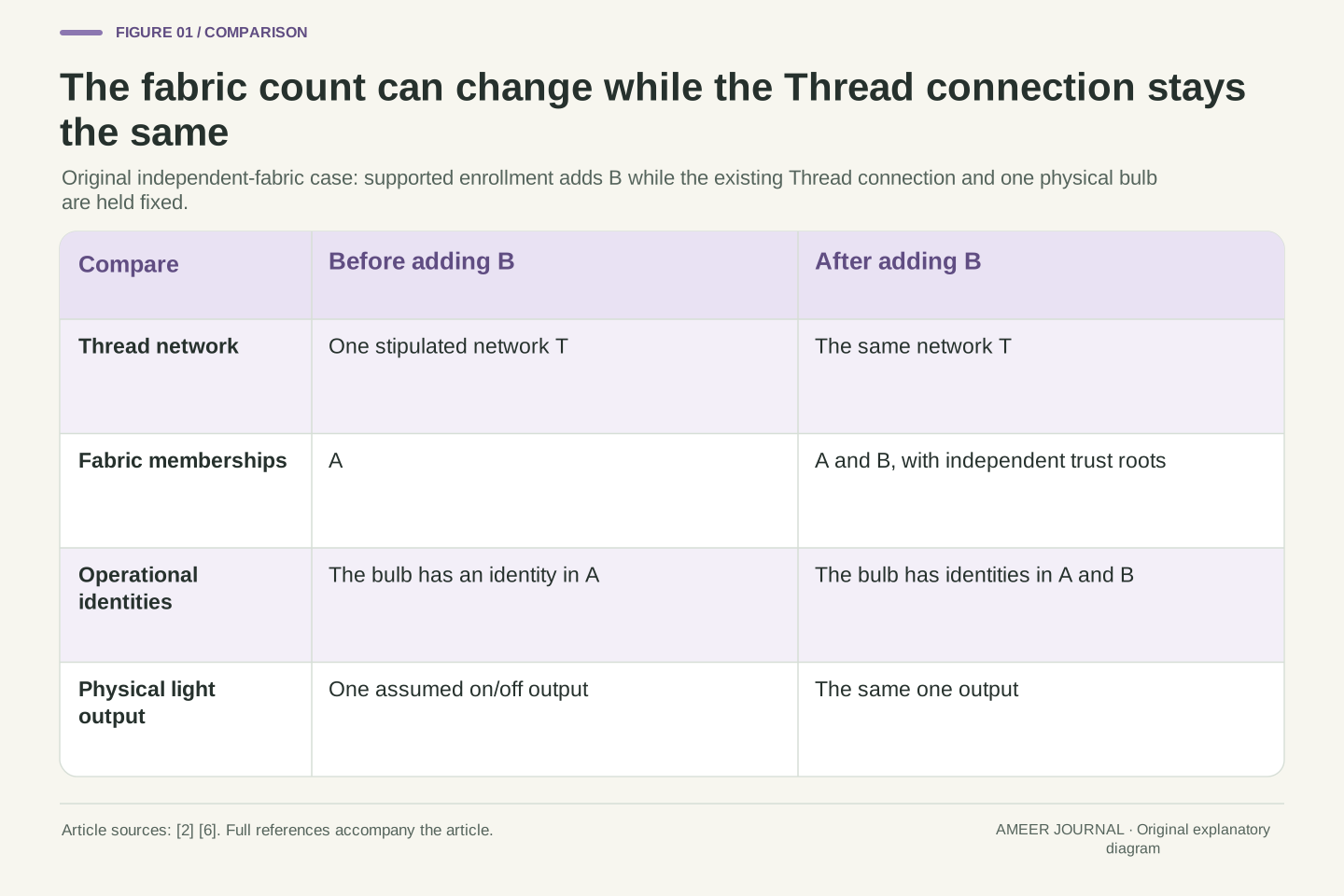
Write a small before-and-after record. Before adding B, the bulb has one Thread connection and membership in fabric A. Afterwards, it still has that one Thread connection, but it belongs to A and B. We have changed one count while holding another fixed. Conversely, two apps do not prove there are two fabrics: Nordic also describes multiple administrators within a single fabric [6]. Count the actual relationships, not the icons on a phone. This avoids a common purchasing assumption that every additional control app necessarily requires an additional wireless mesh.
Transport topology and trust topology are separate descriptions. Thread supplies an IPv6 network; a Thread border router connects that network to other IP networks such as Wi-Fi or Ethernet [4]. A Matter fabric groups operational identities under a common trust context, and its members need not share one underlying IPv6 network [2][6]. Consequently, a transport boundary is not automatically a fabric boundary. Equally, placing two nodes on a reachable local network does not itself give them the operational credentials of the same fabric.
For the original case, let T denote the existing Thread network and let F(L) denote L's set of fabric memberships. Initially F(L)={A}; after the supported addition, F(L)={A,B}, while transport membership remains T. This is an explanatory state record, not an SDK representation. The count changes from one to two fabrics without increasing the stipulated number of Thread networks. It is also not a general app-count formula: multiple administrators can be established inside one fabric [6]. A useful system inventory records network attachments and fabric relationships separately rather than deriving either from the number of user interfaces.
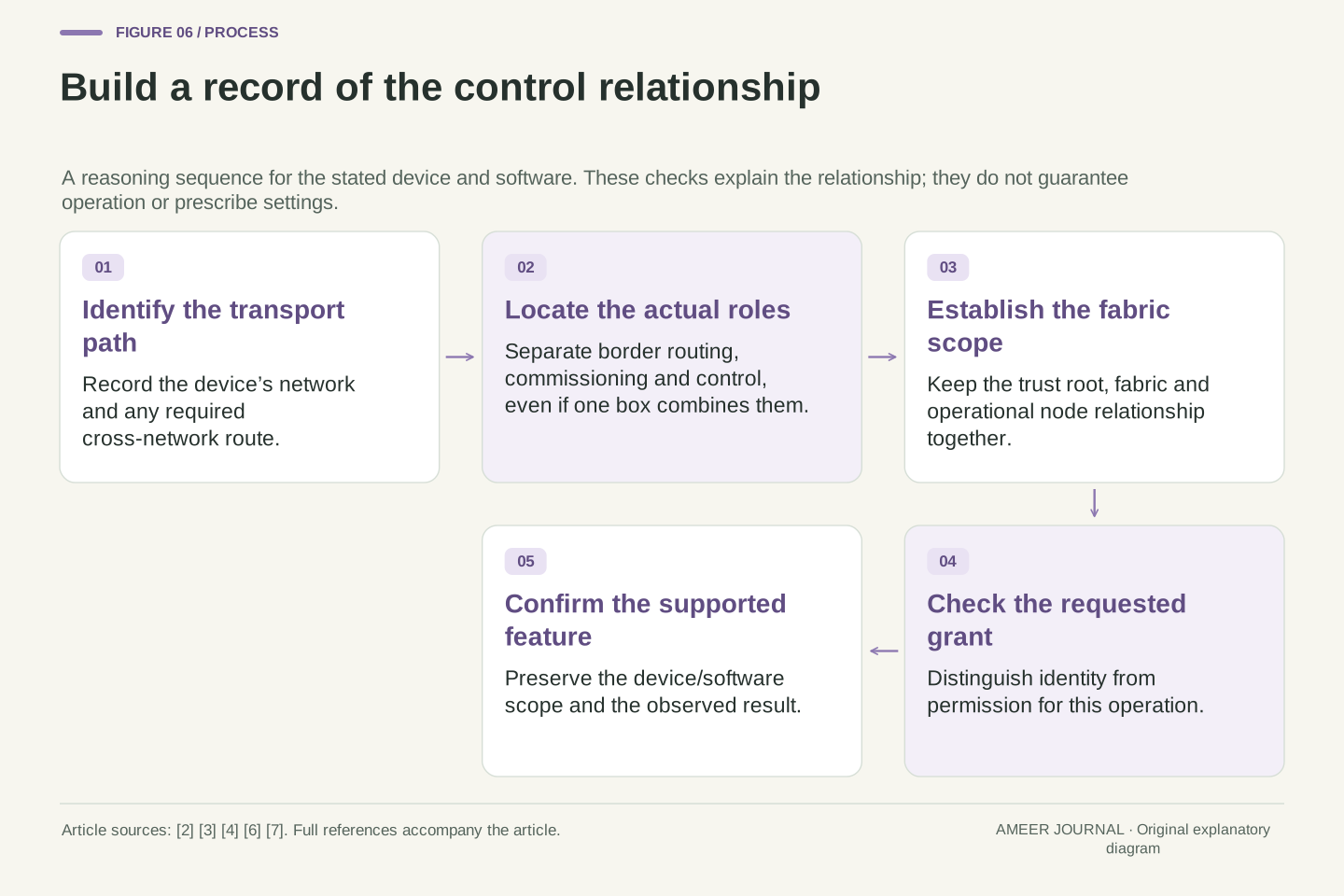
A border router, a controller and a commissioner do different work
A Thread border router lets traffic pass between a Thread network and other IP networks. OpenThread's description includes two-way connectivity and service discovery across that boundary [4]. A Matter controller can control another node, while a commissioner performs the process that adds a node to a fabric [3][7]. One device may perform more than one role [7]. A product described as a hub might combine several jobs, but the word hub alone does not tell us which jobs its particular hardware and software support.
In the fictional home, box H performs the border-router function and also hosts controller A. A separate compatible controller B uses the available IP path. H's forwarding role does not automatically grant B permission to change the bulb. Likewise, a controller's ability to issue an authorized light command does not mean it contains a Thread radio or can provide every commissioning function. Draw the roles before counting boxes. OpenThread's external Thread commissioning concerns joining a Thread network [4]; Matter commissioning concerns fabric credentials [3]. Both can be part of setup, but they solve different membership problems.
OpenThread defines the border-router role through bidirectional IP connectivity and related discovery functions between Thread and infrastructure networks [4]. Matter's commissioner role performs commissioning, whereas its controller role concerns control of other nodes; roles can coexist on a node [3][7]. These definitions describe behavior rather than a required one-box-per-role arrangement. A combined product may implement several functions, but the presence of one function is not evidence that every other function is present.
Assume H combines a Thread border router with A's controller and commissioning functionality. B is a separate compatible controller reachable through the same infrastructure. The traffic path can then include H's routing function without making H's Matter identity the authorization authority for every message. Distinguishing the roles also prevents a terminology collision: external Thread commissioning authenticates and joins a device to Thread [4], while the Matter procedure establishes fabric membership [3]. A network attachment and an operational Matter identity can be provisioned during related setup activities, yet their success conditions remain distinct. This role inventory is more informative than treating every device called a hub as interchangeable.
Initial setup establishes more than a wireless connection
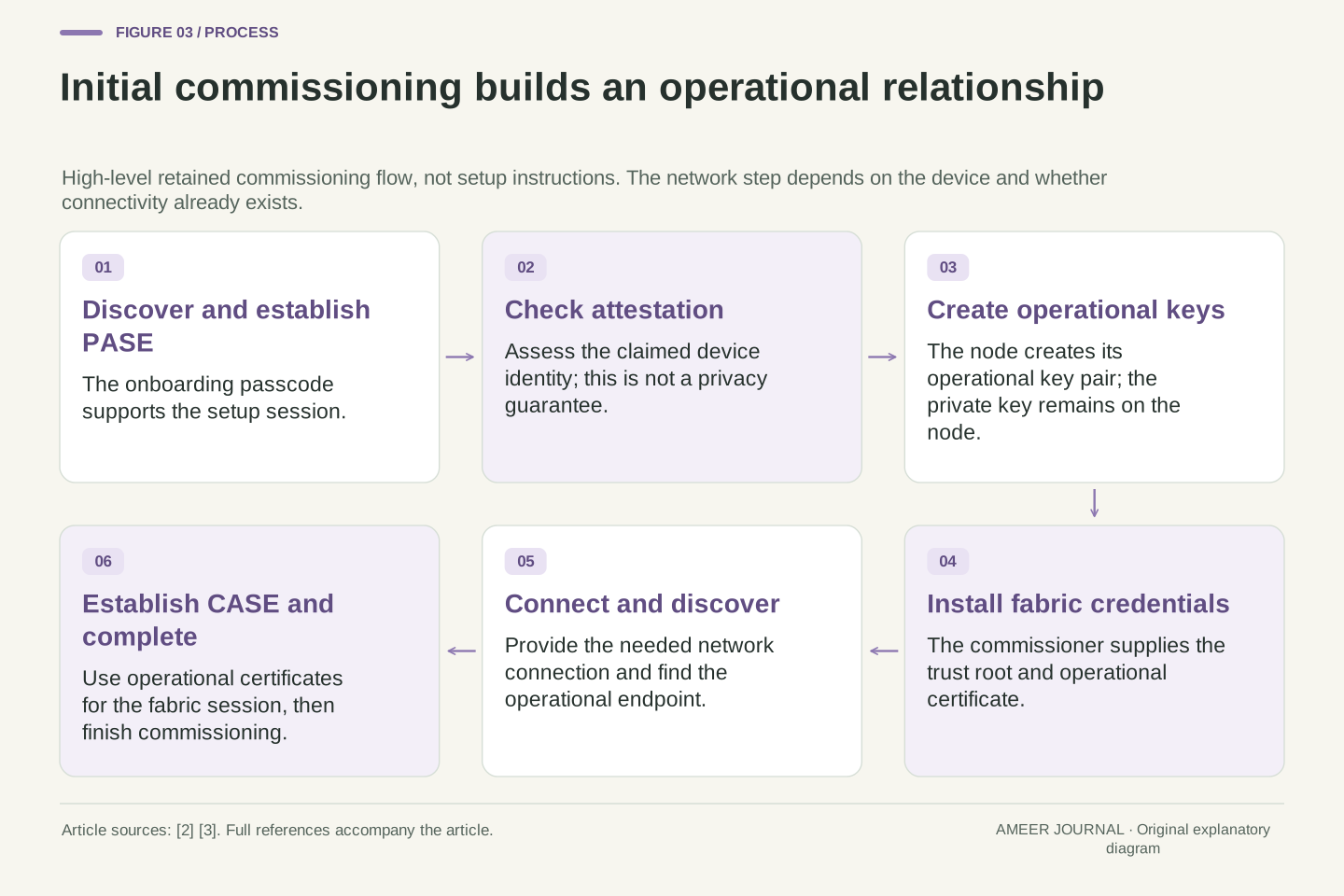
The retained Google commissioning guide describes several separate checks. A device is discovered, a passcode-based setup session is established, its claimed manufacturing identity is checked, and operational credentials are created and installed. Network provisioning and operational discovery then provide the working connection, followed by a certificate-based session and completion [3]. The manufacturing check, called attestation, asks a different question from assigning the bulb an identity in your fabric. A successful identity check is not a general assessment of every privacy promise or cloud feature in an accompanying app.
Bluetooth Low Energy may help with onboarding even when normal Matter control later travels over IP [1]. Google's introductory footnote explicitly discusses BLE in Matter 1.0, so it should not be read as an exhaustive list of setup methods in every newer product. The network step also depends on the connection: the commissioning guide distinguishes Thread or Wi-Fi provisioning from an Ethernet device that is already connected [3]. For our bulb, the useful outcome is both a working Thread connection and usable fabric credentials. Neither should be inferred merely because a setup screen once showed the bulb's name.
The documented commissioning flow separates PASE, attestation, operational-key creation, credential installation, network provisioning, operational discovery and CASE completion [3]. PASE is the passcode-authenticated setup session; CASE subsequently establishes trust using operational certificates. Google also explains that the operational key pair is generated by the node and that its private key is not sent to the commissioner or certificate authority [2]. This distinction matters: provisioning operational trust is not equivalent to distributing one shared application password to all controllers.
Attestation checks the claimed device identity, while the operational certificate places a node in the chosen fabric [2][3]. Neither is a statement that all application behavior has been audited. The operational transport remains another dependency. BLE can support onboarding, with the introductory source explicitly qualifying its discussion to Matter 1.0 [1]; it is not the ongoing IP transport in that description. The retained flow also distinguishes network provisioning for Thread or Wi-Fi from an already-connected Ethernet device [3]. These are explanatory stages, not instructions to enter credentials, change regulatory settings or assume that every current implementation uses an identical setup sequence.
Adding B changes the trust record, not necessarily the Thread connection
Now consider the bulb after A already controls it. In Nordic's independent-fabric description, an administrator of the existing fabric opens a commissioning window so another commissioner can add the device to another fabric. The device stores the new fabric information [6]. This is an authorized enrollment step. Installing a second app, seeing the bulb nearby or joining the same home network is not the same event. The new control system needs the appropriate relationship with the bulb, not simply a route on which to send messages.
In our chosen case, B's enrollment leaves the bulb's Thread connection in place. The bulb gains another set of Matter operational credentials. Google explicitly distinguishes these fabric credentials from the networking information shared across the device's fabrics [2]. A can retain its existing control relationship while B obtains its own. This does not make B a copy of A, and it does not require A's private operational identity to become B's identity. Multiple administrators inside one shared fabric are another documented arrangement [6]; the two-fabric example is one mechanism, not a rule that every extra app must create a separate fabric.
Nordic's documented multiple-fabric flow requires the existing administrator to open a commissioning window through the appropriate supported functionality, after which the other commissioner enrolls the node and it stores the additional fabric identifiers [6]. This changes the node's operational trust configuration. It is not a consequence of passive network discovery or of a second user interface being installed. The additional commissioner must participate in a supported authorized flow; physical reachability alone supplies no equivalent operation.
Holding the original Thread attachment fixed, the postcondition is L with fabric credentials for both A and B. Google's fabric explanation treats networking credentials as separate from those per-fabric operational credentials [2]. Thus the example does not need a second Thread dataset solely because B has an independent trust root. The two fabrics maintain their own communication relationships with L; this is not the copying of A's operational private key into B. Nor should two administrators always be modeled as two fabrics: Nordic expressly discusses multiple administrators on one fabric [6]. The chosen topology must be established from the actual implementation rather than inferred from the word multi-admin alone.
The same small identifier can refer to different fabric contexts
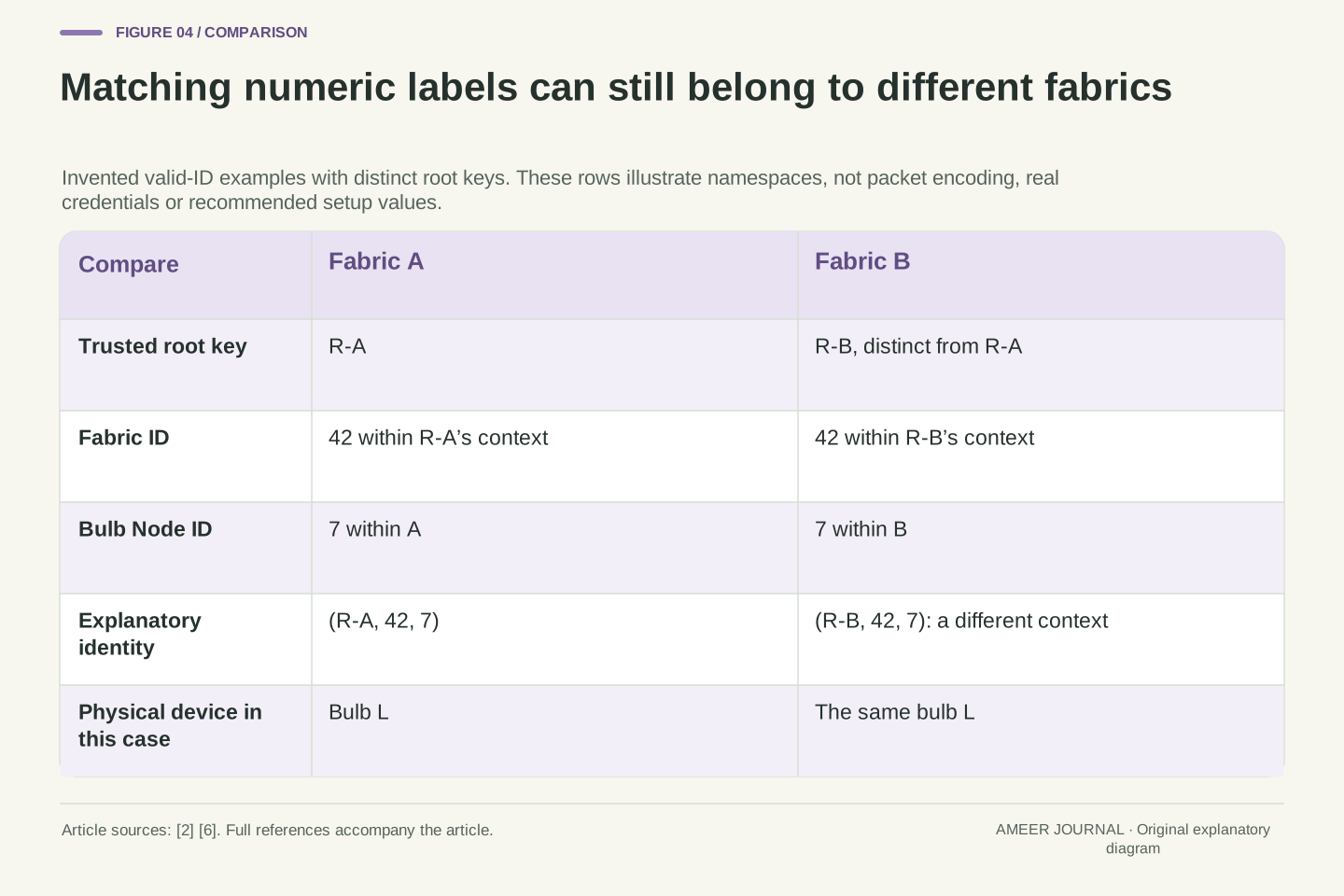
A number is meaningful only inside the namespace that defines it. Google describes a Fabric ID in the context of its root of trust and a Node ID that identifies a node within a fabric [2]. This means a bare number is not a universal serial number for a physical bulb. The root of trust, fabric and node relationship matters. A friendly name such as Hall Light is another label again; it should not be confused with the cryptographic identity used for operational communication.
Use deliberately invented numbers. Fabric A has root key R-A and Fabric ID 42; fabric B has a different root key R-B and also uses Fabric ID 42. In each fabric, our bulb has Node ID 7. The two operational contexts are different because the roots differ, even though the small numbers match. They still describe the same physical bulb in this example. Nothing has been duplicated in the room. These values illustrate the documented scopes [2][6]; they are not discovered credentials, suggested configuration values or a statement about how a particular app displays device identity.
The fabric identifier is scoped by its root-of-trust context, and the operational Node ID is unique within its fabric [2][6]. Comparing a bare 64-bit Fabric ID or Node ID therefore discards relevant identity context. It also conflates an operational identifier with a physical-device identifier. Google separately notes that a physical device may contain multiple nodes, while its introductory data-model example simplifies to one node per device [7]. Our bulb explicitly uses that simpler one-node assumption.
Define A=(R-A,42) and B=(R-B,42), where R-A and R-B denote distinct trusted root keys. Assign L Node ID 7 in each fabric. The explanatory tuples (R-A,42,7) and (R-B,42,7) are unequal despite matching numeric components. This demonstrates a namespace distinction, not a collision or failed identity assignment. The notation is not a Matter packet layout, certificate encoding or compressed-fabric-ID calculation. Nor does it imply that these identities belong to two physical lamps: our model assigns both to L. Preserve the root, fabric and node scopes when interpreting logs; a display name or isolated number omits information needed to understand the relationship.
Being reachable and authenticated does not grant every operation
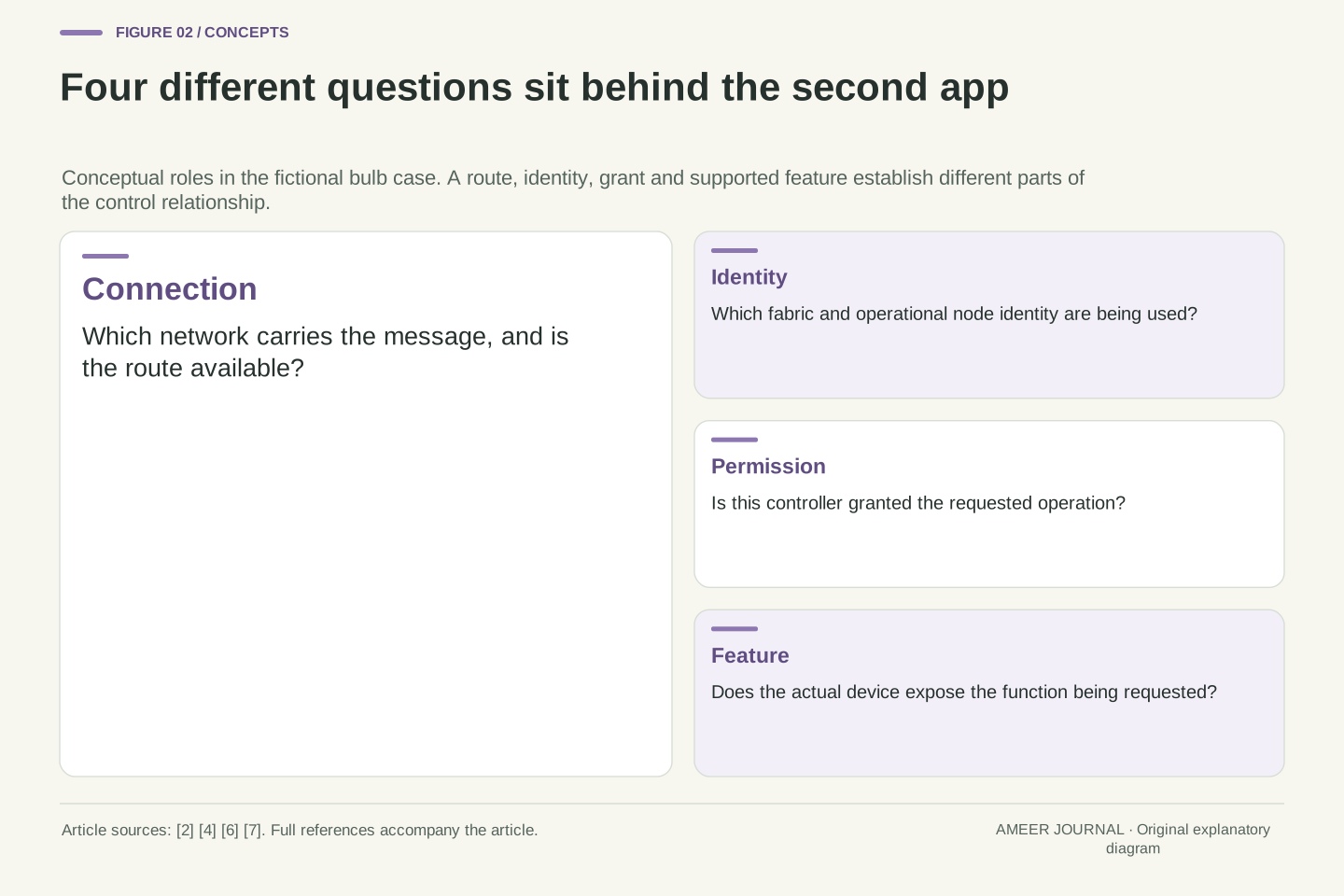
Suppose B can reach the bulb and establish the appropriate fabric relationship. We still need to ask what the requested operation is allowed to do. Nordic explains that administrators can grant different levels of privilege to other nodes through access-control information [6]. In a further fictional case, observer C belongs to A's fabric and is allowed to read the light's state but is not granted permission to change it. Reading and changing are different requests, consistent with Matter's distinction between state attributes and commands [7]. C's successful observation would not prove that its switch command must succeed.
Three simple questions help organize the example: is there a working path, is the relevant fabric identity established, and is this operation granted? If the path is absent, valid credentials do not deliver the request. If B has not been enrolled, reaching the bulb does not create B's fabric identity. If C lacks the change permission, a working authenticated connection does not supply it. Passing all three questions is still only a starting point: the feature must exist and the device must be able to carry out the request. This is a reasoning aid, not a replacement for the protocol's full checks.
Operational discovery identifies an address and port, and CASE establishes trust within the relevant fabric [3]. Authorization is a separate concern: Nordic describes administrator-managed access-control privileges for other nodes [6]. For a deliberately simplified command case, define R as reachability, F as the appropriate authenticated fabric relationship and G as a grant for the requested operation. R∧F∧G is a necessary-condition model for that case, not a complete implementation of Matter access control or proof that actuation succeeds.
Consider three failures. With R=false, the stipulated route cannot deliver the command even if identity and grant remain valid. With R=true but F=false, mere connectivity does not create the absent operational identity. With R=true and F=true but G=false, the requested action remains unauthorized in the model. Observer C is another node within A's fabric, with G=true for reading state and G=false for changing it; no numeric privilege encoding or ACL modification command is prescribed. A fourth case has all three true, but still needs a supported feature and appropriate device behavior [7]. This separation avoids diagnosing every control failure as a radio problem.
A Thread border router is not automatically a Matter bridge
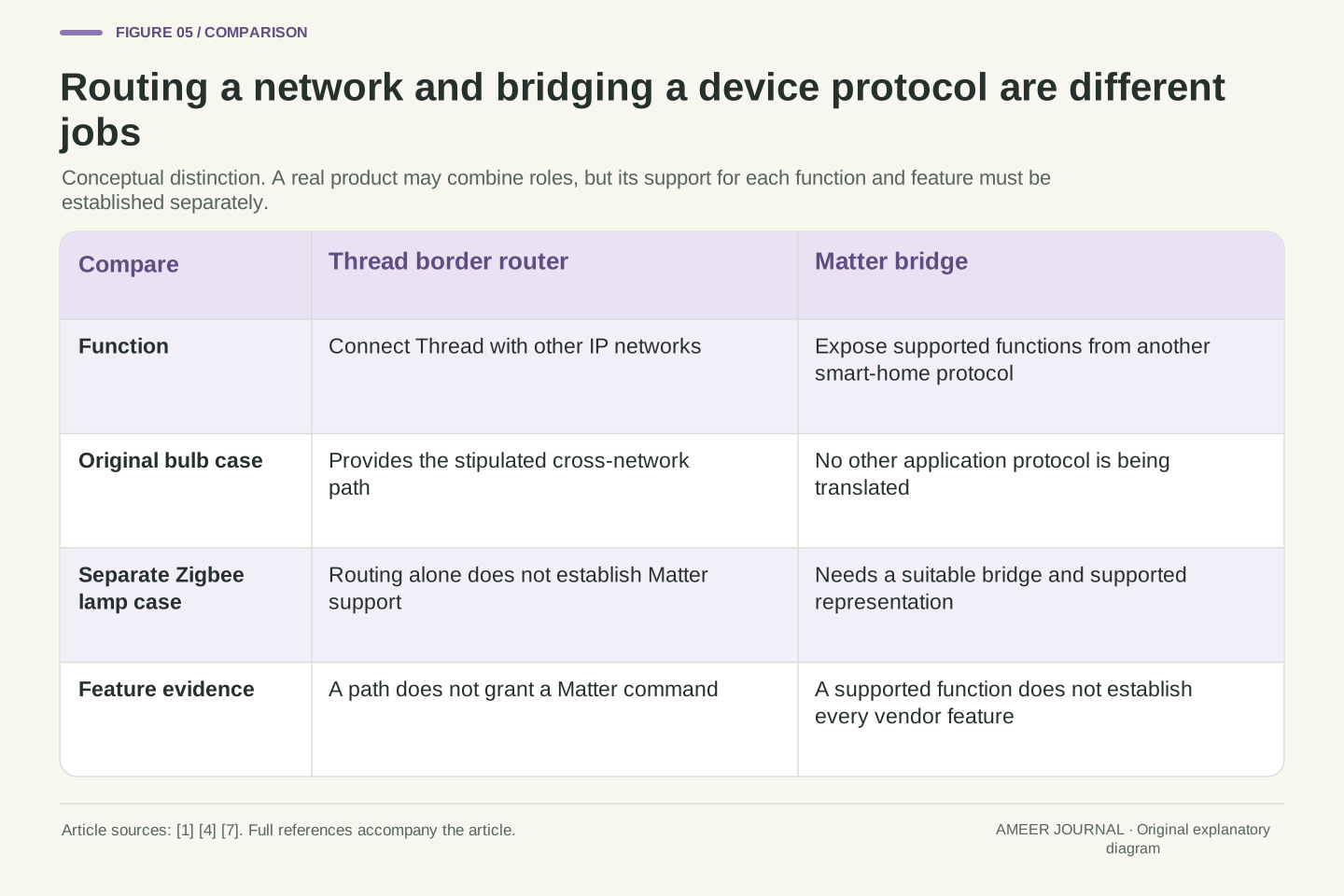
Two devices described as bridges can be doing quite different work. A Thread border router connects Thread to other IP networks [4]. A Matter bridge exposes supported capabilities from other smart-home technologies, with Google giving Zigbee, Bluetooth Mesh and Z-Wave as examples of bridged technologies [1]. The first role provides an IP path across a network boundary. The second role represents functions that otherwise use another smart-home protocol within a Matter system. The distinction is about the job being performed, not simply the number of network sockets on a box.
Our fictional Thread bulb already speaks Matter, so the example needs the stated network path rather than a translation from a different application protocol. A separate hypothetical Zigbee lamp would be a different case: the mere presence of our Thread border router would not establish Matter support for that lamp. Evidence of a suitable bridge and its supported features would be needed. A single product could combine functions, but each capability needs to be identified. This also explains why a supported on/off function does not, by itself, establish that every advanced manufacturer feature appears in every control app [7].
A border-router function and a protocol-bridging function occupy different places in the explanation. OpenThread describes connectivity between a Thread network and other IP networks [4]. Google's Matter introduction describes bridging other smart-home technologies through a device participating in Matter and the bridged technology [1]. These definitions do not justify inferring application translation from IP routing. A combined implementation could supply both, but its support for each role must be established independently.
In the original case, L is already a native Matter-over-Thread node. Its cross-network path uses the stipulated border router; there is no modeled Zigbee-to-Matter translation. If the endpoint were instead an unrelated Zigbee lamp, the forwarding capability of that same border router would not establish that a corresponding Matter endpoint exists. That would require a suitable supported bridge representation. Feature coverage is also a separate dimension: device types distinguish mandatory and optional clusters, and the actual modeled instance determines the functionality exposed [7]. One demonstrated command is evidence for that supported interaction, not a proof that all vendor-specific features are identically represented across systems.
A failure tells you which observation to preserve, not which part to reset
Suppose A still controls the bulb but B does not. In our model, that observation is inconsistent with the bulb being completely unreachable through every path. It does not identify B's exact problem. B might lack the relevant relationship, permission or working path, and the observation must be kept with its conditions. Conversely, if the only stipulated border-router path is unavailable, fabric membership alone cannot carry traffic across that missing path [4]. These are conditional deductions from the example, not diagnoses of a real home.
Internet access is another dependency to describe explicitly. If our fictional controller already has the credentials and uses only the stated local IP path for this command, the model includes no off-site service in that operation. That does not promise that a commercial app's remote access, voice interface or other features work without internet. Matter's IP-based operational architecture [1][3] does not describe every service an app adds. Preserve what failed, from which controller and for which feature. Avoid turning one successful local command into a claim of complete cloud independence, or one failed app action into a reason to reset everything.
Failure interpretation requires a specified observation boundary. If A successfully controls L while B fails, the observation establishes some working path and accepted operation for A at that time. It does not prove that B has the same route, credentials, permissions or feature support. Conversely, removing the only stipulated cross-network route from the model breaks that path even if all fabric credentials remain intact. Routing capability and operational trust cannot substitute for one another [3][4][6].
The same discipline applies to offline claims. Define an illustrative local controller whose complete command path is the existing local IP route and whose required credentials are already available. No internet service is part of that defined transaction. This is an explicit dependency assumption, not a property inferred for every product carrying a Matter label. The retained architecture descriptions concern operational IP communication and its discovery and session establishment [1][3]; they do not enumerate an app's remote, voice, account or cloud dependencies. A useful failure record retains controller identity, requested feature, observed outcome and connection conditions. It supports a narrower inference than either a blanket privacy promise or an unexplained recommendation to remove fabric memberships.
Describe the extra control path before adding another device
Before deciding that another app needs another network box, record five things: the bulb's transport, the available route, the actual controller and commissioner roles, the fabric relationship, and the feature the new controller is allowed to use. Read the specific product and software information for each part. An IP-based compatibility standard [5] gives a framework for communication, while the documented role, fabric and feature distinctions explain the information still needed for a particular setup [2][4][6][7]. A product name or logo cannot fill every blank in that record.
For the fictional bulb, the completed record says one unchanged Thread network, an available border-router path, two independent fabric memberships and two authorized control relationships affecting one physical light. That is why the second app does not inherently require a second Thread network in this case. The same reasoning also tells us what remains conditional: supported enrollment, correct privileges, available connections and implemented features. Keep those relationships explicit and a complicated smart-home diagram becomes easier to read. More app icons can mean more ways to control the same device without meaning more copies of the network underneath it.
A compact system record should distinguish transport attachment and routing, role placement, operational identity scope, authorization for the requested operation and the implemented application feature. These categories follow from the documented IP architecture, border-router behavior, fabric model and device data model [1][2][4][5][7]. For an actual configuration, record the relevant product, software and supported enrollment method; the retained primers describe mechanisms rather than a universal compatibility matrix. The record should explain an existing or proposed relationship without exposing private credentials.
In the original state transition, transport T is unchanged while F(L) grows from {A} to {A,B}. Distinct trust roots and per-fabric identities coexist with one assumed physical on/off state. A working route does not create membership; membership does not grant every operation; and an authorized command still depends on the supported feature and operating conditions [3][6][7]. This is the evidence needed to understand why a second independent Matter control relationship need not create a second Thread network. Other administration arrangements remain possible, so preserve the actual topology rather than turning this one example into a formula based on the number of apps.
Sources & further reading
Explore the references behind this guide. External pages may change after our review.
- What is Matter? | Google Home DevelopersGoogle · Accessed 7 Nov 2026
- The Fabric | Matter | Google Home DevelopersGoogle · Accessed 7 Nov 2026
- Commissioning | Matter | Google Home DevelopersGoogle · Accessed 7 Nov 2026
- OpenThread Border RouterOpenThread · Accessed 7 Nov 2026
- Build With Matter | Smart Home Device SolutionConnectivity Standards Alliance · Accessed 7 Nov 2026
- Matter multiple fabrics feature — Matter add-on for nRF Connect SDK 1.0.0 documentationNordic Semiconductor · Accessed 7 Nov 2026
- The Device Data Model | Matter | Google Home DevelopersGoogle Home Developers · Accessed 7 Nov 2026
Article updated 7 Nov 2026.
Found something we should revisit?
Good explanations get better with thoughtful feedback.