What you’ll take away
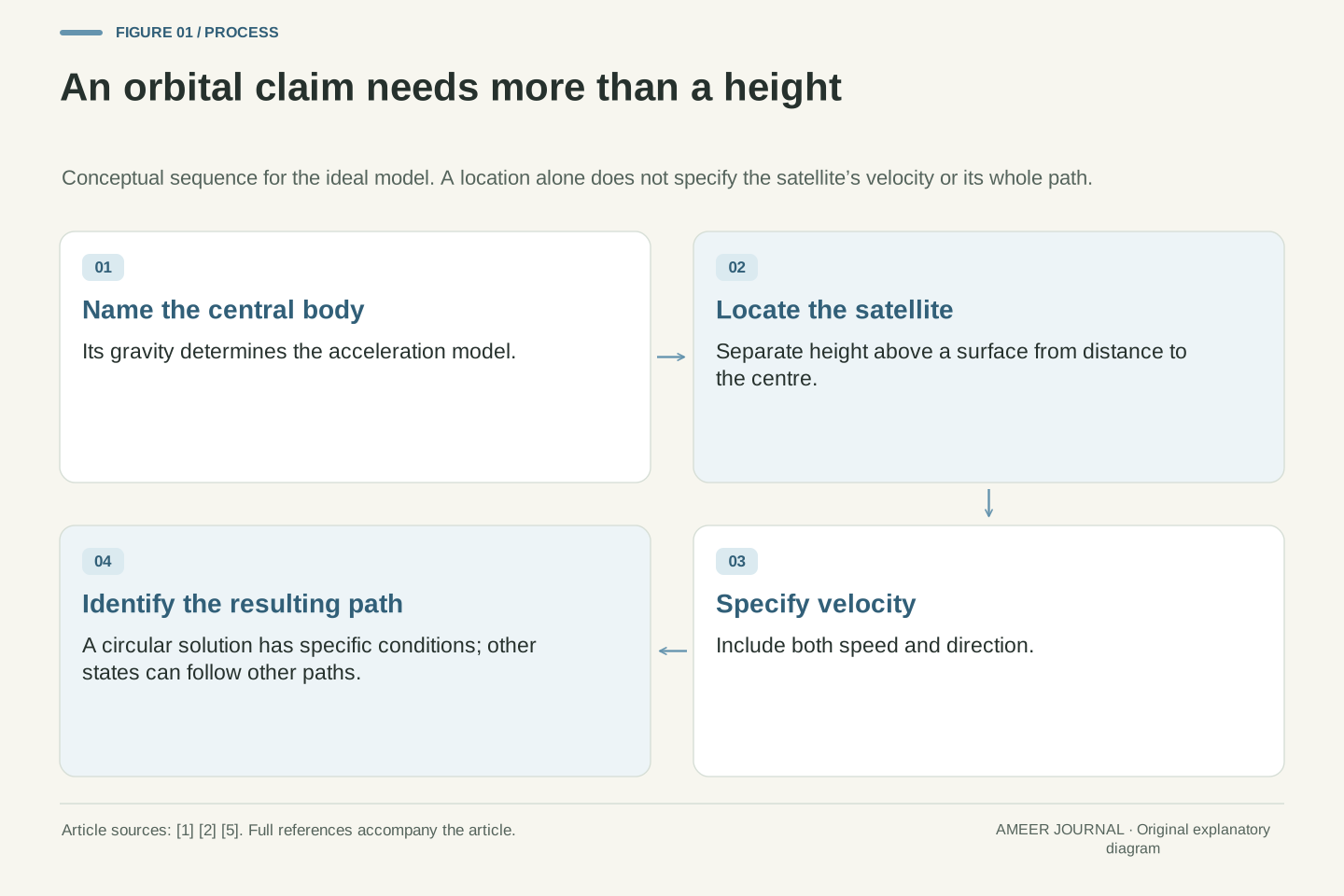
- Altitude alone does not specify an orbit; both the speed and direction of motion matter.
- Gravity supplies the inward acceleration of a circular orbit rather than switching off in space.
- The orbital radius is measured from the planet’s centre, not just above its surface.
- The invented example gives 7.5 km/s and an 89.36-minute period under explicit circular assumptions.
- Elliptical paths, atmospheric drag, other influences and rotating viewpoints require additional information.
Two spacecraft at the same height can have different futures
Imagine two spacecraft at the same point high above a planet. One has no sideways motion relative to the planet's centre. The other moves sideways at a carefully chosen speed. They share a height, but they do not share a future path. Gravity pulls on both, while their starting motion changes how that pull curves their trajectories. NASA's launch explanation makes the essential distinction: reaching a high altitude is different from obtaining the horizontal velocity needed for orbit [1]. A height reading alone cannot establish that a spacecraft is orbiting.
To make that idea concrete, we will use an invented spherical planet and a small satellite. We will leave out its atmosphere, other celestial bodies and engine thrust while doing the main calculation. These are teaching assumptions, not a prediction for an actual mission. The numbers will explain a circular orbit, then we will identify where that special model stops applying. The goal is to understand why an orbit is a continuing fall with suitable motion, not a place above which gravity has suddenly switched off. No launch or physical experiment is needed to follow the argument.
Orbital state is not determined by altitude alone. At a given position, different velocity vectors lead to different trajectories under the same gravitational field. A purely radial initial state and a tangential circular-orbit state therefore cannot be identified by the shared height. NASA's educational treatment distinguishes achieving altitude from acquiring the horizontal velocity required for orbital flight [1]. The relevant information includes both position and velocity, together with the gravitational model being used.
Our worked model uses a small test satellite around a spherical, nonrotating invented planet. We neglect the satellite's contribution to the system's centre of mass, atmosphere, other bodies and propulsion during the coast. The circular solution is chosen for transparent arithmetic, not because all real trajectories are circular. Both reading modes use the same invented parameters and explicitly retain the model boundary. The question is how gravity and initial motion produce a curved path that avoids the surface, not how to execute a launch or certify an actual spacecraft state from one displayed altitude.
Gravity is still acting when an astronaut floats
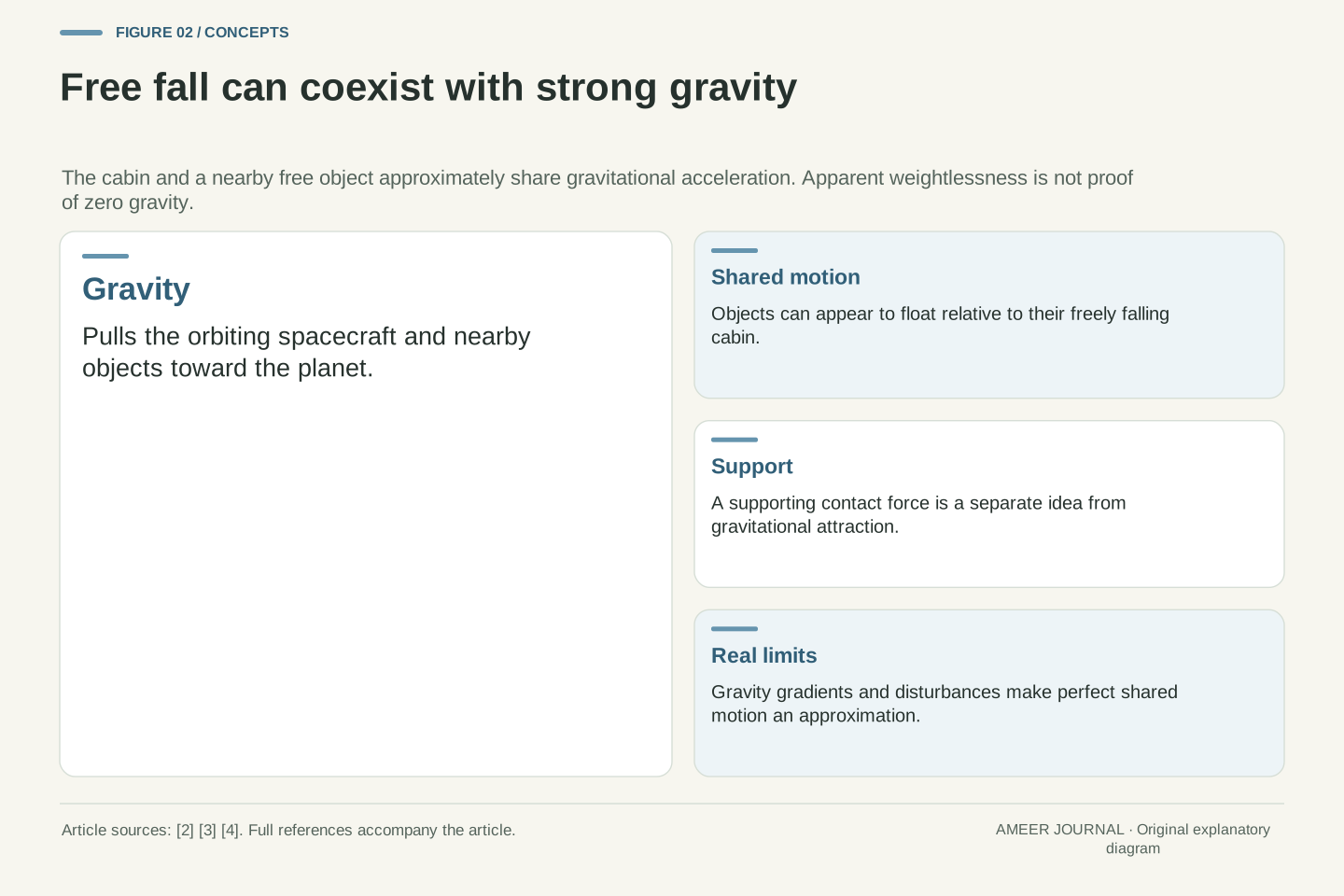
An orbiting spacecraft has not escaped the planet's pull. Gravity is the reason its path curves. Inside a freely falling spacecraft, a loose object and the surrounding cabin move under nearly the same gravitational acceleration, so the object can appear to float relative to the cabin [3][4]. That appearance does not mean the planet has stopped attracting either of them. It also does not mean the object has lost its mass.
Think about what a support does when you stand on a floor. The floor presses on you and prevents your ordinary downward fall. In the ideal freely falling cabin, that support is not required to keep a nearby freely moving object alongside the cabin. The familiar sensation of supported weight changes even while gravitational attraction remains. Real spacecraft have small disturbances and gravity varies across distances, so perfect shared motion is an approximation [2]. The useful comparison is between gravitational pull and support, rather than between 'gravity on the ground' and 'no gravity in space'. We will calculate substantial gravity at our invented orbit height later.
Free fall refers to motion governed by gravity alone in the idealized model; it does not require a vanishing gravitational field. An orbiting cabin and a nearby freely moving object can share approximately the same gravitational acceleration, producing apparent weightlessness relative to the cabin [3][4]. Gravitational mass and inertial mass remain present. The absence of a supporting contact force should not be confused with the absence of gravitational attraction.
This distinction is clearer in a planet-centred inertial description than in loose phrases about gravity being cancelled. Gravity accelerates the spacecraft and object; no additional outward physical force is required to make that statement. A rotating coordinate system can introduce inertial terms, but those terms must be identified as part of the chosen frame. Our calculation stays with the inertial interpretation. Gravity gradients and small non-gravitational disturbances limit perfect shared free fall in real vehicles [2]. Thus the article uses microgravity and apparent weightlessness as descriptions of the local environment, not as a claim that the planet's gravitational field has become negligible.
Constant speed can still mean changing velocity
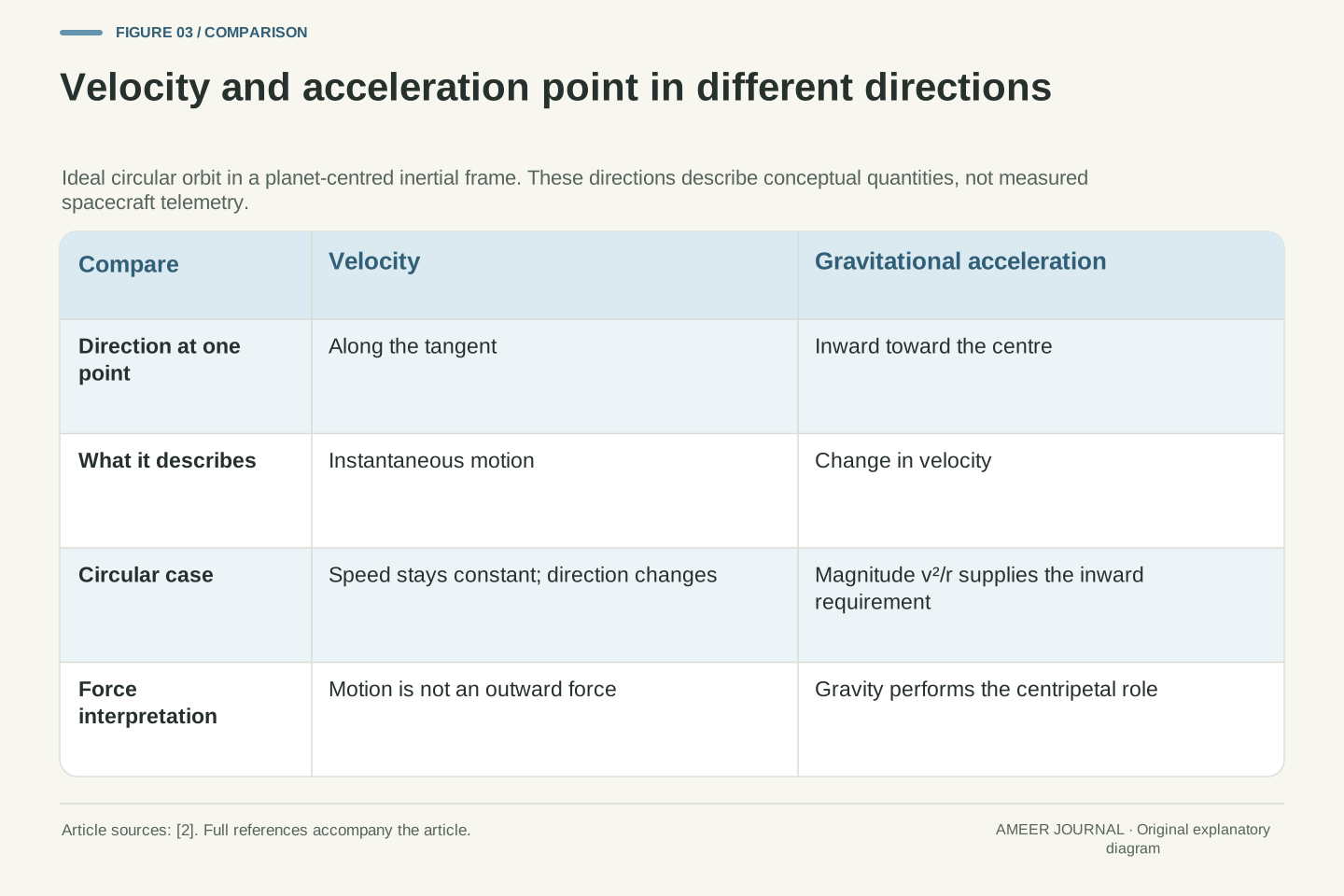
Speed tells us how fast something moves. Velocity also tells us its direction. A satellite travelling around a perfect circle can keep the same speed while changing direction all the time. That directional change is acceleration. NASA calls the inward acceleration needed for circular motion centripetal acceleration and identifies gravity as its source in an orbit [2]. The word centripetal means directed towards the centre; it is not a second force pulling against gravity.
In a paper sketch, draw a circle around the planet. At any point, the instantaneous direction of travel lies along the tangent, which touches the circle there. The gravitational acceleration points inward. Those arrows represent different quantities: motion and change of motion. If gravity disappeared from this ideal picture, the satellite would initially continue along the tangent rather than follow the circle. Gravity continually changes the velocity's direction. Calling the motion free fall therefore does not require its speed to increase at every instant. In our circular example, the speed stays constant while its direction turns through a full circle.
Velocity is a vector, whereas speed is its magnitude. Uniform circular motion has constant speed but nonzero acceleration because the velocity direction changes. The required acceleration magnitude is v²/r and its direction is radially inward. Gravity supplies that centripetal acceleration in the circular orbital model [2]. 'Centripetal force' names the inward role of the net force; it is not an additional interaction that balances gravitational attraction.
At a point on the circle, velocity is tangential and gravitational acceleration is radial. Their perpendicularity in this special case changes direction without changing speed. This is why the phrase free fall must not be translated into 'continually moving faster' for every trajectory. Removing gravity in the ideal model would remove the inward acceleration, leaving straight-line inertial motion along the instantaneous tangent. We are discussing the motion relative to the planet-centred inertial frame, not the satellite's position on a rotating ground map. The vector distinction is necessary before equating gravitational acceleration with the circular-motion requirement; otherwise the same equation can be misread as a balance of opposite forces.
The equation needs distance from the centre
A displayed height usually means distance above a surface. The radius used in the circular-orbit calculation means distance from the planet's centre. Those are different lengths. If the planet's radius is R and the height is h, the orbital radius is R + h. NASA's circular formulas explicitly use that sum [1]. Replacing it with height alone would place the satellite much closer to the centre than the drawing actually shows.
Our invented planet has a radius of 6,000 kilometres. Put the satellite 400 kilometres above its spherical surface. The centre-to-satellite distance is then 6,400 kilometres, not 400. These numbers are deliberately invented and do not describe Earth. On a sketch, give the surface radius and extra height different labels, then mark their total. The distinction also matters when comparing orbits. Four times the centre distance is not generally four times the height, because the planet's own radius must still be included. We will use kilometres and seconds consistently, and convert an acceleration to metres per second squared only after calculating it.
Let R denote the spherical planet's radius, h the satellite's altitude above that reference surface, and r=R+h the distance to the planet's centre. The circular speed and period formulas require r, as NASA's presentation makes explicit [1]. This is a geometrical distinction rather than a unit conversion. Converting h from kilometres to metres does not turn it into the required centre distance.
Set hypothetical R=6,000 km and h=400 km, giving r=6,400 km. The example is not a substitute for Earth's measured shape, a real altitude datum or an actual orbital state estimate. It also shows why relative-height shortcuts fail: multiplying r by four will not multiply h by four when R is fixed. For the following derivation, distances are in kilometres and times in seconds, so the gravitational parameter must be expressed in km³/s². The resulting speed will be in km/s. Only the final gravitational acceleration is also stated in m/s², using the explicit factor of one thousand.
Match gravity to the circular-motion requirement
For a circular path, the inward acceleration needed depends on both speed and radius. Gravity provides that acceleration. Physicists combine the gravitational constant and the planet's mass into one number, called its gravitational parameter, written μ. In this simple model, dividing μ by the square of the centre distance gives gravitational acceleration. Matching that to the acceleration needed for a circle leads to a circular speed equal to the square root of the result of dividing μ by r [1][2].
There is a condition hidden in that word circular: the starting motion must point sideways, along the tangent, at the matching speed. Merely reaching the same speed while moving in another direction does not establish the circular solution. We also assume the satellite is tiny compared with the planet, so the planet can be treated as the fixed central body. Larger bodies actually move around their shared centre of mass [2]. In the simplified satellite model, increasing only the satellite's mass does not require a different circular speed at the same radius. It changes the gravitational force, but not the resulting gravitational acceleration.
Define μ=GM for a dominant central mass M and gravitational constant G. The test satellite's gravitational acceleration is μ/r². Equating it to the circular requirement v²/r gives v²=μ/r and therefore vc=√(μ/r), equivalent to NASA's expression with μ=g₀R² [1][2]. This is an equality between the actual inward acceleration and the acceleration required by a circular path, not cancellation between gravity and an outward physical force.
The circular state additionally requires zero radial velocity and tangential speed vc. A velocity vector with the same magnitude but a different direction is a different initial condition. The satellite-mass cancellation follows from mμ/r²=mv²/r, under the test-mass approximation. It does not assert that mass is irrelevant to propulsion or to two comparable bodies. In the general two-body problem both bodies move about their barycentre [2]. Here the central body's dominance lets us keep a fixed-centre model, so the equation answers a clearly specified circular-orbit question without pretending to solve every gravitational trajectory.
Work the numbers for an invented planet
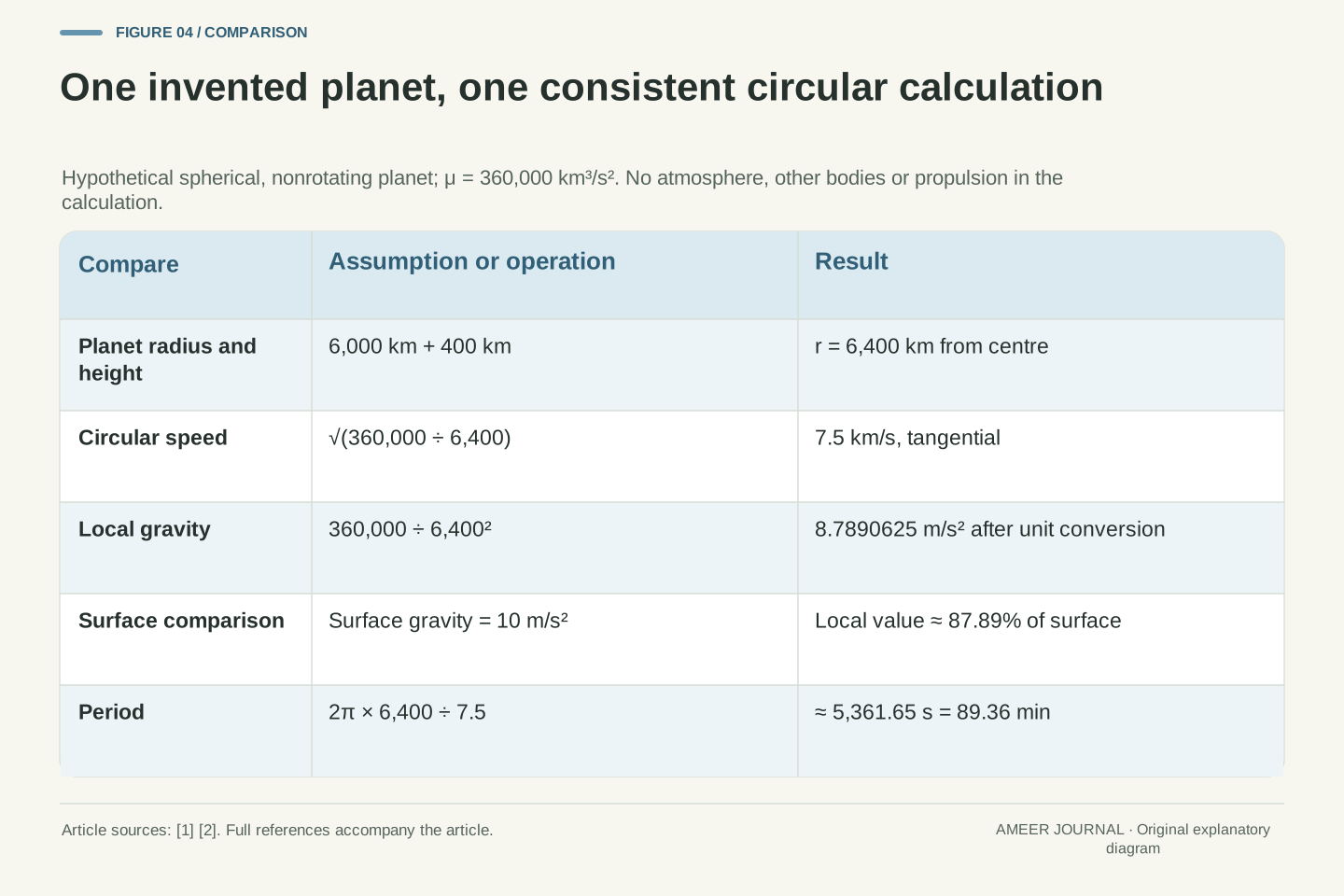
Give our fictional planet a gravitational parameter of 360,000 cubic kilometres per second squared. At the 6,400-kilometre centre distance, divide 360,000 by 6,400 to get 56.25. Its square root is 7.5, so the circular speed is 7.5 kilometres per second. That number is a result of our chosen assumptions, not a measured spacecraft speed. The satellite must also have the sideways direction described earlier. A speedometer number alone still cannot identify the whole orbit.
Now calculate gravity at that location. Dividing 360,000 by 6,400 squared gives 0.0087890625 kilometres per second squared, or about 8.79 metres per second squared. At this invented planet's surface, the corresponding calculation uses 6,000 squared and gives 10 metres per second squared. Gravity at the orbit is therefore about 87.89 percent of its surface value. It remains substantial. These calculations apply the circular and inverse-square relationships [1][2]; they do not use current Earth or space-station data. The example shows why floating in a freely falling cabin can coexist with a strong gravitational pull.
A useful error check is to ask what happens if someone puts the 400-kilometre height into the speed formula as the radius. The calculation would give 30 kilometres per second, four times our correct result. That does not reveal another valid orbit at the same height. It uses a centre distance sixteen times too small. Worse, a point only 400 kilometres from the centre would be inside this 6,000-kilometre-radius planet, outside the exterior-gravity model we assumed. The arithmetic can be tidy while the physical input is wrong. Correct units do not rescue the wrong distance reference.
Choose μ=360,000 km³/s² for the invented planet. With r=6,400 km, vc=√(360,000/6,400)=√56.25=7.5 km/s. Dimensional checking gives √((km³/s²)/km)=km/s. The value is an internally consistent toy result, not a quoted Earth constant or mission measurement. The associated circular initial condition is tangential velocity of that magnitude, with radial velocity zero. These conditions belong together when using the formula derived above [1].
The gravitational acceleration is μ/r²=360,000/40,960,000=0.0087890625 km/s², or 8.7890625 m/s². At R=6,000 km the surface value is μ/R²=0.01 km/s²=10 m/s². The ratio is (R/r)²=(6,000/6,400)²=0.87890625, about 87.89 percent. The inverse-square relationship is the one discussed by NASA [2]. These values demonstrate the distinction between local gravitational field strength and the apparent weightlessness of shared free fall. We neglect rotation and support forces in calculating the field; no measured scale reading or actual spacecraft disturbance environment is being predicted.
A dimensional check alone will not catch the altitude substitution error. Inserting h=400 km where r=6,400 km is required yields √(360,000/400)=30 km/s. The sixteenfold error in distance becomes a fourfold error in speed through the inverse square root. This is not an alternative circular state at the stated 400 km altitude: it assigns the object a centre distance inside the model planet, where the exterior point-mass field used here is not applicable. The calculation illustrates a variable-definition failure even though its units reduce correctly. Geometry, applicable field model and dimensions must all agree before interpreting the resulting number as an orbital speed.
A higher circular orbit is slower and takes longer
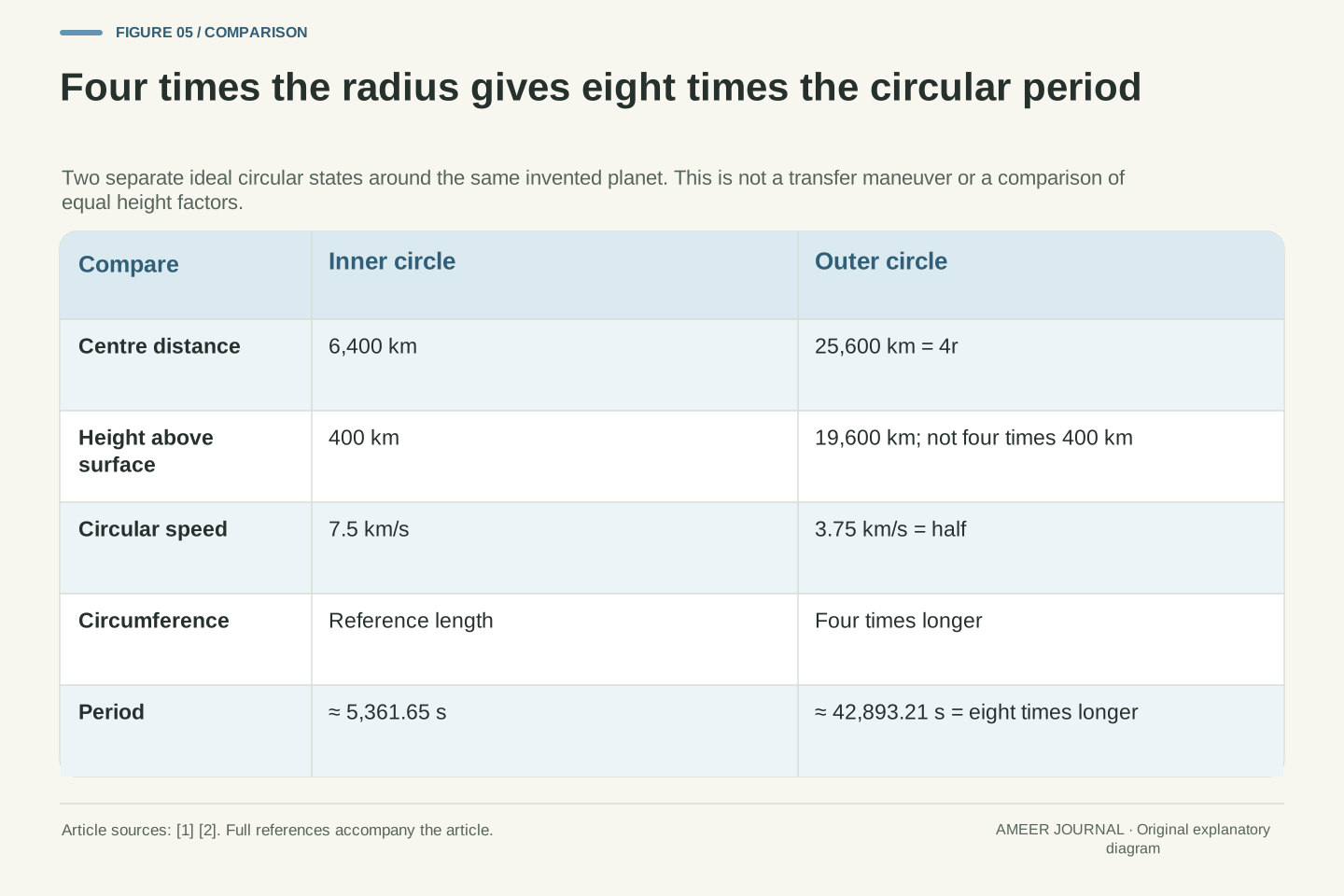
The distance around a circle is two times π times its radius. For our 6,400-kilometre radius, that circumference is about 40,212 kilometres. Dividing by the constant speed of 7.5 kilometres per second gives about 5,362 seconds, or 89.36 minutes, for one circuit. This is the orbital period. NASA's circular period formula expresses the same relationship [1]. The result belongs to our imaginary planet and ideal path, even though it may resemble numbers encountered in real spaceflight.
Compare another circular orbit around the same invented planet at four times the centre distance: 25,600 kilometres. The speed falls to 3.75 kilometres per second, half the first value. The circumference is four times larger, while the speed is half as large, so the period becomes eight times longer. This comparison follows the circular formulas and agrees with Kepler's period relationship [1][2]. Notice the new height: 25,600 minus 6,000 equals 19,600 kilometres. It is not four times the original 400-kilometre height. Also, a lower required speed at the higher orbit does not mean getting there needs no extra energy or a simple reduction in speed from the lower circle.
For circular motion, T=2πr/v. Substituting vc=√(μ/r) gives T=2π√(r³/μ), matching the squared-period form in NASA's treatment [1]. With the hypothetical parameters, the circumference is 40,212.386 km and T=5,361.651 s, or 89.3609 min. This is an analytical period for the specified ideal state. It is not a current orbital period for a named spacecraft, nor does it incorporate Earth's rotation or any ground-track repeat condition.
Holding μ fixed and increasing r to 4r halves circular speed because vc scales as r^−1/2. The circumference grows by four, so T grows by eight, consistent with T² proportional to r³ [2]. Numerically, r₂=25,600 km, vc₂=3.75 km/s and T₂≈42,893.212 s. Altitude is h₂=r₂−R=19,600 km, not 4h. This is a comparison of two separate circular solutions, not a maneuver connecting them. Inferring that one can reach the outer circle merely by slowing down on the inner one would confuse a family of final states with the trajectory required to move between those states.
A circle is one possible orbit, not the definition of orbit
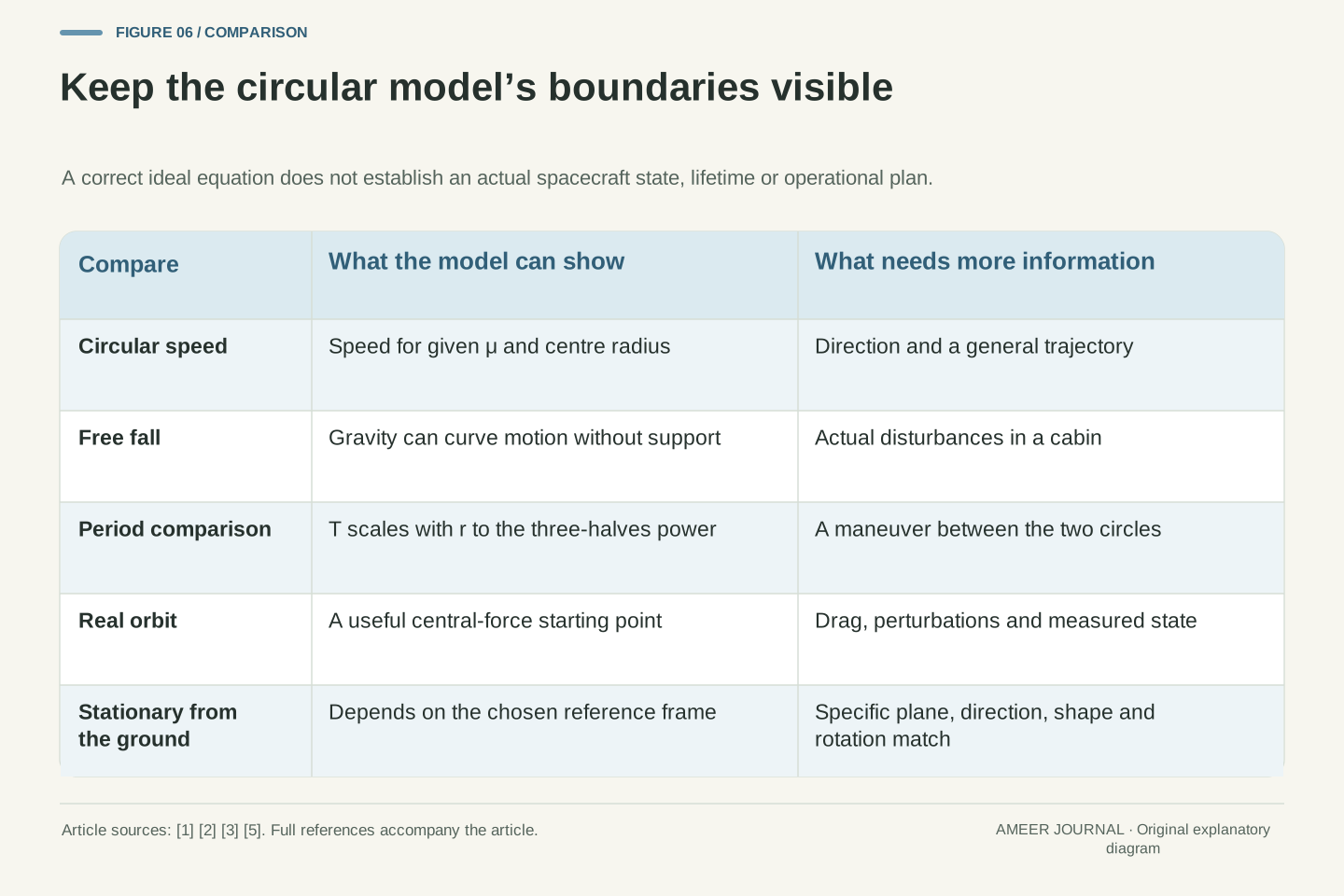
Many orbital paths are better described by ellipses. An ellipse has a nearer part and a farther part, and the speed changes along it. NASA's account of Kepler's laws describes faster motion near the central body and slower motion farther away for an elliptical orbit [2]. ESA also distinguishes circular paths from paths with changing distance [5]. The circular-speed calculation therefore should not be used as though every orbiting object at a given height must have that one speed.
Returning to our two-spacecraft thought experiment, the sideways speed changes the path. A value different from the circular value can produce an elliptical trajectory under suitable conditions. That does not guarantee the entire path clears the planet: its nearest point could reach the surface or a dense atmosphere. Nor does every small mismatch mean an immediate collision. Direction, speed and the whole resulting path matter. A still image showing an object high above a planet cannot establish the height of its later closest approach. Our worked circle avoids that additional problem by assumption; it does not solve arbitrary paths from a single height reading.
The circular solution is a special bound two-body trajectory. For an ellipse, radius and speed vary, and the central body lies at a focus rather than the ellipse's geometric centre. Kepler's equal-area law connects orbital position to the varying motion [2]. ESA's orbit guide likewise distinguishes constant-radius circles from eccentric paths [5]. Consequently, vc=√(μ/r) is not a general formula for the instantaneous speed of every object found at radius r.
At a chosen position, a different velocity vector can define an ellipse, an escape trajectory or a path intersecting the planet, depending on the full state. A tangential speed different from vc is not by itself a complete impact prediction. One must consider the resulting nearest approach and whether the trajectory encounters the surface or significant atmosphere. The original example deliberately specifies a circular state to keep that geometry controlled. Comparing circular states at r and 4r therefore does not calculate an elliptical transfer between them. The distinction prevents a correct circular formula from being overextended into a claim about arbitrary orbital motion or mission feasibility.
Real planets add atmosphere, shape and other influences
An ideal orbit does not need an engine firing continuously to keep the satellite moving. Its existing motion continues while gravity curves the path. Actual spacecraft can use thrust to change or maintain an orbit, but that is a different role from continuously pushing against ordinary air resistance on a road. NASA's explanation also notes that the thin upper atmosphere can gradually affect low orbits [3]. Space is not a sharp boundary beyond which every trace of air or drag instantly disappears.
Our imaginary planet is perfectly spherical and isolated. Real predictions may need its nonuniform gravity, other bodies and additional disturbances; the simple model does not promise an unchanged path forever. The meaning of stationary also depends on the observer. A geostationary satellite follows a circular equatorial orbit in the direction of Earth's rotation, with the matching rotation period, so it appears fixed from the ground [5]. It is still moving around Earth. A long period or a great height alone does not establish that special arrangement. These extra conditions explain why a realistic orbital description needs more than one attractive number.
The ideal central-force coast has no propulsion requirement for preserving its circular solution. In real flight, thrust may be used for deliberate orbital changes or maintenance, while atmospheric drag and other perturbations change the motion [3]. The atmosphere thins with altitude rather than ending at a universal operational cutoff. The article therefore supplies no safe minimum altitude, lifetime guarantee or current vehicle prediction. The exact calculation's neglect of drag is an assumption that must remain visible.
A spherical central field is also an idealization. Other gravitational influences and departures from the simple model can matter, as NASA notes when qualifying Keplerian paths [2]. Reference frame creates another distinction: geostationary motion is stationary relative to Earth's rotating surface, not relative to the inertial frame. It requires the circular equatorial, prograde arrangement and period matching Earth's rotation described by ESA [5]. A generic high orbit, or even a period match without the remaining geometry, does not establish geostationarity. This real-Earth example is separate from the nonrotating invented planet used in our numerical exercise.
Read an orbit claim as a description of motion
Start with the central body and the distance reference. Is the number a height above a surface or a radius from the centre? Next ask about velocity: how fast is the object moving and in which direction? Then identify whether the claim assumes a circle, describes an ellipse or leaves the path unspecified. A period calculated for a circle is meaningful only within its stated model [1][2]. These questions turn 'it reached space' into a more precise account of what the object is actually doing.
Our complete example has a 6,000-kilometre-radius invented planet, a 400-kilometre height, a 6,400-kilometre centre distance and a sideways circular speed of 7.5 kilometres per second. One circuit takes about 89.36 minutes while gravity remains about 87.89 percent of the invented surface value. Each result follows from explicit assumptions. None claims an actual spacecraft measurement. The central conclusion is physical rather than numerical: an orbit combines gravitational acceleration with appropriate motion. Reaching a location is only part of that description. A useful explanation keeps the velocity vector, the full path and the limits of the model visible alongside the height.
An interpretable orbital claim specifies the central body or gravitational model, position reference, velocity vector, path geometry and frame of observation. It distinguishes a circular solution from a general trajectory, and an analytical result from an observed state. The retrieved NASA and ESA explanations support those separations [1][2][3][5]. No single altitude, instantaneous speed or orbital period can substitute for every other part of the description.
The original numerical state is internally complete for its purpose: R=6,000 km, h=400 km, μ=360,000 km³/s², r=6,400 km, zero radial velocity and tangential speed 7.5 km/s. It yields T≈89.36 min and local gravitational acceleration 8.7890625 m/s², or 87.89 percent of the model surface value. The broader conclusion does not depend on those invented values. Gravity supplies the acceleration that curves a suitable velocity into orbit; it does not need to vanish. Retaining that mechanism, and the distinction between centre distance and altitude, makes the circular example useful while preventing it from becoming an unsupported launch calculation, lifetime forecast or claim that every object in space is already orbiting the planet beneath it.
Sources & further reading
Explore the references behind this guide. External pages may change after our review.
- Flight To Orbit | Glenn Research Center | NASANASA Glenn Research Center · Accessed 6 Nov 2026
- Chapter 3: Gravity & Mechanics - NASA ScienceNASA · Accessed 6 Nov 2026
- Chapter 3: Gravity & Mechanics - NASA ScienceNASA · Accessed 6 Nov 2026
- What is Microgravity? - NASANASA Glenn Research Center · Accessed 6 Nov 2026
- Types of orbitsEuropean Space Agency · Accessed 6 Nov 2026
Article updated 6 Nov 2026.
Found something we should revisit?
Good explanations get better with thoughtful feedback.