What you’ll take away
- A heat amount alone does not determine its maximum conversion to work; source and environment temperatures matter.
- A cyclic heat engine must satisfy both energy conservation and a nonnegative complete entropy balance.
- Lost work potential does not mean destroyed energy; more energy can be rejected as heat instead.
- A finite cooling body needs a changing-temperature calculation, not its initial Carnot fraction applied to all released heat.
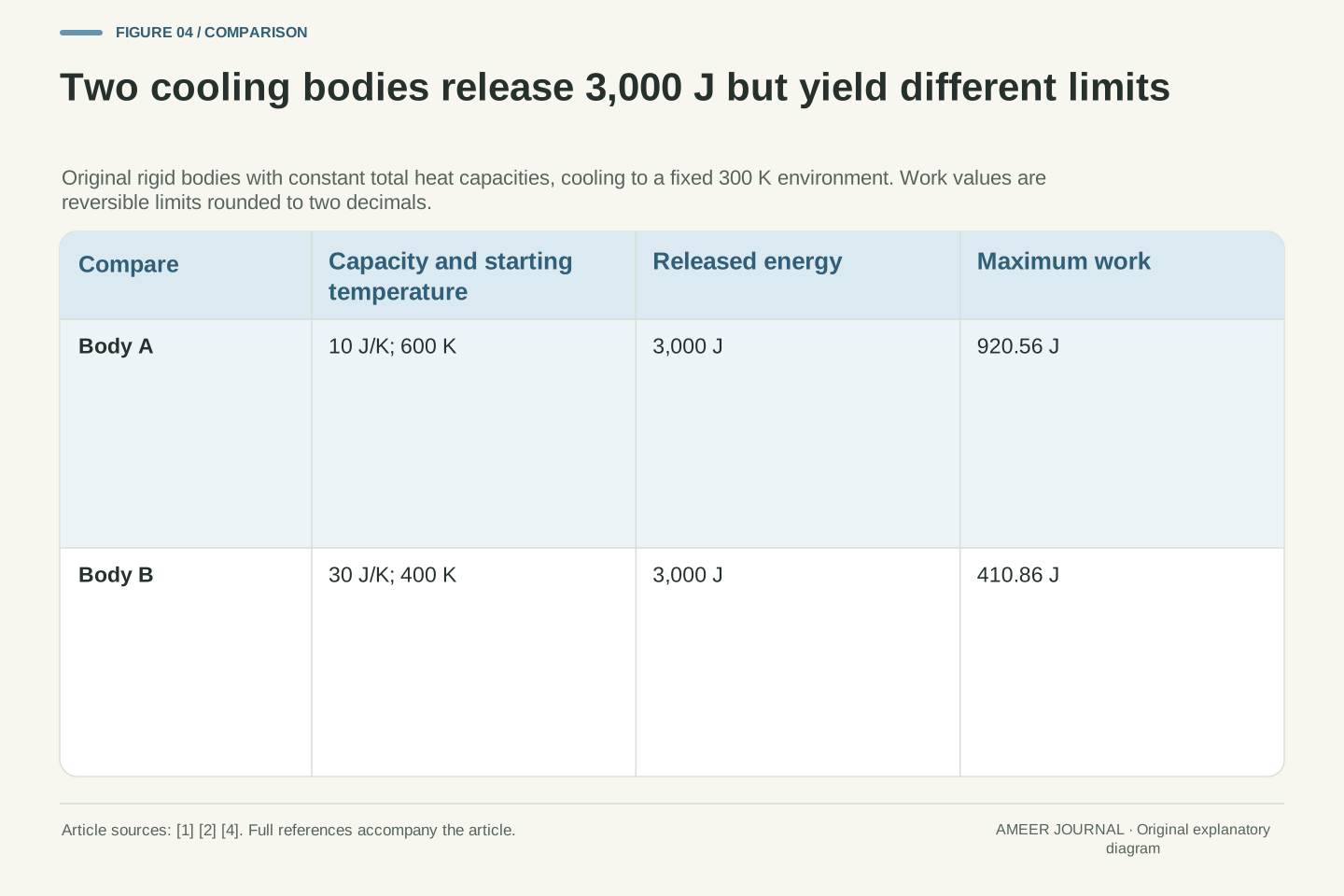
- The two original bodies each release 3,000 J but have reversible work limits of about 920.56 J and 410.86 J.
- A reversible-work bound is an energy comparison, not a measured efficiency or an output-power rating.
Equal heat amounts leave an important question unanswered
Two sources can each supply one hundred joules of heat without offering the same opportunity to produce work. The missing information is temperature: both the temperature at which heat arrives and the temperature of the surroundings receiving the rejected heat. A reversible engine gives the limiting comparison between two constant-temperature reservoirs [1]. Counting joules alone leaves that comparison unfinished.
This matters when an explanation calls something waste heat or says that a process has plenty of energy available. Those statements identify an amount or an origin. They do not yet establish how much could become work under the stated conditions. A large amount close to the surroundings' temperature can have a different work potential from the same amount supplied at a higher temperature.
We will use invented numbers to follow that distinction. First the source stays at one temperature. Then a finite body cools, so the temperature changes as its energy is removed. These are thermodynamic calculations, not an engine design, a heating activity or measured performance. Every example uses an explicitly defined environment, making the comparison reproducible.
Thermal energy quantity and maximum recoverable work are different specifications. For a cyclic engine exchanging heat with reservoirs at fixed absolute temperatures T_h>T_0, Carnot's principle bounds the conversion fraction by 1−T_0/T_h [1]. A heat amount Q_h therefore needs its transfer temperature and rejection environment before a reversible-work bound can be assigned.
The distinction is relational: the same source can have different work potential relative to different environments. It is also path-sensitive when the source temperature changes during extraction. Multiplying all released energy by an efficiency evaluated at the initial temperature generally does not describe a finite cooling source. The reservoir and finite-body calculations below isolate that difference.
Our original constructions omit chemical change, mass transfer and additional mechanical, electrical or other energy sources. The engine completes cycles; the only thermal recipient outside the source is a fixed-temperature environment. A later rigid body has an assigned constant total heat capacity. These assumptions define a thermal-work calculation, not a complete exergy assessment of an arbitrary machine.
Begin with a complete cycle and two heat transfers
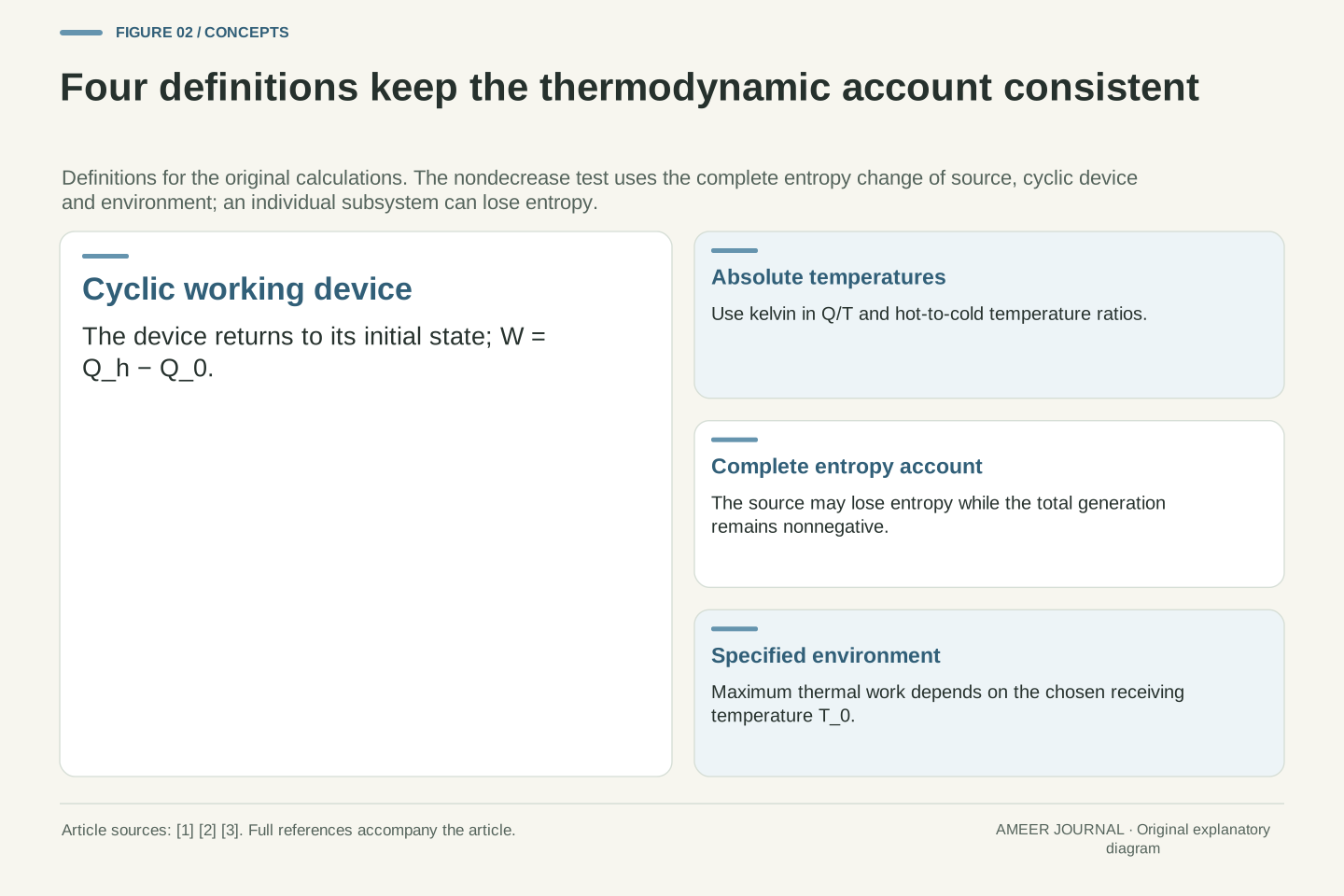
An engine's working material changes state during a cycle and returns to its starting state at the end. NASA's Carnot explanation uses that return to connect net work with net heat transfer [3]. The working material has not been left progressively hotter or compressed as an extra hidden energy store. A one-way expansion ending in a different state would require a different account.
Call the heat taken from the hot source Q_h, the heat delivered to the cooler environment Q_0, and the work delivered W. All three are positive amounts in their named directions. Over the complete cycle, W equals Q_h minus Q_0 [1][3]. If one hundred joules enter and seventy-five leave as heat, twenty-five leave as work.
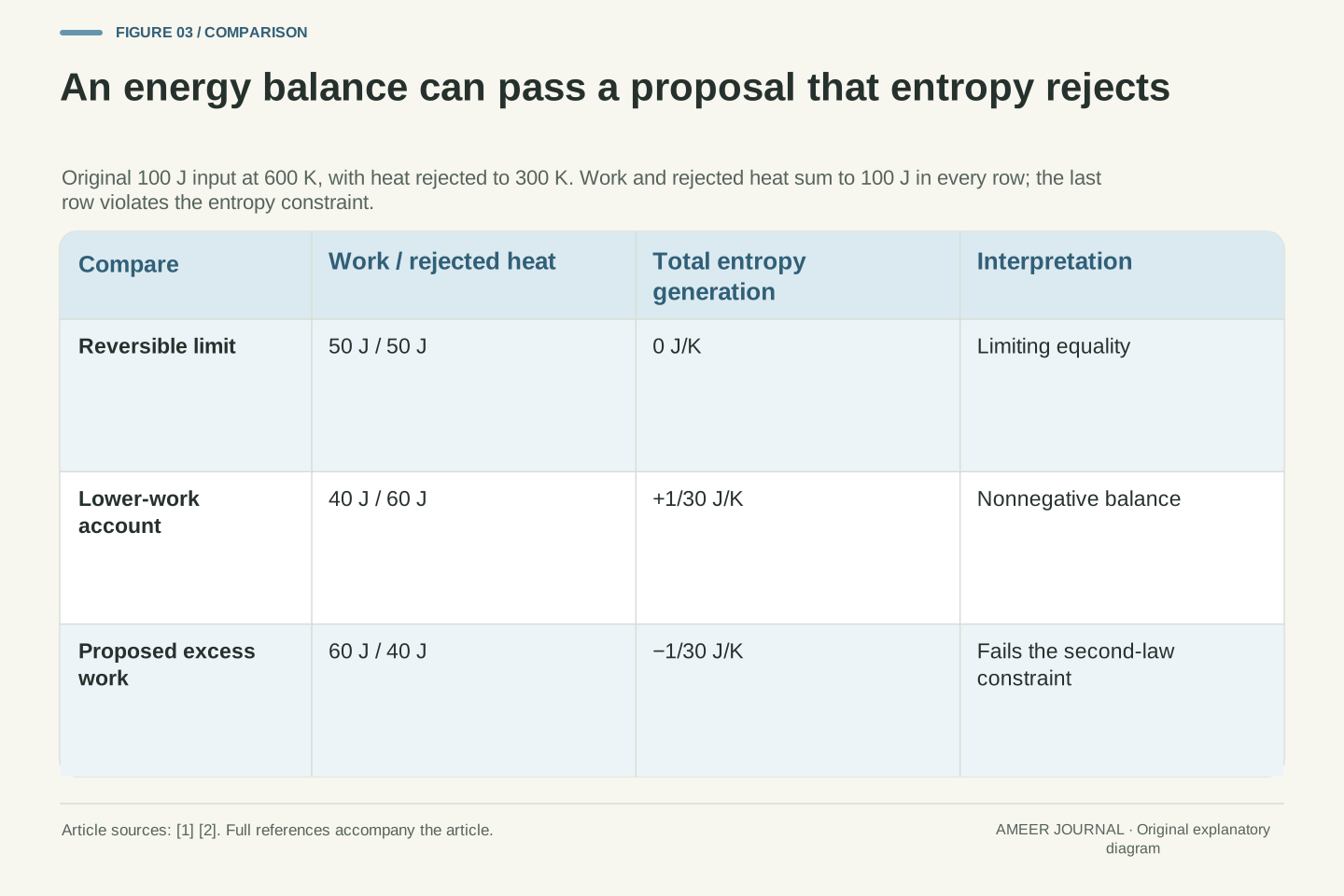
That subtraction checks conservation, but it is not the whole test. A proposed machine receiving one hundred joules and rejecting forty would appear to deliver sixty while balancing the energy totals. Whether it can do so depends on the source and environment temperatures. The second law supplies a further restriction that a correct addition cannot establish.
Use positive magnitudes Q_h for heat absorbed, Q_0 for heat rejected and W for net work delivered. The working device returns to its initial thermodynamic state, so its internal-energy and entropy changes over a complete cycle are zero. The first-law balance is W=Q_h−Q_0, consistent with the cycle definitions in OpenStax and NASA [1][3].
The device boundary alone is useful for energy conservation. For entropy accounting we include the hot reservoir and environment as well. Their entropy changes are −Q_h/T_h and +Q_0/T_0. Work crosses the composite boundary, with no additional heat or mass exchange in this construction. Nonnegative entropy generation applies to this full account, not to every individual subsystem's entropy change.
In particular, a cooling source can lose entropy. That does not violate the second law if the rest of the account compensates appropriately. Nor does a cyclic device's zero entropy change prove that its operation is reversible: entropy can be generated during operation and exported with heat. The complete source–device–environment balance distinguishes these statements. [2]
The temperature ratio changes the reversible fraction
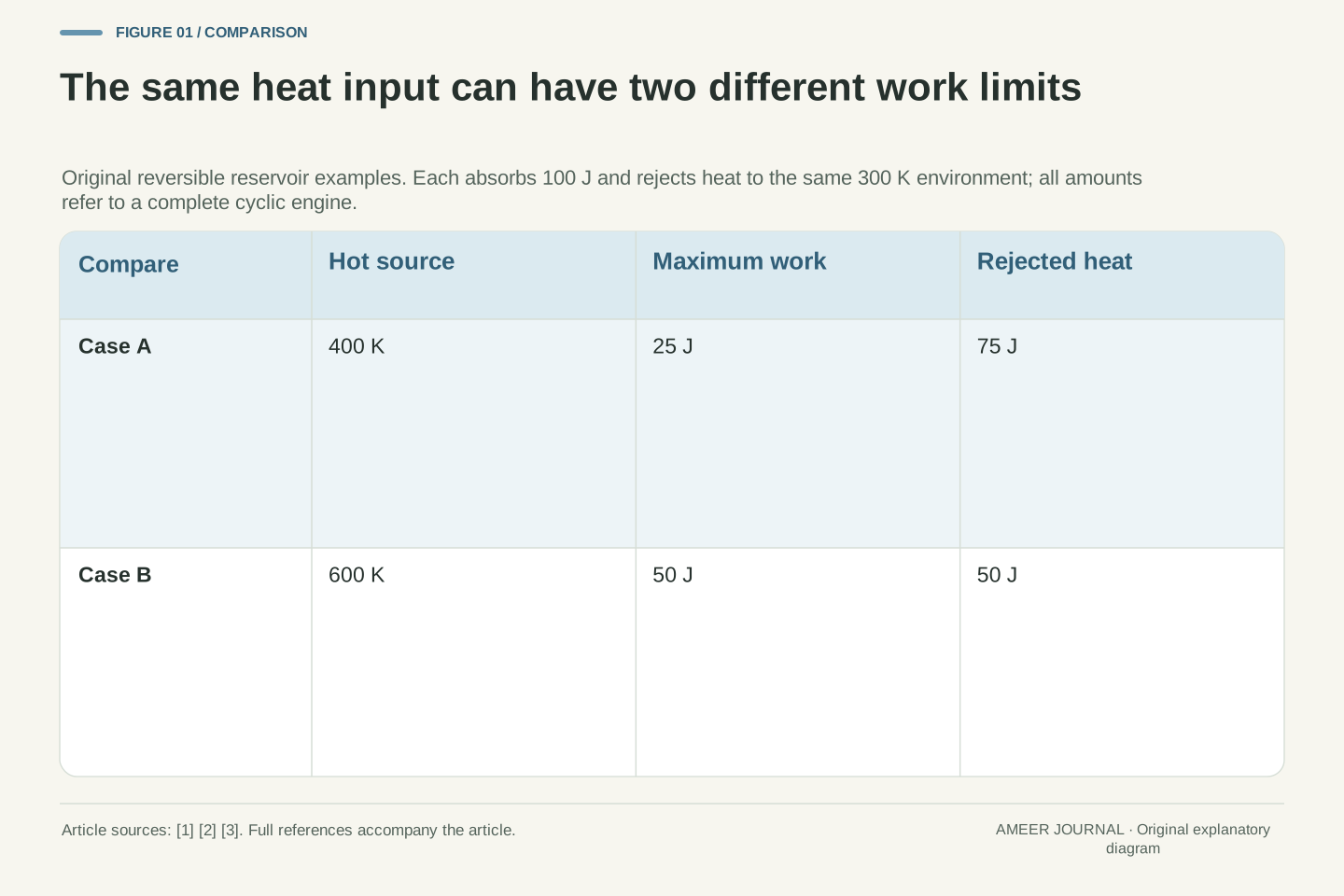
Set the environment to 300 kelvin. If the source remains at 400 kelvin, the reversible fraction is one minus 300 divided by 400: one quarter. From one hundred joules, the maximum work is therefore twenty-five joules, with seventy-five rejected to the environment. The remaining energy has not disappeared; it has a named destination [1].
Now keep the heat amount and environment unchanged but supply the heat at 600 kelvin. The fraction becomes one minus 300 divided by 600, or one half. The reversible account gives fifty joules of work and fifty of rejected heat. The input quantities match, while the work limits differ because the hot-source temperatures do not.
These ratios require an absolute temperature scale. A difference of one kelvin has the same size as a difference of one Celsius degree, but dividing Celsius readings is a different operation. Subtracting the Celsius zero from both temperatures changes their ratio. Use kelvin for the hot-to-cold ratio rather than carrying over a rule suitable only for temperature differences.
For a reversible engine between fixed reservoirs, Q_0/Q_h=T_0/T_h and η_rev=W/Q_h=1−T_0/T_h [1]. With Q_h=100 J, T_0=300 K and T_h=400 K, η_rev=1/4, W_rev=25 J and Q_0=75 J. With T_h=600 K instead, η_rev=1/2, W_rev=50 J and Q_0=50 J.
The temperatures must be absolute. Kelvin differences can share numerical values with Celsius differences, but the Carnot expression contains a ratio of temperatures, not merely their difference. Rewriting η_rev=(T_h−T_0)/T_h still leaves an absolute-temperature denominator. Converting only the numerator or substituting Celsius readings changes the physical expression.
The bound concerns a cyclic heat engine with the stated reservoirs. It is not the heating coefficient of performance of a heat pump, and it is not a universal conversion factor for every form of energy. No measured efficiency is assigned here. The two exact fractions identify the ideal comparison under fixed and different hot-side conditions.
Conservation can pass while the entropy account fails
Entropy adds a temperature-sensitive account to the energy totals. For heat exchanged reversibly at constant temperature, its entropy contribution is the heat divided by the absolute temperature [2]. The hot source loses entropy as it supplies heat, while the environment gains entropy as it receives the rejected portion. For the complete arrangement, the total cannot decrease.
Use the 600-kelvin source and 300-kelvin environment again. In the reversible fifty-joule-work case, the source loses 100/600 joule per kelvin of entropy, and the environment gains 50/300. Those are equal amounts. Their sum is zero, which is the limiting reversible case.
The proposed sixty-joule-work case rejects only forty joules. Its environment gains 40/300 joule per kelvin, less than the source loses. The total would decrease by one-thirtieth of a joule per kelvin. The energy account still balances, but the stated heat-engine process fails this second-law test. A convincing efficiency claim needs both accounts.
For the source–device–environment composite, write S_gen=Q_0/T_0−Q_h/T_h≥0. The cyclic device contributes no net state change, while the reservoir changes use their fixed temperatures. The reversible equality follows from the entropy integral and Carnot heat ratio [1][2]. This statement does not assert nonnegative entropy change for an arbitrary closed subsystem that can export heat.
At Q_h=100 J, T_h=600 K and T_0=300 K, W=50 J implies Q_0=50 J and S_gen=50/300−100/600=0 J/K. A proposed W=60 J instead gives Q_0=40 J and S_gen=40/300−100/600=−1/30 J/K. Negative generation rules it out under the declared interactions.
Eliminate Q_0 with the first law to obtain W=Q_h(1−T_0/T_h)−T_0 S_gen. Because T_0 is positive and S_gen is nonnegative, the reversible term is an upper bound. This derivation explains which additional condition constrains the otherwise valid energy subtraction, without assigning a mechanism or measured loss to a real device.
A shortfall in work is not missing energy
Consider a different admissible energy account with the same 600-kelvin source, 300-kelvin environment and one hundred joules of input. Let work be forty joules and rejected heat sixty. Energy is conserved, and the complete entropy increase is one-thirtieth of a joule per kelvin. This account is below the reversible limit rather than above it.
The work difference is ten joules: fifty in the reversible comparison minus forty in this account. Multiplying the entropy increase by the 300-kelvin environment gives the same ten joules. Meanwhile, the environment receives ten joules more heat than in the reversible comparison. There is no unaccounted energy waiting to be found.
This distinction makes the word loss more useful. It may describe a reduction in work available for the chosen comparison, while the energy itself remains conserved. A positive entropy balance is a necessary thermodynamic check, not proof that somebody has built a machine delivering these exact amounts. The example establishes an account and its limit.
Retain Q_h=100 J, T_h=600 K and T_0=300 K, but assign W=40 J. Then Q_0=60 J and S_gen=60/300−100/600=1/30 J/K. The lost-work difference relative to the reversible comparison is W_rev−W=T_0 S_gen=10 J. Both alternatives begin with the same heat input and fixed reservoir temperatures.
The ten-joule work reduction appears as ten additional joules rejected to the environment. It is therefore incorrect to describe this calculation as destruction of energy. The entropy generation quantifies a loss of work potential relative to the named environment. Its units are J/K; multiplication by T_0 produces energy in joules, not power in watts.
Nothing here specifies the cycle time or the internal mechanism producing entropy. Necessary energy and entropy balances do not construct a realizable engine or establish its output rate. They do, however, separate a first-law discrepancy from a second-law work shortfall. Those are different defects in a technical claim and require different evidence.
Changing the environment changes the comparison
The receiving environment is not a background detail that can be left off the result. Keep the hot reservoir at 600 kelvin and the input at one hundred joules, but raise the environment from 300 to 350 kelvin. The reversible fraction falls from one half to five-twelfths. Maximum work becomes about 41.67 joules instead of fifty.
The source and heat amount have stayed the same. The permitted destination for rejected heat has changed, narrowing the temperature difference available to the engine. The reversible account now rejects about 58.33 joules. These values follow directly from the same reservoir relation [1]; they do not introduce a different kind of energy.
This is why a work-potential statement needs a reference environment. When hot and cold temperatures are equal, the reversible heat-engine fraction is zero. That result does not say the material has zero internal energy or no other possible use. It says this defined heat transfer provides no work through an engine operating between identical reservoir temperatures.
Hold Q_h=100 J and T_h=600 K, then change only T_0 from 300 K to 350 K. The reversible fraction becomes 1−350/600=5/12, so W_rev=125/3 J and Q_0=175/3 J. The earlier 50 J value belongs to a different environment and cannot be retained after this boundary change.
For fixed positive Q_h and T_h, the derivative of the reservoir work bound with respect to T_0 is −Q_h/T_h. The comparison therefore decreases as the rejection temperature rises within the engine regime. This dependence is already present in Carnot's principle [1]; no empirical efficiency curve is required to establish it.
At T_h=T_0, the bound is zero for the stipulated heat-engine interaction. That is a statement about thermal work availability relative to an environment, not an absolute inventory of internal energy. A complete exergy analysis can include mechanical, chemical and other terms; those are absent by construction here. The reference and excluded interactions must remain attached to the result.
A finite body cannot keep its starting temperature
A reservoir maintains its assigned temperature while supplying the heat under discussion. A finite body usually changes temperature as energy leaves it. The earlier fifty-percent fraction at 600 kelvin therefore cannot automatically be applied to everything released as that body cools toward 300 kelvin. Each later portion arrives at a lower source temperature.
Define Body A as a rigid, closed body with a uniform temperature and constant total heat capacity of ten joules per kelvin. Assume no phase or chemical change. It starts at 600 kelvin and ends at the 300-kelvin environment. Cooling through three hundred kelvins releases three thousand joules under this assigned heat-capacity rule.
NPTEL's finite-source discussion illustrates the same need to follow the changing source temperature, using a gas cooled at constant pressure [4]. Our body has a different mechanical boundary: it is rigid and supplies only sensible internal-energy change. The common idea is changing temperature, not an assumption that the two physical models are identical.
Let Body A be a rigid closed thermal body with constant total heat capacity C=10 J/K, uniform equilibrium temperature and no phase or composition change. Its permitted energy change is dU=C dT. It cools from T_i=600 K to T_0=300 K while supplying heat to a cyclic work-extraction device. No mass or boundary-displacement work leaves the body.
The released energy is Q=C(T_i−T_0)=3000 J. Its entropy change is ΔS_body=C ln(T_0/T_i), evaluated along a reversible reference path between the same states [2]. The entropy is a state function; this evaluation does not imply that every actual cooling route is reversible.
The NPTEL source derives finite-source availability for a constant-pressure gas using m c_p [4]. We use its changing-temperature principle while retaining our own rigid-body assumptions and total C. Substituting a heat capacity without its process condition would blur the distinction between a sensible internal-energy decrease and a different thermodynamic boundary.
Add the reversible contributions at their own temperatures
Imagine extracting tiny portions of heat while Body A cools. For each portion, use the reversible fraction corresponding to the body's temperature at that moment and the unchanged 300-kelvin environment. Near the start, the fraction is about one half. At 450 kelvin it is one third. As the body approaches 300 kelvin, the fraction approaches zero.
Adding those changing contributions gives about 920.56 joules of maximum work. The remaining 2,079.44 joules go to the environment. Together they recover the original three thousand joules. The Technical version shows the integral; the key reading point is that later heat cannot be credited with the earlier, larger fraction.
Multiplying all three thousand joules by the initial one-half fraction would predict fifteen hundred joules. That overstates the reversible result because it treats the cooling body as though it remained at 600 kelvin. A source temperature recorded at the start is therefore insufficient for applying one fixed conversion fraction to the entire cooling interval.
During reversible cooling, a positive outward heat element is δQ_out=−C dT. Its maximum work contribution is δW=(1−T_0/T)δQ_out. Integrating over the falling-temperature path gives W_max=C∫ from T_0 to T_i of (1−T_0/T)dT=C[(T_i−T_0)−T_0 ln(T_i/T_0)]. The logarithm has a dimensionless absolute-temperature ratio [1][2][4].
For Body A, W_max=3000−3000 ln 2≈920.558458 J. Reversible rejected heat is Q_0=C T_0 ln(T_i/T_0)=3000 ln 2≈2079.441542 J. The corresponding body entropy change is −10 ln 2 J/K, exactly balanced by Q_0/T_0=10 ln 2 J/K in the environment.
The initial-fraction shortcut gives 3000(1−300/600)=1500 J. Its failure is not rounding: it assigns the largest fraction to every energy element. The reversible integral is a limiting sequence of cycles at changing source temperatures, not a finite-rate prediction. Neither its derivation nor its numerical value establishes a time to complete the extraction.
Another body can release the same heat with a smaller work limit
Define Body B with a heat capacity of thirty joules per kelvin, starting at 400 kelvin and ending at the same 300-kelvin environment. It releases thirty times one hundred, again three thousand joules. Body A and Body B therefore have equal released-energy totals, even though their heat capacities and starting temperatures differ.
Apply the changing-temperature calculation to Body B. Its reversible work limit is about 410.86 joules, with about 2,589.14 joules rejected to the environment. Those amounts still add to three thousand. The smaller work result reflects the lower temperatures at which its energy becomes available during cooling.
This comparison does not rank actual materials or products. Both bodies are assigned models with fixed capacities and the same allowed interactions. It demonstrates exactly what an energy total omits. A report giving only three thousand joules for each source cannot distinguish their work limits without the temperature history and appropriate heat-capacity information.
Body B has C=30 J/K, T_i=400 K and T_0=300 K, with the same rigid sensible-energy assumptions. Its released heat is Q=30(400−300)=3000 J. The finite-source expression yields W_max=3000−9000 ln(4/3)≈410.861348 J and Q_0=9000 ln(4/3)≈2589.138652 J.
Body A's approximately 920.558458 J and Body B's approximately 410.861348 J are therefore different reversible-work limits at equal released energy and the same environment. Their entropy decreases also differ: −10 ln 2 and −30 ln(4/3) J/K respectively. The required reversible rejection T_0 times the magnitude of that decrease accounts for the different balances.
The comparison deliberately changes both C and T_i to preserve Q. It does not claim that equal masses or identical materials behave this way. Nor does it establish a universal relationship between heat capacity and engine quality. It supplies a concrete counterexample to determining recoverable thermal work from a released-energy total alone.
Check the changing-temperature result without evaluating a logarithm
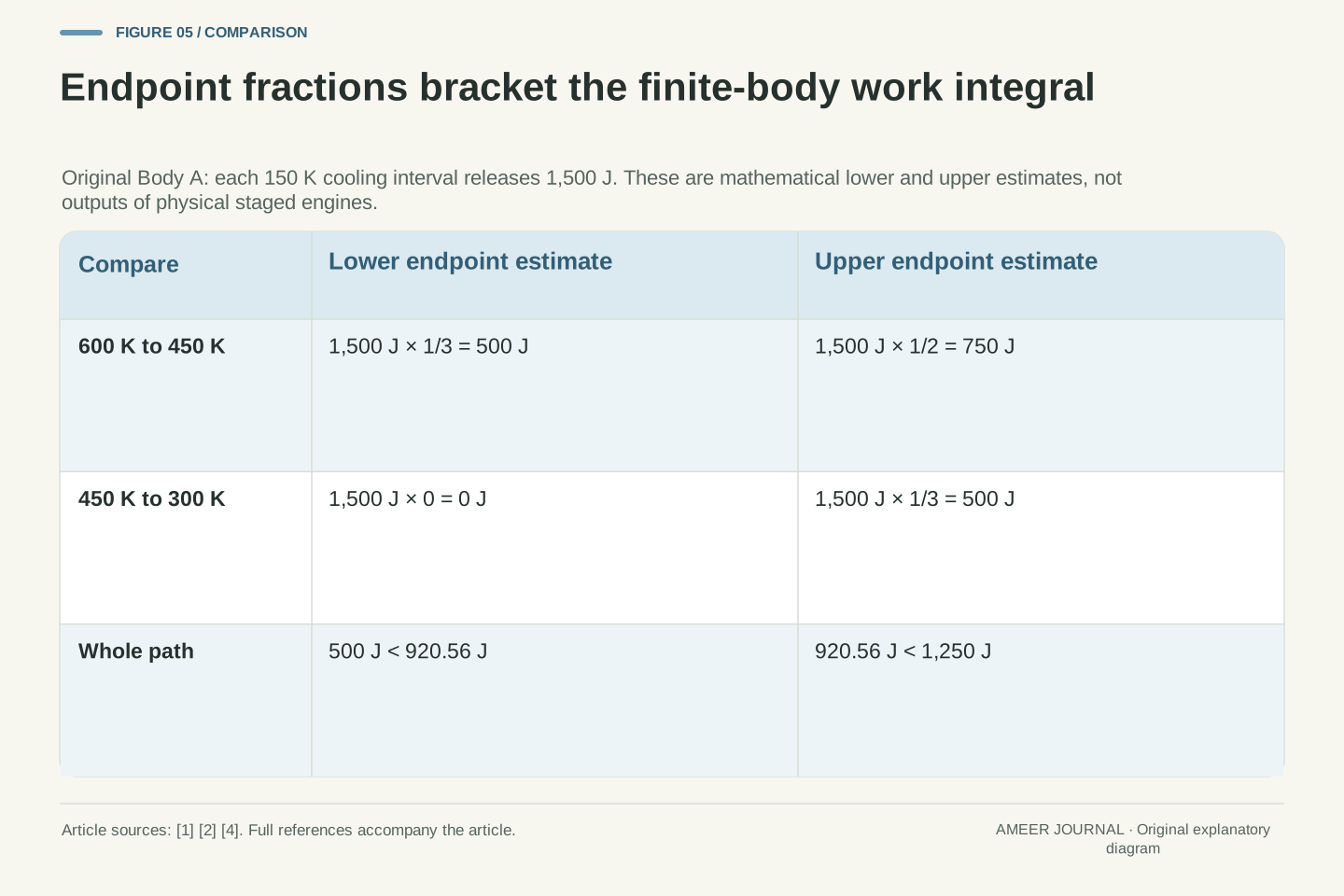
A simple bracket helps check Body A's result. Divide its cooling path into two equal temperature intervals: 600 to 450 kelvin and 450 to 300 kelvin. With ten joules per kelvin of heat capacity, each interval releases fifteen hundred joules. The reversible fraction falls continuously within each interval.
For an upper estimate, assign every joule in an interval its warmer endpoint's fraction. The first interval then contributes 750 joules, and the second 500, totaling 1,250. For a lower estimate, use each cooler endpoint: 500 joules for the first and zero for the second, totaling 500.
The exact reversible result, about 920.56 joules, lies between those limits. They are mathematical bounds on the same integral, not outputs of two physical engine designs. Dividing into smaller temperature intervals tightens the bracket. Even this coarse check shows why the fifteen-hundred-joule initial-temperature shortcut is too large.
The function η(T)=1−T_0/T increases with T for T>0. Partition Body A's [300,600] K range at 450 K. Each temperature interval carries Q_segment=CΔT=1500 J. Replacing η throughout each interval by its colder or warmer endpoint produces lower or upper Riemann sums for W_max.
The lower sum is 1500(1−300/450)+1500(1−300/300)=500 J. The upper sum is 1500(1−300/600)+1500(1−300/450)=1250 J. Thus 500 J<W_max<1250 J, consistent with 3000−3000 ln 2≈920.558458 J. The strict inequalities follow because η varies within each nonzero interval.
These sums bound a reversible-work integral over temperature, not a time integral or an operating sequence with finite heat-transfer gaps. Their role is an arithmetic and interpretation check. Finer subdivisions converge toward the same integral, whereas applying the single initial fraction to the entire heat amount retains an incorrect constant-temperature assumption.
Direct cooling conserves the energy while giving up the work opportunity
Let Body A cool directly into the 300-kelvin environment, with no work-extraction device. Keep the same initial and final body states. The environment now receives all three thousand joules, and delivered work is zero. The energy ledger is complete, just as it was in the reversible calculation.
The body's entropy decrease depends only on those states, so it remains about 6.93 joules per kelvin. The environment gains three thousand divided by three hundred, or ten joules per kelvin. The combined increase is about 3.07 joules per kelvin. The spontaneous cooling route creates entropy instead of preserving the reversible work opportunity [2].
Multiply that increase by the 300-kelvin environment and the result is about 920.56 joules, matching the work available in the reversible comparison. The energy was transferred, not erased. What changed was the opportunity to obtain work under the same initial and final body conditions and the same environment.
For direct cooling of Body A with no extracted work, Q_0=3000 J and W=0. The body still has ΔS_body=−10 ln 2 J/K because entropy is a state function [2]. The fixed environment gains ΔS_env=Q_0/T_0=10 J/K, giving S_gen=10−10 ln 2≈3.068528194 J/K.
Multiplication gives T_0 S_gen=3000−3000 ln 2≈920.558458 J. This equals W_max−W for the same source-state change and environment. The equality is derived here from the complete energy and entropy accounts. It does not require knowing the time-dependent direct heat-transfer rate or introducing an unmeasured material property.
The body has identical endpoint internal-energy and entropy changes in the direct and reversible alternatives. The environment receives different energy amounts because one route exports work. That is why comparing the body's released heat alone cannot describe the full outcome. The direction and form of every transfer remain necessary even when endpoint temperatures match.
Keep source type, temperature history and work boundary beside the number
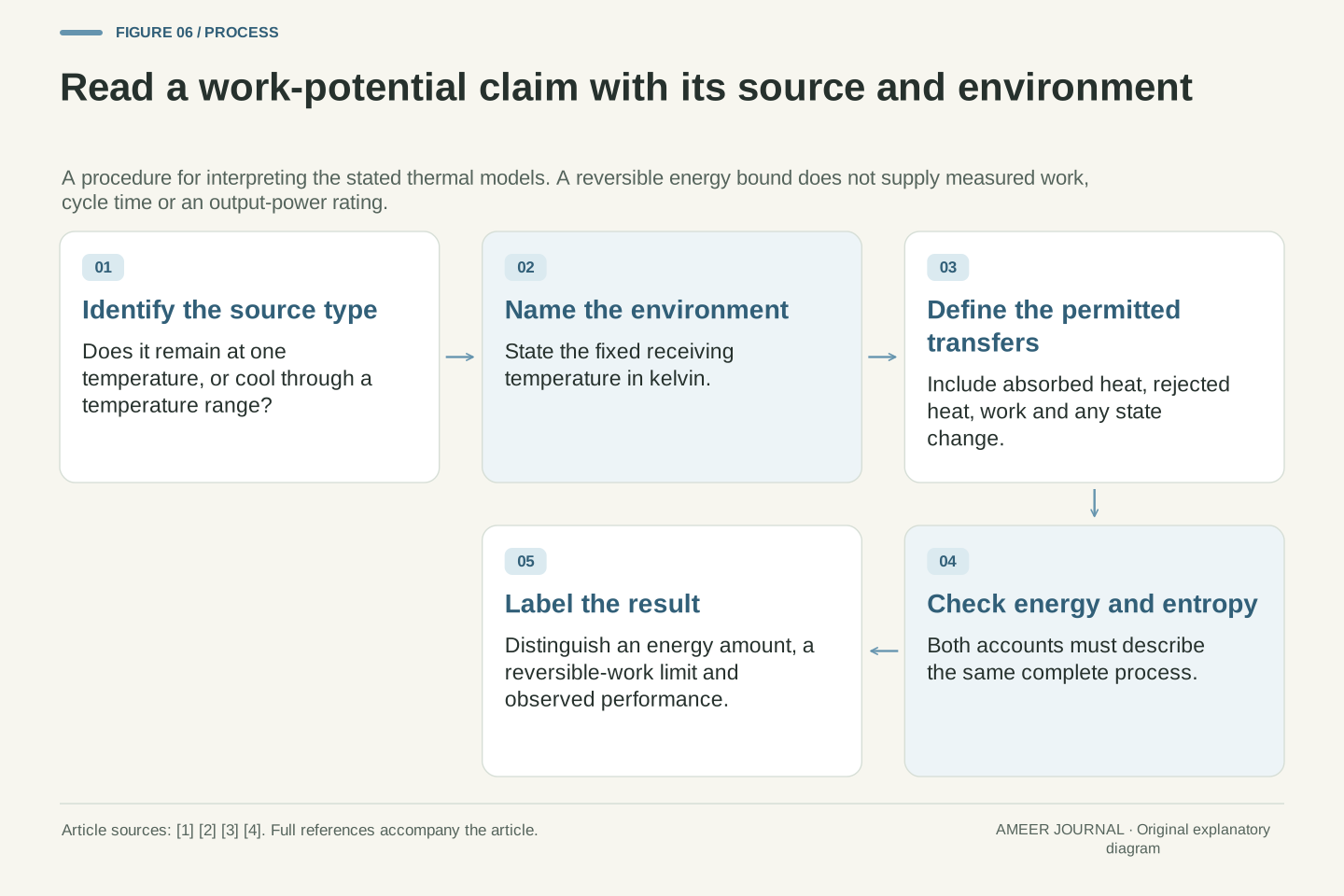
When reading a heat-recovery claim, first ask whether its source is being treated as a constant-temperature reservoir or a finite body that cools. Then identify the receiving environment and the permitted outputs. These choices decide whether one temperature ratio is appropriate or whether changing contributions must be added over a path.
Next separate the heat amount from the work limit and from measured work. In our examples, one hundred joules from fixed reservoirs gives different limits at 400 and 600 kelvin. Two finite bodies each release three thousand joules but have different limits again. None of those calculations supplies a power rating, because no operating duration was specified.
Finally check both conservation and entropy with the same boundaries. Sixty joules of proposed work can balance a hundred-joule input and still fail the temperature-dependent limit. Zero work from direct cooling can conserve every joule while losing an available opportunity. Keeping those two questions visible makes an efficiency statement more informative than a heat total or percentage on its own.
A reproducible thermal-work statement identifies the source model, initial and final states, allowed interactions, environmental temperature and sign convention. For constant reservoirs, W≤Q_h(1−T_0/T_h). For our constant-capacity rigid body cooling to T_0, W≤C[(T_i−T_0)−T_0 ln(T_i/T_0)]. The expressions describe different source behavior under their stated conditions [1][2][4].
Do not substitute a measured heat-transfer rate for an energy amount, an initial temperature for a full cooling path, or an engine bound for a heat pump's heating ratio. The calculations produce joules; a watt value would additionally require a time account. Real performance assessment also needs evidence that the assumed boundaries, properties and process conditions apply.
The central distinction survives the examples: conserving energy does not establish its maximum conversion to work. The entropy account introduces the source temperature, environment and irreversibility. Equal released energy can therefore coexist with unequal reversible work, and a smaller work output can coexist with complete energy conservation. Name the comparison before interpreting the difference as a loss.
Sources & further reading
Explore the references behind this guide. External pages may change after our review.
- 4.5 The Carnot Cycle - University Physics Volume 2 | OpenStaxOpenStax · Accessed 7 Nov 2026
- 4.6 Entropy - University Physics Volume 2 | OpenStaxOpenStax · Accessed 7 Nov 2026
- Carnot CycleNASA Glenn Research Center · Accessed 7 Nov 2026
- Available energy from a finite energy source — Lecture 8: Exergy AnalysisNPTEL · Accessed 7 Nov 2026
Article updated 7 Nov 2026.
Found something we should revisit?
Good explanations get better with thoughtful feedback.