What you’ll take away
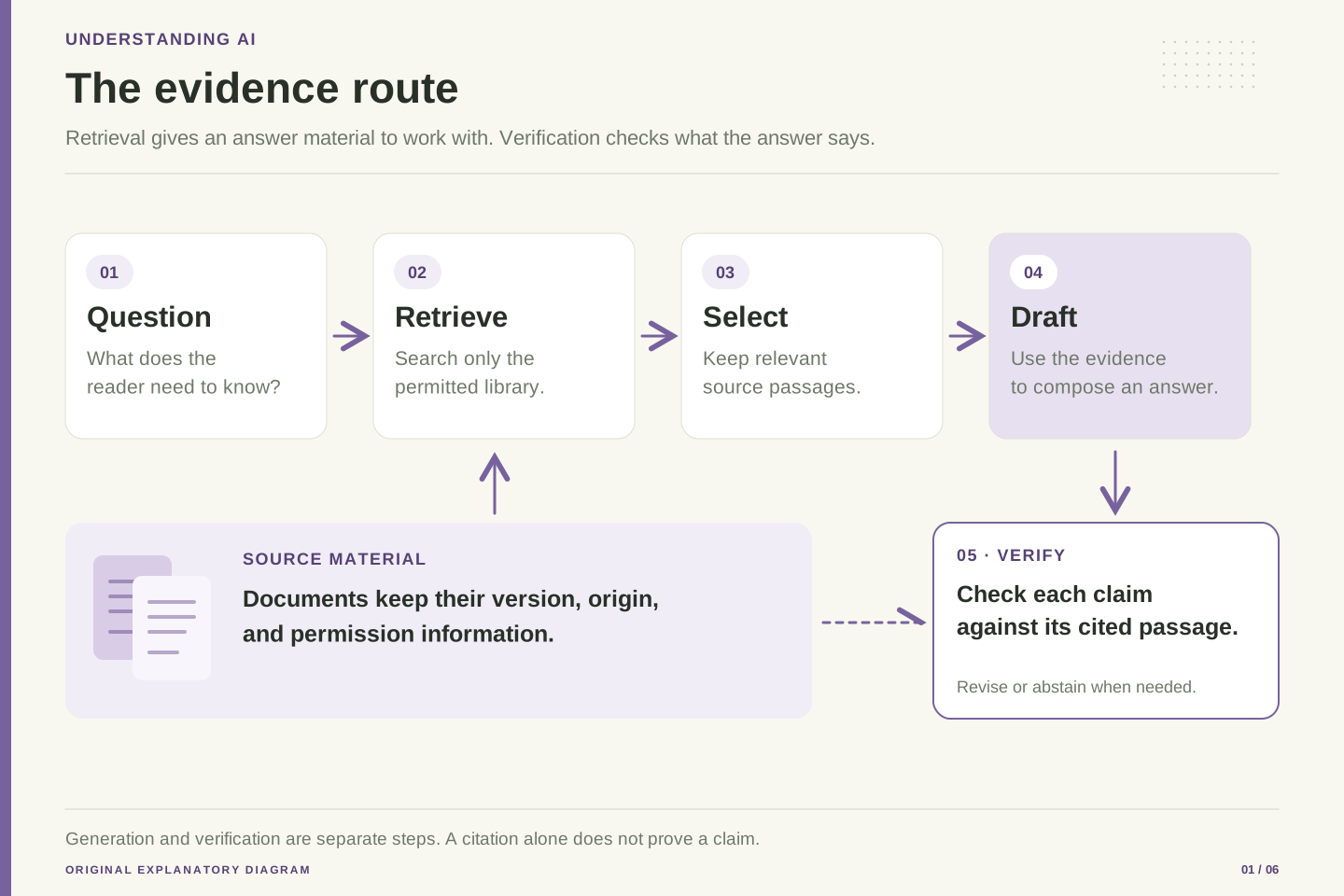
- Retrieval, generation, and citation checking are separate jobs.
- A citation must support the exact scope of a claim, including its exceptions.
- Enforce document permissions before material reaches the model.
- Use a saved test set and publish reviewed drafts with truthful provenance.
What RAG adds to an answer
Ask an AI assistant about a return policy that changed yesterday. A smooth answer is not enough: you need the rule that applies now, the exceptions, and a way to check both. Retrieval-augmented generation, usually shortened to RAG, is a way to give a language model selected information before it writes. A search step finds useful material; the model then uses that material while composing its response. The original RAG research combined retrieval from an external collection with a text-generating model. [1]
Think of a reader working with a small folder of reference pages. Finding the folder, choosing the right page, and explaining its meaning are separate jobs. Success at one does not prove success at the others. A system can find the correct policy but leave out an exception. It can write a sensible answer while attaching the wrong page. It can also fail to find the policy and confidently use an older rule from elsewhere.
For a blog, this distinction matters whenever a statement depends on a product manual, scientific paper, or current policy. A useful research assistant should help you locate and inspect evidence. It should also make uncertainty visible. The goal is an answer you can trace and correct, rather than an answer that merely looks well researched. This article uses fictional shop policies to demonstrate the checks; they are not advice about any real retailer.
RAG is an architecture pattern in which retrieved material conditions generation. The original Lewis and colleagues paper studied models combining a parametric generator with a non-parametric document store; contemporary applications use a broader range of retrieval and orchestration designs. Supplying context at inference time is not the same operation as updating model weights. An external index can change while the generator remains unchanged. [1]
For an engineering review, separate four contracts: which records may be retrieved, which passages are actually supplied, what the generator is allowed to assert, and how assertions are connected to evidence. Treat each contract as independently testable. A correct search result does not guarantee a correct summary, and a valid citation identifier does not establish that a sentence follows from its cited passage.
Consider a support assistant whose observable input is a question plus a tenant identity. Its observable output should include the answer, evidence identifiers, and an explicit unsupported-answer state. The internal design might contain several models, but the user-facing acceptance condition should not depend on how impressive that orchestration sounds. It depends on whether an authorized reader can reproduce the conclusion from the selected evidence. The recommendations below describe one defensible design approach, not a benchmark result or a claim that a particular provider has solved factual reliability.
Find the right passage, not just a related page
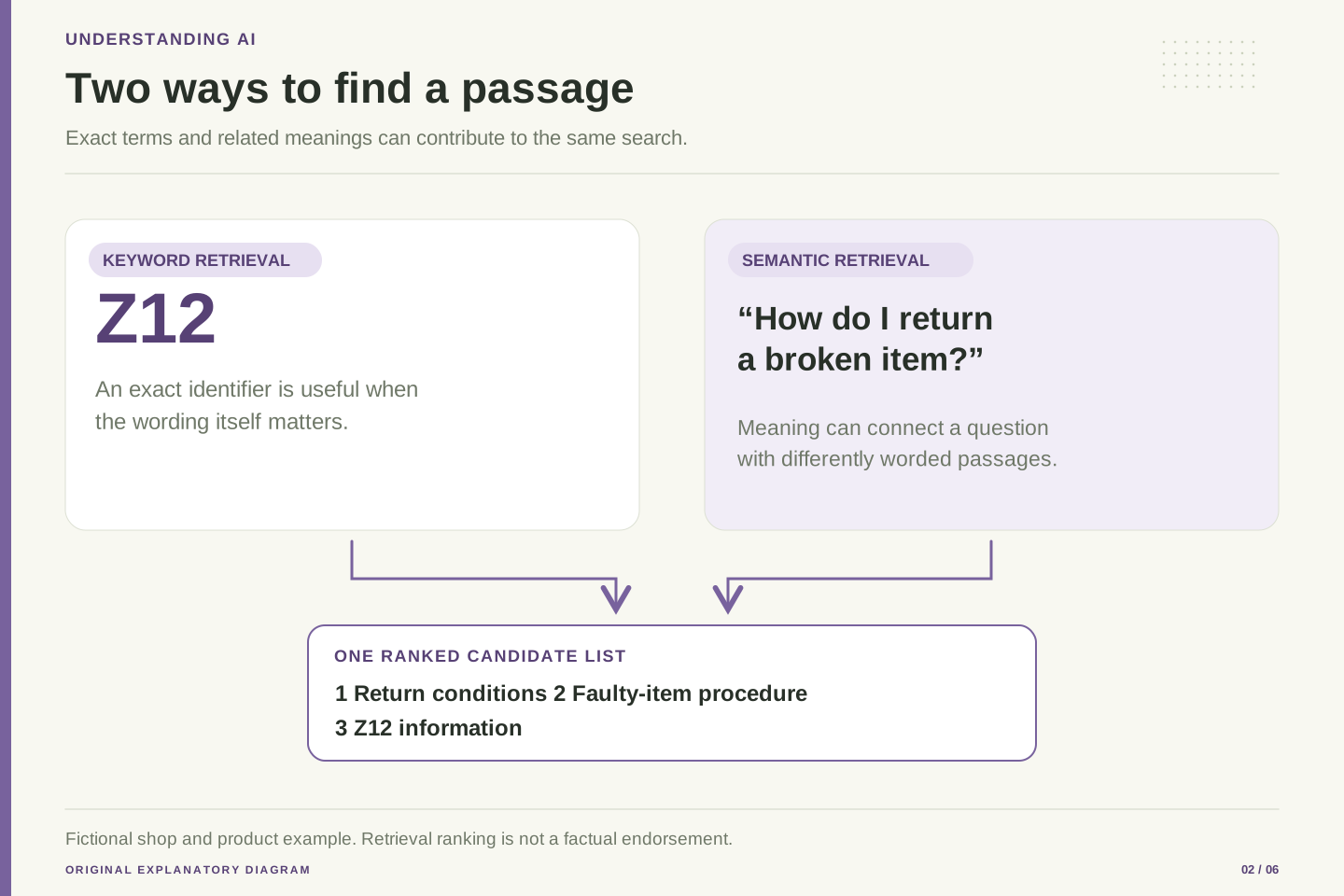
A question and its answer do not always use the same words. Someone might ask, Can I send this back? while the help page uses the word returns. Search based on meaning can connect those phrases. Exact wording still matters for a model number, an error code, a date, or a person's name. Microsoft describes hybrid search as combining text and vector search, with both contributing to the result list. [2]
Imagine two fictional products called Z12 and Z12 Pro. Their names are similar, but their repair rules might be different. An answer about Z12 Pro is not useful evidence for Z12 simply because the page sounds relevant. Good retrieval checks the actual product, the country or market when needed, and the applicable version. It should also find the passage containing the answer rather than hand the writer a long document and hope the important sentence is noticed.
A reader can perform a small version of this check. Open the source and search for the exact model or rule. Read the heading and the nearby paragraphs. Ask whether the source describes the same situation as the article. When an answer combines information from several pages, check whether they refer to compatible products and dates. A neat explanation assembled from incompatible documents can be more misleading than a clearly incomplete answer.
Represent retrieval quality in terms of the evidence needed to answer, rather than superficial topic similarity. A lexical index can preserve the importance of exact identifiers, while embedding retrieval can find semantically related wording. Azure's documented hybrid approach runs text and vector searches and combines ranked results; this is an example implementation, not a requirement to use that platform. [2]
In the fictional Z12 corpus, preserve normalized fields for product family, variant, locale, publication state, effective period, and access scope. Use reliable structured fields as filters where the question establishes those constraints. Do not expect an embedding to infer whether an almost identical product name is interchangeable. If the query does not establish the variant, returning a clarifying question may be better than selecting the most popular variant.
Use a small diagnostic set to inspect retrieval independently of generation. For each question, record the documents that would be sufficient evidence. Examine whether those records appear among the candidates and whether irrelevant versions displace them. Keep search scores separate from probabilities of correctness: a relevance score ranks candidates according to a method, not according to a universal truth scale. Increasing the number of retrieved passages is only useful when it adds needed evidence; it can also add conflicting instructions, duplicate paragraphs, and material that consumes the available context without improving the answer.
Keep the exception beside the rule
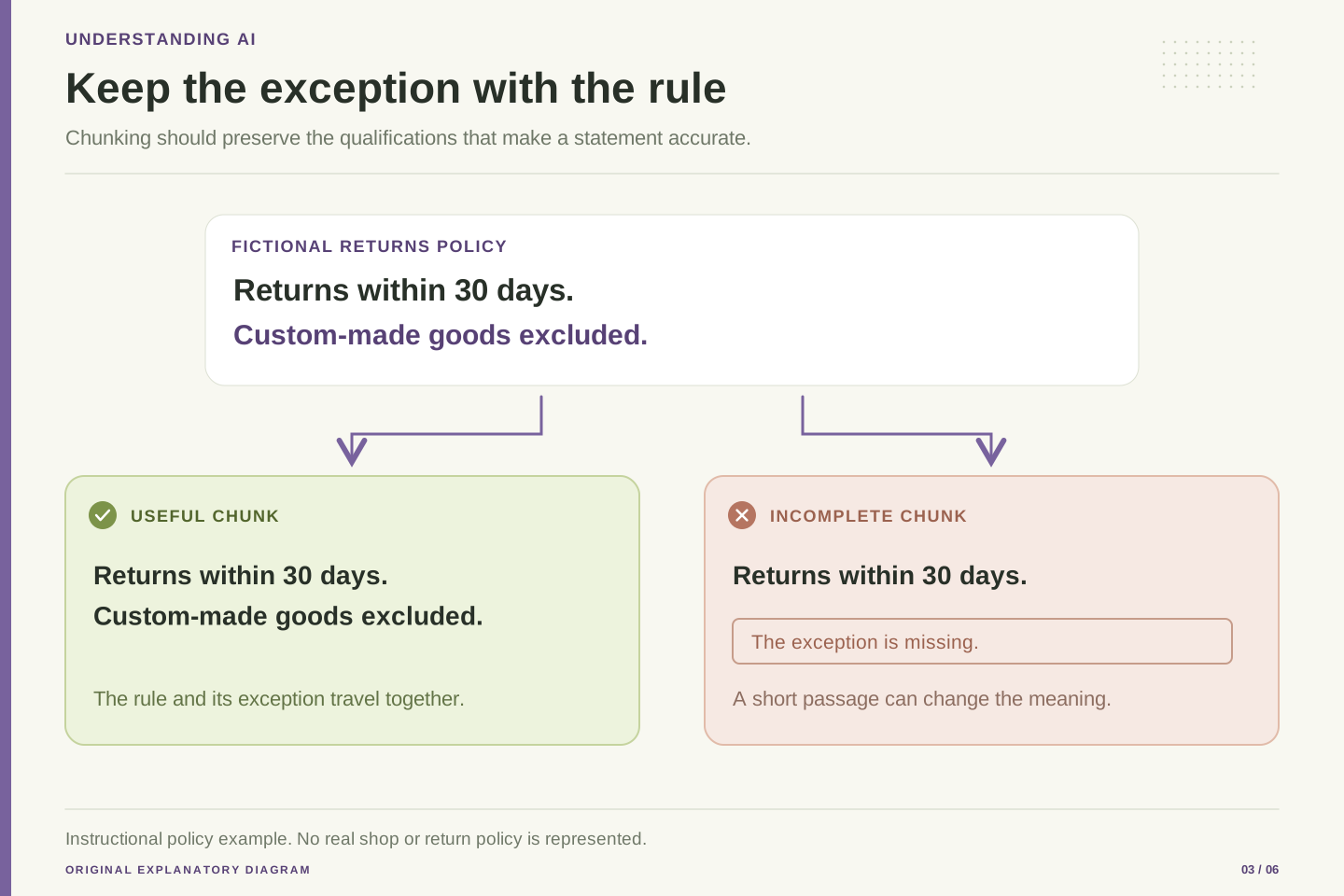
Long documents are often divided into smaller pieces called chunks. This can make searching and supplying information to a model more manageable. But cutting a document is not a purely mechanical job. A heading, a table label, or a sentence beginning except may carry the detail that changes the answer. Microsoft's chunking guidance discusses splitting documents while retaining useful context. [3]
Here is an invented policy: Unused standard items can be returned within 30 days. Custom-made items cannot be returned unless faulty. If the system stores only the first sentence, it may answer a question about a custom-made item incorrectly. If a table lists different periods for different products, removing the row labels creates a similar problem. The numbers survive while their meaning disappears.
For readers, the practical habit is simple: check a little beyond the quoted line. For publishers, preserve section titles, table headings, units, and important exceptions when preparing research material. A source note should lead back to the original document and, where possible, the relevant section. Avoid storing a collection of disconnected quotations with no clear record of where each one came from. A useful research folder keeps the relationship between the passage and the larger rule, so a future editor can check whether the interpretation still holds.
Chunk boundaries are an information-design decision. Microsoft's guidance describes fixed-size, variable-size and structure-aware approaches, as well as the value of overlap in suitable cases. There is no single chunk size that makes every policy, table and manual equally retrievable. [3]
For this example, store a stable document identifier, version identifier, heading path, passage text and passage location together. If a table is transformed into text, carry column headings and units into each meaningful record. A row containing 30 without the product type or the unit days is not useful standalone evidence. Keep the original representation available for inspection when a transformation may have changed interpretation.
Build boundary-focused tests. Put an exception immediately after a proposed split, a definition immediately before it, and a heading shared by several paragraphs. Ask questions whose correct answers depend on those relationships. The test should fail if the selected evidence preserves the main rule but loses its limit. This is a more informative check than merely verifying that every chunk has a similar character count.
Avoid pretending a passage hash is a quality certificate. A hash helps identify exactly which bytes were used; it says nothing about whether those bytes were extracted correctly or whether they answer the question. Provenance supports an audit, while extraction and interpretation still require their own validation.
A citation must support the exact claim
A working link proves only that a page exists. It does not prove the sentence beside it is correct. Citation research such as the ALCE benchmark evaluates citation quality separately from fluency and correctness, because these are different properties of an answer. [4]
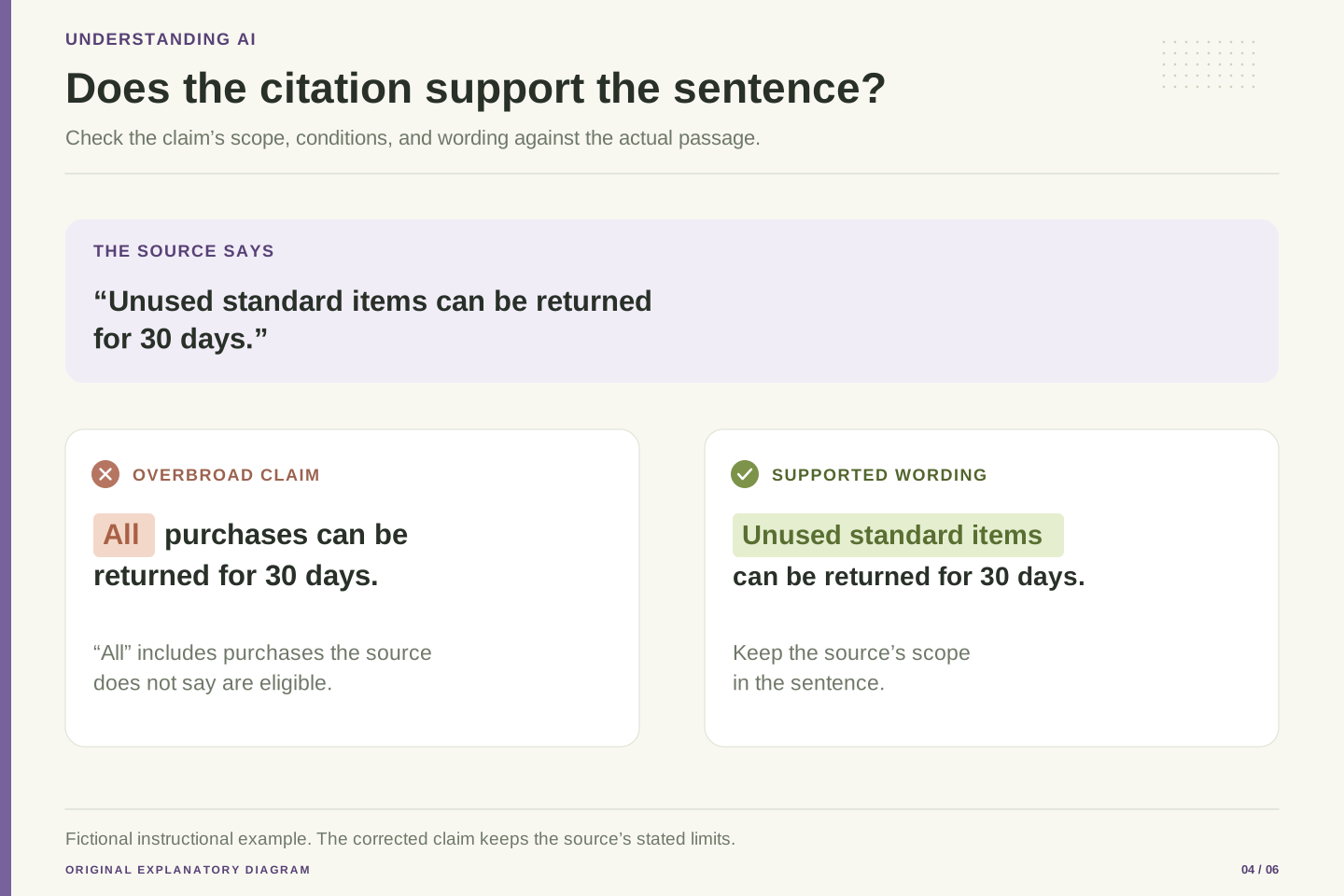
Return to the invented shop policy. The article says All purchases can be returned for 30 days. The linked page says Unused standard items can be returned within 30 days. The source is real within our example and the time period matches, but the word all changes the claim. A careful version would preserve the conditions: The example policy gives unused standard items a 30-day return period. The important work is not adding a footnote. It is making the sentence no broader than the evidence.
Check numbers, units, dates, and words such as always, never, every, and proven. Those words often carry more certainty than a source supports. If an article says a manufacturer recommends a setting, a manufacturer manual may support that narrow statement. It does not automatically prove that the setting is best for every user. If the writer makes a comparison or a calculation, the explanation should say what was compared or assumed. Readers should be able to separate what a source reports from what the writer concludes.
Model the final answer as a set of checkable claims with evidence links, rather than a paragraph followed by an undifferentiated bibliography. ALCE's separation of fluency, correctness and citation quality is useful here: elegant language and the presence of references are insufficient acceptance conditions. [4]
For each externally supported claim, record whether the cited passage supports the entire claim, only part of it, or a narrower version. Preserve qualifiers and scope. An evaluation example should distinguish all purchases from unused standard items, and within 30 days from exactly 30 days after dispatch. These differences are small at the token level but substantial for the reader's decision.
Use deterministic checks where possible: citation IDs must resolve to supplied evidence; numeric units must be retained; a URL must not be invented by the generator. Then review semantic support. A second model can help triage unsupported statements, but its agreement is not independent proof. For important claims, a reviewer should inspect the passage directly.
When the answer includes a derived conclusion, make the derivation visible. For example, combining two documented quantities in an arithmetic calculation requires both inputs and the calculation, not merely a citation to one input. A useful output schema can distinguish reported facts, explicit assumptions, and derived results. That separation makes corrections more precise when a source later changes.
Dates, disagreements, and missing information
A source can be trustworthy and still be the wrong source for today's question. A manual might describe an older product. A support page might apply only to one region. A research paper might establish a result under a limited test setup. RAG systems are commonly used to bring external, domain-specific information into an answer, but the application still has to select and maintain that information carefully. [5]
Suppose one fictional policy says 14 days and a later one says 30 days. Do not average them to 22 days. First check the dates, the customers covered, and whether the newer document actually replaces the older one. If the relationship remains unclear, say so. An honest answer might explain that two versions disagree and identify the detail that needs confirmation. It should not quietly choose the longer period because that sounds more helpful.
A blog needs a similar habit. Keep an access date and a meaningful review date with the source list. Recheck facts that can change, such as prices, product support, legal requirements, and plan limits. When information is missing, leave a visible gap instead of filling it with a plausible number. Readers can work with a clear limit. They cannot easily detect a confident invention hidden inside an otherwise accurate article.
Versioning should be part of the data model, not a note added after a factual dispute. Microsoft's RAG documentation discusses preparing searchable content and retaining metadata useful for citation and retrieval. Extend that idea into an explicit editorial record for your own application. [5]
Separate publication date, effective date, retrieval time and editorial review time. They answer different questions. A document downloaded today may describe a policy that ended last year. A recently edited page may have changed navigation rather than the rule being cited. Avoid using a fresh crawl timestamp as evidence that every factual statement has been revalidated.
Define conflict behavior before launch. In a policy corpus, precedence may come from an authenticated policy registry or an explicit supersedes relationship; it should not be inferred solely from whichever passage ranks first. In a research corpus, disagreement may be legitimate and should be summarized with study conditions rather than collapsed into a single certainty.
Store the version used for a published answer and create a review task when its source changes. Retaining evidence must respect access permissions and copyright; it need not mean republishing the full source. For missing evidence, define an abstention outcome that includes what was searched and what remains unknown. This provides a useful boundary without converting a retrieval failure into an unsupported factual conclusion.
Treat retrieved text as evidence, not instructions
A page used for research can contain text that tries to tell the AI what to do. That text might ask it to ignore its task, reveal information, or recommend something unrelated. This is called indirect prompt injection when it arrives through external material. OWASP warns that retrieval does not remove this risk. [6]
A normal reader would not treat a sentence in a product manual as permission to open a private staff folder. A research assistant should not do that either. Material found during a search belongs in the evidence pile. It should not gain the power to change the assistant's rules or authorize actions. This is especially important if the same assistant can send messages, edit a website, or use account credentials.
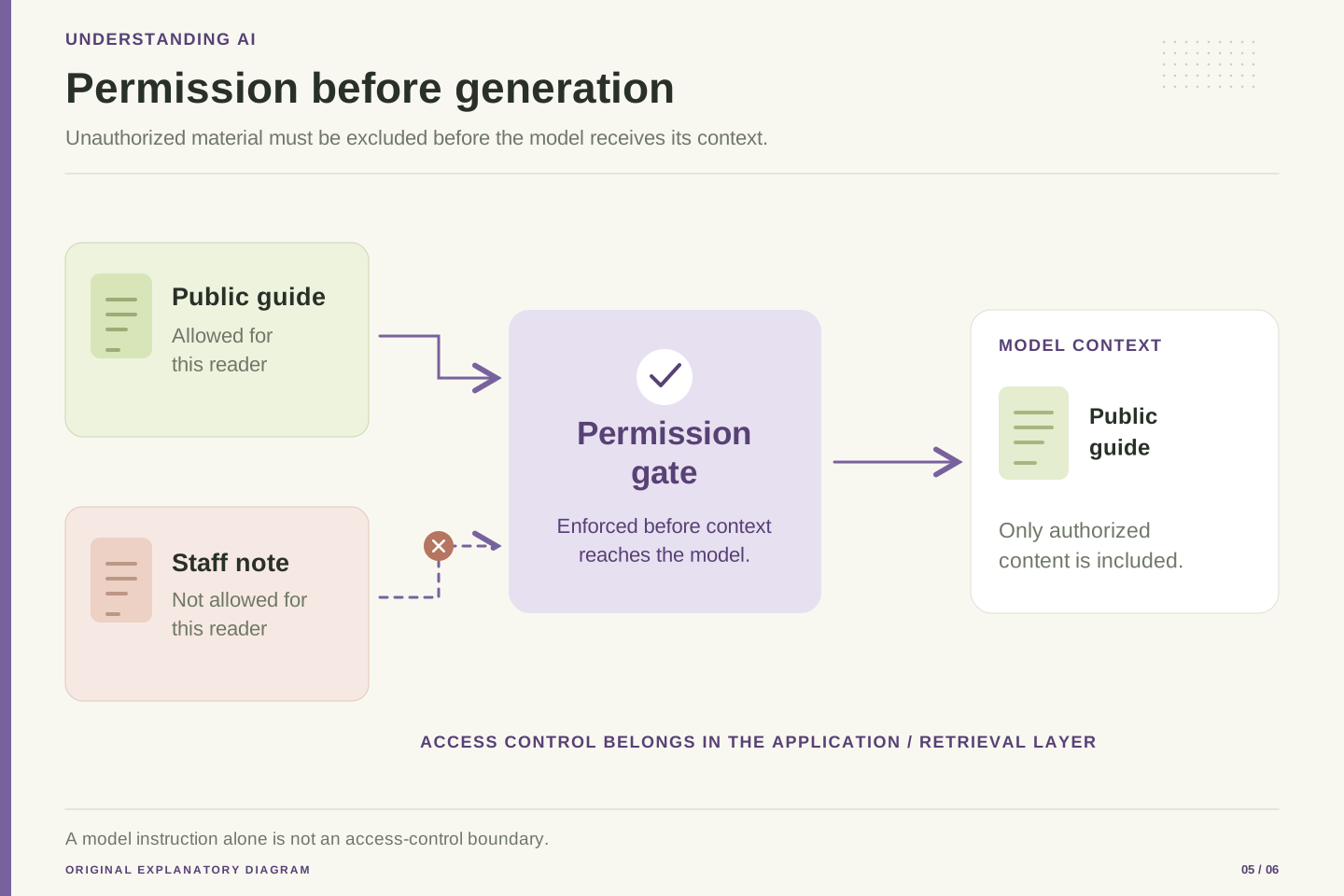
Privacy needs a separate check as well. A public visitor asking a question should never receive a passage from a confidential document simply because it matches the topic. Filtering after the answer is written is too late if private material has already been passed to an outside model. For a small publication, a practical first design is a read-only research helper with a carefully selected source collection. Give publishing, account changes, and message sending their own controls. An interesting document is not an instruction from the site owner.
The retrieval boundary is a trust boundary. OWASP describes indirect prompt injection through external websites or files and notes that RAG is not a complete mitigation. Retrieved content must remain untrusted application data even when it comes from a useful source. [6]
Enforce authorization before constructing model context. A tenant or audience filter should apply to the source query and to any subsequent fetch of the selected record. Do not rely on a natural-language instruction telling the model not to mention confidential passages. Keep retrieval permissions, tool permissions and publication permissions distinct; possession of evidence does not imply authority to take an action.
For this proposed editorial workflow, retrieval and drafting can run with read-only capabilities. The model can suggest an article revision, but the publishing endpoint should verify an authenticated editor, a current revision and the required review state. Source content cannot promote a draft, add an integration secret or send a marketing message. These are application-level boundaries that remain meaningful even when a generated answer is wrong.
Logs also deserve a deliberate policy. Record operational IDs and error categories where possible, while avoiding unrestricted storage of private documents, credentials or reader inputs. A useful security test places an instruction-like passage in a permitted document and checks that it neither changes tool privileges nor appears as an authorized command. The test is evidence about that scenario, not a guarantee against every future injection.
Test the failures you expect to meet
A good demonstration question often has a clear answer in an obvious document. Real readers ask messier questions. They misspell product names, leave out dates, combine two issues, or ask for something your sources do not contain. Testing should include those cases before the assistant becomes part of a publishing process.
Build a small question set from your actual subject area. Include a straightforward question, a question needing an exception, one with similar product names, one with conflicting versions, and one that cannot be answered from the available material. Write down the evidence and the acceptable answer before running the assistant. Otherwise it is easy to move the target after seeing a persuasive response. Treat these as original test-design suggestions, not published performance figures.
When an answer fails, find the stage that failed. Did search miss the needed page? Did the correct page arrive without its heading? Did the writer add a claim that no source supported? Did a correct statement receive the wrong link? Fixing every failure by asking the model to be more careful hides the real problem. Also rerun earlier questions after changing a search setting or prompt. A change that helps one question may make another worse, so a saved test set is more useful than an isolated success screenshot.
Use a staged evaluation harness so that failures are attributable. For each test question, retain the corpus version, query constraints, candidate documents, selected context, answer, citations and reviewer decision. This is a proposed diagnostic record; redact sensitive fields and apply a retention policy rather than collecting everything indefinitely.
Measure retrieval coverage against the evidence required for the question. Then inspect claim support, citation resolution, appropriate refusal, and cross-tenant isolation separately. If twenty test questions contain fifty externally checkable claims, report the denominator when discussing a claim-support result. Do not convert a handful of favorable examples into an advertised accuracy percentage.
Test source removal and permission changes, not just source addition. A document deleted from the approved collection should not remain answerable through a stale public cache. A changed policy should trigger review of affected content. Include malformed extraction, duplicated passages, conflicting effective dates and unavailable source URLs. Decide whether the expected behavior is a partial answer, clarification or abstention.
Maintain a regression set across model and index changes. Evaluate the smallest change that addresses a demonstrated failure; adding an agent, reranker or larger context window introduces cost and new behavior that should earn its place. Citation evaluation research provides useful categories, but your own acceptance criteria should reflect the decisions readers will actually make with the answers. [4]
Build a publishing habit readers can inspect
For a researched blog, the most useful RAG workflow may happen behind the scenes. Start with a real reader question. Gather relevant primary material, such as the maker's documentation or the original study. Draft an explanation, check its claims, and add examples that make the topic easier to understand. Let the source list show where the factual foundations came from without turning the article into a stitched collection of summaries.
Keep the easy version and the technical version aligned on facts. The easy version can use shorter sentences and everyday examples. The technical version can explain assumptions, measurements, failure cases and implementation details. Neither should quietly change the conclusion. If the technical version says a result depends on certain conditions, the easy version still needs to communicate that limit in plain language.
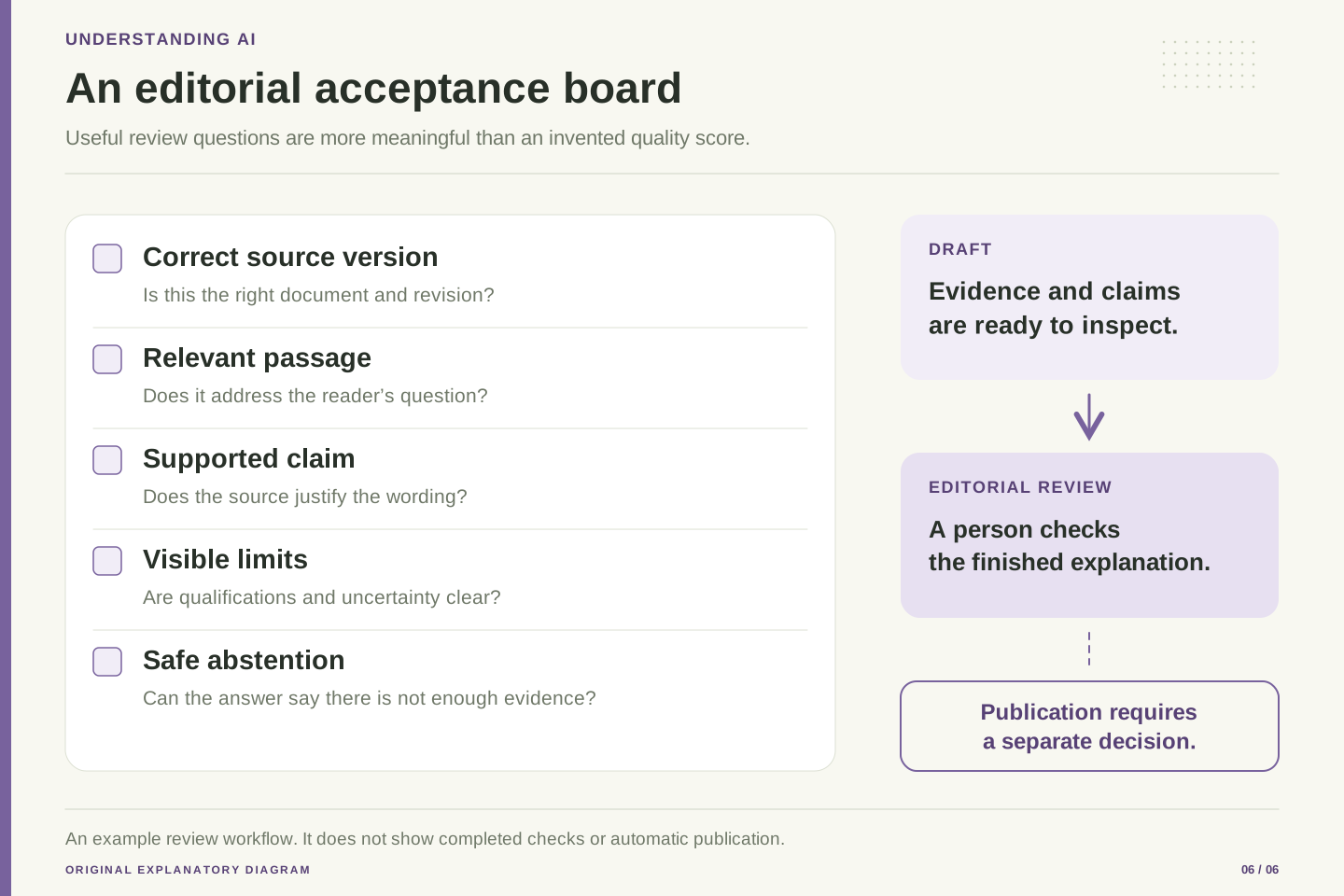
Before publication, ask three final questions. Can a reader find the evidence? Does the evidence support the wording? Would the article still be useful if the AI brand names were removed? These questions direct attention toward the actual job: helping someone understand a topic and make a better-informed choice. RAG can shorten the path from a question to relevant material. Trust comes from the visible checks around that path, the quality of the explanation, and the willingness to correct an answer when its evidence changes.
A defensible editorial implementation separates source acquisition, drafting, review and publication. Store article text as structured content, keep source IDs stable across revisions, and track the claim-bearing passages that require renewed review after an update. Generation should produce a draft with explicit gaps rather than silently marking its own work as verified.
Use one factual review record for both reading modes. Easy and technical prose can differ substantially in vocabulary and depth, but dates, units, scope and conditions should reconcile. If a simplified explanation uses an analogy, identify where the analogy stops applying. If the technical mode introduces a derivation, preserve the assumptions that make it valid. A reviewer should be able to compare conclusions without reading two unrelated stories.
Treat the evidence interface as part of the product. A citation should open a meaningful source, show a readable title, and avoid implying that an external author endorses your article. Record AI assistance honestly; do not fabricate a human specialist or a hands-on test to create a stronger appearance of authority.
Finally, distinguish freshness, factual support and operational reliability in the admin dashboard. An article can be recently reviewed yet contain an unsupported sentence; a well-supported article can be unavailable because of a failed deployment. Keeping these concerns separate makes maintenance actionable. The practical outcome is a research and publishing system whose decisions can be inspected, rather than a promise that fluent output is automatically trustworthy.
Sources & further reading
Explore the references behind this guide. External pages may change after our review.
- Retrieval-Augmented Generation for Knowledge-Intensive NLP TasksLewis et al.; arXiv / NeurIPS · Accessed 6 Nov 2026
- Hybrid search using vectors and full-text searchMicrosoft Learn · Accessed 6 Nov 2026
- Chunk large documents for RAG and vector searchMicrosoft Learn · Accessed 6 Nov 2026
- Enabling Large Language Models to Generate Text with CitationsGao et al.; ACL Anthology · Accessed 6 Nov 2026
- Retrieval augmented generation and indexesMicrosoft Learn · Accessed 6 Nov 2026
- LLM01:2025 Prompt InjectionOWASP Gen AI Security Project · Accessed 6 Nov 2026
Article updated 6 Nov 2026.
Found something we should revisit?
Good explanations get better with thoughtful feedback.