What you’ll take away
- kW measures power; kWh measures energy.
- A station rating is a ceiling, not a guaranteed session speed.
- Charging curves and losses matter when estimating time and cost.
- Plan around energy needed and parking time; use qualified local installation advice.
Follow the energy from the socket to the battery
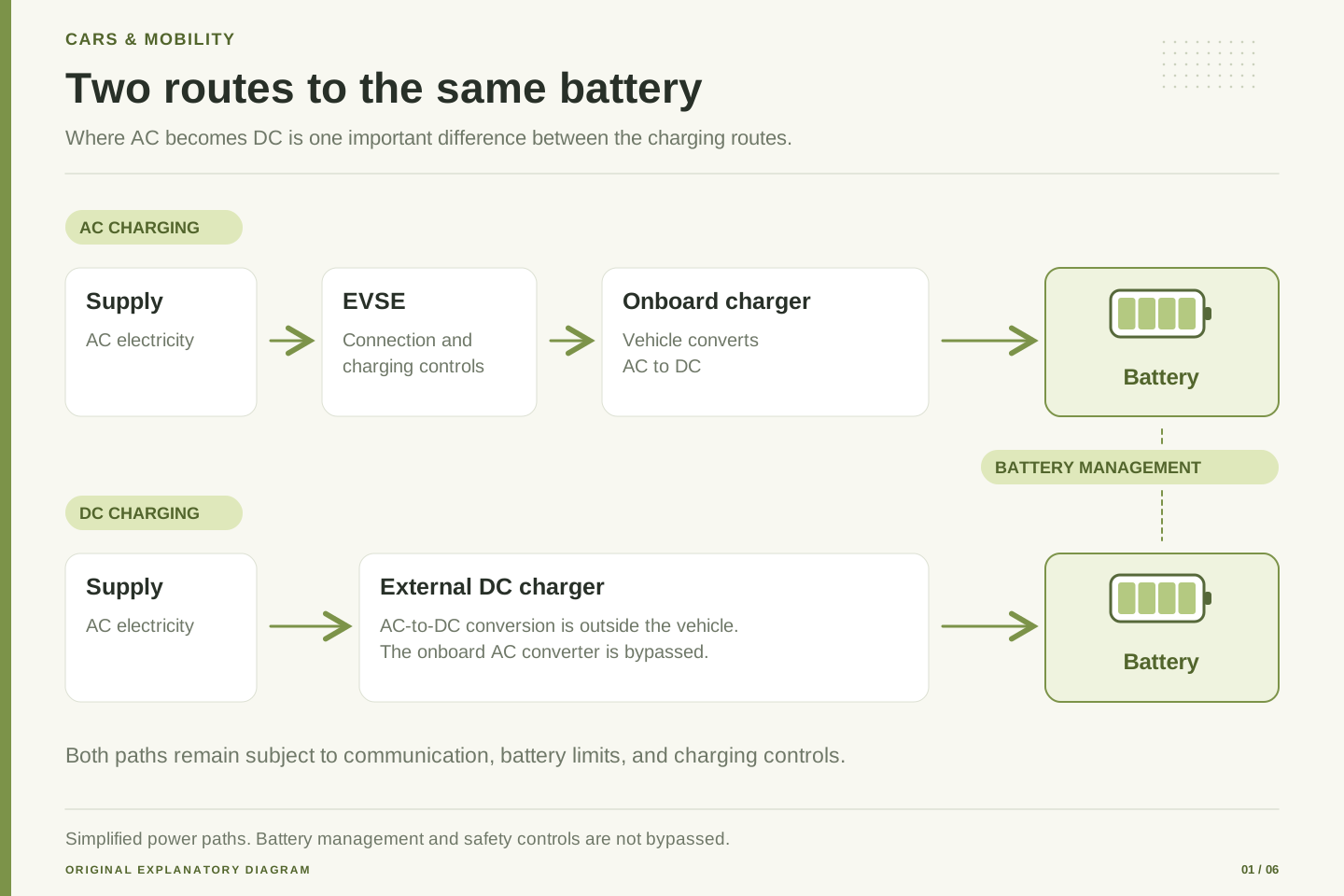
An electric car does not simply pour electricity into an empty box. Its charging equipment, onboard electronics and battery controls work together to move energy into the battery under suitable conditions. The first useful distinction is between alternating current, or AC, and direct current, or DC. An EV battery stores energy through electrochemical processes and is charged with DC. During AC charging, the vehicle's onboard charger converts incoming AC to DC. The US Department of Energy identifies this converter as a separate component from the charge port and battery. [1]
At a typical AC charging point, the equipment outside the car provides a controlled connection to the supply. It is often called a charger in everyday conversation, although EVSE, meaning electric vehicle supply equipment, is the more precise term for that part of the arrangement. With DC fast charging, the major AC-to-DC conversion happens outside the vehicle, and power reaches the battery through the vehicle's controlled DC charging path. [2]
This explains a common surprise: a powerful charging unit does not force a car to accept that power. The car and the equipment have to be compatible, and the battery must be ready to receive it. The useful question is not only How big is the charger? It is Which part of this particular charging session sets the limit?
Separate the supply interface, power conversion stage and battery-management function. In an AC session, EVSE makes an appropriately controlled supply available, while the vehicle's onboard charger performs the AC-to-DC conversion. The battery-management system supervises the pack's operating conditions; the external equipment does not eliminate the vehicle's charging controls. DOE's component description identifies the onboard charger and its monitoring role explicitly. [1]
In a DC session, the offboard charger supplies regulated DC through the vehicle's compatible DC path. This bypasses the onboard AC conversion stage, not the battery's protection and control functions. AC and DC capability therefore need separate entries in a vehicle specification. A vehicle's high DC peak does not establish its maximum AC intake. [2]
For practical analysis, draw boundaries around what is measured. Power at the premises meter, AC input to the vehicle, DC output of a charger and net energy entering the pack are related quantities, but they are not interchangeable. Conversion losses and auxiliary loads sit between some of those boundaries. An unexplained screenshot showing charging at 7 kW may refer to a different measurement point from another screenshot using the same label. Any comparison of charging performance should identify the measurement location, initial state of charge, target state and environmental conditions before interpreting the number.
Kilowatts and kilowatt-hours answer different questions
A kilowatt, written kW, is a measure of power: how quickly energy is being transferred. A kilowatt-hour, written kWh, is a measure of energy. You can think of power as the filling rate and energy as the amount added, as long as you remember that a battery is not literally a water tank. Charger ratings usually describe power, while battery capacity and electricity bills commonly use energy.
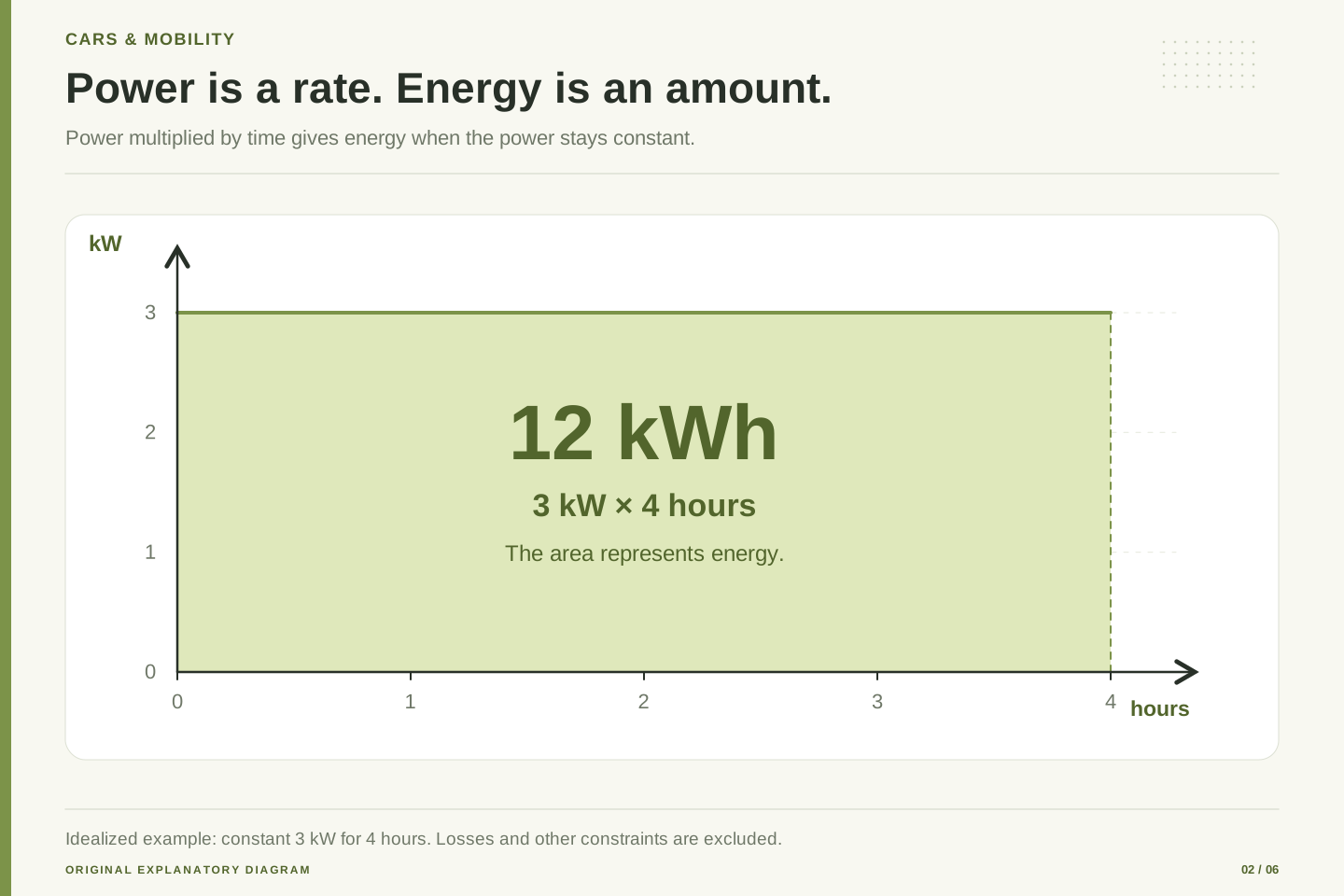
Here is an invented example with deliberately simple numbers. A steady input of 3 kW for four hours supplies 12 kWh. A steady input of 6 kW for two hours also supplies 12 kWh. These are ideal arithmetic examples, not promises for a vehicle. They exclude charging losses and changes in power. If the rate drops halfway through a session, multiplying the initial rate by the whole time will overestimate the energy delivered.
Battery percentage adds another layer. Ten percentage points in a small battery represent less energy than ten percentage points in a much larger battery. Compare the energy needed for your trip, not only the percentage on someone else's dashboard. Government charging guides also distinguish charger capability from vehicle capability when explaining charging time. [3] Once you keep rate, amount, and percentage separate, many apparently contradictory charging claims become much easier to read.
Use dimensional checks before comparing specifications. Energy is the time integral of power. For a constant rate, E = P × t, with kW multiplied by hours giving kWh. If the rate varies, divide the session into intervals and sum each interval's average power multiplied by its duration. This arithmetic is independent of any particular charging standard.
For a deliberately idealized 12 kWh input requirement, constant input powers of 3 kW and 6 kW imply four hours and two hours respectively. Those values describe energy at the selected input boundary. They do not automatically describe a 12 kWh increase in stored battery energy. Introduce efficiency and auxiliary loads only after identifying the boundary to which each term applies.
A second approximation relates battery energy to state-of-charge change: usable capacity multiplied by the fractional change can estimate the energy increment. A hypothetical 60 kWh usable pack moving from 40% to 60% suggests about 12 kWh. The calculation assumes the displayed percentage maps sufficiently closely to usable energy over that interval. Treat it as planning arithmetic, not a precision measurement of electrochemical state.
Manufacturer charging-rate limits remain independent of these calculations. The EPA notes that a vehicle with a lower AC acceptance limit does not gain that same advertised advantage from a higher-rated supply unit. [3] A valid unit conversion cannot remove a hardware or control constraint.
The advertised rating is only one ceiling
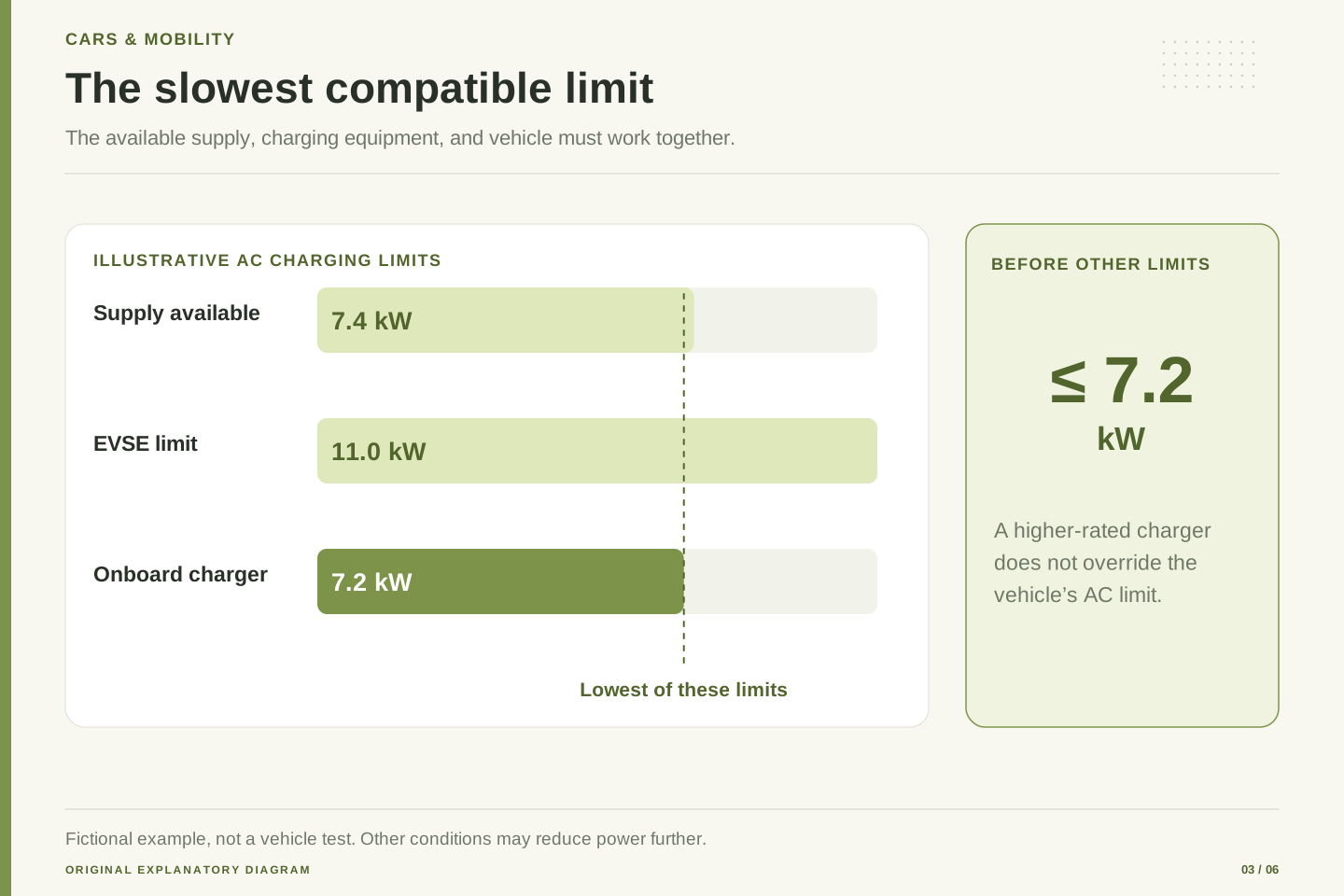
Picture three gates in a row. The electricity supply has a limit, the charging equipment has a limit, and the car has a limit. The session cannot safely move power through a gate faster than that gate allows. Other conditions may reduce the rate further. This is why choosing the largest number on a sales page does not automatically shorten every charging session. [2,3]
Take a fictional AC example: the available supply can provide 7.4 kW, the EVSE is rated for 11 kW, and the car's onboard charger can accept 7.2 kW in that setup. The car cannot receive 11 kW merely because the EVSE has that number printed on it. Before considering losses or other restrictions, 7.2 kW is the smallest of the stated limits. The example is a calculation, not a description of a specific model.
Compatibility includes more than the shape of a plug. A car's market version, charging hardware and approved accessories matter. So do the installation and the charging network's operating rules. Check the exact vehicle manual and the equipment documentation together. When comparing two cars, record their AC capability and DC capability separately. That small habit prevents a headline fast-charging figure from being mistaken for the speed you will get at home every evening.
A simplified ceiling model for an AC session is the minimum of available site power, configured EVSE output and the vehicle's supported AC input for that electrical arrangement. It is a ceiling, not a prediction: actual demand can be lower. In the illustrative 7.4/11/7.2 kW example, 7.2 kW is the smallest stated ceiling. Net pack charging power is lower if losses and auxiliary demand are included.
Be precise about configuration. A published maximum might assume a supply arrangement that is not present at a particular parking space. The equipment's nameplate capability and its commissioned limit can differ. A household load-management system may reduce charging when other loads rise. The installed system therefore needs a documented operating configuration, not merely a collection of maximum ratings.
For DC, consider the charger's voltage/current envelope and the vehicle's permitted demand at the current pack state, in addition to site sharing and thermal limits. Do not derive an entire charging curve from a single peak figure. AFDC describes several vehicle and equipment factors affecting session time, while the EPA explicitly distinguishes the current the station can provide from what a vehicle can accept. [2,3]
For a review article, a useful comparison table lists the conditions behind each number. An unsupported universal fastest claim should be replaced by the narrower result actually established by the specifications or a documented test.
Why charging often slows near the top
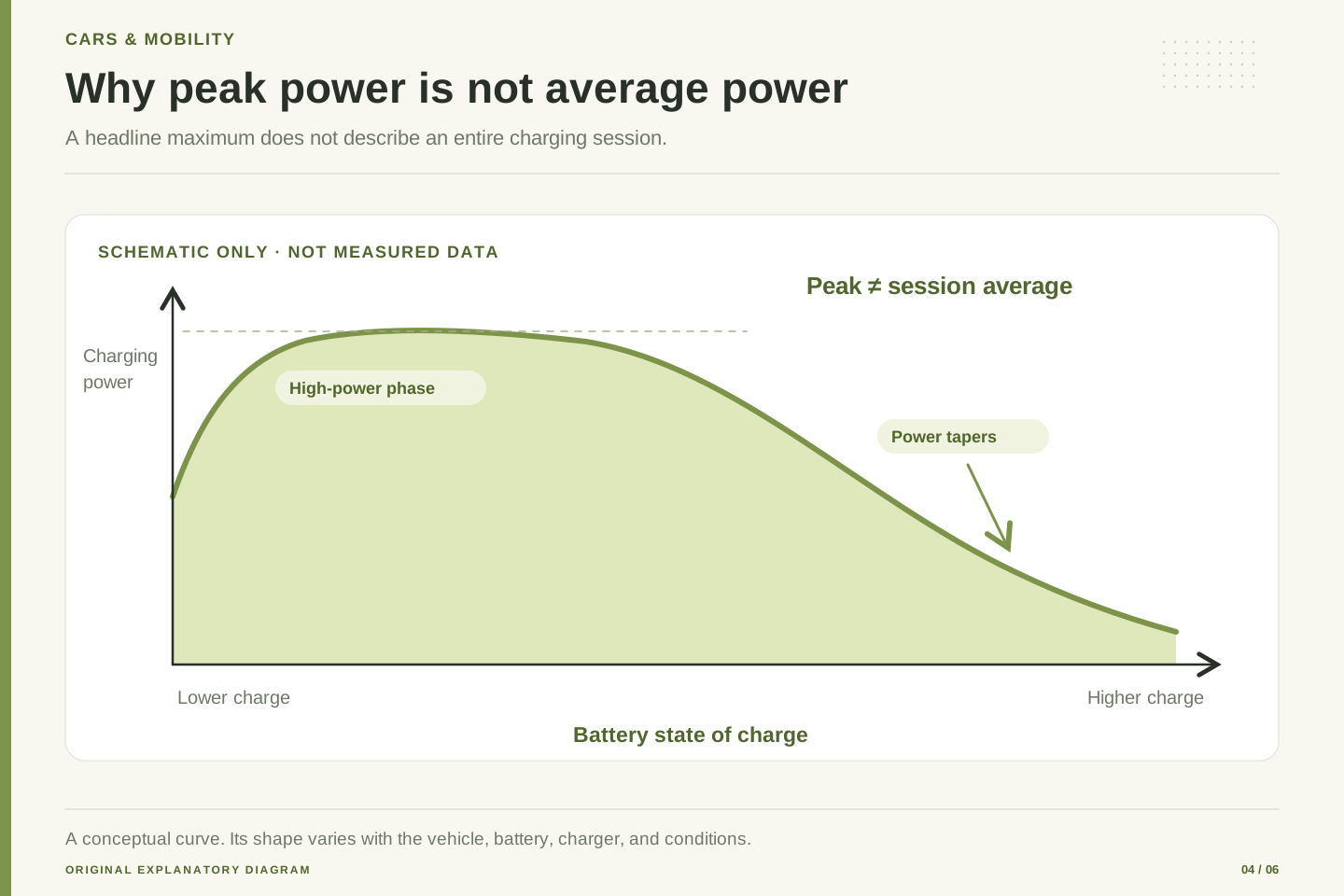
An EV may charge quickly during one part of a session and more slowly later. The battery's state of charge and operating conditions affect the rate it can accept. Official charging guidance warns that the upper part of the battery can take disproportionately longer to fill. Temperature and vehicle characteristics also affect charging speed. [6,8]
This is why a peak figure and a charging-time figure tell different stories. A car might briefly reach a high rate without maintaining it throughout the stop. For a journey, the more useful question is how much energy it adds during the part of the battery range you expect to use. A well-described charging test gives the starting percentage, ending percentage, conditions and elapsed time. A single exciting number cannot supply all of that context.
Avoid turning a common travel habit into a universal battery rule. Some vehicles have different recommended daily charging limits or periodic charging instructions. Australian government guidance points out that battery chemistry and management can change those recommendations, and directs drivers to the specific manual. [7] Use your vehicle's instructions rather than copying a fixed percentage from an unrelated car. A conceptual charging curve helps explain tapering, but it is not a prediction of how your model will behave on every trip.
Charging power is a controlled trajectory, not a constant property of the station. State of charge, temperature, vehicle limits and equipment conditions influence it; published government guidance explicitly notes these factors and the slower upper portion of many sessions. [6,8] The precise curve is vehicle- and condition-dependent.
For an original comparison example, imagine one session delivers 20 kWh in twenty minutes and another delivers the same energy in thirty minutes. Their average delivered powers are 60 kW and 40 kW respectively, regardless of a short peak above either value. These invented numbers demonstrate the distinction between peak and average; they are not measured results. A reported 10–80% time is only comparable when the usable capacity and test conditions are also understood.
Do not treat 80% as a universal electrochemical boundary. It is a common reporting and trip-planning point, while actual charging strategies vary. Manufacturer recommendations can depend on chemistry, pack design and software. The Australian maintenance guidance specifically warns that recommended charge ranges differ and can change. [7]
When inspecting a curve, ask whether power is measured at the charger or at the pack, whether the battery was conditioned beforehand, whether another vehicle shared site power, and whether heating or cooling was active. These questions explain more than assuming a lower observed peak proves a defective charger.
The electricity meter counts more than stored energy
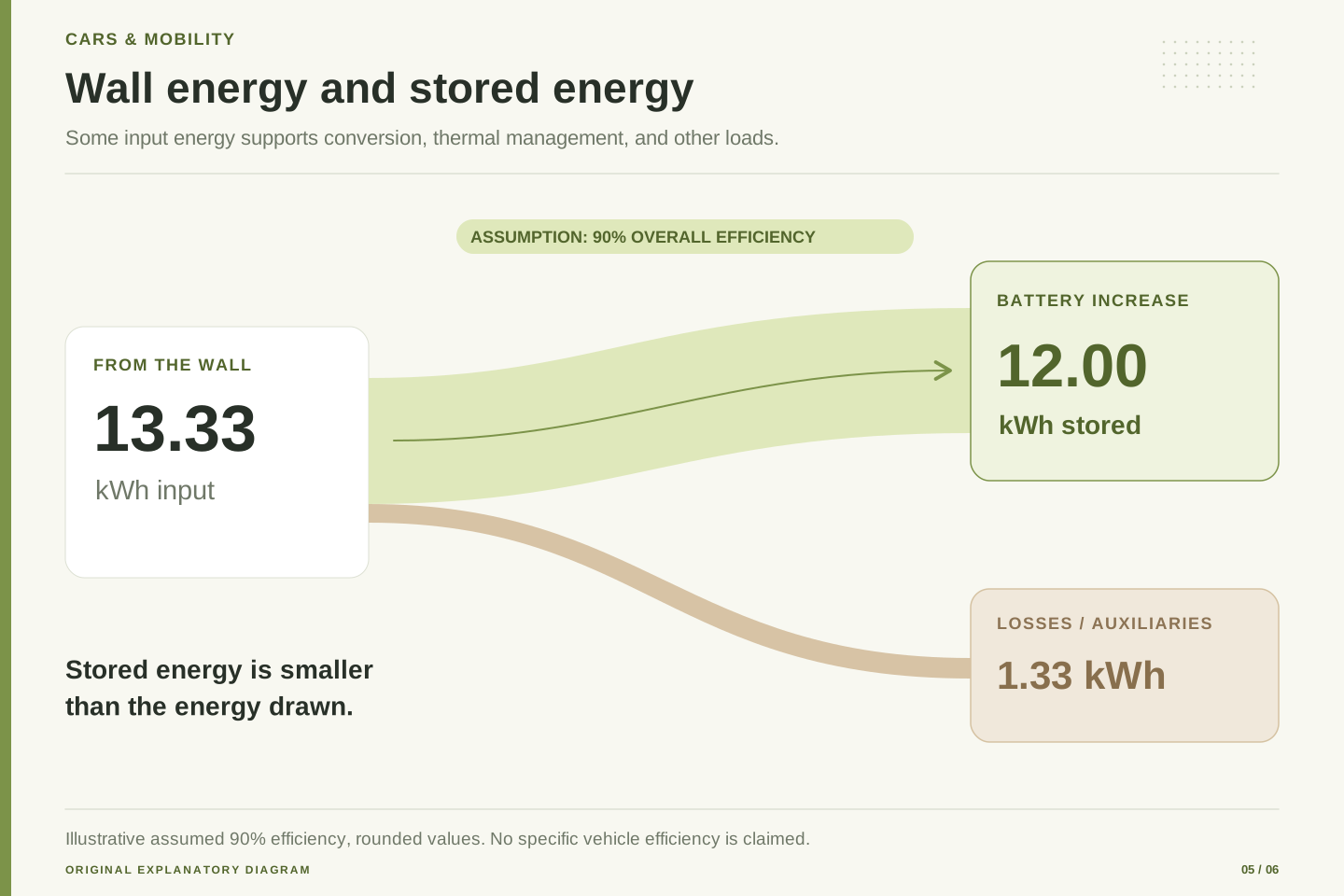
Not every unit of electricity drawn from the supply becomes extra energy stored in the battery. Charging involves losses, and the vehicle may use energy for supporting systems. FuelEconomy.gov identifies charging efficiency as a variable rather than a universal constant. [5] That matters when you estimate cost from a change in battery percentage.
Consider an invented example in which you want to add 12 kWh to the battery and assume an overall charging efficiency of 90%. The input energy would be 12 divided by 0.90, or about 13.33 kWh. The difference, about 1.33 kWh, represents losses and other use within the chosen calculation. The 90% figure is an assumption for learning, not a rating for your vehicle. Real sessions need real measurements or appropriate vehicle-specific estimates.
To estimate the energy charge, multiply the electricity bought by the applicable price per kWh. Keep any parking, session, connection or idle fees separate. If the price changes by time of day, divide the session into the relevant periods. Home charging guidance discusses electricity cost and time-dependent rates. [4] The best estimate is transparent about what it includes. A low cost per unit does not explain the whole bill if the parking charge or a long idle period adds a separate cost.
State the system boundary before applying efficiency. In a simplified model with constant overall efficiency eta, E_input = delta_E_pack / eta. Setting delta_E_pack to 12 kWh and eta to the illustrative value 0.90 gives 13.33 kWh input. This is a teaching calculation. FuelEconomy.gov reports that charging efficiency varies, so a fixed assumption should not be marketed as a measured property. [5]
For a more explicit model, integrate conversion losses and auxiliary power over the session rather than folding every effect into a single constant. A cooling or heating load that persists for time may affect a slow session differently from a shorter one. Whether a dashboard or tariff meter includes that load depends on the measurement boundary. Avoid adding an extra loss factor to a consumption figure that already includes wall-to-battery losses; that would count the same effect twice.
A billing model can sum energy in each tariff interval multiplied by its price, then add applicable fixed or time-based fees. Label currency, tax treatment and the date of the tariff. The AFDC home-charging guide notes the importance of electricity prices and time-of-use arrangements. [4]
For editorial comparisons, show inputs alongside the answer. A reader should be able to replace your assumed tariff and consumption with local figures. The result then becomes a reusable calculation, rather than a headline saving that silently assumes one location and one driving pattern.
Plan for tomorrow's driving and tonight's parking
A home charging decision is easier when you start with a normal day. How far do you drive, how much energy does the car use for that journey, and how long is it parked somewhere you can charge? You do not usually need to replace an entire battery every night. The useful requirement is the energy you need before the next departure, with a sensible margin for your plans.
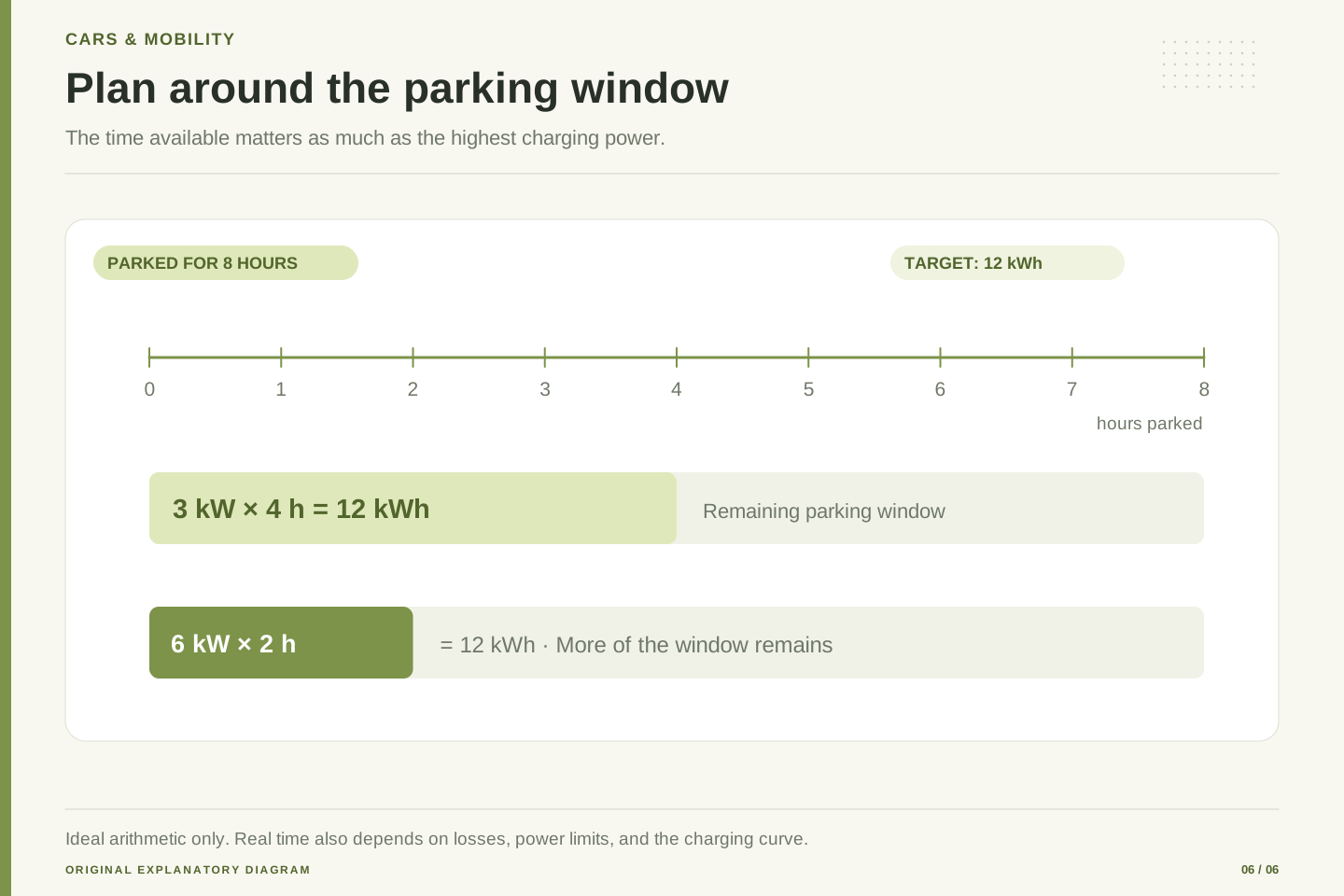
Imagine a fictional driver who needs roughly 12 kWh restored after a day out and has an eight-hour parking window. In our loss-free arithmetic, 3 kW could supply 12 kWh in four hours. A higher rate may offer flexibility, but it is not automatically necessary for that example. Add real charging losses, the vehicle's limits and a reserve before applying the calculation. These are planning examples, not installation recommendations.
Now change the situation. The same driver arrives late and leaves two hours later, or shares a charger with another vehicle. Time becomes the tighter constraint. Public charging or a different schedule may be part of the plan. Write down the unusual days as well as the average day. A good charging arrangement fits the parking pattern you actually have, rather than copying a setup designed around someone else's home, commute or electricity supply.
Model charging as an energy requirement within an available window. Let the required pack increment be derived from planned distance and a clearly defined consumption estimate. Add an explicit reserve instead of hiding it inside an unexplained oversized charger recommendation. Check that the feasible charging trajectory supplies the required energy before departure.
For a hypothetical 12 kWh input requirement and eight hours of availability, the minimum constant average input is 1.5 kW. A 3 kW constant input would meet that idealized requirement in four hours. If 12 kWh instead refers to stored battery energy, adjust the input requirement for losses. These two formulations answer different questions and should never share an unlabeled result.
Extend the plan with scenarios: late arrival, early departure, two vehicles, a constrained household supply, and a cheaper tariff window that is shorter than the total parking window. A schedule that works only on the average day may be inconvenient even when its annual energy budget looks adequate. Use a fallback plan for the constrained case, rather than automatically treating the worst case as the nightly requirement.
This scenario method is an original planning framework. It does not determine cable ratings, protective devices or installation legality. Those decisions require the actual site and qualified local assessment. Keep energy arithmetic separate from electrical design so a reader cannot mistake a useful estimate for permission to connect equipment to an unsuitable circuit.
A safe installation is part of the charging system
Charging is a sustained electrical load. The suitability of a socket, circuit or installation cannot be judged from a photograph or from the fact that a plug fits. The Department of Energy recommends appropriately certified equipment and a qualified electrical contractor, and notes that some homes need their electrical capacity assessed. [4]
This article explains concepts, not how to install a circuit. Ask a qualified local installer to assess the actual supply, parking location, equipment instructions and applicable rules. Outdoor equipment needs to be suitable for its environment. Damaged cables, connectors or equipment should be taken out of use and assessed through the manufacturer or operator's support process. Do not improvise adapters or treat a general charging guide from another country as your local wiring code.
For shared parking, the practical questions extend beyond electricity. Who controls access? Who pays? Can the cable be kept out of walking routes? What happens if the space is occupied or the equipment is offline? A connected charger also has an account and software lifecycle. Keep the owner's account secure and understand what happens if its app or cloud service is unavailable. These ownership questions are part of the system you will live with, even though they are rarely captured by a peak charging-power figure.
The installation is an engineered interface between a building supply and a sustained load. AFDC's home-charging guidance calls for equipment certification and qualified electrical assessment, including available premises capacity. [4] Site-specific requirements cannot be inferred from a generic kW calculation.
A procurement record should distinguish equipment certification, environmental suitability, configured operating limit, commissioning evidence and maintenance responsibility. Keep local code compliance with the installer and relevant authority. This article deliberately does not specify conductor sizes, breaker settings, earthing arrangements or protective-device substitutions. Those depend on jurisdiction, supply characteristics and the exact product.
For a shared site, add operational requirements: authentication method, metering boundary, allocation of cost, behavior during communications loss and recovery after a power interruption. If dynamic load management is used, document its failure behavior. A management feature that works only while an external service is reachable should not be assumed to provide the same behavior offline.
Keep the consumer's comparison focused on verifiable requirements. Ask whether essential charging can continue without a subscription, whether administrators can revoke access, how firmware support is handled, and how billing records can be exported. These are proposed evaluation questions, not claims that all chargers implement those features. A modestly rated but well-supported installation may satisfy the actual use case better than a higher advertised rating whose operating conditions are poorly understood.
Read a charging claim like a complete sentence
When you see a claim such as charges in minutes, look for the missing words. From what starting percentage to what ending percentage? In which vehicle? At what battery temperature? Using what equipment? Was the car sharing available power with another vehicle? A charging claim becomes useful when those conditions are stated, not when its number is made larger or its wording more dramatic.
For home use, keep a simple record of your actual parking time, energy needed, available supply assessment and the vehicle's AC limit. For trips, check compatible charging locations and the energy needed to reach the next reliable stop. For costs, use current local tariffs and include separate fees. None of these checks requires you to become an electrical engineer; they require the right information to be kept beside the right number.
The diagrams in this article are explanations and invented arithmetic examples. They are not measurements from a tested car or a recommendation for a particular installation. The central idea is that charging speed comes from the whole system and its conditions. Once power, energy, compatibility, battery behavior and parking time are considered together, you can ask clearer questions and spot the difference between a useful specification and an incomplete marketing promise.
A reproducible charging statement specifies the vehicle variant and software context, compatible equipment, starting and ending states, relevant thermal conditions, measurement boundary and elapsed time. When those fields are absent, treat the figure as incomplete rather than attempting to reconstruct hidden conditions from marketing language.
A useful specification sheet separates maximum AC intake, supported DC interface, reported DC peak, and a documented session interval. Keep capacity as usable or gross according to the source; do not silently interchange them. For an original calculation, write each assumption explicitly and show the unit arithmetic. For an actual measurement, distinguish observed values from estimates and retain the source of the test.
Apply the same discipline to cost comparisons. A tariff from one city, a consumption figure from one test cycle and an idealized charging efficiency do not become a universal result merely by being placed in one spreadsheet. Label the scenario so readers can substitute their own values, and avoid implying certainty about installation suitability from operating-cost estimates.
The most useful charging knowledge is a set of relationships: input power over time yields input energy; losses separate input from stored energy; control and hardware set changing limits; the parking window sets the practical deadline. These relationships help explain a session without promising identical results across vehicles. Vehicle-specific instructions and a qualified installation assessment complete the picture where a general article must stop.
Sources & further reading
Explore the references behind this guide. External pages may change after our review.
- How Do All-Electric Cars Work?US Department of Energy, Alternative Fuels Data Center · Accessed 6 Nov 2026
- Electric Vehicle Charging StationsUS Department of Energy, Alternative Fuels Data Center · Accessed 6 Nov 2026
- Plug-in Electric Vehicle Charging: The DetailsUS Environmental Protection Agency · Accessed 6 Nov 2026
- Charging Electric Vehicles at HomeUS Department of Energy, Alternative Fuels Data Center · Accessed 6 Nov 2026
- All-Electric Vehicles — energy-use data sourcesUS Department of Energy / Environmental Protection Agency · Accessed 6 Nov 2026
- How to charge your electric vehicleAustralian Government, energy.gov.au · Accessed 6 Nov 2026
- Electric vehicle maintenance and servicingAustralian Government, energy.gov.au · Accessed 6 Nov 2026
- Charger Types and SpeedsUS Department of Transportation · Accessed 6 Nov 2026
Article updated 6 Nov 2026.
Found something we should revisit?
Good explanations get better with thoughtful feedback.