What you’ll take away
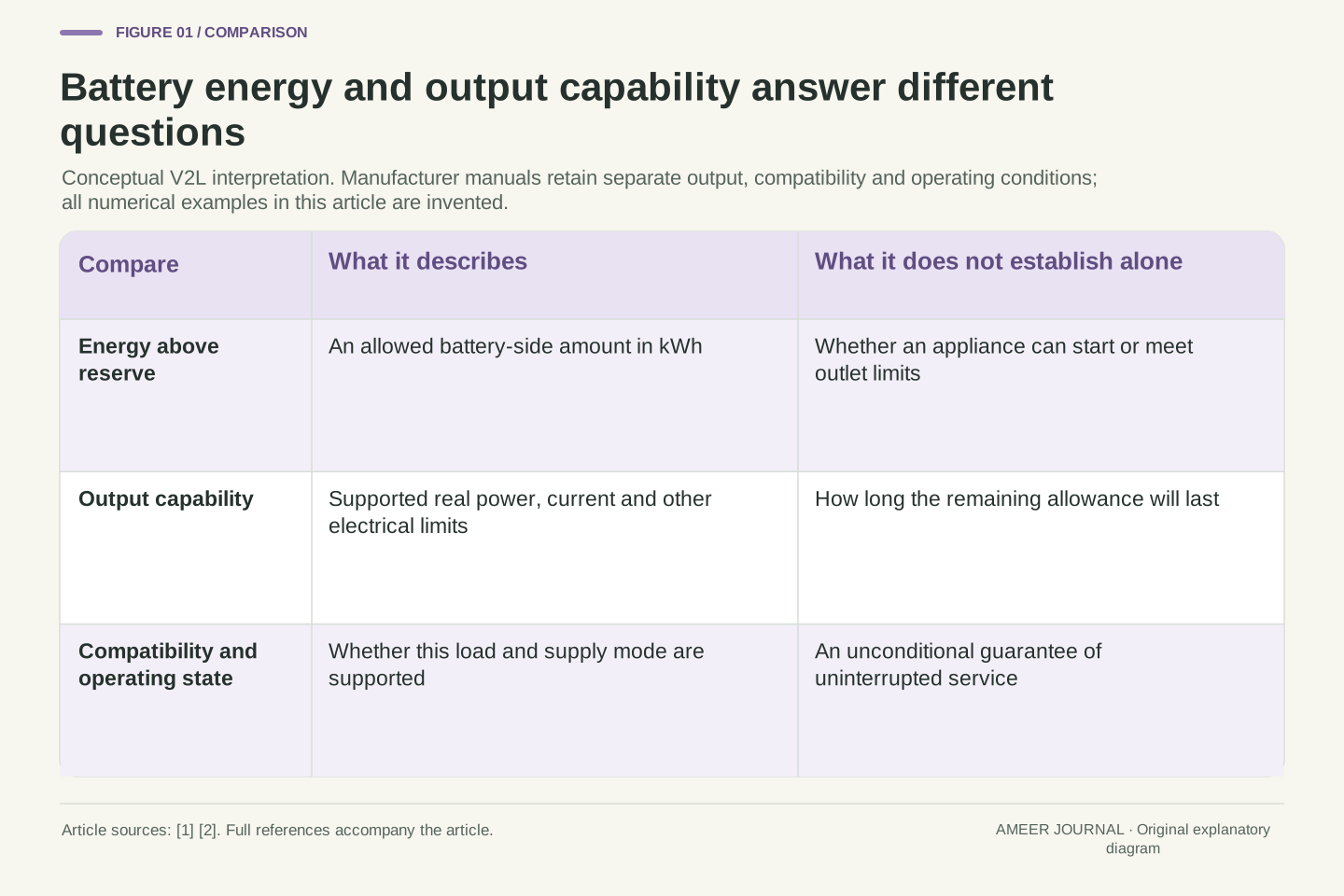
- Battery energy in kWh does not establish an outlet’s power, current or appliance compatibility.
- Add simultaneous demands and check starting behaviour separately from running consumption.
- Real watts, apparent volt-amperes and RMS current are related but different; power factor is not converter efficiency.
- Runtime needs energy available above reserve plus conversion loss and vehicle-side consumption at consistent boundaries.
- A conditional appliance-supply calculation does not guarantee uninterrupted output or establish building-backup capability.
A large battery does not remove an outlet’s limits
An EV can hold enough energy for a long journey yet be unable to run a particular appliance from its vehicle-to-load outlet. The battery's energy and the outlet's power capability answer different questions. Vehicle to load, usually shortened to V2L, supplies external electrical equipment from the vehicle. The retrieved Kia manual describes AC output powered by the high-voltage battery, while both Kia and Hyundai warn that some appliances may not work even when their stated running consumption is below the vehicle's maximum output [1][2]. A large energy store does not settle that compatibility question.
This article follows a hypothetical V2L system through total power, starting demand, current limits and a runtime budget. All numerical examples are invented, and none describes a particular vehicle or appliance. The manufacturer evidence comes from specific 2026 U.S. Kia and 2025 U.S. Hyundai manual pages; their controls and restrictions are not universal specifications. The useful outcome is a reading method: establish whether a load is supported before estimating how long it could run, then include the energy the vehicle itself needs while supplying it.
V2L capability combines an available energy store with an electrical conversion path, output constraints and operating conditions. The Kia manual defines its V2L system as external AC supplied from the traction battery, and the Kia and Hyundai pages separately identify maximum-output and appliance-compatibility limitations [1][2]. Battery capacity alone therefore cannot establish whether an appliance can start, remain powered or satisfy the supported operating conditions.
The original analytical examples distinguish total real-power demand, individual outlet current, transient demand and available battery-side energy above a reserve. They assume no actual vehicle test, appliance test or measured efficiency. The cited manufacturer pages are bounded to their retrieved manual versions and markets, not generalized to every EV. We first examine feasibility constraints, then construct a runtime account with explicitly separated conversion loss and vehicle overhead. These are interpretation exercises rather than electrical connection, hardware modification or building-backup installation instructions. A numerical energy budget is useful only after the relevant output and compatibility conditions have been established.
Power is a demand rate; energy is the accumulated amount
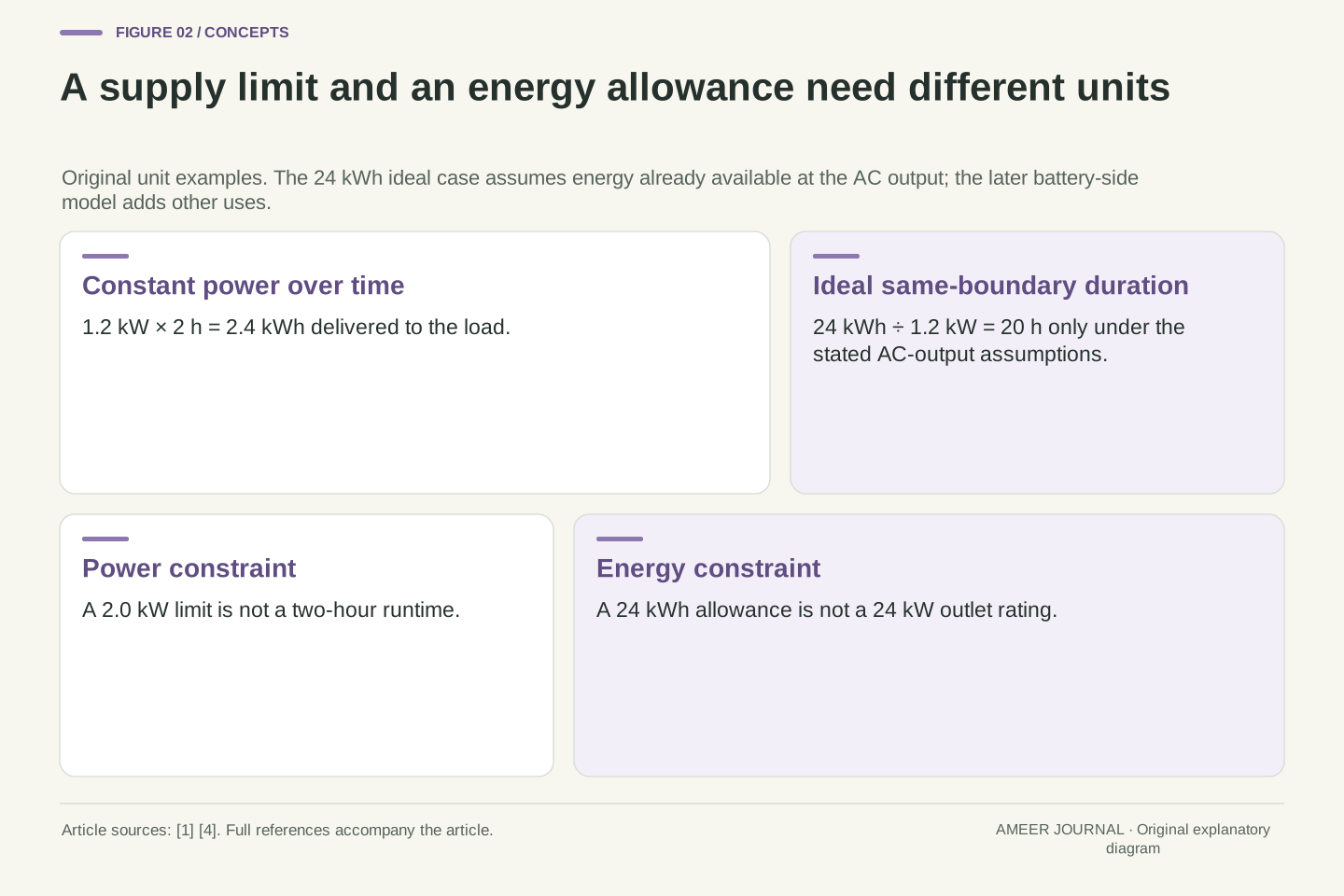
A kilowatt describes a rate of energy transfer. A kilowatt-hour describes an amount transferred over time. If a compatible load draws a constant 1.2 kW for two hours, it receives 2.4 kWh. A 2 kW output limit is not a promise of two hours of operation, and a 24 kWh energy allowance is not permission to connect a 24 kW appliance. The unit names look similar because they are linked by time, but they cannot replace one another.
The simple duration calculation divides energy by power only when both quantities belong to the same boundary and the power assumption is appropriate. If 24 kWh were already available at the AC output and the load stayed at 1.2 kW, the ideal duration would be 20 hours. If the 24 kWh instead describes energy available from the battery, some of it may be used in conversion or by the vehicle before reaching the appliance. The Kia manual's distinction between the battery power source and external AC output makes that boundary visible [1]. We will account for those separate uses explicitly.
Energy is the time integral of real power: E=∫P(t)dt. Under constant P=1.2 kW over t=2 h, E=2.4 kWh. The inverse relation t=E/P assumes a constant or suitably defined average power and matching input/output boundaries. A power capability in kW and an energy allowance in kWh are not competing descriptions of the same limit.
For example, 24 kWh of stipulated AC-output energy divided by 1.2 kW gives 20 h. The same numerical energy stated at the battery boundary does not automatically yield 20 h of external supply. V2L converts energy from the traction-battery side to an AC output, as the manufacturer description establishes [1]. Losses and other battery-side demands must be included before applying the duration equation. Equally, an appliance's maximum or starting power is not necessarily its time-average real power. Feasibility and duration therefore require related but different summaries of the load profile.
Count the simultaneous demands and the relevant limits
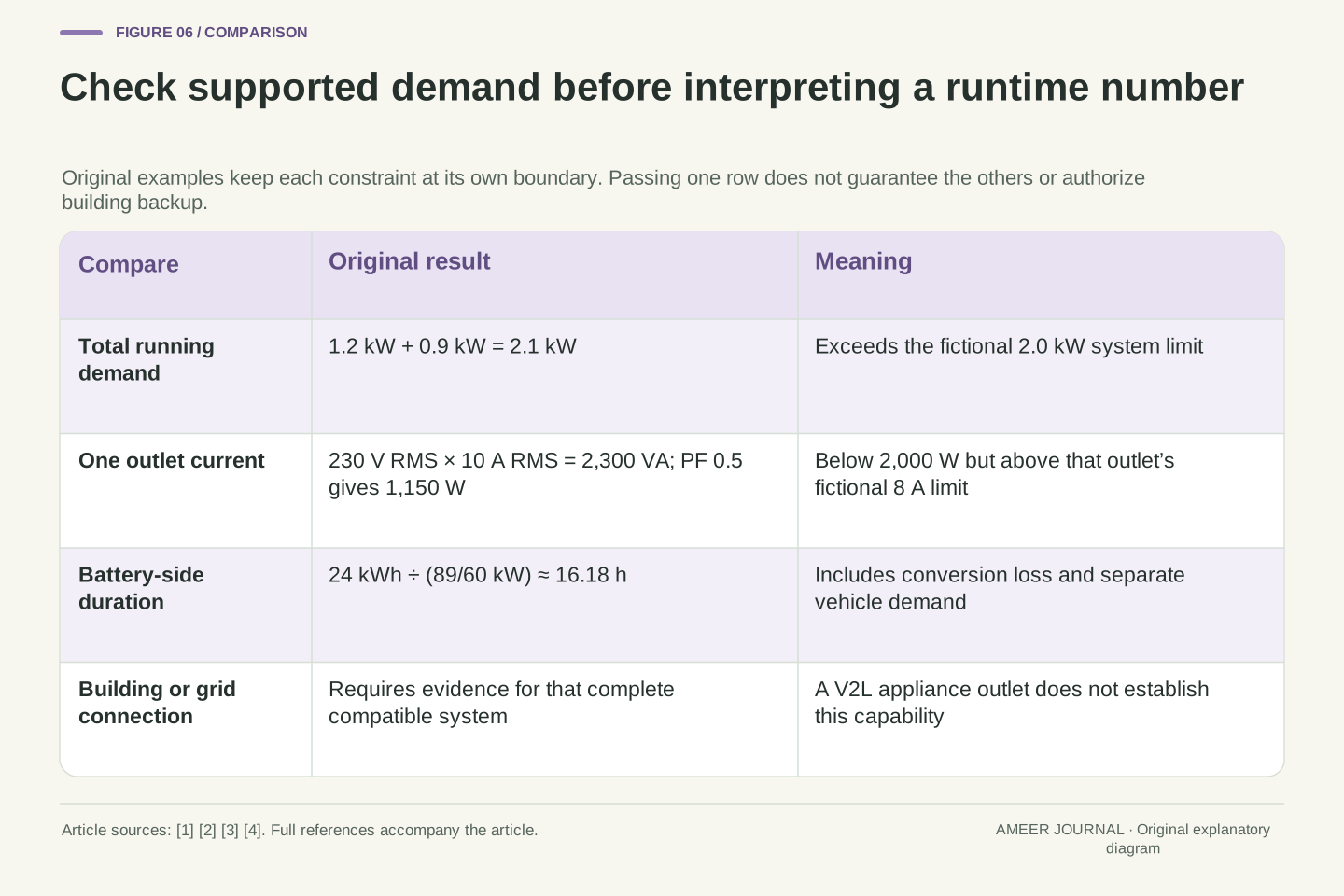
Give the hypothetical system a total continuous real-power limit of 2.0 kW. Two loads drawing 1.2 kW and 0.9 kW simultaneously demand 2.1 kW. Each is individually below 2.0 kW, but their combined demand is not. The battery could contain far more energy without changing this constraint. Kia's manual explicitly tells the reader to keep combined appliance use within the vehicle's maximum supply and describes an interruption for excessive output demand [1].
Do not assume that finding a second socket doubles the available conversion capacity. The same manual notes that the interior outlet can also be supplied while the exterior V2L connector is in use [1]. That creates a reason to include all active loads, including an easily overlooked one inside the vehicle. A system may also have limits attached to an individual outlet, connector or supply path. Our later current example gives one hypothetical outlet an 8 A limit within a system with the stated 2.0 kW total limit. Those are separate constraints, not two alternative ratings from which the user can simply choose the larger number.
For a common output boundary, simultaneous real-power demands add. In the original case, P_total=(1.2+0.9) kW=2.1 kW, exceeding the stipulated 2.0 kW continuous system limit. The comparison is between coincident demand and capability, not between either load separately and the total rating. Kia's manual addresses combined use, excessive-power interruption and an interior outlet energized during exterior V2L use [1]. It does not support multiplying an aggregate rating by the number of sockets.
A complete feasibility account retains both aggregate and local constraints. Our model later stipulates an 8 A limit for one particular outlet while retaining a 2.0 kW total real-power limit for the system. The local current condition can bind even when the combined real-power condition passes. These limits are invented and do not replace a manual's voltage, frequency, current, apparent-power, connection or equipment restrictions. The logical task is to satisfy every applicable constraint at its own boundary. An ample energy reserve cannot compensate for a limit exceeded at an output path.
A short starting event can matter more than its tiny energy total
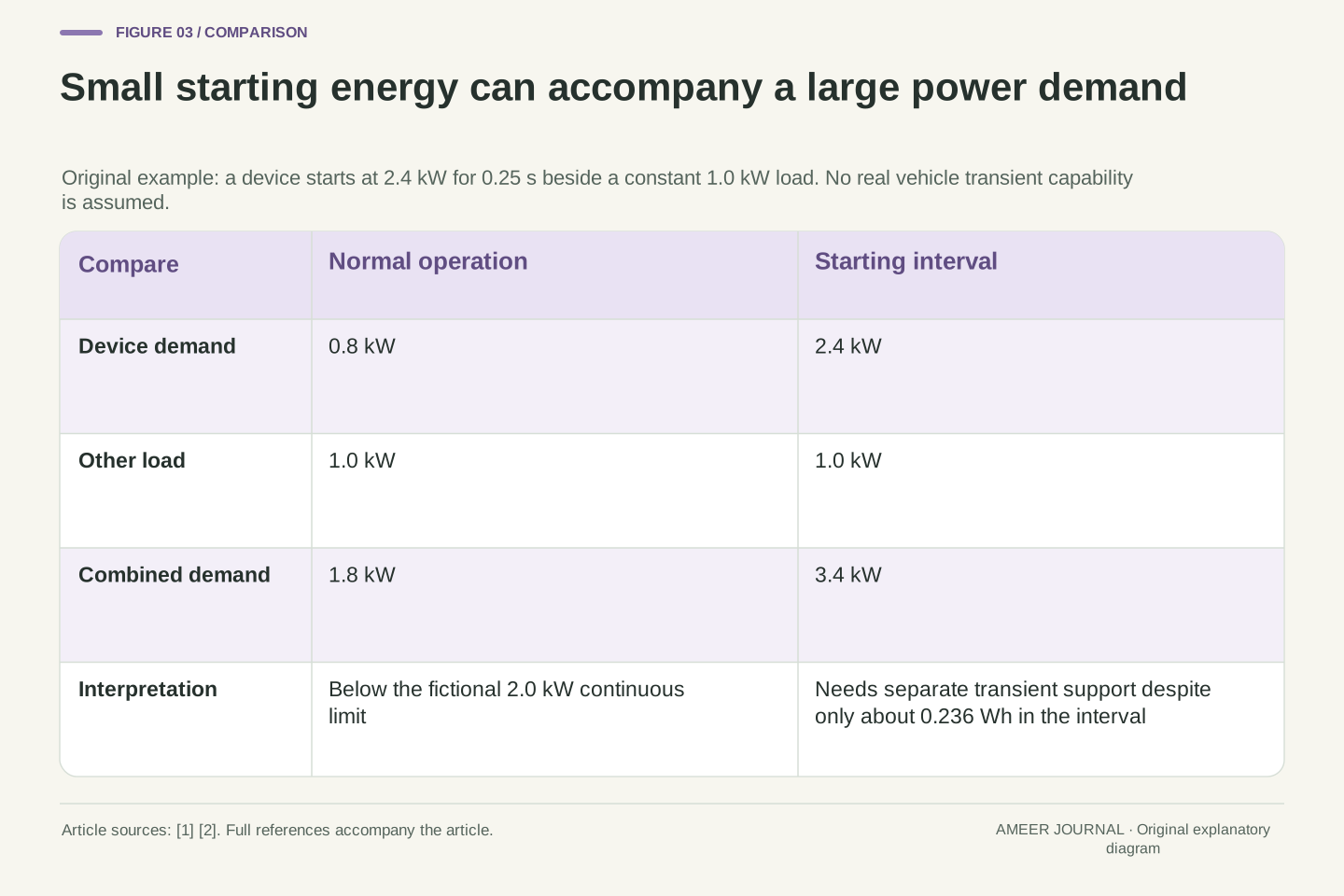
Suppose a device normally draws 0.8 kW but briefly needs 2.4 kW at startup. If another load draws a steady 1.0 kW, the normal combined demand is 1.8 kW, while the starting demand reaches 3.4 kW. The normal demand fits our model's 2.0 kW continuous limit; that fact does not establish that the starting event is supported. Both retrieved manufacturer pages specifically identify high initial demand as a reason an appliance may not operate normally despite an apparently acceptable running figure [1][2].
Make the invented starting event last a quarter of a second. At 3.4 kW, it uses only about 0.236 Wh during that interval. That is a very small energy amount, yet its power demand is still 3.4 kW while it occurs. A total-energy calculation can therefore look reassuring while missing the limiting event. The real system's supported transient behaviour must come from appropriate vehicle and appliance information; the continuous rating does not supply it. This example neither assigns a universal starting multiplier nor predicts exactly when any particular vehicle will interrupt its output.
Let the fictional device draw 0.8 kW in normal operation and 2.4 kW for its stated startup interval, alongside an unchanged 1.0 kW load. The combined profile changes from 1.8 kW to 3.4 kW during startup. Comparison with a 2.0 kW continuous capability is insufficient to certify that transient: a separate supported transient envelope would be required. The manufacturer warnings explicitly distinguish high initial demand from ordinary consumption below the maximum [1][2].
For a rectangular 0.25 s event, E_start=3.4 kW×(0.25/3,600) h=0.000236111… kWh≈0.236 Wh. Relative to the 1.8 kW normal profile over the same interval, the extra energy is about 0.111 Wh. These small energies do not reduce the instantaneous demand. The example separates power and duration without asserting a surge rating, protection delay or successful start for a real product. A protection or compatibility assessment needs the appropriate time-dependent demand and supported response, not merely the integral of that demand.
An acceptable watt figure can still hide excessive current
AC equipment can draw more current than a simple watts-divided-by-volts calculation suggests. Apparent power is the RMS voltage multiplied by RMS current, measured in volt-amperes. Real power, measured in watts, is the average rate of energy transfer. Power factor compares real power with apparent power [4]. RMS names a defined effective measure of a changing AC waveform. The distinction matters when an outlet or appliance specification includes a current limit as well as a watt limit.
Take a separate hypothetical single-phase sinusoidal load at 230 V RMS and 10 A RMS, with power factor 0.5. Apparent power is 2,300 VA and real power is 1,150 W. The watts are below our system's 2,000 W limit, but the current exceeds the particular outlet's invented 8 A limit. That load does not pass both conditions. The power factor of 0.5 is not a statement that half the battery energy disappears in the inverter. Power factor and conversion efficiency describe different relationships. Neither should be guessed from the other when deciding what a specification actually supports.
For the original single-phase sinusoidal example, S=V_rms I_rms=(230 V)×(10 A)=2,300 VA. With PF=P/S=0.5, real power is P=1,150 W. Analog Devices' AC-power explanation distinguishes real power, apparent power and their ratio [4]. The current therefore cannot be recovered as P/V_rms unless the required power-factor assumption is valid; here P/V_rms would give 5 A instead of the stipulated 10 A.
At the model outlet's 8 A limit, the load fails the current constraint even though its 1.15 kW real demand is below the system's 2.0 kW total limit. These are deliberately different boundaries: an individual outlet and the complete converter system. No real rating is being inferred. The example assumes sinusoidal quantities and does not equate every real appliance's power factor with a simple phase-angle expression. Nor is PF an input-to-output efficiency: its numerator and denominator describe the same AC load, while conversion efficiency compares real powers across different energy boundaries. A 0.5 power factor does not imply a 50% inverter energy loss.
The usable allowance stops where the chosen reserve begins
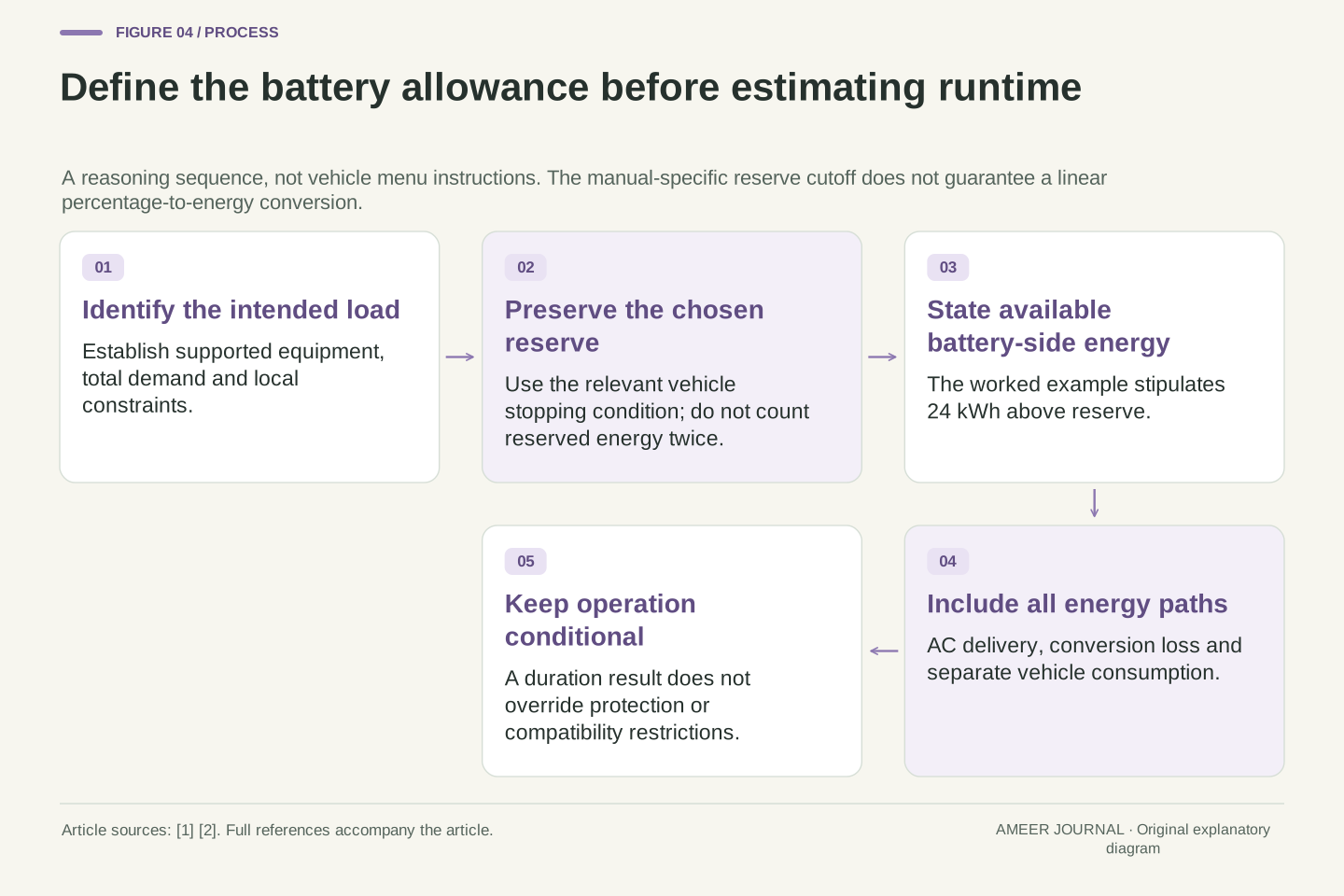
A runtime estimate should start with the energy allowed for the task, not the largest battery-capacity number found in a brochure. Some energy may already be unavailable because the battery is partly discharged, and some may be kept for driving or another purpose. The retrieved Kia manual allows a battery discharging limit and says the V2L supply stops when that limit is reached [1]. This establishes a stopping condition before every last unit of stored energy has been used.
For our runtime model, simply stipulate that 24 kWh is available from the battery before reaching the chosen reserve. That is an energy allowance at a defined battery boundary. We do not calculate it by multiplying a dashboard percentage by an advertised pack capacity, because those figures need their own definitions and usable-energy relationship. The 24 kWh also is not a promise of remaining driving distance. A vehicle's own supported reserve control and current guidance govern its operation. The calculation's job is to explain how an explicitly supplied energy allowance is consumed, while preserving the decision to keep the reserve.
Define E_allow as battery-side energy available between the current condition and the selected stopping condition. The manufacturer page supplies a concrete example of such a condition: its configurable discharge limit terminates V2L when reached [1]. It is not necessary to assume that every vehicle exposes the same control, threshold or displayed percentage relationship.
Set E_allow=24 kWh as an independent model input. It is neither gross pack capacity nor total theoretical extractable energy. No linear mapping from displayed SOC to available kWh is assumed, and no range guarantee follows from the reserve quantity. A real estimate would require an appropriate usable-energy assessment under the relevant state and operating conditions. Keeping the allowance separate from the reserve also avoids counting the same energy twice: once for the external load and again for a later driving task. The remaining calculation consumes only E_allow and does not prescribe lowering a reserve or continuing after the vehicle's stopping condition.
Conversion loss and vehicle overhead belong in the duration calculation
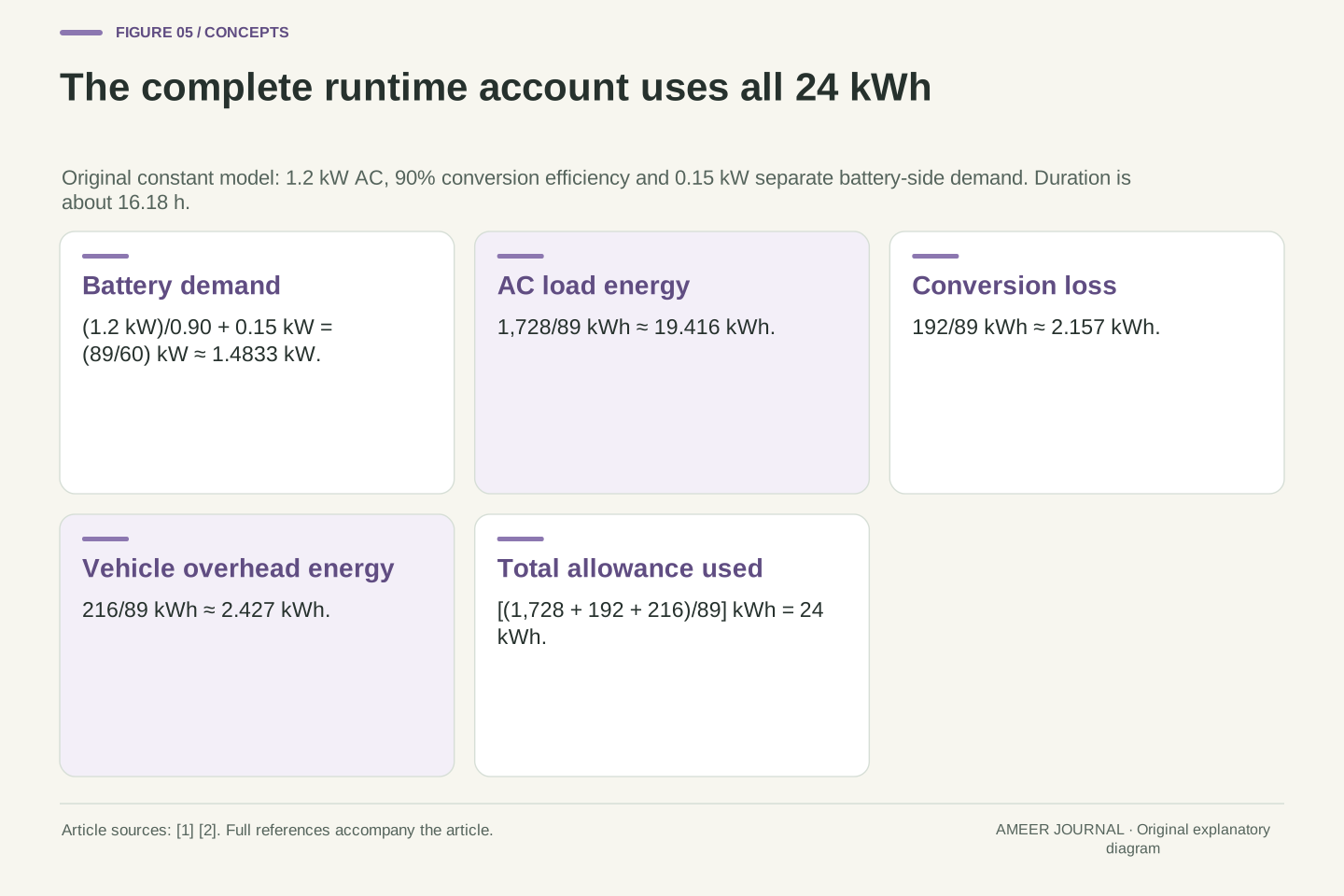
Use the 24 kWh allowance with a compatible constant 1.2 kW AC load. Assume the conversion path is 90% efficient at this operating point and that the vehicle separately uses 0.15 kW from the battery while providing power. The AC load requires 1.2÷0.9, or about 1.333 kW, on the converter's battery side. Adding the vehicle demand gives about 1.483 kW in total. Dividing 24 kWh by that total gives about 16.18 hours, rather than the 20 hours obtained by ignoring both losses and overhead.
The energy account can be checked at that endpoint. About 19.416 kWh reaches the AC load, 2.157 kWh becomes conversion loss, and 2.427 kWh supplies the separate vehicle demand. Together they use the stated 24 kWh. The efficiency and overhead are assumptions, not measurements from either cited vehicle. Manufacturer manuals note that vehicle equipment such as a cooling fan may operate during V2L [1][2]; they do not supply our 150 W allowance. A real estimate needs actual operating information because efficiency and auxiliary demands can change with conditions.
For a steady model, define P_bat=P_ac/η+P_aux, where P_aux is a separate battery-side load excluded from the converter efficiency. With P_ac=1.2 kW, η=0.90 and P_aux=0.15 kW, P_bat=89/60 kW≈1.48333 kW. Runtime to the model reserve is t=E_allow/P_bat=1,440/89 h≈16.1798 h. This placement of P_aux matters: dividing it by η again would count a converter loss that the definition does not assign to that path.
At this time, AC energy is P_ac t=1,728/89 kWh≈19.4157 kWh; converter loss is (P_ac/η−P_ac)t=192/89 kWh≈2.1573 kWh; and auxiliary energy is P_aux t=216/89 kWh≈2.4270 kWh. Their sum is (2,136/89) kWh=24 kWh. The account has no changing stored-energy term beyond the depleted allowance. Both efficiency and auxiliary power are invented constants. The manuals support the presence of possible vehicle-side activity during V2L, including cooling-fan operation [1][2], not a fixed consumption figure or the calculated duration for an actual car.
A quarter of the appliance demand need not mean four times the runtime
Now reduce only the AC load from 1.2 to 0.3 kW, leaving the model's 90% efficiency and 0.15 kW vehicle demand unchanged. The battery supplies about 0.333 kW to the converter plus 0.15 kW elsewhere, for a total of about 0.483 kW. The 24 kWh allowance lasts about 49.66 hours. That is roughly 3.07 times the previous 16.18-hour duration, even though the appliance's power has fallen to one quarter.
The reason is the unchanged vehicle demand. It continues to consume energy during each extra hour, so stretching the task changes how much of the allowance goes to that separate use. In the first case, this demand takes about 10.1% of the battery power. At the lighter load, it takes about 31.0%, even though the vehicle demand itself has not increased. Real overhead need not be constant, and converter efficiency may change at lighter loads; the manufacturer fan example confirms activity can exist without defining its time profile [1][2]. The calculation shows which information matters. Reducing an appliance's average demand can extend operation, but a realistic duration forecast needs the whole supply system's consumption, not just a ratio between two appliance watt figures.
With P_ac reduced to 0.3 kW under the same stipulated η and P_aux, P_bat=[(0.3/0.9)+0.15] kW=(29/60) kW. Runtime becomes 1,440/29 h≈49.6552 h. Relative to the previous 1,440/89 h, the duration ratio is 89/29≈3.069, not four. The ratio would be four under equal constant conversion efficiency only if the extra unchanged power term were absent.
The result is a sensitivity calculation, not a prediction of a particular low-load operating mode. Real η can depend on operating point, and P_aux can be intermittent or state-dependent. Possible cooling activity is documented [1][2], but its power and timing are not provided by those passages. For variable quantities, the appropriate endpoint satisfies E_allow=∫[P_ac(t)/η(t)+P_aux(t)]dt under a consistent efficiency definition. This integral also makes clear why one instantaneous appliance reading may be inadequate for a long-duration estimate. The time profile and all energy paths matter. The auxiliary share provides another check: P_aux/P_bat is 9/89, about 10.1%, at the original load, but 9/29, about 31.0%, at the lighter load. Because the powers are constant within each case, these are also the respective fractions of the depleted allowance used by the separate auxiliary path. The larger fraction comes from a smaller total denominator, not a larger auxiliary demand. Neither fraction includes converter loss, which remains its own entry in the account.
Remaining battery energy does not guarantee uninterrupted output
V2L can stop while energy remains in the battery. In the retrieved Kia manual, a reached discharge limit and excessive power use have different messages. Hyundai's cited page also describes interruption associated with overheating [1][2]. Those are different conditions, so an interruption does not by itself identify an empty battery or prove that one particular appliance is defective. A useful interpretation keeps the displayed reason and the applicable vehicle guidance with the observation.
This is also a limit on what the runtime calculation promises. Our 16.18-hour result assumes the stated supply conditions continue; it is not a guarantee of uninterrupted service. Both manuals expressly exclude equipment that depends on continuous supply, giving medical equipment as an example [1][2]. The relevant lesson is to respect the supported use, not to override a cutoff because a spreadsheet says energy remains. If operation falls outside the documented conditions, the calculation cannot make it acceptable. A lower running-watt figure alone does not remove startup, compatibility, temperature or vehicle-state constraints.
Energy exhaustion is only one possible termination mechanism. The cited manual pages distinguish battery-limit termination, excessive-demand interruption and thermal blocking [1][2]. A simple energy integral models runtime only while the assumed operating mode remains available and compatible. It does not model fault detection, temperature evolution or every state transition of a production vehicle.
Accordingly, the model endpoint is conditional rather than an uptime guarantee. The manuals' exclusion of continuously supplied equipment is material to interpreting that distinction [1][2]. A theoretical positive energy balance cannot validate an application that the vehicle documentation excludes. Likewise, a stop event does not uniquely diagnose depletion, overload or thermal behaviour without its accompanying status and conditions. Preserve the actual indication and use the appropriate vehicle support information; do not infer an override procedure from the model. This keeps a useful energy estimate from becoming an unsupported assertion about reliability or permissible operation.
An appliance supply and a building backup system are different arrangements
V2L is often described alongside vehicle-to-building or vehicle-to-grid systems, but the labels identify different jobs. The U.S. Department of Energy's educational material distinguishes supplying an individual external load from a system designed to supply a building and from one designed to interact with the electricity grid [3]. A working appliance outlet does not establish that the vehicle and its accessories can safely energize a building's wiring.
The same material explains that building and grid arrangements involve compatible equipment and additional protection or coordination [3]. They must be assessed as their own installations. This article gives no household connection method, backfeed arrangement or electrical modification. The distinction also helps when reading a sales claim: 'can power an appliance' and 'supports this building backup system' are different capabilities that need different evidence. Before comparing either with the runtime figures, preserve what equipment is being supplied and which documented system is doing the supplying. The shared battery does not make every possible connection equivalent.
The AFDC training transcript separates V2L, which supplies an external load, from V2B and V2G functions that involve building or grid interaction [3]. The document describes additional protection equipment and coordination for those latter configurations. It supports a functional-system distinction; it is not used here as a complete statement of every jurisdiction's current electrical requirements.
Consequently, a V2L converter rating or an appliance runtime calculation cannot be extended into a building-interconnection approval. Such a claim needs evidence for the compatible vehicle, interface equipment, protection and installation as a complete system. The electrical boundary has changed, not merely the number of loads in the spreadsheet. No ordinary household-socket connection or improvised energy-export path is proposed. Keeping this boundary explicit prevents a correct local power calculation from being used to justify an unsupported configuration. The article remains about interpreting appliance-supply capability and its conditional energy budget.
Establish supported operation before calculating duration
Start with the exact vehicle, its market and equipment version, the specified V2L interface and the appliance requirements. Keep the total output limit and any individual current limit together. Include every simultaneous demand and distinguish normal running from startup. Then identify the battery energy allowed above the chosen reserve, the conversion losses and the vehicle's other consumption. Those inputs support a duration estimate with a clear meaning.
Our examples show why that order matters. Two individually acceptable loads can exceed a shared limit; a brief start can have tiny energy but high power; and an appliance below the watt limit can still exceed an outlet's current limit. Once a load is supported, the 24 kWh battery allowance produces about 16.18 hours in the stated 1.2 kW model, with all three energy uses counted. The manuals remain the authority for the supported operation of their particular systems [1][2]. A large battery is valuable, but useful V2L planning needs the complete path from that battery to the intended load.
The decision sequence is compatibility and constraints first, energy accounting second. Retain vehicle/interface identity, output voltage and frequency requirements, total and local ratings, coincident load profile, starting behaviour and allowed operating state. Only then attach an energy allowance, its stopping boundary and a consistent conversion/auxiliary model [1][2]. The AC real/apparent distinction helps interpret current constraints without confusing power factor with efficiency [4].
The original calculations demonstrate separate limits rather than one universal sizing rule: 2.1 kW exceeds the fictional total rating; a 3.4 kW starting event needs its own supported transient evidence; 10 A fails the fictional 8 A outlet condition despite only 1.15 kW real power; and the defined runtime consumes 24 kWh across appliance energy, conversion loss and vehicle demand. Building/grid capability remains a separate system question [3]. Keeping these definitions visible lets a reader judge what a V2L claim actually establishes and what information is still needed before applying it to a particular vehicle and appliance.
Sources & further reading
Explore the references behind this guide. External pages may change after our review.
- Vehicle to load (V2L) — Kia 2026 U.S. owner manualKia · Accessed 7 Nov 2026
- Safety Precautions When Using the V2L FunctionHyundai Motor Company · Accessed 7 Nov 2026
- Alternative Fuels Data Center: Flipping the Switch on Electric School Buses: Infrastructure Planning and Solutions: Module 2 (Text Version)U.S. Department of Energy Alternative Fuels Data Center · Accessed 7 Nov 2026
- Activity: Power and Power Factor in AC circuits, For ADALM1000 [Analog Devices Wiki]Analog Devices · Accessed 7 Nov 2026
Article updated 7 Nov 2026.
Found something we should revisit?
Good explanations get better with thoughtful feedback.