What you’ll take away
- Stored battery energy does not establish a compatible or functioning islanded home supply.
- Conversion, local reference, utility separation and the selected load boundary have different roles.
- In the original record, service exists only from minute 8 to minute 15, when all stipulated conditions overlap.
- The same record gives 35% time coverage and 40% requested-energy coverage, without uninterrupted service.
- Vehicle presence, system readiness and verified reconnection must remain visible beside an energy estimate.
Stored energy and an energized home are different facts
A vehicle may have plenty of battery energy while a home remains without power. The missing fact is not necessarily the battery percentage. A vehicle-to-home system must make that energy available through a supported electrical system while the home operates apart from the failed utility supply. The U.S. Department of Energy describes a bidirectional vehicle as needing a similarly capable interface to supply an external load, and distinguishes building backup from other uses of mobile storage. [1] Those capabilities belong to the complete arrangement, not to the battery alone.
This article follows an original, invented outage record to show the difference. Its times, loads and equipment limits are assigned for explanation, with no vehicle or home system tested. The central question is when a defined group of loads can actually receive power. That question includes the vehicle's presence, the system's readiness and the boundary separating the home from the utility. Once those are clear, we can calculate a delivered-energy total and see why it does not describe uninterrupted service or support for every circuit.
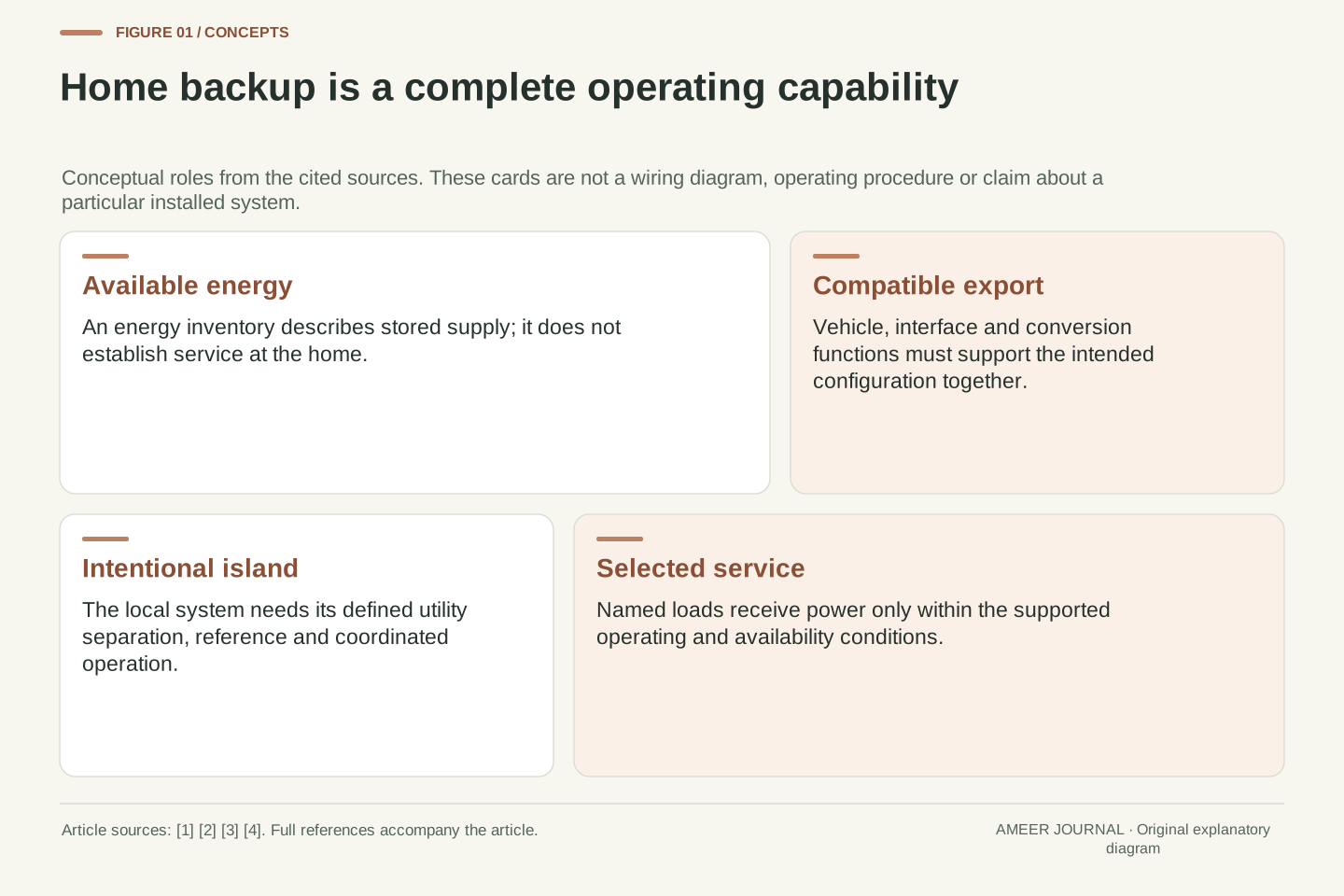
An energy inventory is not an operational state. Vehicle-to-home capability requires a compatible export path and a system able to supply its defined loads under the relevant grid condition. DOE's mobile-storage description requires compatible bidirectional vehicle and interface functions, while its inverter guidance makes outage operation conditional on the system being designed for it. [1][2] The same stored-energy value is therefore consistent with several different service outcomes, including no permitted or available islanded supply.
The original analytical fixture below separates component capability, selected-load boundaries and time-dependent availability. All timestamps and powers are stipulated. Compatibility, adequate available energy and a suitable AC output envelope are assumed so that the calculation isolates service-state timing. We do not derive battery depletion, inverter dynamics or a production controller's response. The useful outputs are a supported interval and its associated AC energy, each with an explicit reference window. Neither output alone establishes continuity, whole-home operation or the behaviour of a real installation.
Read the component roles as a compatible system
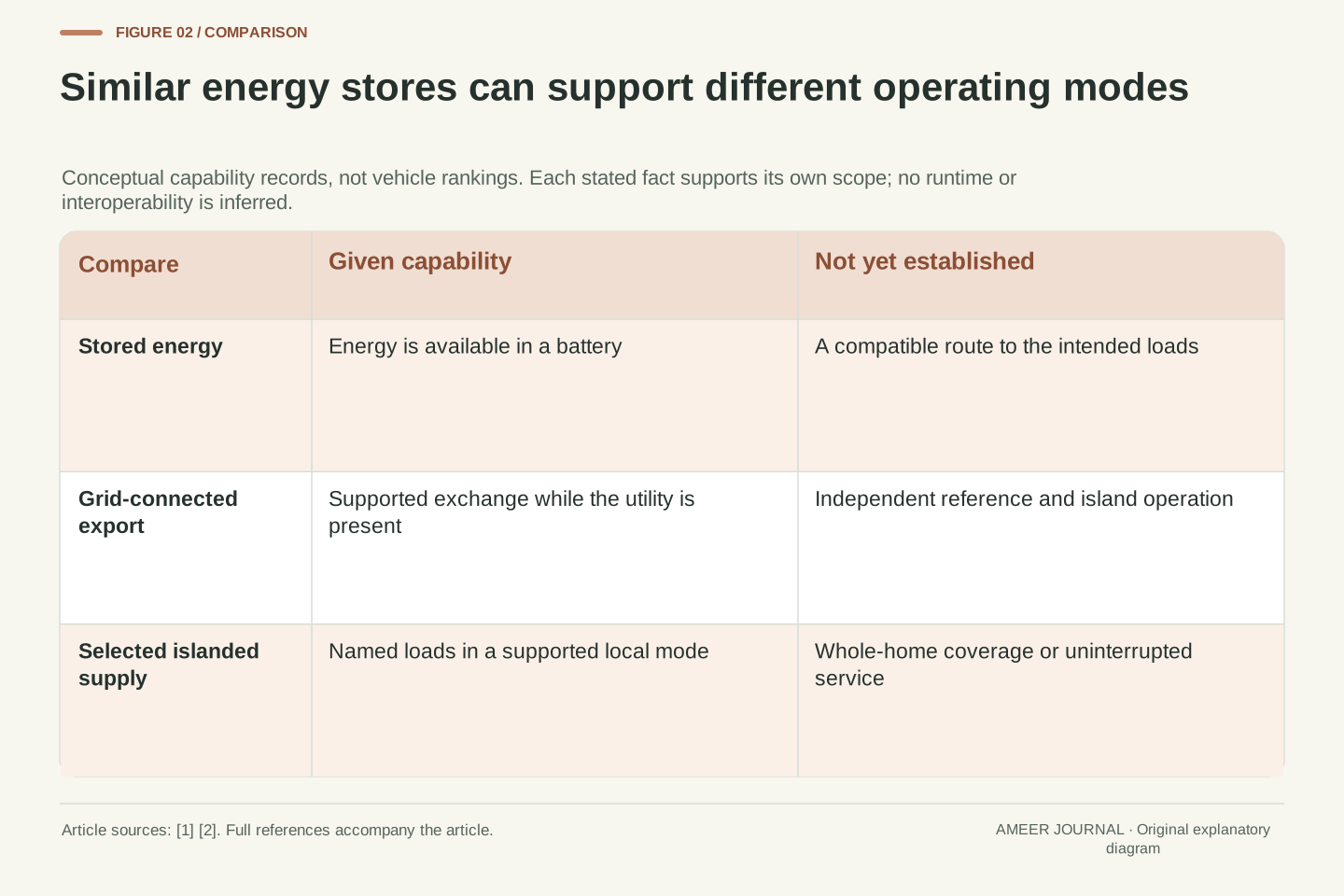
There are several jobs between stored energy and a household load. The vehicle must support export, the interface must support the matching transfer, and the system must convert battery-side DC electricity to the AC required by the intended loads. A retrieved Tesla overview lists those roles separately from the islanding controller; it also notes that the inverter can be inside the vehicle or external in different systems. [4] A familiar charging connector or a normal charging session does not, by itself, demonstrate that all these reverse-flow functions are supported together.
That is why a capability description needs exact equipment identities and operating scope. An ordinary appliance outlet, an arrangement that exchanges energy while the utility is present, and a supported home-backup configuration answer different questions. DOE describes building support and grid interaction as distinct applications and notes that site equipment needs vary. [1] Reading the complete arrangement prevents a common mistake: combining a vehicle specification, an unrelated converter specification and a large battery figure as if they already described one approved, functioning system.
A functional decomposition separates energy storage/export, the compatible vehicle interface, DC-to-AC conversion and intentional-island control. The manufacturer's retrieved overview names these roles and allows the conversion stage to be internal or external to the vehicle. [4] This is an architectural description, not an interoperability statement for arbitrary components. Physical connection, communication support, power conversion and supported system operation are different properties; evidence for one does not establish the others.
The relevant boundary is also application-specific. Supplying a standalone load, supporting a building and participating in grid interaction are different functions in DOE's mobile-storage account. Equipment requirements depend on the site and design. [1] A complete capability claim should therefore identify the vehicle/interface combination and the intended operating mode, rather than treating every bidirectional label as synonymous with outage backup. This article uses that decomposition to interpret a hypothetical service record. It supplies no wiring arrangement, installation sequence or method for turning an unsupported charging interface into a home supply.
Conversion alone does not establish a local AC reference
An inverter can convert DC electricity to AC without being able to establish an independent home supply. DOE distinguishes equipment that follows an existing grid signal from equipment capable of creating a reference for a local system. In the first case, there is something outside the inverter to follow. In the second, a suitably designed system can establish the reference other participating equipment needs. [2] Knowing that a converter exists therefore does not answer what happens when the utility reference disappears.
The distinction appears in DOE's campus microgrid animation. Its solar equipment initially stops during the outage, then participates after a local source has energized the relevant part of the system. [3] That is a campus teaching example, not a predicted sequence or delay for a house. Its useful lesson is about roles: an available energy source, a converter and a working local reference are related but separate conditions. A label such as grid-forming still needs supporting evidence for the complete system's startup, load support and coordinated operation.
Grid-following control uses an external waveform reference; grid-forming capability can establish a local reference within a designed system. DOE explains this distinction using solar inverter examples, including one resource forming a reference that others follow. [2] We apply the functional distinction without inferring the control architecture of any particular EV converter. A DC-to-AC stage and an available DC source are insufficient evidence that the complete arrangement can establish and maintain the required local voltage and frequency.
DOE's simulated campus example illustrates the dependency: a disconnected PV resource participates after another source energizes its local electrical environment. [3] The example does not specify home transfer performance, and the term grid-forming alone cannot prove every prerequisite for a particular system's black start. Protection, supported loads, energy availability and coordination still belong in the complete capability assessment. In our later timing model, readiness denotes completion of the assigned other system conditions. It is not an independently energized AC bus that somehow remains powered after its only energy source has departed.
An intentional island has a defined set of loads
An islanded system operates apart from the utility connection. The DOE microgrid explanation identifies a disconnected island and shows separation intended to prevent power from feeding back into the utility. [3] That functional boundary matters even when the local source is a parked vehicle. Our diagrams describe relationships between capabilities and loads; they are not connection diagrams or instructions for operating switches. The supported design, rather than a calculation of stored energy, determines how the island is established.
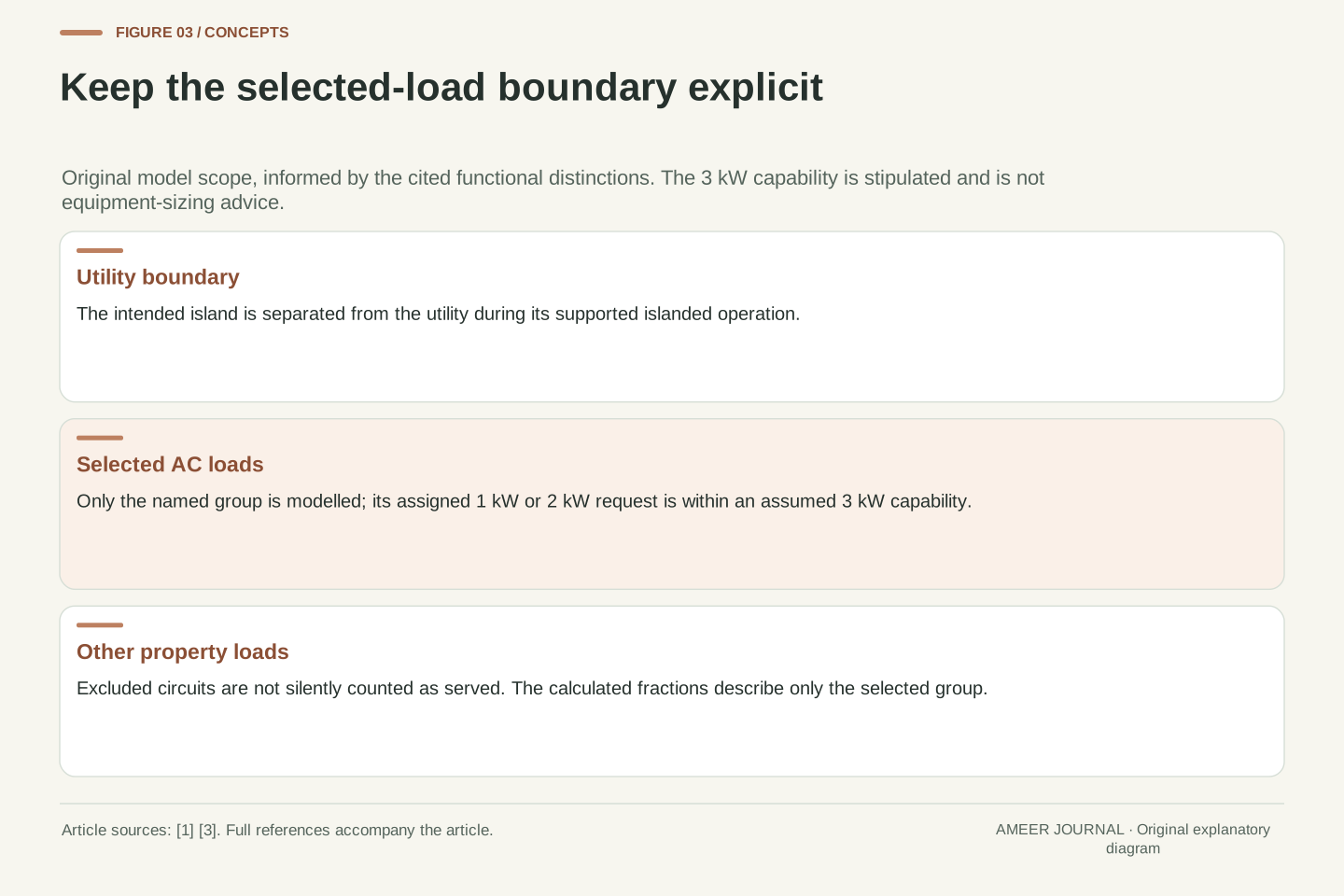
A second boundary identifies what the island supplies. A system may serve a selected group of loads without supporting every circuit at the property. DOE's teaching example distinguishes critical and noncritical loads and describes coordinated load reduction. [3] For the original calculation here, we choose one aggregate group called the selected loads and stipulate that it is supported within a three-kilowatt AC limit. Other household loads are outside that group. Their exclusion is not evidence that they are powered elsewhere, and a successful result for the group cannot be relabelled whole-home coverage.
Intentional islanding defines an electrical operating boundary distinct from the utility-connected mode. DOE's microgrid explanation explicitly separates the local system to prevent back-feeding into the utility and describes coordinated resources within that island. [3] This functional separation is not interchangeable with a mere absence of utility power. We treat it as a confirmed state in the hypothetical record, without supplying a switching procedure or using the campus sequence as a home design specification.
The service boundary is independently chosen. Define one aggregate selected AC load group; all other property loads are outside the model. Assume the complete supported system can supply that group up to 3 kW under the stated conditions. This is a fixture assumption, not equipment sizing or proof of transient, current or waveform compatibility. DOE's distinction between critical and noncritical loads motivates naming the selection explicitly. [3] An energy or duration fraction computed for this group describes only this group, even if the same property has additional circuits or generation.
Give each event its own timestamp
Now assign a twenty-minute utility outage, beginning at minute zero and ending at minute twenty. The record says the home's separation is confirmed at minute two. The vehicle is connected and available from minute six until it leaves at minute fifteen. Other system-readiness conditions are complete at minute eight. Finally, the record assigns verified grid reconnection at minute twenty-two. These are invented observations in a paper example, not actions for a homeowner to perform and not the timing of a product.
Several facts are deliberately independent. The vehicle's arrival does not erase the remaining readiness delay. Separation alone does not create a source of power. The vehicle's departure removes the only islanded source in this example, even though it may still contain energy. Utility return is also different from the assigned reconnection event. The model contains no stationary battery, generator or solar contribution. Those choices let us follow one clearly defined path without silently giving the house another source whenever the vehicle is absent.
Use minutes from a common origin and half-open intervals: an event at an interval's end belongs to the next state. The utility outage is [0,20). Separation is confirmed from t=2 until reconnection at t=22. Vehicle availability is [6,15). The remaining system-readiness condition holds from t=8 onward, conditional on an available source and supported operation. Verified grid reconnection is assigned to t=22. These are independent fixture inputs, not a reproduced control algorithm or measured transfer sequence.
Within the selected-load boundary, no stationary storage, PV contribution or generator exists. Assume sufficient vehicle energy throughout every served interval and a compatible output path satisfying the declared 3 kW limit. The timing model therefore contains no energy-exhaustion cutoff. Readiness also does not mean that output persists without its source: it is one condition among several. Utility availability resumes at t=20, but the selected loads do not receive grid supply before the separately assigned reconnection at t=22. This explicit distinction prevents replacing an equipment-state record with a battery-capacity inference.
Service exists only where the required intervals overlap
The earliest service time is minute eight. Before minute two, separation is not confirmed in our record. From minute two to minute six, the vehicle is absent. From minute six to minute eight, the remaining readiness condition is still incomplete. At minute eight, the conditions first overlap. The vehicle then leaves at minute fifteen, ending the only available islanded supply. The selected loads therefore receive power for seven minutes, from eight to fifteen, during the twenty-minute utility outage.
This result does not come from dividing battery capacity by a load. It comes from comparing event times. Choosing the earliest of two readiness times would be a mistake, because service requires both conditions. Similarly, extending output beyond departure would invent a source that the example does not contain. The interval calculation is deliberately ideal: whenever all stipulated conditions hold, the selected group is fully served. It does not predict partial voltage, a failed start, a disturbance or the behaviour of an appliance across an interruption.
Let S(t) equal one only when the selected group receives its full assigned service, and zero otherwise. In the outage window, the interval begins at max(0,2,6,8)=8 and ends at min(20,15)=15. Its length is 7 min. Equivalently, S is the indicator of [8,15) for t in [0,20). The maximum enforces every prerequisite start; the minimum respects both the observation endpoint and the end of vehicle availability. If the calculated end preceded the start, the intersection would be empty rather than a negative service duration.
This binary model deliberately assumes supported operation throughout the intersection. It is not a dynamic model of voltage quality, transition disturbances or restarting loads. The energy store is adequate by assumption, so its size does not determine these endpoints. The distinction is useful: a capacity calculation could be correct while the actual permitted service set is empty or fragmented. Here it is one continuous seven-minute interval, with earlier and later unserved parts. That complete interval record contains more continuity information than its length alone.
Count requested and delivered energy at the same AC boundary
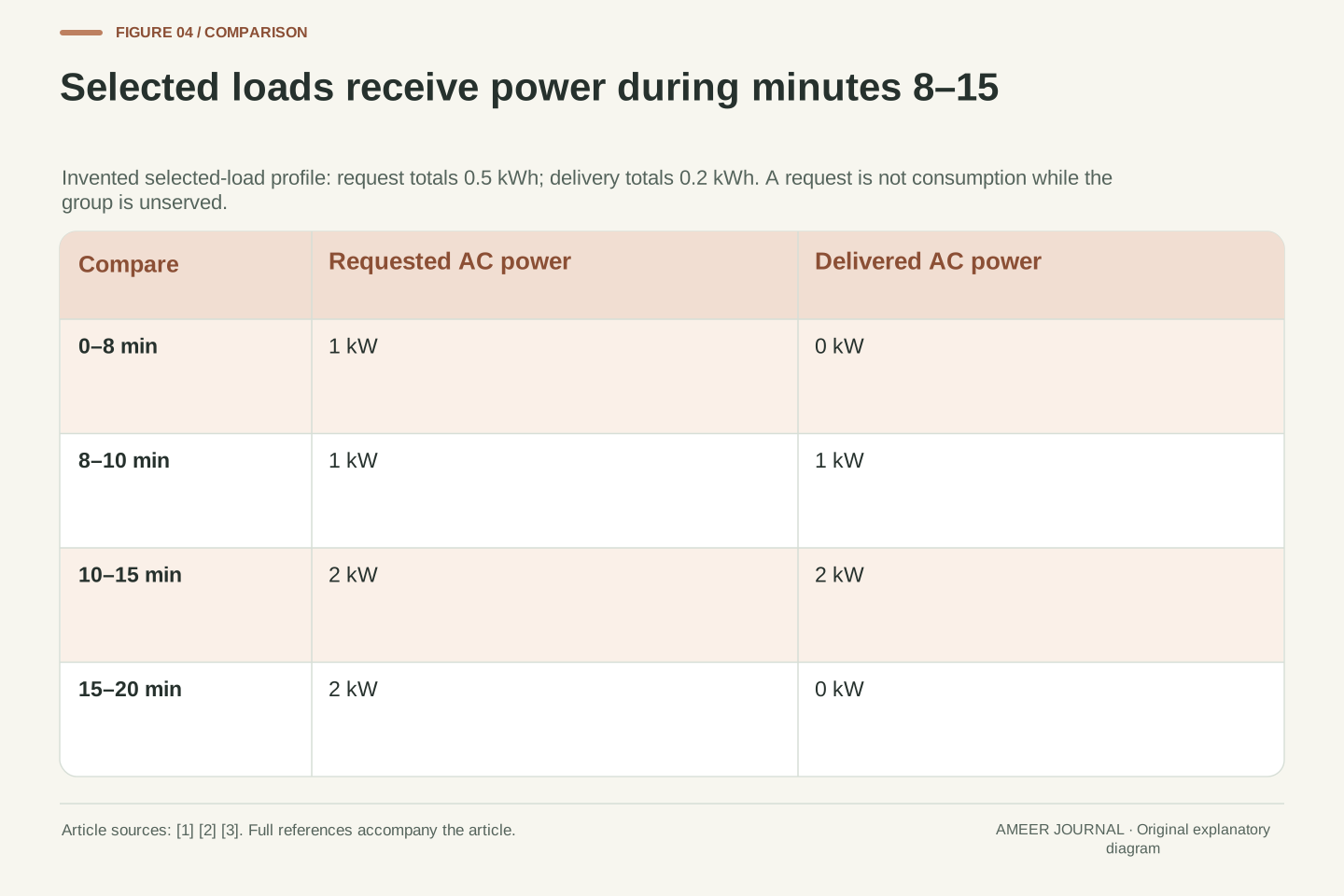
Assign the selected group a requested power of one kilowatt during the first ten minutes and two kilowatts afterward. Requested power means what the group would need if served; it is not electricity consumed during an outage. Both values are below the model's stipulated three-kilowatt capability. Over the twenty-minute outage, full service would require ten minutes at one kilowatt plus ten at two: thirty kilowatt-minutes, or half a kilowatt-hour. This request profile stays fixed whether service is present or absent.
The vehicle actually supplies the group from minute eight to fifteen. That covers two minutes at one kilowatt and five at two, giving twelve kilowatt-minutes. Dividing by sixty gives 0.2 kilowatt-hours of delivered AC energy. The remaining eighteen kilowatt-minutes of the request are unserved in this model. This is a load-side account. It does not say the battery lost exactly 0.2 kilowatt-hours: conversion losses, vehicle auxiliaries and battery-side limits would need their own model before making that different claim.
Define requested selected-load power P(t)=1 kW for 0≤t<10 min and 2 kW for 10≤t<22 min. The request is assigned independently of service; actual delivery is P(t)S(t). Over the outage, the requested energy is [1×10+2×10]/60=0.5 kWh. The factor 60 converts kilowatt-minutes to kilowatt-hours. Both power levels satisfy the assumed 3 kW output condition, but this scalar check is not a substitute for the compatibility and other electrical constraints already stipulated.
Integrating only the supported interval gives E_EV=[1×(10−8)+2×(15−10)]/60=12/60=0.2 kWh. The unserved request is 0.5−0.2=0.3 kWh. All three quantities refer to the same selected AC load boundary. None is a measured battery inventory change or a converter-efficiency result. This separation matters because an AC service record can be complete for its own purpose while leaving battery-side energy, vehicle consumption and reserve information entirely unspecified. Adding those quantities later would require a consistent second boundary, not silently relabelling this one.
Time coverage, energy coverage and continuity answer different questions
Seven supported minutes out of twenty give 35 percent time coverage. The delivered 0.2 kilowatt-hours out of the requested 0.5 give 40 percent energy coverage. Both results are correct within this assigned record. The difference arises because the supported interval includes more of the higher-demand part of the record. Each minute counts equally in the first percentage. In the second, a minute at two kilowatts carries twice the energy request of a minute at one kilowatt.
Neither percentage means the selected loads had uninterrupted power. The record includes a gap before minute eight and another after minute fifteen. Even a larger energy total could not erase those gaps. The seven-minute interval is useful information for a reader assessing service, but it is not a probability of success, a forecast of future outages or a general reliability score. Keep the supported interval beside the energy total so that a summary number does not hide the sequence the loads experienced.
For the outage window W=[0,20), define time coverage as ∫W S(t)dt/20=7/20. Define requested-energy coverage as ∫W P(t)S(t)dt/∫W P(t)dt=12/30=2/5. The former is an unweighted duration fraction; the latter weights each supported minute by requested power. They coincide for a positive constant request but need not coincide for a varying profile. Here average requested power during served minutes is 12/7 kW, compared with 30/20 kW across the full outage, explaining the higher energy-weighted result.
Continuity is a separate property of the support set. S(t)=1 on [8,15) and zero on the rest of W, so this record does not provide continuous outage service even though both aggregate fractions are positive. These finite deterministic fractions are neither failure probabilities nor measured long-run availability. They also concern only the selected group, not the entire property. A useful report retains the full intervals, the request profile and the denominators instead of treating one energy fraction as an all-purpose description of backup quality.
Utility return is not the same timestamp as restored home service
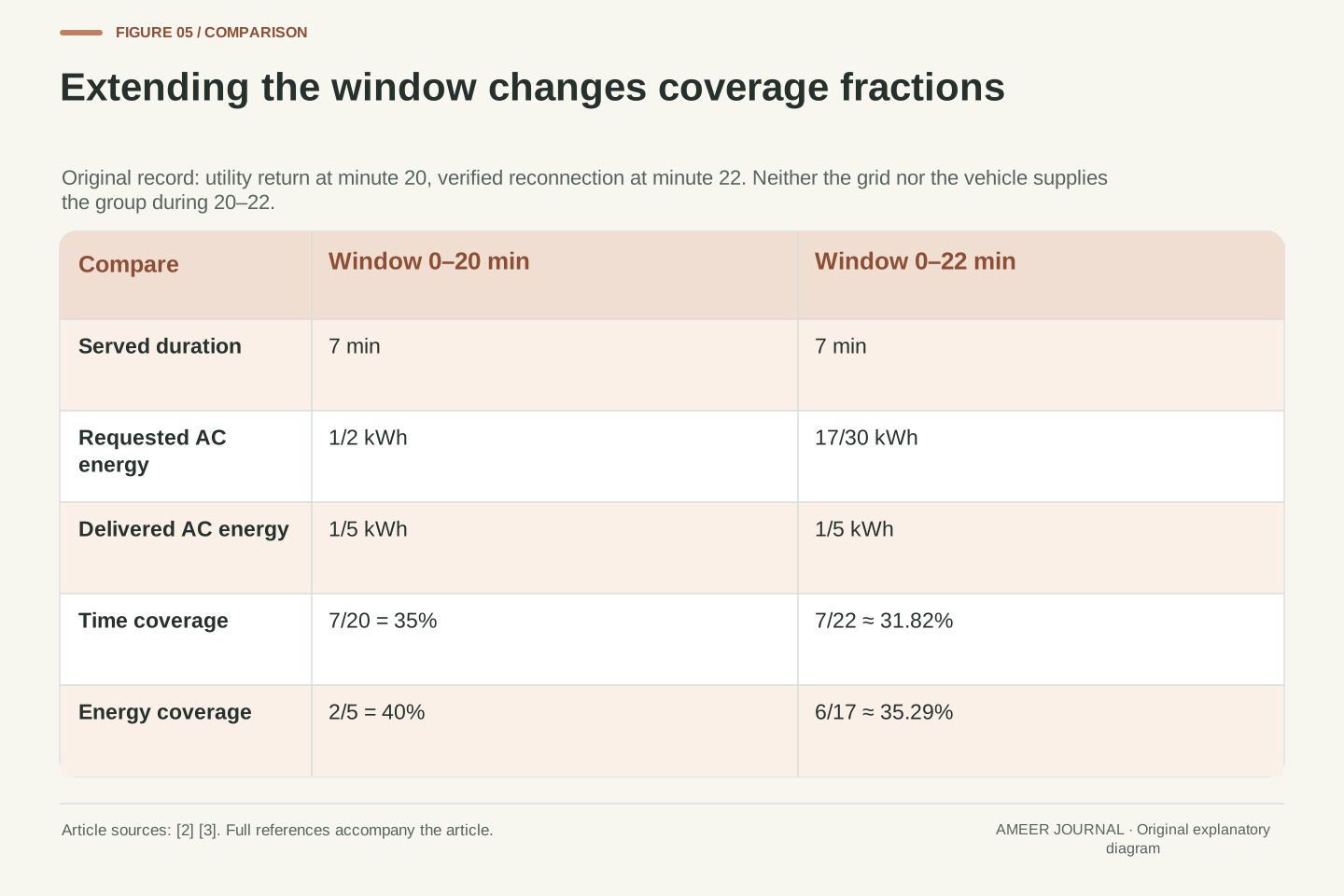
In our record the utility becomes available at minute twenty, but verified home reconnection occurs at minute twenty-two. The vehicle has already left, so the selected loads remain unserved during those two extra minutes. This delay is an assigned example, not a required waiting period or a product specification. The conceptual distinction follows from having separately defined utility-connected and islanded operating states. [2][3] It would be incorrect to replace the recorded reconnection time merely because utility power is now available outside the island.
If we widen the observation window to twenty-two minutes, the vehicle still delivered the same 0.2 kilowatt-hours. The request now includes two more minutes at two kilowatts, increasing its total from thirty to thirty-four kilowatt-minutes. Vehicle delivery therefore covers twelve divided by thirty-four, or about 35.3 percent of the wider request. Time coverage becomes seven divided by twenty-two, about 31.8 percent. These changed percentages describe a changed reference window; they do not show that the vehicle supplied less energy than before.
The fixture distinguishes utility restoration at t=20 from selected-bus reconnection at t=22. Neither event is equated with vehicle departure at t=15. This is a specified state record, not an inferred relay delay. The functional distinction between a utility-connected system and a deliberately isolated operating system is supported by the inverter and microgrid sources. [2][3] No particular switching logic, synchronization criterion or mandated restoration time is imported from those educational descriptions.
Over W′=[0,22), requested energy is [10+2×12]/60=34/60=17/30 kWh. Vehicle delivery remains 12/60=1/5 kWh because its available interval is unchanged. Energy coverage becomes (1/5)/(17/30)=6/17≈35.29%, while duration coverage is 7/22≈31.82%. Comparing either with the outage-only 40% or 35% without naming the new denominator would misrepresent the result. The grid contributes nothing within this wider half-open window by the assigned record; its verified supply resumes at the excluded endpoint t=22.
Changing one event can reveal the active constraint
Consider three separate changes to the original record, keeping everything else fixed and measuring only the twenty-minute outage. If the vehicle is connected from minute zero instead of six, service still begins at eight: the other readiness condition is now the limiting start. If the vehicle stays until twenty instead of leaving at fifteen, service runs from eight to twenty. It covers twelve minutes and delivers twenty-two kilowatt-minutes, because the extra five minutes each request two kilowatts.
A different change makes the other readiness condition complete at minute four instead of eight, while the vehicle still arrives at six and leaves at fifteen. Service then runs from six to fifteen: nine minutes and fourteen kilowatt-minutes. Earlier readiness does not produce service before the source is present. The comparisons identify different constraints without changing the battery-size assumption. They are separate paper cases, not three improvements applied together, and none suggests that an operator should shorten a real system's protection or verification process.
Keep the outage window, separation time, selected request and supported output assumptions fixed. Changing only arrival from 6 to 0 leaves max(0,2,0,8)=8 and therefore preserves the base 7 min and 12 kW·min of delivery. Changing only departure from 15 to 20 instead produces [8,20), with duration 12 min and delivery 1×2+2×10=22 kW·min. Its time coverage is 3/5 and requested-energy coverage is 11/15. These are distinct counterfactuals rather than a combined scenario.
Changing only the other-readiness threshold from 8 to 4 gives [6,15), because vehicle arrival now controls the start. Delivery is 1×4+2×5=14 kW·min, giving time coverage 9/20 and requested-energy coverage 7/15. Readiness before arrival denotes a completed prerequisite, not an energized source. The max/min construction exposes a piecewise response: moving a nonlimiting event has no effect until it becomes the limiting one. No value here represents a permissible protection setting or a recommended change to actual equipment controls.
Additional resources change the system rather than filling gaps by assumption
A stationary battery or suitable local generation could change this record, but only after its supported role is added explicitly. DOE describes vehicle storage as potentially complementing solar, other distributed resources or an existing backup arrangement. [1] A stationary source might support a selected group while the vehicle is absent; that possibility needs its own energy allowance, output capability and control assumptions. It cannot be inserted into our example just because a home happens to have a battery-shaped box on a diagram.
Solar also needs a compatible operating environment. The DOE campus animation shows a PV resource returning after a local source establishes the relevant supply, while the inverter guidance distinguishes equipment that forms a reference from equipment that follows one. [2][3] Sunlight and a nominal panel rating therefore do not by themselves establish outage production at the selected loads. Adding another resource may change availability, the served group or energy duration. Each change deserves a new stated boundary and record, rather than an unexplained extension of the vehicle's seven-minute interval.
Adding stationary storage, PV or another source enlarges the system model. DOE identifies potential combinations of mobile storage with distributed resources, and its inverter guidance discusses coordinated reference roles. [1][2] A second source could alter the support set, but its availability, conversion path, control role and energy constraints would need explicit representation. Our single-source intersection would no longer be a complete service model. Even where two possible service intervals overlap, adding their durations would double-count that shared time.
The campus animation provides a bounded illustration of resource dependence: its PV contribution follows the establishment of a local supply and changes the burden on another source. [3] This does not mean every rooftop installation resumes during an outage or that every combination can operate together. A revised account would identify which source establishes the reference, which resources can join it, which loads are admitted and how energy sufficiency is maintained. These are system questions beyond the arithmetic of battery capacity, and they cannot be answered by copying a grid-connected energy-flow balance into an islanded case.
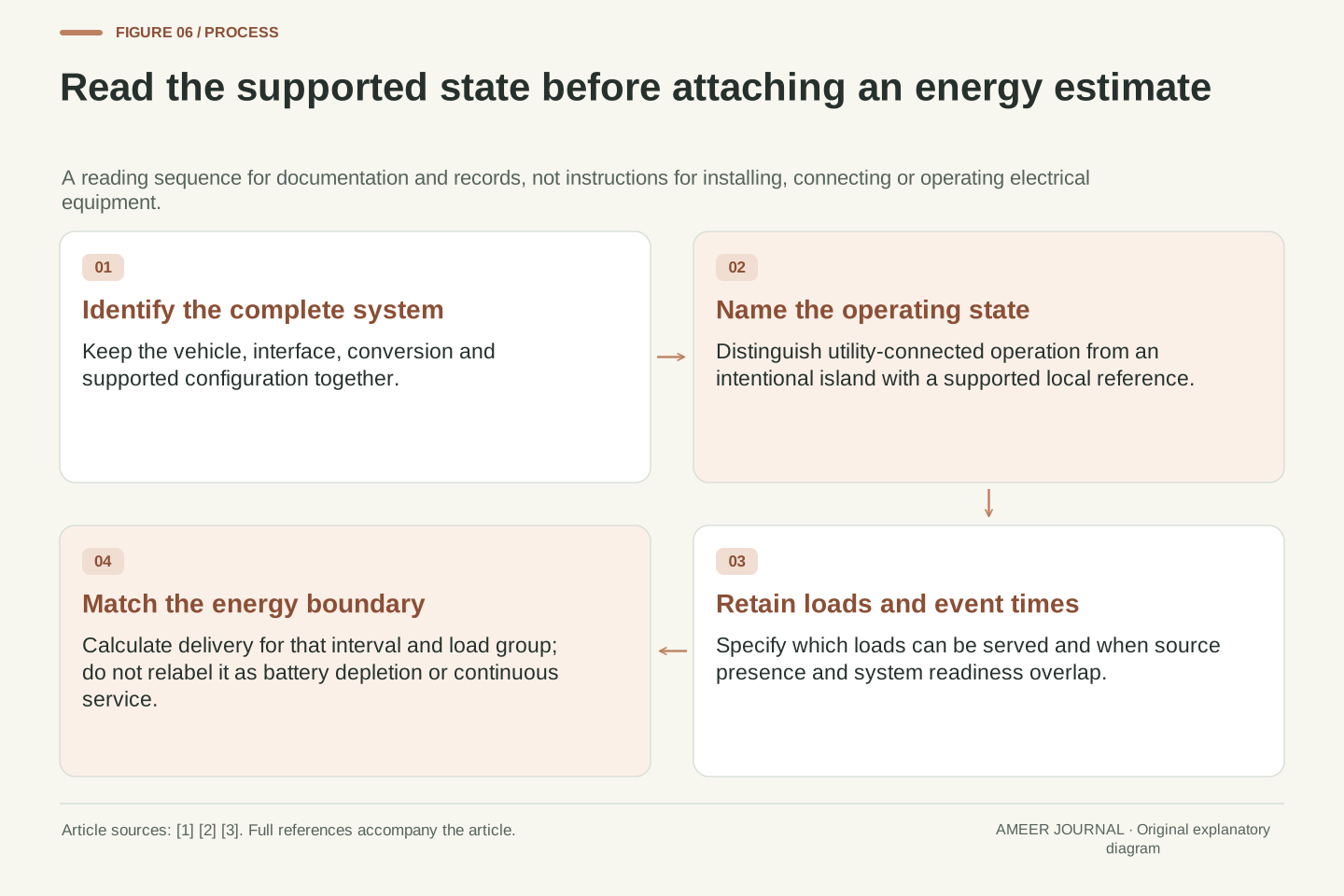
Read a backup claim from its supported state to its energy account
A useful backup description names the vehicle, interface and complete supported configuration; the intentional-island function; the selected load group; and the conditions for starting, continuing and returning to normal service. It also identifies what happens when the vehicle is away. DOE's site-planning discussion makes equipment and utility coordination part of the wider context. [1] These are questions to resolve from the applicable system documentation and responsible provider, not facts that a generic battery-capacity figure can supply.
Our original record makes the distinction concrete. The selected group receives seven minutes of service and 0.2 kilowatt-hours during a twenty-minute outage, despite the assumed adequate energy store. Earlier arrival alone changes neither result; a later departure changes both. The energy total describes delivery at one boundary, while the intervals reveal interruptions and the named load group limits the claim's scope. Keeping those facts together makes a vehicle-to-home statement interpretable without mistaking stored energy, a bidirectional label or a successful normal charge for demonstrated home-backup capability.
Interpret a capability statement in the order system identity, supported mode, electrical boundary, selected loads, state transitions and available energy. The DOE sources support treating compatible equipment, reference roles and site coordination as separate concerns. [1][2][3] Exact documentation must establish their implementation for the proposed system; this conceptual article cannot confer interoperability, commissioning approval or a guaranteed transition. A record of normal charging establishes a different operating state from the intentional-island service considered here.
The fixture's complete conclusion is a support set [8,15), delivered AC energy 1/5 kWh and an outage reference request of 1/2 kWh for one stipulated load group. Their associated 35% duration and 40% energy fractions answer different questions. Neither determines battery depletion, whole-property coverage or future reliability. The event counterfactuals show why capacity is not the only limiting information: the latest required start and earliest relevant end can dominate the result. A useful backup account preserves those constraints before attaching a duration estimate to a battery's energy inventory.
Sources & further reading
Explore the references behind this guide. External pages may change after our review.
- Bidirectional Charging and Electric Vehicles for Mobile Storage | Department of EnergyU.S. Department of Energy — Federal Energy Management Program · Accessed 7 Nov 2026
- Solar Integration: Inverters and Grid Services Basics | Department of EnergyU.S. Department of Energy · Accessed 7 Nov 2026
- Islanding a Microgrid | Department of EnergyU.S. Department of Energy — Federal Energy Management Program · Accessed 7 Nov 2026
- Bidirectional Charging 101: Vehicle-to-Home | TeslaTesla · Accessed 7 Nov 2026
Article updated 7 Nov 2026.
Found something we should revisit?
Good explanations get better with thoughtful feedback.