What you’ll take away
- Charging completion and release for the next driver are different events.
- A port’s simultaneous vehicle capacity is not established by counting its connector heads.
- Shorter occupancy can reduce several drivers’ waits without changing the supplied charging energy.
- An idle gap can absorb an earlier release, so queue improvements do not always propagate unchanged.
- Use the actual site policy and matching observation boundaries before interpreting a queue statistic.
A finished charge is not necessarily an available bay
A driver can finish receiving energy while the next driver is still waiting. The missing piece is the time between charging completion and the point when someone else can actually use that place. A useful timeline therefore has four events: arrival, charging start, charging completion and release for the next user. Combining them into one session length hides which part of the visit is holding up the queue. Workplace charging guidance explicitly recognizes sharing arrangements and the need to coordinate successive users. [2]
We will follow four invented vehicles through a single charging bay. Their arrival times and charging durations are supplied, so you can check every result on paper. The bay is usable only after the preceding vehicle's release event. This is one chosen arrangement, not a description of every charger layout. The example separates active charging from a later clearance interval; it includes no faults, payment delays or interruptions. Its shorter-clearance comparison is a mathematical change, not a recommended deadline for moving a vehicle. The goal is to understand the queue, not to infer a stranger's needs from a parked car.
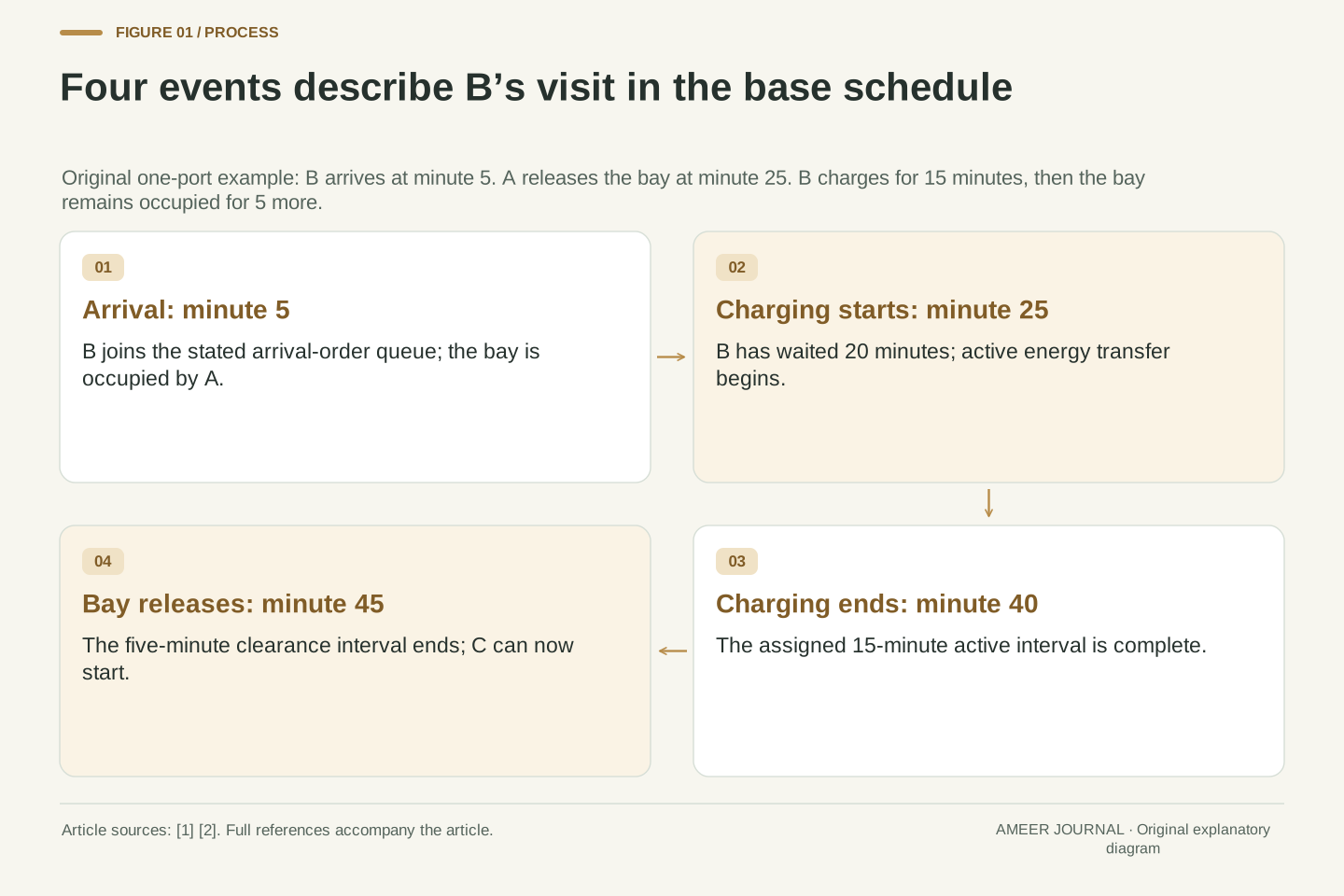
Define arrival a, charging start s, charging completion c and release d. In the model, waiting is s−a, the contiguous active interval is c−s, and post-charge clearance is d−c. The resource remains unavailable to another vehicle throughout [s,d), although energy transfer occupies only [s,c). A departure or release timestamp therefore carries information that an energy-completion timestamp does not. AFDC's sharing guidance provides a real context for distinguishing completion from subsequent access. [2]
The original deterministic model below represents one operational, compatible port paired with one bay. Only release makes the pair available to the next vehicle; charging begins immediately when it is assigned. There are no interruptions, reservations, failures, connection delays or shared-power effects. These assumptions isolate an occupancy mechanism rather than reproduce an actual site's management software. All numerical inputs are invented. In particular, a clearance parameter describes the supplied record; it is neither a safe movement allowance nor an assessment of an individual driver's conduct. Real records can contain additional phases that would need separate event definitions.
Count the resource that can serve another vehicle
Before counting a queue, decide what it is a queue for. A charging location is a place that can contain several charging ports. In AFDC's terminology, a port can charge one vehicle at a time, even if it has several connector heads. A connector is the part plugged into the vehicle. Two plugs hanging from a post therefore do not, by themselves, establish that two vehicles can charge at once. [1] A sign showing a large connector count may answer a different question from how many compatible places are free.
Our one-bay example requires that the next vehicle can physically use the released place and the port can supply it. Some workplace arrangements allow several connected vehicles to take turns without their owners moving them, so clearance need not work like our example. [2] The distinction matters when reading a map or a discussion about etiquette. A location may have several ports, a port may have several connectors, and the vehicle may still need a particular compatible option. Name the actual resource before treating a change in plug count as a change in capacity.
AFDC distinguishes station location, EV charging port and connector. A location can contain multiple ports, while a port supplies one vehicle at a time and can expose multiple connector types. [1] These are counting units, not interchangeable descriptions of one object. Our capacity variable counts independently usable, vehicle-compatible port-and-bay pairs. Connector quantity alone cannot establish that capacity, and a physically empty bay does not by itself establish electrical availability or compatibility.
The release rule is also a model choice. AFDC describes workplace equipment that permits sequential use through multiple connectors without each driver moving a vehicle. [2] Such an arrangement would require a different resource-state account. Here, the fixed active duration q is the assigned time required by each vehicle under the stipulated supply conditions. Actual duration depends on battery and vehicle conditions and charging equipment, as AFDC explains. [1] Adding another independent port later will preserve q by assumption. If the added outlet instead shares a power limit, preserving those durations would need justification; it cannot follow merely from the appearance of another connector.
Put arrivals and active charging times on the same clock
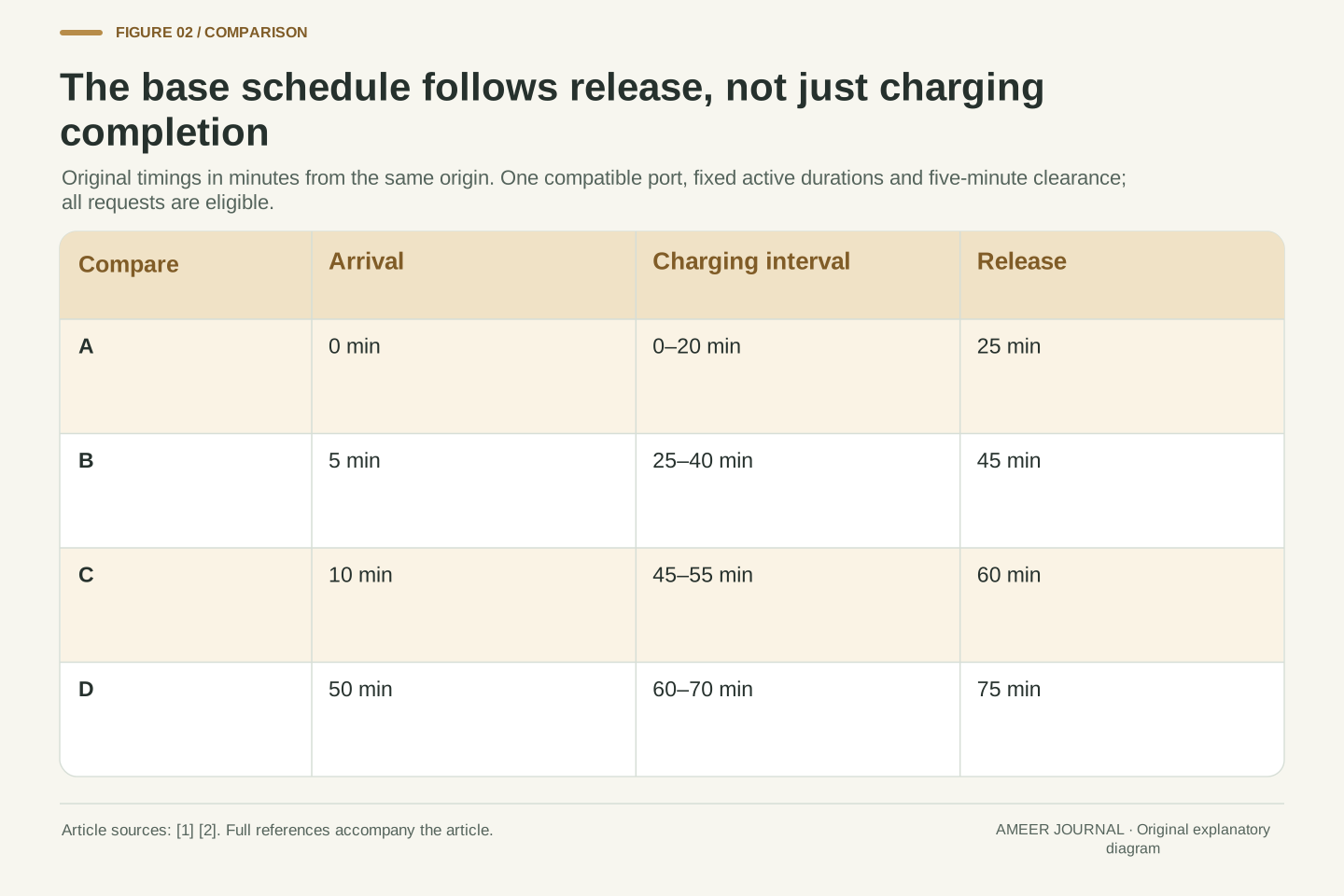
Set minute zero when vehicle A arrives. B arrives at minute five, C at minute ten and D at minute fifty. A needs twenty minutes of active charging; B needs fifteen; C and D each need ten. The first version adds five minutes between each charging completion and release of the bay. We serve eligible arrivals in their order of arrival. A starts immediately because the bay is initially free. Every later driver waits until both conditions are true: they have arrived, and the preceding visit has released the bay.
Nothing about these numbers says that four real vehicles would charge this way. In particular, a driver's arrival time does not necessarily establish priority at a real site. AFDC's workplace examples include assigned access, reservations and a self-managed first-come arrangement. [2] We choose the last type of ordering only to make the paper schedule determinate. No one leaves the queue, changes their request or arrives after D. The common observation window runs from minute zero to minute ninety, long enough to include every visit in each comparison.
Use arrival vector a=(0,5,10,50) min and active-duration vector q=(20,15,10,10) min for A through D. The base clearance is h=5 min for every visit. The service order is the listed arrival order, all vehicles are eligible, and the resource is free at time zero. With initial release d0=0, compute si=max(ai,d(i−1)), ci=si+qi and di=ci+h. The maximum enforces both arrival and resource availability; it prevents a schedule from assigning a vehicle before it exists in the queue.
This is a finite first-come schedule, not a stochastic arrival model or a claim about universal charging priority. AFDC's workplace guidance describes several distinct sharing policies, including assigned pairs, reservation systems and self-managed arrival order. [2] The chosen order is therefore an explicit input. We also hold demand and active durations fixed across the first two schedules. Compare them over the same T=90 min window, with all four requests completed and no unobserved later arrivals. These boundary conditions make totals and denominators reproducible without estimates of a long-run arrival or service distribution.
Follow the first schedule all the way to release
A charges from minute zero to minute twenty, then releases the bay at twenty-five. B arrived at five, so B has waited twenty minutes when charging starts at twenty-five. Its fifteen-minute charge ends at forty, and its release follows at forty-five. C arrived at ten but cannot start until forty-five: thirty-five minutes of waiting. C charges until fifty-five and releases at sixty. D arrived at fifty, so it waits ten minutes, charges from sixty to seventy and releases at seventy-five.
The four waits are zero, twenty, thirty-five and ten minutes. Together they make sixty-five vehicle-minutes of waiting; dividing by four vehicles gives an average of 16.25 minutes. Vehicle-minutes count several people's waiting separately, even when it happens at the same time. This is not a sixty-five-minute clock interval before the final car leaves. The final release is minute seventy-five. Nor was the charger actively supplying energy throughout those seventy-five minutes: twenty minutes of that occupied time belong to the four five-minute clearance intervals.
Applying the recurrence gives start times s=(0,25,45,60) min, charge completions c=(20,40,55,70) min and releases d=(25,45,60,75) min. Subtracting arrivals from starts yields waits W=(0,20,35,10) min. The fixed-cohort mean is ΣWi/4=65/4=16.25 min. The sum has the interpretation of 65 vehicle-minutes because each vehicle contributes its own waiting interval; overlapping waits are counted once per waiting vehicle. The mean includes A's zero wait; excluding A would instead describe only the three delayed arrivals.
The resource is continuously occupied from 0 to 75 min in this base schedule. Its active-time total is Σqi=55 min, and its total post-charge clearance is 4h=20 min. Thus occupied time is 55+20=75 min, consistent with the final release because there is no gap. This last equality would not hold automatically if the resource had been idle between visits. The timeline supplies the distinction: a charge completion determines the end of energy transfer, while the release determines the next possible start. Changing the earlier event alone without checking the later one would miscalculate B, C and D's waiting.
A shorter gap can help several people before the benefit reaches an idle period
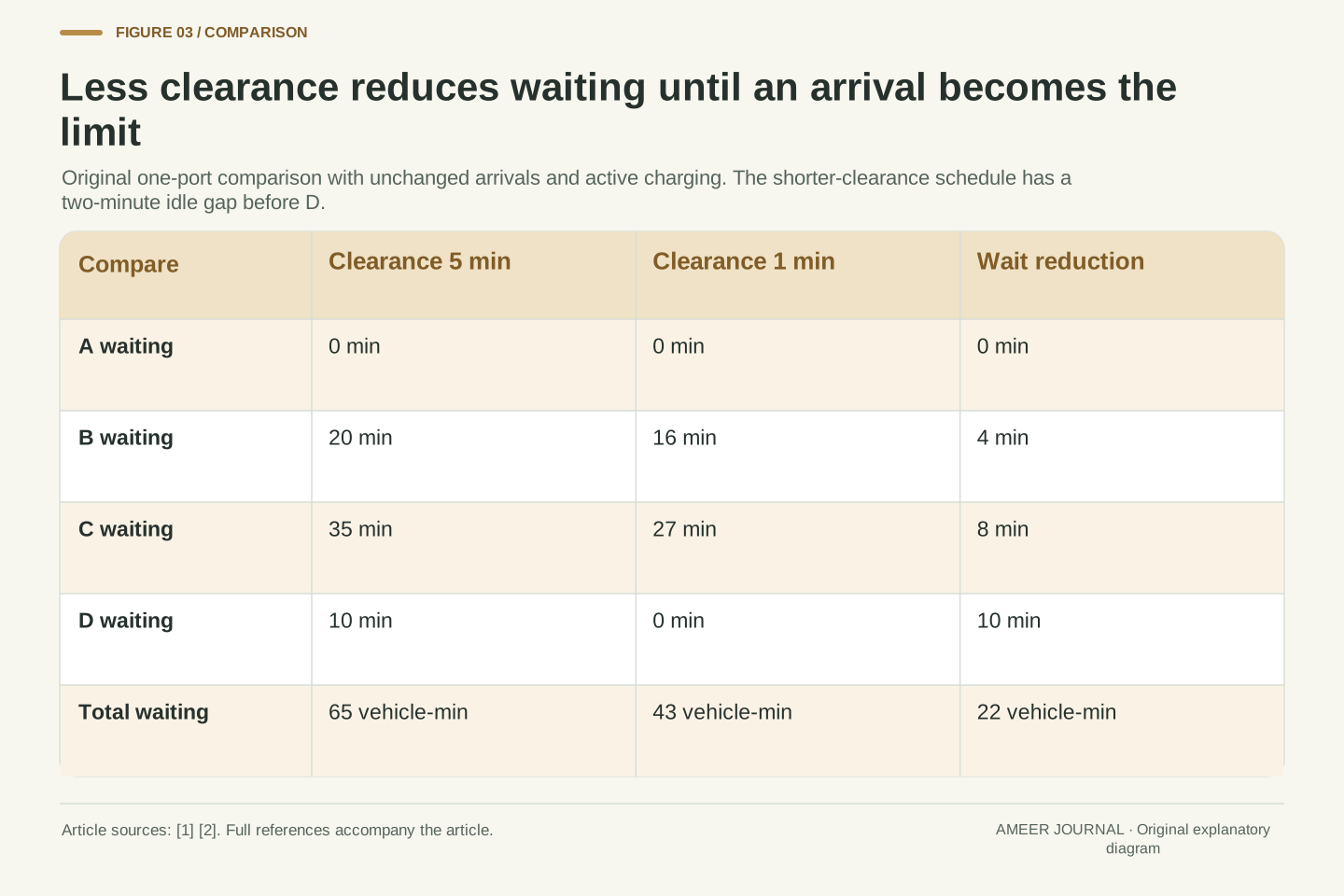
Now change only the clearance interval, from five minutes to one. A finishes charging at twenty and releases at twenty-one. B starts then, finishes at thirty-six and releases at thirty-seven. C starts at thirty-seven, finishes at forty-seven and releases at forty-eight. D has not yet arrived, so the bay sits free for two minutes. D starts at its arrival time of fifty, finishes at sixty and releases at sixty-one. No charging duration changed. D still has a separate charging end and bay-release event.
The waits are now zero, sixteen, twenty-seven and zero minutes. Their total is forty-three vehicle-minutes, and their average is 10.75 minutes. B saves four minutes of waiting, C saves eight and D saves ten. D does not save twelve: the two-minute idle gap absorbs that part of the earlier releases. A change can therefore pass through several occupied visits and then stop affecting the next start when arrival becomes the limiting event. The total waiting reduction is twenty-two vehicle-minutes, while the reduction in all four clearance intervals is sixteen port-minutes; those are different accounts.
With h=1 min and all a and q unchanged, the recurrence gives s=(0,21,37,50), c=(20,36,47,60) and d=(21,37,48,61) min. Waiting becomes W=(0,16,27,0) min, so ΣW=43 vehicle-minutes and the cohort mean is 43/4=10.75 min. The base-minus-revised wait differences are 0,4,8 and 10 min. These are exact results for the supplied finite schedule, without a probabilistic confidence claim. A's zero wait persists because the resource was initially free; the earlier release helps its successors rather than advancing A's arrival.
The cumulative release improvement before D is 12 min: C releases at 48 instead of 60. But D's arrival floor is 50, so only 10 min becomes a start-time improvement. Formally, the max operation clips any proposed start below ai. The two-minute surplus appears as idle time over [48,50), rather than as negative waiting. Total post-charge occupancy falls by 16 port-minutes, but total waiting falls by 22 vehicle-minutes because one occupied interval can delay multiple vehicles simultaneously. Different units and counting rules explain why those reductions need not match. The calculation does not assign a movement-time target to real drivers.
More availability can coexist with exactly the same energy total
Both schedules contain the same fifty-five minutes of active charging. To give that a simple energy meaning, assign a constant six kilowatts of output to the active port. Six kilowatts for fifty-five sixtieths of an hour gives 5.5 kilowatt-hours in either schedule. This is energy at the assigned port-output boundary; we have not supplied a battery-loss calculation. Finishing the visits earlier does not create extra energy in the example. It changes when the resource is available.
Over the common ninety-minute window, active charging uses fifty-five of ninety available port-minutes in both versions. Occupancy uses seventy-five minutes in the first version and fifty-nine in the second. The second final release is minute sixty-one, but its two-minute idle gap does not count as occupied time. If a report instead stops its clock at each schedule's last release, it divides by seventy-five in one case and sixty-one in the other. Those fractions can be useful, but they describe different observation windows and should not be mistaken for the same comparison.
Under the separate assigned constant port-output power P=6 kW, delivered output energy is E=PΣqi/60=6×55/60=5.5 kWh. The factor 60 converts the duration from minutes to hours. Both schedules have the same integral of output power and the same active duration. No battery-side efficiency, taper, charging curve or product capability is inferred from this additional stipulation. It is simply a consistent energy account on the chosen active intervals.
For one port over T=90 min, active utilization is 55/90=11/18 in both schedules. Occupied fractions are 75/90=5/6 and 59/90, because 55+4×1=59 min in the shorter-clearance case. Its elapsed first-start-to-last-release span is 61 min and contains 2 min of idleness. Dividing active time by each schedule's own final-release time instead gives 55/75 and 55/61. That changes the denominator as well as the resulting fraction. None of these definitions is intrinsically invalid, but the named observation boundary determines the question answered. A lower occupancy fraction can accompany unchanged energy and shorter waits.
The queue has its own kind of total
There is another way to check the waiting total without adding the four waits. Count how many vehicles are waiting during each interval. In the first schedule, B waits alone from minute five to ten. B and C both wait from ten to twenty-five. C waits alone from twenty-five to forty-five. Later D waits alone from fifty to sixty. Multiply each interval's length by its waiting count: five, thirty, twenty and ten vehicle-minutes. Their sum is the same sixty-five.
This second view explains how clearing one bay can benefit more than one person. During the busiest part of this tiny queue, two vehicles are accumulating waiting time together. Dividing the sixty-five vehicle-minutes by the ninety-minute observation window gives an average waiting count of about 0.722 vehicles. That is different from the average wait of 16.25 minutes per vehicle. One averages a changing count over time; the other averages four individual durations. Neither number says that a real queue is always that size or that a new arrival will wait exactly the average.
Let Nw(t) count arrivals that have not started charging, excluding the vehicle already being served. Each vehicle contributes an indicator over its interval [ai,si). Summing those indicators and integrating over the common window gives ∫Nw(t)dt=Σ(si−ai), since all waiting intervals lie inside it. For the base case, the nonzero pieces are 1×5,2×15,1×20 and 1×10, giving 65 vehicle-minutes. This is an exact finite counting identity, not an assumption of stationary queue behavior.
The time-average waiting count is therefore 65/90=13/18≈0.7222 vehicles in the base case and 43/90≈0.4778 in the shorter-clearance case. The cohort-average waits remain 65/4 and 43/4 min. Their denominators are respectively observation time and number of observed vehicles. Keeping them distinct avoids reporting a vehicle count as a time estimate. It also separates the queue from the occupied resource: Nw excludes an actively charging vehicle and excludes a completed vehicle still occupying the bay. Those vehicles consume port-and-bay capacity but are no longer waiting to start.
Two independent ports change the schedule in a different way
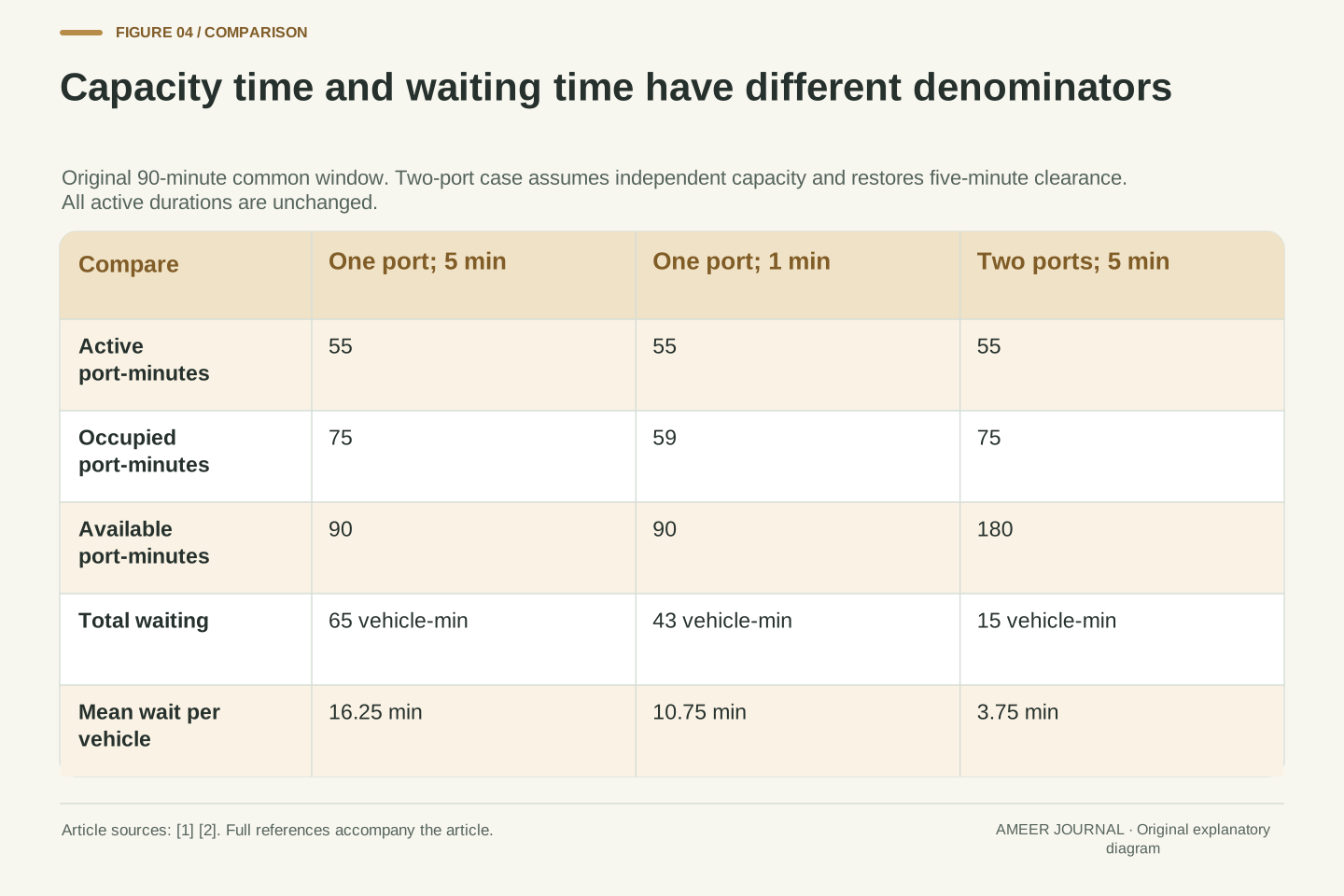
For a separate comparison, restore the five-minute clearance and provide two independently usable ports, each with its own bay and enough power to preserve the assigned charging durations. A starts on the first at zero; B starts on the second at five. Both release at twenty-five. C, which arrived at ten, starts then and waits fifteen minutes. D arrives at fifty, after a port is already free, and starts immediately. The four waits are zero, zero, fifteen and zero, averaging 3.75 minutes.
Active charging still totals fifty-five port-minutes across the two ports. Occupancy totals seventy-five port-minutes. But the ninety-minute window now contains one hundred and eighty available port-minutes, so the fractions use a different capacity denominator. This is not the same change as reducing clearance on one bay. It is also not the automatic result of adding a second connector head: the original definition of a port still matters. [1] If two outlets share a supply that changes charging durations, the schedule must be recalculated with that information.
Use two parallel independent ports with h=5 min. Assign each arrival to the port with the earliest availability; break an availability tie by choosing port 1. The resulting assignments are A→1, B→2, C→1 and D→2. Their starts are 0,5,25 and 50 min. A and B both release at 25, C at 40 and D at 65. Waiting is (0,0,15,0) min, with total 15 vehicle-minutes and mean 15/4=3.75 min. Choosing between two already idle ports for D would not change its zero wait; the stated tie rule simply makes the assignment record definite.
The resource denominator is now 2 ports × 90 min = 180 port-minutes. Aggregate active time remains 55 port-minutes and aggregate occupancy remains 75, giving fractions 55/180 and 75/180. Overlap between simultaneous visits is deliberately counted once for each occupied port, rather than collapsed into one clock interval. Output energy remains 5.5 kWh if each active port has the separately assigned 6 kW output; simultaneous operation requires the assumed independent capacity. AFDC's one-vehicle-per-port definition supports the counting distinction, not the extra supply assumption. [1] A shared-power installation would require new service durations or a power-allocation model before drawing the same conclusions.
A queue notification is another event, not the start of charging
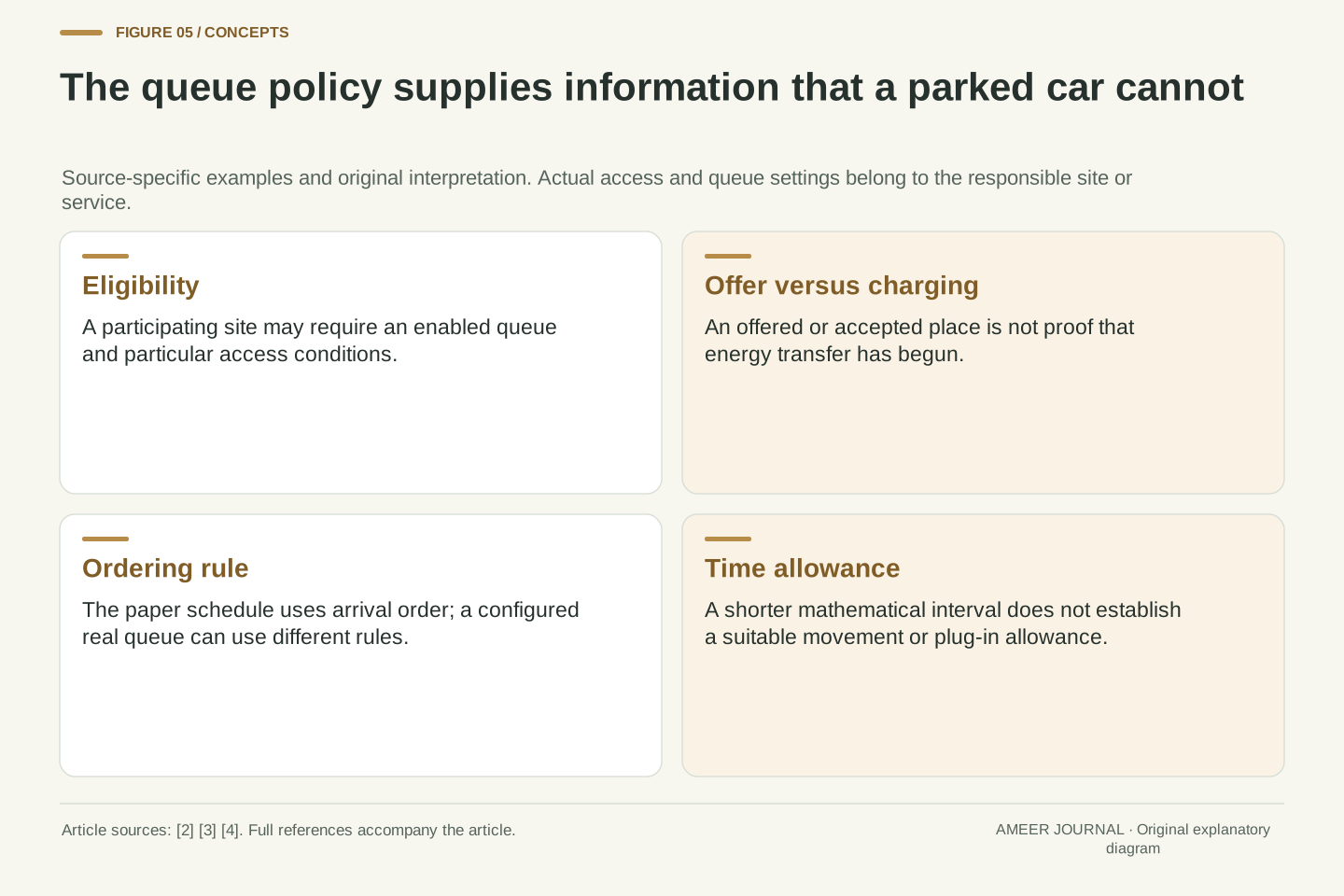
A real queue can include an offer and a temporary hold before the driver reaches the bay. ChargePoint's retrieved support page, for example, lists owner-enabled Waitlist at participating busy stations and excludes roaming partner networks. It distinguishes accepting an offered place from deferring it or leaving the queue. [3] An offer therefore is not evidence that a vehicle has connected or begun receiving energy. Our paper schedule intentionally leaves that extra phase out.
The owner's settings can also change the timing and order. ChargePoint's FAQ describes configurable hold and charging periods, and a particular exception in which drivers queued before a configured remote opening enter in random order. [4] We should not read our simple arrival-order recurrence into every software queue. To interpret a real notification, the useful questions are which site policy applies, when eligibility began, whether the offer was accepted, and when the resource became usable. A missing queue button or an old alert alone cannot supply all of those events. Follow the actual service's current instructions rather than a timing value invented for a worked example.
The mathematical start si is an energy-transfer event. A platform offer, acceptance or temporary reservation would introduce additional states and timestamps. ChargePoint's retrieved driver documentation scopes Waitlist to enabled participating busy stations, excludes roaming partner networks and distinguishes acceptance, deferral and leaving. [3] Those documented states cannot be collapsed into an assertion that acceptance equals connection, charging or physical bay release.
Its owner FAQ makes hold and charging periods configurable and identifies a random-order exception at certain configured remote-queue openings. [4] Thus the FIFO recurrence here remains an authored model assumption, not an implementation claim about that platform. A fuller model could include offer issuance, acceptance, travel-to-bay, connection and timeout, but it would need specified transition rules and durations. For example, reserving an unused port for an accepted offer could leave it unavailable while no power flows. That is a logical extension of the resource definition, not a measured property of the example site. Counting offers as completed sessions would mix different event types and inflate conclusions about service actually delivered.
Useful etiquette starts with the site's actual arrangement
Clear information helps people coordinate. AFDC's workplace guidance recommends defined administration and sharing policies; its examples include access restrictions, assigned partners and reservations. [2] A workplace example does not establish the rules of a public car park. At the site you use, check the displayed access conditions and the responsible operator's instructions. A queue may be for a particular set of ports, and a parking rule may apply separately from a charging session. An arithmetic example cannot grant priority, extend access or settle a fee dispute.
The smaller clearance value in our comparison also says nothing about how quickly a particular person can safely return and move. Even the ChargePoint owner FAQ notes that a configured plug-in interval can be too short. [4] The practical response to an unclear situation is to use the site's stated contact or reporting process, not to interfere with another vehicle or connector. Coordinate within the arrangement that actually exists. A useful policy explains how a driver gives up an unused offer and how the next person learns that access is available.
Policy is an input to the resource model. AFDC's workplace material distinguishes administration, access, enforcement and sharing, with examples of paired assignments and reservations. [2] These alternatives show why physical arrival order alone cannot establish an entitlement. Site eligibility, reserved access and parking conditions need their own definitions; the present queue arithmetic is not a legal or contractual interpretation of the currently applicable conditions.
Likewise, h is not a measure of personal fault. A driver may need a different access or movement allowance, and an unsuitable configured window can itself be a management problem; the manufacturer FAQ explicitly recognizes an insufficient plug-in period as a possible explanation for missed offers. [4] The model's counterfactual holds everything else fixed only to expose a timing relationship. Operational changes would need to account for their effects on access, safe movement, notification and the actual site arrangement. A clearer event record can support that discussion, but a calculation of reduced waiting does not establish that every proposed reduction is feasible or appropriate.
One session length cannot reveal where the time went
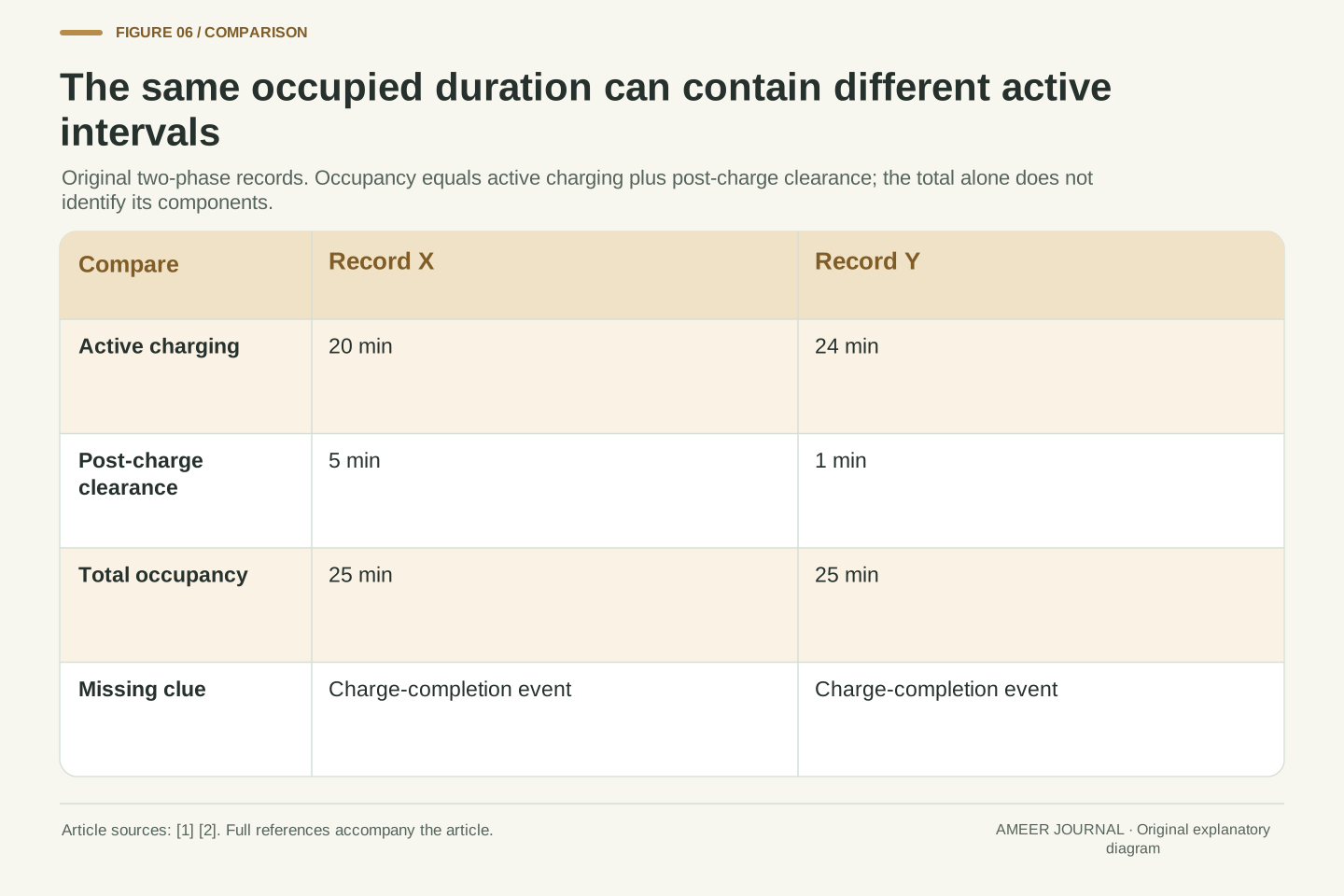
Suppose a record says that a vehicle occupied the resource for twenty-five minutes. It could have charged for twenty minutes and then occupied it for five more. It could instead have charged for twenty-four minutes and occupied it for one more. Both add to twenty-five. The total alone does not identify the split. A completion timestamp supplies a missing clue, provided the record clearly explains what completion means. An arrival timestamp adds waiting information but does not resolve this internal split.
Real records may be more complicated than our two-part example. A connected vehicle could have an interval in which charging has not started, or charging could pause before its eventual completion. If the report includes such time, do not silently label all of it as post-charge clearance. Similarly, a low count of completed sessions could reflect long requests, unavailable equipment, eligibility limits or simply few arrivals. To distinguish these explanations, the record needs the corresponding events and conditions. Raising a quoted peak charging power does not, by itself, tell us whether the occupied intervals in a particular queue would become shorter.
Within the two-phase model, occupied duration o=q+h. Observing only o=25 min does not identify q and h: both (q,h)=(20,5) and (24,1) min satisfy it. The additional completion event separates those possibilities. If energy were also reported, inferring q would still require a stated power history; energy alone is an integral, not a unique duration. The constant 6 kW assumption was introduced for one calculation, not established for every possible visit.
A more detailed record may have pre-charge occupancy or mid-session pauses. Then o=q+h is incomplete unless q is redefined, and that redefinition would change its meaning as active charging time. Keep the event vocabulary fixed or expand the model explicitly. The finite schedules also hold the arrival cohort fixed, so they cannot distinguish low demand from restricted access or unavailability in an unrelated dataset. An observed aggregate can be compatible with several mechanisms. Identifying the relevant mechanism requires the events or constraints that separate them, rather than selecting whichever explanation seems plausible from a single session count or total duration.
Read the timeline before judging the queue
The worked example gives a practical reading method. First count compatible, usable ports rather than plug heads. Next separate arrival, charging start, charging completion and release. State the order in which eligible requests will be served. Then compare the same observation window and name whether you are counting active time, occupied time, waiting time or delivered energy. Each quantity answers a useful question, but replacing one with another changes the conclusion.
In our one-port comparison, the active charging and assigned energy stayed the same while waiting fell. In the two-port comparison, a new capacity assumption changed both the schedule and the available port-minutes. The gap before D showed why an earlier release need not produce an equally earlier start. These are specific explanations for the supplied records. At an actual station, the most useful next detail is often the missing event or rule: whether a port is compatible, whether an offer is still held, whether charging has completed, or whether the bay has been released. That detail is more informative than treating every stationary vehicle as the same kind of delay.
Interpret a charging queue through a declared resource, policy, state sequence and observation boundary. The single-port recurrence exposes the bottleneck at each start: either resource release or the vehicle's own arrival. The waiting integral counts users awaiting service, while occupancy counts resource time and the power integral counts energy. Their units and denominators prevent them from being interchangeable efficiency scores. AFDC's definitions and the scoped provider documentation supply context for those distinctions. [1][2][3][4]
The original results are therefore bounded but informative: 55 active port-minutes in all cases; 65,43 and 15 vehicle-minutes of waiting; and different occupied-capacity fractions under the declared 90-minute window. No one number establishes actual availability, priority or the next driver's waiting time. A usable real comparison would preserve event meanings, identify interruptions and eligibility, and report its observation boundary. The lesson is to connect a conclusion to the particular recorded event that supports it. Charging completion explains the end of an energy interval; release explains when the next user can take the resource. The distance between those events is a separate part of the account.
Sources & further reading
Explore the references behind this guide. External pages may change after our review.
- Alternative Fuels Data Center: Electric Vehicle Charging StationsU.S. Department of Energy — Alternative Fuels Data Center · Accessed 7 Nov 2026
- Alternative Fuels Data Center: Workplace Charging for Electric VehiclesU.S. Department of Energy — Alternative Fuels Data Center · Accessed 7 Nov 2026
- When can I join a Waitlist? | ChargePointChargePoint · Accessed 7 Nov 2026
- Waitlist FAQ | ChargePointChargePoint · Accessed 7 Nov 2026
Article updated 7 Nov 2026.
Found something we should revisit?
Good explanations get better with thoughtful feedback.