What you’ll take away
- A low-pressure lamp can clear without proving that the recommended cold pressure has been restored.
- Direct monitoring measures pressure at the wheel; indirect monitoring infers a pressure-related state from vehicle signals.
- Use the vehicle’s label and manual for the correct pressure and relevant tyre position.
- Temperature calculations require absolute pressure and absolute temperature; cooling can lower pressure without gas loss.
- A monitoring fault, calibration acknowledgement and tyre condition are separate pieces of evidence.
A warning can go out while the cold pressure still needs attention
A tyre-pressure light appears on a cold morning, then disappears later. It is tempting to conclude that the system made a mistake. Another explanation is that the pressure really changed as the tyre warmed. The US National Highway Traffic Safety Administration describes this on-and-off warning pattern and still advises checking the tyres and their pressures. [1] A dashboard lamp reports a condition interpreted by the monitoring system; it does not explain every reason that condition arose or establish that the recommended cold pressure has been restored.
Three questions make the situation easier to understand: what does the system measure, what pressure does the vehicle require, and what makes the warning appear? We will examine direct and indirect monitoring, then use invented wheel and gas examples to explain the differences. Actual pressure settings and procedures come from the vehicle's label and manual. If a warning appears, arrange a pressure and condition check as soon as it is safe, following the vehicle's instructions. NHTSA emphasizes that monitoring supplements regular tyre care. [1] Waiting for a lamp to disappear is not a pressure measurement.
An extinguished tyre-pressure warning does not uniquely identify the tyre's condition. The sensed or inferred pressure state may have moved across a warning criterion as temperature changed, even though the appropriate cold-pressure target still requires attention. NHTSA explicitly describes an intermittent cold-morning warning caused by marginal pressure crossing the threshold as temperature rises. [1] That explanation connects the indication to a changing physical state rather than assuming either a false sensor reading or a repaired tyre.
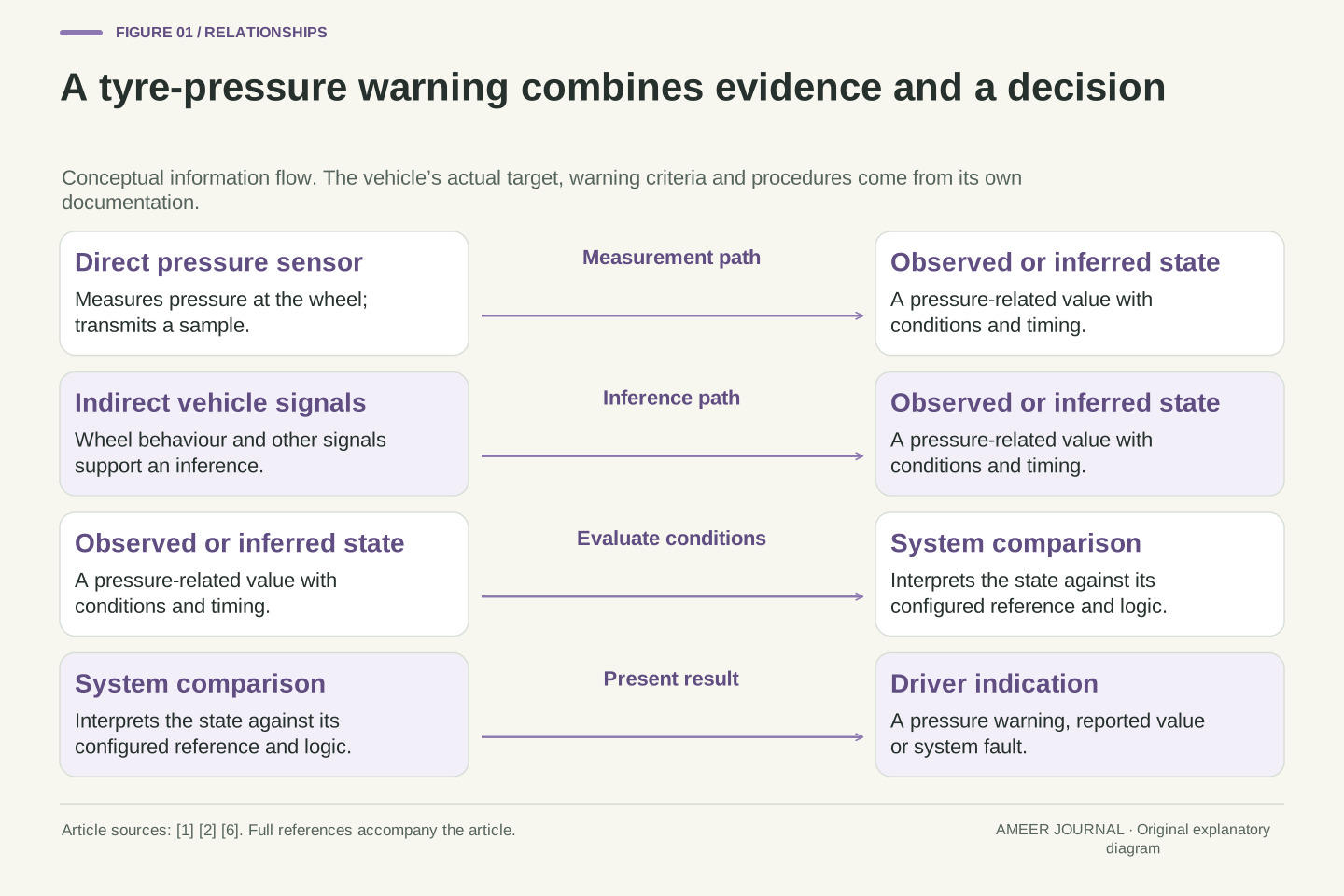
The analysis separates three layers: measurement or inference, comparison with a reference, and driver indication. Direct and indirect TPMS obtain their evidence differently, while both require interpretation against the applicable vehicle requirements. All numerical cases below are original hypothetical examples; none specifies a production system's thresholds or replaces a vehicle placard. The practical response to a warning remains a timely, safe pressure and condition check under the owner's instructions. NHTSA's guidance treats TPMS as a supplement to maintenance rather than a complete condition-monitoring or diagnostic system. [1]
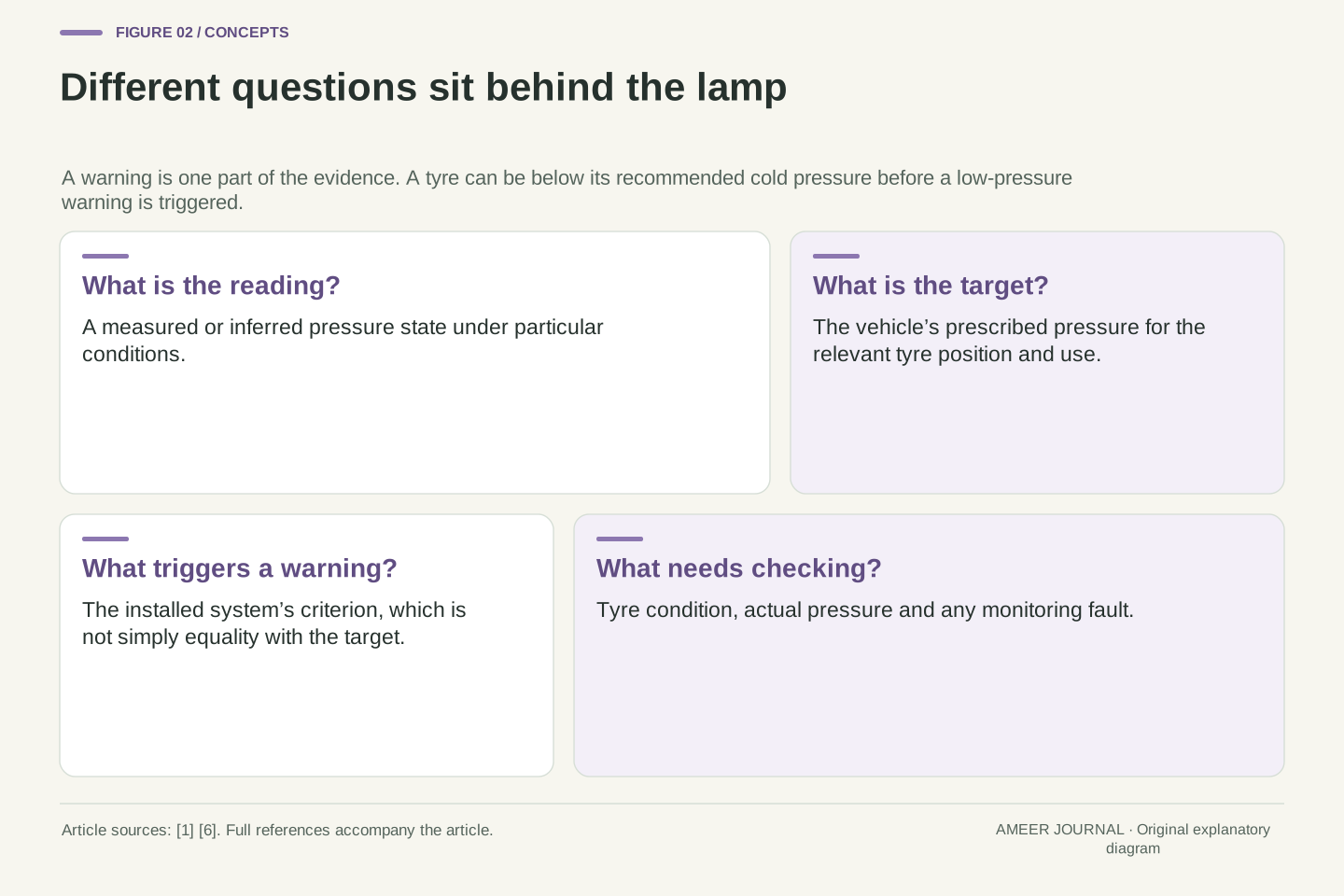
Keep the reading, the target and the warning condition separate
The reading is a pressure measured or estimated under particular conditions. The target is the vehicle's recommended pressure for the relevant tyre position and use. The warning condition is the point at which the monitoring system alerts the driver. NHTSA says the low-pressure warning activates when a tyre is significantly underinflated, while regular checks remain necessary. [1] Those statements make sense together because a tyre can move away from its recommended pressure before a warning is triggered.
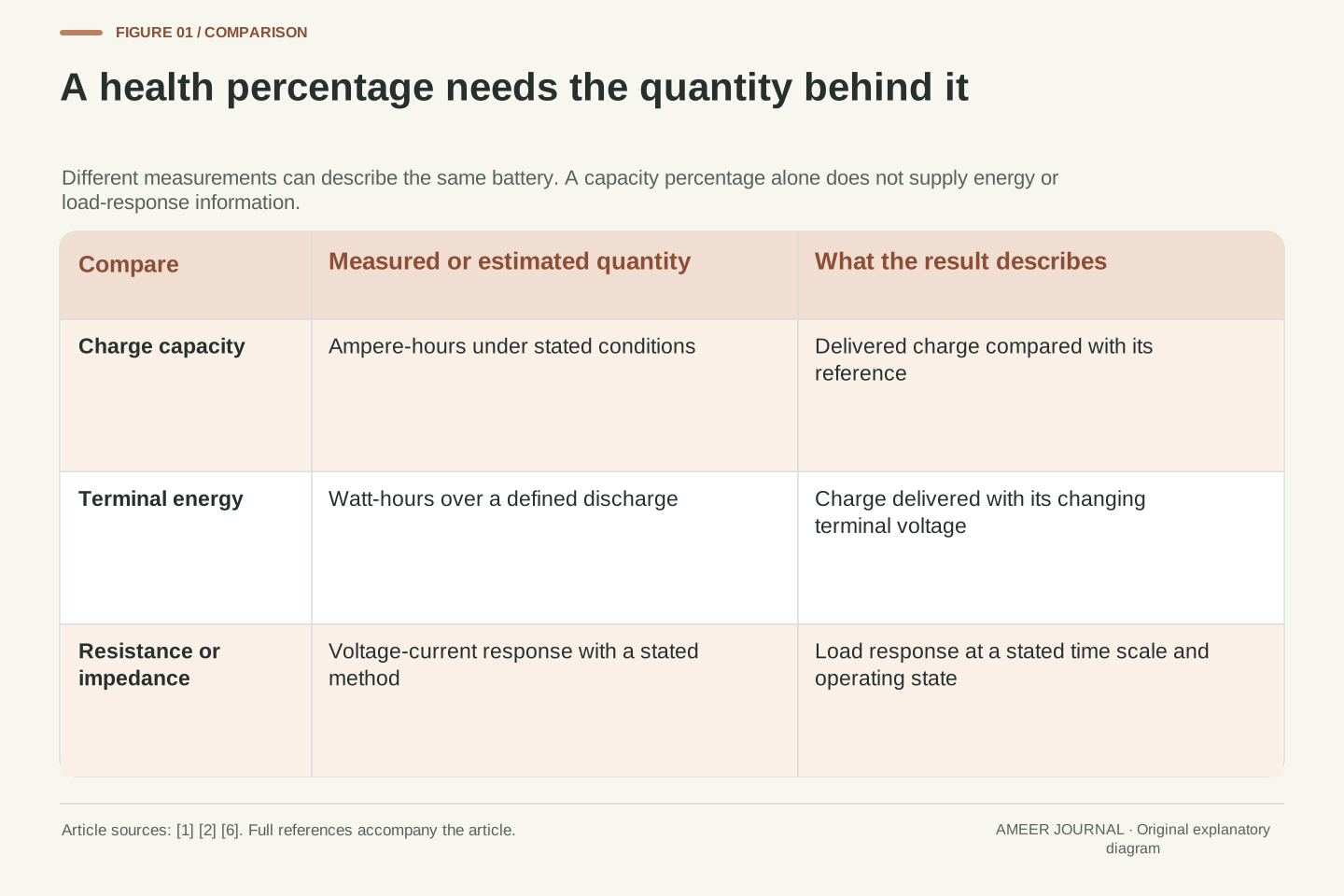
Consider a simplified imaginary indicator with a target of 240 kPa and a warning below 200 kPa. At 190 kPa the warning is on. At 210 kPa it is off, yet the reading is still 30 kPa below the target: 12.5 percent of 240. These chosen numbers describe logic, not a vehicle setting. The second state answers the question 'Is the reading below 200?' differently, but it does not answer 'Has it reached 240?' differently. A lamp that shows only one condition cannot replace the richer information in a measured value and its correct target.
Distinguish an observed pressure Pobs, a maintenance reference Pref and a warning criterion. A real criterion can include operating conditions and processing as well as a pressure comparison; it need not be an instantaneous threshold switch. NHTSA's consumer guidance describes the low-pressure indication as a response to significant underinflation and separately recommends routine cold-pressure measurement. [1] Absence of that indication therefore cannot be treated as equality between Pobs and Pref.
For an intentionally simplified logical example, set Pref=240 kPa and illuminate a fictional warning when Pobs<200 kPa. A change from 190 to 210 kPa clears that criterion. The remaining deficit is 240−210=30 kPa, or30/240=12.5%. No inference about safety, regulatory compliance or a real warning algorithm follows from those arbitrary thresholds. The example isolates information loss: a binary output partitions the possible readings into two sets, while the maintenance question concerns a specific reference and conditions. Knowing which set contains a reading is less information than knowing the reading itself.
Direct monitoring has a measurement and communication chain
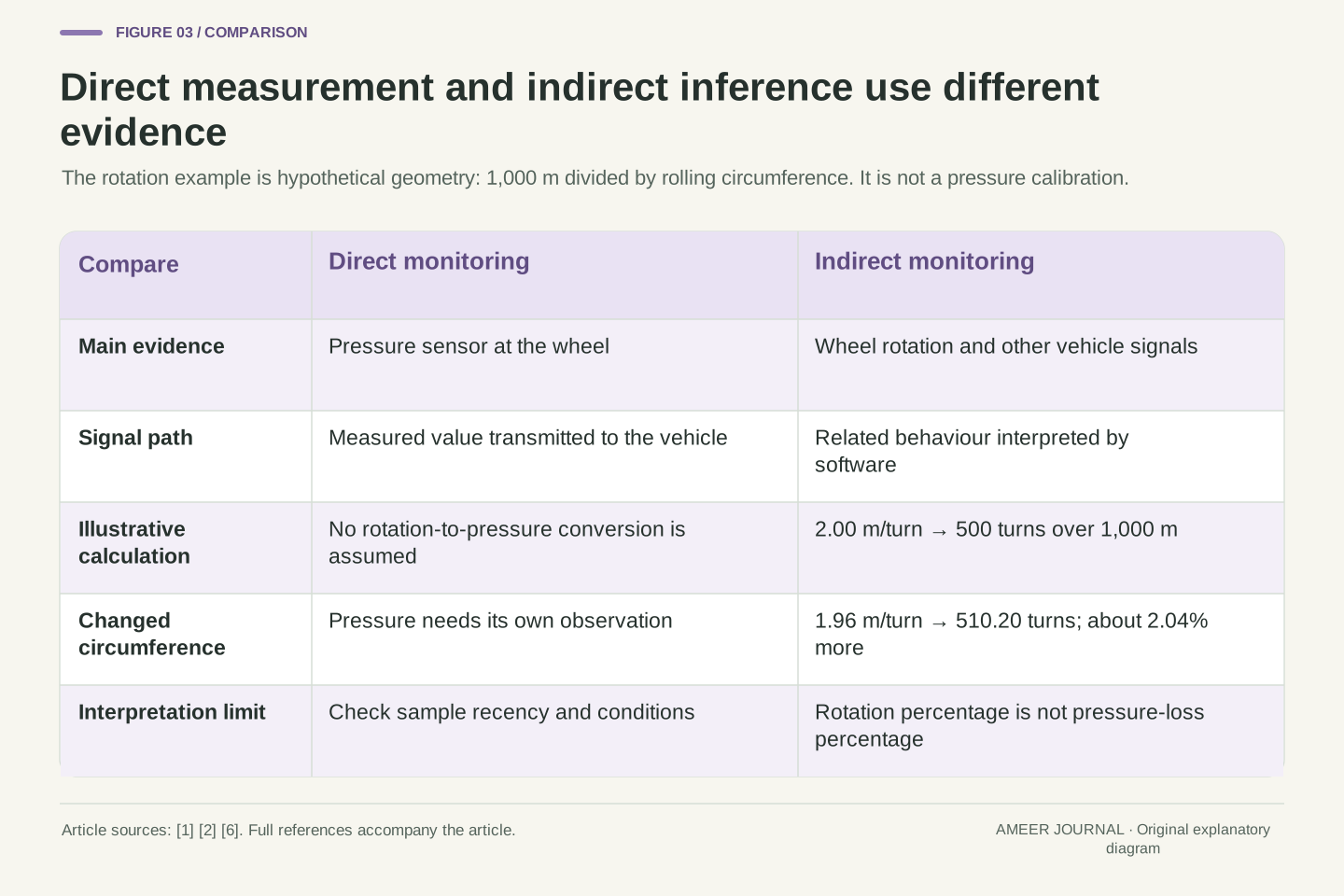
In a direct system, a sensor at the wheel measures pressure and sends information to the vehicle. HELLA's technical explanation describes wheel-mounted, battery-powered sensors measuring pressure and temperature and transmitting the data wirelessly. [6] Continental describes the next stages: a receiver obtains the coded signal, and software processes it for the dashboard. [2] The displayed result therefore depends on a chain that includes the pressure sensor, communication and interpretation.
This helps separate two kinds of question. 'What pressure did the sensor measure?' concerns the tyre at a particular time. 'Has the vehicle received a usable update?' concerns the monitoring chain. A system can report a pressure warning, a monitoring fault or a temporarily unavailable value, according to its design. Some dashboards provide individual tyre numbers; other interfaces provide less detail. Even a numerical display should be read with its units and update conditions. Continental describes systems that vary their measurement and transmission behaviour between moving and stationary operation. [2] A screen value should not automatically be assumed to be a fresh reading from that exact instant.
Direct TPMS uses wheel-mounted pressure transducers rather than inferring pressure solely from vehicle motion. HELLA describes an implementation with pressure/temperature sensing, battery power and wireless transmission to the control or display system. [6] Continental separately describes coded radio data, a receiver and software processing before dashboard presentation. [2] These are distinct stages in the information path, each relevant when interpreting what a displayed value means.
The physical measurand, transmitted sample and displayed state should therefore be distinguished. A direct sensor can provide a pressure observation without making every displayed state continuously current or eliminating communication faults. Continental's explanation includes different sampling/transmission behaviour while moving and stationary. [2] The exact scheduling, filtering, location identification and fault indication belong to the installed system. For a useful comparison with an external gauge, establish whether both readings refer to the same tyre, comparable thermal conditions and a sufficiently recent sample. Merely having a digital number does not establish that these conditions already match.
Indirect monitoring interprets how the wheels behave
An indirect system uses wheel-speed information and other vehicle signals to infer a pressure-related change. NHTSA distinguishes that approach from sensors measuring pressure inside the tyres. [1] HELLA explains a basic mechanism: a change in rolling circumference changes how many turns a wheel makes over a given distance. [6] Pressure can affect the tyre's rolling behaviour, giving the software something to detect without a pressure transducer in that wheel.
For a geometric example, imagine one wheel covering exactly 2.00 metres per turn and another covering 1.96 metres. Over 1,000 metres, the first makes 500 turns and the second about 510.20. The second turn count is roughly 2.04 percent higher. This illustrates why wheel rotation can carry information, but it supplies no conversion from that percentage to a pressure deficit. A tyre's construction, load and operating conditions belong to the real relationship. Nor does this little two-wheel comparison describe every indirect algorithm. The distinction to keep is direct pressure measurement versus inference from related behaviour; the system's documentation explains which evidence it actually uses.
Indirect TPMS derives a pressure-related state from wheel rotational characteristics and other available vehicle signals. NHTSA identifies wheel-speed and vehicle sensors as its information source. [1] HELLA's basic circumference explanation shows how an altered rolling distance per revolution changes wheel-speed relationships. [6] The measured signal is rotational behaviour; pressure is inferred through an algorithm and its reference conditions.
Use an elementary no-slip example over distance s=1,000 m. With effective rolling circumferences C1=2.00 m and C2=1.96 m, the rotation counts are N1=s/C1=500 and N2=s/C2=510.2041. The relative increase is N2/N1−1=2.0408%. These are assumed geometric values, not an empirical pressure-versus-circumference curve. Converting the result into a pressure estimate requires a tyre and operating model; equating a 2.04% rotation difference with a 2.04% pressure loss would be unjustified. Modern implementations need their own documented scope, so the example also does not prove a universal inability to detect several tyres losing pressure together.
Cold pressure is a measurement condition
Find the recommended pressure on the vehicle's tyre information label or in its manual. NHTSA explicitly distinguishes that recommendation from a number printed on the tyre sidewall. [1] The label can specify different front and rear pressures, so making every reading identical is not always the goal. The relevant tyre position and the vehicle's instructions matter more than choosing a familiar pressure used on a different car.
Cold describes the tyre's condition before heat from driving affects the comparison. NHTSA's consumer guidance uses at least three hours without driving and recommends checking all tyres, including a spare, at least monthly. [1] Cold does not mean only winter weather: a tyre rested on a warm day can still be cold for this purpose. A reading after driving may be higher because the enclosed gas is warmer. That higher pressure can be physically real. The difficulty is comparing it directly with a cold-pressure reference, not assuming the gauge has become inaccurate whenever a tyre warms.
The vehicle's specified cold inflation pressure defines the appropriate maintenance reference. NHTSA directs drivers to the tyre information label or owner's manual rather than the sidewall value, and acknowledges that front and rear requirements can differ. [1] Thus the reference is associated with an axle/tyre configuration and relevant operating instructions. A pressure measurement without that reference cannot establish correct inflation.
Thermal state is part of the measurement conditions. NHTSA defines cold for its routine-check guidance as a vehicle that has not been driven for at least three hours, with checks at least monthly including the spare. [1] This condition seeks a meaningful comparison before driving heat elevates the reading; it is not a particular outdoor season. A warm reading is not necessarily a falsely measured pressure. It may accurately describe a different thermodynamic state. Keeping measurement accuracy separate from comparability prevents a correct warm observation from being mistaken for evidence that the cold reference itself should be changed.
A cooling example needs absolute pressure and kelvin
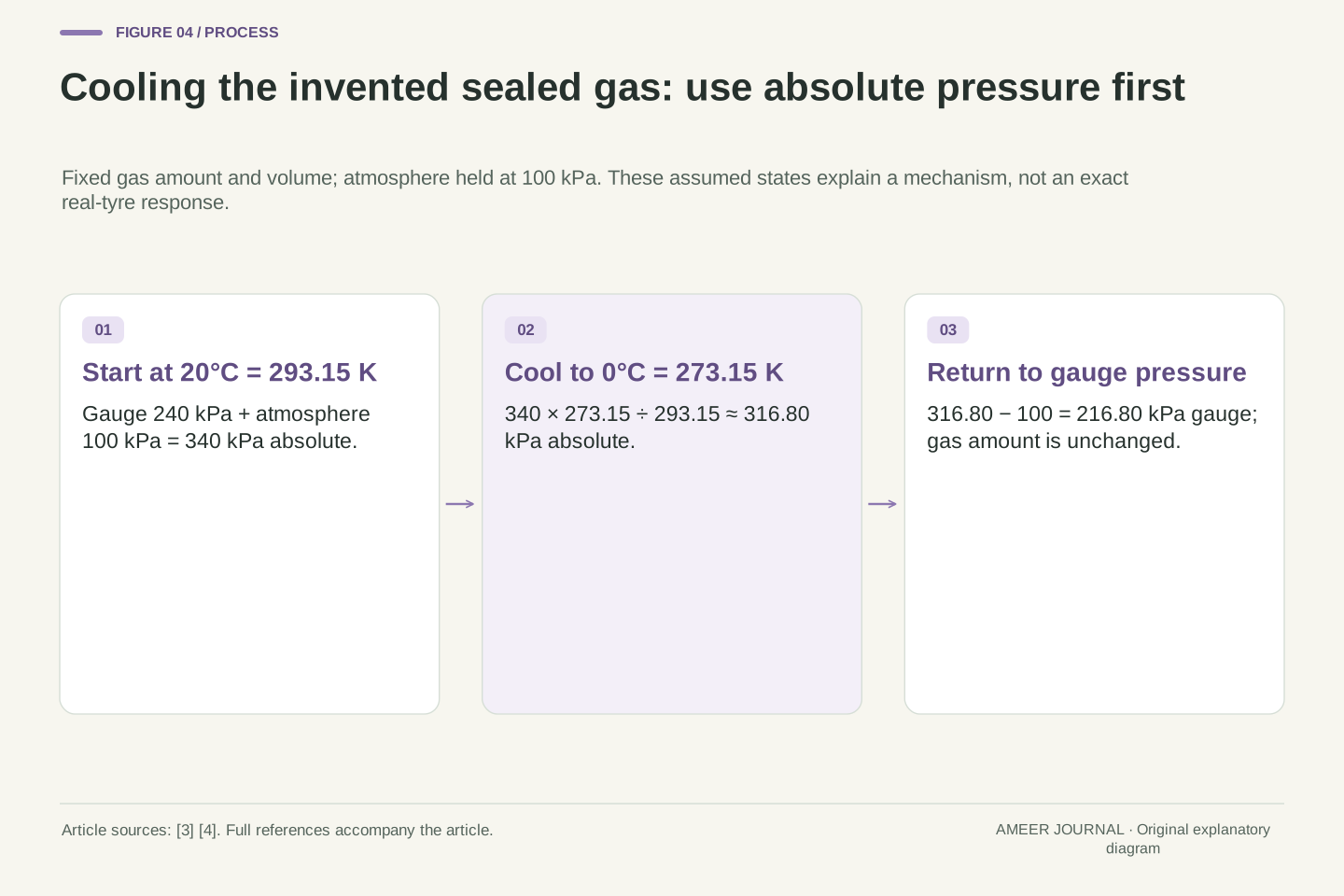
Pressure depends on the gas's temperature as well as how much gas is present and its volume. NASA's ideal-gas equation connects those quantities. [3] For an invented sealed, fixed-volume example, suppose a gauge reads 240 kPa when the gas is at 20°C. Assume the surrounding air pressure stays 100 kPa. The gas's absolute pressure is 340 kPa: the gauge reading plus its atmospheric reference. Penn State's pressure explanation makes this distinction explicitly. [4]
Cool the same gas to 0°C without letting any escape. The temperature ratio must use kelvin:273.15 divided by 293.15. Multiplying 340 kPa by that ratio gives about 316.80 kPa absolute. Subtract the unchanged 100 kPa atmosphere and the gauge reads about 216.80 kPa. The gauge pressure has fallen by 23.20 kPa even though the gas amount is unchanged. Scaling the original 240 kPa directly by the temperature ratio would instead give 223.63 kPa, which uses the wrong pressure reference.
A real tyre can change volume and have uneven temperatures, so this model explains a mechanism rather than predicting an exact tyre reading. It also explains why a pressure change alone cannot identify a leak. The result depends on several variables. Using 0°C directly in a temperature ratio would be another error:0°C is 273.15 K, not zero thermodynamic temperature. NASA specifically requires an absolute temperature scale in the gas equation. [3]
For an ideal gas, PabsV=nRT. [3] At constant gas amount n and volume V, Pabs,2/Pabs,1=T2/T1. Gauge pressure is Pg=Pabs−Pamb, with the local atmospheric pressure as reference. [4] Therefore, when Pamb is also held constant, the correct gauge conversion is Pg,2=(Pg,1+Pamb)(T2/T1)−Pamb. The atmospheric term cannot be omitted merely because the instrument displays gauge units.
Choose hypothetical Pg,1=240 kPa, Pamb=100 kPa, T1=293.15 K and T2=273.15 K. Then Pabs,1=340 kPa, Pabs,2=316.803684 kPa and Pg,2=216.803684 kPa. Gauge pressure drops 23.196316 kPa, approximately 9.665% of its initial 240 kPa, while the absolute-pressure ratio is 0.93177554. The different percentage is a consequence of subtracting a fixed atmospheric reference. Incorrectly scaling the gauge reading directly gives 223.626130 kPa.
These quantities describe uniform ideal-gas states in a sealed fixed volume. Real tyre interpretation additionally depends on thermal distribution, volume, loading and any gas loss; a single pressure difference does not isolate those causes. Celsius ratios are invalid here because the thermodynamic zero is different. [3] The model establishes the narrower physical point: cooling can reduce pressure without leakage, and correctly labelled pressure and temperature references are necessary even for that simple calculation.
Warming can change the indication without replacing lost air
Return to the warning that disappeared. NHTSA explains that a marginal cold pressure can move back above the warning threshold as the tyre warms during operation or as outside temperature rises. [1] The change can be real and still leave the cold-pressure question unresolved. A lamp is responding to its conditions; it is not certifying that the tyre will meet the recommended value after it cools again.
There are two useful distinctions. First, warming an unchanged amount of gas can raise pressure; it does not add gas. Second, a tyre may also be leaking, so a temperature explanation does not rule out another problem. Compare readings taken under similar cold conditions, and have a tyre that repeatedly fails to maintain its proper pressure assessed. NHTSA recommends professional attention when pressure cannot be maintained. [1] Michelin also advises using cold checks instead of releasing air in response to a hot reading. [5] Trying to make a warm number match a cold target can create a lower pressure once the tyre cools.
The ideal-gas relationship gives a reversible temperature contribution to pressure when gas amount and volume remain fixed. An indicator crossing caused by warming therefore need not imply a measurement fault. NHTSA describes exactly this class of intermittent cold-morning warning and still recommends checking tyre condition and pressure. [1] Threshold recovery and recovery to the specified cold reference are different events.
At the same time, assigning the entire change to temperature without evidence would be an identification error. Gas loss, changing volume and temperature can all contribute to the pressure observations. Repeated measurements under comparable cold conditions reduce one source of ambiguity, while professional inspection is appropriate when correct pressure cannot be maintained. [1] A hot gauge reading should not be reduced to the cold target merely to make the displayed number agree; Michelin warns against that response to summer or driving heat. [5] The practical objective is correct inflation under the specified reference conditions, rather than forcing a dashboard state to look reassuring.
A monitoring fault asks a different question from low pressure
A low-pressure warning concerns a tyre condition detected by the system. A malfunction indication concerns the system's ability to monitor as intended. NHTSA describes a US-system pattern in which the lamp flashes for 60 to 90 seconds and then remains on; this may indicate a TPMS fault. [1] Check the particular vehicle's manual for its lamp patterns and messages rather than assuming every icon behaves identically.
A monitoring fault is not proof that the tyres are correctly inflated. The two problems can exist together: a tyre may need attention while the system also lacks a usable signal. Equally, a steady warning alone does not identify a puncture, valve problem or failed sensor. Note the exact message and whether the lamp flashes or stays on, then provide that information with the pressure findings when seeking service. NHTSA recommends a system inspection for a malfunction indication. [1] Clearing the visible message without resolving its cause removes information rather than establishing a healthy tyre or a working monitor.
Pressure-state detection and monitoring-system diagnostics should be interpreted separately. NHTSA describes a 60–90-second flashing sequence followed by steady illumination as a possible malfunction indication for the US systems covered by its guidance. [1] The owner-facing message, lamp sequence and applicable manual determine the interpretation for the particular vehicle. This consumer explanation is not a universal fault-code decoder.
A malfunction indication means confidence in the monitoring function is limited; it does not establish a positive tyre condition. Conversely, a pressure warning does not uniquely identify the physical cause of underinflation. A useful service record therefore retains the indication pattern, actual pressure observations, their conditions and any recent tyre/wheel work. The sensor/communication chain described by Continental and HELLA explains why monitoring functionality is a distinct diagnostic question. [2][6] Both tyre condition and system function may require verification, and resetting the display alone verifies neither.
Make two pressure readings comparable before judging them
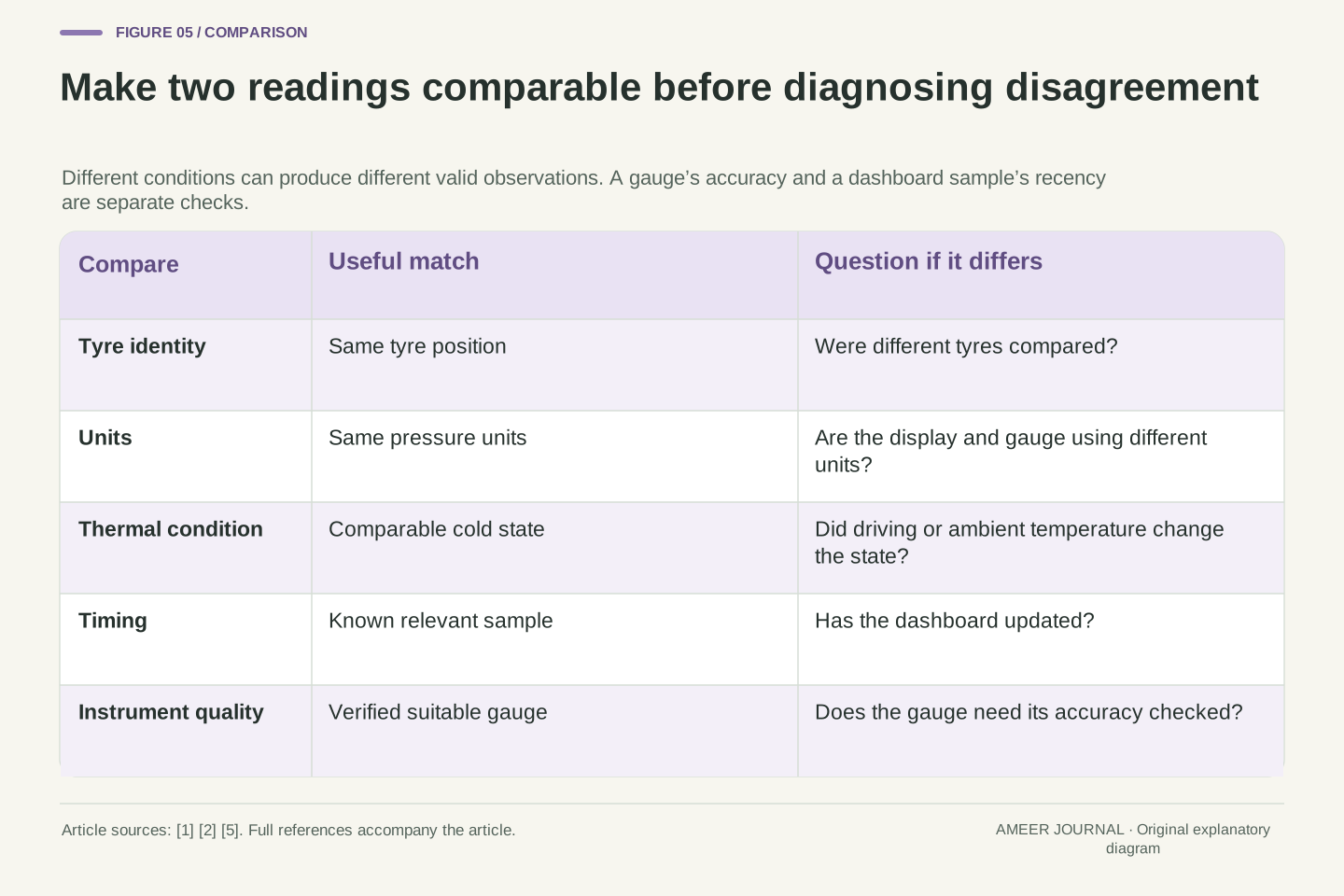
Suppose a dashboard number and a handheld gauge disagree. First compare the units and tyre positions. Then ask whether the dashboard value has updated and whether the tyre changed temperature between readings. Direct systems can have different transmission behaviour while parked and moving. [2] A recent warm dashboard value and a later cold gauge value may represent different physical states, even if both instruments worked correctly.
Instrument accuracy still matters. NHTSA recommends an accurate gauge, while Michelin suggests having a gauge's accuracy checked with a tyre professional. [1][5] That is a stronger basis than choosing whichever number is more convenient. Keep a brief record of the tyre position, value, units and whether it was checked before driving or after use. Compare those observations with the applicable vehicle target. The record cannot diagnose every cause, but it preserves the context needed to distinguish an inconsistent comparison from a recurring pressure problem or a monitoring fault.
A discrepancy should first be tested for compatible measurement definitions. Confirm tyre identity, displayed units, update recency and thermal conditions. A direct TPMS value can represent a transmitted sample rather than a simultaneous external-gauge measurement; Continental's discussion explicitly includes different stationary and moving update behaviour. [2] A comparison across changing physical conditions does not isolate instrument error.
Next consider the instruments. NHTSA calls for an accurate pressure gauge, and Michelin recommends checking gauge accuracy with a tyre professional. [1][5] The number of displayed digits alone does not establish accuracy. Preserve each observation's value, units, tyre position and condition rather than averaging incompatible readings into a supposedly better value. For example, averaging a warm measurement with a cold measurement does not create the cold pressure that the label requests. Comparable observations support a meaningful check against the target and provide better evidence for diagnosing an unresolved disagreement.
Calibration needs a sound physical reference
Some TPMS designs require learning, initialization or sensor coding after particular tyre or wheel work. HELLA describes these requirements as system dependent and notes that an indirect-system example must be initialized with the prescribed tyre pressures. [6] This explains why the order matters: first establish the correct physical condition, then follow the applicable manufacturer's learning procedure.
Pressing a calibration control does not put air into a tyre or repair a leak. It changes information used by the monitoring system. If a procedure teaches the system a reference, that reference needs to be appropriate. The same menu name can also conceal different tasks: recognizing sensors and accepting a pressure-related baseline are not necessarily identical operations. Use the vehicle-specific instructions and professional service when needed. HELLA's examples show why copying a reset sequence from another model is a poor substitute for identifying what your own system must learn. [6]
Learning and calibration concern the system's reference or identification state. HELLA describes direct-system recalibration or sensor coding that may be required after a tyre change, and an indirect worked example requiring initialization at the prescribed inflation pressure. [6] These examples support a conditional statement about system-specific procedures, not one universal algorithm for every TPMS.
The measurement reference must be valid before it can serve as a useful baseline. Teaching a system does not itself change gas amount, seal a leak or verify the tyre's structural condition. It may update a stored comparison value or sensor association, depending on the design. Consequently, the meaning of a reset must be established from the applicable instructions. A successful user-interface acknowledgement is evidence that a requested operation occurred; it is not independent evidence that the physical pressure was correct. This is why the documented sequence and prerequisites matter more than simply extinguishing the lamp.
Use the warning to start a check, then keep the conditions
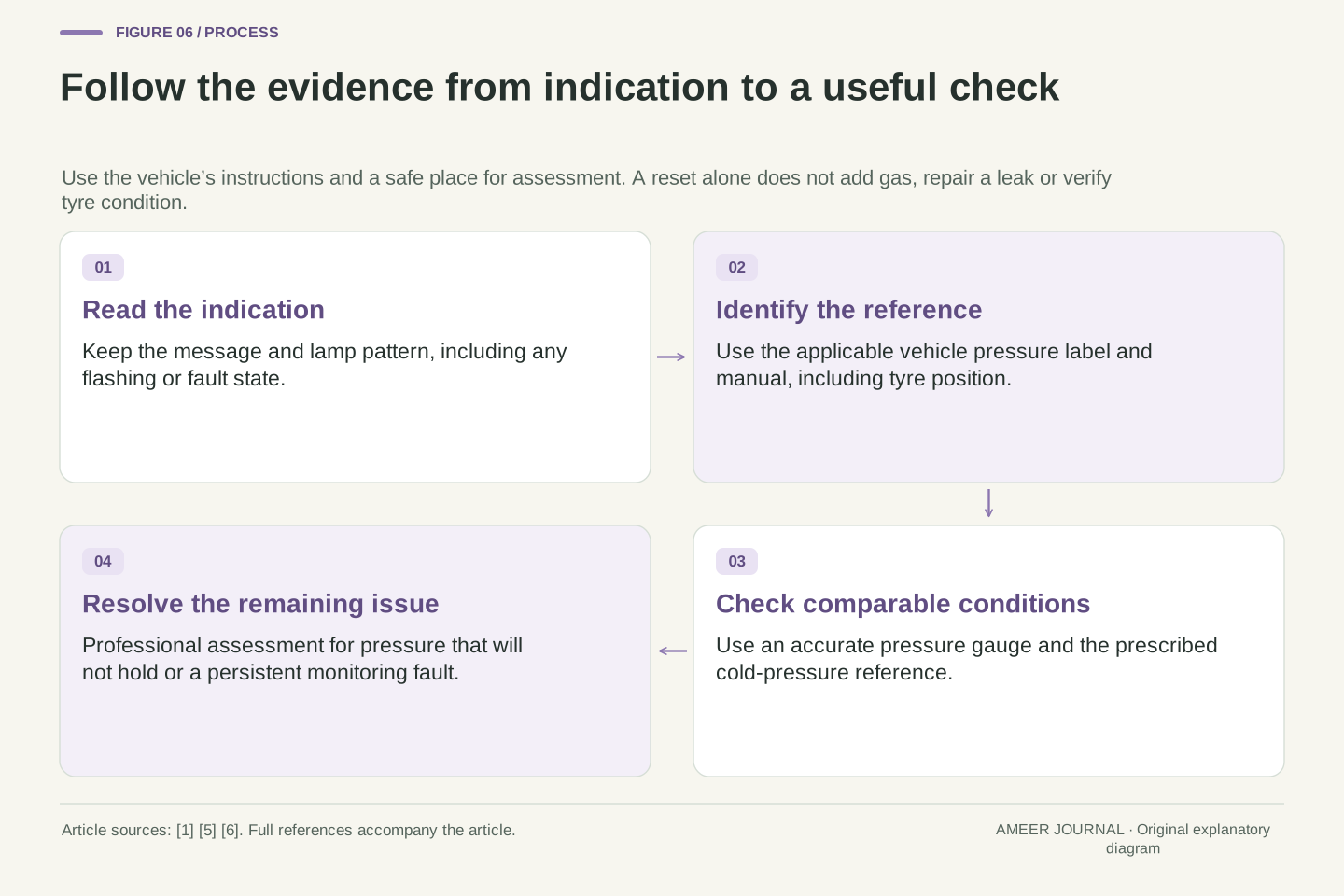
Read the lamp and message, find the relevant vehicle pressure recommendation, and obtain a pressure check under the specified conditions as soon as it is safe. Compare each tyre with its proper target, including any different front/rear requirements. If the pressure repeatedly falls or the monitoring fault remains, arrange a professional assessment. These steps follow NHTSA's maintenance and warning guidance without assuming that the lamp can diagnose the cause for you. [1]
The scientific pieces now fit the everyday problem. A direct monitor receives pressure observations; an indirect monitor infers a pressure-related state from other signals. Temperature can move a real pressure reading, and a warning condition can clear before the maintenance reference is satisfied. A clear lamp is useful information, but it is only one part of the record. Correctly identified targets, comparable cold measurements and a functioning monitoring system together provide a much stronger account of what is happening than the light's disappearance alone.
Interpret the observation, reference and indication together. Establish the system's signal type, the vehicle's prescribed cold reference, the measurement conditions and the meaning of any fault state. NHTSA's guidance connects these to regular pressure checks and timely investigation of warnings or a failure to retain pressure. [1] A service decision should use the combined evidence rather than elevating a binary dashboard output into a complete physical diagnosis.
The worked examples expose three different mechanisms. A threshold comparison can lose information about the remaining deficit. Rotation counts can change without supplying a unique pressure conversion. Temperature alters absolute pressure even at fixed gas amount, while gauge pressure requires its atmospheric reference. Those mechanisms explain why both an intermittent warning and a discrepancy between readings deserve context. A useful TPMS interpretation preserves that context and the manufacturer’s requirements, allowing the monitoring system to support maintenance without asking it to answer questions its displayed state cannot resolve.
Sources & further reading
Explore the references behind this guide. External pages may change after our review.
- Tire Safety Ratings and Awareness | TireWise | NHTSAU.S. National Highway Traffic Safety Administration · Accessed 6 Nov 2026
- Tire Pressure Monitoring System (TPMS) | Continental TiresContinental Tires · Accessed 6 Nov 2026
- Equation of StateNASA Glenn Research Center · Accessed 6 Nov 2026
- Introduction to Pressure in Fluid MechanicsPennsylvania State University — John M. Cimbala · Accessed 6 Nov 2026
- Learn Tire Care Tips You Need To Be Doing Regularly | MichelinMichelin · Accessed 6 Nov 2026
- TPMS – tyre pressure monitoring system | HELLAHELLA TechWorld · Accessed 6 Nov 2026
Article updated 6 Nov 2026.
Found something we should revisit?
Good explanations get better with thoughtful feedback.