What you’ll take away
- A positive battery charge or remaining-range estimate does not independently guarantee that the engine stays off.
- Charge depletion describes an overall battery-state trend; engine-off operation is a different observation.
- A charge-sustaining battery can still supply and receive energy while its overall state is maintained.
- Keep gasoline consumption and electricity inputs together, with their measurement boundaries and journey periods.
- Charging opportunities and operating conditions can change the source split without changing the car’s advertised battery size.
An engine start does not necessarily mean the battery is empty
You charge a plug-in hybrid, start a short journey and hear its engine before the displayed electric range reaches zero. That can feel as though the car has broken a promise. But a range estimate, a battery's remaining energy and an engine-start decision describe different things. The U.S. Department of Energy lists rapid acceleration and substantial heating or air-conditioning demand among conditions in which a plug-in hybrid's engine can operate. EPA also distinguishes vehicles that blend gasoline and electricity while battery charge remains [1][3]. Whether a particular start is expected depends on that vehicle's instructions and conditions.
The useful question is therefore more specific than whether the battery is charged: what is supplying the present demand, and what is happening to stored battery energy over the journey? This article separates those questions before interpreting the numbers on a label. Its numerical journeys and power balances are original, deliberately simplified examples, not measurements or ratings of a real car. We will use the U.S. EPA label for the label discussion; another market's terminology and test procedure need their own reference. The aim is to explain what each number can establish, so an engine sound and a range display are not asked to prove more than they can.
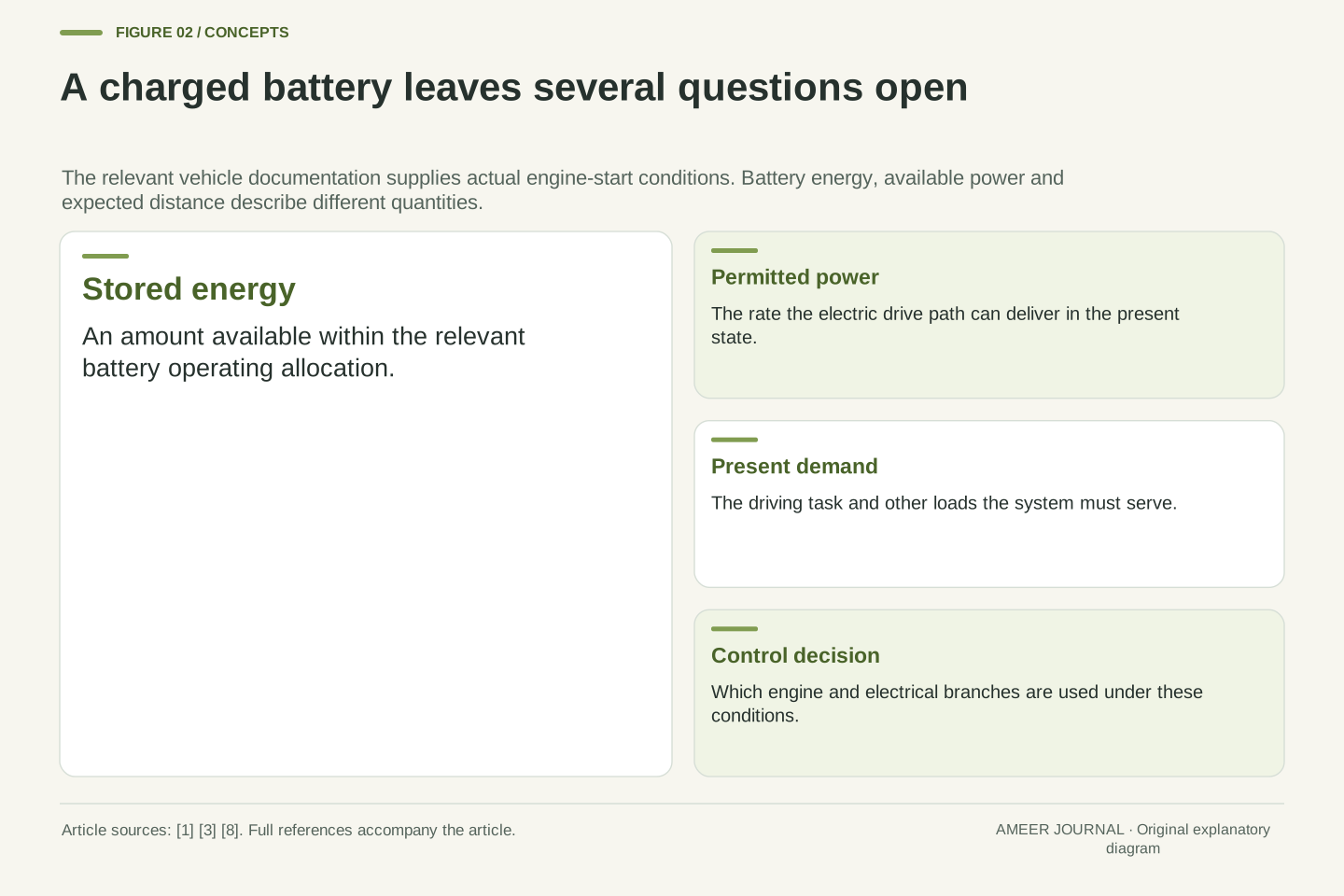
A plug-in hybrid's state cannot be represented by one remaining-range value. At least three quantities must be separated: available stored energy, instantaneous power allocation, and the distance estimate produced under specified assumptions. Engine operation can coexist with usable battery charge. DOE identifies acceleration and substantial thermal loads as possible engine-use conditions, while EPA explicitly describes blended PHEVs that consume gasoline and electricity before the battery's plug-in contribution is exhausted [1][3]. An actual vehicle's supervisory logic determines the permitted operating state.
The analysis below distinguishes an engine-off observation from a battery-energy trend, then connects both to consumption reporting. All numerical cases are constructed examples with stated boundaries; no vehicle testing, current model comparison or universal control threshold is implied. EPA terminology is used specifically for U.S. consumption labels. That scope matters because an electrical energy inventory does not determine every operating constraint, and a standardized range estimate does not reproduce every trip. A useful interpretation preserves which quantity was observed, how it was measured, and which control or test assumptions were supplied. It also leaves room for vehicle-specific faults or restrictions that cannot be diagnosed from an engine sound alone.
Follow the energy source as well as the part turning the wheels
A plug-in hybrid has an engine and an electric traction motor, with fuel and a traction battery supplying energy. The external charge connection adds energy to that battery. Regenerative braking can return some of the vehicle's motion energy, and an engine can also supply energy for charging [1][2]. Those routes are different. Seeing energy enter the battery does not, by itself, tell you whether it came from a plug, braking or burning fuel.
The mechanical arrangement also matters. In a parallel path, the engine and motor can both send mechanical power toward the wheels. In a pure series path, the engine drives a generator and the electric motor drives the wheels; some vehicles can change between arrangements [1]. Consequently, 'the motor is driving' does not always mean 'no gasoline is being used'. Electricity can be an intermediate form of energy made by the engine. For the same reason, an animated arrow from the battery is only part of the picture. To identify engine-off travel, you need the engine's operating state as well as evidence of electrical activity. To identify the original energy input, you need the complete path.
Separate energy origin, conversion path and final actuator. DOE's component description identifies the traction battery, motor-generator functions, onboard charger, combustion engine and power electronics controller [2]. External AC charging passes through conversion equipment before reaching the battery. Regeneration redirects mechanical energy into electrical storage. Engine-generated electricity originates in fuel conversion rather than an external electricity purchase. A battery charging event is therefore insufficient to identify its upstream energy source.
For an idealized parallel architecture, engine and electric-machine mechanical outputs can contribute to the drivetrain. For a pure series architecture, engine mechanical output drives generation and traction remains electric; multimode arrangements can add a mechanical engine path in another operating state [1]. These are distinct paths, not a claim that every series vehicle changes into parallel operation. The observable 'traction motor active' is compatible with battery-only propulsion and with engine-generated electrical supply. It cannot independently classify the journey as all-electric. Likewise, an instantaneous battery-discharge arrow does not rule out simultaneous fuel use. A correct system description identifies which branches are active, then keeps the energy accounting boundary consistent when comparing their contributions.
Engine state and battery trend answer different questions
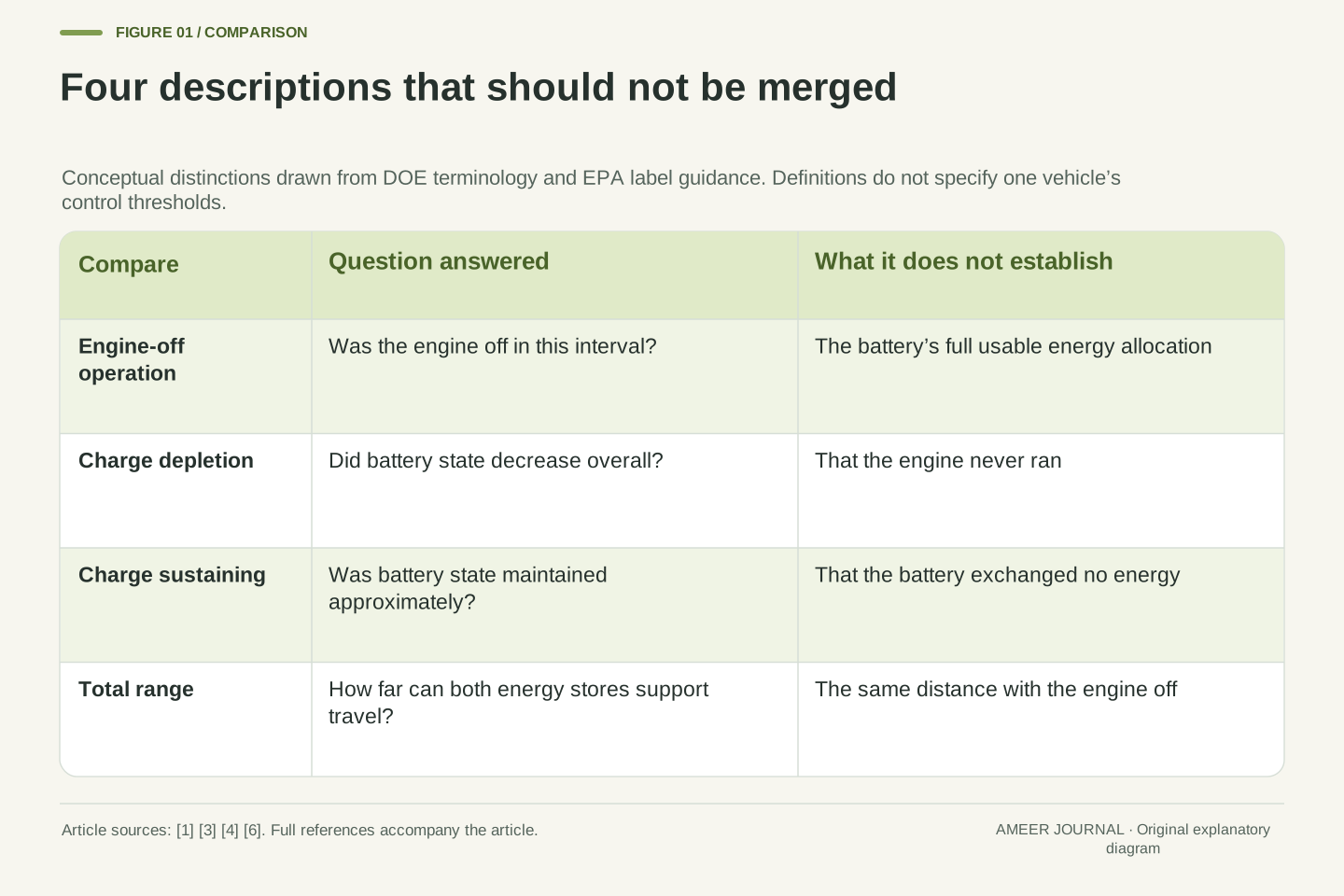
Two technical phrases help here. Charge-depleting operation means that the battery's state of charge decreases overall. Charge-sustaining operation keeps it approximately steady over the relevant interval. Those phrases describe a trend, not a promise about every moment. DOE's historical draft development definitions distinguish both strategies from electric mode, which has the engine off, and from hybrid mode, which allows different combinations of engine and electric drive [6]. The definitions are useful vocabulary, not a current vehicle's control specification.
Imagine four battery readings in order: 70%, 63%, 65%, 56%. The small rise does not erase the overall fall; energy recovery can interrupt depletion. Now imagine 25%, 24%, 26%, 25%. The matching start and finish do not mean the battery did nothing between them. These invented readings illustrate the difference between a trend and a flat line. A charge-sustaining battery can supply and receive energy as an active buffer [7]. Conversely, charge depletion can occur while the engine helps. Calling every charge-depleting kilometre an engine-off kilometre would merge two different observations. Ask both questions: was the engine operating, and did the battery's stored state decrease overall?
DOE's 2007 draft non-regulatory terminology separates operation mode from control strategy: engine-off electric operation differs from hybrid operation, while charge-depleting and charge-sustaining strategies describe net-decreasing and relatively constant battery SOC respectively [6]. These definitions do not require monotonically decreasing SOC in the first case or an invariant instantaneous SOC in the second. Their purpose here is conceptual classification, not replication of a current certification rule.
Consider constructed SOC samples 70,63,65,56 percent. The final-minus-initial change is −14 percentage points despite an intermediate recovery. A second sequence, 25,24,26,25 percent, has zero net change but nonzero excursions. Neither sequence reveals all intervening power flows or the engine state. MathWorks' documented charge-sustaining hybrid controller explicitly treats the battery as an energy buffer and regulates SOC rather than preventing battery use [7]. Its separate power-split reference model demonstrates engine/motor blending and charge-support control [8]. These are mechanism examples, not evidence that a particular PHEV implements those algorithms. The core distinction remains valid: battery-state evolution and engine operation are separate variables, and net depletion alone does not establish engine-off driving.
Remaining energy does not settle the power demand right now
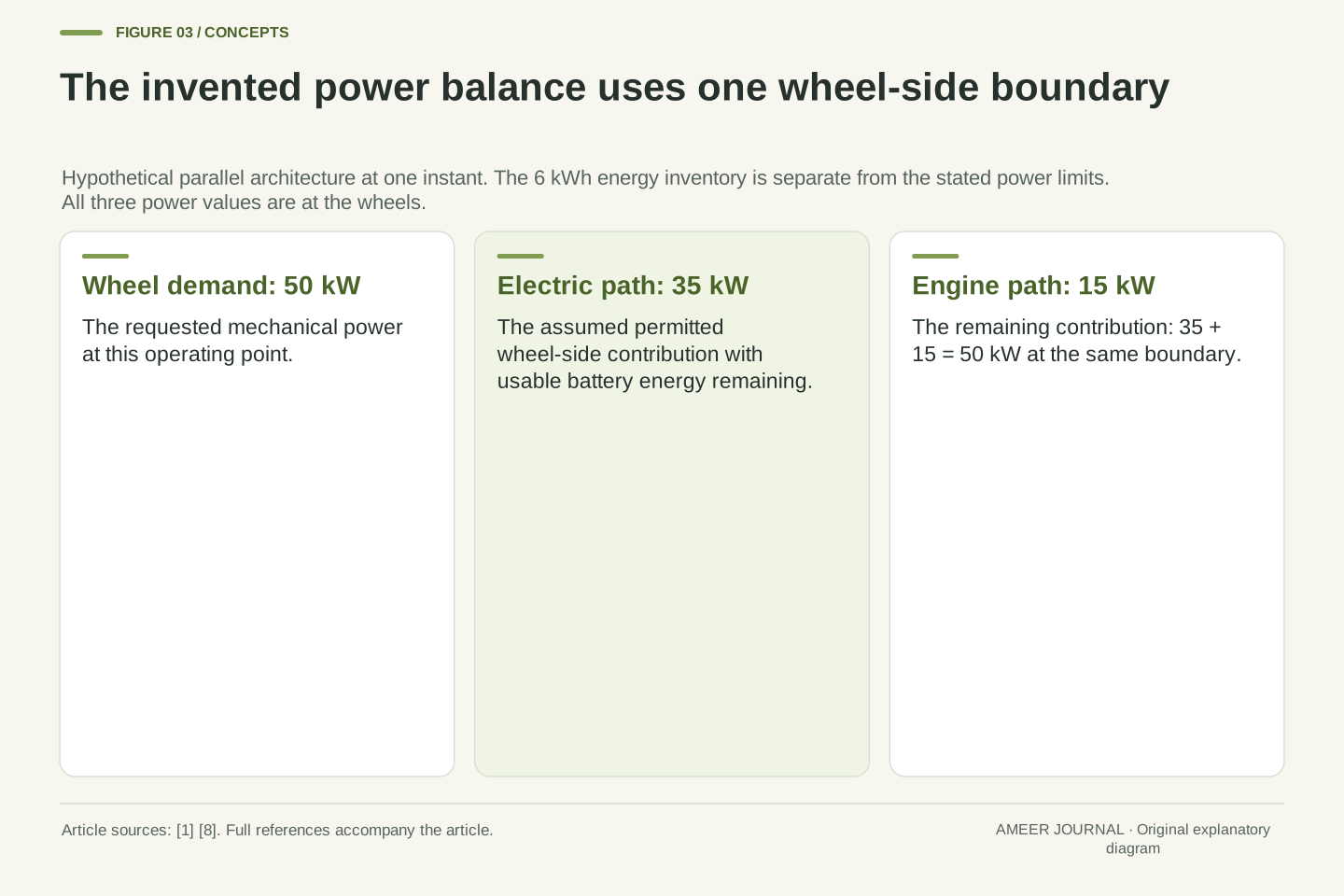
Suppose a fictional parallel hybrid still has 6 kWh of usable battery energy. At one instant, its operating limits allow the electric drive path to deliver 35 kW at the wheels, while the requested wheel power is 50 kW. If the engine path supplies the remaining 15 kW at that same wheel boundary, the total is 35+15=50 kW. The battery can still contain substantial energy while the engine contributes. We have specified the electric-path limit separately; it cannot be calculated just from the 6 kWh inventory.
The distinction is between an amount and a rate. Kilowatt-hours describe energy, while kilowatts describe how quickly energy is transferred. A controller also considers operating conditions and available components. DOE's acceleration and thermal-load examples explain why the simple instruction 'use electricity until it is gone' is incomplete [1]. MathWorks' reference controller likewise uses demand, vehicle state and battery power limits to choose its operating mode [8]. For a real car, the relevant handbook may describe several engine-start conditions. Reading those conditions is more informative than assuming that any positive battery percentage guarantees enough permitted electric power for the present request.
Use an instantaneous wheel-side power balance for an invented parallel architecture: demanded mechanical power is 50 kW, the permitted electric-drive contribution is 35 kW, and the engine drivetrain supplies 15 kW. All three values refer to the same wheel boundary, so their sum is meaningful. They are not battery-terminal electrical power and engine crankshaft power mixed without conversion losses. The assumed 6 kWh remaining battery energy is an inventory, not an independent specification of allowable wheel power.
Energy capacity and instantaneous capability constrain different aspects of operation. The allowable electrical contribution depends on the battery, machine, conversion path and control state; the requested contribution depends on the driving task and other loads. MathWorks' power-split reference application explicitly includes SOC-dependent battery power limits and mode decisions using requested wheel power, vehicle speed and other inputs [8]. DOE separately notes engine use for acceleration and substantial heating or cooling demand in PHEVs [1]. These sources support the distinction without defining one universal threshold. The constructed balance explains a possible coexistence of positive remaining energy and engine output; it does not prescribe how any production controller must allocate that demand.
The end of plug-in depletion is not an empty, inactive battery
The word 'depleted' is easy to read too literally. In a plug-in hybrid discussion, it can mean that the vehicle has reached the end of the battery drawdown allocated to its charge-depleting strategy. The vehicle can then use charge-sustaining hybrid operation [6]. That does not mean the traction battery has vanished from the system, has no stored energy, or can no longer exchange energy with the motor. The system is pursuing a different energy-management objective.
Think again about the invented 25%, 24%, 26%, 25% sequence. The lower reading could accompany battery assistance; a later rise could follow charging. The example leaves the actual cause of each change unspecified because SOC readings alone cannot identify it. The useful observation is that the overall state has been maintained while the battery remained active. A documented charge-sustaining controller uses the battery as a buffer and adjusts engine/motor allocation toward an SOC objective [7]. A dashboard's remaining electric-range display can use its own presentation rules. Its zero point should not be treated as a measurement that every cell contains zero energy, nor should it be used to infer a universal reserve percentage.
A strategy transition is an operational boundary, not a statement of electrochemical emptiness. DOE distinguishes the distance travelled under charge depletion from the subsequent charge-sustaining strategy [6]. In the latter, SOC is maintained approximately rather than continuously drawn down to support additional plug-in travel. The traction battery can still participate in propulsion assistance and energy recovery. A zero displayed electric range consequently does not establish zero physical battery energy.
The controller may use charging and discharging excursions around a target region, as illustrated by MathWorks' charge-sustaining energy-buffer description [7]. Endpoint balance is not the same as absence of power throughput: positive and negative transfers can partly offset over an interval. Even equal SOC endpoints should not be turned into a precise energy-throughput calculation without the battery-state relationship and measurements. A display may express an operating allocation or prediction rather than raw electrochemical SOC. This article therefore uses the two conceptual strategies without assigning a reserve size, a dashboard calibration or a lower-cell-voltage threshold. The practical interpretation is narrower and stronger: finishing the plug-in drawdown does not make a PHEV cease to be a hybrid.
Keep two energy entries for a journey that uses both sources
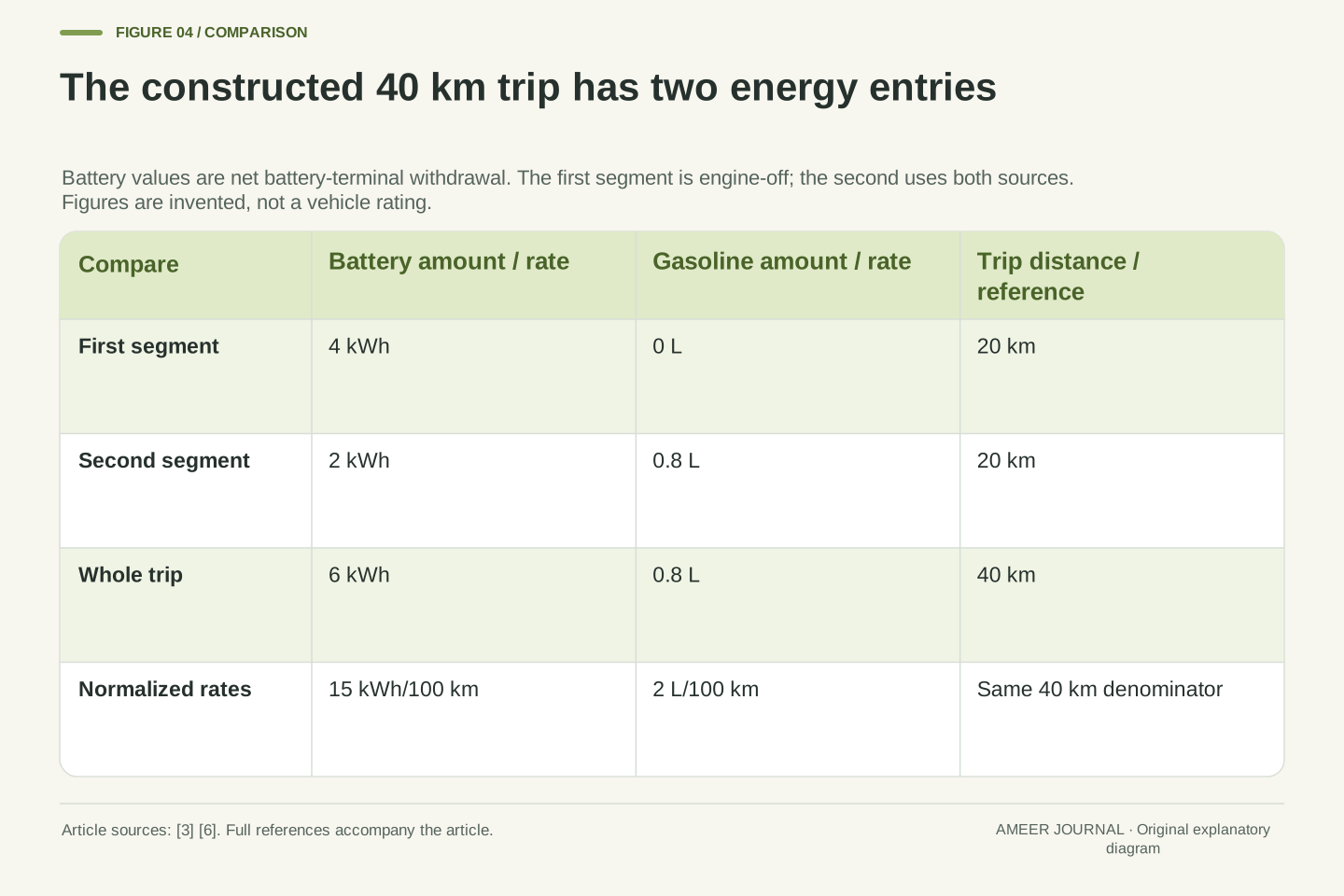
Consider an invented 40 km journey. During the first 20 km, the engine stays off and the battery supplies 4 kWh net. During the next 20 km, the battery supplies another 2 kWh net while the engine consumes 0.8 litres of gasoline. Assume SOC decreases overall through both portions and that these battery figures are net energy removed at the battery boundary. The journey uses 6 kWh of battery energy and 0.8 litres of gasoline. Only its first 20 km are specified as engine-off travel.
Normalize each input separately. Battery energy is 6÷40×100=15 kWh per 100 km; gasoline is 0.8÷40×100=2 litres per 100 km. Neither entry includes the other. Reporting only the gasoline figure would hide the battery contribution, while calling the whole 40 km 'all-electric' would hide the engine contribution. DOE's definitions and EPA's blended-operation description explain why both omissions matter [3][6]. Our energy boundary also matters: 6 kWh removed from the battery is not automatically the electricity later purchased at the charging outlet. Keeping the two entries is more informative than compressing a mixed trip into a single impressive number without its assumptions.
Define a constructed 40 km trip with two 20 km segments. Segment one has net battery-terminal withdrawal 4 kWh and zero fuel use, with the engine off. Segment two has net withdrawal 2 kWh and gasoline use 0.8 L. Assume the battery SOC declines overall in both segments. Total net electrical withdrawal is 6 kWh, and total liquid consumption is 0.8 L. Under those assumptions, the entire interval is charge-depleting while only the first segment is specified as engine-off operation [3][6].
The separate distance-normalized quantities are 15 kWh/100 km and 2 L/100 km. These have different dimensions and should remain separate until an explicitly stated conversion or objective requires otherwise. The gasoline-only distance-to-volume ratio would be 40/0.8=50 km/L, but presenting it without the 6 kWh input would not describe total energy use. Nor does the 6 kWh net battery withdrawal specify AC replenishment energy, conversion losses, or instantaneous battery throughput. This ledger deliberately records a boundary and a period for each value. It illustrates why blended travel can extend the distance over which external battery energy contributes without extending engine-off travel by the same amount.
Read the mode and unit beside each label number
The EPA plug-in hybrid label explains electricity and gasoline consumption separately, and distinguishes all-electric range from total range using a charged battery and fuel [4]. Start with those descriptions before comparing the large numbers. A gasoline MPG figure and an electric MPGe figure do not mean the same physical input. Nor does total range say how far the engine remains off. When a reported operating condition uses both electricity and fuel, both inputs belong in your comparison.
MPGe puts different energy inputs on a common energy-equivalent scale. EPA uses 33.7 kWh as the energy equivalent of one U.S. gallon of gasoline [5]. For an invented electricity-only consumption rate of 30 kWh per 100 miles, the vehicle travels 100÷30 miles per kWh. Multiplying by 33.7 gives about 112.3 MPGe. No gallon was actually burned in that electric interval. The calculation also says nothing about how many miles the battery can support before the operating state changes. A consumption rate answers how much energy a distance uses; a range estimate also needs an available energy allocation and applicable driving conditions. Keep those questions separate when reading the same label.
Interpret a label field as a value plus a unit, operating condition and measurement boundary. EPA's PHEV label description separates electrical consumption in kWh/100 miles from gasoline consumption in gallons/100 miles, and distinguishes all-electric distance from total driving range [4]. An electric MPGe value should not be averaged arithmetically with a gasoline MPG value to invent an overall trip result. The actual distances, input quantities and applicable modes are needed first.
For electricity-only operation with assumed consumption c=30 kWh/100 mi, the EPA energy-equivalent conversion gives MPGe=33.7/(30/100)=112.333. The 33.7 kWh/gallon-equivalent convention normalizes energy content; it is not a statement that one physical gallon powered the electric interval [5]. It also does not measure upstream emissions, tariff cost or battery capacity. Gasoline MPG retains actual fuel-volume meaning for its stated operating condition. If a calculation combines inputs, its energy-equivalence treatment and period must be explicit. A high MPGe value can coexist with a short electric range because consumption intensity and available stored energy are different inputs to a distance calculation. The correct comparison preserves both, rather than choosing whichever number looks most impressive.
Charging electricity and battery withdrawal use different boundaries
EPA says its MPGe values include charging losses, with the measurement moved toward the electricity taken from the outlet [5]. That matters when you try to calculate range from a battery capacity. A battery-energy figure and an outlet-based consumption figure cannot be combined as though they describe the same point in the energy path. DOE's component diagram places an onboard charger between incoming AC electricity and stored battery energy [2].
Imagine a separate engine-off 40-mile example. It removes 10 kWh net from the battery, and restoring the same starting state under the stated conditions takes 12 kWh at the outlet. Battery withdrawal is 25 kWh per 100 miles; outlet replenishment is 30 kWh per 100 miles. Both describe the same assumed distance, but different energy boundaries. Dividing the 10 kWh battery withdrawal by the outlet rate of 0.30 kWh per mile gives 33.3 miles, which is wrong for this example. The matching battery rate is 0.25 kWh per mile, giving 40 miles. The extra outlet energy has to be accounted for in the charging process, rather than being silently treated as extra battery energy available for driving.
EPA specifies that MPGe includes AC charging losses associated with equipment and onboard conversion, shifting the accounting boundary from stored battery energy toward wall electricity [5]. DOE separately identifies the onboard AC-to-DC charger and its battery-monitoring role [2]. The distinction prevents a common dimensional-looking error: both quantities may use kWh, yet refer to different physical boundaries. Unit agreement alone is insufficient for an energy-balance calculation.
For the constructed 40 mi engine-off interval, take net battery withdrawal as 10 kWh and subsequent AC replenishment to the matched initial state as 12 kWh. The respective normalized rates are 0.25 and 0.30 kWh/mi. Thus 10/0.25=40 mi, whereas 10/0.30=33.333 mi mixes a battery numerator with an AC denominator. The difference, 2 kWh, represents charging-related energy outside the restored battery allocation in this defined example; it is not additional propulsion energy. The assumed replenishment ratio is 10/12=83.333%, not a vehicle-independent efficiency. Consistent endpoints and boundaries make the illustration work. Without them, even precisely recorded electricity and battery numbers can describe different periods or state changes.
The distance between charges can change the fuel split
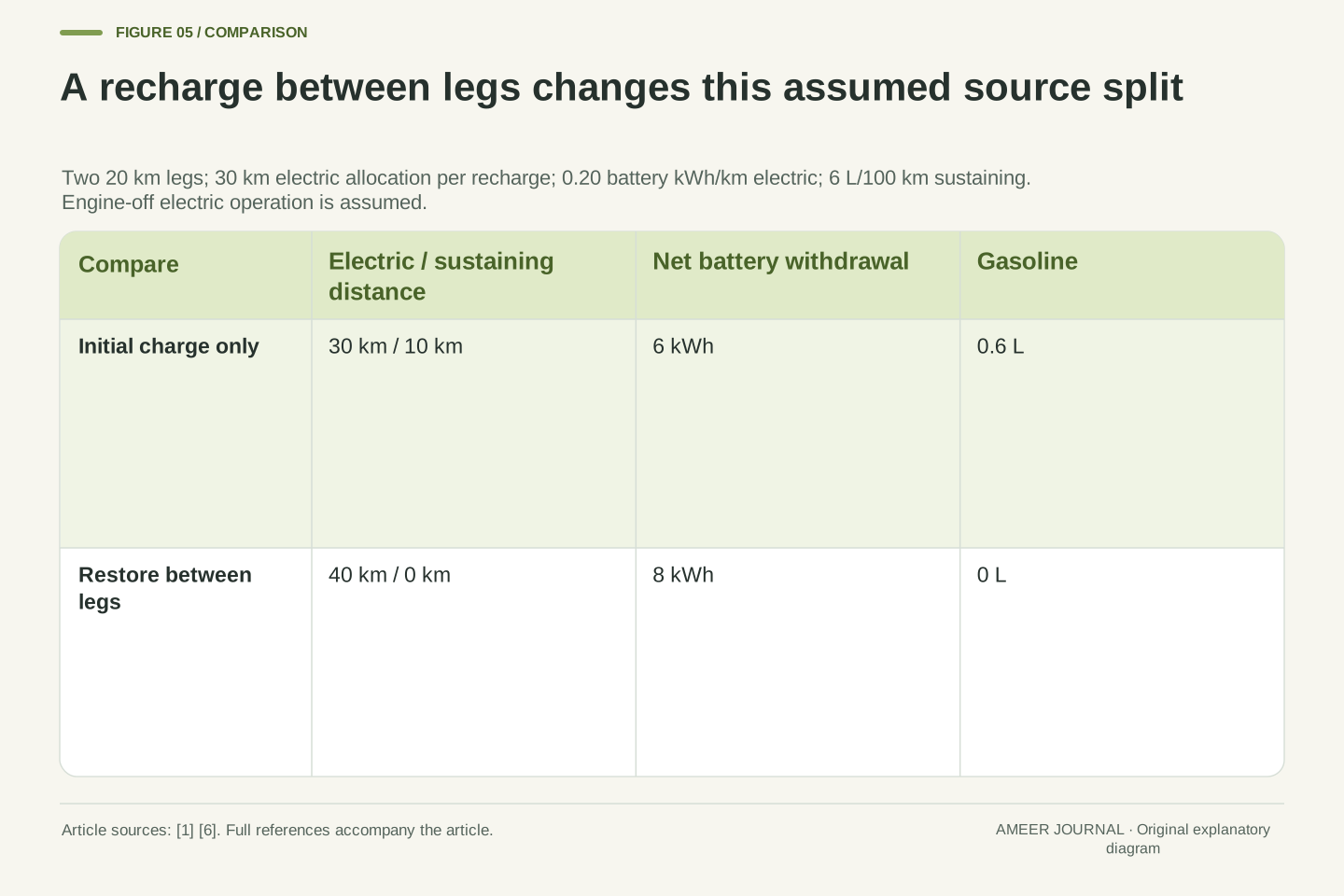
Now change the journey schedule rather than the car. Our next simplified case has two 20 km trips, 30 km of engine-off travel available after each full recharge, battery withdrawal of 0.20 kWh per electric kilometre, and gasoline consumption of 6 litres per 100 km after that allocation is used. Assume the electric portion stays engine-off and the later hybrid portion holds battery energy steady overall. One starting charge supports 30 electric kilometres, leaving 10 km of gasoline-sustained travel: 6 kWh net battery withdrawal and 0.6 litres of gasoline.
If a suitable recharge restores the starting allocation between the two trips, each 20 km leg fits within the 30 km allowance. The day then uses 8 kWh net battery energy and no gasoline under these assumptions. Distance is still 40 km; the difference is access to additional external energy between legs. These are not universal savings figures. They show why DOE relates PHEV fuel consumption to distance between charges [1]. The relevant question is whether the actual charging opportunity restores enough energy in time. Counting parking stops or plug connections alone does not establish how much energy was transferred.
Specify a second toy schedule: two 20 km legs; usable engine-off allocation 30 km after each full replenishment; electric battery rate 0.20 kWh/km; charge-sustaining fuel rate 6 L/100 km with zero net battery-energy change over its segment. Under the expressly engine-off electric assumption, one initial allocation produces 30 electric kilometres and 10 charge-sustaining kilometres. Battery withdrawal is 30×0.20=6 kWh; fuel is 10×6/100=0.6 L.
Restoring the initial allocation between legs changes the partition to 20+20 electric kilometres, giving 8 kWh net battery withdrawal and zero fuel in the model. Each intermediate recharge only replaces the energy actually used; the calculation does not assume two complete battery capacities were consumed. AC input would additionally require the charging boundary and losses. This illustrates DOE's dependence on distance between charging events [1], not a fleet-average utilization assumption. The electric-distance fractions are 30/40=75% and 40/40=100% under these declared conditions. A blended real vehicle's charge-depleting fraction need not equal its engine-off distance fraction, so those terms must not be interchanged when interpreting usage statistics.
A range claim needs conditions, not just a larger number
When comparing two claims, first identify what each range means. Is it engine-off distance, distance over which plug-in battery energy contributes, or total travel supported by both energy stores? A larger number in the second or third category does not automatically beat a smaller engine-off range. DOE's terminology separates all-electric and charge-depleting range, while EPA's consumer label separates electric and total range [4][6]. Those are different questions even when every value is measured in miles or kilometres.
Then look at the driving and operating conditions. EPA describes its estimates as comparison guidelines and notes that weather, accessories and higher-speed travel can change achieved range [3]. A short trip beneath a quoted rating therefore does not guarantee an engine-off outcome on every day. For a useful record of your own travel, keep the starting charge, distance, fuel used, charging electricity and conditions together when the vehicle or charging records provide them. Compare complete periods with comparable endpoints. A single engine start cannot establish long-term fuel use, and one favourable battery-assisted trip cannot establish the consumption of a week with different charging opportunities.
Range comparisons require a common defined event. All-electric range, charge-depleting distance and total range have different stopping conditions [4][6]. The first concerns electric operation under its specified conditions; the second concerns a battery-management phase; the third includes both onboard energy stores. Equal distance units do not make those definitions interchangeable. A comparison that preserves only the numerical kilometre value can therefore reverse the meaning of a specification.
EPA cautions that achieved range varies with driving and environmental conditions [3]. This is relevant to inference as well as expectation: an observed early engine start is insufficient to infer battery capacity loss, because demand and supervisory conditions also matter. Likewise, a displayed electrical contribution cannot quantify purchased electricity without charging records. For an individual usage ledger, retain distances, fuel inputs, AC electricity, starting and ending battery conditions, and the period each covers where those records are available. Reconcile a recharge with the driving interval it restores before comparing rates. This does not require a vehicle experiment; it is an accounting rule for interpreting existing observations without attributing every difference to one component.
Use four questions to interpret the next engine start
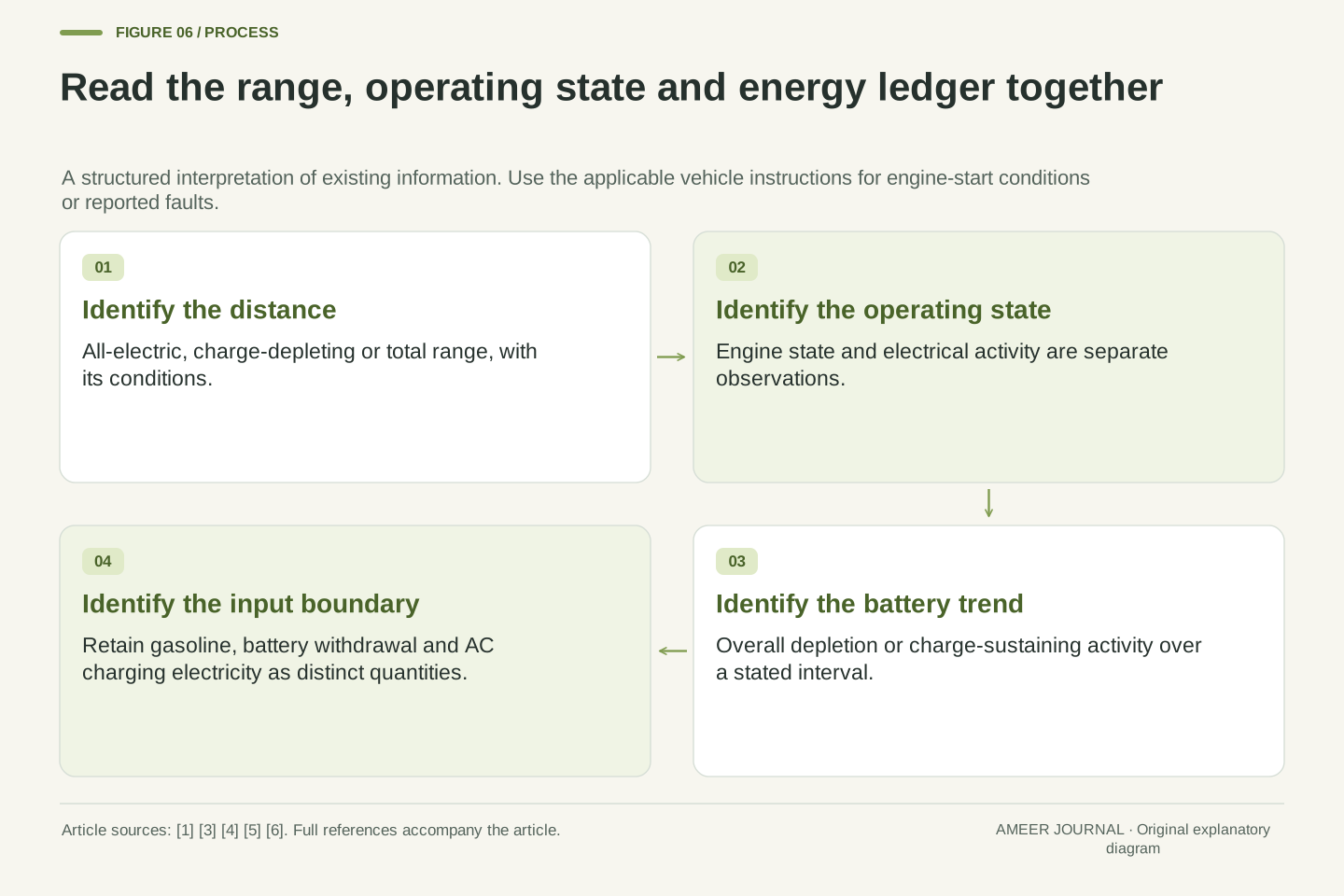
First, ask what the range number describes: electric, charge-depleting or total travel. Second, ask what the engine and motor were doing at the relevant moment. Third, ask whether the battery was being drawn down overall or managed around a continuing level. Fourth, ask which energy inputs your trip figure includes. These questions connect the label, the operating state and the consumption ledger without pretending that any one display contains all three [1][3][4][6].
The worked cases show why the answers matter. A remaining energy inventory can coexist with a power shortfall. A journey can consume battery energy and gasoline together. A charge-sustaining battery can remain active. More charging between trips can change the source split, and a wall-energy rate cannot simply be substituted for a battery-energy rate. For a particular engine-start condition, use the vehicle's own explanation and any warning or diagnostic information it provides; a generic range article cannot classify every event as normal. The more useful understanding is that 'plug-in', 'electric motor active' and 'engine off' are different descriptions. Knowing which one a claim actually supports makes the vehicle's behaviour and its published figures easier to read.
A compact interpretation retains four independent descriptors: the range definition, instantaneous engine/electric-machine operation, battery-state trend, and energy-accounting boundary. These correspond to different evidence. A label supplies standardized consumption or distance estimates; a status indication describes an operating observation; an SOC series describes a stored-state trajectory; charging and fuel records quantify inputs over a period [1][3][4][6]. None should silently replace the others.
The constructed wheel balance, mixed-trip ledger, AC-versus-battery example and charging schedule all follow that separation. Their arithmetic remains simple because the assumptions are stated before the sums and divisions. A real PHEV adds model-specific limits, transitions and displays, but the same questions still organize the information. Consult the applicable vehicle documentation to determine which engine starts and mode transitions are expected, and distinguish those from reported faults. No suppression of engine operation or alteration of control limits is needed to understand the mechanism. The resulting explanation can acknowledge useful battery energy without assuming engine-off travel, and report low gasoline use without losing the external electricity that helped produce it.
Sources & further reading
Explore the references behind this guide. External pages may change after our review.
- Alternative Fuels Data Center: Plug-In Hybrid Electric VehiclesU.S. Department of Energy Alternative Fuels Data Center · Accessed 6 Nov 2026
- Alternative Fuels Data Center: How Do Plug-In Hybrid Electric Cars Work?U.S. Department of Energy Alternative Fuels Data Center · Accessed 6 Nov 2026
- Electric & Plug-In Hybrid Electric Vehicles | US EPAU.S. Environmental Protection Agency · Accessed 6 Nov 2026
- Interactive Version of the Plug-in Hybrid Electric Vehicle Label | US EPAU.S. Environmental Protection Agency · Accessed 6 Nov 2026
- Fuel Economy and EV Range Testing | US EPAU.S. Environmental Protection Agency · Accessed 6 Nov 2026
- Plug-In Hybrid Electric Vehicle R&D Plan, External Draft — Appendix B: PHEV DefinitionsU.S. Department of Energy · Accessed 6 Nov 2026
- Equivalent Consumption Minimization Strategy - Energy management controller for P0–P4 hybrid electric vehicles - SimulinkMathWorks · Accessed 6 Nov 2026
- Build Hybrid Electric Vehicle Input Power-Split Model - MATLAB & SimulinkMathWorks · Accessed 6 Nov 2026
Article updated 6 Nov 2026.
Found something we should revisit?
Good explanations get better with thoughtful feedback.