What you’ll take away
- The approximately 170 mAh/g LFP reference counts charge per initial positive active-material mass, not energy per complete battery mass.
- Utilization changes the charge numerator; additional component mass changes the normalization boundary.
- A positive-electrode lithium half-cell profile is not automatically a complete-cell terminal voltage.
- The same specific energy can accompany different total energies and different utilization–mass-fraction pairs.
- Keep quantity, reaction interval, voltage reference and mass boundary attached to every battery comparison.
The missing words after “per gram” change the question
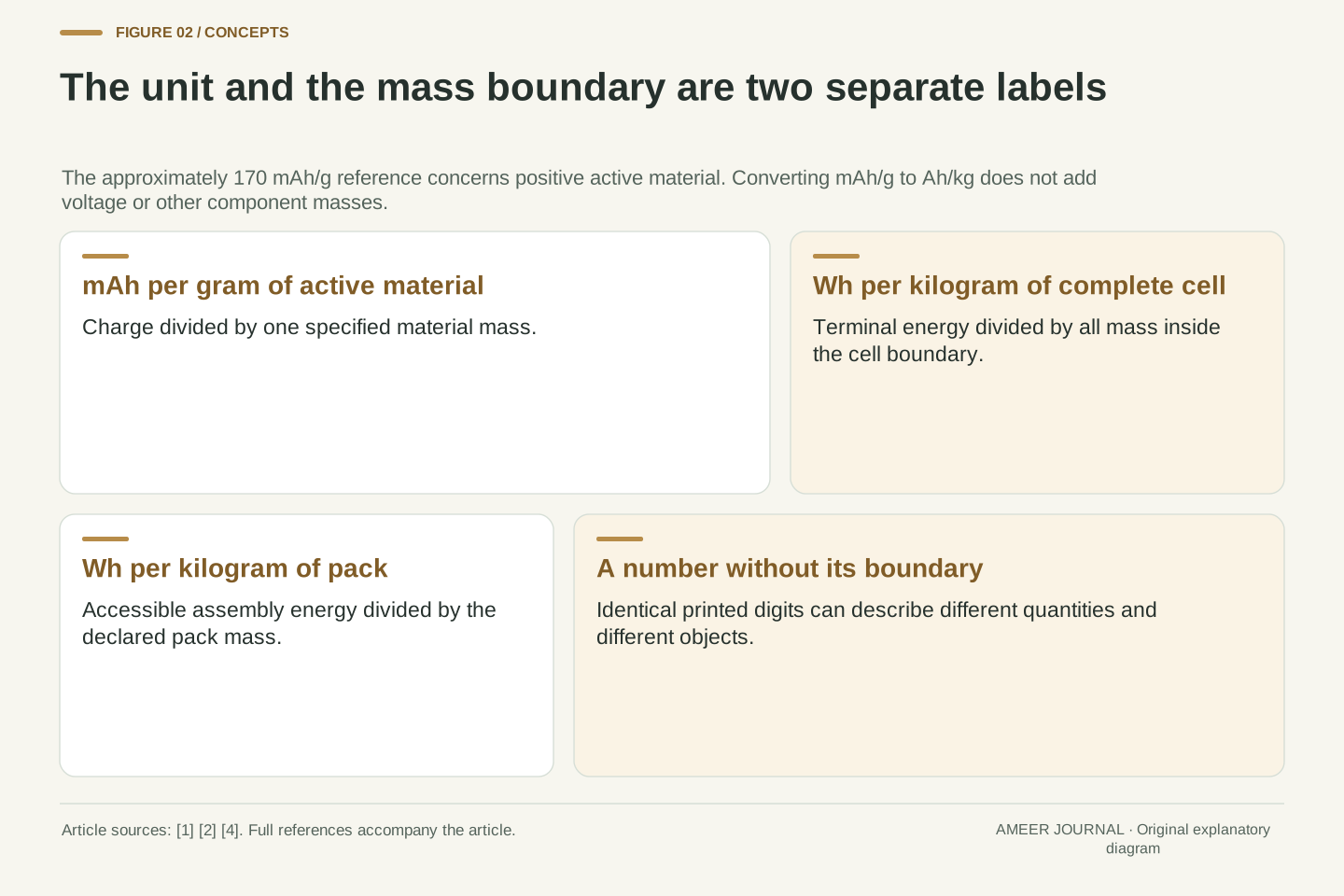
An LFP material can have a theoretical specific capacity of about 170 milliamp-hours per gram without a finished battery pack having an energy rating of 170 watt-hours per kilogram. The technical reference reports the first number for lithium iron phosphate, LiFePO₄, as a positive-electrode material. [1] It does not say that every gram of a complete battery is that material. It also reports charge, whereas watt-hours describe energy. Both the quantity being counted and the mass underneath it must stay visible.
Even a correct unit conversion leaves this distinction intact. One mAh/g has the same numerical value as one Ah/kg: both the numerator and denominator change by a factor of one thousand. But changing milliamp-hours into watt-hours requires voltage information. Changing active-material mass into complete-battery mass requires a component account. Neither change is supplied by the familiar letters LFP.
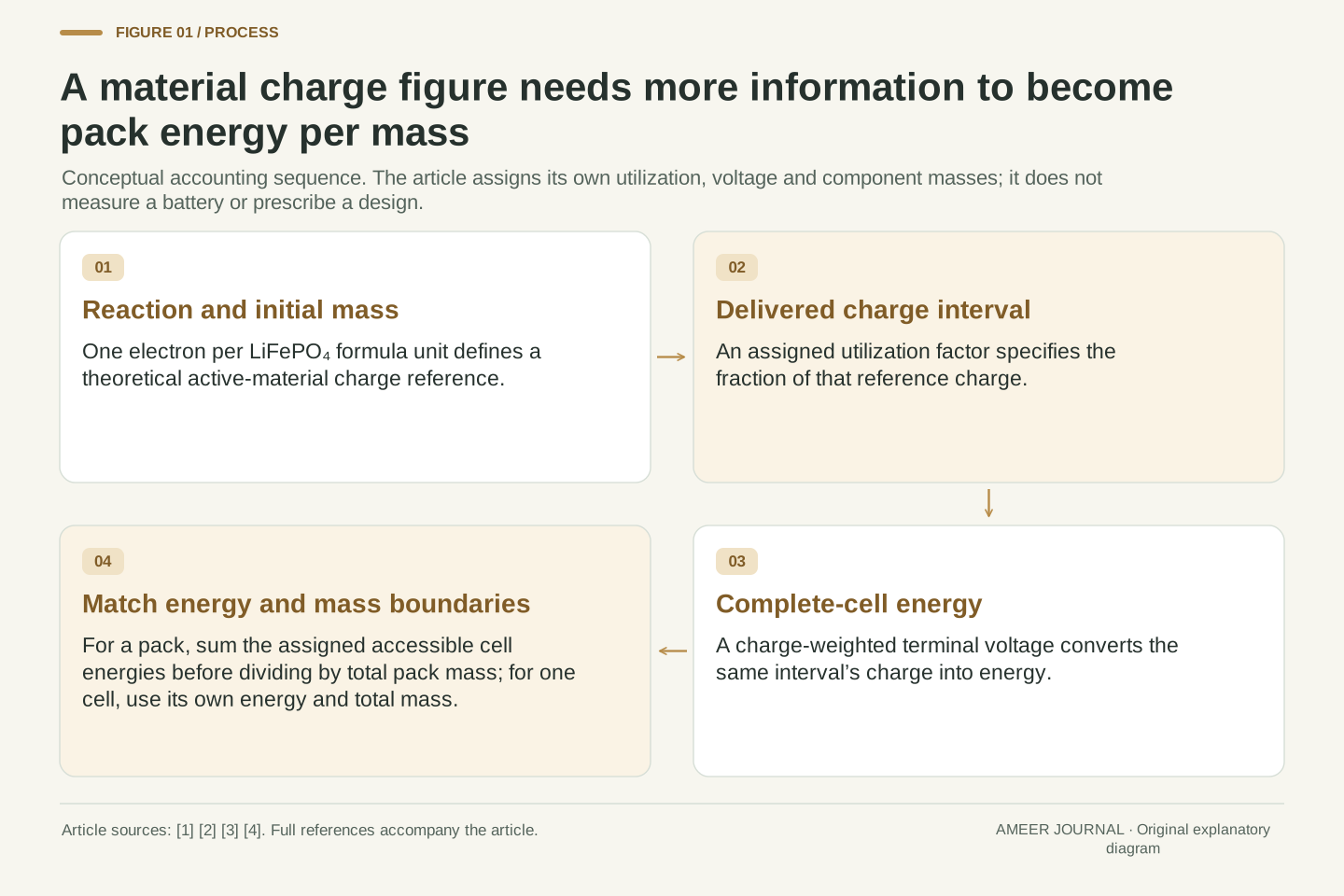
We will build an original numerical example from the one-electron reaction, then follow it through four mass boundaries. All chosen material amounts, utilization, cell voltage and packaging masses are hypothetical. No battery was tested or assembled. The purpose is to understand what a number means before comparing it with a different number on a specification sheet.
The approximately 170 mAh/g value in the technical reference is a theoretical specific charge for LiFePO₄ positive active material. [1] It must not be interpreted as complete-cell or pack specific energy. The two metrics differ in numerator, denominator and operating assumptions: charge divided by active mass versus terminal energy divided by a larger assembly mass. Identifying the chemistry does not establish any of those missing boundaries.
Numerically, 1 mAh/g equals 1 Ah/kg, because the factors of 10⁻³ in charge and mass cancel. That conversion does not introduce volts. Specific energy in Wh/kg requires an energy calculation and a declared mass basis. A value normalized to active material may be useful for materials research while remaining insufficient to describe a complete device.
Our original account uses the stated one-electron LFP reaction, explicitly rounded chemical inputs and assigned utilization, voltage and component masses. All subsequent device numbers are conditional calculations, not measured performance. Complete-cell charge balance and lithium inventory are assumed adequate for the chosen interval. The exercise follows the information needed to move from a reaction count to a finished-assembly metric.
Count the stated reaction before counting the whole battery
The material formula contains lithium, iron, phosphorus and oxygen, but those atom counts are not separate counts of electricity. The technical reference writes the LFP reaction as LiFePO₄ changing into FePO₄ while releasing one lithium ion and one electron; the reverse direction restores LiFePO₄. [1] For this particular reaction, one formula unit corresponds to one electron transferred. The four oxygen atoms do not turn the reaction into a four-electron allowance.
The released lithium ion and electron follow different routes in a working rechargeable cell. Ions travel through the electrolyte inside the cell, while electrons move through the external circuit. DOE explains this separation of ionic and electronic movement. [4] A complete cell therefore needs both electrodes and the intervening components. The LFP half-reaction describes only one side of that larger arrangement.
Our mass reference is the LiFePO₄ active material before that lithium-removal reaction. Fixing this reference matters: a capacity divided by an initial material mass cannot silently be compared with a value divided by a different reaction-state mass. The reaction supplies the charge count; the reference mass supplies the denominator. Keeping those two choices together is the first step towards a meaningful specific-capacity number.
Use the source's half-reaction LiFePO₄ ⇌ FePO₄ + Li⁺ + e⁻. [1] The rightward direction is delithiation of the positive material; reversal restores the lithium-containing phase. Its stoichiometry associates one mole of electrons with one mole of initial LiFePO₄ for the specified one-lithium transformation. This is not a sum over every atom in the formula or a claim about additional reactions outside that transformation.
Normalize the theoretical charge to the initial LiFePO₄ active mass. Changing to a different composition-state mass would change the denominator, even if the electron count were held fixed. That distinction belongs in the metric definition. The source also describes reversible lithium insertion and removal in a dual-intercalation cell, while DOE separates internal ionic transport from external electronic transport. [1][4]
A half-reaction is not a complete-cell design. The other electrode must support a corresponding charge transfer, and the cell must have suitable transferable lithium and a usable operating interval. The source's discussion of capacity matching illustrates why improving one electrode alone does not automatically scale complete-cell energy by the same factor. [1] Our later model assumes those requirements rather than trying to prove them from positive-material mass.
Use the molar mass to turn an electron count into charge per gram
A mole is a counting amount that lets the reaction and the material's mass use matching units. For our rounded calculation, choose contributions of 6.94 grams for lithium, 55.85 for iron, 30.97 for phosphorus and 16.00 for each oxygen per mole of the corresponding atoms. Their total for LiFePO₄ is 157.76 grams per mole. These are declared rounded inputs based on the CIAAW table, whose values include precision and natural-composition qualifications. [3] They are not an exact mass measured from a sample.
One mole of electrons carries about 96,485 coulombs of charge, using the rounded Faraday constant in OpenStax's charge calculation. [2] One ampere-hour is 3,600 coulombs, so one milliamp-hour is 3.6 coulombs. Divide 96,485 by 3.6 and then by 157.76. The result is about 169.8871 mAh for each gram of the initial active material, consistent with the reference's approximately 170 mAh/g. [1]
This calculation explains where the scale comes from. It does not require a particular battery size: doubling the amount of this ideal material doubles both its theoretical charge and its mass. The per-gram value stays unchanged. The following sections keep extra digits during calculations and round the displayed answers only at the end, so small rounding differences do not accumulate.
Adopt the rounded elemental molar contributions Li=6.94, Fe=55.85, P=30.97 and O=16.00 g/mol. Thus M=6.94+55.85+30.97+4×16.00=157.76 g/mol for the initial LiFePO₄ formula amount. CIAAW supplies the underlying abridged atomic weights and explains their precision and isotopic-composition limits. [3] The chosen rounded values define this calculation; their decimal representation is not a claim of exact sample composition.
OpenStax gives Q=nF, relating transferred charge to moles of electrons, and uses the rounded constant F=96,485 C/mol. [2] For one electron per formula unit, theoretical charge per active mass is F/M in C/g. Since 1 mAh=3.6 C, q=F/(3.6M)=169.88709995 mAh/g. The units cancel as (C/mol)/(g/mol), followed by conversion of coulombs into milliamp-hours.
This is approximately the source's 170 mAh/g, not an independently measured capacity. [1] It describes the complete stipulated stoichiometric transformation. Neither electrode kinetics nor the accessible interval of a real assembled cell has been evaluated. The calculation nevertheless provides a reproducible reference against which a declared realized fraction can be defined, with the reaction and initial-mass basis both explicit.
A chosen fraction of the theoretical charge gives a different numerator
Now assign ten grams of positive active material. Multiplying by the unrounded specific charge gives a theoretical amount of about 1.698871 Ah. Suppose the modeled interval delivers eighty percent of that charge. Its delivered amount is then about 1.359097 Ah. Dividing that amount by the same ten grams gives about 135.9097 mAh/g of active material. We changed the charge numerator while keeping the mass denominator fixed.
Call the assigned eighty-percent factor utilization. Here it means the fraction of this reaction's theoretical charge realized over our chosen interval. It does not mean the dashboard says eighty-percent charge, that the battery has retained eighty percent of its original health, or that charging wastes twenty percent. Those percentages compare different quantities. The factor is a premise of our example, rather than a diagnosis of why an actual cell delivered a particular amount.
The technical source distinguishes the LFP theoretical capacity from practical utilization and discusses the importance of material and electrode design. [1] We use that distinction without borrowing a real product's result. A useful report would identify the interval and conditions associated with its delivered charge, allowing readers to understand which portion of the theoretical reference the measurement represents.
Let mₐ=10 g and q=169.88709995 mAh/g, retaining the exact rational value from the declared rounded inputs. Then Qₜ=q mₐ/1000=1.6988709995 Ah. Assign u=0.80 for the fraction realized over the modeled interval. Q=uQₜ=1.3590967996 Ah, and 1000Q/mₐ=u q=135.90967996 mAh/g. The material mass reference remains unchanged throughout this step.
The source's separation of theoretical capacity from material utilization motivates defining u explicitly. [1] Our scalar is not a model of transport, reaction distribution or limiting mechanisms. A value of 0.80 does not establish that precisely twenty percent of particles remain inactive, nor does it quantify coulombic efficiency, state of charge or aging retention. It aggregates the stated interval's realized charge relative to one specified stoichiometric reference.
Consequently, Q depends on both material amount and u. Reporting either alone leaves the charge unresolved. The later mass accounts hold this Q fixed unless a comparison explicitly changes active amount or utilization. This controlled ordering prevents an apparently harmless denominator change from being mixed with an unexplained change in the numerator.
A coating includes more mass than its active material
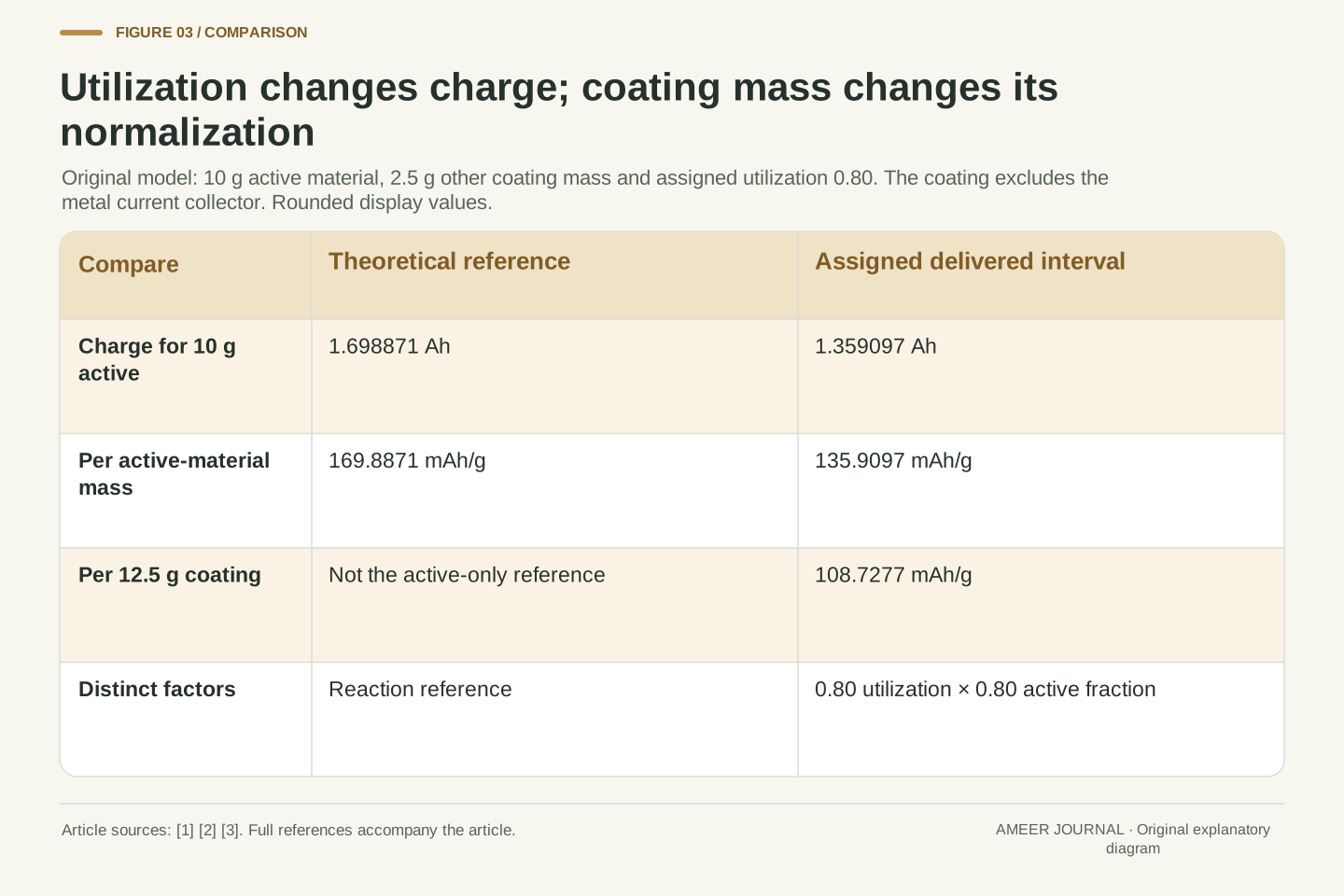
Imagine that our ten grams of active material sit in a coating with another 2.5 grams of components that do not contribute to the reaction being counted. The coating therefore weighs 12.5 grams. By our definition, this coating mass does not yet include the metal current collector. The technical reference separately describes current collectors and notes that carbon, binder and conductive additions affect practical energy density. [1] Those components cannot simply disappear from a complete mass account.
Keep the delivered charge at 1.359097 Ah. When divided by 12.5 grams instead of ten, it becomes about 108.7277 mAh/g of coating. No charge vanished during that division. We asked how much of the same charge corresponds to each gram of a larger defined object. The active material occupies eighty percent of the coating's mass, so the coating-normalized value is eighty percent of the active-normalized value.
There are now two different eighty-percent factors. The utilization factor reduces charge relative to the theoretical reaction. The mass fraction includes additional material in the denominator. Together they give 0.8×0.8=0.64 of the theoretical active-material number when expressed per gram of coating. Equal numerical percentages do not make the two operations the same physical claim.
Define coating mass m_c=12.5 g, comprising mₐ=10 g of active material and 2.5 g assigned to components that do not contribute to the counted reaction. The metal current collector is outside this particular coating boundary. The source explicitly distinguishes collectors and discusses the specific-energy penalty of carbon, binder and conductive additions. [1] It does not supply our invented component amounts.
Holding Q fixed, the coating-specific charge is 1000Q/m_c=u q(mₐ/m_c)=108.72774397 mAh/g. The active fraction mₐ/m_c=0.80 is independent of the assigned utilization u=0.80. Their product is 0.64. One factor describes realized charge relative to the reaction reference; the other describes how much of the denominator is positive active material.
This algebra assumes that adding the stated noncontributing mass does not change Q. It is a comparison of accounting boundaries, not a prediction that changing an actual electrode formulation leaves its transport and electrical behavior unchanged. The practical interpretation is straightforward: two published values with different mass bases cannot establish a material-performance difference until those bases are reconciled.
A positive-electrode voltage is not automatically the cell voltage
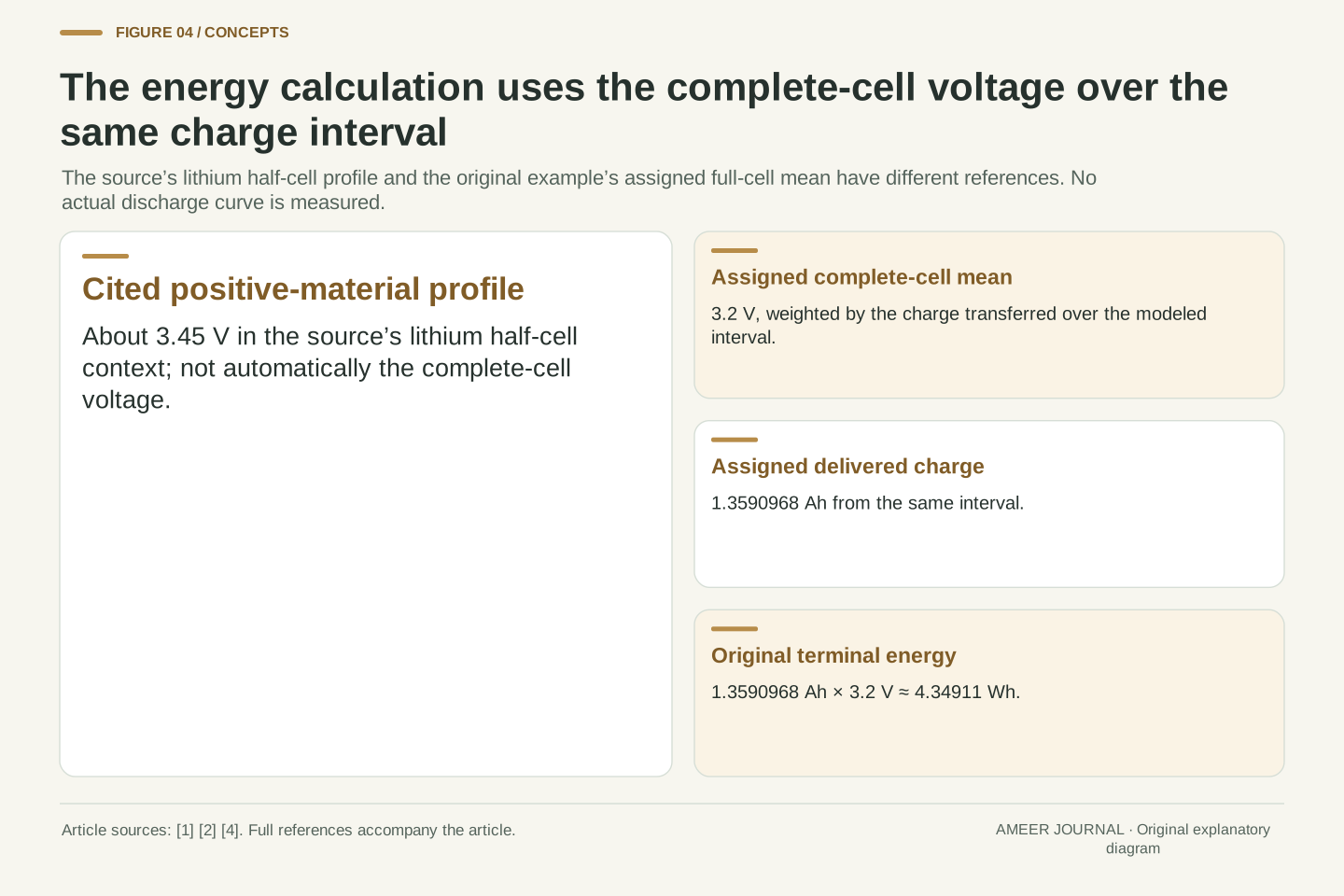
A charge amount still does not tell us energy. The technical source places its electrode voltage profiles in half-cells with lithium anodes, and places the LFP profile near 3.45 volts in that context. [1] That is a voltage associated with a stated comparison electrode. A complete cell has its own pair of electrodes and its own terminal voltage. Multiplying a charge by the cited positive-electrode number without checking the reference can therefore answer the wrong energy question.
For our hypothetical complete cell, assign a mean terminal voltage of 3.2 V over the chosen delivered charge. This mean is weighted by charge: a part of the discharge contributing more charge contributes more weight. It is not automatically the midpoint of two voltages or the voltage written on a battery's nameplate. Multiplying 1.3590968 Ah by this assigned 3.2 V gives about 4.34911 Wh of terminal energy.
The multiplication connects the correct quantities only because the charge interval and voltage mean describe the same transfer. DOE explains the battery's conversion between chemical potential energy and electricity in an external circuit. [4] Our example accounts for the resulting terminal energy; it does not infer a complete voltage curve from a chemistry name or a single electrode profile.
The source identifies its electrode profiles as lithium half-cell profiles, including the approximately 3.45 V LFP plateau. [1] A positive-electrode potential referenced to a lithium electrode is not automatically the voltage across a complete cell using a different negative electrode. Complete-cell terminal voltage concerns the two-electrode system and its operating state. Our calculation therefore supplies its own terminal-voltage premise rather than treating the cited half-cell plateau as that premise.
For delivered charge Q in Ah, terminal energy in Wh is E=∫V dQ. Define the charge-weighted mean V̄=(∫V dQ)/Q for Q>0. Assign V̄=3.2 V over exactly the interval used to define Q=1.3590967996 Ah. Then E=V̄Q=4.3491097588 Wh. This is an energy account, not an assertion that terminal voltage remains constant throughout the interval.
A time-weighted mean, a voltage measured at one instant and a nominal label cannot be substituted without justification. When current varies, equal time intervals need not transfer equal charge. The distinction follows from the integral's weighting. The electrochemical sources supply the conversion context and charge relation; the assigned voltage and resulting numerical energy are our original conditional example. [2][4]
Count every gram inside the complete-cell boundary once
Give the complete hypothetical cell a mass of forty grams. Its 12.5-gram positive coating is part of that total; the remaining 27.5 grams covers everything else inside our cell boundary. This includes the other electrode and the additional components needed for the assigned cell. We are not adding forty grams on top of the coating. We are defining a complete forty-gram object containing it.
Divide the modeled 4.34911 Wh by 0.040 kg. The result is about 108.7277 Wh/kg of complete cell. Ten of the forty grams are the positive active material, so its cell mass fraction is one quarter. The full calculation combines the theoretical active-material charge, the utilization factor, that one-quarter mass fraction and the assigned voltage. Each factor answers a different missing question.
Notice an accidental numerical match: the coating result was 108.7277 mAh/g, while the cell result is 108.7277 Wh/kg. Their printed numbers match because of our chosen masses and voltage. Their units and meanings do not. A copied number without its complete unit and boundary would hide precisely the distinction the example was designed to reveal.
Set total cell mass m_cell=40 g, consisting of the 12.5 g coating plus 27.5 g of all remaining cell components. The active-material mass fraction at this boundary is f=mₐ/m_cell=0.25. The source's component and capacity-matching discussion supports treating a full cell as more than one active powder. [1] Our mass partition and adequate counter-electrode capacity remain assigned conditions.
Express q numerically in Ah/kg of active material. Then complete-cell specific energy is e_cell=V̄u q f. Substitution gives 3.2 V×0.80×169.88709995 Ah/kg×0.25=108.72774397 Wh/kg. Equivalently, divide E=4.3491097588 Wh by 0.040 kg. These two routes agree because the full-cell mass contains the active mass already used in Q.
The equality of this numerical value with the earlier coating mAh/g value is coincidental. The mass ratio 40/12.5 has numerical value 3.2, matching the assigned voltage's numerical value when expressed in volts. That does not make voltage dimensionless or equate energy with charge. Both labels must remain attached even when a table happens to display identical digits.
Pack components create another mass denominator
Now assign a pack containing ten identical copies of the hypothetical cell. Their energies add to about 43.4911 Wh, and their combined cell mass is 0.400 kg. Add 0.100 kg of pack components outside those cell boundaries. The complete pack mass is then 0.500 kg. In this account, every cell contributes the same assigned energy interval and no further deduction is made from the energy sum.
Dividing 43.4911 Wh by 0.500 kg gives about 86.9822 Wh/kg of pack. That is eighty percent of the complete-cell specific energy because cells account for eighty percent of the pack's mass. The added mass changed the denominator. It did not, within this particular model, remove energy from the numerator. The explanation remains clear because cell mass, extra pack mass and total pack mass occupy separate entries.
An actual pack can impose further limits on the energy that is accessible, so its usable energy must come from an appropriately defined report. Our example supplies neither an electrical connection arrangement nor a real reserve or control strategy. We added energies over an assigned common interval. We did not add ampere-hour labels while leaving their associated voltages and connections unspecified.
For N=10 identical model cells, assign accessible cell energy E to each and sum N E=43.4910975884 Wh. Their aggregate mass is N m_cell=0.400 kg. With additional pack-level mass m_extra=0.100 kg, total mass is 0.500 kg. The modeled pack-specific energy is e_pack=N E/(N m_cell+m_extra)=86.9821951769 Wh/kg.
The cell-to-pack mass fraction is 0.400/0.500=0.80, so e_pack=0.80 e_cell under the assigned energy-access premise. This is a mass-normalization result. It is not an eighty-percent electrical efficiency: no fraction of the cell energy was assigned to a loss mechanism. The accounting separates a larger denominator from a smaller numerator.
The aggregation presumes the stated cell intervals remain accessible without further balancing, control, reserve or window restrictions. Those effects would require additional information for a real pack and could change the energy numerator as well. No series or parallel arrangement is specified. Energy addition under the declared premise is sufficient for this example; summing Ah values without their voltage and connection context would be a different, unresolved operation.
The same specific energy can describe different total energies
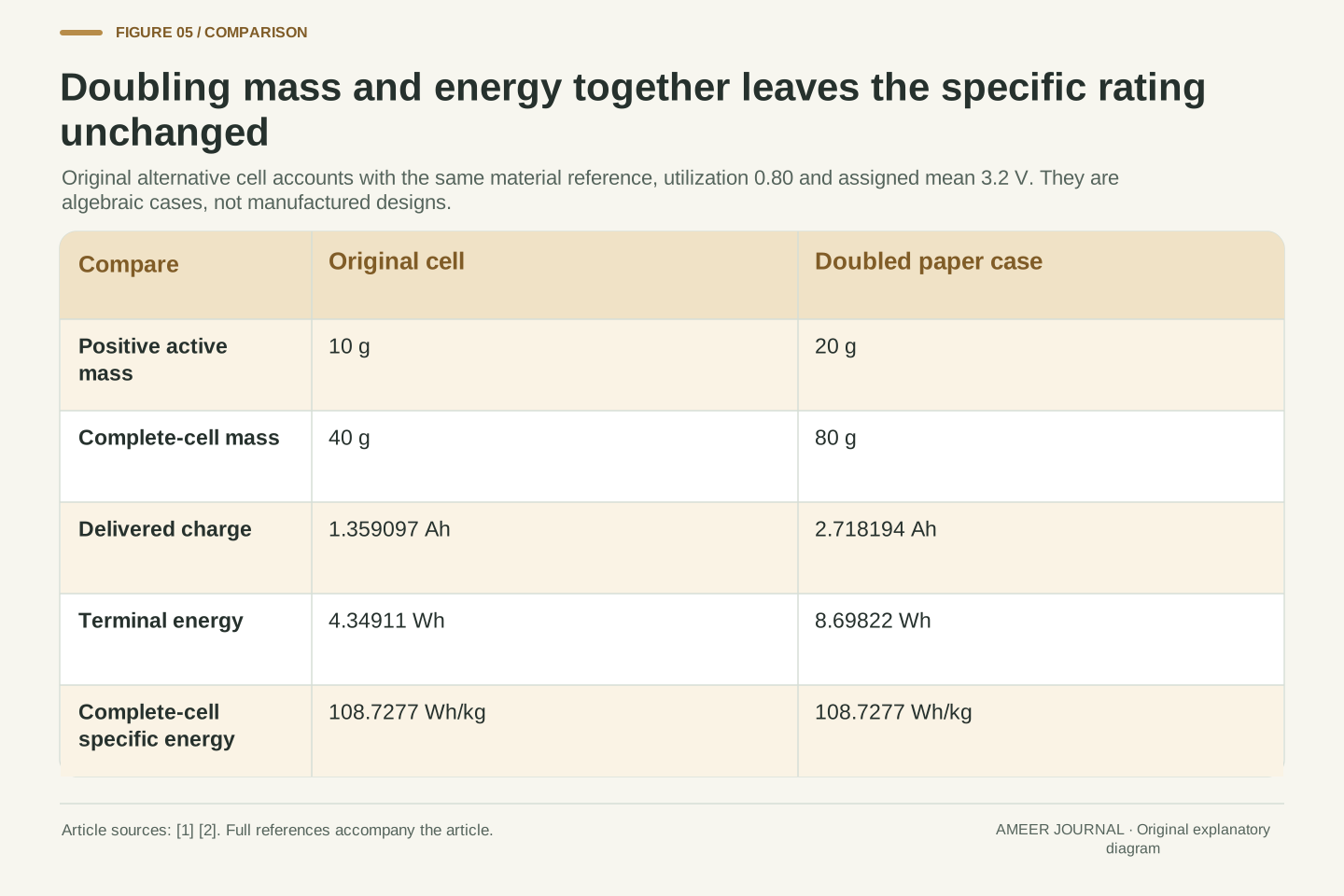
Compare the original cell with a second paper case that has twenty grams of active material and a total mass of eighty grams. Keep utilization and mean terminal voltage unchanged. Both active mass and complete-cell mass doubled, so the active fraction remains one quarter. The second case has about 2.718194 Ah and 8.69822 Wh, twice the original amounts, yet still has about 108.7277 Wh/kg.
That is why an energy-per-kilogram figure cannot by itself tell you how much energy a whole cell contains. The mass is needed to recover the total. Equally, knowing the LFP material number does not choose between these two cell sizes. Both share the same reaction and normalized assumptions in our calculation. A specific quantity deliberately removes one aspect of scale.
A different comparison keeps the original 4.34911 Wh but assigns a fifty-gram total cell mass. Its specific energy drops to about 86.9822 Wh/kg. This time absolute energy did not increase; the mass denominator did. These are separate paper cases, not claims that real cells can be resized without changing their behavior. They show which information a normalized rating retains and which information it leaves unresolved.
Construct case B by replacing mₐ=10 g and m_cell=40 g with 20 g and 80 g while holding u and V̄ fixed. Q_B=2Q_A=2.7181935993 Ah and E_B=2E_A=8.6982195177 Wh. Since f_B=f_A=0.25, both have e_cell=108.72774397 Wh/kg. Specific energy is invariant under this simultaneous algebraic scaling.
Therefore e_cell does not identify E or m_cell separately. Recovering E requires multiplication by the applicable total mass. The original and doubled examples have different absolute capacities and energies despite identical specific energy. This is a dimensional-information issue, not evidence that either design has the same physical power, thermal response or longevity as another.
In an independent case C, retain E_A while assigning m_cell=50 g. Then E_A/0.050 kg=86.98219518 Wh/kg. The change is caused solely by the stipulated larger denominator. Case B scales numerator and denominator together; case C changes only the denominator. Keeping those operations separate prevents a comparison of specific ratings from being mistaken for a comparison of absolute energy.
A final rating cannot reveal every factor that produced it
The original forty-gram cell uses ten grams of active material at eighty-percent utilization. Consider a different forty-gram paper case with eight grams of active material at one-hundred-percent utilization. Keep the same theoretical reaction number and the same 3.2 V mean terminal voltage. Both cases deliver the same modeled charge because 10×0.8 and 8×1 give the same charge-count multiplier.
Their complete-cell energy and energy-per-kilogram rating therefore match, although their positive active-material amounts and utilization factors differ. The calculation is not identifying an eight-gram portion inside the first cell that alone reacts. Utilization can represent an average extent of the specified reaction. What is equal here is the resulting charge account, not a microscopic picture of where every reaction occurs.
Reading a final energy rating backwards consequently requires more evidence. Even if the mass and mean voltage are supplied, that rating alone cannot distinguish these two parameter pairs. A report that separately states active mass, theoretical reference and delivered charge can resolve questions that a single final number cannot. The same chemistry label does not fill in those missing measurements or definitions.
At fixed q and V̄, the equation e_cell=V̄ q u f identifies the product u f, not its two factors independently. Our original pair is u=0.80 and f=0.25, giving u f=0.20. The alternative pair u=1 and f=0.20 gives the same product. For a 40 g cell, that second active fraction corresponds to 8 g of positive active material.
Both pairs give Q=1.3590967996 Ah, E=4.3491097588 Wh and e_cell=108.72774397 Wh/kg under the common assumptions. The first pair's product u mₐ equals the second pair's product, but that equality does not establish a distribution of reacted particles or a manufacturable design. It is an explicit counterexample to inferring both utilization and active fraction from a single energy metric.
The inverse ambiguity also depends on the supplied information. If u were separately established over the same interval, f could be solved within this model. If mean terminal voltage were missing, another unknown would enter. An inference is only as specific as its independent premises; a complete-cell rating cannot be unpacked into material utilization, component mass and voltage by naming LFP alone.
Keep the quantity, reference and boundary beside every comparison
When reading a battery claim, first identify whether the numerator is charge or energy. Then locate the exact mass boundary: active powder, coating, complete cell or pack. Check which reaction or delivered interval defines the charge, and whether a voltage refers to one electrode against a reference or to the complete cell terminals. These are document-reading questions. They do not require opening, charging or experimenting with a battery.
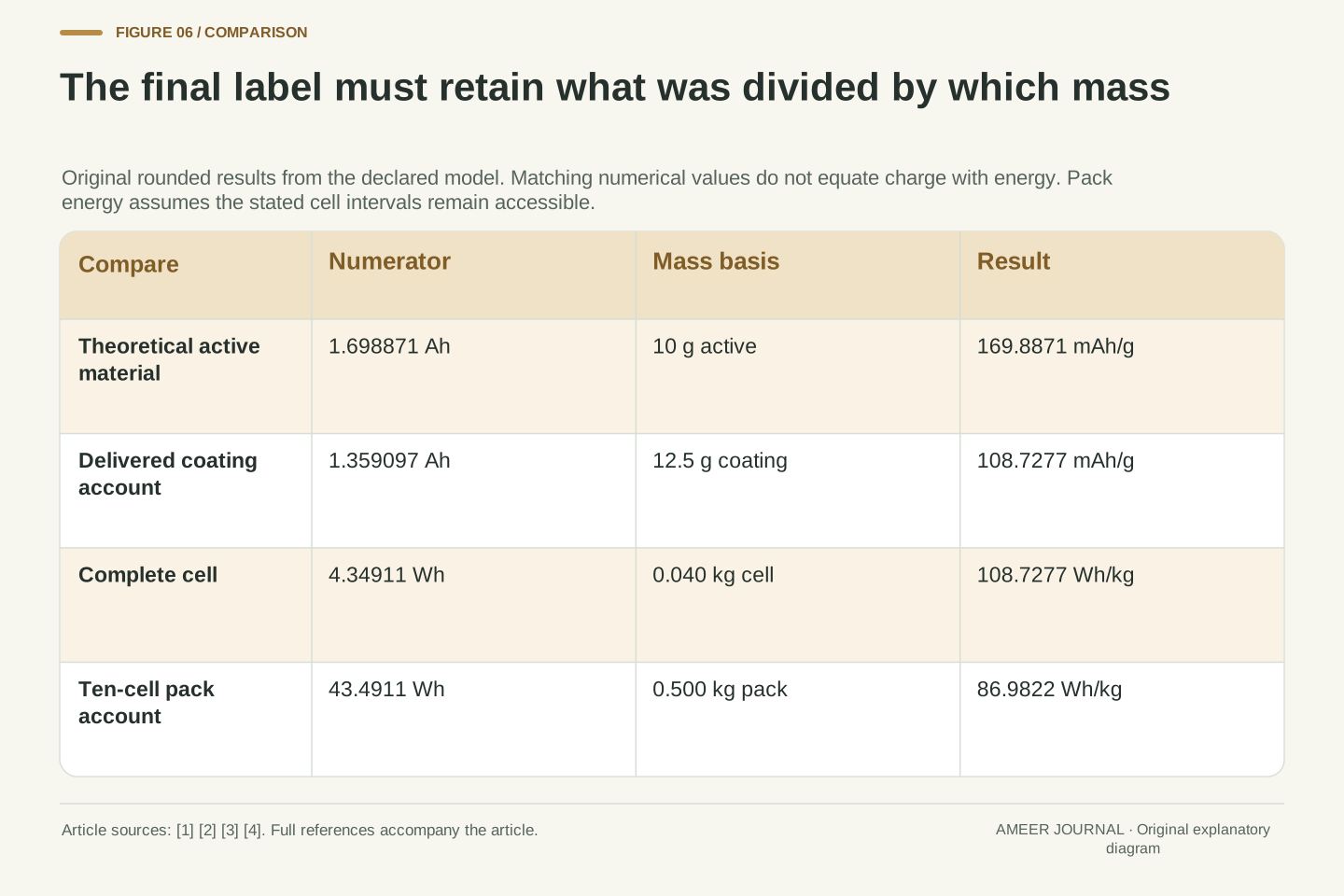
The original example now has four clear answers. Theoretical active-material charge is about 169.8871 mAh/g. After the assigned utilization and coating mass, the coating value is about 108.7277 mAh/g. With the separately assigned full-cell voltage and mass, complete-cell specific energy is about 108.7277 Wh/kg. Adding the stipulated pack mass produces about 86.9822 Wh/kg. Each number is correct for its own stated definition.
The active-material value remains useful: it connects a chemical reaction to a charge reference. It simply does not answer every question about the finished battery. Capacity matching, voltage, component masses and the usable interval supply additional information. [1][2][4] A comparison becomes informative when those definitions match, or when the calculation explicitly shows how one defined boundary is converted into another.
A reproducible comparison records the physical quantity, reference reaction or interval, mass boundary and voltage reference. For measured claims it also needs the relevant measurement conditions. Source-specific theoretical values, electrode half-cell profiles and complete-assembly measurements should retain their original scopes. The source material provides a charge reference and component context, not a universal conversion from one metric into all others. [1][2][3][4]
Our forward calculation is explicit: q≈169.8871 mAh/g of initial active material; u q≈135.9097 mAh/g on that same mass basis; u q(mₐ/m_c)≈108.7277 mAh/g of coating; V̄u q(mₐ/m_cell)≈108.7277 Wh/kg of cell; and the stipulated cell-to-pack mass fraction gives about 86.9822 Wh/kg of pack. The equal displayed cell and coating numbers do not equate their dimensions.
The scale comparison and inverse counterexample establish the remaining limits. A specific rating does not determine absolute energy without mass, and one complete-cell energy metric does not separately identify utilization and active fraction. None of these scalar accounts establishes power capability, safety or lifetime. Their contribution is a transparent chain of definitions and calculations that lets a reader evaluate what an LFP number actually supports.
Sources & further reading
Explore the references behind this guide. External pages may change after our review.
- Electrode Materials for Li-ion BatteriesSigma-Aldrich / Merck technical documentation · Accessed 7 Nov 2026
- 17.7 Electrolysis - Chemistry | OpenStaxOpenStax / Rice University · Accessed 7 Nov 2026
- Abridged Standard Atomic Weights | Commission on Isotopic Abundances and Atomic WeightsIUPAC Commission on Isotopic Abundances and Atomic Weights · Accessed 7 Nov 2026
- DOE Explains...Batteries | Department of EnergyU.S. Department of Energy Office of Science · Accessed 7 Nov 2026
Article updated 7 Nov 2026.
Found something we should revisit?
Good explanations get better with thoughtful feedback.