What you’ll take away
- In the stated NMC811 formula, 80% means nickel within the selected Ni–Mn–Co atom count.
- Atom fractions and mass fractions use different weighting rules, and each still needs its selected denominator.
- Equal formula amounts and equal material masses do not contain the same relative nickel amounts.
- A conditional oxidation-number average does not identify each individual entry or prove a measured atomic charge.
- A nominal or averaged composition does not by itself determine phase structure or complete-battery performance.
The three digits need an element order and a denominator
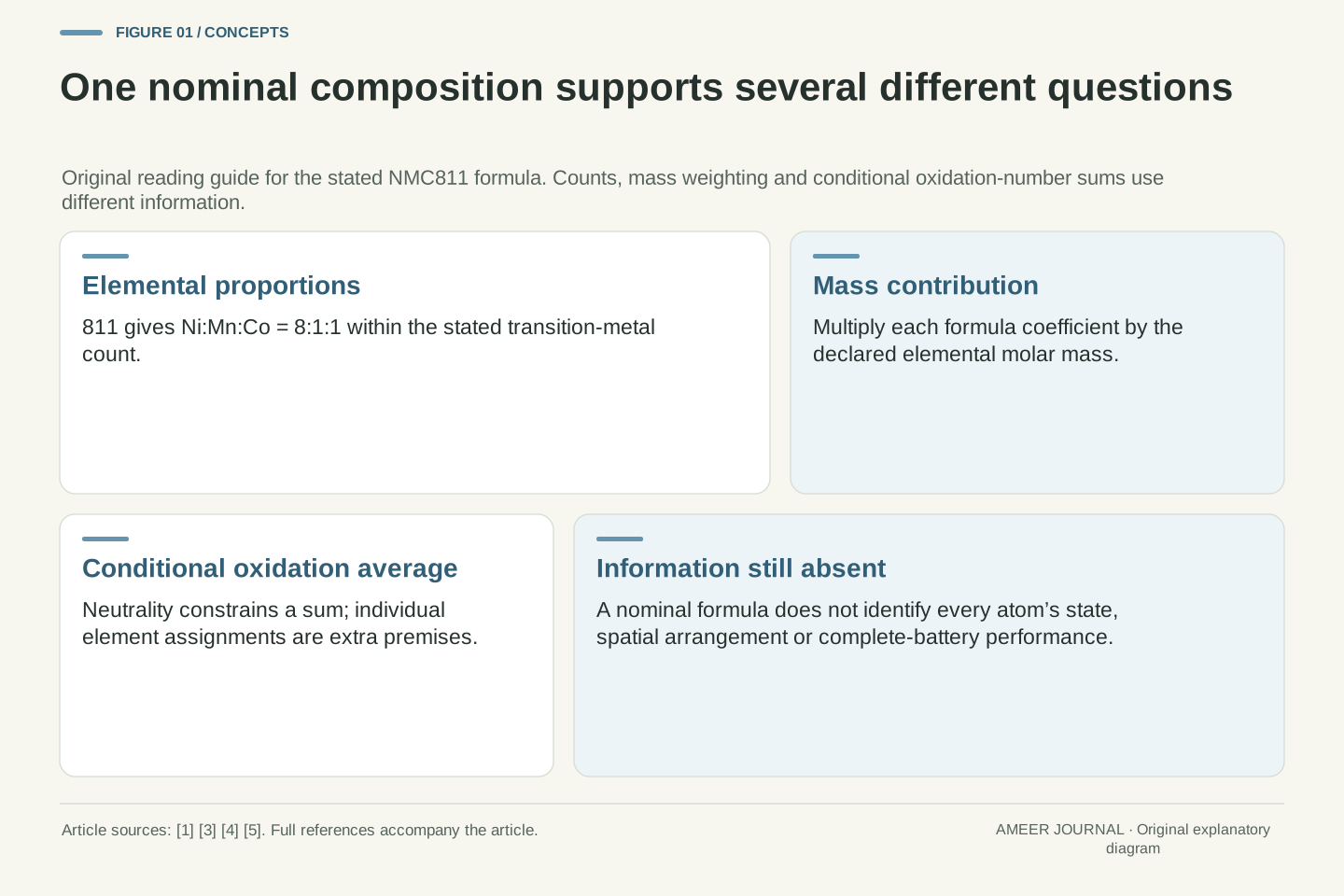
The name NMC811 can suggest a material that is eighty percent nickel. The missing question is: eighty percent of what? The public abstract of the Cambridge research record identifies NMC811 with the formula LiNi₀.₈Mn₀.₁Co₀.₁O₂. [1] Its nickel, manganese and cobalt amounts are in the ratio eight to one to one. Nickel therefore supplies eighty percent of that selected three-element count. Lithium and oxygen are also in the formula, but they are outside this particular denominator.
Idaho National Laboratory uses the corresponding 80:10:10 nickel–manganese–cobalt description in its report. [2] That shorthand does not say that eighty percent of the complete material's mass is nickel. To see the difference, we will build an original paper account from the stated formula and declared atomic-mass inputs. We will also ask what an average oxidation number can establish. No material was sampled, mixed or tested; the calculations explain the information contained in a nominal composition and the extra assumptions needed for stronger conclusions.
Use the explicit nominal composition LiNi₀.₈Mn₀.₁Co₀.₁O₂, identified as NMC811 in the retrieved public abstract. [1] The transition-metal coefficients sum to one: 0.8+0.1+0.1=1. Thus xNi=0.8 within the selected Ni–Mn–Co population. The three digits specify the ratio in that stated element order; they do not define nickel's fraction of every atom, every gram or a complete battery assembly.
The INL report's 80:10:10 description is consistent with this ratio. [2] Here the formula defines an idealized composition account, while chosen representative molar inputs define its mass conversion. Later oxidation-number assignments are additional premises. These are original mathematical examples, not assays, synthesized samples, fitted populations or device tests. The central task is to preserve the numerator, denominator and weighting rule when translating a short chemistry label into a quantitative statement. A correct ratio becomes misleading if any of those choices changes silently.
Fractional subscripts describe proportions rather than pieces of an atom
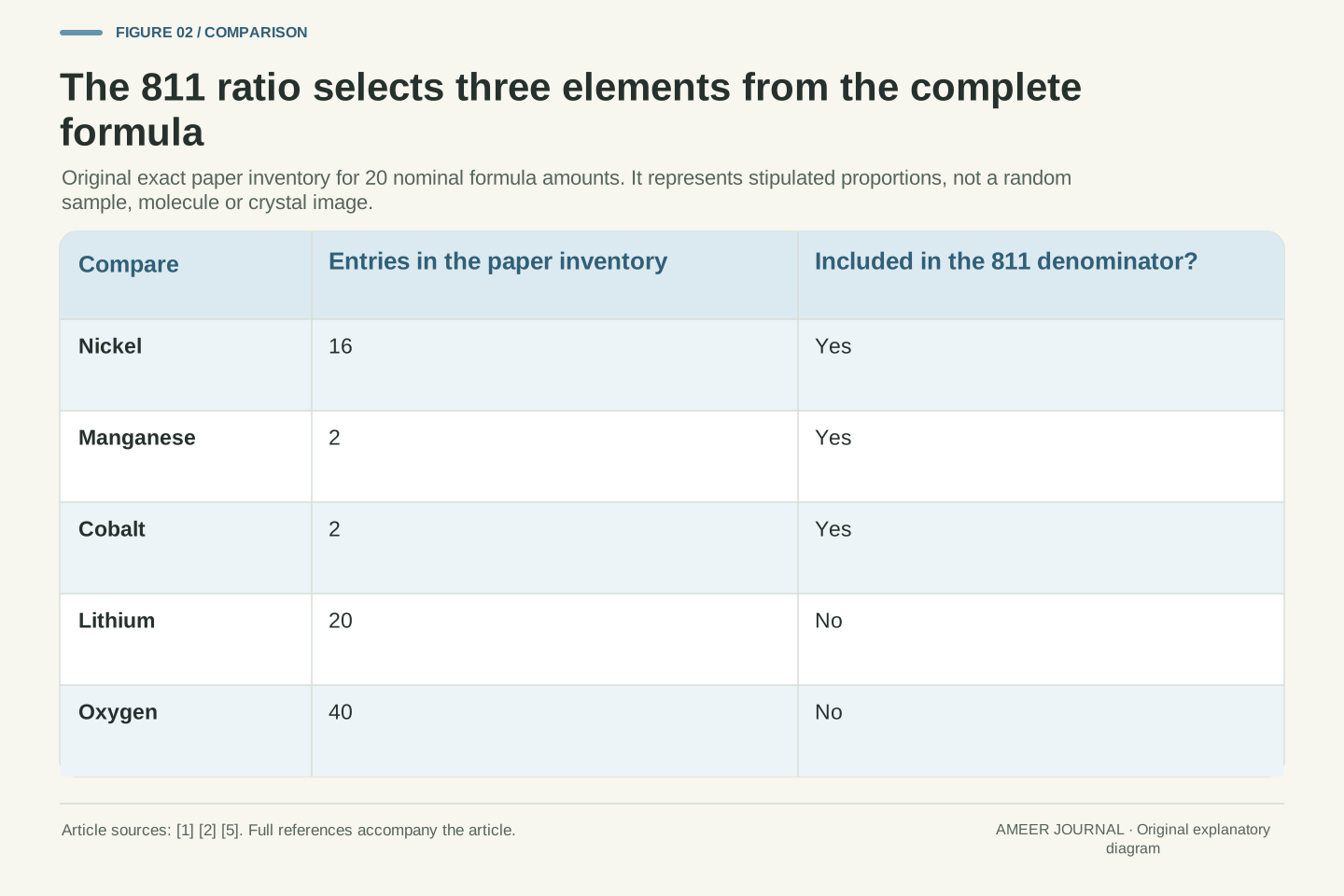
A subscript of 0.8 does not mean that someone has cut a nickel atom into parts. It gives a relative amount within the formula's chosen scale. Multiply every coefficient by twenty and the account becomes twenty lithium entries, sixteen nickel entries, two manganese entries, two cobalt entries and forty oxygen entries. The proportions remain unchanged. We have chosen twenty because it turns the decimals into small whole numbers that are easy to inspect.
This is a paper inventory, not a picture of twenty isolated NMC molecules. The technical materials reference places these compositions in a layered solid family and illustrates the broader LiMO₂ form, where M represents transition metals. [5] The inventory contains no instructions about which entries sit next to one another. It is also not a prediction that a randomly selected tiny region must contain our exact counts. Scaling a nominal formula preserves its overall proportions; it does not supply a measured arrangement, local variation or crystal drawing.
A nominal formula normalizes relative elemental amounts. Scaling Li₁Ni₀.₈Mn₀.₁Co₀.₁O₂ by twenty gives Li₂₀Ni₁₆Mn₂Co₂O₄₀ as an integer accounting vector. Scaling back by twenty recovers the original coefficients. Neither operation asserts a discrete molecule, a crystallographic unit cell or a statistically representative twenty-site sample. The vector is a convenient representation of exact stipulated proportions.
The technical reference describes layered oxide structures and gives both an NMC composition and the general LiMO₂ notation. [5] That solid-state context matters when interpreting fractional coefficients: composition accounting does not specify spatial occupation, ordering, particle architecture or phase purity. Our twenty-formula vector deliberately discards positional information. Two spatial arrangements could have identical total counts, so the count vector alone cannot identify an arrangement. A structural claim would need evidence carrying that additional information, rather than a more detailed-looking rendering of the same five elemental totals.
The same sixteen nickel entries give two different count percentages
Start with the twenty-formula inventory. The selected transition-metal group contains sixteen nickel, two manganese and two cobalt entries, making twenty in total. Nickel's share is sixteen divided by twenty, or eighty percent. Now count every atom represented in the formula: twenty lithium plus twenty transition-metal entries plus forty oxygen gives eighty. Nickel's share of that larger count is sixteen divided by eighty, or twenty percent. Nothing about the numerator changed.
The formula supports both statements because they answer different questions. [1] The first asks how the Ni–Mn–Co group is divided. The second asks how the complete nominal atom inventory is divided. A percentage without its selected population leaves those questions unresolved. Even the phrase 'metal content' can be too loose if the reader does not know which elements were included. Keeping the explicit group name beside the result makes the calculation reproducible and prevents the familiar eighty from being carried into an unrelated denominator.
For the integer account, the transition-metal count is NTM=16+2+2=20, whereas the total represented atom count is Nall=20+16+2+2+40=80. Consequently NNi/NTM=16/20=0.8 and NNi/Nall=16/80=0.2. Equivalently, use the normalized coefficients: 0.8/(0.8+0.1+0.1)=0.8, but 0.8/(1+0.8+0.1+0.1+2)=0.2. Both follow from the stated nominal formula. [1]
These are count fractions, with each included atom receiving equal weight. Multiplying the entire inventory by any common positive factor leaves both fractions invariant, but changing the included set does not. The term transition-metal fraction here means the explicitly selected Ni–Mn–Co set. It must not silently become all-element fraction or an unspecified metal fraction. This is the first source of ambiguity in a composition percentage: even before introducing atomic masses, an unchanged nickel amount can produce different correct fractions because the denominator names a different population.
Mass accounting weights each elemental amount differently
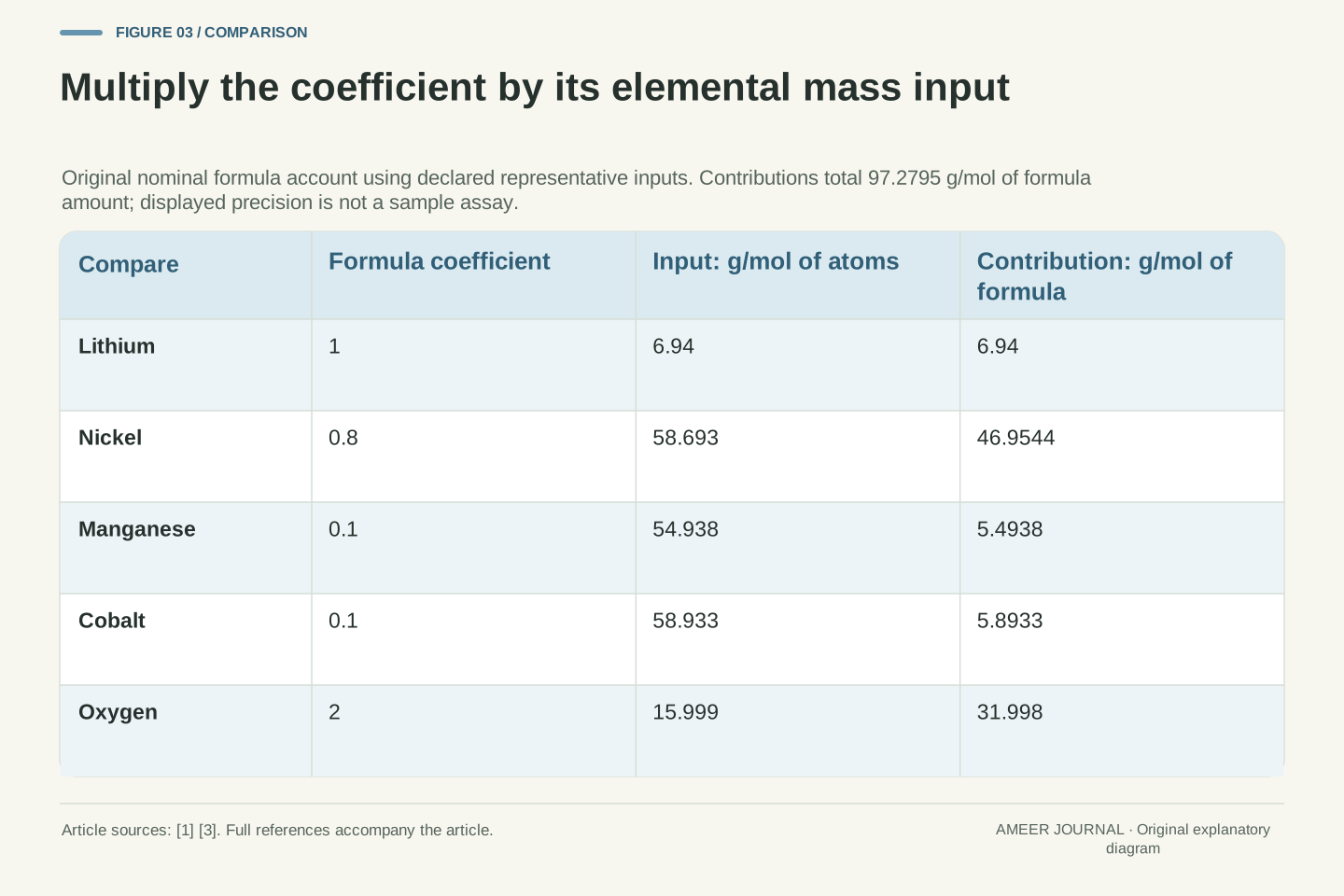
Counting treats each atom as one entry, but different elements contribute different masses. For this calculation, use representative molar inputs of 6.94 for lithium, 58.693 for nickel, 54.938 for manganese, 58.933 for cobalt and 15.999 for oxygen, all in grams per mole of the corresponding atoms. These declared inputs use the CIAAW table, which also records precision and isotopic-composition qualifications. [3] A mole is an amount unit that lets us use the same counting scale for each element.
Multiply each input by its formula coefficient. One mole of the nominal formula therefore has contributions of 6.94 g from lithium, 46.9544 g from nickel, 5.4938 g from manganese, 5.8933 g from cobalt and 31.998 g from oxygen. Adding them gives 97.2795 g. The arithmetic uses our declared inputs consistently; its extra digits are useful for checking the account, not evidence of an equally precise sample measurement. Notice especially that the two oxygen entries contribute twice the single-oxygen input.
Adopt elemental molar inputs in g/mol: MLi=6.94, MNi=58.693, MMn=54.938, MCo=58.933 and MO=15.999. They are declared representative values from the retained CIAAW rows, not exact isotope-characterized sample masses. The table's uncertainty and composition qualifications remain relevant. [3] Multiplying each elemental molar mass by its nominal stoichiometric coefficient gives its contribution per mole of formula amount.
Thus M811=6.94+0.8(58.693)+0.1(54.938)+0.1(58.933)+2(15.999)=97.2795 g/mol. The nickel contribution is 46.9544 g/mol, while the Ni–Mn–Co subtotal is 58.3415 g/mol. Each contribution has the same formula-amount reference, so their sum is dimensionally consistent. This weighted sum is different from adding the coefficients, which gives four represented atoms per normalized formula. The calculations retain the declared decimals exactly and round final ratios for display; that bookkeeping precision must not be mistaken for experimental uncertainty or a certified material assay.
Four definitions produce four legitimate nickel fractions
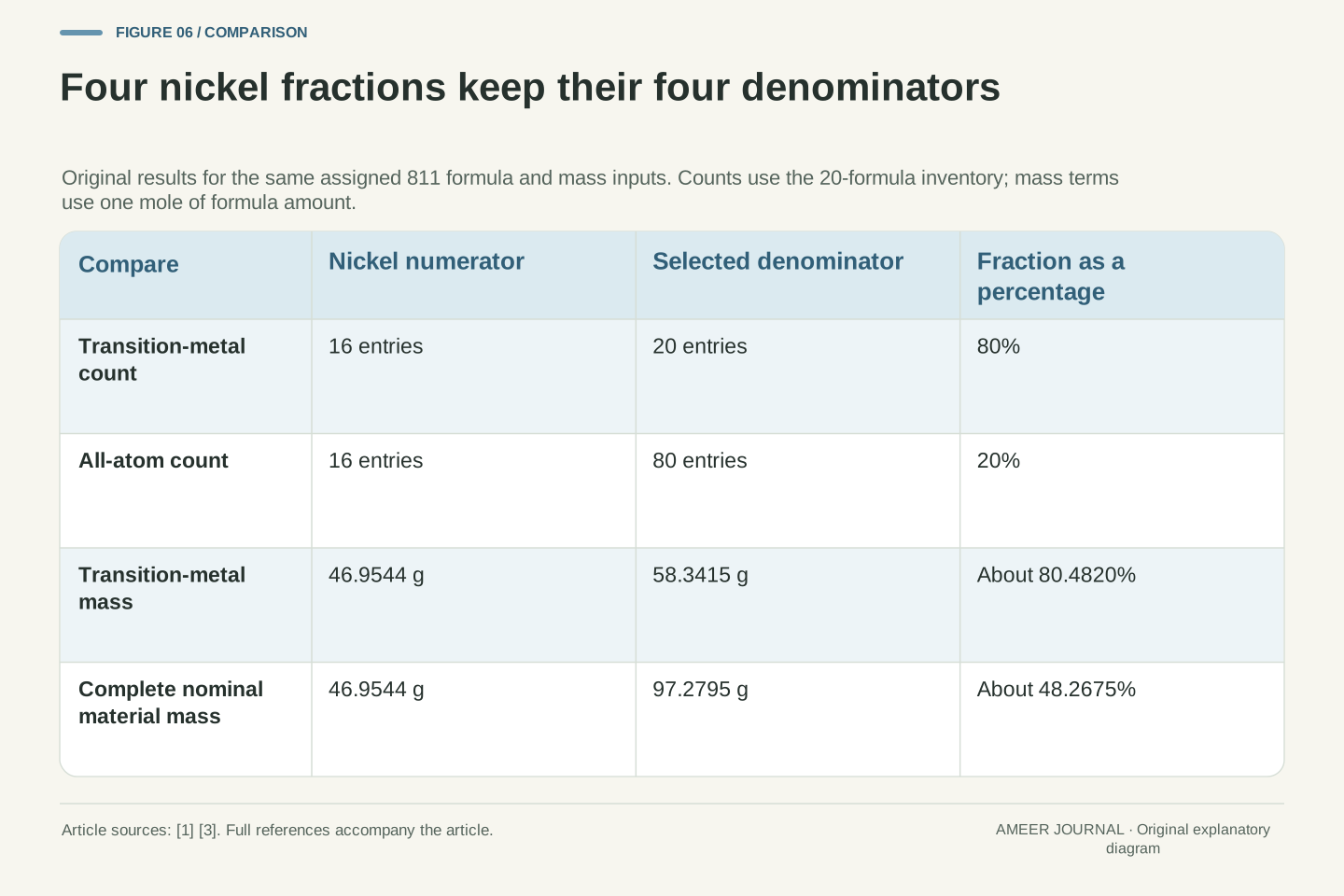
Divide nickel's 46.9544 g contribution by the 97.2795 g total. Nickel supplies about 48.2675 percent of the complete nominal material mass in this model. If the denominator instead contains only nickel, manganese and cobalt mass, divide by 58.3415 g. The result is about 80.4820 percent. The whole-material and selected-metal mass calculations use the same nickel numerator but different mass totals.
We now have four answers: eighty percent of the transition-metal atom count, twenty percent of all represented atoms, about 80.4820 percent of transition-metal mass, and about 48.2675 percent of complete nominal material mass. The two values near eighty are close because the three declared metal masses are fairly similar; they are not the same definition. [3] Nor is the forty-eight-percent result automatically the nickel fraction of a finished battery. A complete assembly includes components outside this formula, and their amounts have not entered the account.
Define the whole-material nickel mass fraction as wNi=0.8MNi/M811=46.9544/97.2795≈0.4826751782. Define the nickel fraction of transition-metal mass as wNi,TM=46.9544/58.3415≈0.8048198966. The first denominator includes lithium and oxygen; the second excludes both. The mass inputs are those already declared from CIAAW. [3] These ratios are dimensionless, despite having been computed from molar-mass contributions.
Compare them with the count fractions 0.8 and 0.2. Equal atom weighting and elemental-mass weighting are distinct operations, while selecting all elements or only Ni–Mn–Co is a separate choice. Their combination creates four different metrics. Similar MNi, MMn and MCo values make the two selected-metal fractions numerically close, but equality would require an appropriate equality of weights, not merely a familiar shorthand. None of the four metrics has complete-cell or pack mass in its denominator. Moving to an assembly would require its material inventory and a matching nickel numerator.
The direction of the small selected-metal difference can also be checked without rounding the final fraction. Group manganese and cobalt together and compute their coefficient-weighted mean elemental mass. Nickel's declared mass input is greater than that mean, so weighting by mass increases nickel's share within this group. For a nonzero nickel fraction below one, equality between the count and mass fractions would require nickel's mass input to equal the mean of the other included elements. That condition concerns the chosen group; introducing lithium and oxygen changes both the other-element mean and the denominator.
A 532 comparison changes the same account without changing its rules
INL also describes NMC532 with nickel, manganese and cobalt in the proportions fifty, thirty and twenty. [2] For an explicit comparison, assign formula B as LiNi₀.₅Mn₀.₃Co₀.₂O₂. Keep formula A as our original 811 account. Twenty formula amounts of B contain ten nickel, six manganese and four cobalt entries, alongside twenty lithium and forty oxygen. Nickel is now fifty percent of the transition-metal count and 12.5 percent of all represented atoms.
Apply the same declared mass inputs. B's nickel contribution is 29.3465 g per mole of formula amount, and the complete total is 96.5525 g. Its whole-material nickel mass fraction is therefore about 30.3943 percent. The new atom ratio did not turn into a fifty-percent mass fraction. Comparing these formulas tells us how their stipulated elemental inventories differ. It supplies no measured charging speed, usable battery energy or lifetime ranking. Those are different observations, requiring more information than an inventory of nominal elemental amounts.
Use the source's Ni:Mn:Co ratio 5:3:2 to define comparison formula B=LiNi₀.₅Mn₀.₃Co₀.₂O₂. [2] This is an explicitly assigned nominal stoichiometric comparison, rather than a universal assay of every product bearing a family label. Its twenty-formula inventory is Li₂₀Ni₁₀Mn₆Co₄O₄₀. The nickel count fractions are 10/20=0.5 within Ni–Mn–Co and 10/80=0.125 over all represented atoms.
With the same elemental inputs, M532=6.94+29.3465+16.4814+11.7866+31.998=96.5525 g/mol. Therefore wNi,532=29.3465/96.5525≈0.3039434505. Retaining identical input values and definitions makes the comparison internally consistent. It does not isolate a causal effect of nickel content on an actual cell, since no device, structure, operating interval or test has been specified. The source's research context should not be converted into a universal performance conclusion from these original composition calculations. Here the result is a mass fraction with a stated formula reference.
Equal formula amounts and equal material masses are different comparisons
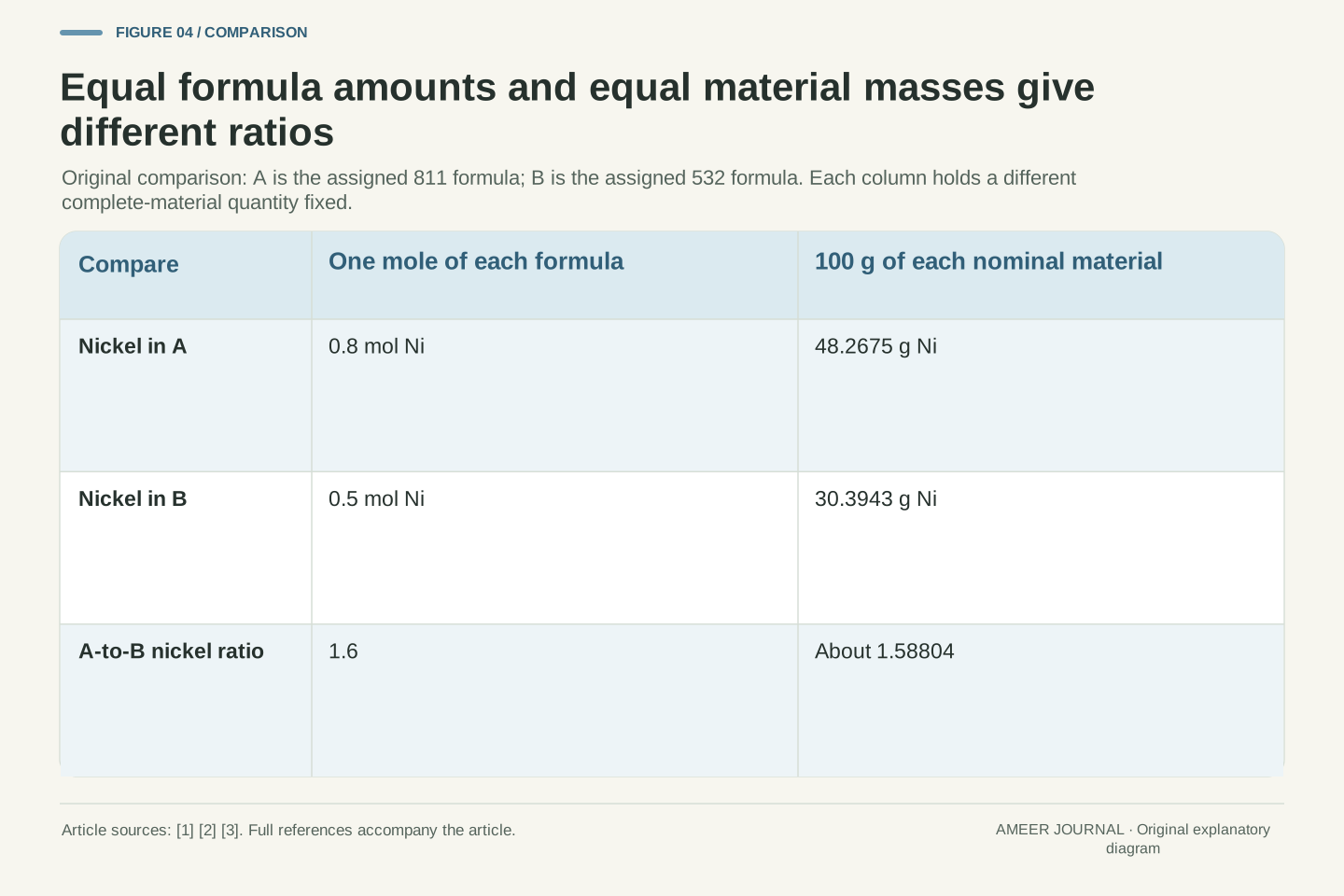
Compare one mole of formula A with one mole of formula B. Their nickel amounts are 0.8 mole and 0.5 mole, so A contains 1.6 times as much nickel. That ratio applies to both nickel amount and nickel mass because the same nickel mass input converts both sides. However, the two complete material amounts do not weigh the same: one is 97.2795 g and the other is 96.5525 g.
Now give A and B equal total material masses of 100 g. The nickel masses become about 48.2675 g and 30.3943 g. Their ratio is about 1.58804, rather than 1.6. Equal material masses contain slightly different numbers of formula amounts because their molar masses differ. The apparent disagreement disappears once the comparison basis is restored. Before saying that one composition contains a certain multiple of another's nickel, specify whether you held formula amount, total material mass or some separately defined device quantity constant.
For equal formula amounts nA=nB, the nickel-amount ratio is 0.8nA/(0.5nB)=1.6. Multiplying numerator and denominator by the same MNi leaves the nickel-mass ratio unchanged. The complete-material masses differ because M811≠M532. Thus equal formula amount is not the same constraint as equal material mass, even though both comparisons use unchanged nominal compositions.
For equal total masses mA=mB, formula amounts are mA/M811 and mB/M532. The nickel-mass ratio becomes (0.8/M811)/(0.5/M532)=1.5880427017. For 100 g of each material, the corresponding nickel masses are 48.26751782 g and 30.39434505 g. This is a normalization effect, not a change in either formula. In symbolic form, the fixed-mass ratio equals the fixed-amount ratio multiplied by M532/M811. Keeping that factor visible explains both its origin and why rounding both formula masses to one identical number would erase the small difference.
Oxidation numbers add another kind of accounting
Mass fractions answer how much of a declared material mass belongs to an element. Oxidation numbers answer a different formal bookkeeping question. OpenStax defines them using an ionic approximation, rather than as a direct measurement of each atom's actual charge. [4] We can use their sum rule to check a neutral formula, provided we state the assigned values. This calculation does not use atomic masses at all.
For our next model, assign lithium an oxidation number of +1 and oxygen −2. Two oxygen entries contribute −4, and one lithium entry contributes +1. The selected transition metals must therefore contribute +3 altogether to make the nominal formula neutral. Because their coefficients add to one, their coefficient-weighted average is +3. That result does not mean nickel, manganese and cobalt must each receive +3 separately. It constrains their combined total. Individual element assignments require further premises, which we will now add explicitly rather than hiding them inside the name 811.
Oxidation number is an ionic-approximation assignment; it is not an experimentally measured partial atomic charge or a Lewis formal-charge calculation. OpenStax distinguishes the concept and states the sum rule for the specified overall charge. [4] Apply that bookkeeping to a neutral nominal LiMO₂ account, explicitly assigning zLi=+1 and zO=−2. Oxygen's assignment is a premise for this example, not a claim that every oxygen-containing compound has the same oxidation number.
Neutrality gives 1(+1)+zTM+2(−2)=0, so the coefficient-weighted transition-metal contribution is zTM=+3. For A, this expands to 0.8zNi+0.1zMn+0.1zCo=3. There is one constraint on three unknown element averages, not three independent measurements. Atomic masses play no part in this sum. Replacing the coefficients by mass fractions would impose the wrong weights: oxidation-number accounting follows the numbers of represented atoms, while the previous mass calculation intentionally weighted those atoms by their elemental molar inputs.
A nickel average follows only after additional assignments
Add two new premises: assign manganese +4 and cobalt +3. In one normalized formula account they contribute 0.1×4=0.4 and 0.1×3=0.3. Together that is 0.7 of the transition-metal total of 3. Nickel must supply the remaining 2.3. Dividing by its coefficient, 0.8, gives a nickel average of +2.875. The calculation follows the oxidation-number sum rule under our stated assignments. [4] It is not a measured value recovered from the three digits alone.
The twenty-formula inventory makes the same balance easier to check with whole counts. Lithium contributes +20, the two manganese entries contribute +8, the two cobalt entries +6, and forty oxygen entries −80. The sixteen nickel entries must contribute +46, since 20+8+6+46−80=0. Dividing 46 by sixteen again gives 2.875. A fractional average is perfectly possible in an account even when particular entries receive whole-number labels. The average by itself does not tell us which labels were assigned to those individual entries.
With the additional stipulated assignments zMn=+4 and zCo=+3, neutrality requires 0.8zNi+0.1(4)+0.1(3)=3. Consequently zNi=(3−0.4−0.3)/0.8=23/8=+2.875. The conditional nature of the result is essential: the bulk formula supplied the coefficients, while the manganese and cobalt values were added as separate assumptions. The sum rule supplies the algebra, not independent evidence for those assumptions. [4]
Multiply the account by twenty. The non-nickel contributions are +20 from lithium, +8 from manganese, +6 from cobalt and −80 from oxygen. Nickel therefore has a total assigned oxidation-number contribution of +46 across sixteen entries. Its average is 46/16=23/8. These dimensionless signed contributions are bookkeeping sums, not coulombs of transferable charge or measurements of atomic electron density. A mean of +2.875 neither requires every nickel entry to share that value nor identifies an integer-state distribution. The next calculation shows the ambiguity explicitly.
Two different sets of labels can have the same average
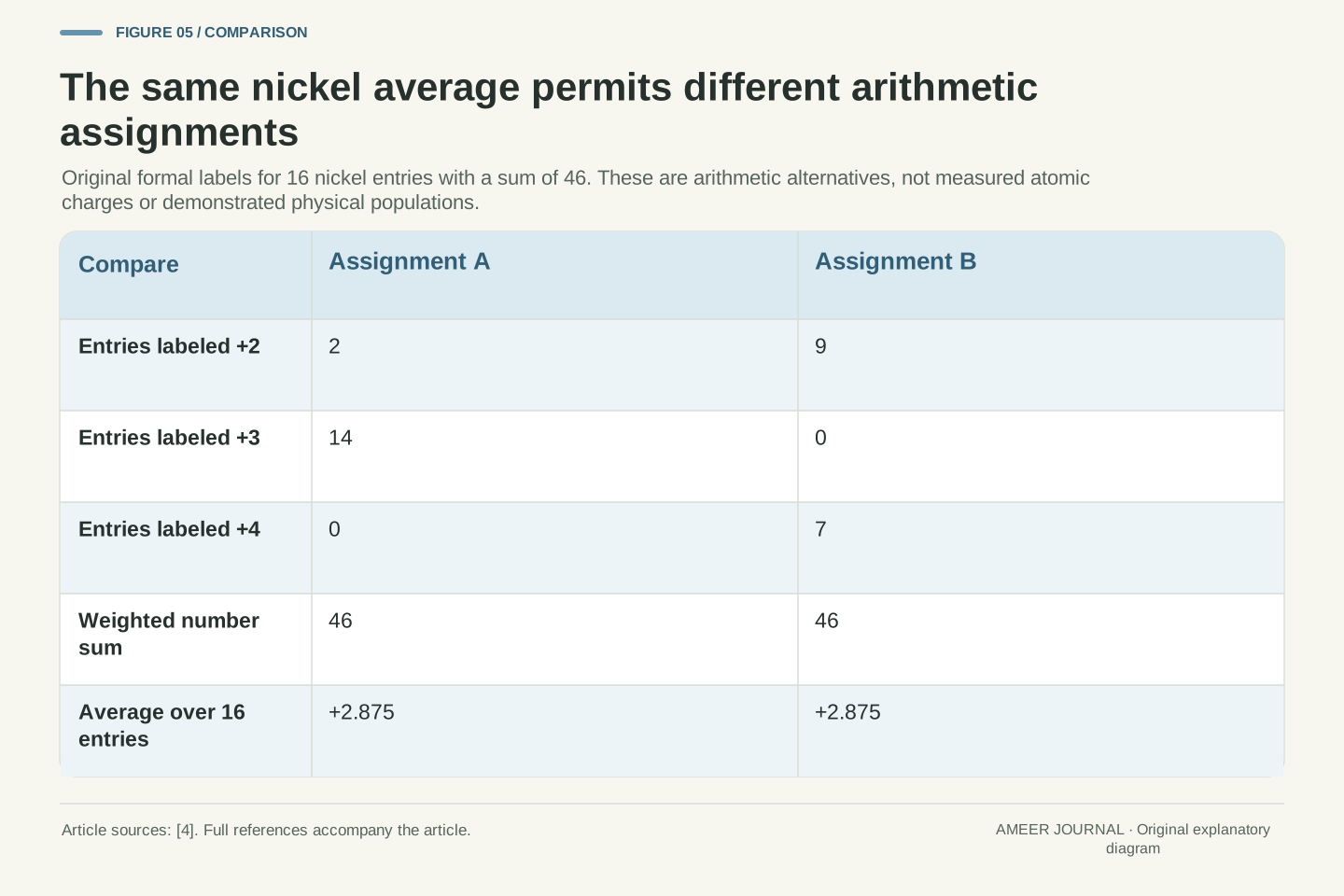
For the sixteen nickel entries, imagine assigning two the number +2 and fourteen the number +3. Their sum is 2×2+14×3=46. Now consider a different arithmetic assignment: nine entries at +2 and seven at +4. That sum is 9×2+7×4=46 as well. Both accounts contain sixteen entries and both average +2.875, yet their individual labels differ completely.
These are two invented number assignments, not proposed stable material populations. Their purpose is to show what a mean leaves unresolved. Knowing the count and total does not uniquely recover every entry, just as knowing a class's average score would not identify each student's score. The distinction matters when reading a chemistry explanation: a correctly derived average can still be insufficient evidence for a claim about individual atomic states. Identifying an actual population or arrangement would require suitable additional observations. More decimal places on the same average cannot restore information that the averaging operation discarded.
Construct two formal integer assignments to sixteen nickel entries. Assignment A uses n₂=2, n₃=14, n₄=0, giving n₂+n₃+n₄=16 and 2n₂+3n₃+4n₄=46. Assignment B uses n₂=9, n₃=0, n₄=7 and satisfies the same two equations. Both therefore yield the mean 46/16=2.875. The differing vectors are an explicit non-uniqueness example for these arithmetic constraints.
This does not demonstrate that both assignments describe physically realizable NMC phases, much less that either was observed. Oxidation-number bookkeeping and actual microscopic evidence are separate levels of description. [4] Even selecting one count vector would still leave spatial arrangement unspecified. The example establishes only that the available totals do not uniquely identify the entries. A claim about a particular oxidation-state population would need independent support and an appropriate interpretation of the measurement, rather than treating a conditional mean as a complete microscopic model.
Combining two records requires weights and does not prove one phase
Suppose we combine paper records for equal formula amounts of A and B. Average their coefficients using equal weights. The resulting nickel, manganese and cobalt proportions are 0.65, 0.20 and 0.15, with lithium still one and oxygen still two on the same formula scale. This is an aggregate inventory. Writing a single averaged formula does not establish that the underlying material is a single uniform phase; the records might still describe two separately labeled populations.
Equal masses require a different average. Each mass must first be divided by its formula molar mass to find its formula amount. Using those weights, the aggregate nickel share of the transition-metal count is about 64.9437 percent, not exactly sixty-five percent. The difference is about 0.05626 percentage points. It comes from how much of each paper inventory is represented, not from a new chemical reaction. These examples combine numerical records only. They show why a composition average needs both its weighting basis and a clear statement of what information it has discarded.
For equal formula amounts, the aggregate normalized coefficients are (A+B)/2, giving Li₁Ni₀.₆₅Mn₀.₂₀Co₀.₁₅O₂. The Ni–Mn–Co coefficients still sum to one. This averaging concerns elemental totals, not the formation or identification of a homogeneous phase. The layered-solid reference supplies structural context, but an aggregate composition alone does not reconstruct phase or positional information. [5]
For equal complete-material masses, the formula-amount weights are proportional to 1/M811 and 1/M532. Hence the aggregate nickel transition-metal fraction is (0.8/M811+0.5/M532)/(1/M811+1/M532)=503527/775328≈0.6494373994. The departure from 0.65 is about 0.05626006 percentage points when expressed on the percentage scale. Equal mass and equal formula amount are different mixture-accounting constraints, even without a physical mixing experiment. This calculation supplies a weighted total; it does not prove chemical equilibration, a single crystallographic phase or any particular distribution of atoms within a particle.
A direction check helps catch a reversed weight. At equal total mass, A's larger molar mass gives it fewer formula amounts than B. Since A is the more nickel-rich count record, reducing its relative formula-amount weight pulls the aggregate nickel fraction below the equal-amount midpoint. Weighting directly by molar mass would favor A instead and answer a different question. The denominator's physical meaning determines which weighting operation is appropriate.
Read the composition statement before reading a conclusion into it
Return to the original eighty-percent claim. A useful first question is whether it means nickel among the stated transition-metal counts. If so, the explicit 811 formula supports it. If the claim concerns mass, the account needs atomic-mass weights and a selected mass boundary. If it concerns an oxidation-number average, it needs the charge convention and any extra assignments. Each calculation can be correct while answering a different question.
A readable composition record therefore keeps the explicit formula, element order, denominator and weighting rule beside its result. It also distinguishes a nominal formula from an observed sample and an aggregate total from a structural conclusion. The four nickel fractions in our final comparison all follow from one declared model, so their differences are useful rather than contradictory. Once those definitions are visible, the NMC811 label becomes easier to interpret: it supplies a particular composition ratio, while mass content, individual atomic states and complete-battery performance each require the information appropriate to that separate question.
A composition statement should identify its normalized formula, ordered element set, counted or mass-weighted quantity and selected denominator. For A, the four established nickel fractions are 0.8 of the Ni–Mn–Co atom count, 0.2 of all represented atoms, approximately 0.8048198966 of transition-metal mass, and approximately 0.4826751782 of complete nominal material mass. They coexist because their definitions differ, not because the elemental inventory changed.
Oxidation-number conclusions require a separate list of assignments and the neutrality constraint. Averages or combined records additionally require their weights and do not restore individual or spatial information. Distinguish the source's nominal formula from any actual sample measurement, and distinguish material composition from complete-cell or pack properties. This creates a reproducible interpretation: another reader can recover the same numerator and denominator, check the chosen atomic inputs, and see where further evidence would be needed. The label is then useful for the precise composition statement it makes, without silently becoming an assay, structural determination or performance test.
Sources & further reading
Explore the references behind this guide. External pages may change after our review.
- Understanding the limits of Li-NMC811 half-cellsMcNulty and coauthors / University of Cambridge Apollo repository · Accessed 7 Nov 2026
- It’s your nickel: Small changes in materials could lead to big improvements in fast charging - Idaho National LaboratoryIdaho National Laboratory · Accessed 7 Nov 2026
- Abridged Standard Atomic Weights | Commission on Isotopic Abundances and Atomic WeightsIUPAC Commission on Isotopic Abundances and Atomic Weights · Accessed 7 Nov 2026
- 4.2 Classifying Chemical Reactions - Chemistry | OpenStaxOpenStax / Rice University · Accessed 7 Nov 2026
- Electrode Materials for Li-ion BatteriesSigma-Aldrich / Merck technical documentation · Accessed 7 Nov 2026
Article updated 7 Nov 2026.
Found something we should revisit?
Good explanations get better with thoughtful feedback.