What you’ll take away
- A steering or speed command does not by itself identify the complete driving-task allocation.
- Expected supervision follows the feature’s design, not whether a person visibly intervened or paid attention.
- The engaged feature instance matters; an equipment list does not describe every moment of a journey.
- Separate feature durations can overlap, and identical totals can hide different amounts of combined assistance.
- Operating conditions, fallback roles, safeguards and safety evidence remain distinct parts of a complete claim.
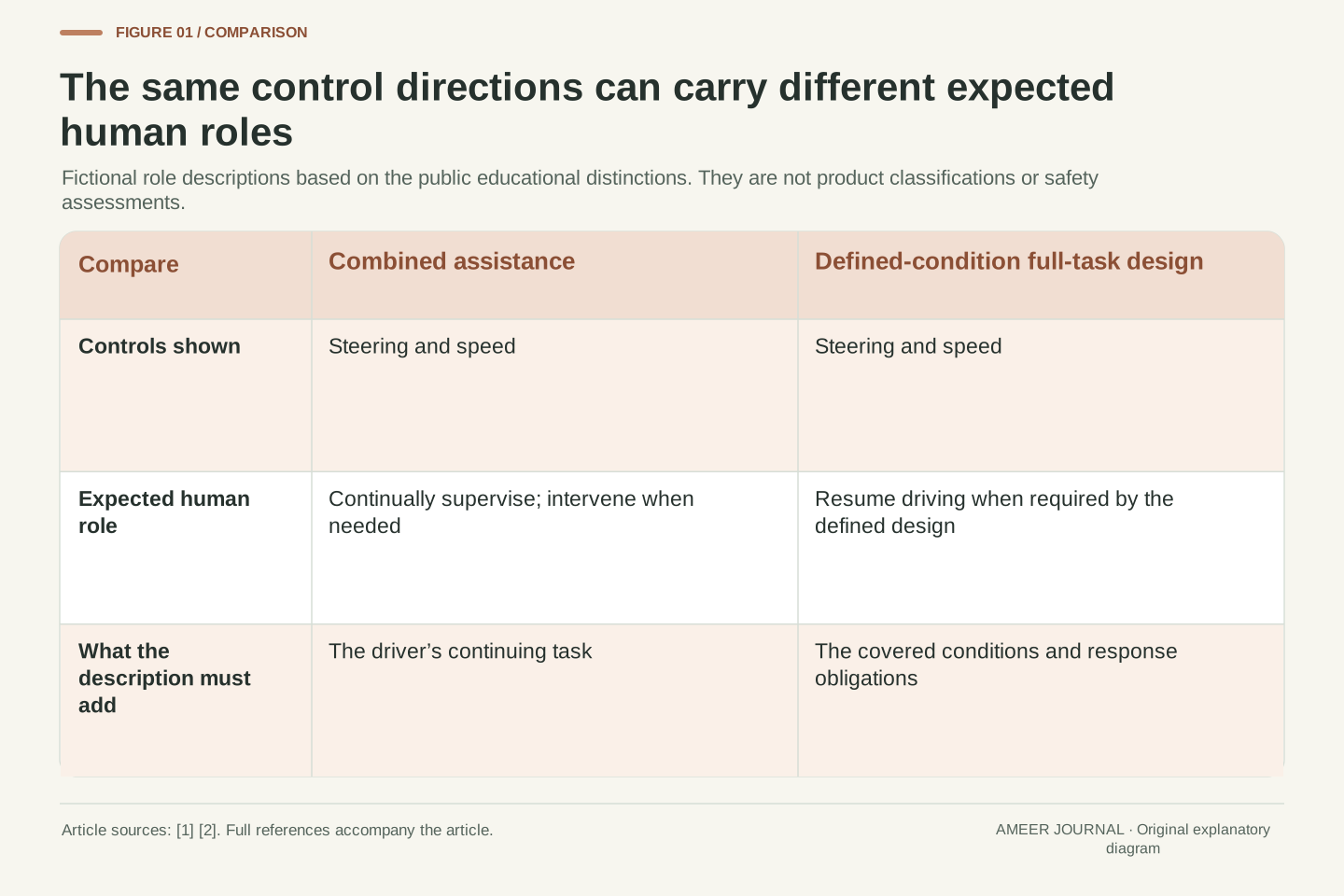
The same two controls can belong to different driving roles
A short video shows a car adjusting its speed and steering. What does that tell you about the person in the driver's seat? Less than it first appears. Combined steering and speed assistance can still require the driver to supervise continuously and intervene when needed. A different design can perform the whole driving task under defined conditions while expecting a person to resume driving when required. The distinction concerns the designed roles, not just which controls moved. SAE's public scope and NHTSA's educational descriptions make that separation explicit. [1][2]
We will use fictional feature descriptions and three invented activity logs to explore the difference. They describe no real car, road test or monitoring experiment. In the logs, every assistance state retains an attentive human driver; the question is how much each feature was active, not whether a person behaved correctly. The result is a practical reading skill: a list of features or a record of steering and speed commands cannot replace the documentation that states who must do what.
Observing simultaneous longitudinal and lateral control does not uniquely identify the allocation of the driving task. The public SAE scope distinguishes combined driver support with continual supervision from automated driving under defined conditions with a different expected human role. NHTSA likewise separates continuous two-direction assistance from full-task operation that requires a human to be available for takeover. [1][2] Actuator activity is evidence about outputs; actor responsibility is a statement about the design and engaged function.
The original examples below are abstract role cards and deterministic activity intervals, not reconstructed vehicle data or a formal certification exercise. Every state in the duration example explicitly retains the expected attentive driver. We calculate overlap between feature intervals without assuming any response latency, road coverage, actual attention or safety outcome. This isolates an inference error: a correct measurement of when a controller acted can still be insufficient evidence for a claim about who was expected to perform or supervise the complete task.
A brief intervention is different from continuing assistance
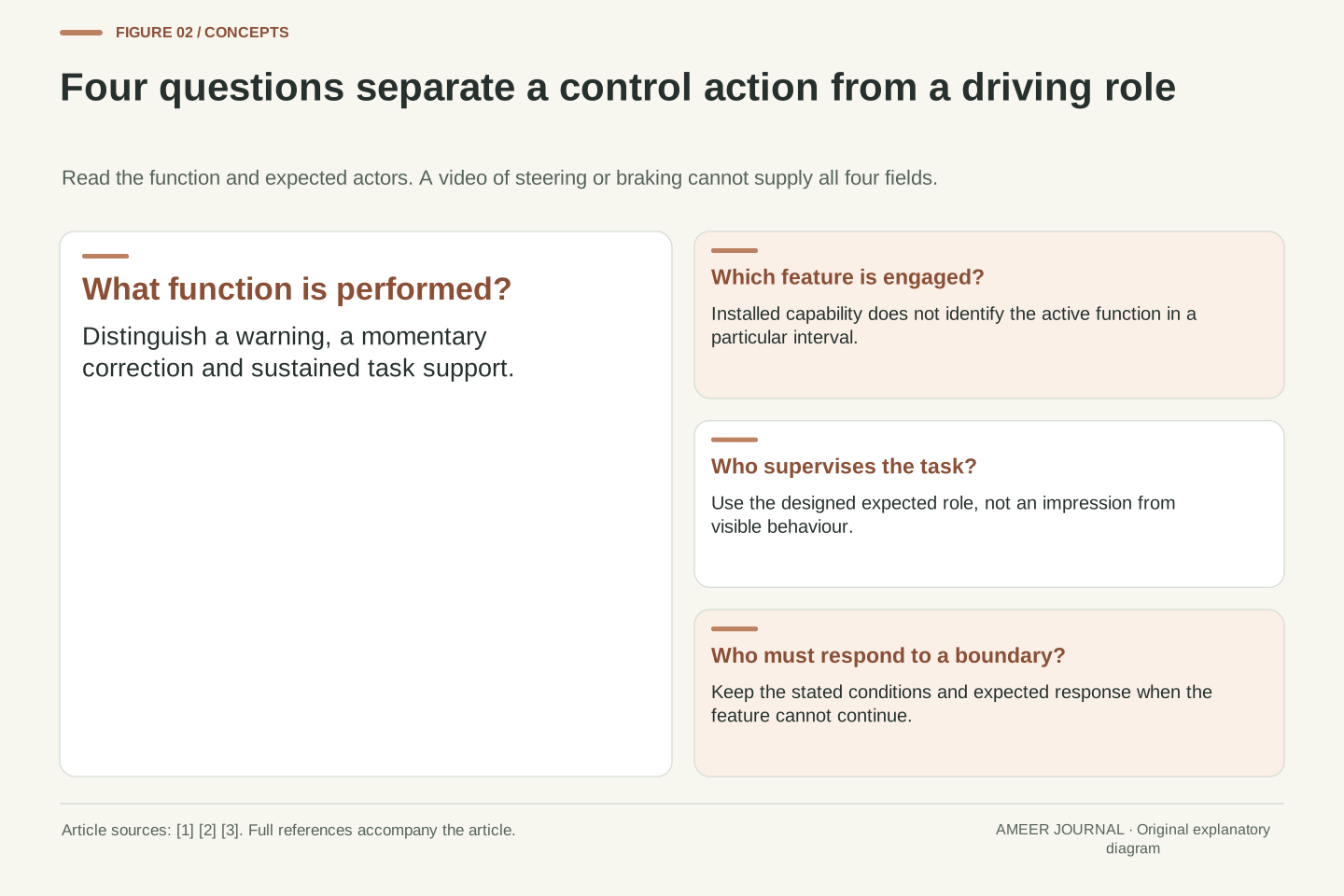
Begin by asking what the feature is intended to do. A forward-collision warning alerts the driver. Lane-departure warning also supplies an alert, while a departure-correction function can act to reduce unintended drift. Adaptive cruise adjusts speed in relation to traffic ahead, and lane centring provides continuing steering support. NHTSA describes these as different functions. [3] A brief brake application and a long period of speed regulation may use related vehicle controls, but their purposes and patterns of operation differ.
That distinction matters before counting automation features. SAE's taxonomy concerns part or all of the driving task performed on a sustained basis. It excludes warning-only functions and momentary safety interventions from that classification, while recognizing that such features can coexist with driving automation. [1] Adding several emergency or warning features therefore does not manufacture sustained automated driving. Nor does excluding a brief intervention from this taxonomy say it is unimportant; it says that the classification answers a narrower question about continuing task performance.
Separate functional purpose and persistence before reasoning from an actuator. NHTSA distinguishes a warning without avoidance action, a departure-related correction, adaptive speed regulation and continual lane centring. [3] A steering command alone cannot identify which of these objectives produced it. In particular, a momentary corrective action is not evidence that a sustained lateral-support feature remains engaged after the intervention ends.
The September 2026 SAE public scope explicitly restricts its driving-automation taxonomy to sustained performance of some or all of the dynamic driving task. Warning systems and momentary active-safety interventions are outside that scope, although they may be present at any automation level. [1] This prevents feature arithmetic such as counting several warnings and emergency interventions as successive steps toward full-task automation. A useful capability record identifies the actual function, its sustained or momentary role and the expected actors rather than treating every automated actuation as equivalent.
A person neglecting a role has not transferred it to the system
Suppose a fictional assistance feature's instructions require the driver to watch the road and intervene. Now imagine a recording in which the person stops doing that. The recording would show a failure to perform the expected role. It would not show that the feature had acquired a new ability or had become responsible for the whole task. SAE explicitly bases the role distinction on what the design expects, rather than whether the person actually fulfils that role. [1]
The reverse inference also fails. Seeing someone make no correction during one quiet interval does not prove that no intervention was required by the design. The person may have remained attentive while the assistance happened to follow the intended path. A record of physical interventions and a record of assigned duties answer different questions. Keep the distinction even when an advertisement emphasizes how relaxed or effortless a journey appears: a person's visible behaviour is not a substitute for the feature's documented supervision requirements.
Define expected role separately from observed compliance. The SAE public scope assigns actor roles according to system design, including the expected driving-task and fallback responsibilities. It specifically warns that a driver who neglects monitoring while using assistance remains the driver in the taxonomy. [1] Actual inattention is therefore not evidence of a successful transfer of the driving task to the automation. The classification can remain unchanged even when compliance changes, because the engaged feature and its expected roles are still the same.
This distinction also applies to an intervention-free log. Zero recorded human corrections is compatible with a continuously supervising driver whose intervention was never needed during that interval. It is also compatible with noncompliance; the control log alone does not discriminate between them. A classification based on expected roles should not be recomputed from an observed absence of steering-wheel or pedal movement. Such observations need their own interpretation and do not establish attention, readiness, task competence or the complete allocation specified by the design.
Adding steering support does not erase the supervising driver
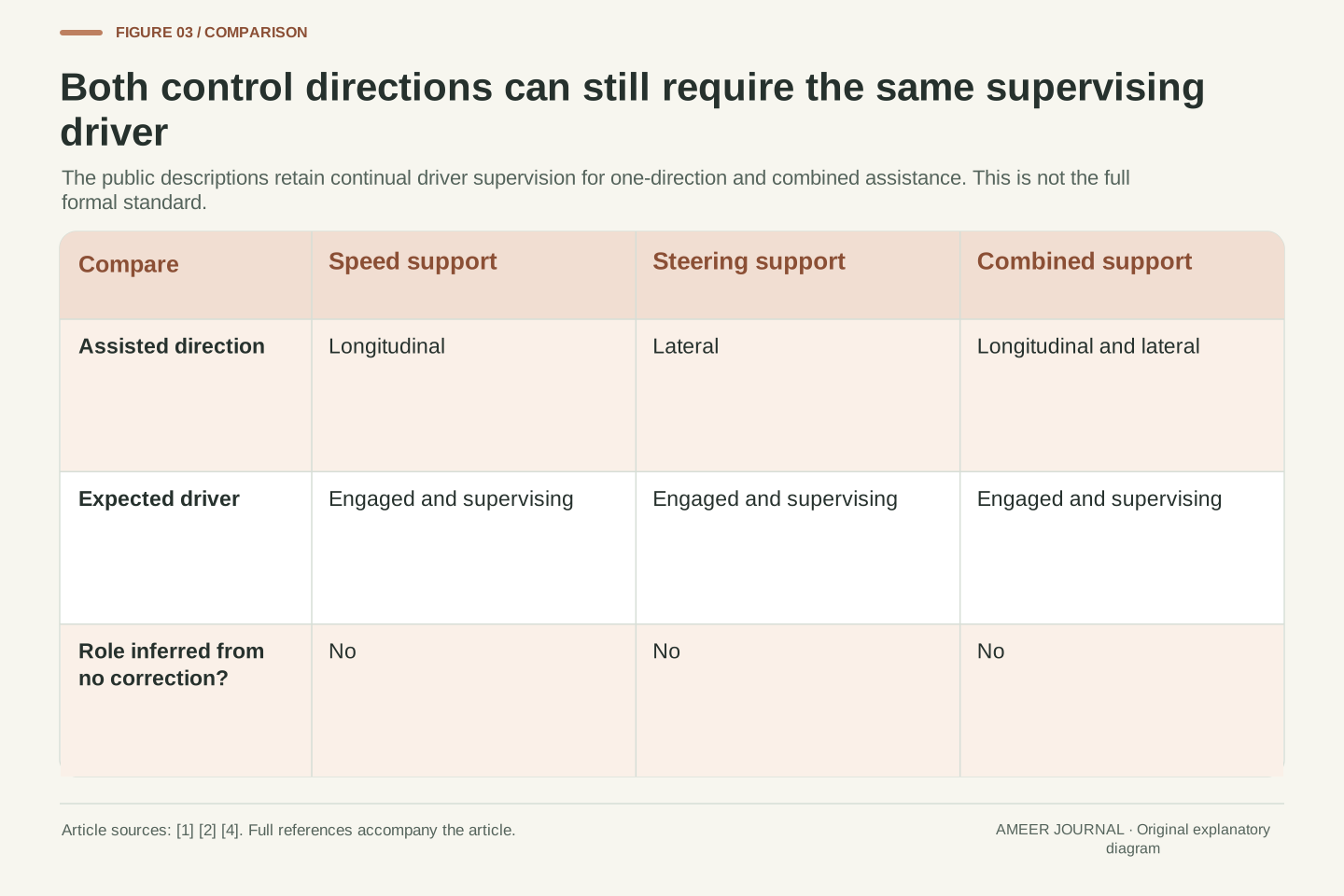
For a speed-only assistance feature, the system can regulate speed while the driver continues the other driving work and supervises the support. A steering-only feature changes a different part of the task. Combining the two expands the supported functions, but the public descriptions of combined assistance still retain continual driver supervision and intervention when needed. [1][2] The word both describes the two directions of control, not the removal of the human role.
Think of three fictional cards. The first says speed support with an attentive driver. The second says steering support with an attentive driver. The third says both kinds of support with an attentive driver. The control column changes across the cards; the supervision column does not. IIHS also states that partial driving automation does not replace the driver. [4] That comparison is more informative than counting pedals and steering as though automating both exhausted every judgment involved in responding to the road.
The SAE public descriptors associate continuing one-direction support with Level 1 and combined steering/speed support with Level 2, retaining continual driver supervision in both descriptions. NHTSA's educational account preserves the same engaged-driver distinction. [1][2] These public descriptions help explain roles; they are not the complete detailed definitions needed for a formal classification of a particular implementation. Changing what assistance controls and changing who is expected to supervise are separate changes in that account.
In a role matrix, the assisted-control set may change from longitudinal to lateral to both while the supervising-actor field remains human. Expanding that set does not prove that the feature assumes every remaining part of the driving task or its fallback obligations. IIHS makes the continuing driver role explicit for partial automation. [4] Keep that role attached to the feature description rather than deriving it from the number of automated control directions. A video showing both controls operating is consistent with combined assistance and cannot, by itself, establish a higher-level role allocation.
Describe the feature in use, not the best capability on the equipment list
A vehicle can have more than one available driving feature. The feature used at one moment may differ from the feature used later. SAE's public scope says the automation level of an operating instance follows the features actually engaged, rather than every capability installed in the vehicle. [1] A brochure can establish that a feature is offered without establishing that it was active throughout a particular journey. For example, a vehicle equipped with both supports could be using only one of them.
This is why a useful account needs both a feature description and a time record. A setting saved earlier, an available option and the currently engaged function should not be silently treated as one fact. NHTSA advises reading the particular owner's documentation and notes differences in manufacturers' names. [3] Our calculations will use explicitly stated activity intervals instead of guessing a universal dashboard meaning. They also keep the driver's expected role fixed, so a change in which assistance is active cannot be mistaken for an undocumented transfer of responsibility.
Distinguish the capability set of the equipped vehicle from its engaged-feature instance. The public SAE scope states that a vehicle can provide multiple features operating at different levels, while the level exhibited in a given instance depends on which features are engaged. [1] Classification is therefore not obtained by attaching the vehicle's highest advertised capability to every moment in its operating history. Feature availability is an equipment property; activity at a named time belongs to the operating record.
An activity record must identify its signals and their meaning. Configuration, eligibility and engagement are not established merely by the presence of a feature name. The particular documentation defines the relevant indications; NHTSA cautions that manufacturers use different names. [3] The abstract log below stipulates exact active intervals and omits interface behavior entirely. This avoids inventing a shared color convention or transition protocol. The recorded states tell us which assistance operates, while a separate declared field supplies the expected human role for every state.
Follow one hundred minutes without losing the overlap
Record A covers one invented 100-minute interval. Speed support operates from minute 10 until minute 70, lasting 60 minutes. Steering support operates from minute 40 until minute 90, lasting 50 minutes. Both features require an attentive driver whenever used. Outside their active intervals, the driver performs the corresponding control work. These are deliberately exact paper timings, with no actual journey or switching delay represented. We will follow the same clock for both features.
Break the record at minutes 10, 40, 70 and 90. The first ten minutes have neither support. The next thirty have speed support only. From 40 to 70, both operate for thirty minutes. From 70 to 90, steering support alone lasts twenty minutes. The final ten have neither. Adding the separate pieces gives the full 100 minutes. The complete timeline now says something that the two individual totals concealed: the system supported both directions for thirty minutes, not for sixty or fifty.
Let the observation window be [0,100) minutes. In original record A, the longitudinal-support interval is S=[10,70) and the lateral-support interval is L=[40,90). The intervals are half-open so each boundary belongs to only one adjacent state; isolated endpoints have zero duration. Every assistance state retains continual human supervision by stipulation. The example models activity membership, not an actual controller transition or driver response.
The partition is [0,10) neither, [10,40) S only, [40,70) both, [70,90) L only and [90,100) neither. Durations are respectively 10, 30, 30, 20 and 10 minutes. Thus |S|=60 min, |L|=50 min and |S∩L|=30 min. The two neither intervals sum to 20 minutes. This partition can be checked without assigning a numerical road speed. Each quantity has a defined denominator and temporal boundary; none is yet a distance fraction, a measure of workload or an observation that the supervising human actually remained attentive.
Two feature totals can count the same minute twice
Adding 60 minutes of speed support to 50 minutes of steering support gives 110 feature-minutes. That does not mean the 100-minute record contained 110 elapsed minutes of assistance. The thirty minutes when both were active were counted once in each total. Count that shared interval only once: 60 plus 50 minus 30 gives 80 minutes with at least one kind of support. The other twenty minutes had neither. Counting one minute once or twice is the entire reason the totals differ.
The expected driver role nevertheless covers all 100 minutes. That follows from how every state was defined, not from subtracting feature minutes from journey time. Eighty percent of the window had at least one support function and thirty percent had both. Neither percentage means time without a supervising driver. Likewise, 110 feature-minutes is a valid total of two activity counters if labelled that way, but it cannot be relabelled elapsed driving time. The calculation changes meaning when the counted unit changes.
Inclusion–exclusion gives |S∪L|=|S|+|L|−|S∩L|=60+50−30=80 min. Separate integration of the two activity indicators produces 110 feature-minutes because the overlap contributes twice. Integration of their logical union produces 80 elapsed minutes. The indicator sum is two during overlap, while the union indicator remains one. These are two valid aggregates of the declared record, with different meanings; the former is not a physical duration beyond the 100-minute observation window.
The four mutually exclusive states have durations 20 min neither, 30 min speed only, 30 min both and 20 min steering only. Their total is 100 min. The expected attentive-driver role is present in every state, so its duration is 100 min and the stipulated transfer-away duration is 0 min. The role distinction follows the design-based interpretation in the sources. [1][4] An assistance-activity fraction is therefore not a driver-replacement fraction, and the declared responsibility record is still not a measurement of actual compliance.
![The original activity states partition one hundred elapsed minutes. Record A: speed [10,70), steering [40,90), window [0,100), all in minutes. Every state retains an attentive driver by stipulation.](/media/production/830e62b22bd3a89c2d7755c0fdd405531ff91a65c4df4ee7ecb897164d1dc82e.svg)
Identical separate totals can hide different amounts of combined support
Now read a separate record B. Speed support lasts from minute zero to 60, and steering support from 50 to 100. The individual totals remain sixty and fifty minutes. Their overlap is only ten minutes, from 50 to 60. At least one function is active throughout the 100-minute window. This is not a change observed after record A; it is another invented arrangement showing that the same two totals can describe a different history. The difference is the relative placement of the two intervals.
Record C makes the opposite comparison. Speed support runs from 10 to 70, while steering support runs from 10 to 60. All fifty steering minutes fall inside the sixty speed minutes. Combined assistance therefore lasts fifty minutes, and the union lasts sixty. A, B and C share the same individual totals, yet their combined durations are 30, 10 and 50 minutes. Ask for the overlap or the actual intervals before claiming how long both operated. In all three records, the expected human driver role remains unchanged throughout.
For independent record B, choose S=[0,60) and L=[50,100), giving overlap 10 min and union 100 min. For independent C, choose S=[10,70) and L=[10,60), giving overlap 50 min and union 60 min. Both preserve |S|=60 min and |L|=50 min. The separate marginal durations therefore do not identify the duration of the joint active state. The extra overlap in C is offset by additional time with neither feature active: C has 40 such minutes, whereas B has none. Both records still fill the same 100-minute observation window.
The allowable overlap x obeys x≤min(60,50)=50 min. Because the union cannot exceed the 100-minute window, 60+50−x≤100, so x≥10 min. Hence 10≤x≤50 min. B and C attain the two bounds; A lies between them. These are exact constraints on the stipulated sets, not confidence intervals or probabilities. Nor does a larger overlap establish greater safety, reduced supervision or a longer distance traveled with assistance. Those conclusions require different evidence from the two activity durations.
Conditions and the response when they end are separate questions
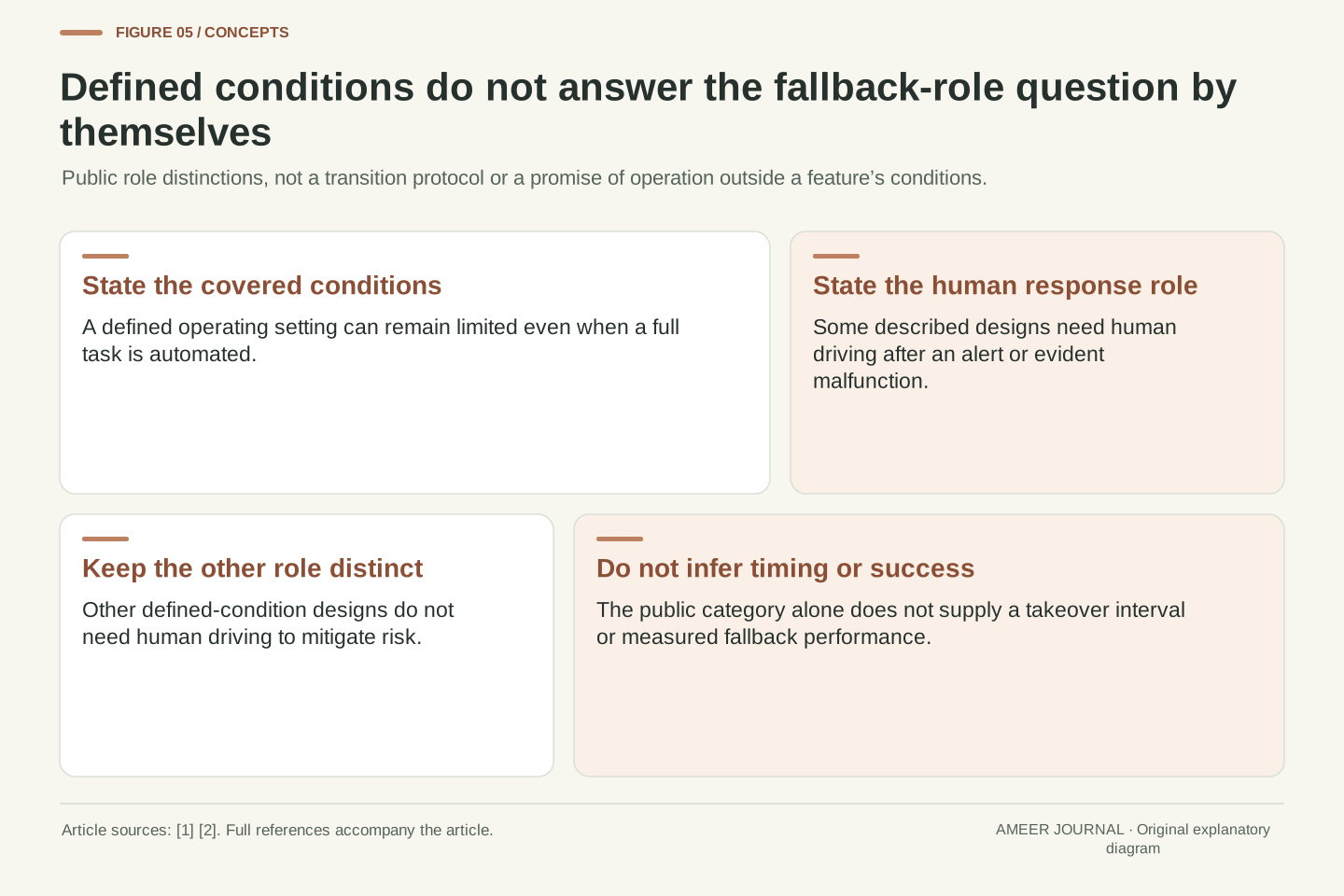
The next distinction needs information that an activity timeline does not contain. Under what conditions is a full-task feature designed to operate, and who must act when it cannot continue? The public SAE descriptors distinguish defined-condition automated driving that needs human driving after an alert or evident malfunction from defined-condition automated driving that does not need human driving to mitigate risk. [1] Both descriptions include limits on conditions; the difference is not simply whether steering and speed are controlled.
Read those two fields separately. A fictional description might identify a limited operating setting yet leave the expected response to a problem unspecified. Knowing the setting does not fill that missing role. Equally, a statement that no human driving is needed within a defined design does not promise operation everywhere. NHTSA's educational account distinguishes limited-service operation from universal operation. [2] A narrower operating range and a different human role can coexist; neither can be recovered by counting the control functions that appeared in a video.
Operating conditions and fallback-role allocation are distinct dimensions. The September 2026 public descriptors distinguish Level 3, where human driving is needed after an alert or evident malfunction, from Level 4, where human driving is not needed to mitigate risk under the defined conditions. [1] This is an explanatory use of the public scope, not an assertion that its simple descriptors reproduce all detailed requirements of the standard.
An engaged feature's role record should identify the covered conditions, expected actor while operating and expected response when continued operation is not possible. A stated domain restriction alone cannot determine that response. Conversely, a no-human-driving role within a defined design does not establish an unrestricted domain. NHTSA's educational comparison retains limited-service conditions for the relevant category. [2] The distinction prevents a partial specification from being filled with assumptions about takeover timing, fallback success or permission to operate outside the feature's documented limits.
A driver monitor supports the assigned role rather than deleting it
A system may include ways to monitor the driver or issue attention reminders. Those functions concern how the design encourages or checks continued involvement. They do not, just by existing, convert the underlying assistance into a design that requires no driver. IIHS treats driver monitoring, escalating attention alerts and fail-safe procedures as subjects of its partial-automation safeguard assessments. [4] They are important separate questions about the support around a role that still exists.
Imagine two fictional features with the same steering-and-speed support and the same continual-supervision requirement. Their reminder arrangements differ. A comparison of those reminders could be meaningful without changing either feature's basic role allocation. It also would not tell us whether a particular person paid attention on a particular trip. Keep the feature description, its safeguards and actual behaviour in separate fields. That allows each piece of evidence to answer its own question instead of letting one reassuring label stand for all three.
Driver-monitoring and alert functions concern the interaction with an expected human role. IIHS describes partial-automation safeguards in terms that include monitoring, escalating attention alerts and fail-safe procedures. [4] A statement that such a safeguard exists is not evidence that the system has assumed the complete driving task or removed the driver's obligation to supervise the assistance. Examine the safeguard as a documented mechanism for supporting that role, not as a reason to delete the role from the record.
Two designs can share the same role allocation while implementing different monitoring and escalation strategies. Evaluating those strategies is therefore a different exercise from assigning the automation-role category. A further distinction separates design capability from the observed state of a particular person: neither an advertised monitor nor the absence of an alert establishes continuous actual attention. The role matrix, safeguard evidence and behavioural observations should remain independently labelled. This article does not derive a measured monitoring accuracy, comparative safeguard rating or crash outcome from any of those descriptions.
An automation category is not a safety score
The SAE page used here is the public scope of its September 2026 revision. It explicitly says that its simple level descriptions are not the detailed definitions, and that the document supplies a taxonomy rather than a safety standard. [1] That gives the reader two useful limits: a short category description is not a complete product assessment, and a category number is not a measured safety result. Check the category's purpose before treating it as a quality ranking.
IIHS likewise cautions that higher automation does not automatically guarantee greater safety. [4] A claim about safety needs evidence for the relevant system, conditions and outcome. A claim about human involvement needs its role documentation. A claim about time in use needs its activity record. None should silently replace the others. The definitions discussed here also do not decide where a particular feature is lawful to use or which products are currently available. Those are separate, specific questions rather than properties hidden inside an automation label.
Retain the evidence version and its scope. This article uses the publicly retrieved September 2026 J3016 scope, whose simple descriptors are explicitly distinguished from the detailed level definitions. The scope also states that the document is a taxonomy, not a safety standard or guidance for safe system operation. [1] No claim is made to have assessed a vehicle against the complete paid standard. An audit should preserve the version supplying each definition instead of silently mixing older and newer descriptions.
A category is therefore not an empirical safety score. IIHS explicitly rejects the inference that a higher level must produce improved safety. [4] Safety assessment requires appropriate conditions, endpoints and evidence; legal authorization and present product availability require their own records. Keeping these questions separate also avoids importing inconsistent availability statements from general educational pages. The source-supported conclusion here concerns expected actor roles and the information needed to interpret active-feature records, not a ranked list of vehicles or a jurisdictional operating decision.
Keep the function, the interval and the expected person together
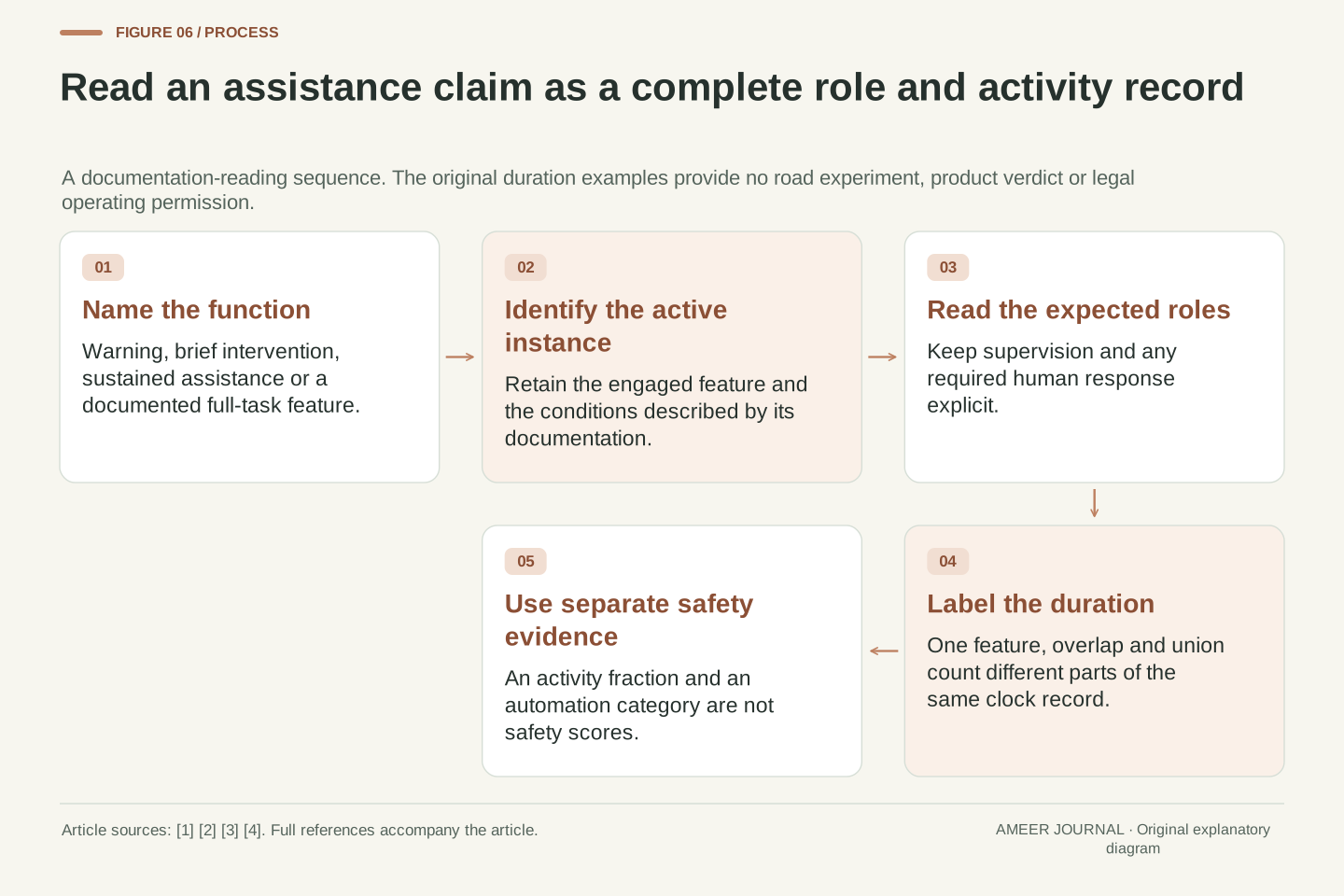
When reading a feature claim, first name its job: warning, brief intervention, continuing assistance or a documented full-task function. Then identify the feature actually engaged and the conditions attached to it. Read the expected human role directly, including supervision and any requirement to resume driving. Use the particular owner's documentation for the vehicle's features rather than inferring those duties from a name or an impressive demonstration. [1][3]
For a usage claim, keep the clock record beside the role description. Ask whether a number counts one feature, their overlap or their union. Our 60/50-minute totals allowed combined durations from 10 to 50 minutes, while none of the three stipulated records transferred the attentive-driver role away. That is the useful distinction to retain: more automated control activity can be real and useful without answering every question about human involvement. An explanation becomes clearer when each claim names both the quantity being counted and the responsibility that the design still assigns.
A defensible interpretation records function, engaged instance, operating conditions, expected human participation and evidence type. The public taxonomy supplies the role distinction; particular feature documentation supplies the implementation context. [1][3] Keep momentary intervention separate from sustained support, installed capability separate from engagement, and expected supervision separate from observed compliance. A useful final record can contain a known activity state alongside an unresolved classification field.
For temporal claims, preserve the observation window and joint activity information. Record A demonstrates why 110 feature-minutes correspond to 80 union minutes and 30 overlap minutes, while the attentive-driver role covers 100 minutes. B and C show that identical marginal totals do not identify overlap. None of these aggregates supplies a safety score or an unobserved transfer of the driving task. A useful report states exactly which part of that chain its evidence establishes and retains the missing fields as questions for the appropriate documentation or assessment.
Sources & further reading
Explore the references behind this guide. External pages may change after our review.
- J3016_202609: Taxonomy and Definitions for Terms Related to Driving Automation Systems for On-Road Motor Vehicles - Recommended PracticeSAE International · Accessed 7 Nov 2026
- Automated Vehicle Safety | NHTSANHTSA · Accessed 7 Nov 2026
- Driver Assistance Technologies | NHTSANHTSA · Accessed 7 Nov 2026
- Advanced driver assistanceIIHS · Accessed 7 Nov 2026
Article updated 7 Nov 2026.
Found something we should revisit?
Good explanations get better with thoughtful feedback.