What you’ll take away
- Use a consistent energy boundary: wall electricity and added usable battery energy are different quantities.
- Calculate with the limiting vehicle-and-installation power, not the wallbox label alone.
- Check energy before every departure and whether a real recovery session closes the weekly deficit.
- Stress-test a missed session and replace hypothetical inputs with documented specifications and suitable observations.
Start with the hours you can actually use
A car can be parked at home for ten hours and have only four hours available for the charging plan you chose. Perhaps the cheaper electricity period is short, someone returns late, or the car must leave early. Those are different limits. Home-charging guidance from the U.S. Department of Energy discusses both overnight charging and time-of-use electricity rates, so a useful plan needs the driving requirement and the available time together [4]. Writing down “charge overnight” leaves the important question unanswered: how much energy must be ready at the next departure?
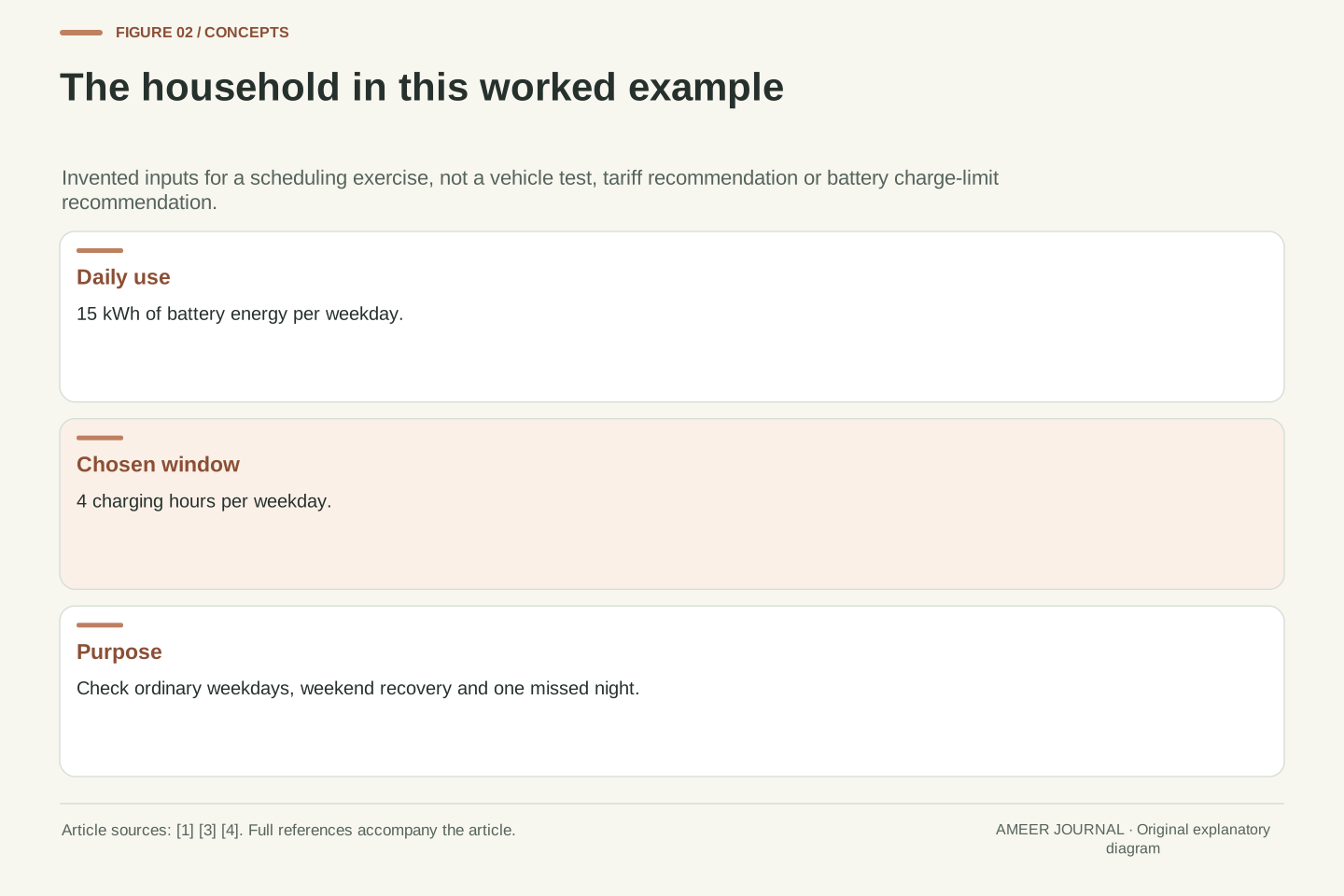
Imagine two people sharing one car. Their combined weekday journeys use an invented 15 kilowatt-hours of battery energy each day. They want to use a four-hour charging window. No real car, tariff or household was tested for this example. We will keep the numbers visible, check a whole working week and then remove one charging night. The purpose is to show which questions to ask about your own routine. The final choice still needs your vehicle's instructions, actual energy records and a suitable, professionally assessed installation [3][4].
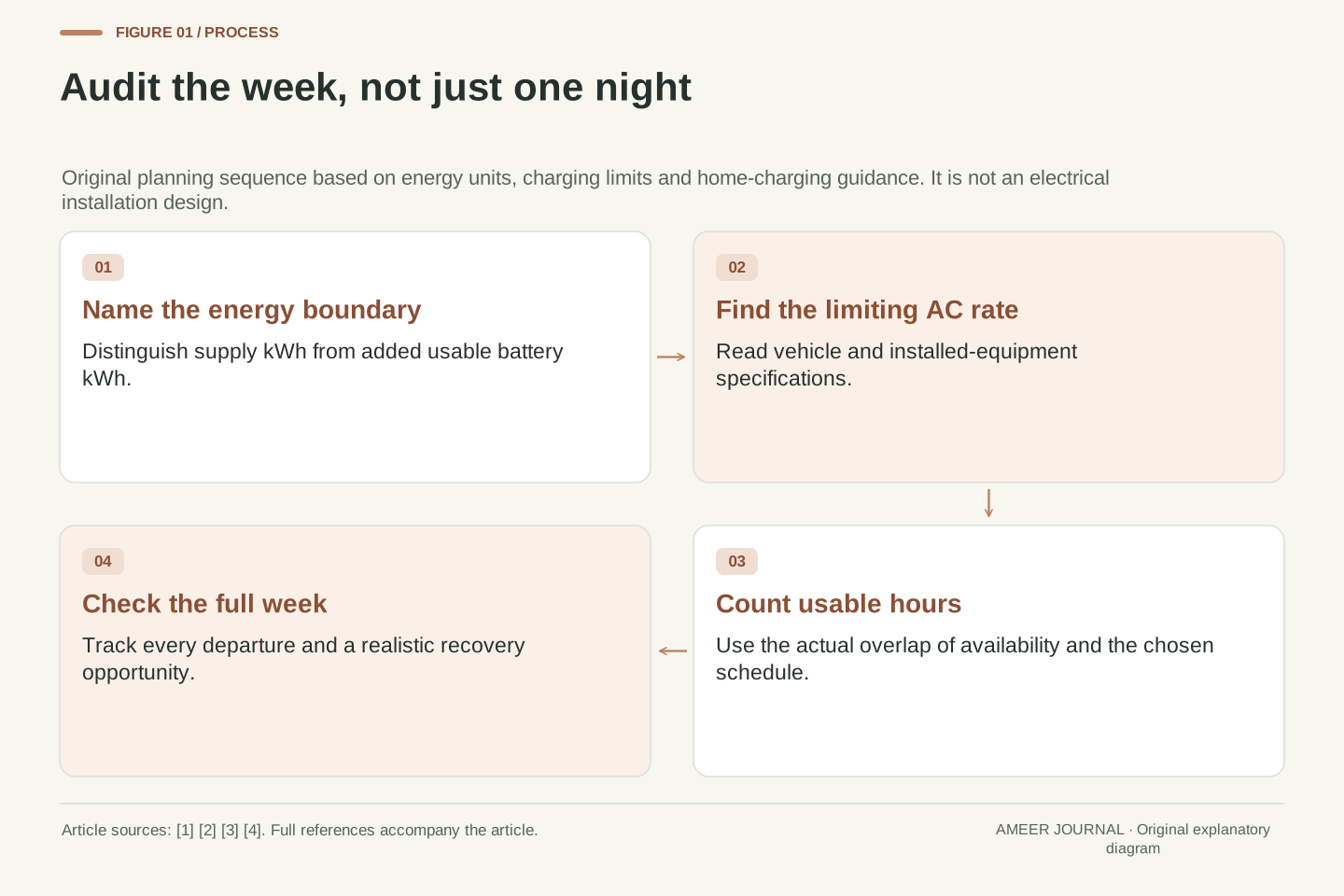
A residential charging plan is a scheduling problem with an energy balance. Its useful time interval is the overlap between vehicle availability, the selected charging schedule and any relevant electricity-price window. Connected duration alone is insufficient. AFDC identifies both vehicle/equipment characteristics and battery state as charging-time variables, while its home guide discusses time-of-use rates and charging timers [3][4]. Define the required departure state first, then evaluate whether the permitted interval can supply the corresponding energy. This avoids treating a long parking dwell as evidence that a short tariff window is adequate.
The worked case is deliberately synthetic: one shared vehicle, 15 kWh of battery-side weekday consumption, four usable charging hours per weekday, and a later opportunity for weekend recovery. Every numerical result below follows from stated assumptions rather than a vehicle measurement. The exercise isolates an overlooked distinction between daily replenishment and weekly sustainability. A schedule can miss its daily replacement target yet remain feasible over a week if the battery has sufficient working headroom and a genuine recovery interval. Conversely, a large battery can temporarily conceal a persistent energy deficit; it does not remove that deficit.
Keep wall energy and battery energy in separate columns
Kilowatts, written kW, describe a rate. Kilowatt-hours, written kWh, describe an amount of energy. A steady one-kilowatt load running for one hour uses one kilowatt-hour [1]. For our schedule, the car needs 15 kWh added back to its battery after each weekday. That is not automatically the amount the household meter will record. EPA explains that charging loses some energy through conversion and heat, and that its MPGe figures include charging losses at the wall-outlet boundary [5]. Before using any consumption number, find out which side it describes.
For this invented case, assume that 90% of the electricity drawn for a charging session becomes added usable battery energy. That is a convenient calculation assumption, not a measured efficiency or a promise for your car. Replacing 15 battery kWh would then require 15 divided by 0.90, or about 16.67 kWh from the supply. If a different estimate already counts electricity at the wall, do not add the same allowance again. Label your worksheet columns “wall energy” and “battery energy”; a clear label prevents more confusion than extra decimal places.
Choose a measurement boundary before calculating a charging duration or bill. Let E_b denote the increase in usable battery energy and E_w denote the associated AC energy drawn at the charging supply. Power and energy are related through duration; for constant power, E = P × t [1]. EPA's MPGe procedure includes AC Level 2 cable and onboard-charger losses, explicitly moving its accounting boundary to the wall outlet [5]. An onboard driving-consumption estimate and a wall-inclusive replenishment estimate therefore must not be mixed without examining their definitions.
For the synthetic model, set the aggregate wall-to-usable-battery factor η to 0.90, held constant across the modeled interval. Then E_b = ηE_w and E_w = E_b/η. A 15 kWh battery replacement becomes 16.666… kWh at the wall. η here absorbs the modeled difference between supply energy and added usable energy; it is not a component-efficiency specification. Actual auxiliary loads and operating conditions may make that relationship vary, so the assumption must be replaced with suitable observations before it is used to predict a particular vehicle. Never apply a second loss factor to a quantity whose defined boundary already includes those losses.
A higher wallbox rating cannot remove the car’s AC limit
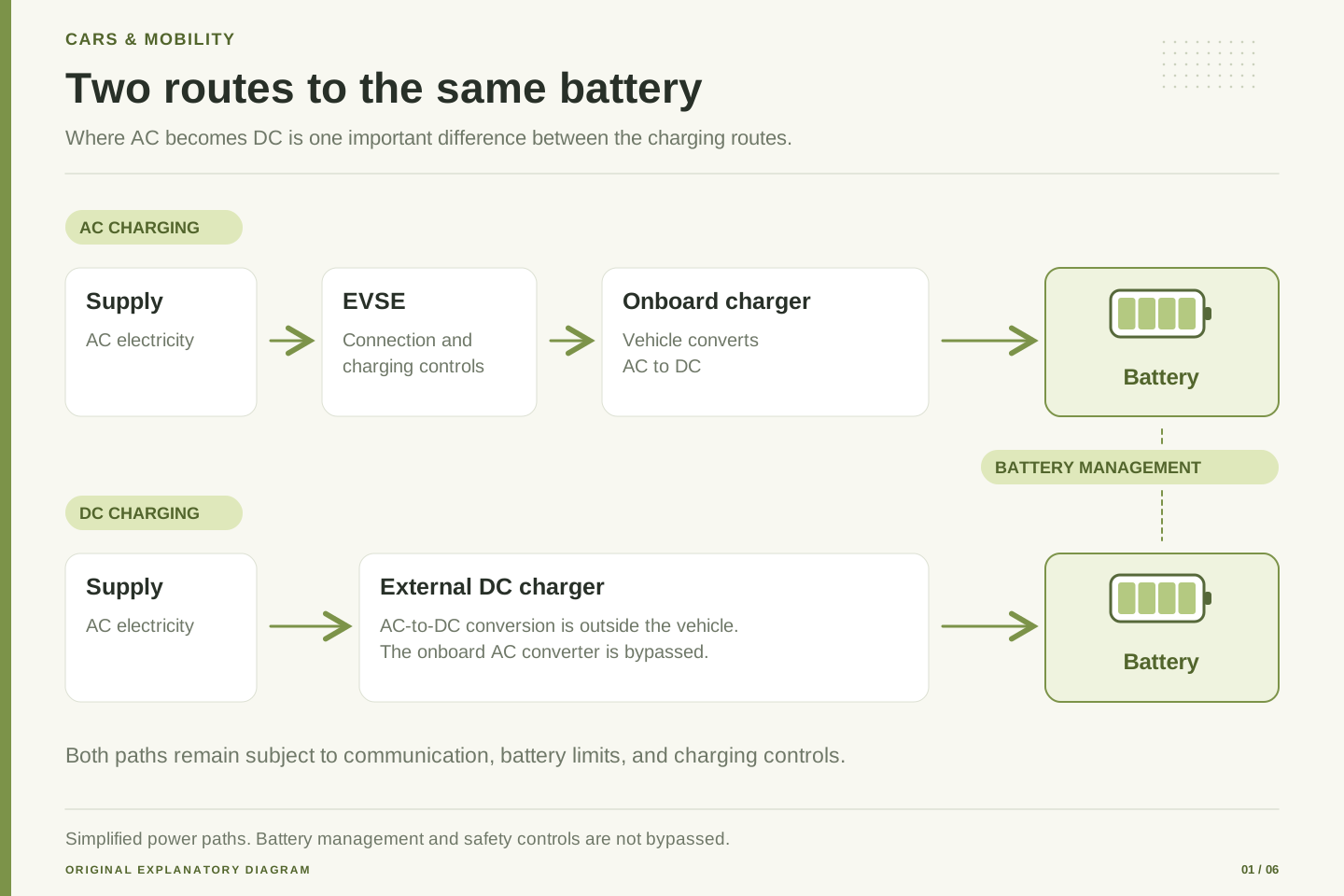
For AC charging, the car's onboard charger changes the incoming electricity into DC for its traction battery. It also communicates with the charging equipment and monitors battery conditions [2]. The wall unit is therefore only one part of the path. AFDC lists the vehicle's internal charger capacity and the charging equipment among the things that affect charging time [3]. A bigger number on a wallbox is not evidence that every connected car can use that number. Check the vehicle's AC charging specification, not just a headline fast-charging claim.
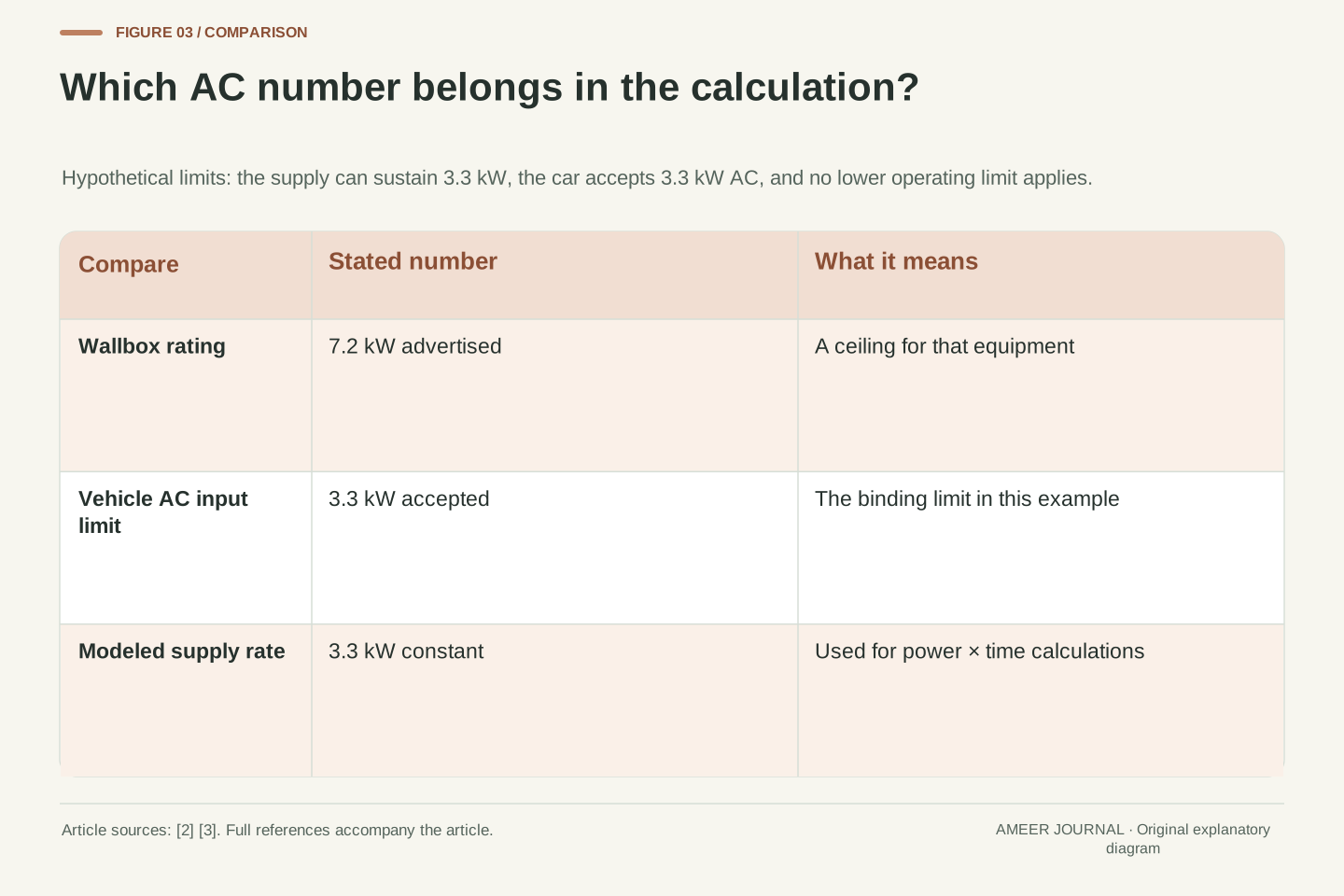
Give our fictional home a wallbox advertised at 7.2 kW, while its car accepts at most 3.3 kW from that AC connection. Assume the installed supply allows that 3.3 kW continuously and no other limit reduces it. The calculation must use 3.3 kW. Replacing the wallbox with another higher-rated unit would not change this particular bottleneck. This is a comparison of stated limits, not advice to alter electrical settings. The Level 1 and Level 2 labels in the cited U.S. guidance describe that region's arrangements; readers elsewhere should use the specifications and installation requirements that apply locally [3][4].
The AC conversion boundary matters when interpreting ratings. The onboard charger receives AC through the charge port and supplies DC to the traction battery; AFDC also describes its communication and battery-monitoring functions [2]. A residential EVSE rating, a vehicle AC acceptance rating and a DC fast-charging maximum describe different parts or operating modes. AFDC specifically identifies internal charger capacity, charger output and electrical-service specifications as contributors to charging duration [3]. Comparing unlike ratings can make an otherwise correct energy calculation irrelevant to the installed system.
In the model, P_EVSE,rated = 7.2 kW and the vehicle's accepted AC input is capped at 3.3 kW. Assume the installation can continuously provide 3.3 kW and that neither operating conditions nor settings impose a lower limit. Thus P_w = 3.3 kW, not 7.2 kW; modeled net storage power is ηP_w = 2.97 kW. This is a simplified constant-power assumption, not a claim that an AC session is always flat. U.S. voltage, connector and circuit examples in the sources are jurisdiction-specific. The numerical exercise does not select a circuit rating, authorize an adapter or establish compliance in another country [3][4].
Calculate one ordinary night before planning the week
Now multiply the rate by the usable time. Four hours at our assumed 3.3 kW draws 13.2 kWh from the supply. With the invented 90% factor, 11.88 kWh reaches the modeled battery energy balance. The car used 15 kWh during the day, so the night leaves a 3.12 kWh shortfall. These are applications of the energy-and-time relationship explained by EIA, with our own assumptions added [1]. The four-hour window does useful work; it simply does not replace everything used that day in this example.
There are several different ways to respond to a shortfall, and buying equipment is only one question among them. At the same modeled rate, replacing all 15 kWh takes about 5.05 hours: 15 divided by 2.97. That is roughly one hour longer than the chosen window. You could investigate whether extra charging time is practical, whether a planned later session can recover the deficit, or whether a different setup would genuinely remove the limiting factor. Compare those options using your real routine. A faster wallbox helps only when the rest of the system can use its extra capacity [2][3].
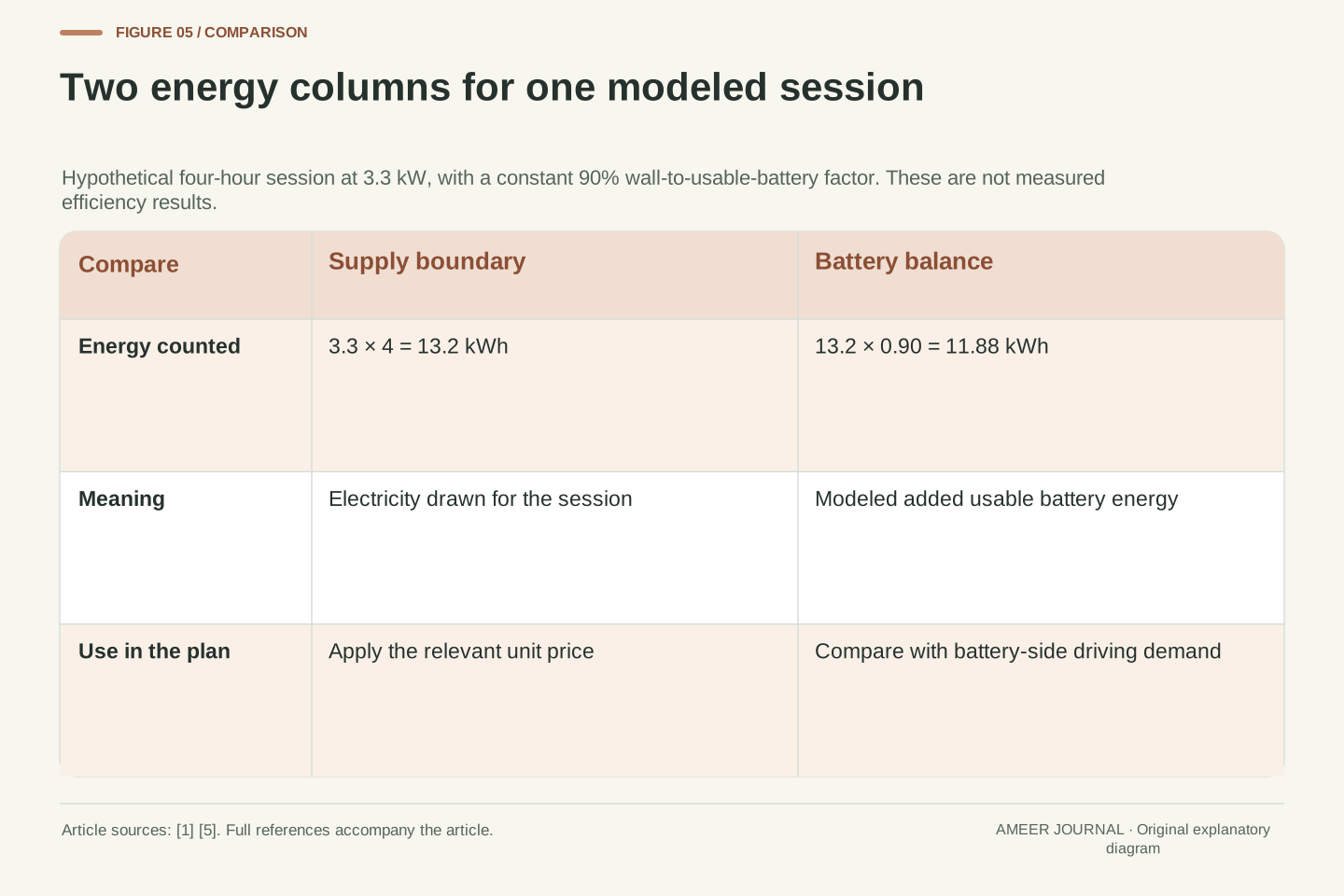
For a four-hour eligible interval, modeled supply energy is E_w = 3.3 × 4 = 13.2 kWh. Added usable battery energy is E_b = 0.90 × 13.2 = 11.88 kWh. Subtracting this from the assumed weekday demand gives a daily deficit D = 15 − 11.88 = 3.12 kWh. The calculation uses an energy boundary consistently from beginning to end: supply power is converted to stored energy before being compared with battery-side demand. The dimensional relationship comes from the definition of kWh; the power, efficiency and demand values are invented inputs [1].
The corresponding continuous replenishment duration would be t = 15/(0.90 × 3.3) = 5.0505… hours. This provides a useful threshold for evaluating schedule changes, but should not be presented as a guaranteed completion time. Real charging may depart from the assumed power and efficiency, and the battery may reach a selected limit before the entire interval is used [3]. The practical comparison is between additional usable hours, any justified equipment or vehicle change, and a later recovery opportunity. Distinguish a supply constraint from an onboard constraint before attributing value to a higher advertised EVSE rating.
A daily deficit and a failed weekly plan are different things
Over five identical weekdays, the shortfall grows to 5 × 3.12 = 15.6 battery kWh. Suppose the fictional car starts Monday with 54 kWh of usable energy and has a chosen working reserve of 18 kWh. Those are only worksheet assumptions, not recommended charge levels. After Monday's driving and charging it has 50.88 kWh; after five such cycles it has 38.4 kWh. The lowest weekday point is just before Friday's charge, at 26.52 kWh. Checking that low point matters: an acceptable Friday-night total would not rescue an earlier departure that lacked enough energy.
If there is no weekend driving or other modeled energy use, recovering the missing 15.6 kWh at 2.97 kW takes about 5.25 hours, or 5 hours 15 minutes. A genuinely available six-hour weekend session can cover it under these assumptions. That makes the fictional week repeatable without replacing the full daily amount every night. It does not prove that this schedule fits your household. Change the starting energy, weekday trips, reserve or weekend availability and redo the balance. The useful result is a method for checking every departure and recovery period, rather than a universal overnight rule [1][3].
Represent each weekday as a demand event followed by a charging event. With B_0 = 54 kWh, daily demand U = 15 kWh and restoration R = 11.88 kWh, the end-of-night state is B_n = 54 − 3.12n for n = 1…5. The Friday post-charge value is 38.4 kWh. More importantly, the pre-charge minimum occurs after Friday driving: 54 − 4(3.12) − 15 = 26.52 kWh. Both the starting energy and the 18 kWh working reserve are arbitrary planning inputs; they are not manufacturer limits or battery-health recommendations.
The recovery requirement is 54 − 38.4 = 15.6 kWh. At the same modeled net rate, t_recovery = 15.6/2.97 = 5.2525… hours. A six-hour weekend opportunity is sufficient only under the explicitly stated assumptions of no intervening consumption, continued power availability and sufficient permitted battery headroom. The recurrence also shows why checking a weekly total alone is insufficient: energy must be available before each demand event, not merely by the end of the week. This is original scheduling analysis using the power–energy relation and the source-supported dependence of charging on vehicle and equipment conditions [1][3].
A cheaper tariff is useful only while the car can charge
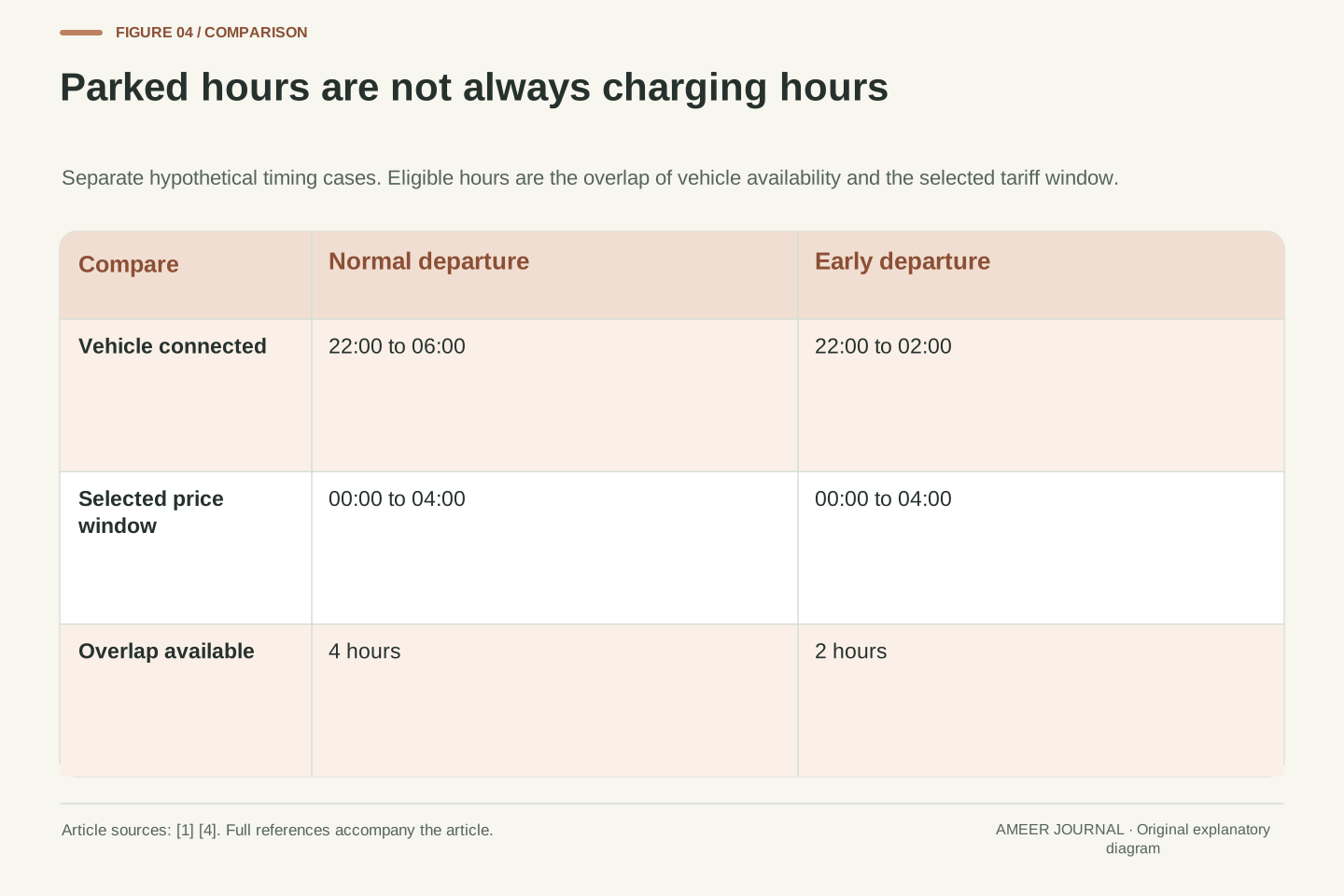
Consider a separate invented timing example. A car is plugged in from 22:00 until 06:00, but the chosen lower-price period runs from midnight to 04:00. That gives four eligible hours, not eight. If the driver unexpectedly leaves at 02:00, only two of those lower-price hours remain available. Charging timers are among the features offered by some home equipment, and AFDC advises checking electricity-rate options with the utility [4]. Your worksheet should show the overlap of the actual parking period and the charging schedule, including any planned early departure.
An attractive unit price does not make missing energy disappear. For our normal four-hour case, the modeled 13.2 wall kWh would cost $1.32 at an invented $0.10 per kWh. A further 3.12 battery kWh would require about 3.47 wall kWh at the same assumed efficiency; at an invented $0.25 per kWh, that would add about $0.87. These are arithmetic examples, not current tariffs or a complete electricity bill. Use your own plan's terms and charges, and compare a workable schedule with another workable schedule instead of comparing an adequate plan with one that leaves you short [1][4].
Treat the tariff window and vehicle presence as intersecting intervals. In the separate scheduling example, availability [22:00, 06:00] and the selected low-rate window [00:00, 04:00] intersect for four hours. An actual 02:00 departure reduces the intersection to two hours. If independent vehicle and EVSE scheduling controls are configured, examine their combined behavior rather than assuming either schedule alone determines the session. This is a conditional planning check, not a claim that every product has two timers or resolves conflicts in the same way. AFDC documents timers as an optional smart-EVSE feature [4].
For a deliberately simplified tariff with no added charges, the normal window uses 13.2 kWh × $0.10/kWh = $1.32. The daily 3.12 kWh battery deficit corresponds to 3.4666… supply kWh under the same η, costing approximately $0.87 at the invented outside-window price of $0.25/kWh. These figures illustrate marginal energy cost only. They exclude fixed charges, taxes, demand-based charges where applicable, and any tariff conditions. AFDC notes that residential charging costs depend on equipment and timing, and that some utilities offer time-of-use rates [4]. Do not transfer these hypothetical prices into a claim about current savings.
Stress-test one missed night
A schedule that works on a tidy calendar may have very little room for disruption. Remove one of the five four-hour weekday sessions from our invented week, while leaving the driving unchanged. You lose 11.88 kWh of planned battery restoration. The amount that must be recovered for the next identical week becomes 15.6 + 11.88 = 27.48 kWh. At our assumed 2.97 kW net rate, that takes about 9.25 hours. The six-hour weekend opportunity that was sufficient before is now too short. A single missed session has changed the weekly answer.
Check the low-energy point as well. If an earlier weekday charge is missed, Friday's pre-charge energy becomes 26.52 − 11.88 = 14.64 kWh, below the invented 18 kWh working reserve. The example fails that chosen planning constraint before the weekend even arrives. It does not justify driving with an unsuitable reserve to protect a cheap tariff. Identify a realistic backup opportunity in advance, then check its access, compatibility and time allowance. AFDC treats home, workplace and public charging as complementary opportunities; whether a particular one is available to you must be confirmed [3][4].
A one-session sensitivity test distinguishes nominal feasibility from resilience. Removing one weekday charging event subtracts R = 11.88 kWh from every subsequent energy state until recovery. The end-of-week deficit becomes 15.6 + 11.88 = 27.48 kWh. Required recovery duration is 27.48/2.97 = 9.2525… hours. The available six-hour weekend interval supplies at most 17.82 kWh in the constant-rate model, so it cannot return the vehicle to the chosen starting state. The original schedule has no demonstrated resilience to this particular failure case.
Timing of the failure matters. When a charge before Friday is missed, the Friday pre-charge state drops from 26.52 to 14.64 kWh, violating the hypothetical 18 kWh reserve. Missing only Friday's later session produces a different within-week minimum, even though the final energy deficit is the same. Evaluate event order explicitly rather than attaching a generic percentage margin to a weekly sum. A backup plan needs an accessible charging opportunity and a revised energy/time calculation; home, workplace and public locations are options in the AFDC framework, not guarantees of a compatible, open or available port at a particular time [3][4].
Check the record, not just the “plugged in” icon
After an ordinary week, compare the plan with whatever session records your equipment or vehicle actually provides. Useful entries include connection time, charging start and end, supplied kWh, departure time and the vehicle's indicated battery level. Some smart home equipment offers data collection and displays, but those features are not universal [4]. Keep uncertainty visible when a number is unavailable. A single household-meter total also includes other household electricity use; do not label all of it as car charging simply because the car was plugged in [1].
In our invented four-hour session, the two energy columns would read 13.2 kWh from the supply and 11.88 kWh added to the modeled battery. Their difference is already built into the 90% assumption. Actual displays can use different definitions, so read the documentation before treating their subtraction as a precise efficiency test. Likewise, hours connected are not automatically hours of energy delivery. Use observed records to identify whether the shortfall came from less time, less power or more driving than assumed. Then change the affected input instead of rewriting every part of the plan.
Validate the model with records whose measurement boundaries are documented. Useful fields are connection timestamp, energized interval, reported energy delivered, departure timestamp, vehicle state indication and any documented reason for interruption. AFDC lists data collection and enhanced displays among optional smart Level 2 features; their presence and meaning must be established for the selected equipment [4]. A utility meter measures the household's billed electricity boundary, so whole-home consumption cannot be attributed entirely to the EV without a defensible separation of other loads [1].
The synthetic session predicts 13.2 kWh AC input and 11.88 kWh additional usable battery energy. A disagreement between real displays does not, by itself, identify a faulty component: the displays may report different boundaries, rounded states or different portions of the session. Do not derive an exact charging efficiency from a battery-percentage change without establishing the corresponding usable-energy mapping. Instead, compare like quantities across comparable sessions and record the assumptions. The diagnostic question is whether availability, delivered power or energy demand departed from the model; the worksheet does not provide an electrical fault diagnosis or a substitute for vehicle documentation.
Take the schedule to a qualified installer
If the calculation suggests a hardware change, bring the actual schedule to a qualified electrical professional. Explain the car's documented AC limit, the required daily energy, when it is parked and how much flexibility you have. AFDC recommends checking vehicle specifications before buying equipment and using a certified electrical contractor; it also says that some homes may not have enough electrical capacity for the desired installation [4]. A clear demand-and-time worksheet helps frame the question more usefully than simply asking for the biggest charging number available.
Ask which equipment is suitable for the vehicle and location, what approved charging power the installation can support, and which local permissions or inspections are required. For an outdoor location, equipment suitability matters as well [4]. This article deliberately does not prescribe a breaker size, wiring arrangement or adapter. Those choices depend on the real site and its local rules. Keep the installer's answer separate from your arithmetic: a schedule can be mathematically adequate while its proposed installation is unsuitable, and an approved installation can still be poorly matched to a household's timing.
Translate the scheduling result into a requirements brief rather than a wiring design. The brief should state the vehicle's documented AC acceptance, required replenishment energy and boundary, availability intervals, likely exceptional journeys and acceptable recovery options. AFDC's home guidance recommends consulting vehicle-manufacturer specifications and a qualified electrical contractor, and notes that household electrical capacity can constrain Level 2 installation [4]. These are complementary inputs: the energy worksheet describes demand; a site assessment determines what can be installed and operated appropriately.
Request confirmation of compatible equipment, supported charging power, site suitability and the applicable permitting or inspection process. AFDC's installation and code discussion is U.S.-specific, so readers in other jurisdictions must use their local professional and authority rather than transplant a cited U.S. circuit example [4]. No circuit sizing, protective-device selection or conductor modification is supplied here. Keeping this boundary explicit also improves the economic comparison: a larger advertised unit has no demonstrated benefit if a vehicle limit remains binding, while an installation change may have costs that a simple per-kWh calculation does not include.
Keep a small workbook you can update
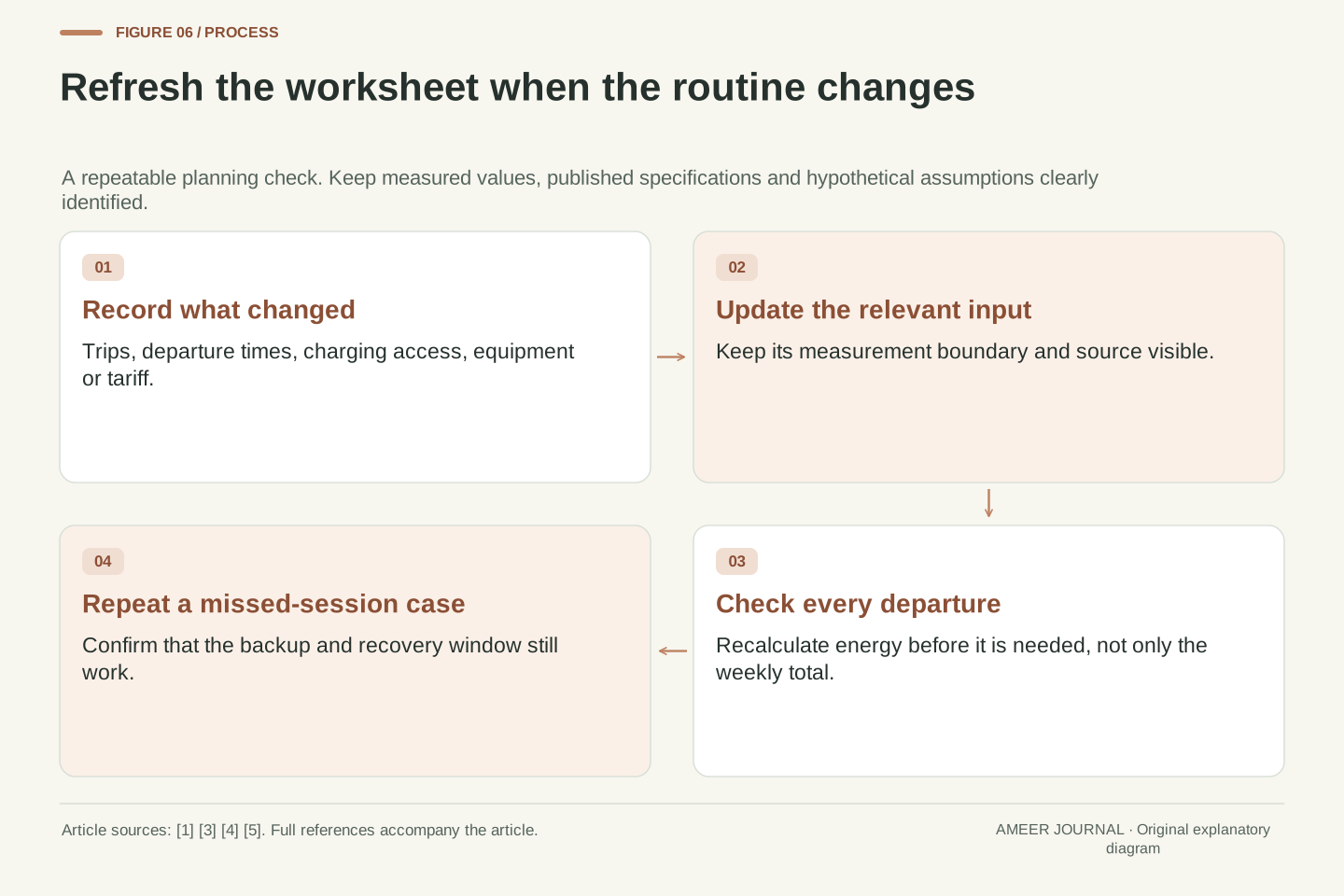
A reusable home-charging plan needs only a few clearly named entries: the energy needed for each day, whether that figure is measured at the wall or battery, a realistic charging rate, the hours genuinely available, and the required energy before each departure. Add the current tariff details if cost matters. The sources explain why power, battery conditions, equipment and time all affect charging; the weekly worksheet connects those facts to a particular routine [1][2][3][4]. Save the date and the vehicle or equipment information you used so that later changes are easy to identify.
Update the affected numbers when journeys, schedules, equipment or electricity plans change. Recheck a busy day and one missed charging opportunity, rather than trusting the smoothest week alone. In the fictional case, four cheap hours did not replace a full weekday's use, yet weekend recovery made the normal week workable; one earlier missed session broke the chosen reserve and recovery plan. Your result may be different. The useful outcome is knowing why it works, where it stops working, and which observation would tell you that the plan needs attention.
Preserve the model inputs and their provenance: energy-demand estimate with boundary, effective AC power assumption, storage factor if used, event times, working-energy constraints and tariff assumptions. Record which values came from official specifications, which came from actual session records and which remain estimates. The technical foundation is source-supported, but the schedule is a user-specific model whose validity depends on those inputs [1][2][3][4][5]. Retain the original figures when revising the workbook so a later reader can distinguish a changed routine from a changed calculation.
A useful revision check reruns the chronological energy balance, confirms that no permitted upper limit or chosen minimum is crossed, and verifies that recovery occurs before it is needed. It also repeats a concrete disruption scenario, such as one missed weekday session. The worked numbers demonstrate conditional feasibility, not an optimal charging policy: the normal case closes its weekly energy balance, while the missed-session case does not fit the stated six-hour recovery interval. This decision method supports a precise next question—more usable time, different verified power or a dependable backup—without pretending that a higher equipment label alone answers it.
Sources & further reading
Explore the references behind this guide. External pages may change after our review.
- Measuring electricity - U.S. Energy Information Administration (EIA)U.S. Energy Information Administration · Accessed 6 Nov 2026
- Alternative Fuels Data Center: How Do All-Electric Cars Work?U.S. Department of Energy / AFDC · Accessed 6 Nov 2026
- Alternative Fuels Data Center: Electric Vehicle Charging StationsU.S. Department of Energy / AFDC · Accessed 6 Nov 2026
- Alternative Fuels Data Center: Charging Electric Vehicles at HomeU.S. Department of Energy / AFDC · Accessed 6 Nov 2026
- Fuel Economy and EV Range Testing | US EPAU.S. Environmental Protection Agency · Accessed 6 Nov 2026
Article updated 6 Nov 2026.
Found something we should revisit?
Good explanations get better with thoughtful feedback.