What you’ll take away
- At a fixed consecutive playback rate, each local time-compression ratio equals the rate multiplied by the interval between those capture starts.
- In the hypothetical 30 fps sequence, a missing interior exposure changes one ten-second capture gap to twenty seconds, making its local ratio 600 instead of 300.
- Holding an earlier photograph preserves a presentation slot while adding no new capture of the missing moment.
- Counts, endpoints and a mean ratio can match even when the local capture intervals differ.
- Changing every playback slot from 1/30 to 1/24 second lengthens the example by 25 percent while preserving the relative irregularity.
A regular movie can contain an irregular time jump
A time-lapse can show a fresh photograph at every playback step and still jump over an unusually long part of the original scene. Imagine photographs intended to begin ten seconds apart. One never happens. If the surviving photographs are placed in consecutive movie frames, the jump across the missing photograph covers twenty seconds of scene time in the same playback interval that normally covers ten. The output keeps its regular rhythm, while the amount of original time represented by one step changes. This is a hypothetical example about complete photographs, with no camera experiment behind it.
Real documentation gives a reason to take the distinction seriously: Canon's EOS R7 time-lapse guide warns that an unavailable scheduled shot is skipped and may shorten the resulting movie [2]. The example below does not reproduce that camera's internal assembly. We choose our own capture log and two explicit ways to arrange its surviving images. That lets us answer a practical reading question: does a movie's frame rate describe how evenly its original moments were sampled? To find out, we need the capture times and the assignment of photographs to playback slots, as well as the frame rate.
A constant presentation period does not imply a constant interval between the acquisitions represented by consecutive frames. Let t denote elapsed scene time at the start of a complete hypothetical exposure, and p denote the start of its assigned presentation slot. The local ratio of an acquisition-time difference to a presentation-time difference describes how that pair of sampled moments is compressed. If consecutive surviving captures are separated by different amounts of scene time but assigned equal presentation intervals, this ratio varies. It is a property of the chosen temporal mapping, rather than a measurement of subject velocity or perceived smoothness.
The EOS R7 manual documents skipped scheduled shots and possible shortening of a time-lapse movie [2]. That motivates the question without establishing a universal camera implementation. Our original model will explicitly stipulate a missing interior exposure, complete retained images, exact presentation rates, and no further frame conversion. We then compare consecutive assignment with a deliberately held image. These constructions separate acquisition evidence from editorial timing. The result is independently checkable arithmetic, not a device benchmark, an Adobe application test, or an assertion that every camera automatically fills or removes an empty position in the same way.
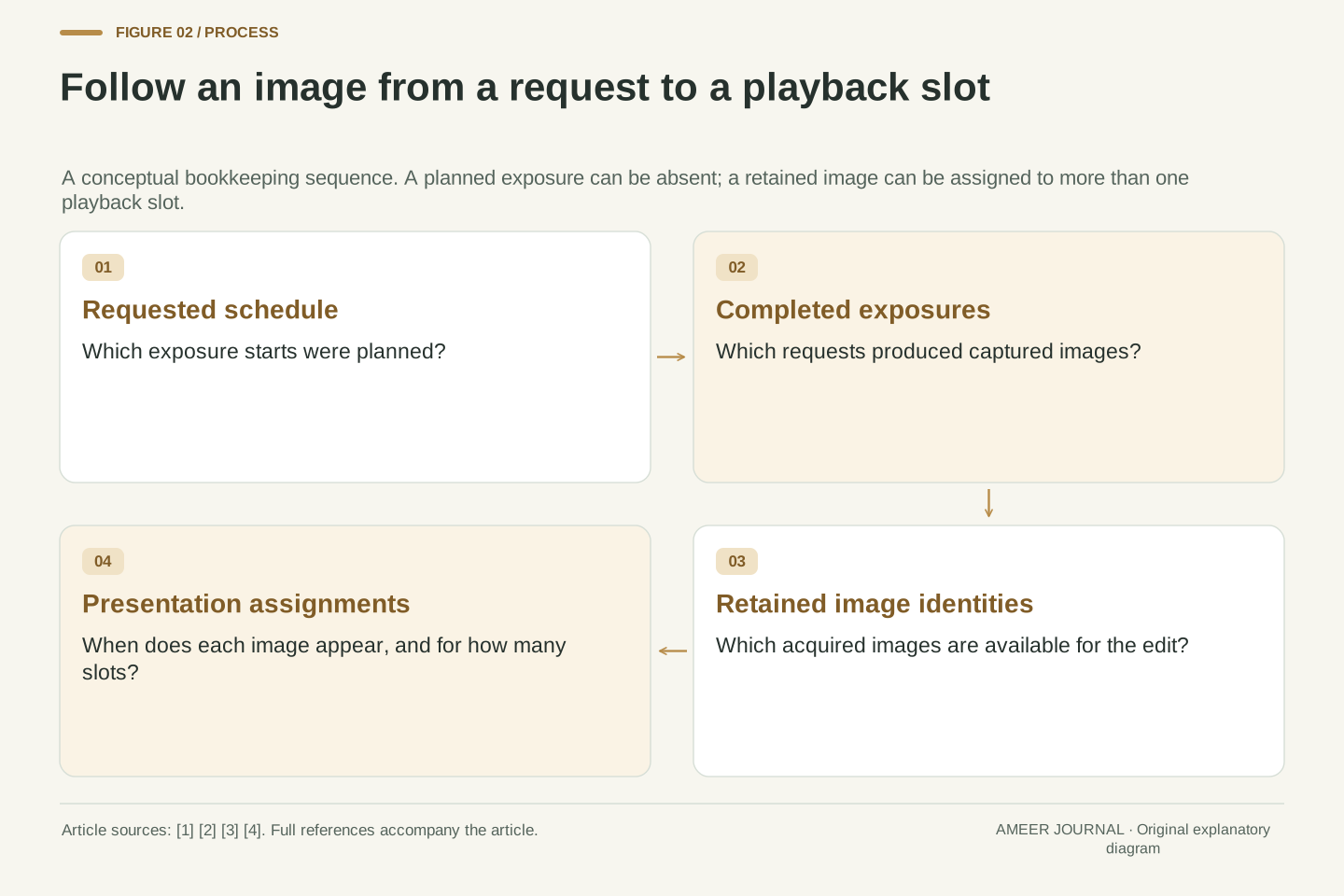
Write the capture history before arranging the movie
Our imaginary plan has 61 photographs, with exposure starts at 0, 10, 20 seconds and so on through 600 seconds. Each successful exposure lasts two seconds and produces one complete image. We stipulate that the exposure due at 300 seconds never occurs; every other planned exposure succeeds and its image is retained. The retained collection therefore has 60 capture records. Around the missing event, the starts read 280, 290, 310 and 320 seconds. These timestamps label our invented exposure starts. They are not file modification dates, camera menu estimates, or times measured from real equipment.
The distinction between a requested schedule and completed shots matters. Nikon's Z 8 interval-timer guide says exposure and processing need time, and an interval that is too short can result in skipped intervals and fewer shots [1]. Our example chooses no particular cause. It also distinguishes an exposure that never happened from a photograph that was captured and later lost. Those histories can leave the same surviving files but support different statements about acquisition. A record with a missing number alone cannot settle which history occurred. Keep the original identity of each surviving photograph, even if you later give the files new names for editing.
Define scheduled indices i = 0 through 60 and exposure starts t_i = 10i seconds. A successful image integrates over the two-second window beginning at t_i. Remove the exposure at i = 30 entirely, retaining all other images. This yields 60 retained records, 59 intervals between their starts, 58 intervals of ten seconds and one interval of twenty seconds. The first and last retained starts remain 0 and 600 seconds. Exposure duration is specified to make acquisition meaning explicit; the calculations will use start timestamps and will not treat a photograph as an instantaneous measurement of every event during its integration window.
Nikon's documented short-interval limitation supports separating the intended schedule from completed shots [1]. The missing event here is an assumption, not a diagnosis from a file list. Under that assumption, total exposure duration is 60 × 2 = 120 seconds; the two-second exposure at 300 seconds never contributed information. If it had occurred and its file had merely been discarded, the acquisition history would instead contain 61 completed exposures. Both histories could have the same retained subset. A sound time map therefore preserves acquisition identity, timestamp definition and retention status as separate fields, rather than using a consecutive filename index as evidence of elapsed time.
Consecutive playback slots squeeze the missing gap
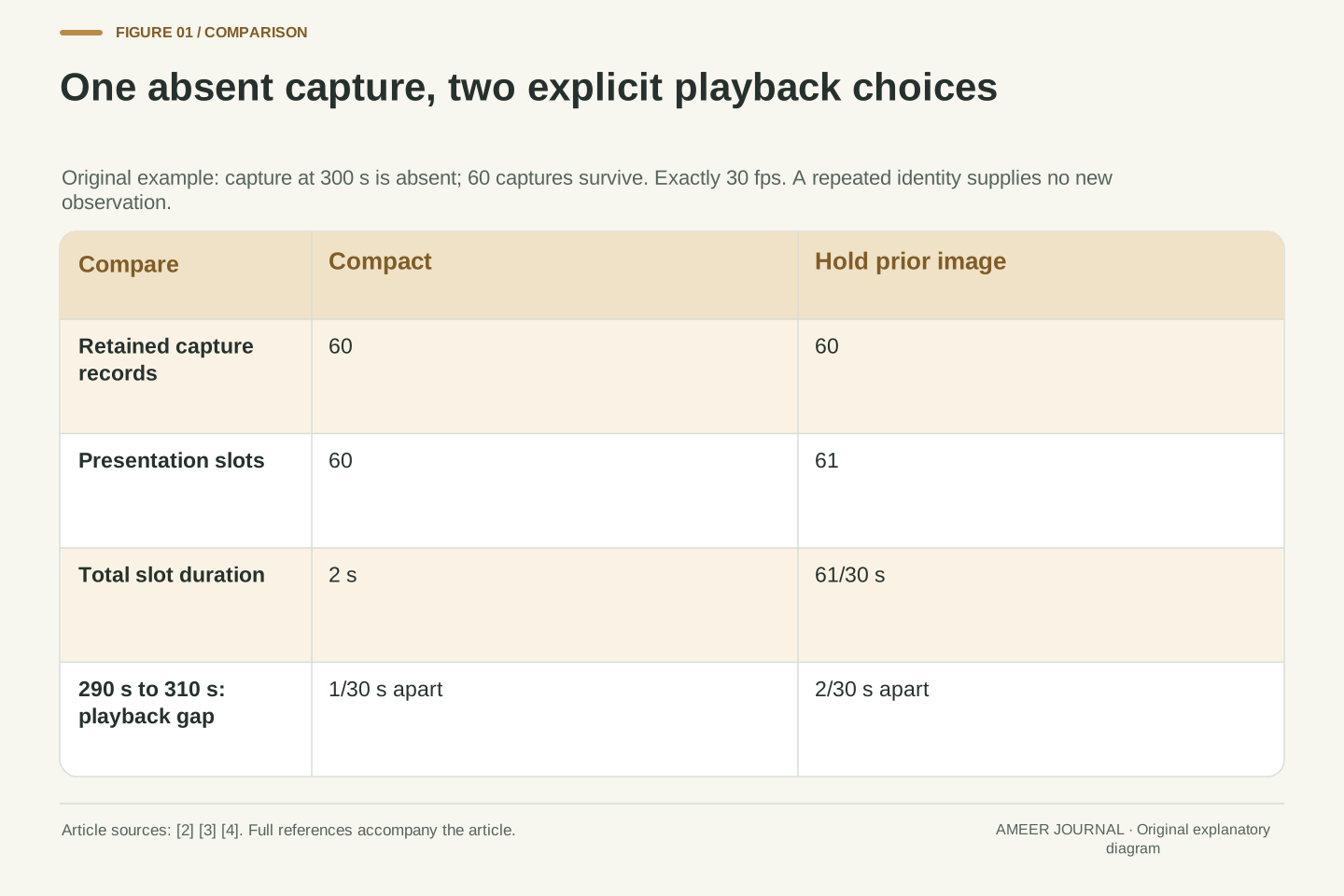
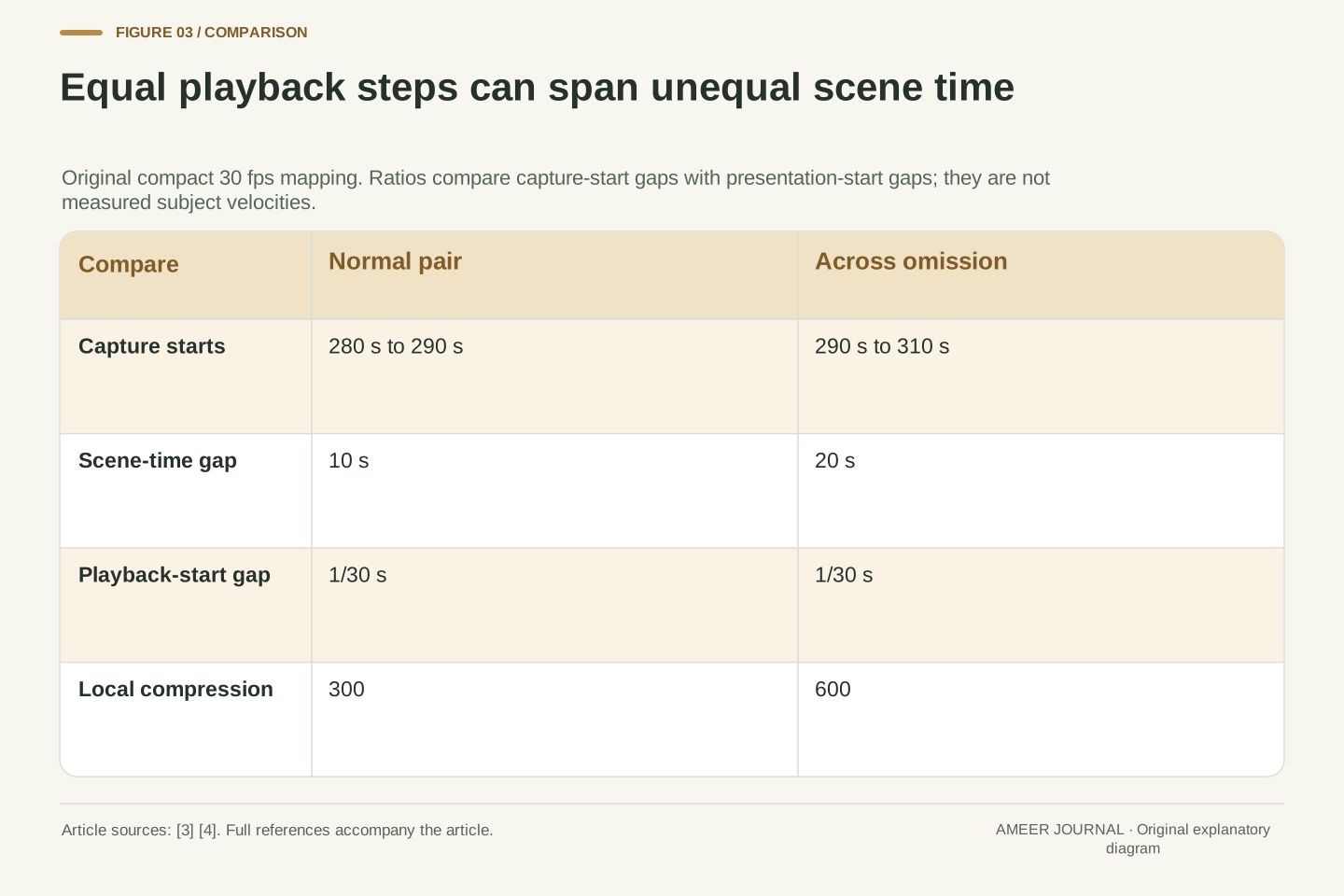
First choose a compact movie: use each of the 60 retained photographs once, in order, with no empty playback slot between them. Give every slot exactly one thirtieth of a second. The rate is exactly 30 frames per second, abbreviated fps. Adobe describes a still-image sequence as using each still image for one frame [3]; our explicit arrangement adds the assumption that all retained photographs are packed consecutively with no additional processing. The photographs beginning at 280 and 290 seconds land in neighboring slots. So do the photographs beginning at 290 and 310 seconds, even though the second pair spans twice as much original time.
Divide the scene-time gap by the playback-time gap to see the difference. A usual ten-second gap divided by one thirtieth of a second gives 300. Across the missing exposure, twenty seconds divided by the same one thirtieth gives 600. We call these local time-compression ratios: the number of scene seconds between the chosen capture starts per playback second between their assigned starts. The larger ratio describes a bigger jump in the sampled timeline. It does not prove that anything in the scene actually moved twice as fast. A stationary object could remain stationary across both gaps, and the missing photograph's contents are unknown.
Index the retained photographs consecutively by j = 0 through 59. Assign presentation starts p_j = j/30 seconds and one slot of duration 1/30 second to each image. This is the stipulated compact mapping, not a claim about the default handling of missing filenames by an importer. The general single-image-per-frame sequence concept is documented by Adobe [3]. Immediately before the omission, retained index 29 has t_29 = 290 s and p_29 = 29/30 s; retained index 30 has t_30 = 310 s and p_30 = 1 s. Scheduled index and retained index consequently cease to be interchangeable after the missing exposure.
For adjacent retained records define C_j = (t_(j+1) − t_j)/(p_(j+1) − p_j). At a fixed consecutive rate f, the denominator is 1/f, so C_j = f × (t_(j+1) − t_j). Here 58 values equal 30 × 10 = 300, while the single value across the omission equals 30 × 20 = 600. The ratio is dimensionless, with a useful interpretation as scene seconds per presentation second. It describes a finite difference between documented or stipulated capture starts. It does not recover a continuous trajectory, an unrecorded intermediate image, the within-exposure timing of sensor rows, or a perceptual threshold for seeing the jump.
A single speed label hides the distribution of jumps
The compact sequence has 60 equal slots at 30 fps, so its modeled playback duration is two seconds. The first and last capture starts are ten minutes apart. Dividing 600 by two produces a tempting headline: 300 times faster. Yet the local calculation has already found one 600-to-one step. A total-duration quotient can be arithmetically correct for its named endpoints while saying little about where time is compressed more strongly. To explain the actual arrangement, report the usual gap and the longest gap alongside the total. That tells a reader something a single headline cannot.
There is also a small endpoint distinction. The last photograph begins its playback at 59/30 seconds and occupies the final slot until two seconds. Thus the capture-start span and the full playback duration do not end at corresponding kinds of event. Comparing first-to-last starts on both sides gives 600 divided by 59/30, or about 305.08. Even that matched average hides the one larger step among 58 normal ones. These are different descriptions of the same invented sequence, not contradictory measurements. Our concern is the distribution of time jumps; the last frame's own display duration cannot reveal the missing scene interval.
For K retained images in K equal slots, the stipulated slot duration totals K/f, whereas the first-to-last presentation-start span is (K−1)/f. In our compact example these are 2 s and 59/30 s respectively. The quotient 600 s / 2 s = 300 compares the scene's capture-start span with the full presentation duration. It is valid as that defined summary, but it is not the common value of every local C_j. Endpoint conventions are necessary background; the new issue is that a scalar summary cannot specify how the capture-time increments are distributed across the output slots.
Using corresponding start endpoints instead yields 600/(59/30) = 18000/59, approximately 305.0847. Because every presentation gap has equal duration here, this also equals the arithmetic mean of the 59 local ratios: (58 × 300 + 600)/59. The maximum remains 600. A complete report can therefore state a mean, a maximum and their underlying counts without confusing them. This calculation does not claim that a movie player reports that ratio or that a camera's menu uses our endpoint convention. It is an original analysis of the specified finite mapping. With unequal presentation intervals, an unweighted average of local ratios would generally require a different justification.
Holding a photograph preserves a slot, not an observation
Now choose a different arrangement for the same 60 retained photographs. Keep all 61 positions from the original plan. In the position intended for the absent 300-second capture, display the photograph that began at 290 seconds again. The 290-second image now occupies two neighboring slots, lasting two thirtieths of a second altogether. The 310-second image starts at 31/30 seconds. There are 61 playback slots, so their total duration is 61/30 seconds, about 2.033 seconds. There are still only 60 retained capture records. We have deliberately chosen a hold; this is not a statement that a camera or importer performs it automatically.
Between the starts assigned to the real 290-second and 310-second photographs, twenty scene seconds now correspond to two playback slots. Their ratio returns to 300. Inside that gap, however, the older image stays on screen. No new observation exists at 300 seconds, and the repeated image should not be described as a photograph of that moment. The arrangement preserves where later retained captures sit on our ideal schedule, while visibly holding the earlier information. An explicit missing-image placeholder would communicate absence differently. Either choice needs a clear description when the movie is being used as evidence of how a scene changed.
Construct 61 presentation slots indexed k = 0 through 60, with starts k/30 seconds. Use capture identity k in every available scheduled position, but assign capture identity 29 to both slots 29 and 30. The output identity sequence locally becomes 28, 29, 29, 31, 32. The repeated identity is not a newly acquired sample. Capture 29 remains displayed for 2/30 = 1/15 second; capture 31 first appears at 31/30 second. The total slot duration is 61/30 seconds. This is an original hold policy whose bookkeeping is fully specified; no automatic source-application behavior is inferred.
Considering only consecutive distinct retained captures, their presentation starts now satisfy p = t/300. The twenty-second acquisition gap therefore maps to 2/30 second, giving a ratio of 300 between those real endpoints. If instead every adjacent output slot is examined, the mapped capture-start increments across this region are zero for the repeated identity, followed by twenty seconds for the next acquired image. Their ratios are zero and 600. These two analyses use different event streams and are consistent. Preserving the timestamps of available captures does not create uniform new observations inside the hold. The acquisition count and total acquired exposure duration remain 60 and 120 seconds respectively.
The same method works when every photograph exists
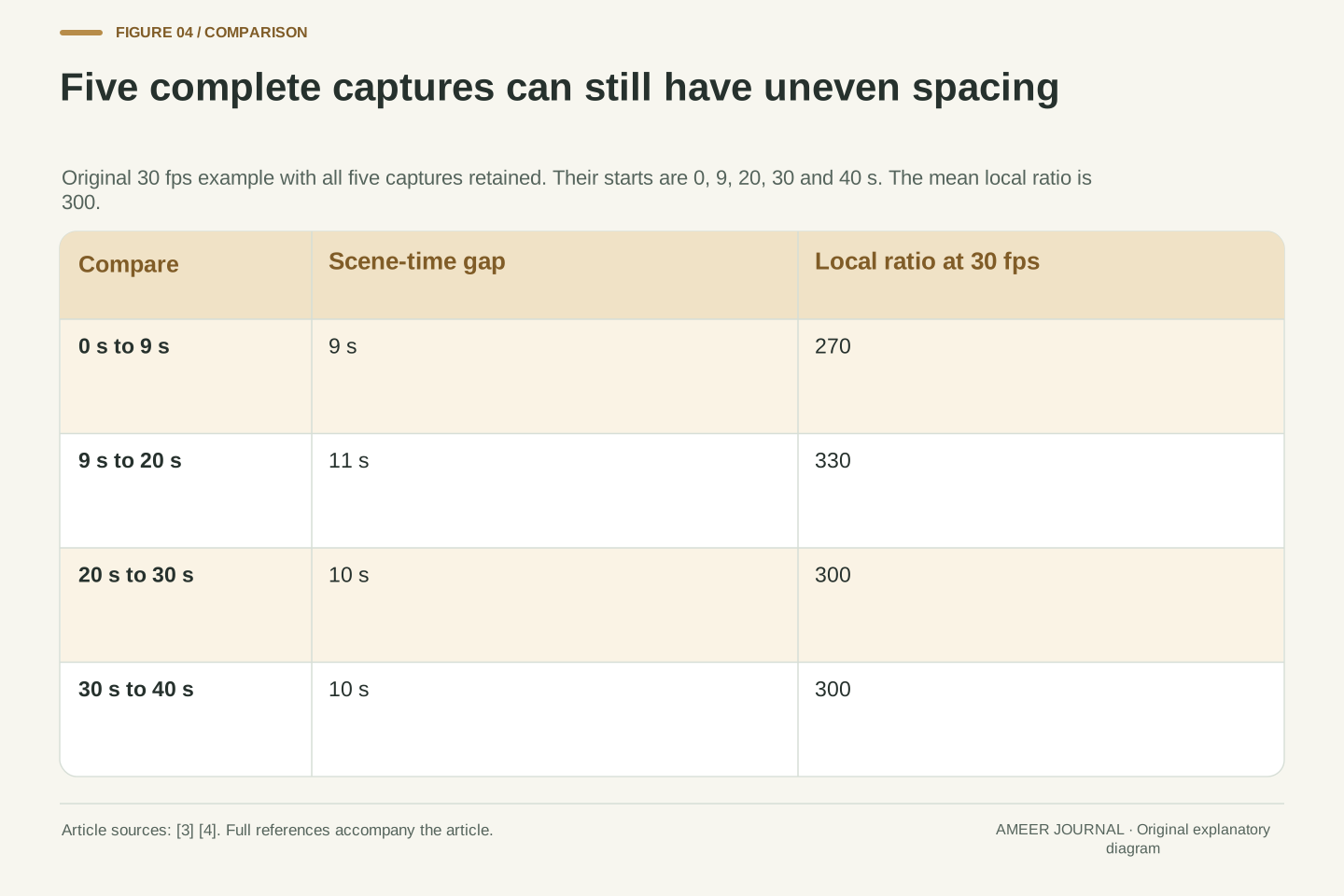
A missing exposure is only one way to get uneven capture spacing. Consider a separate imaginary collection of five complete photographs beginning at 0, 9, 20, 30 and 40 seconds. Nothing is missing from this stipulated collection. The intervals are nine, eleven, ten and ten seconds. Give each photograph one consecutive slot at exactly 30 fps. Every playback step is again one thirtieth of a second, but the local time-compression ratios are now 270, 330, 300 and 300. The first two steps squeeze different amounts of scene time into equal movie time, even though there is no empty filename position to find.
Compare that with five photographs beginning at 0, 10, 20, 30 and 40 seconds. Both collections have five photographs, the same first and last starts, the same playback rate and the same total movie duration. Their average local ratio is also the same: 300. The regular collection has four equal jumps; the uneven collection has a shorter jump followed by a longer one. This is a useful counterexample to judging temporal regularity from counts and endpoints alone. Our chosen timestamps provide the information that separates the two histories. An actual investigation would need trustworthy timing evidence before making the equivalent claim.
Use a second acquisition vector t = (0, 9, 20, 30, 40) s, retaining all five images. Choose p = (0, 1/30, 2/30, 3/30, 4/30) s, with each image displayed for 1/30 second. The consecutive acquisition increments are (9, 11, 10, 10) s, so the local ratio vector is C = (270, 330, 300, 300). No acquisition failure is required for this variation. The finite records may describe intentional uneven scheduling or another stipulated history; their numerical values alone do not identify a mechanism that caused the spacing. This example is independently calculated and contains no measured device timings.
The comparison vector t_regular = (0, 10, 20, 30, 40) s has the same image count, first and last acquisition starts, presentation starts and total slot duration, 5/30 = 1/6 second. Both mean local ratios equal 40/(4/30) = 300, but the regular vector has zero variation while the other has values from 270 to 330. Equality of those aggregate measurements therefore leaves the temporal map underdetermined. This is stronger than merely noting that a missing frame shortens a sequence: even identical counts and endpoints do not establish equal local compression. Inspect the interval vector, or an equivalent capture-to-presentation record, when the interpretation depends on timing regularity.
A slower playback rate keeps the irregularity in proportion
Return to the compact collection with 60 retained photographs and the missing exposure at 300 seconds. Change our playback rule from exactly 30 fps to exactly 24 fps, while keeping every photograph in the same order and giving each one slot. The duration becomes 60 divided by 24, or 2.5 seconds. That is 25 percent longer than the earlier two-second sequence. The usual ten-second capture gap now corresponds to one twenty-fourth of a second, giving a local ratio of 240. The twenty-second gap gives 480. Everything plays more slowly under this rule, while the larger time jump remains twice the usual jump.
Adobe's footage-interpretation documentation distinguishes changing frame duration from changing frame content [4]. That distinction supports the logic, but the numbers here come from our own chosen rates. They are not instructions to set only a final export option and assume every earlier stage will change identically. A source sequence, an editing composition and a final output can use different rates [4]. If a later stage repeats, removes or generates frames, the simple one-photograph-per-slot calculation no longer describes the whole path. Write down which stage you changed and inspect the resulting assignment before claiming that a new rate repaired missing information.
Holding acquisition records and consecutive image order fixed, change f from 30 to 24 s⁻¹. The local formula C_j = fΔt_j scales every ratio by 24/30 = 0.8. The values 300 and 600 become 240 and 480, preserving their ratio of two. Total duration scales inversely: (60/24)/(60/30) = 30/24 = 1.25. Thus a 20 percent reduction in the chosen rate yields a 25 percent increase in duration; the percentages use different denominators. This exact transformation cannot replace a missing capture, and it does not establish any specific subjective improvement in the movie.
Adobe documents conforming a footage item's rate as changing frame duration while retaining frame content, and distinguishes footage interpretation, composition rate and output rate [4]. Our arithmetic assumes those later stages introduce no additional resampling, interpolation, trimming or holds. It therefore describes the explicit mapping being evaluated, rather than an arbitrary export preset. For unequal but positive acquisition gaps, multiplying every C_j by the same positive factor leaves the ratio of maximum to minimum unchanged. A global rate change can alter overall duration without equalizing local compression. Equalization would require changing individual presentation assignments, and the absent acquisition would still remain absent.
Check what the named camera and importer actually promise
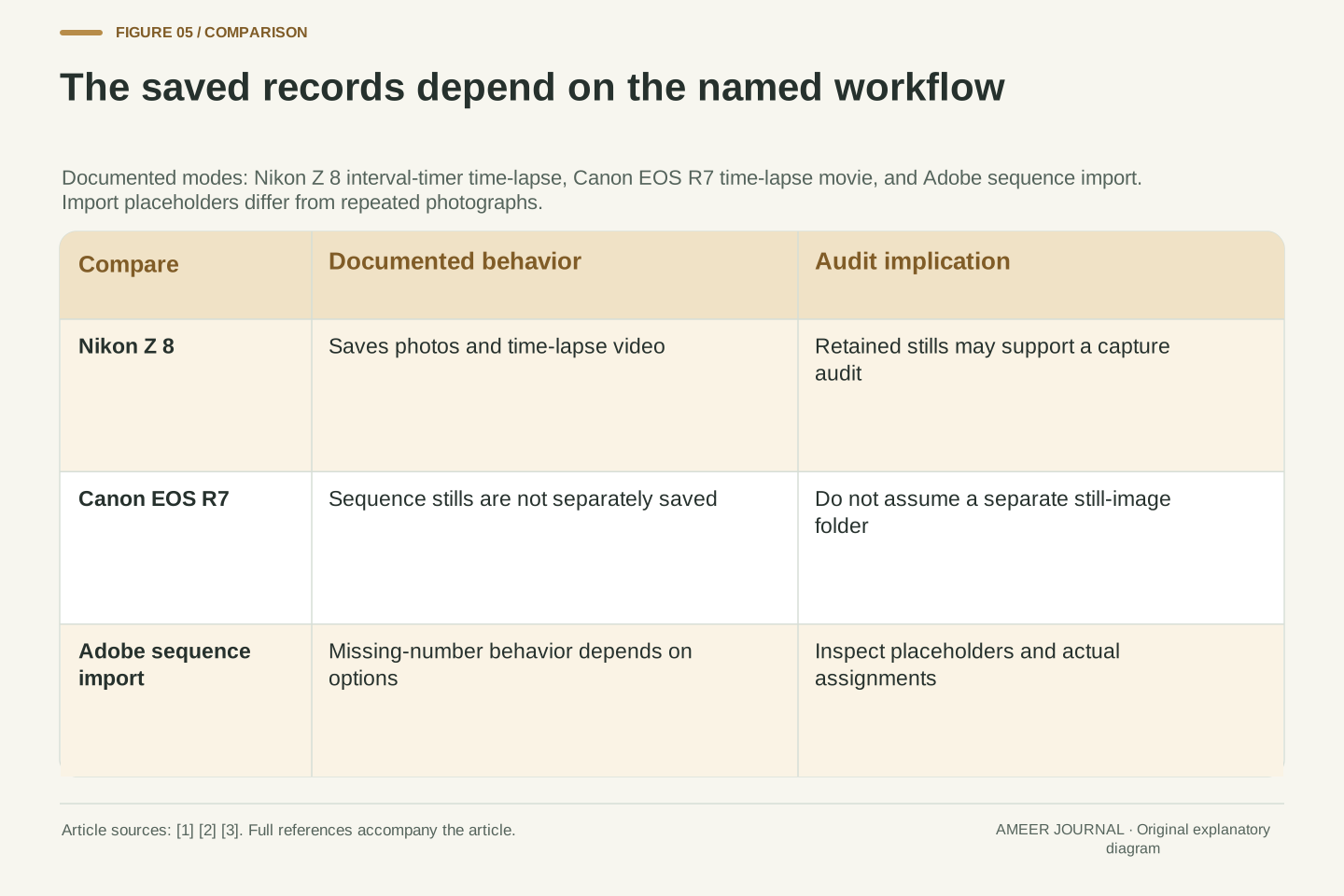
The saved material depends on the camera mode. Nikon's documented Z 8 interval-timer time-lapse option retains both photographs and the movie [1]. Canon's EOS R7 time-lapse movie page says the sequence's captured images are not saved separately as still photos [2]. These are named-mode facts, not a ranking of the cameras. They affect which original records may be available for an audit. Canon's page also lists 29.97 or 25 fps for that movie mode [2]; our exact 30 and 24 fps examples are independent teaching choices and should not be mistaken for those menu settings.
Importing surviving files adds another choice. Adobe documents an option for importing a sequence with gaps in filename numbering, and describes warnings and placeholders under the specified alternative settings [3]. A placeholder signals a missing item; it is not automatically the earlier photograph held for another slot. A file-number gap also does not prove that the underlying exposure was skipped. Our compact and held arrangements were deliberately specified so their meaning could be checked. When interpreting a real project, establish what the importer actually produced, including any placeholders, before applying either arrangement's arithmetic. The documentation establishes possibilities; the particular project's records establish its outcome.
Preserve implementation scope. The Nikon Z 8 interval-timer time-lapse option saves still photographs alongside video [1], whereas the EOS R7's described time-lapse movie mode does not separately save the sequence's captured stills [2]. Canon specifies 29.97 or 25 fps for that mode [2]. Neither statement licenses substituting the exact 30 fps model for a product-specific calculation. The exposure history, available assets and presentation rate must be identified for the actual recording. A description of one mode also does not establish the behavior of a different firmware, a separate intervalometer, another capture option or a subsequent editing workflow.
Adobe's documented missing-number handling depends on import options, including Force alphabetical order and the Report Missing Frames condition for warnings and placeholders [3]. This is a filename-sequence interpretation rule; it does not certify camera acquisition times or substitute a previous-image hold for every absent item. Distinguish three records: an unavailable numbered source item, a placeholder inserted by an importer, and a chosen repeated capture identity. Only the last is our held-image construction. If any of these records is unknown, leave the resulting mapping unresolved until the actual sequence is inspected. Software defaults are evidence about an expected operation, not proof that an edited project retains that operation unchanged.
Keep a small table that makes the timing claim checkable
A useful table starts with one row per retained photograph. Record its stable capture identity, the time and event that timestamp describes, and the first playback slot assigned to it. Add its hold length if it spans several slots. Keep the planned schedule separately, so an unfulfilled request cannot silently become a completed image. In our compact example, the rows around the omission say that the 290-second image first appears at 29/30 seconds and the 310-second image at one second. In the held arrangement, only the latter presentation start changes, to 31/30 seconds. Those few entries explain the different mapping without depending on a product label.
Then compare neighboring rows. Calculate the difference between their capture times and the difference between their presentation starts, and divide the first by the second. Mark which rows represent actual retained captures and which are placeholders or repeats. Where timing information is unavailable, record that uncertainty instead of inventing evenly spaced timestamps from a nominal interval. Renaming files into a neat sequence can be useful for an editing workflow, but preserve the original identity-to-time table so the new order does not erase the history. This is a proposed bookkeeping method. The records in this article were generated as mathematical examples; no user's photographs were inspected.
Represent each retained capture by an identity and an acquisition timestamp with defined semantics, such as the stipulated exposure start used here. Store presentation assignments separately, allowing a capture identity to occupy multiple slots. The compact map is one-to-one between retained images and output slots; the held map includes a repeated identity. Retain missing planned events as explicit acquisition-status records instead of fabricating image content. This separation prevents scheduled, acquired, retained and presented counts from becoming interchangeable. It also makes an edit auditable: changing a hold modifies the presentation map without rewriting the acquisition record that supports it.
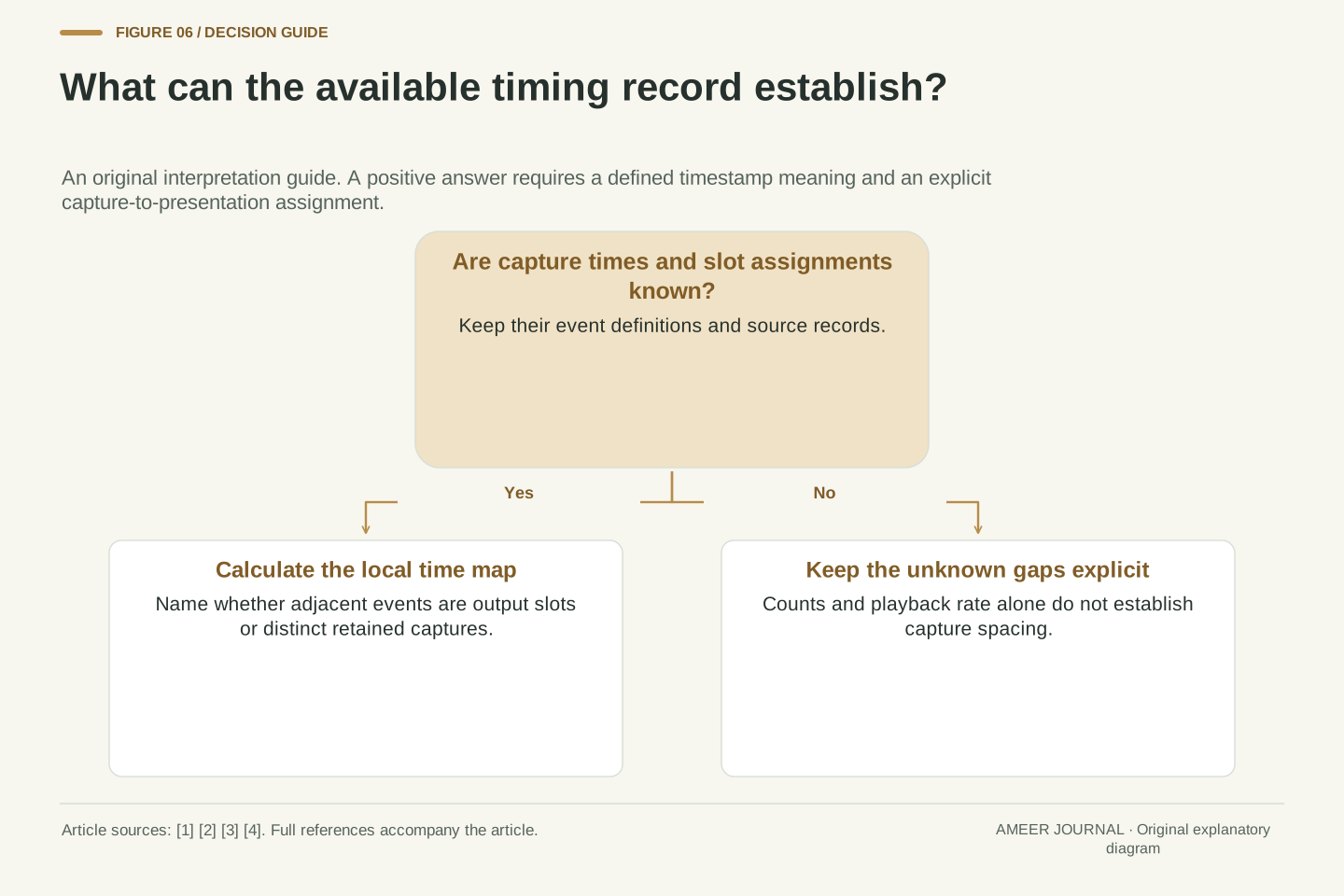
Compute finite differences over the event stream relevant to the question. Consecutive distinct captures answer how their elapsed scene time maps to their assigned starts; consecutive output slots reveal repetitions and jumps within a hold. Require positive presentation-start differences for the ratio and preserve the exact chosen rate before rounding decimals for display. If the acquisition timestamps are unknown, a frame count and an output rate determine the stipulated slot duration but cannot determine each Δt. Treat filename numbers or inferred nominal spacing as assumptions unless corroborated by appropriate records. This method offers a reproducible account of the known mapping, without claiming a particular metadata field is always accurate.
Let the timing evidence set the limit of the conclusion
Suppose an object appears farther along its path in the photograph after the gap. The larger change could reflect more elapsed time, a change in the object's motion, or both. Our known timestamps let us identify the longer interval, but the photographs do not show everything the object did between them. It might have stopped, turned or moved out and back. Even a held image provides no additional view of that period. For a creative movie, choosing a compact sequence or an obvious hold can be an editorial decision. For an explanatory movie, describe the choice so a viewer can distinguish a change in the scene from a change in its presentation.
This article treats each complete photograph as one retained unit. Timing across rows inside a photograph is a separate subject, covered in our rolling-shutter explainer, Why a Fast Shutter Can Still Bend a Moving Shape. Here the useful result is a table of scene-time gaps and their playback assignments. A regular frame rate alone leaves that table unknown. A repeated photograph can preserve an intended position without recovering the missing observation, and a slower rate can lengthen the movie without equalizing its time jumps. Keep those limits beside any speed claim, along with the records that make the particular calculation possible.
The ratio C_j describes temporal compression between two acquisition-start labels; it is not a reconstruction of the scene between exposures. Recovering motion would require an additional observation and motion model. For example, equal endpoints could be compatible with a stationary object or with an unobserved excursion that returns to the same position. Our finite capture record cannot choose between those histories. Likewise, unequal displacements in retained images cannot be attributed solely to timing without accounting for the scene's own dynamics. Exposure integration further limits treating a captured image as an instantaneous state. None of the mathematical checks performed here establishes a camera's measured behavior or a perceptual response.
The novelty of the analysis is the mapping between complete-image acquisition and presentation when captures are absent or unevenly spaced. Within-frame row offsets belong to the separate rolling-shutter explanation; repeated refreshes of a source image belong to display-cadence analysis. Their general lesson about naming events is relevant background, while this model supplies different records and calculations. State whether a reported ratio uses consecutive output slots, consecutive retained captures or whole-sequence endpoints. Then preserve the acquisition evidence and explicit presentation policy. That combination allows another reader to reproduce the timing conclusion while leaving unrecorded scene content and untested implementation details open.
Sources & further reading
Explore the references behind this guide. External pages may change after our review.
- Interval Timer ShootingNikon · Accessed 7 Nov 2026
- Canon : Product Manual : EOS R7 : Time-Lapse MoviesCanon · Accessed 7 Nov 2026
- Preparing and importing still images in After Effects | After EffectsAdobe · Accessed 7 Nov 2026
- Importing and interpreting footage items in After Effects | After EffectsAdobe · Accessed 7 Nov 2026
Article updated 7 Nov 2026.
Found something we should revisit?
Good explanations get better with thoughtful feedback.