What you’ll take away
- A real reference still needs a passage that supports the exact claim and its qualifications.
- Separate direct evidence, a declared calculation and an unsupported inference.
- Citation-marker coverage and claim support use different judgments.
- Multiple passages can jointly support a derived result when their inputs and assumptions are explicit.
- Keep the inspected version and applicable corrections with the claims that depend on them.
An opening link answers only the first question
An AI answer gives you a number, a confident explanation and a footnote. You open the footnote, and a real document appears. That is a useful start. The remaining question is more demanding: which words, table entries or calculations in that document support the exact statement you were given? A page about the right subject can still describe another setting, another version or a different measurement. The explanation needs a traceable connection to its evidence.
NIST’s July 2024 generative-AI profile identifies invented reasoning and citations as a risk and suggests reviewing sources and citations [4]. Here we will examine a narrower problem that can survive a real reference: a claim that goes beyond what its evidence says. Our example uses invented evidence cards about a fictional classification device. No device was tested, and no AI answer was collected. The cards let us inspect every premise, including the point where a later correction changes a previously valid calculation.
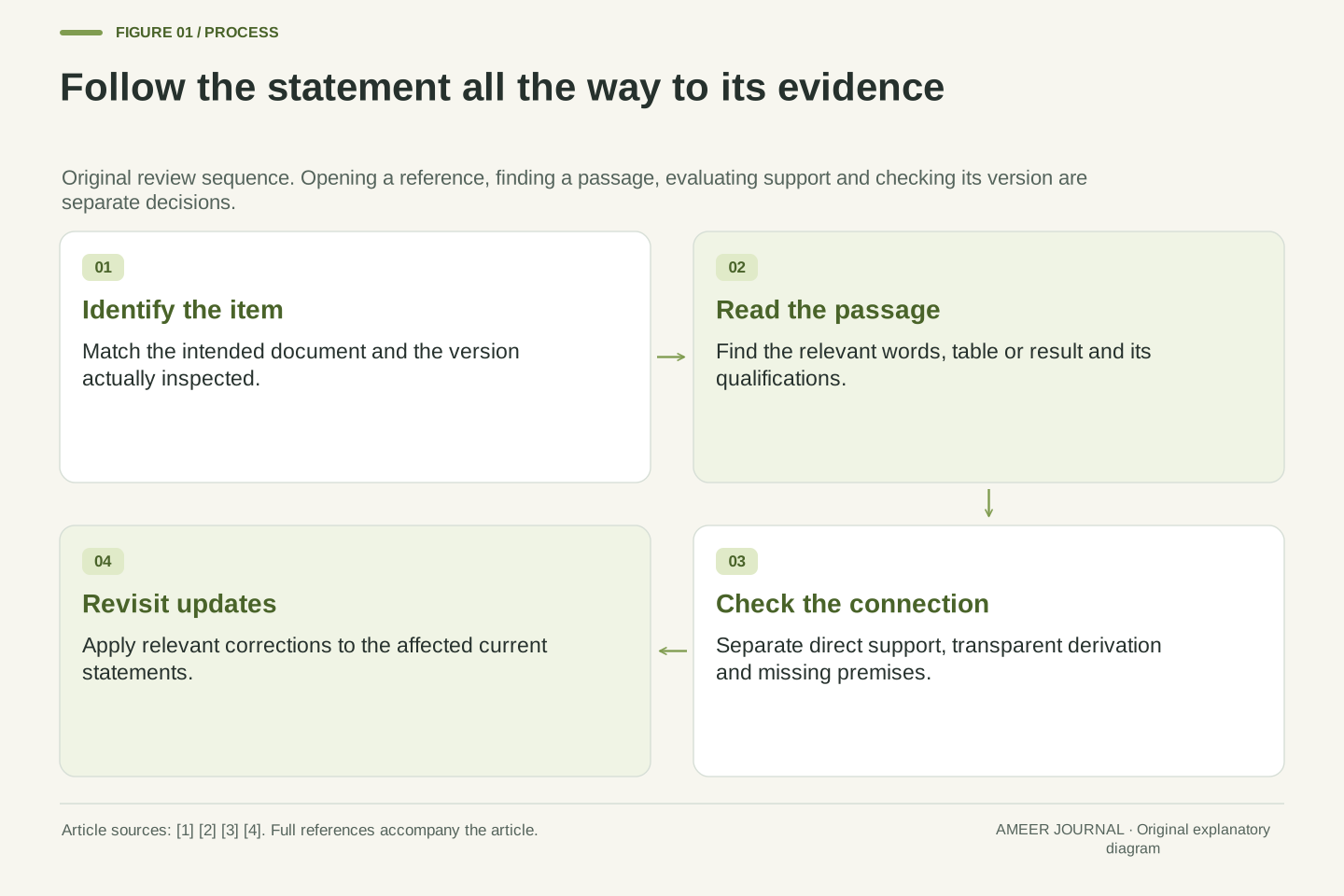
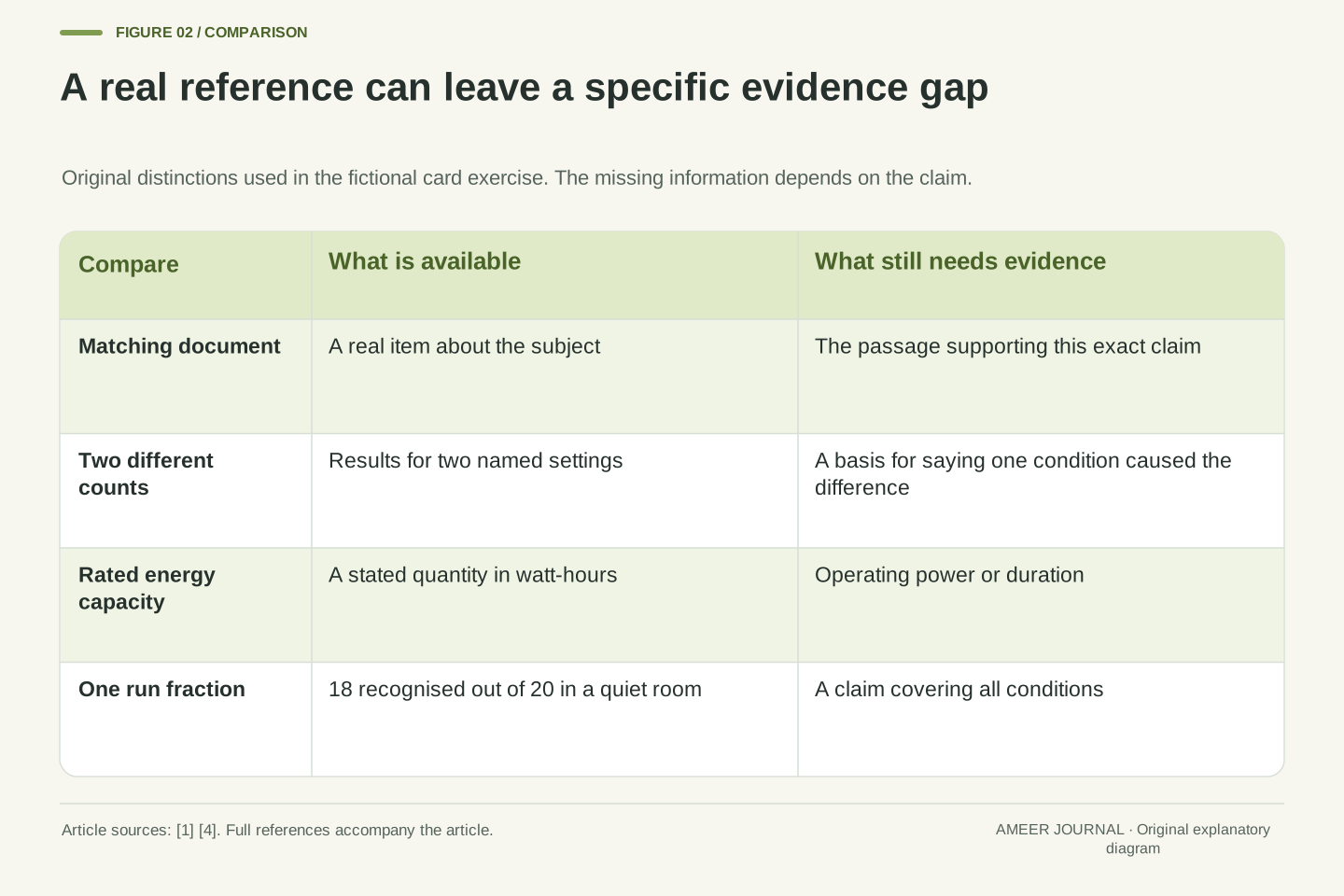
Citation verification contains several distinct propositions: the referenced item exists, the inspected content belongs to that item, the selected passage supports the asserted claim, and the source version is appropriate to the question. Success on an earlier proposition leaves the later ones unresolved. A valid location or bibliographic identifier cannot by itself establish an entailment relation between a passage and a statement. The object being checked must include both sides of that relation.
The July 2024 NIST generative-AI profile describes misleading generated logic and citations and includes a suggested citation-verification action [4]. This article develops an original, bounded evidence ledger rather than measuring a model. Three fictional revision-one cards supply inputs to six declared claim units; a fourth card later corrects one count. Support judgments are reasoned relative to those stipulated records. They establish neither the reliability of an actual classification device nor the accuracy of an automated verifier. Keeping that boundary explicit makes each result reproducible from the displayed premises.
Identify the source before deciding what it proves
First check that the title, author or organisation, publication date and identifier describe the source you intended to inspect. Crossref’s REST API provides deposited scholarly metadata, including bibliographic information and update information; its documentation also recognises that records can be incomplete or incorrect [2]. Such a record can help you locate and distinguish a work. You still need to read the material relevant to the claim.
Imagine two documents with similar titles, one describing a battery’s rated energy and another measuring how quickly a device uses energy. Finding the first document does not supply the second measurement. Even the right document may contain several experiments with different conditions. Write down the page, section or table you actually used, along with the version and date inspected. If you can access only an abstract, keep that access limit visible. A claim about an unseen table needs further evidence, even when the abstract’s title sounds exactly right.
A bibliographic match and a content-support decision should occupy separate fields. Crossref documents an API for deposited scholarly metadata, with records for individual Crossref DOIs and associated information such as updates. It also provides a route to report incorrect or partial metadata [2]. Those functions help establish record identity; they do not perform the claim-to-passage comparison in this example.
The proposed inspection record contains source identity, resolved location, retrieved version, access date and a passage locator. Preserve which representation was inspected: an abstract, full article, appendix or correction notice. A matching title leaves room for a wrong experiment, an omitted qualification or a historical version. Conversely, a title that sounds less similar can contain the required result. These are reasons to evaluate the actual passage rather than treating title similarity as a support label. Access failure should remain an access outcome; substituting a plausible sentence from memory would destroy the evidence trail.
Give the fictional evidence a clear boundary
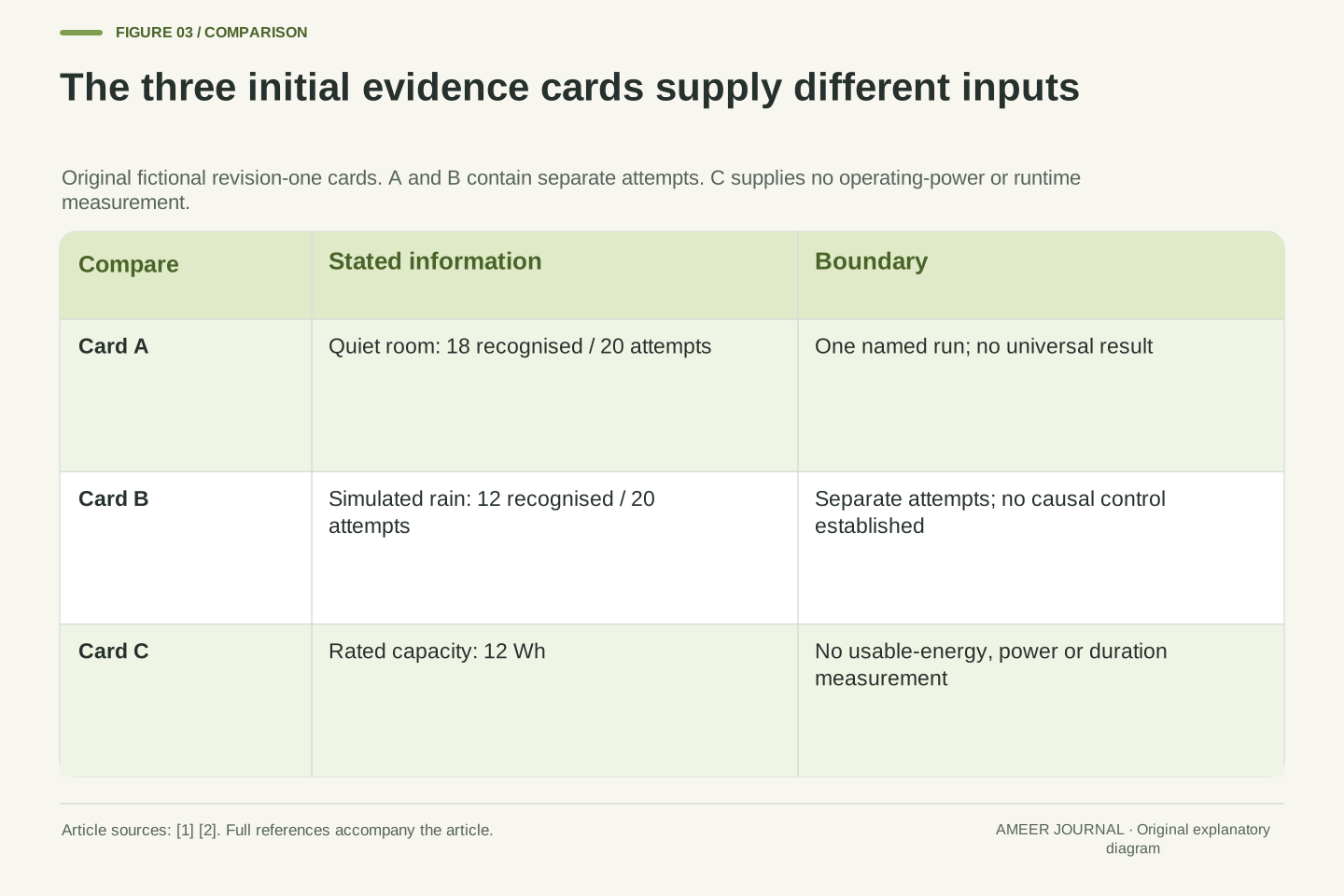
Card A says that a classification run in a quiet room had 20 attempts, of which 18 were recognised. Card B describes a separate run in simulated rain: 20 attempts, with 12 recognised. Card C gives the fictional device’s rated battery capacity as 12 watt-hours under its declared rating conditions. It gives no power measurement or operating time. These lettered cards are original teaching data; the numbered references at the end of the article are real sources.
Treat A and B as separate sets of attempts, with each attempt counted once. We have not said that the attempts involve 40 different objects or 40 people. We also have not supplied controls showing that rain was the only difference between the runs. Those omissions matter. A reader may calculate the counts that are present, but cannot quietly add an experimental design that is absent. Keeping the cards short exposes the exact information available before any conclusion is written.
The revision-one fixture consists of A=(quiet-room setting, 20 attempts, 18 recognised), B=(simulated-rain setting, 20 separate attempts, 12 recognised), and C=(rated battery capacity 12 Wh, with no stated power draw, usable-energy measurement or duration). The cards are invented premises, not summaries of an actual study. Letter identifiers refer only to these premises and remain distinct from the article’s numbered external references.
For aggregation, the A and B attempt sets are stipulated disjoint, with no duplicate attempt records. Their cardinalities do not establish the number of distinct objects or participants. Naming the two settings also leaves other experimental factors unspecified. There is no randomisation, controlled comparison or causal model in the supplied evidence. Consequently, the ledger can assess exact count statements and arithmetic while leaving causal and universal assertions unsupported. This separation prevents a faithful numerical calculation from being used to smuggle in stronger experimental conclusions.
Split the answer into statements you can actually check
We will check six units. U1 says the quiet-room run had 20 attempts and points to A. U2 says that run recognised 18 attempts and points to both A and B. U3 says the simulated-rain run recognised 12 attempts and points to B. Each of those statements is directly supported by the relevant card. B adds no support to U2 because it describes a different run; A already supplies the required count.
The remaining units ask more of their citations. U4 says rain caused the lower result and points to A and B. U5 says the device draws 2 watts and points to C. U6 says the device recognises 90 percent of attempts in all conditions and points to A. Every unit has a citation marker, yet the last three lack the premises needed for their wording. This six-unit breakdown is our declared inspection method. It makes the individual problems visible instead of giving one broad approval to a paragraph containing several different assertions.
Define six review units and their linked evidence sets: U1, quiet-run attempts=20, cites {A}; U2, quiet-run recognitions=18, cites {A,B}; U3, rain-run recognitions=12, cites {B}; U4, rain caused the lower result, cites {A,B}; U5, device power=2 W, cites {C}; U6, recognition=90% under all conditions, cites {A}. These units and equal weights are chosen for this example, not presented as a universal sentence-segmentation standard.
U1–U3 are supported by direct card values. U2’s B link is extraneous to its particular assertion even though B is useful elsewhere in the article. U4–U6 require additional premises. The distinction attaches to a claim-evidence pair: a document is not permanently labelled useful or useless for every possible question. Separating the units also avoids allowing a correct count to validate a causal phrase attached to it. An inspection record should preserve the asserted wording before classification so that later editing does not silently change what was reviewed.
Find the missing premise rather than arguing with the tone
For U4, A and B show different recorded counts. They do not show that all relevant conditions were held constant or that the difference was caused by rain. A careful description can report the two results while leaving the explanation open. The unsupported causal sentence is not rescued by adding a second copy of the same citation. What is missing is evidence for the causal step.
U5 crosses a different boundary: watt-hours describe an energy quantity, while watts describe a rate of energy use. C contains only the rated capacity. U6 crosses a scope boundary: 18 out of 20 is 90 percent in A’s stated quiet-room run, not a result for every possible condition. The review should say which information is absent. “Not established by these cards” is also different from “proved false”. Another source might supply the missing measurement or experiment; until then, keep the published wording within the evidence actually available.
The three unsupported units fail for different reasons. U4 adds a causal relation to descriptive counts without a design establishing that relation. U5 changes the measured quantity from rated energy capacity to power, with no time interval or power observation. U6 removes the setting restriction from a finite-run fraction and asserts universal performance. These are failures of the declared evidence relation, not judgments about how confidently the sentence is phrased.
Use an explicit unsupported or insufficient-evidence outcome rather than automatically substituting false. The fixture does not contain every possible fact about the fictional device. A missing power measurement leaves 2 W unresolved; it does not establish zero power or another particular value. Likewise, the absence of a causal design leaves multiple explanations available. The practical repair follows the failure type: obtain the missing premise, narrow the statement, identify the inference as conditional, or omit it. Adding a real reference with the same evidential gap changes none of those logical requirements.
Count markers and supported claims separately
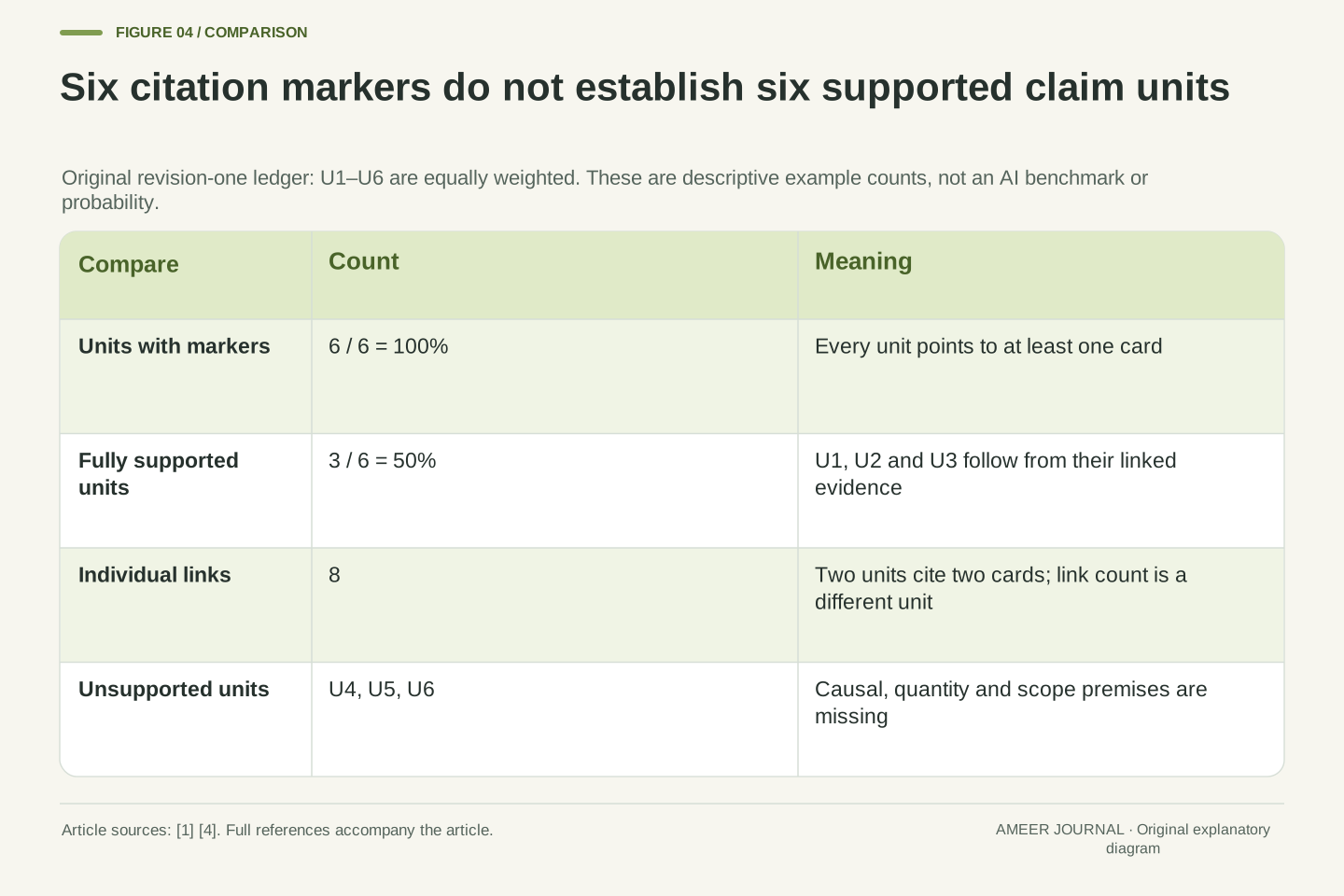
Our initial answer has citation markers on all six claim units: 6 divided by 6, or 100 percent. Only U1, U2 and U3 are supported by their linked cards: 3 divided by 6, or 50 percent. Both numbers are correct descriptions of this small, invented ledger. They answer different questions. The first asks whether a marker is present; the second asks whether the linked evidence establishes the unit’s stated content.
There are eight links in total because U2 and U4 each cite two cards. Counting those links does not turn them into eight independent confirmations. In particular, B does not help U2, while A and B together still leave U4’s causal premise missing. These percentages are not a measured AI failure rate, a probability that the next answer is right, or a published benchmark score. Their purpose is to make one review mistake visible: a fully decorated answer can still have substantial gaps in support.
For the six specified units, let m_i indicate at least one citation marker and s_i indicate complete support by the linked card set under the declared manual judgment. Here m=(1,1,1,1,1,1) and s=(1,1,1,0,0,0). The equal-weight descriptive fractions are therefore sum(m)/6=1 and sum(s)/6=1/2. The denominator is claim units, not words, sources, attempts or users.
The total link count is 1+2+1+2+1+1=8. We do not label a ratio over those links as an official citation-precision metric. Different review protocols handle partial, redundant and jointly necessary support differently, so the unit and rule belong beside any score. This fixture has complete stipulated cards and explicit manual labels; it supplies no sampling design for estimating a population accuracy rate. If the six-unit segmentation changed, the aggregate could change too. Retaining the individual decisions makes the summary interpretable without mistaking formatting coverage for evidential support.
Two passages can support a calculation that neither contains alone
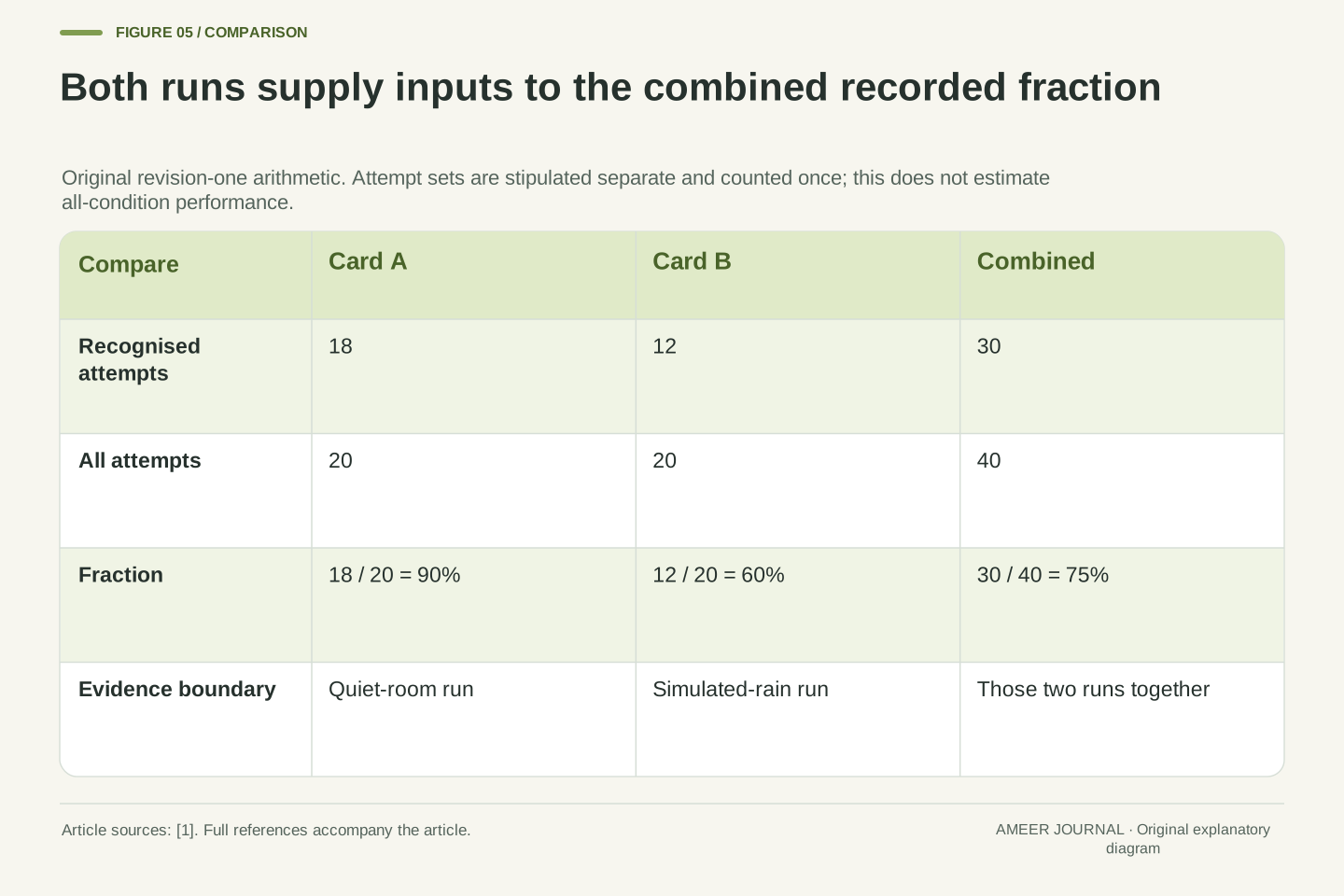
Now ask a new question: how many attempts were recognised across the two revision-one runs together? A supplies 18 recognised out of 20 attempts. B supplies 12 out of a separate 20. Add the recognised counts to get 30 and the attempt counts to get 40. The combined recorded fraction is 30 divided by 40, or 75 percent. We show both cards because each supplies part of the calculation.
Neither card by itself states the combined result. That does not make the combined claim unsupported: the arithmetic and the separate-attempt assumption are explicit. The claim remains carefully limited to those two invented runs. It does not estimate performance in every environment or establish why the runs differed. This is a useful pattern for a research-based article: identify the source inputs, show the operation performed, and describe the result at the same boundary. A reader can then check the calculation instead of having to guess how the writer moved from two references to one number.
Introduce a separate derived unit G, outside the initial six-unit coverage count. For revision one, R_A=18, N_A=20, R_B=12 and N_B=20. Under the stipulated disjoint-attempt accounting, G=(R_A+R_B)/(N_A+N_B)=30/40=0.75. A and B are jointly sufficient inputs to this declared arithmetic; neither alone contains the complete numerator and denominator for G.
The support record should therefore include the evidence set and the derivation, not merely demand that one passage repeat the final sentence verbatim. Direct quotation and transparent calculation are different support paths. Here aggregation preserves the unit of attempts and counts each record once. It does not create a deployment distribution, justify a confidence interval or identify a causal effect. A further claim about future environments would require further premises. The original derivation illustrates why a per-link decision cannot always replace assessment of the linked evidence set as a whole.
A plausible calculation can still begin with an invented input
Return to the 12 watt-hour battery card. Someone might write that the device runs for six hours by dividing 12 by 2. The arithmetic is fine if 12 watt-hours of usable energy and a constant two-watt load are actually the assumptions. Card C supplies neither that usable-energy measurement nor the two-watt load. A correct division cannot manufacture the missing inputs.
There are two honest ways to handle this example. A conditional teaching sentence can say, “If usable energy were 12 watt-hours and the load stayed at two watts, the ideal calculation would give six hours.” A factual runtime claim needs relevant measurements and conditions instead. The same discipline applies to percentages: say which events were counted, which conditions apply and whether the number is observed, rated or calculated. A reference can be accurate while the writer’s substitution is wrong. Reviewing the inputs often reveals the problem faster than checking the final number in isolation.
The hypothetical runtime relation t=E/P uses energy and power at compatible boundaries. Assigning E=12 Wh of usable energy and P=2 W of constant load yields t=6 h. That is a valid conditional calculation. Card C, however, states rated capacity under rating conditions and provides no operating-power value, usable-energy measurement or duration. Substituting those absent quantities would add premises not present in the evidence.
Keep an input-provenance field for each operand in a derived assertion. It can name an observed quantity, a documented rating or an explicitly invented assumption; those categories should remain visible in the resulting sentence. For the count aggregation above, every operand comes from A or B and the non-duplication rule is stipulated. For runtime, the required operational inputs remain unavailable. Both calculations can be arithmetically correct while only one is supported as a description of its supplied records. This distinction prevents mathematical fluency from becoming a substitute for checking what the source actually measured.
A later correction can change the answer without breaking the link
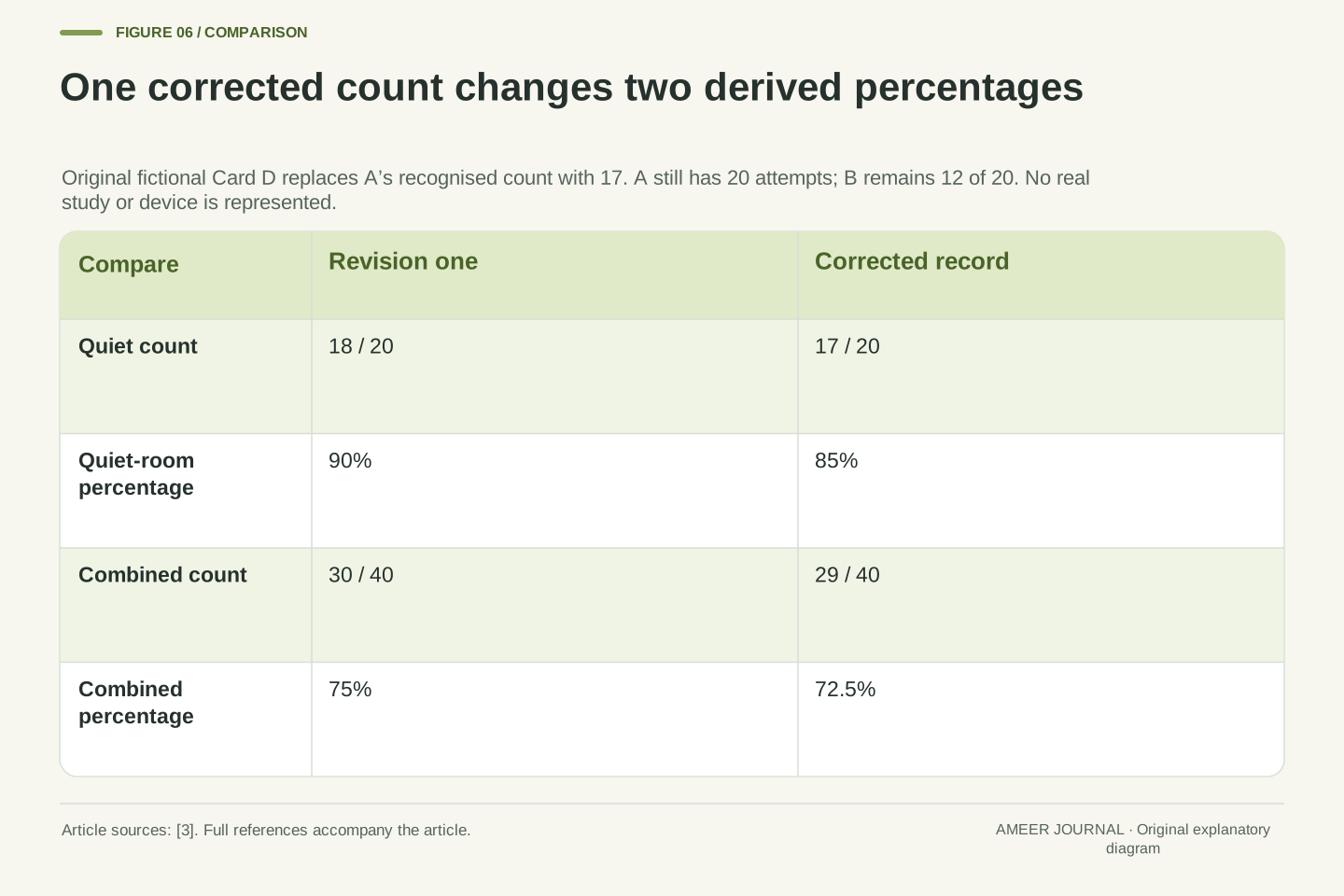
Introduce Card D, an explicit fictional correction. It replaces A’s recognised count of 18 with 17 while keeping A’s 20 attempts; B and C are unchanged. A current description of the quiet-room run now uses 17 out of 20, or 85 percent. The combined count becomes 17 plus 12, giving 29 out of 40, or 72.5 percent. The earlier 75 percent remains identifiable as the calculation from revision one, not the corrected current result.
Crossref’s Crossmark service exposes participant-reported updates such as corrections and retractions. Crossref also says the button’s presence is not a guarantee [3]. Use update information as another evidence check. In our example, the correction changes a specific input and therefore the claims derived from it. A saved page or a still-working link can preserve the older value. The useful question is which version the statement describes and whether an applicable correction has been considered, not simply whether the address continues to open.
D explicitly supersedes A’s recognition count: R_A changes from 18 to 17, while N_A=20 and B remains (12,20). The corrected quiet-run fraction is 17/20=0.85. The corrected pooled fraction is (17+12)/(20+20)=29/40=0.725, a reduction of 2.5 percentage points from the revision-one 75%. This change is deterministic revision accounting, not statistical uncertainty. The initial six-unit assessment remains labelled as a revision-one exercise.
Crossmark provides access to metadata about participant-reported status updates, including corrections and retractions; Crossref explicitly qualifies its presence as no guarantee [3]. The proposed review therefore records the inspected version and any applicable update rather than inferring complete currentness from a button. A historical statement can accurately describe what revision one reported. A current unqualified count must incorporate D in this fixture. Preserve the old calculation with its version label and revise the affected current claims, so that provenance and current reporting remain understandable together.
An automated support judgment also needs an evidence trail
The 2023 ALCE paper treats citation quality as something to evaluate and uses a natural-language inference model to check support. It considers multiple cited passages together and discusses a limitation involving partially supporting citations [1]. That research is useful context for asking precise questions; its historical results are not a measurement of a current assistant or this fictional ledger.
Suppose an automated checker says U4 is supported because both cards mention the same device. Keep its verdict beside the actual claim and passages, then inspect the missing causal step. The verdict is a proposed assessment, not another experiment showing that rain caused the change. A useful review record identifies which part of a sentence each passage supports, which assumptions a calculation needs, and why any portion remains unresolved. The same record helps a later reviewer correct an overly strict rejection of G, where two cards jointly supply all the declared arithmetic inputs.
ALCE’s 2023 citation evaluation uses natural-language inference over cited passages and explicitly permits joint passage support. Its discussion also identifies a partial-support limitation in the automatic precision procedure [1]. Those are scoped properties of that published evaluation, not a claim that its historical performance applies to present models. The manual six-unit ledger here does not implement ALCE’s scoring algorithm or run its NLI model.
An automated verdict should retain the evaluated claim, evidence set, relevant passage spans and reason for the outcome. In the invented U4 case, topic agreement leaves the causal premise absent; in G, the two-source derivation supplies the pooled count under the declared accounting rule. A verifier that conflates these cases can accept an unsupported inference or reject a supported composition. Preserving the inputs allows those decisions to be challenged directly. Model agreement alone adds no missing measurement, and rerunning the same judgment without inspecting the disputed relation leaves the underlying evidence gap untouched.
Repair the sentence at the point where its evidence ends
A repaired revision-one description could say: “The quiet-room run recorded 18 recognised attempts out of 20. The separate simulated-rain run recorded 12 out of 20. Together, those runs recorded 30 out of 40, or 75 percent. The cards do not establish the cause of the difference.” Each factual part now has a visible route to its inputs, while the unanswered question remains explicit.
After D, update the first count to 17 and the combined result to 29 out of 40, or 72.5 percent. Keep the battery sentence limited to its rated 12 watt-hour capacity unless additional operating evidence is supplied. Remove the all-conditions claim or narrow it to the exact run and revision. These repairs change the substance of the answer, not merely its footnotes. A reader should be able to distinguish what the source states, what the writer calculates and what is still unknown without reconstructing that distinction from a long reference list.
The repair operation is claim-specific. U1 and U3 retain their revision-one count wording. U2 uses A as its relevant support, with B’s extraneous link removed. U4 becomes a descriptive comparison plus an explicit statement that causation is not established. U5 is omitted as a factual power claim; C supports only its stated capacity rating. U6 is narrowed to A’s particular run and revision rather than extended to all conditions.
When D is introduced for current reporting, update the affected quiet-run numerator and every dependent derived value. The 30/40 revision-one result becomes 29/40 for the corrected record; the quiet-run percentage changes from 90% to 85%. Do not silently relabel a historical assessment as a current one. A dependency record can show why one corrected input affects several sentences while leaving B’s count and C’s rating intact. This gives the correction a precise scope and preserves the difference between direct evidence, authored derivation and an unanswered question.
Save enough information for someone else to repeat the check
For a useful citation check, keep the exact statement, the source identity, the relevant passage location, the version inspected and a short explanation of support. Add the calculation when a result combines inputs. If evidence is inaccessible or incomplete, record that outcome rather than replacing it with a confident guess. The record should make it easy to return to the disputed sentence, not merely to a publisher’s home page.
NIST’s profile includes citation verification during evaluation and ongoing monitoring [4]; Crossmark illustrates one way update information can be exposed [3]. Our practical application is simple: preserve the claim-to-evidence connection when an article changes. A new number, removed qualification or corrected source can require another look at the affected claims. The goal is a readable answer whose important statements can be checked. A working link helps the reader begin that process; the passage, reasoning and version explain why the statement deserves to remain.
The proposed record links claim text and revision to source identity, inspected content version, retrieval date, passage locator, support classification, reasoning and any derived-input dependencies. It also retains access limitations and unresolved premises. This is an original editorial record design: it does not certify the underlying study, make an inaccessible source visible or eliminate judgment from interpretation. Its benefit is reproducibility of the particular support decision.
The NIST profile includes source and citation review in evaluation and monitoring [4]. Applying that idea here means revisiting affected claims when an operand, qualification or source status changes, with Crossmark serving as one documented update-information mechanism [3]. Preserve prior decisions with their scope rather than overwriting the history without explanation. A future reviewer can then identify whether the disagreement concerns document identity, passage meaning, arithmetic, version choice or an unsupported inference. That level of traceability makes a citation useful to the reader instead of leaving it as an unexplained marker beside confident prose.
Sources & further reading
Explore the references behind this guide. External pages may change after our review.
- Enabling Large Language Models to Generate Text with CitationsAssociation for Computational Linguistics / Gao et al. · Accessed 7 Nov 2026
- REST API - CrossrefCrossref · Accessed 7 Nov 2026
- Crossmark - CrossrefCrossref · Accessed 7 Nov 2026
- Artificial Intelligence Risk Management Framework: Generative Artificial Intelligence ProfileNIST · Accessed 7 Nov 2026
Article updated 7 Nov 2026.
Found something we should revisit?
Good explanations get better with thoughtful feedback.