What you’ll take away
- An uploaded source image and the prepared input supplied to a multimodal model are different objects.
- The original mean-only example merges opposite diagonal patterns into the same input, so no downstream rule can correctly identify both from that input alone.
- Preserving sample order can retain a distinction without guaranteeing that a trained model uses it correctly.
- A crop-local coordinate needs the crop origin, dimensions and resize scales to map back to the original image.
- Image identity, ordering, question references and actual processor settings belong in a useful comparison.
The uploaded picture and the model input are different objects
When you ask an AI a question about a picture, it is natural to imagine the model studying the same image you can enlarge on your screen. The system actually has to turn that picture into a form the model accepts. Which details survive that preparation matters as much as whether the question mentions them.
A multimodal system combines different kinds of input, such as text and images. Hugging Face’s Transformers v4.56.0 documentation represents a multimodal chat message with typed content items and describes a processor that prepares the text and media [1]. That is a concrete example of an input boundary, not a statement that every service uses the same message format.
We will examine what can happen at that boundary using two tiny, invented images and a completely specified reduction rule. We will then follow a point through a crop and a resize. These examples do not measure an AI product. They let us separate three questions that are easy to confuse: what the original image contains, what the model receives, and what a proposed answer can establish from those inputs.
The original media asset, its decoded samples, the preprocessed tensors and the model’s subsequent internal representations are distinct objects. A question about the source asset is answerable from a particular representation only if the necessary distinction remains available there or is supplied through other relevant input.
In the named Transformers v4.56.0 interface, multimodal messages contain typed content blocks and a Processor handles media preparation alongside text tokenization and chat formatting [1]. The documented example produces image-related tensors as well as text inputs. This supplies a real interface example, without defining every vision-language architecture or every hosted service’s preprocessing behavior.
Our analysis uses an original deterministic reduction of two finite arrays. It proves an identifiability limitation under explicitly identical complete downstream inputs. A separate ideal coordinate map illustrates why spatial outputs also require an origin and scale. Neither exercise executes a visual encoder, tokenizer or language model. Their purpose is to identify the information contract that an empirical system would need to preserve, rather than infer a model’s accuracy from the size or appearance of an uploaded file.
Read the preparation rule before interpreting a result
An image processor may resize a picture, select a crop or adjust the numerical scale of its samples. The cited Hugging Face image-processing guide keeps these choices in model-specific configuration and distinguishes preparing the expected input from creating augmented training examples [2]. A change made before the answer is generated can therefore change the evidence available for that answer.
It helps to name each object in order. First there is the retained original. Then there is the selected region and its transformed values. Those values become model inputs, associated with a question. Finally, the model produces an answer. A thumbnail shown in the app is another object; without checking the implementation, it does not prove exactly which values reached the model.
Not every transformation loses information. Subtracting a known number from every sample can be reversed if the result is retained exactly. Cropping away a region or merging several samples can be different. The important task is to inspect the particular operation and the particular question. Saying that an image was preprocessed tells us too little to decide what was preserved.
The v4.56.0 image-processor guide describes model-specific preparation, configuration storage, pixel tensors and operations including resizing, cropping and numerical normalization [2]. Those operations should not be conflated with one another. They can have different domains, metadata requirements and invertibility properties, while an augmentation pipeline has a different stated purpose from satisfying an inference input contract.
For this article, distinguish the asset X from a declared preprocessing map P and the downstream input P(X). Additional text and metadata are separate components of that input. An interface preview is not evidence that P is the identity map; equally, a small preview is not evidence that the backend discarded the original. The actual preparation path must settle those implementation questions.
We will specify P exactly before drawing a conclusion. A known affine transformation in exact arithmetic can be invertible, whereas a mean-only map over several independent samples is many-to-one. Real finite-precision conversion, clipping or cropping needs its own analysis. The following proof is deliberately about a stated map, rather than a general assertion that all normalization, resizing or multimodal processing necessarily destroys every useful distinction.
Two small images can require opposite answers
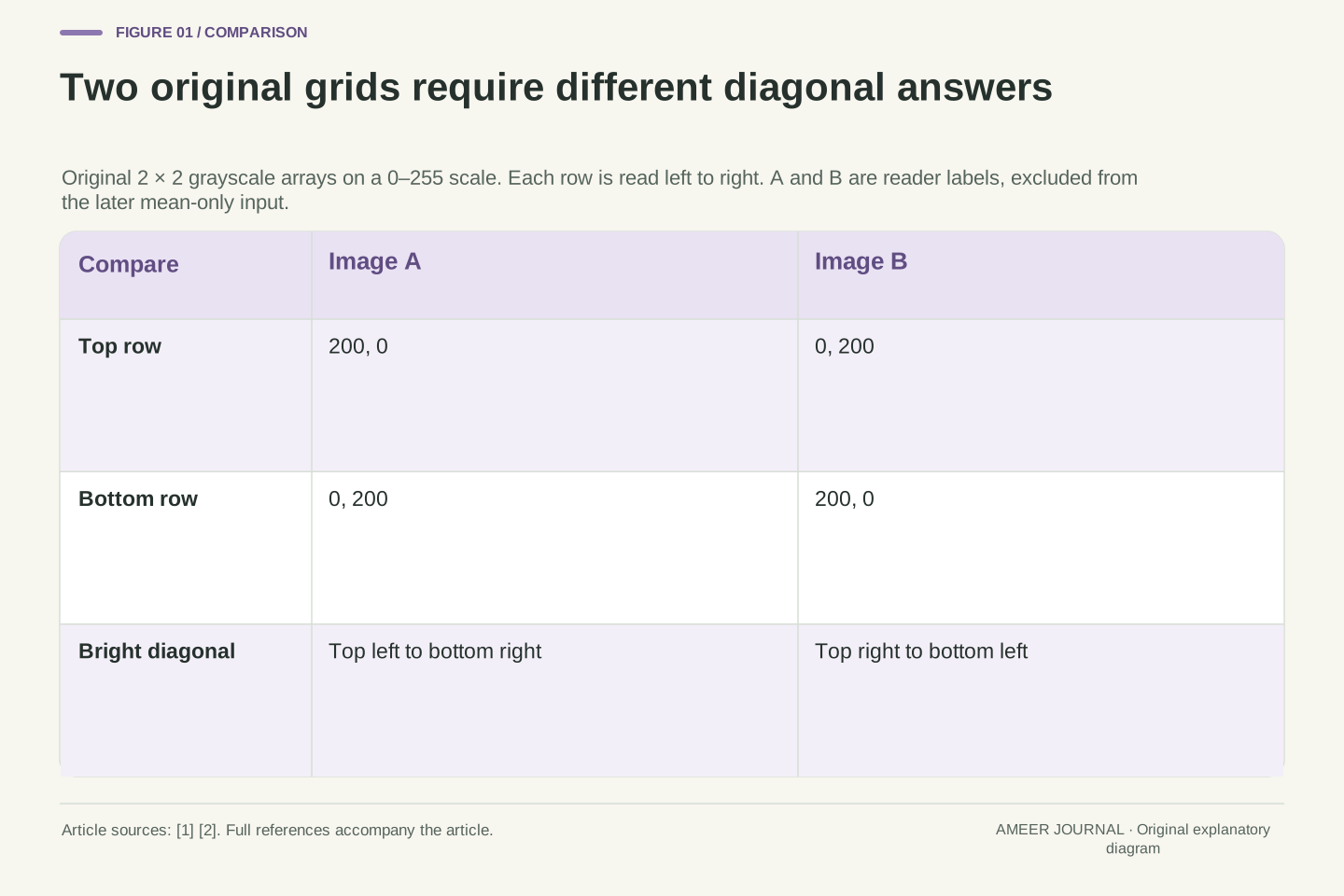
Make image A a square of four grayscale samples. Its top row is 200, 0 and its bottom row is 0, 200. Image B reverses the arrangement: its top row is 0, 200 and its bottom row is 200, 0. We use a scale from 0 to 255, so 200 denotes the brighter samples and 0 the darker ones. These numbers are chosen for the exercise.
Ask the same question about each image: which diagonal contains the bright squares? For A, the answer runs from top left to bottom right. For B, it runs from top right to bottom left. A reader looking at the complete grids has enough information to tell those answers apart. No object recognition, world knowledge or interpretation of a real photograph is needed.
The letters A and B are labels for our explanation. In the next experiment they are not sent to the downstream system, either as filenames or as extra text. Otherwise those labels could carry the answer independently of the image. Keeping that boundary explicit prevents an unnoticed clue from undermining the example.
Define A=((200,0),(0,200)) and B=((0,200),(200,0)), with rows ordered from top to bottom and columns from left to right. Entries lie within the declared grayscale range [0,255]. Define the target g(X) as the diagonal containing the two entries of value 200. Then g(A) is the main diagonal and g(B) is the other diagonal.
These are four-sample mathematical images, not downscaled photographs or outputs from a vision model. The complete arrays differ in spatial arrangement while sharing a multiset of values. The target is fully specified on this two-element domain, making the distinction testable without assuming a learned classifier, a perceptual metric or a semantic annotation process.
The downstream prompt q is identical for both trials. The source labels, filenames and any state correlated with which original was selected are excluded from the input. This includes a prearranged trial order that would reveal the answer. Those restrictions are part of the proof’s premises. If a real system receives additional distinguishing context, the complete-input equality must be reassessed rather than applying the conclusion to an incomplete description of its inputs.
A mean-only reduction removes the diagonal distinction
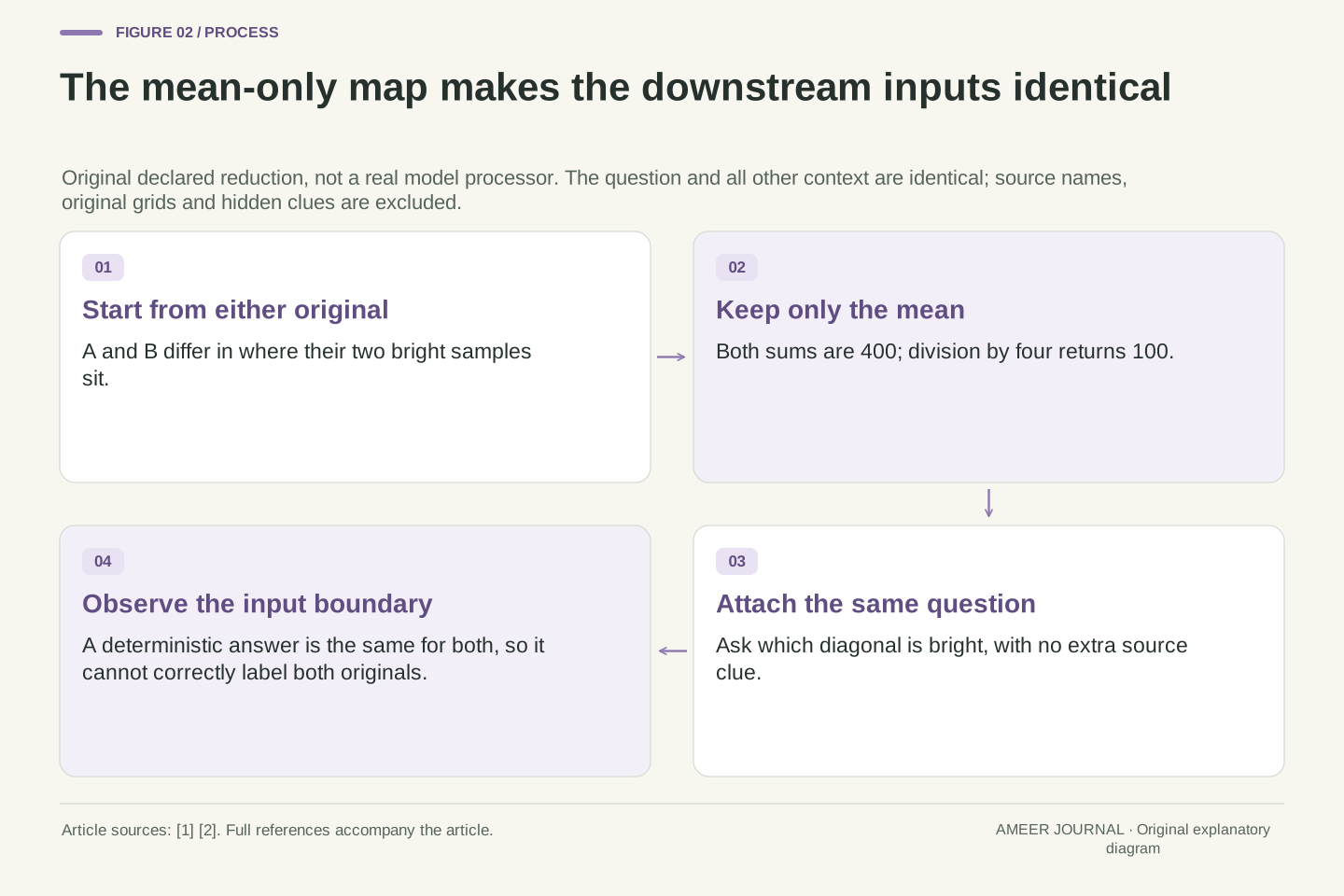
Define a very severe preparation rule: add the four sample values, divide by four and keep only that one number. For A, the sum is 200+0+0+200=400, giving a mean of 100. For B, the sum is 0+200+200+0=400, giving the same mean of 100. Both images have now become the same single input value.
This rule is intentionally simple enough to inspect completely. It is not a description of a named multimodal model’s image processor. The general reason to examine preprocessing comes from the documented image-input pipeline [1][2]; this particular mean calculation is our own construction. The reduction preserves overall average brightness while dropping the arrangement needed for the diagonal question.
Notice that the lost information depends on the task. If the question asks for the original mean, the retained value supplies the answer exactly. If it asks which diagonal was bright, that same value is insufficient to choose between A and B. A representation can therefore be adequate for one question and inadequate for another, even though the original source file is unchanged.
Let P(X)=(x11+x12+x21+x22)/4, with P returning only a scalar and retaining no positional metadata. Direct substitution gives P(A)=P(B)=100. Thus P is not injective on the declared two-image domain: distinct originals map to the same representation.
The loss is relative to the target. For a mean-estimation target m(X)=P(X), the identity function on the scalar input reconstructs the target exactly. For the diagonal target g, no function h defined only on that scalar can satisfy both h(P(A))=g(A) and h(P(B))=g(B), because the left-hand inputs are equal while the required labels differ.
This is an original finite proof, not a statement that a documented product reduces images to global averages. The cited interfaces establish that preparation exists [1][2]; the chosen map establishes its own mathematical consequence. Keeping those roles separate avoids turning an illustrative counterexample into a claimed evaluation. It also shows why input preservation should be assessed against the intended question rather than an unspecified idea of whether an image still looks useful.
A stronger downstream model cannot manufacture a distinguishing input
Suppose the answering system receives only the number 100, the same diagonal question and the same other context in both cases. A deterministic answering rule must produce the same answer for the same complete input. Since A and B require different answers, that one answer cannot be correct for both originals.
A system could guess. If the experiment chooses A or B with equal probability and supplies no extra clue, guessing one diagonal every time is correct half the time. Randomly changing the guess does not improve that average for this two-image task. A model may have useful prior knowledge in other circumstances, but our defined input does not tell it which member of this equally likely pair was selected.
A cautious answer could instead say that the received representation does not determine the diagonal. That is a truthful description of the evidence, although it is not a correct orientation label under the experiment’s scoring rule. The choice between an answer and an explicit uncertainty should not be confused with recovering the missing image arrangement.
Write the deterministic downstream rule as F(P(X),q,c), where q and all other context c are fixed across the two trials. Equality of P(A) and P(B) forces equality of the outputs. Since g(A)≠g(B), the composition cannot correctly identify both originals’ target labels. Model size, a longer answer or more internal computation does not alter that input equality.
For a randomized rule, let p be the probability of returning the main-diagonal label and r the probability of returning the other label conditional on this identical input. Because p+r≤1, equal prior selection of A and B gives expected correctness (p+r)/2≤1/2. Other responses, including abstention, are not counted as correct labels in this stated metric. This bound is analytical, not an observed accuracy result.
The conditions matter. Unequal source priors permit a better majority guess, and additional metadata or a retained original can distinguish the trials. Neither change restores information from the mean alone; each changes the task or the complete input. The appropriate conclusion is therefore conditional identifiability, not a universal ceiling on real multimodal systems or a claim that plausible reconstruction is impossible in every setting.
More summary numbers can still omit the same arrangement
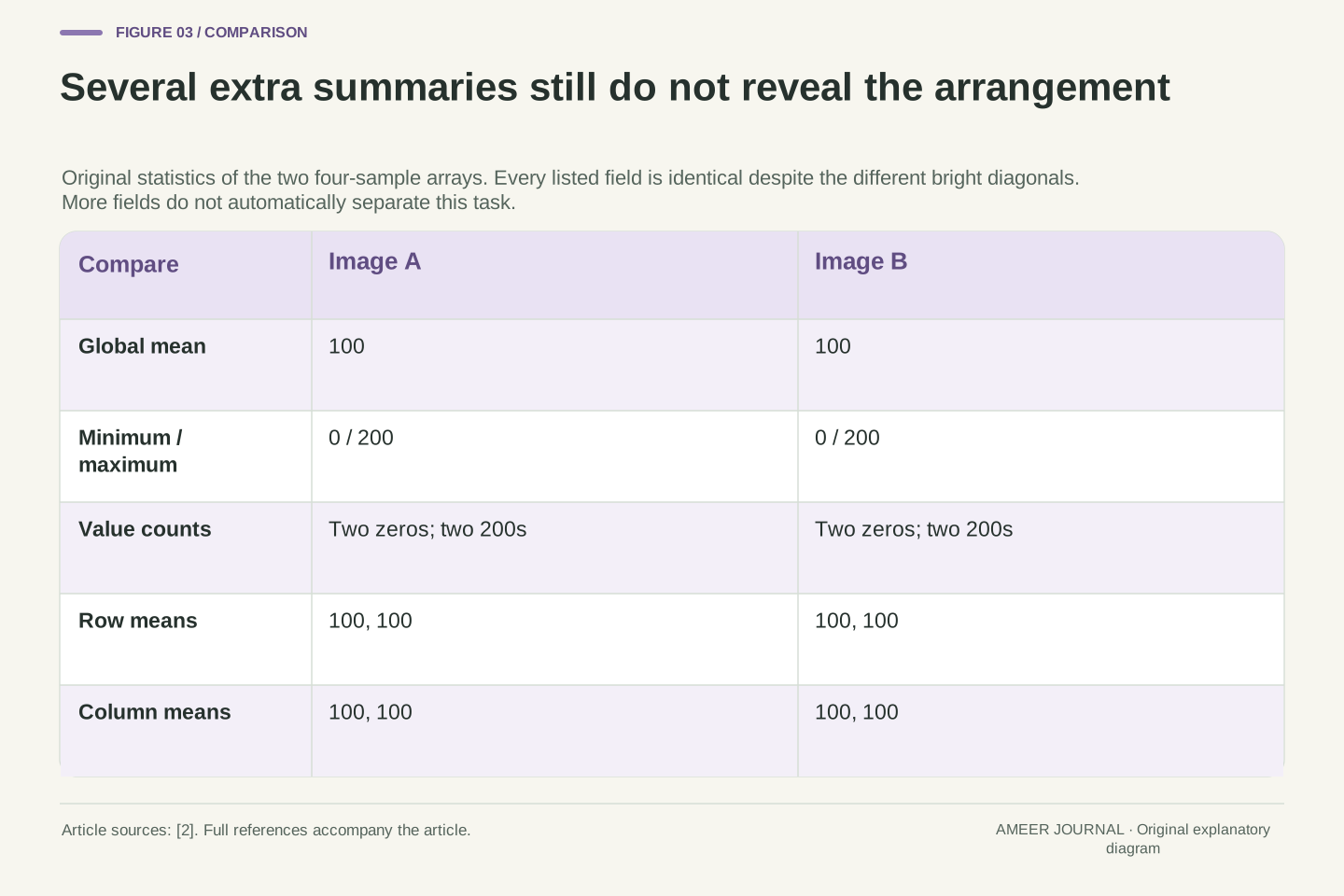
Perhaps a single average seems too restrictive. Give the answering system the smallest value, largest value and count of each value as well. Both originals still have minimum 0, maximum 200, two zeros and two values of 200. Those extra summaries describe the same collection of numbers without saying where they belong.
Even adding each row’s mean and each column’s mean does not separate this pair. Both row means are 100, and both column means are 100, for A and B. The summary is longer, but every field is identical. It still cannot identify the bright diagonal under the same no-extra-clue conditions.
This does not mean that all summary features are useless. A different feature that preserves a relevant positional distinction could separate these particular arrays. The example shows why the number of retained fields is a poor substitute for examining their contents. Before claiming that more image information solves a question, ask whether that information actually changes between the candidate situations the question needs to distinguish.
Extend P to a summary H containing the global mean, minimum, maximum, value histogram, two row means and two column means. For both arrays, these are 100,0,200, the histogram {0:2,200:2}, row means (100,100) and column means (100,100). Hence H(A)=H(B) despite the larger representation.
The same identifiability argument therefore applies to H. These features retain several numerical properties but are invariant to the particular rearrangement that changes our target. The proof is not that every aggregate feature map fails, nor that spatial information always requires retaining all original samples. A carefully chosen task-specific feature could distinguish the two cases; it would define a different map.
This is a useful distinction when evaluating a proposed input change. Increasing representation length is not equivalent to increasing task-relevant discrimination. One must check whether candidate inputs with different target labels still collide under the new mapping. Our two-array construction supplies an exact counterexample for the listed summaries only. It says nothing about the learned features, collision frequency or practical recognition accuracy of an untested visual encoder.
Keeping sample order preserves a distinction that averages lose
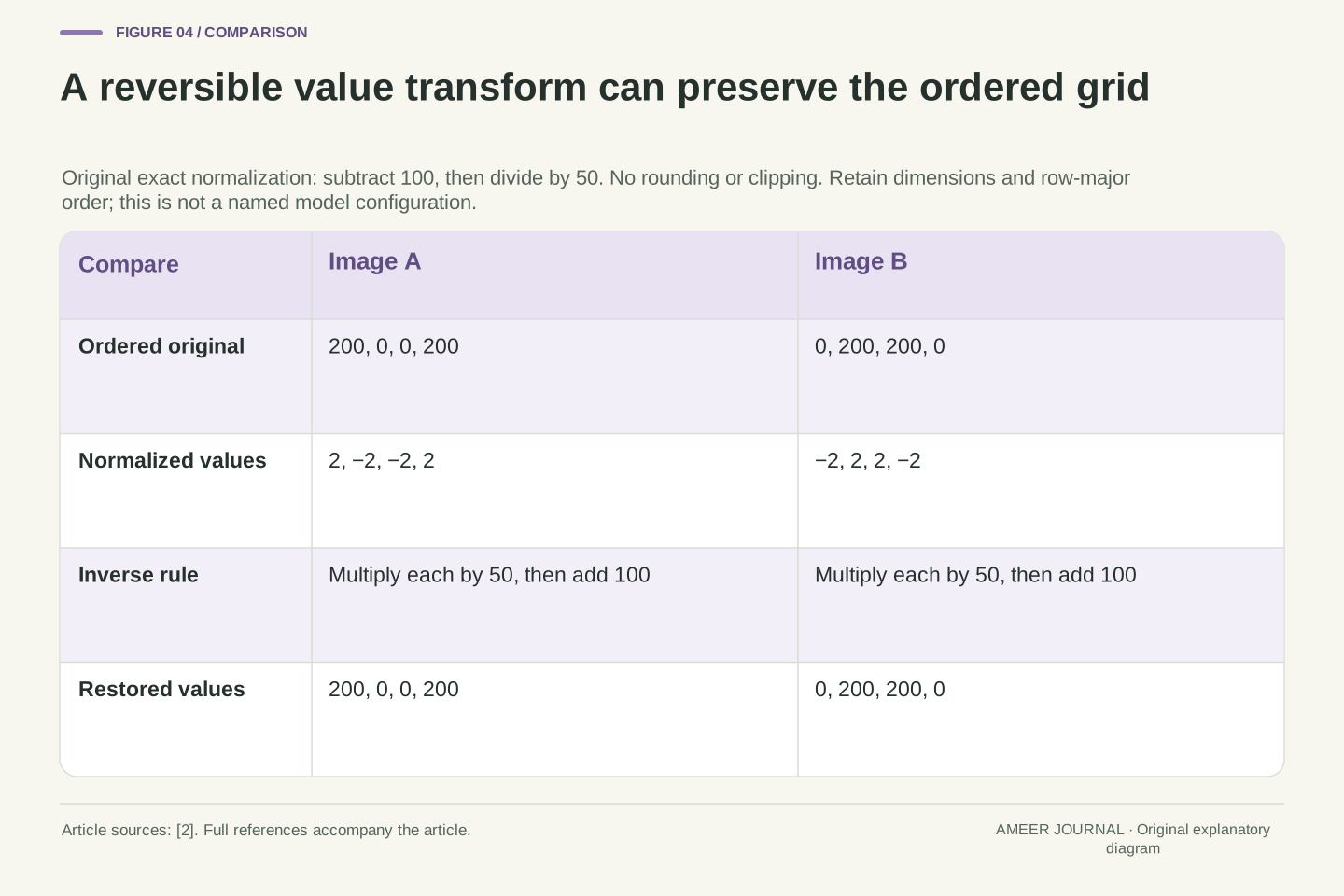
Read each image across its top row and then across its bottom row. A becomes the ordered sequence 200, 0, 0, 200. B becomes 0, 200, 200, 0. These sequences are different. If the reader also knows that the image has two rows and two columns and knows the reading order, the four original positions can be reconstructed.
A reversible numerical change can preserve that distinction too. For each sample, subtract 100 and divide by 50, with no rounding or clipping. The dark samples become −2 and the bright samples become 2. A’s ordered sequence is 2, −2, −2, 2. B’s sequence is −2, 2, 2, −2. Multiplying each retained value by 50 and adding 100 reverses this operation exactly.
The lesson is about available information, not guaranteed intelligence. A downstream system receiving the ordered values now has a basis for distinguishing the images. It could still use those values incorrectly. Preserving the evidence removes this particular impossibility; it does not prove that an untested model will give the right answer.
Define a row-major map R(X)=(x11,x12,x21,x22). Then R(A)=(200,0,0,200) and R(B)=(0,200,200,0). With dimensions and ordering retained, R is invertible on these arrays. A task rule can inspect the specified positions to distinguish g(A) from g(B), although no learned system’s competence follows from that existence result.
Now apply the componentwise affine map N(x)=(x−100)/50 in exact arithmetic. It produces (2,−2,−2,2) and (−2,2,2,−2). Since the scale factor is nonzero, the inverse x=50N(x)+100 reconstructs every supplied value. This is a separate original example; it does not assert the mean or standard deviation used by a named model’s processor.
If the normalized values are averaged and only that average is retained, both arrays instead yield zero. The invertibility of the componentwise transform does not make the subsequent aggregation invertible. The complete composition is what matters. Real quantization, clipping or numerical rounding can change that analysis and must be specified separately. Retained sample ordering establishes distinguishability here, not successful recognition, general image understanding or any measured accuracy gain.
A real model’s input design must be checked on its own terms
The mean-only example should not become a rumor about how actual vision systems work. Real designs can preserve spatial structure in much richer ways. Qwen’s January 26, 2025 release description for Qwen2.5-VL discusses a dynamic-resolution visual encoder and converting differently sized images into visual-token sequences of varying lengths [3]. That is a dated description of one model family, not a claim about the latest model or a universal token budget.
Changing the image size can therefore change more than the size of an uploaded file. The relevant questions include which spatial samples are retained, which regions are processed and what shape or position information accompanies them. Those answers belong to the selected model and processor configuration. A fixed assumption copied from another system can describe the wrong input.
More visual tokens also do not, by themselves, prove that a particular answer improved. Our summary example already showed why more numbers need not separate the relevant cases. A real improvement claim requires a comparison on the intended task with the actual preparation settings and outputs recorded. The model description helps define that comparison; it does not supply its result.
Qwen’s dated Qwen2.5-VL release describes a native dynamic-resolution visual encoder and image-to-token sequences whose lengths vary with image size [3]. This is sufficient to reject treating our scalar reduction as a reconstruction of that architecture. The source also describes coordinates on an image-size scale; it is not an endorsement of importing another model’s normalized-coordinate convention into its outputs.
A real input contract should identify the checkpoint, processor version and relevant configuration. Spatial dimensions, crop or tile selection, padding, ordering and associated metadata can all be part of the representation being investigated. The precise combination is implementation-specific. Our analysis has not run the documented processor and does not derive its visual-token count, interpolation behavior or localization accuracy.
Increasing a representation’s size changes a resource and potentially its available distinctions, but does not establish task performance without evidence. Preserve the preparation path when comparing model responses, so that a change in answers is not automatically attributed to model weights while the visual inputs also changed. The original counterexamples provide questions to ask at this boundary, not a replacement for evaluating the actual trained system under the required conditions.
A crop gives the same point a new coordinate
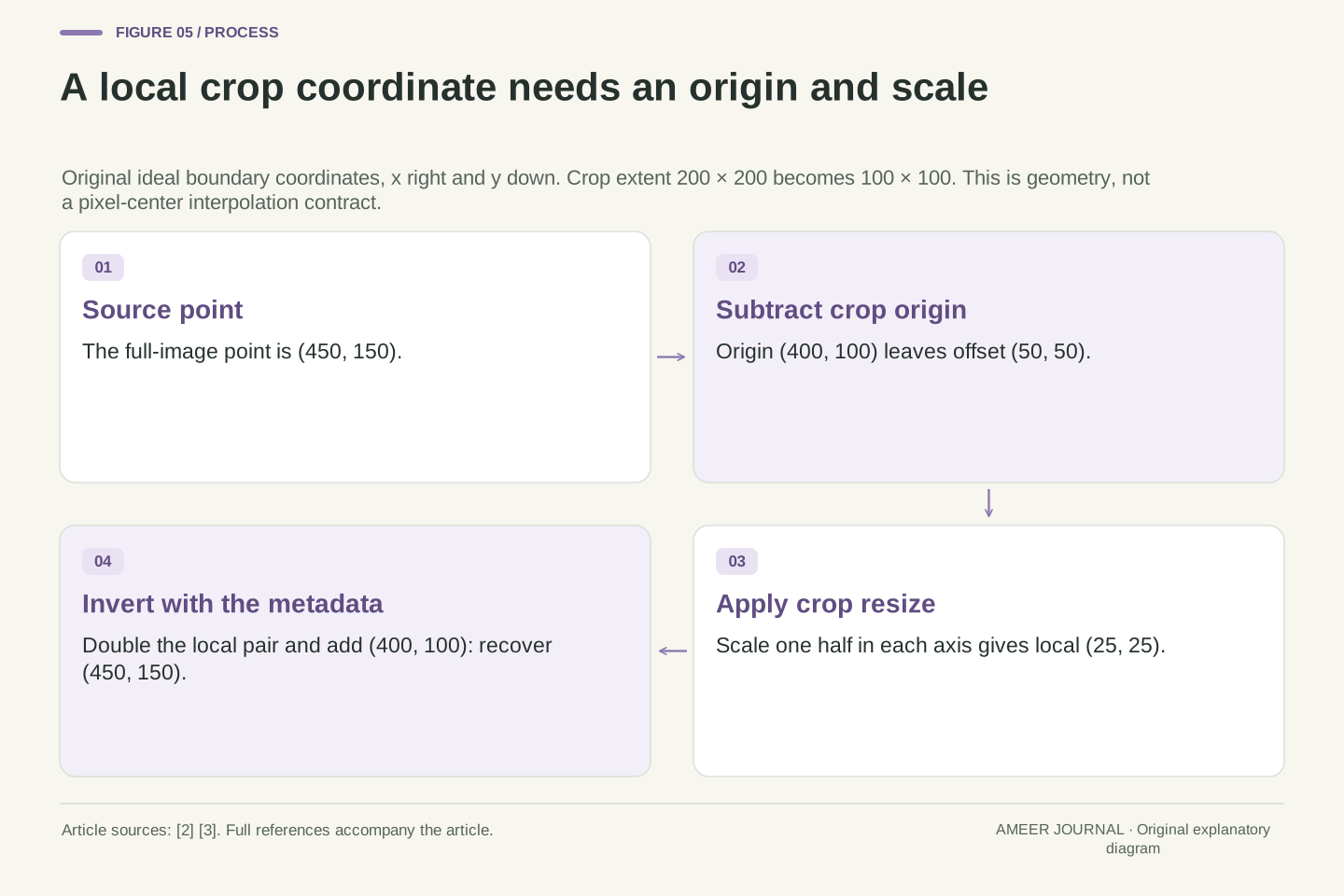
Consider a separate ideal image whose width is 600 coordinate units and height is 400. Measure positions from the top-left boundary, moving right for the first number and down for the second. Choose a square crop that starts at position 400, 100 and extends 200 units in each direction. A point at 450, 150 lies inside that crop.
Relative to the crop’s own origin, the point is 50 units right and 50 down. Now resize the crop from 200 by 200 units to 100 by 100. Both distances halve, placing the point at 25, 25 in the resized crop. To recover its full-image position, double those local numbers and add the crop’s original offset: 400+50, 100+50 gives 450, 150.
This is continuous coordinate geometry, not a simulation of how a particular library samples pixels. We have excluded rounding, rotation, distortion and padding. The example isolates the information needed for the mapping: crop origin, crop dimensions and output dimensions. Retaining the local point without those details leaves part of its meaning behind.
Use ideal continuous boundary coordinates on a 600×400 source extent, with x increasing rightward and y downward. Let crop origin be (x0,y0)=(400,100), crop extent (Wc,Hc)=(200,200) and output extent (Wo,Ho)=(100,100). Exclude rotation, distortion, padding and numerical rounding.
The forward map is u=(Wo/Wc)(x−x0), v=(Ho/Hc)(y−y0). For source point (450,150), each offset is 50 and each scale is 1/2, yielding (u,v)=(25,25). The inverse is x=x0+(Wc/Wo)u and y=y0+(Hc/Ho)v, which returns (450,150). The point is inside both declared extents, so no clipping or out-of-bounds rule is needed.
These equations define our geometry; they do not specify the pixel-center convention or interpolation kernel of an image-resampling API. A production system must add any such conventions needed for its own coordinates. The distinction prevents an ideal geometric illustration from being mistaken for an implementation-level recipe. It also exposes exactly which metadata is required to move a reported point between the two coordinate frames.
The same local numbers can refer to different places
Keep the local point 25, 25 and the same half-size crop transformation, but move the crop’s source origin to 0, 0. The inverse now gives full-image position 50, 50. The local numbers have not changed, yet they describe a different place in the original image. A coordinate pair alone does not say which crop it belongs to.
Resizing the whole original image gives another answer. Scaling the complete 600-by-400 image to 300 by 200 sends the original point 450, 150 to 225, 75. That is different from 25, 25 because the whole-image operation never subtracted the crop’s offset. Both answers can be correct when their coordinate frames are stated.
Width and height need their own scales as well. If our 200-by-200 crop becomes 100 by 50, the point’s local coordinates become 25, 12.5. Assuming the horizontal scale also applies vertically would produce the wrong second number. Before drawing a marker or comparing two detections, establish the source image, crop and coordinate convention that each result describes.
For the original crop map, (25,25) in output coordinates corresponds to (450,150) in source coordinates. If the source origin is instead (0,0), with identical extents and scales, the same local pair corresponds to (50,50). Therefore the inverse is not determined by the pair alone when crop origin is unknown.
A whole-image resize from 600×400 to 300×200 uses a zero origin and scale 1/2 in each axis. It maps the same source point (450,150) to (225,75). This is not a disagreement with the crop result; it is a different transformation. For a separate output extent 100×50 from the original 200×200 crop, scales are 1/2 and 1/4, giving (25,12.5).
The coordinate record therefore needs source identity, origin, extents, axis orientation and any further transformations. A normalized fraction, a source-image coordinate and a crop-local coordinate are not interchangeable merely because each is written as two numbers. These examples establish geometric interpretation only. They do not imply that a real model localized the point correctly, that a returned box uses our convention, or that the documented Qwen interface exactly implements this chosen mapping.
Keep each question attached to the image it actually names
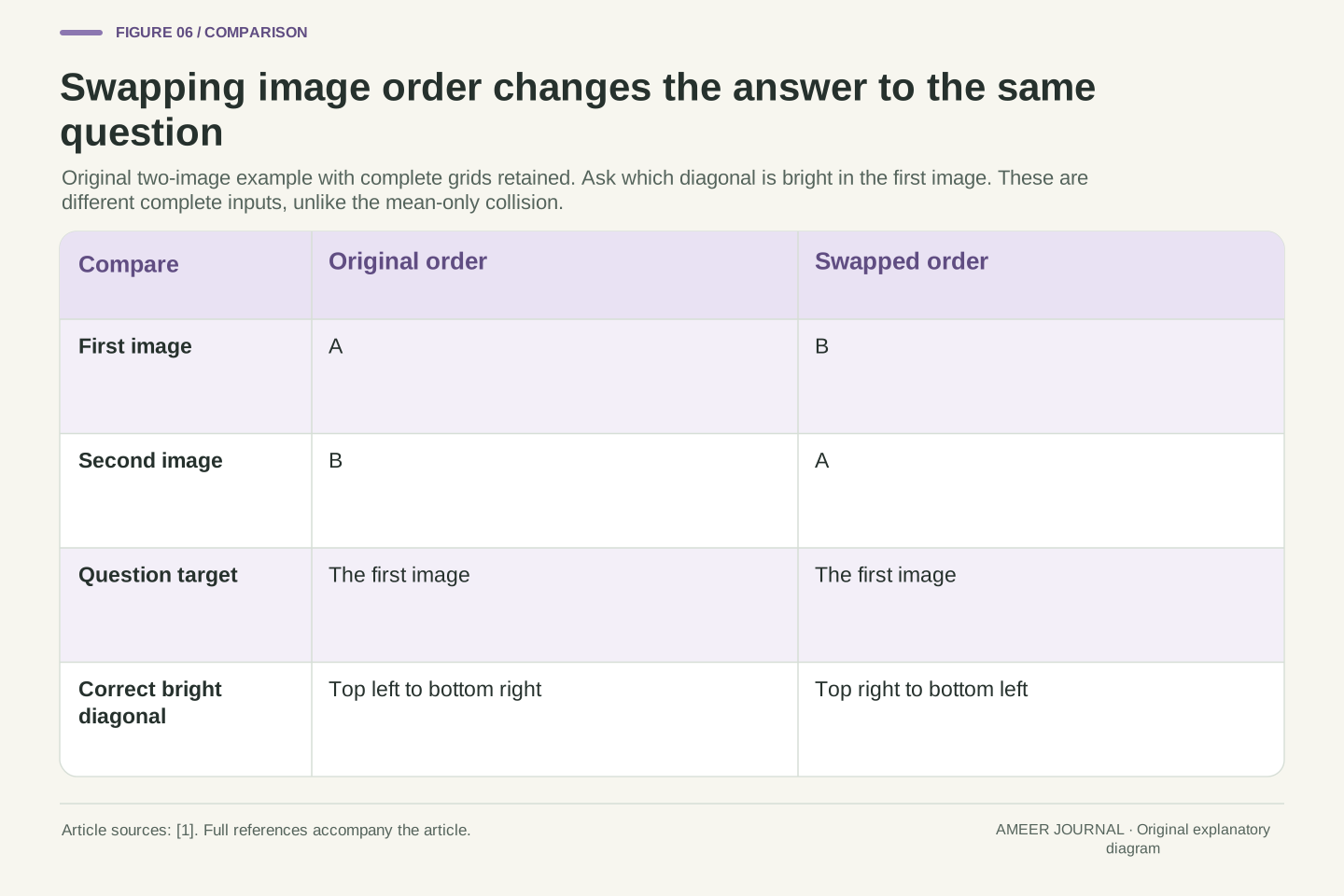
Return to the two original grids, this time preserving their complete ordered values. Put A first and B second, then ask which diagonal is bright in the first image. The correct answer is top left to bottom right. Swap the image order while leaving the question unchanged, and the correct answer becomes top right to bottom left.
The collection of images is identical in both requests. What changed is the association between a position in the request and an image. Treating two inputs as an unordered pile would discard a distinction that the word first requires. This is another original construction, separate from the earlier mean-only experiment. The complete requests are now different, so the identical-input proof does not apply.
For a real multi-image comparison, preserve the ordering and any labels the question uses. If crops or derived views are added, keep their relationship to the original visible in the input record. A correct-looking description of the wrong image still fails the question. Good image quality cannot compensate for an association error introduced while assembling the request.
Define an ordered two-image input I=(A,B) and I′=(B,A), with the same prompt asking for the bright diagonal of the first image. The target labels differ even though the unordered multisets of source arrays are equal. This example retains full grids and intentionally changes the complete ordered input; it is not another case of identical inputs requiring a deterministic model to produce different answers.
If a preparation layer discards ordering while the task depends on ordering, the resulting representation can again merge distinct target cases. If it preserves ordering but the answering system attends to the wrong item, that is a different failure: relevant evidence was supplied, but the output used the association incorrectly. Distinguishing those cases requires the actual submitted structure rather than only copies of the source assets.
The typed media/text interface documented in the named library provides an example of structured inputs [1], but this original ordering argument does not assume a universal API convention. Record image identity, order, crop lineage and the text references that connect them. That record allows a reviewer to ask whether the question was well-defined and whether the response refers to the intended evidence before interpreting a wrong answer as a general visual-recognition limitation.
Separate missing evidence from a model’s use of available evidence
A useful investigation keeps the original image and the actual prepared input together. Record the question, image order, selected crops, output dimensions and any coordinate mapping. Where the system exposes them, retain the model and processor identities and the settings that produced those inputs. This makes it possible to locate a change instead of attributing every difference to the final answering model.
Our examples lead to different conclusions. The mean-only input cannot identify the diagonal of both originals. The ordered grid preserves that distinction, but an answering rule still has to use it correctly. A crop-local point needs its origin and scale to become a full-image point. Swapping two images changes what the word first refers to. None of those conclusions requires a fictional benchmark result.
For an actual task, compare the answers against the evidence that was truly supplied. If a relevant region was excluded, change the input and document the new comparison. If the evidence was preserved but misread, investigate that different problem. The goal is a clear explanation of the failure boundary: which information was available, which interpretation was required, and what the observed response actually supports.
An inspectable comparison should retain source identity, selected regions, transformation parameters, prepared-input structure, prompt, model configuration and observed outputs. Include the coordinate convention when outputs refer to locations. Exact intermediate values are useful where they can be obtained; when they cannot, leave the preparation step explicitly unknown rather than inferring it from a preview or a response.
The original constructions establish distinct boundaries. P and H merge arrays with different diagonal targets; ordered samples with known geometry preserve their distinction; an invertible normalization does not rescue a later lossy aggregation; crop coordinates require a transform; and an ordered-image question depends on association. These are analytical results under declared assumptions, not empirical assessments of the cited model family.
A real evaluation then has to determine whether a relevant distinction survived preparation and whether the trained system used it successfully. Preserve the actual conditions when changing resolution, crop selection or request structure, and assess the task outputs rather than treating an input-size increase as a performance result. This separation makes errors more explainable: lack of available evidence, an ambiguous reference, an incorrect coordinate conversion and a mistaken inference can require different changes even when the user sees only one wrong answer.
Sources & further reading
Explore the references behind this guide. External pages may change after our review.
- Multimodal chat templates · Hugging FaceHugging Face · Accessed 7 Nov 2026
- Image processors · Hugging FaceHugging Face · Accessed 7 Nov 2026
- Qwen2.5 VL! Qwen2.5 VL! Qwen2.5 VL! | QwenQwen Team · Accessed 7 Nov 2026
Article updated 7 Nov 2026.
Found something we should revisit?
Good explanations get better with thoughtful feedback.