What you’ll take away
- Vegetables can be roots, stems, leaves, flower buds, fruits, seeds or combined structures.
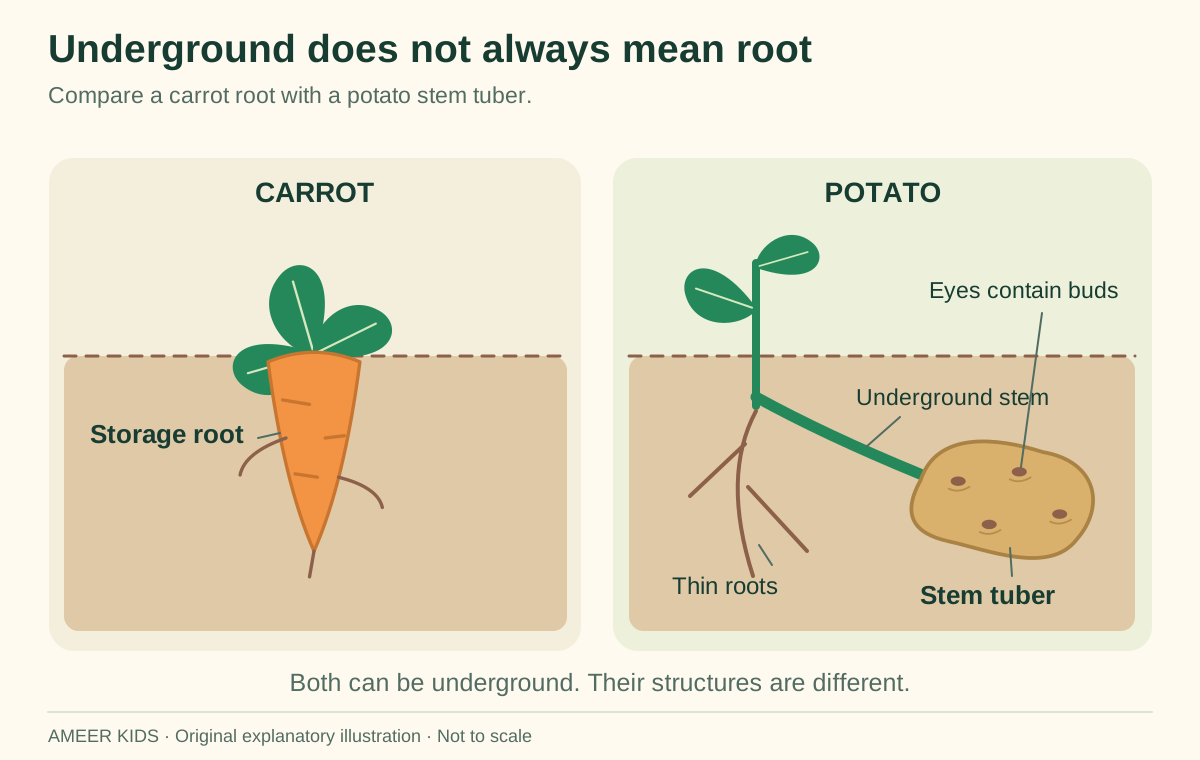
- A potato is a stem tuber; its eyes contain buds. Underground does not always mean root.
- Celery stalks are petioles, and an onion bulb includes fleshy leaf bases around a short stem.
- Use the pictured plant part to explain your answer in Veggie Sort; add categories for more advanced examples.
The question is: which plant part?
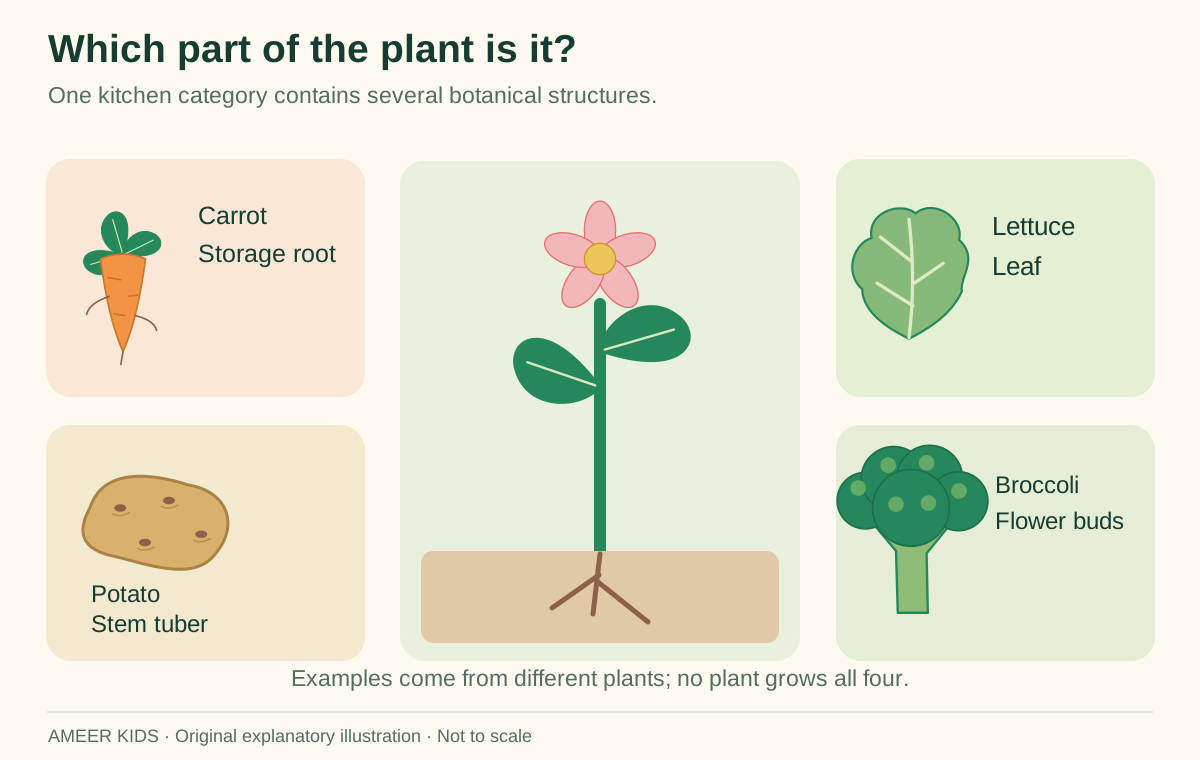
Imagine a basket containing a carrot, lettuce leaves, a potato and a head of broccoli. A cook may call all of them vegetables. A plant scientist sees several different structures. The carrot is a storage root. Lettuce gives us leaves. The potato is a swollen underground stem. Broccoli has clusters of unopened flower buds on branching stalks. One kitchen category can contain many plant parts. [1,5,6]
This makes an excellent detective puzzle. You are not trying to guess which food is nicest, healthiest, or best for someone to eat. You are asking what a particular piece was doing while it was part of a growing plant. Did it help gather light? Did it anchor the plant? Did it contain buds that could grow? Those questions send you looking for evidence instead of judging by colour alone.
Use the drawings in this article as your case files. You can solve every activity with paper and a pencil or by talking with a reading partner. If a grown-up shows you real shop-bought produce, let them handle any cutting. Do not taste, pick, or dig up unknown plants. A plant-part label is a science label, not permission to eat something that looks similar.
“Vegetable” is a culinary category rather than a single botanical organ. To classify a specimen anatomically, identify the exact harvested structure: root, stem, leaf, reproductive structure, or a combination. A whole plant contains several organs, so the name of the crop alone may be insufficient. In a broccoli sample, for example, the green bud clusters and the supporting stalk are distinguishable tissues even though both may arrive together in the kitchen. [1,6]
A productive investigation starts with a narrow question. “What part is this carrot storage organ?” is better defined than “What kind of plant is a carrot?” The first concerns an organ; the second might mean species, life history, growth habit or culinary use. State the question clearly before collecting clues, and keep the label attached to the particular structure being discussed.
The deeper reading mode introduces morphology, the study of form and structure, through familiar examples. It does not provide a foraging guide or a nutritional assessment. Photographs, the original diagrams and paper cards are sufficient. If a responsible adult chooses to demonstrate a cut surface using known produce, that adult handles the knife and selects appropriate materials. A child should not test a classification by tasting. We will practise deciding what a diagram supports, what it leaves uncertain, and when a simple game category needs a more detailed explanation.
Case one: a root that stores resources
Roots help hold a plant in place, absorb water and minerals, and may store resources made by the plant. The thick part of a familiar carrot is a storage root. Smaller roots can grow from the main root, while the leafy top belongs to a different part of the plant. Notice how the diagram includes both the orange root and the leaves above it. The carrot did not grow as a loose orange object sitting under the soil. [2,5]
Look at the drawn soil line. It helps you imagine the position of the root, but position is only one clue. Later we will meet a stem that also grows underground. For now, trace the carrot's main root downwards and find a smaller side root. Then trace upwards towards the leaves. Describe which parts remain connected.
Make a case card with three spaces: “name,” “part,” and “clue.” Write carrot, storage root, and a short explanation in your own words. You could mention the main root with smaller roots branching from it, using the labelled illustration as your evidence. Do not use orange as your only clue. Your explanation should still work if someone printed the picture without colour.
Roots provide anchorage, absorb water and mineral nutrients, and can store photosynthetic products. A taproot system has a prominent main root with lateral roots branching from it. The enlarged storage organ of a carrot is a useful teaching example, although a crop's appearance can vary with cultivar and growing conditions. Its role is connected to the whole plant rather than defined by its shape in a supermarket display. [2,5]
In an anatomical drawing, distinguish the organ from the tissues within it. Calling a carrot a root does not mean its interior is uniform, just as calling a building a school does not mean every room has the same purpose. Our illustration stays at the organ level. It shows the main axis and branching roots without claiming to represent microscopic cell layers or a measured cross-section.
For a reasoning exercise, compare two proposed classification rules: “All orange vegetables are roots” and “This labelled carrot storage organ is part of its root system.” The first generalises from a surface feature and would need much broader evidence. The second makes a specific claim supported by the example. Practice rewriting an overconfident statement into a precise one. This is a stronger scientific skill than memorising a long list without knowing which part of each plant the list describes.
Case two: underground does not always mean root
A potato is the surprise in our basket. The potato tuber is a swollen underground stem, not a root. Its little “eyes” are places containing buds. Those buds are clues to its stem identity. Stems can support leaves and flowers, connect different parts of a plant, and sometimes store resources. They do not all look like the tall green stalk in a simple flower drawing. [3,7]
Put the carrot and potato pictures side by side. Both grow below the soil in the example, and both can be fairly chunky. If you sorted only by where they grow, you would put them in the same box. Now read the labels and compare their structures. The rule needs more information than “underground.” The potato helps you improve your rule instead of spoiling the game.
Draw two thought bubbles for a detective. In the first write, “I thought everything underground was a root.” In the second write, “I checked for other clues and changed my idea.” You do not need to grow a sprouting potato, cut one into pieces, or handle planting material for this lesson. The diagram already shows the clue we need. Changing an explanation when you learn more is a useful part of investigating.
A stem tuber is a modified stem that has expanded for storage. Potato tubers form underground and carry eyes containing buds. Nodes and associated buds are important stem characteristics; being beneath the soil surface does not convert a stem into a root. Other modified stems include rhizomes, while some plants have swollen storage roots. Similar functions therefore need not imply identical organ identity. [3,7]
The comparison separates three independent properties: location, function and developmental structure. “Underground” describes location. “Stores reserves” describes function. “Stem tuber” identifies morphology. Put those headings across a paper table and enter carrot and potato beneath them. Two entries may match while the third differs. This is an example of why a good description often needs more than one label.
Treat the potato eyes as a clue within a verified example, not a universal identification trick for unfamiliar plants. A small bump on an unknown object is not enough to establish its anatomy, species or safety. Our drawing deliberately labels the eyes and shows a connection to an underground stem. If an unlabelled photograph omits that connection, explain which conclusion comes from visible evidence and which comes from a trusted botanical source. That distinction makes the detective activity careful rather than merely confident.
Case three: a leaf can have a long stalk
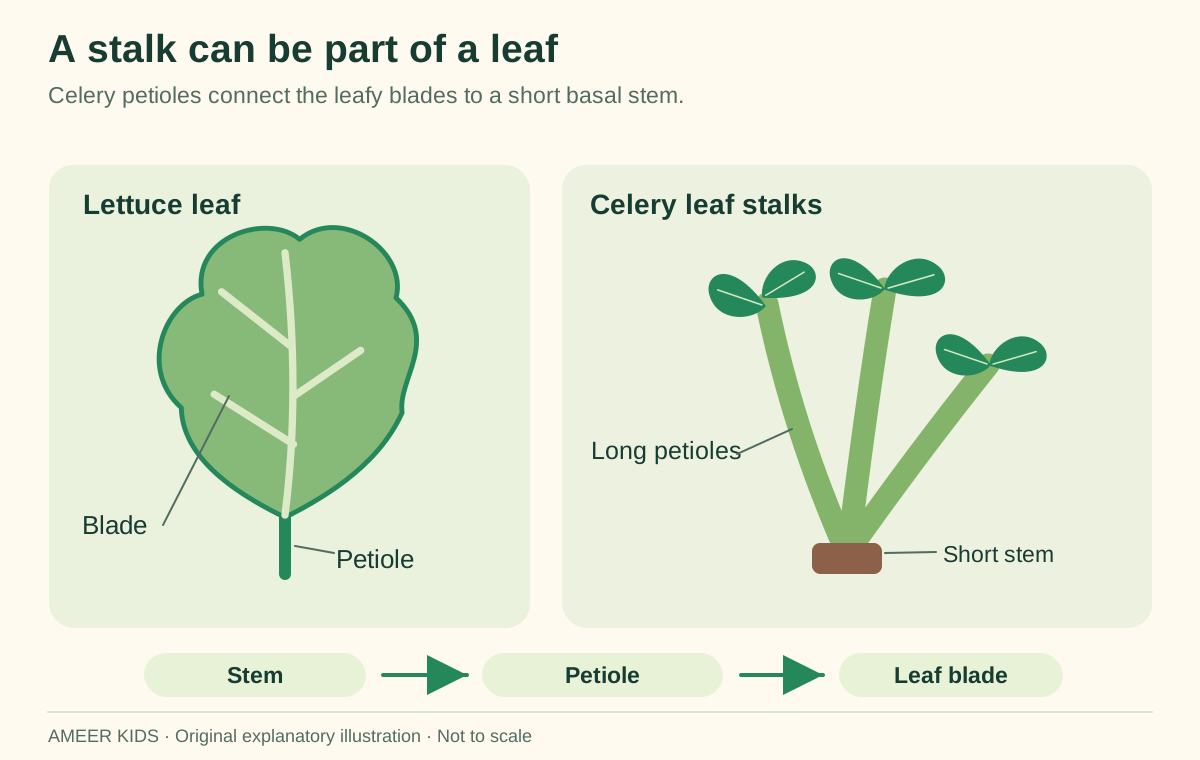
Leaves are important places where a plant uses light energy to make sugars. A leaf often has a broad blade with veins. It may also have a stalk called a petiole that connects the blade to the stem. The large leafy parts of lettuce and spinach are easy examples. Celery gives us a trickier one: the long crunchy pieces commonly called celery stalks are mainly leaf stalks, or petioles. They are not the plant's main stem. [1,4]
Follow the celery drawing from the leafy top down the long petiole to the short base. Then compare it with the lettuce drawing. Their outlines look different, but both examples lead us to leaves. A familiar everyday word like “stalk” can describe a shape without telling you exactly which botanical structure it is.
Make a large paper leaf with a blade and a petiole. Draw a separate plant stem and show where your leaf would attach. Label each piece before colouring it. Next, hide the labels and ask a partner to explain the connections. If they call the petiole a stem, show the leaf blade at its end and read the explanation together. The aim is to discover how the parts join, not to catch someone making a mistake.
A typical leaf has a lamina, or blade, and may have a petiole connecting it to the stem. The vascular system extends through the petiole into the blade's veins. Leaves are major photosynthetic organs, although their shapes and internal arrangements vary. Celery is a useful terminological test: the elongated edible “stalk” is a petiole. Everyday descriptions of slender shapes should not automatically be treated as botanical stem labels. [1,4]
Use a connection diagram with three labelled regions: stem, petiole and blade. Put the attachment at a node on the stem. Then compare that schematic with the celery illustration, which emphasises long petioles rising from a short basal region. The point is to recognise a leaf component from its relationships, not to decide that every long green piece has the same identity.
For an observation exercise, work from a clear photograph of a known leafy vegetable and trace one continuous route from the central plant axis to the leaf surface. Mark any hidden connection with a dotted line. A dotted line declares an inference rather than pretending the camera recorded it. Ask a partner whether the caption accurately distinguishes what is visible from what the drawing explains. This is also a useful reading skill for science graphics: labels and arrows can add information, but they should not quietly change the structure they are meant to explain.
Case four: a flower before it opens
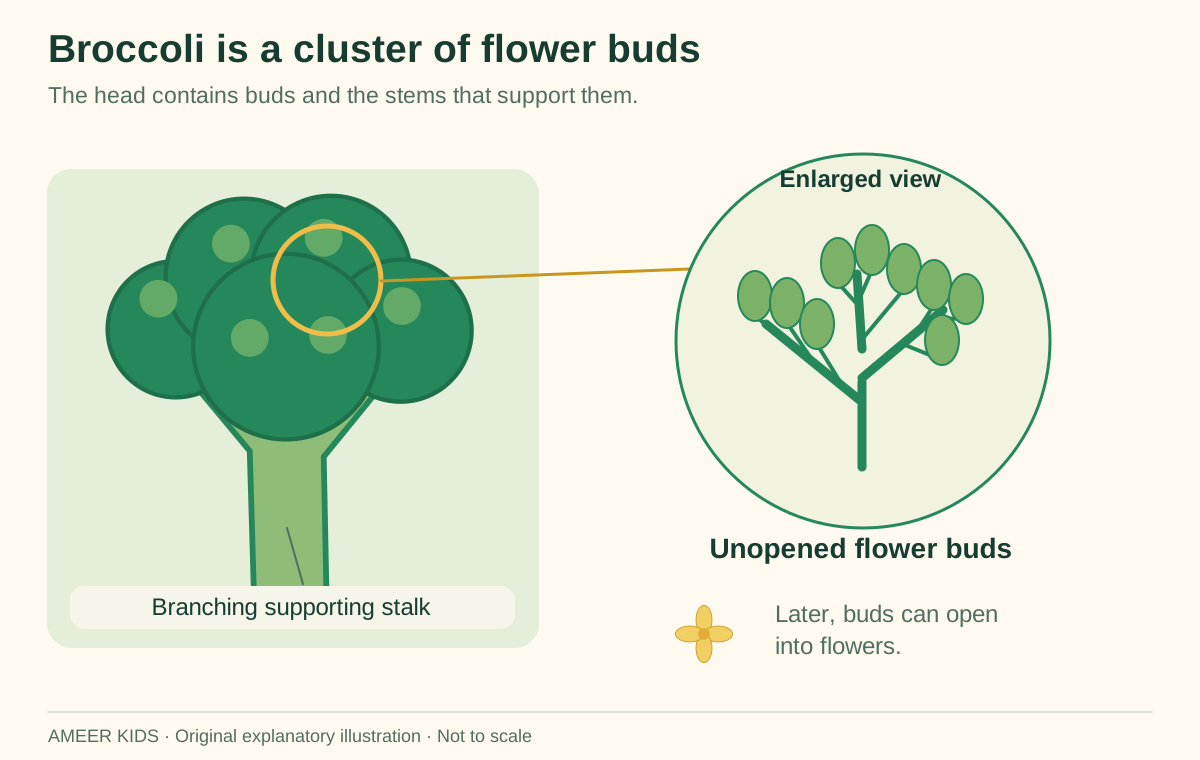
The bumpy green top of broccoli contains many unopened flower buds. The buds sit on branching stalks. If the plant continues developing, buds can open into flowers; broccoli is usually harvested while the head is still tight. The stem below the buds is a different part, even though a piece of broccoli often includes both. [6]
This is why the Veggie Sort game uses the choice “Flower buds” for the broccoli head. A bud does not have to show colourful open petals yet. Imagine a book that is still closed: there is more structure inside than its outside view reveals. The book comparison only helps with the idea of something not yet opened. A bud is living tissue that grows, unlike a book.
In the drawing, find the whole head, one smaller branch, and the enlarged group of buds. These are different views of the same type of structure, not three different vegetables. Make your own zoom picture: draw a circle around a tiny area and connect it to a larger sketch. Write “enlarged view” so a reader knows why the buds suddenly look much bigger. Good labels make a science picture easier to trust.
Broccoli is harvested as an immature inflorescence: a branching arrangement bearing many developing flower buds. The familiar head contains buds and supporting stem tissue. A whole serving-sized piece therefore combines structures, whereas a classroom classification usually names the prominent harvested feature. University of Minnesota guidance specifically describes harvesting before the flower buds open. [6]
A useful diagram should identify its level of organisation. An individual bud, a cluster of buds, the branching inflorescence and the whole plant are related, but they are not interchangeable names for a single object. Follow the magnification connector in our illustration from a small region of the head to the enlarged inset. Because the illustration is schematic, the connector identifies the kind of structure being enlarged without supplying a measured magnification factor.
Try writing two captions for the same broccoli drawing. One should suit a young reader: “The green bumps are unopened flower buds.” The other can be more specific: “The head includes developing buds on branched supporting stems.” Both can be accurate at different levels. Avoid a caption saying that the entire broccoli plant is a flower. Precision is often a matter of narrowing the subject, rather than replacing every ordinary word with technical vocabulary. The game starts with a useful simplified category; the article supplies the anatomical detail behind it.
Case five: an onion is a small package of parts
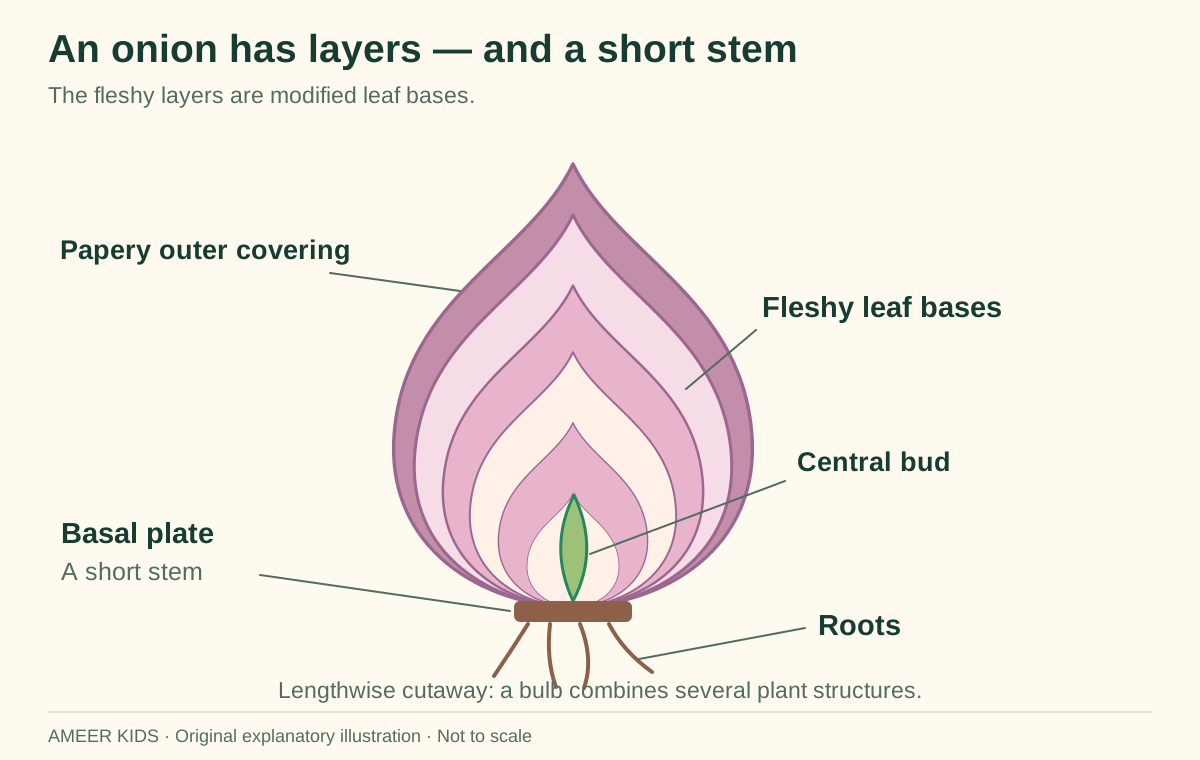
An onion bulb is more than a round root. It has fleshy layers made from modified leaf bases around a bud. At the bottom is a short stem region called the basal plate, and roots grow from that base. A single familiar onion therefore includes more than one kind of plant part. The layers and the roots should not receive the same label. [7]
Look at the cutaway drawing without needing a real onion or a knife. Find the nested layers first. Then follow the labels to the base and the roots below it. Imagine gently drawing an outline around each group with a different pencil pattern: stripes for leaf bases, dots for the short stem, and plain lines for roots. Patterns help even when colours are hard to tell apart.
Now decide how to describe the whole object in one sentence. “An onion bulb combines fleshy leaf bases, a short stem and roots at its base” is more informative than squeezing it into a box labelled only “root.” Some good questions have answers with several parts. That does not make the answer messy; it makes it match the thing you are investigating.
A bulb is a composite storage structure. In an onion, fleshy leaf bases or scales surround a central bud and attach to a compressed basal stem, the basal plate. Roots arise from the lower region. Calling the bulb simply a root obscures both the layered leaves and the stem component. This is a useful example of why an anatomical description may need to identify several organs within one harvested item. [7]
The longitudinal cutaway has a specific purpose: it reveals how the layers meet at the base. A transverse slice would show concentric rings more readily but would hide much of that vertical relationship. Before interpreting any cutaway, ask which direction the imaginary cut follows. Two views of the same object can emphasise different features without disagreeing.
For a drawing exercise, create a labelled onion outline using nested curved lines and a short bar at the bottom. Give the basal plate its own label rather than drawing every root directly from a fleshy layer. Use a key explaining which lines represent leaf bases and which represent roots. Then ask whether a reader could reconstruct the relationships from the caption alone. This is not an instruction to dissect an onion; the paper model makes the essential connections visible without knives, loose pieces or food handling.
The same plant changes as it grows
A vegetable picture shows one moment in a plant's life. Carrots and several other garden plants are often harvested before they flower. Carrots are usually biennials: they grow leaves and a storage organ in the first season and can flower and make seeds in the next. That means a drawing of a harvested carrot leaves out later chapters of the plant's story. [8]
The part we harvest also changes what we notice about pollination. A lettuce grower harvesting leaves is collecting a different structure from a grower collecting seeds. Many leaf and stem crops do not need pollination to make the particular part being harvested, even though seed production belongs to their wider life cycle. [10]
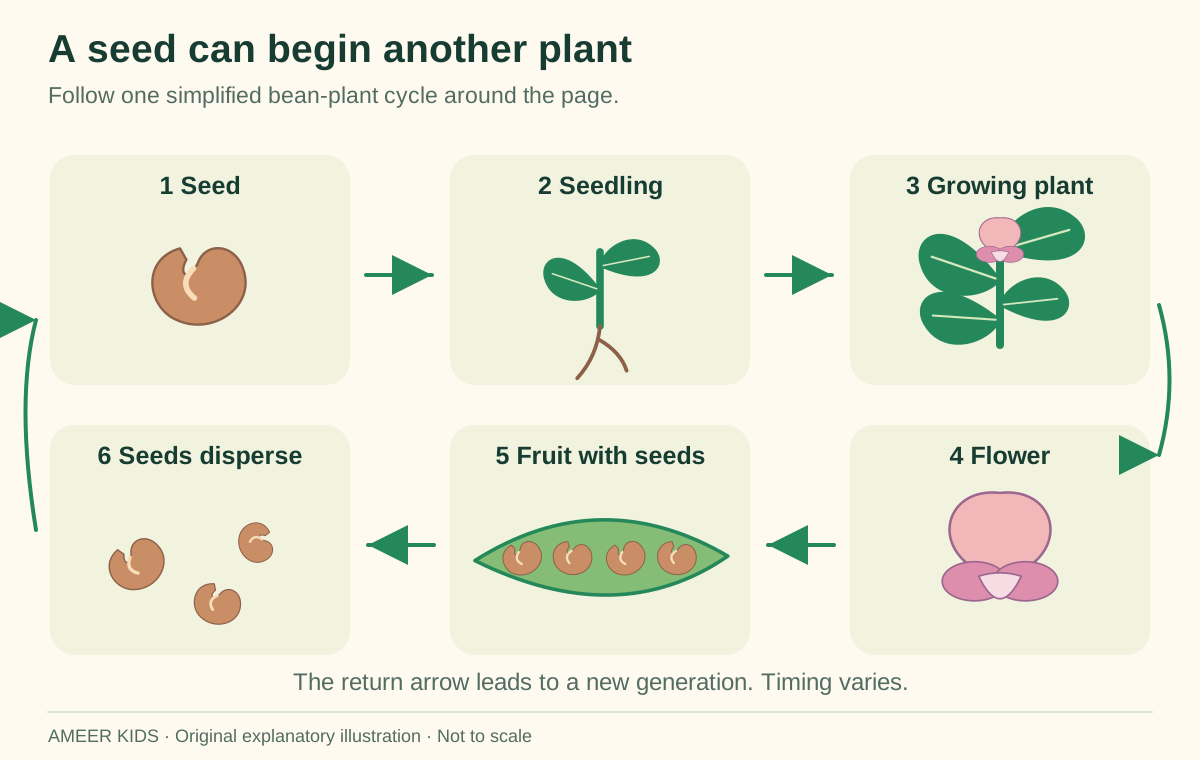
Arrange three paper cards: growing plant, harvested part, and later flower or seed stage. Connect them carefully. The harvested part is something people select; it is not the plant's whole identity. You can add a tomato as a comparison. Its kitchen name may be vegetable, while its botanical structure is fruit. [9] Keep the two questions separate: “How do people use it?” and “What plant part is it?” Neither question needs a taste test.
Classification needs a developmental time point as well as an organ name. Carrot is commonly treated as a biennial: vegetative growth and storage precede a later reproductive season, although conditions can alter the timing. Harvesting a storage root does not mean the species lacks flowers. It means the crop is being collected at a particular stage and for a particular organ. [8]
Pollination requirements also depend on the product being grown. Producing a leaf or stem crop and producing its seed are different agricultural goals. A flowering crop can be harvested for vegetative tissue before pollination becomes relevant to seed formation. This distinction prevents a misleading leap from “we do not eat its fruit” to “this plant does not reproduce through flowers.” [10]
Build a two-axis chart on paper: plant part across the top and life stage down the side. Place a carrot-root drawing in a vegetative-stage row and a separate flowering-carrot sketch in a reproductive row. Add a tomato fruit with a note that culinary vegetable and botanical fruit are compatible labels. [9] The chart is deliberately a thinking tool rather than a complete crop calendar. Do not fill every empty square with a guess. An empty square can mark a question requiring another source, a later observation or a clearer definition of what is being classified.
Use your clues in Veggie Sort
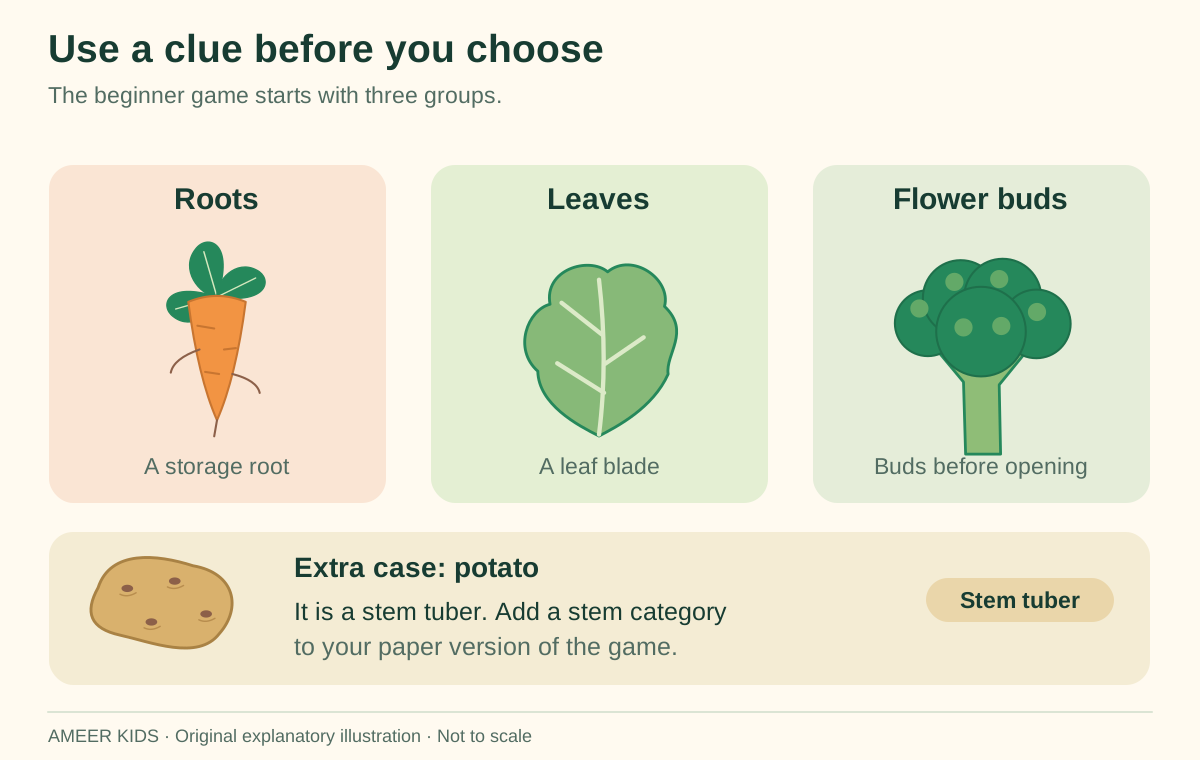
Open the Kids Games area and choose Veggie Sort. The game begins with three groups: roots, leaves and flower buds. When a vegetable appears, think about the particular part in the picture. A carrot points you towards roots; spinach or lettuce points you towards leaves; a broccoli head points you towards flower buds. Read the explanation after your choice. You can use it to improve your next answer.
Before tapping a button, say one reason aloud or think it quietly. “I chose leaves because this is the leafy part of the plant” is a stronger answer than “I chose the green button.” If you choose a different group, pause and compare the explanation with this article's diagrams. The purpose is to learn the connections. You do not need to finish quickly or keep a perfect streak.
Remember the extra cases we explored. Potato tubers are stems, celery stalks are leaf stalks, and onion bulbs combine several structures. The beginner game does not need a button for every botanical possibility. If you make your own paper version, add a “needs another category” card. That card lets you handle a potato honestly without forcing it into one of the first three groups. You can play with a partner or work alone; no name, photograph or message is part of this activity.
The site's Veggie Sort game deliberately limits its starting categories to roots, leaves and flower buds. Treat it as a learning exercise with a defined scope, rather than a complete classification system for all produce. The correct reasoning concerns the pictured harvested organ. A player's explanation matters because a category can otherwise be selected through colour, familiarity or elimination without understanding the structure.
An adult can extend the game offline by asking for a claim and a reason before each selection. After the feedback, ask whether the original reason should be kept, narrowed or replaced. Avoid turning an incorrect answer into a judgement about ability. A useful correction explains the relationship: for example, the broccoli head contains developing flower buds on supporting stalks. The learner can then apply the relationship to a new drawing.
For a more advanced paper version, add “stem,” “fruit,” “seed” and “composite structure” cards. Now the potato and onion become productive challenges instead of exceptions that the game hides. Specify the target each time: whole bulb, fleshy onion layer, root at the base, or central bud. A well-designed question can have one clear answer because it names a particular structure. An ambiguous question should be revised, not defended by insisting that the learner guess the designer's intention. The offline extension needs no account or submission of personal information.
Build a tiny museum of plant clues
Make a museum page with four drawings: carrot, lettuce, broccoli and potato. Under each drawing, write its familiar name, the plant part you are studying, and one clue from this article. Add an onion cutaway on a second page if you want a harder case. Use large labels and leave room for questions. A museum label should help someone understand, even if they have never played the game.
Ask a reading partner to cover the names and explain the drawings. If they cannot tell where a leaf joins a stem, add a clearer line. If they think the potato is a root because it is underground, add a label pointing to the eyes. You are improving a scientific explanation, not just decorating a page. The best change might be a short sentence rather than another colour.
Finally, choose one idea you changed. Perhaps you learned that stems can live underground, that an onion contains several structures, or that a flower bud does not need open petals. Tell that story in two sentences: what you first thought, and which clue helped you think again. The next familiar vegetable you see may become a new question. Start by asking which part of the growing plant you are looking at.
Finish with an annotated classification plate, a page that pairs several drawings with precise captions. For each specimen, identify the target structure, the proposed category and the evidence used. Distinguish a visible clue from information supplied by a source. For example, a drawing can show a potato eye, while its interpretation as a bud-bearing stem feature depends on botanical knowledge.
Review the page for three common errors. First, make sure location has not replaced anatomy: underground does not automatically mean root. Second, separate the entire plant from the part people harvest. Third, check whether a composite object needs several labels. These review questions are transferable to unfamiliar examples without pretending that the examples themselves have been identified. An uncertain structure can remain uncertain until an appropriate reference is available.
A second reader can help by trying to explain the plate without hearing your commentary. Their questions reveal where an arrow, caption or boundary is unclear. Revise the explanation accordingly and preserve any genuine uncertainty. This activity makes scientific communication part of the investigation rather than an afterthought. A good vegetable detective does more than remember the answer to a game: they can state the classification rule, point to relevant evidence and explain why a simpler rule sometimes needs an exception. Keep the finished page for your own learning or share it privately with a trusted adult.
Sources & further reading
Explore the references behind this guide. External pages may change after our review.
- Vegetative plant partsOregon State University Extension · Accessed 6 Nov 2026
- Roots — Biology 2eOpenStax, Rice University · Accessed 6 Nov 2026
- Stems — Biology 2eOpenStax, Rice University · Accessed 6 Nov 2026
- Leaves — Biology 2eOpenStax, Rice University · Accessed 6 Nov 2026
- Growing carrots and parsnips in home gardensUniversity of Minnesota Extension · Accessed 6 Nov 2026
- Growing broccoli in home gardensUniversity of Minnesota Extension · Accessed 6 Nov 2026
- Bulbs, Rhizomes, Corms, and Tubers ExplainedUniversity of California Agriculture and Natural Resources · Accessed 6 Nov 2026
- Know the life cycles of plants — annuals, biennials and perennialsOregon State University Extension · Accessed 6 Nov 2026
- Angiosperms — Biology 2eOpenStax, Rice University · Accessed 6 Nov 2026
- Fruits and vegetables that require pollinationUniversity of Minnesota Extension · Accessed 6 Nov 2026
Article updated 6 Nov 2026.