What you’ll take away
- Earth’s rotation carries places into and out of the directly sunlit side; the Sun does not switch off to make night.
- The daily turn and the yearly journey around the Sun are different motions.
- A whole solar day includes daytime and night-time; the daylight share changes with place and season.
- Twilight involves sunlight scattered by the atmosphere, which a plain ball model leaves out.
- Use the diagrams or a grown-up’s safe indoor model; no Sun viewing, optical equipment or personal information is needed.
One moment, two different parts of the day
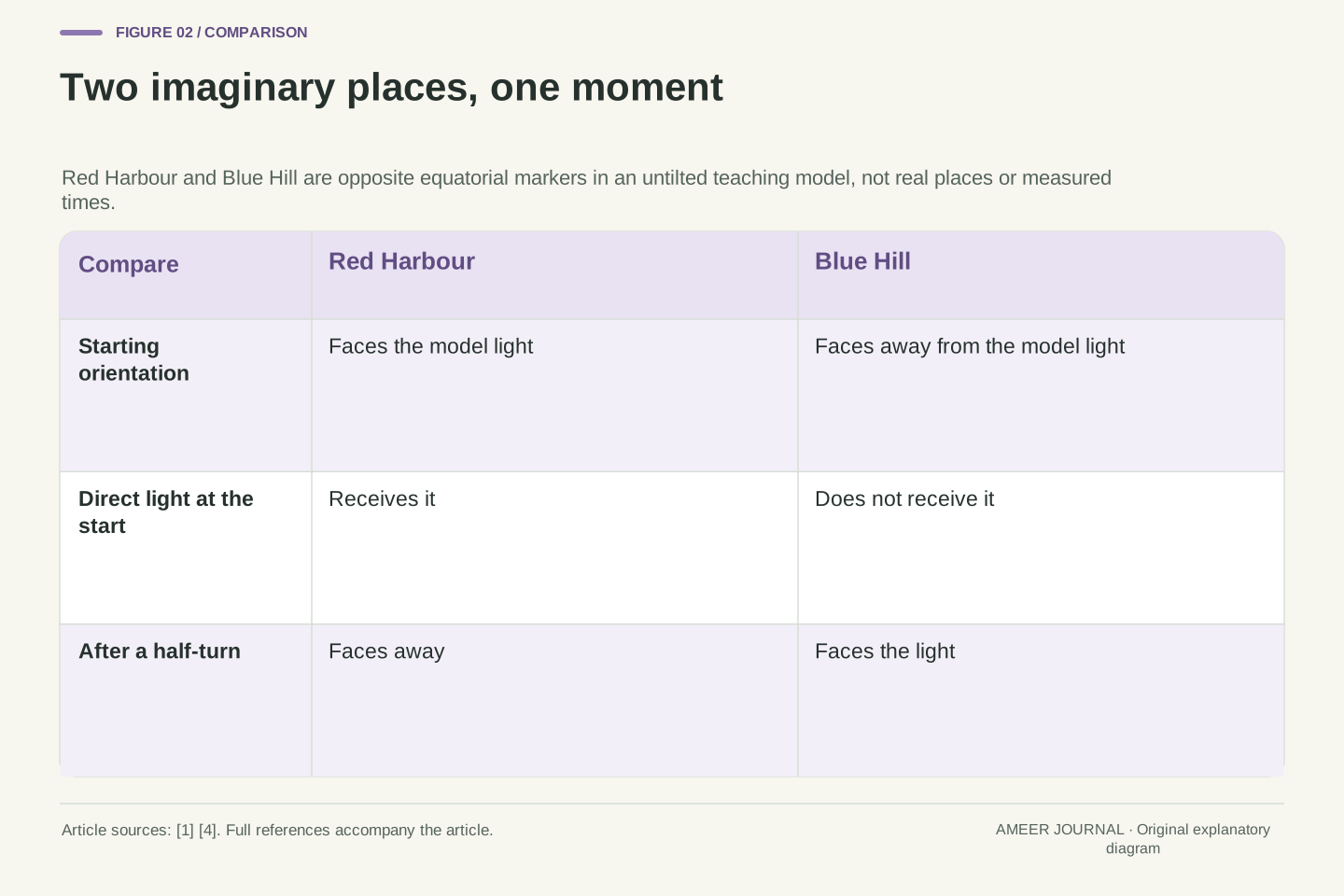
Imagine two make-believe places called Red Harbour and Blue Hill. They sit on opposite sides of a small model Earth. At one moment, Red Harbour faces the light that represents the Sun. Blue Hill faces away. It can be daytime at Red Harbour while it is night-time at Blue Hill. The Sun does not have to switch off for one place to have night. NASA explains that day and night depend on which way a place on the turning Earth faces [1]. Our two places are imaginary, so you do not need to find them on a map.
Now ask a question before turning the model: will Red Harbour stay on the bright side forever? If the place moves with the turning Earth, it can move away from the sunlight. Blue Hill can turn toward it. This is the puzzle we will follow. We will keep the light in one place and watch one marked spot travel around the ball. You can read the story with a grown-up, point to the diagrams, or try the simple indoor model later. Looking directly at the real Sun is never part of the activity.
The central distinction is between a global illumination pattern and the changing illumination of a particular surface location. In a simplified model with a spherical Earth and a distant light source, approximately one hemisphere receives direct sunlight at an instant. An equatorial location carried through that pattern by rotation can alternate between the illuminated and unilluminated sides. NASA and the European Southern Observatory identify Earth's rotation as the mechanism of the daily cycle [1][4]. Red Harbour and Blue Hill are fictional, opposite equatorial markers, not places with measured sunrise times.
This article uses a fixed-light model to isolate that mechanism. It initially omits Earth's orbital movement during a day, axial tilt, atmospheric scattering and local terrain. Those omissions are explicit because the model should answer a specific question: can turning Earth change the lighting at one marked place without turning the source off? Later sections add the distinctions needed for real observations. The Easy mode is intended for a child reading with an adult; this mode supplies the assumptions and limits needed to explain the activity accurately.
The Sun lights one side of a round Earth
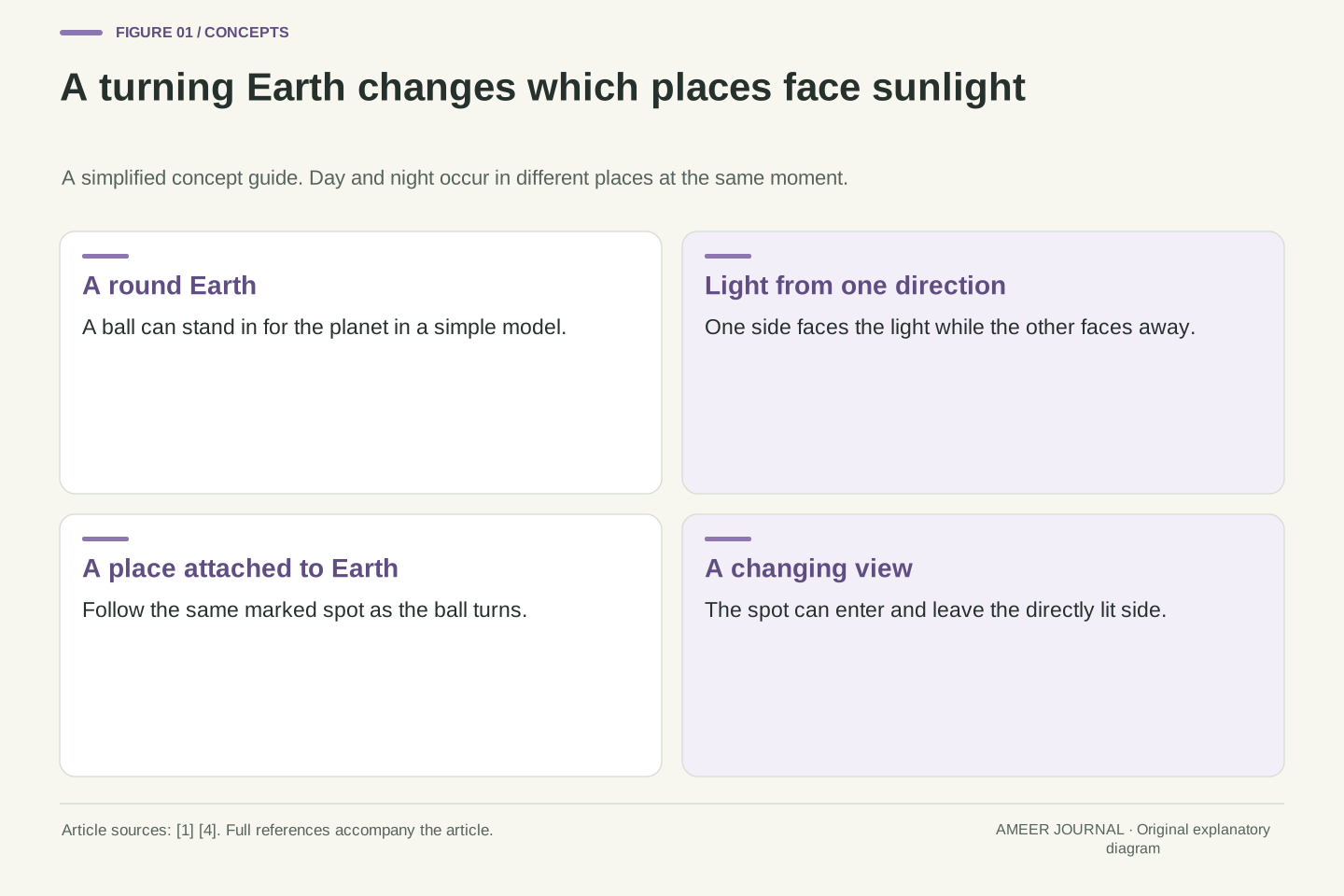
Earth is round, although it is not a perfect ball. NASA describes it as slightly flattened at the poles [1]. For our first picture, a plain ball is close enough to show the important idea. Light arriving from one direction reaches the side facing that direction. The opposite side is turned away. On Earth, sunlight reaches the daytime side while the night-time side faces away from the Sun [4]. The whole planet does not become daytime or night-time together.
Keep two different kinds of half separate. North and south are halves used to describe places on Earth. Day and night describe which parts are facing the sunlight at that moment. A map of the Northern Hemisphere is not a map of the daytime half. NASA explains the equator, Northern Hemisphere and Southern Hemisphere as location labels [1]. In your drawing, you might use a line for the equator and pale shading for sunlight. Those marks do different jobs. Neither line needs to be a real painted stripe on the planet.
A sphere is an adequate first approximation for illumination geometry, although Earth's actual figure is not perfectly spherical [1]. In the ideal distant-source model, the surface normal faces toward the source over one hemisphere and away over the other. The dividing great circle is a geometric boundary between direct illumination and its absence. ESO calls the day-night boundary the terminator and explains that atmospheric scattering makes the real transition less sharply defined [4]. The sharp boundary in a classroom sketch is therefore an intentional simplification.
Geographic hemispheres and illumination hemispheres are different partitions. The equator divides northern and southern locations, while the illuminated hemisphere is defined by the Sun's direction relative to Earth [1][4]. A drawing that shades the entire northern half as day without specifying orientation would conflate these two ideas. For the initial model, label the axis and equator independently of the light-facing side. That lets an adult explain both how a place remains in its geographic hemisphere and how its illumination can change as the globe rotates.
Turning and travelling are different motions
Earth does two things at once. It turns around an imaginary line called its axis, and it travels around the Sun along a path called an orbit. NASA connects the repeating day-and-night cycle with the turn, and a year with the journey around the Sun [1]. You can remember the difference with a toy: turning it in your hands changes which side faces a lamp; carrying it around the room changes where the whole toy is. Those actions are different, even when you combine them.
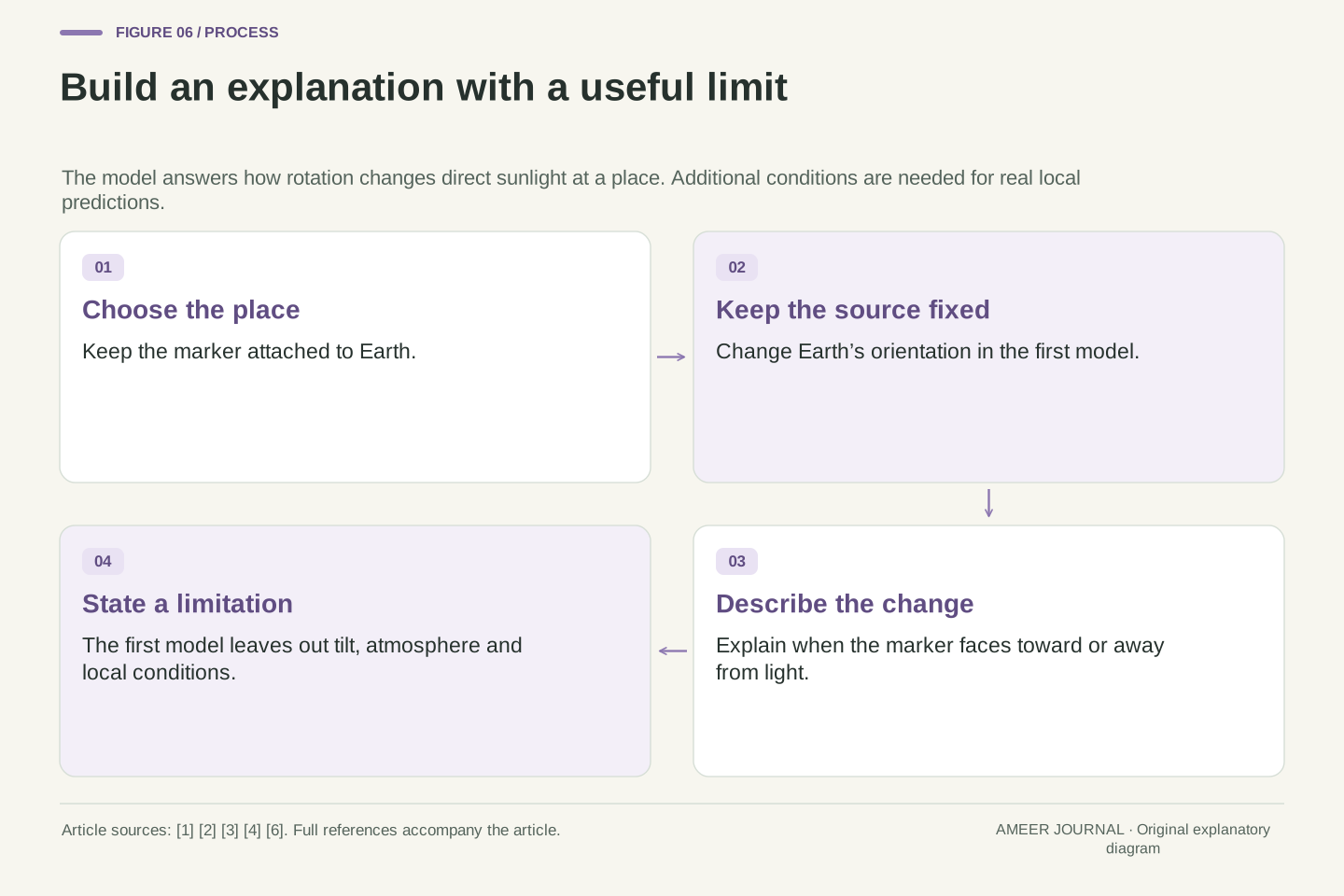
For the first part of our model, keep Earth in one place and turn it. The real Earth does not stop travelling, but leaving out that travel helps us see the daily change clearly. Later, the tilt and the yearly journey will help explain why daylight hours change through the seasons [3]. A model can leave something out on purpose. The important part is saying what you left out, rather than forgetting it. If someone asks whether Earth really stays beside one lamp, you can explain that the lamp and ball are only stand-ins.
Rotation changes Earth's orientation about its axis; orbital revolution changes its position around the Sun. NASA's elementary description assigns the daily cycle to rotation and the yearly cycle to the orbit [1]. The Sun's apparent daily passage across the sky should not be explained by moving a classroom lamp around a stationary Earth unless the purpose is explicitly to compare reference frames. Our physical demonstration instead keeps the source fixed so the learner can attribute the change at a marked location to the globe's rotation.
The stationary-centre demonstration is not a complete dynamical model. Earth continues orbiting while rotating, and the choice of reference direction matters when defining a day precisely [2]. For this first causal comparison, we deliberately suppress the orbital displacement and inspect only the changing orientation. A separate seasonal explanation can then restore the tilted axis and the annual orbital position [3]. Keeping the two demonstrations conceptually separate reduces the risk of teaching that one orbit produces one ordinary day or that changing the source's brightness causes night.
Follow one place instead of the whole ball
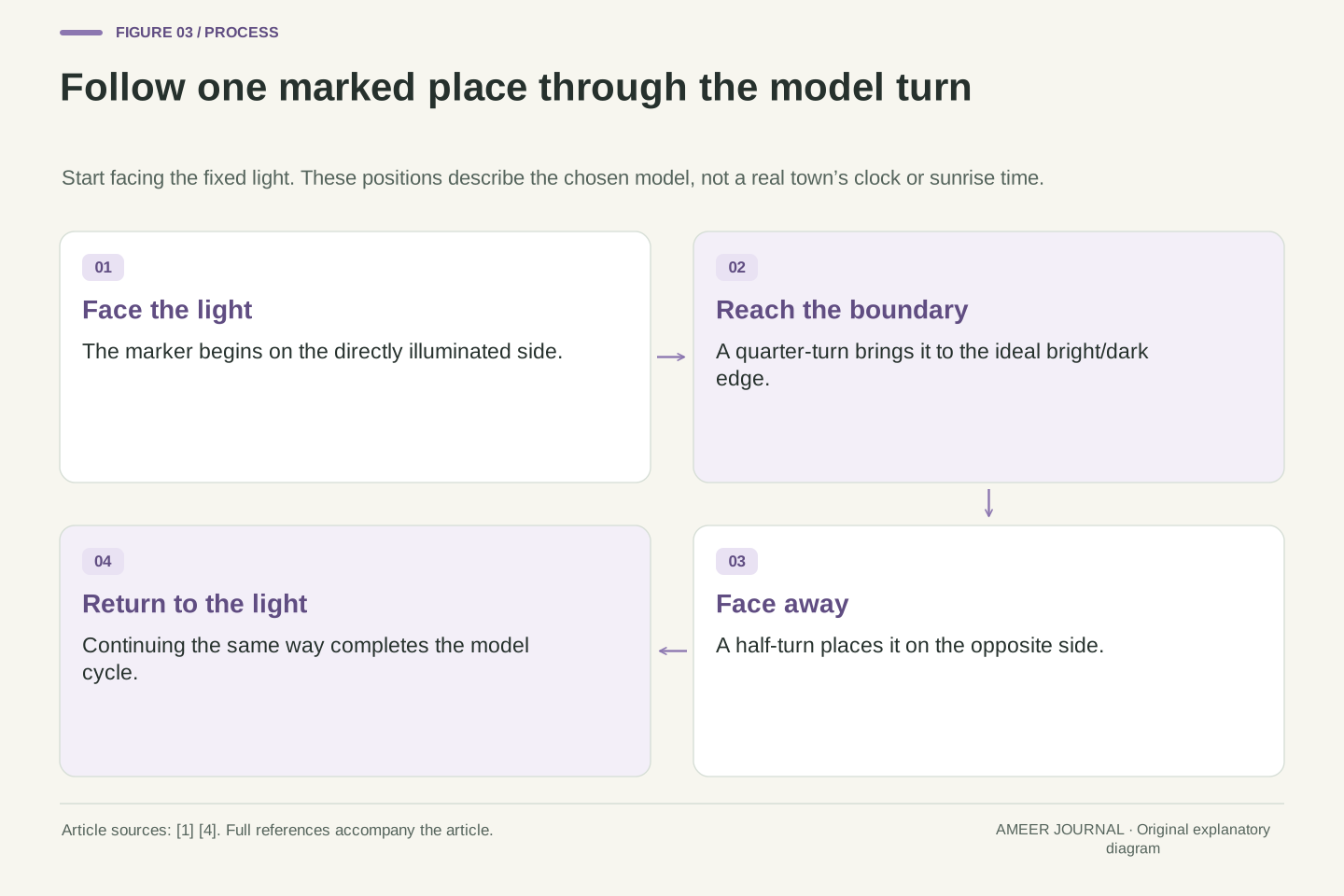
Picture Red Harbour in the middle of the model's light-facing side. It receives the light directly. Turn the ball slowly in one chosen direction while keeping the lamp still. The red mark moves toward the edge of the bright area. Turn farther and it reaches the side facing away. Continue the same way and the mark eventually comes toward the light again. This is a model sequence, based on Earth's turning through day and night [1][4]. It is not a timetable for an actual harbour.
Now follow Blue Hill, which is opposite the red mark. When the red mark faces the light most directly, the blue mark faces away. After half a turn, their positions relative to the light are exchanged. Both marks stayed attached to the ball; neither travelled across its surface. What changed was the ball's orientation. Ask a grown-up to pause at different positions so you can predict what the next small turn will do. A prediction is an idea to check, and changing it after looking carefully is part of learning.
Choose antipodal equatorial markers and an axis perpendicular to the source direction in the simplified setup. Start with one marker facing the source. A quarter-turn carries it to the geometric illumination boundary, a half-turn carries it to the opposite side, and a complete turn restores the initial orientation. The other marker follows the same sequence with a half-cycle offset. These are consequences of the chosen geometry, not empirical sunrise or sunset measurements [1][4]. The initial conditions must accompany the sequence.
The exercise tracks material locations on the rotating body rather than a freely moving dot. That distinction matters: the place remains fixed relative to Earth while its direction relative to the source changes. Pause-and-predict questions can ask which marker receives direct light and which will enter the illuminated region next. The activity should not attach local clock labels to these positions without additional assumptions. Real latitude, axial tilt, atmospheric effects and the definition of a clock day all matter before an ideal angular position becomes a real event time.
Make a small model with a grown-up
A grown-up can hold a plain ball or globe beside a cool LED torch aimed only at the ball, away from faces. Use a clear, stable space with ordinary room light; darkness is not required. A ball large enough to handle comfortably works well, and no sharp stick is needed. Mark two opposite places with broad pieces of paper, or use existing features on a globe. Keep the light still and turn the ball slowly. Watch the marked place, not the bright lamp. You can also use the diagrams without setting up any equipment.
Before each turn, say what you expect. Afterwards, describe what you actually notice. If the dim side is still visible, room light may be reaching it too. The model is useful even if it does not make a perfectly black half. Its job is to show the changing side that receives the torch's direct light. ESO's explanation connects the real pattern with a turning, sunlit Earth [4]. Our indoor activity is a suggested way to explore that idea; it is not an experiment we have performed or a measurement of Earth's size or speed.
Use an adult-managed, cool LED source and an easily handled sphere without pins, skewers or other sharp supports. Keep the beam off faces and preserve enough ambient light for comfortable movement. A wide separation relative to the sphere's size makes the illumination more like a distant source, but this household arrangement is not a scale model. If the available setup does not show a useful contrast, use the diagrams instead of making the room unsafe or seeking a brighter source.
Hold source position and globe centre fixed while changing only orientation. Ambient light, source size, near-field geometry, surface reflectance and the holder's hand can modify the visible pattern. Those effects limit the model's visual resemblance to Earth but need not defeat the causal question. Distinguish direct source illumination from visibility under other room light. The intended observation is whether a fixed surface marker changes its relation to the source as the sphere turns, consistent with the rotation explanation [4]. No real-Sun observation, optical concentration or outdoor solar instrument is required.
A whole day is different from daytime
The word day can mean the light part of the day, or it can mean the whole cycle that includes daytime and night-time. NASA calls the repeating cycle a solar day, which is about 24 hours on Earth [2]. If a grown-up says a winter day is short, they usually mean fewer hours of daylight. They do not mean that every clock has suddenly lost half its numbers. Asking which meaning someone intends can solve a surprising number of puzzles.
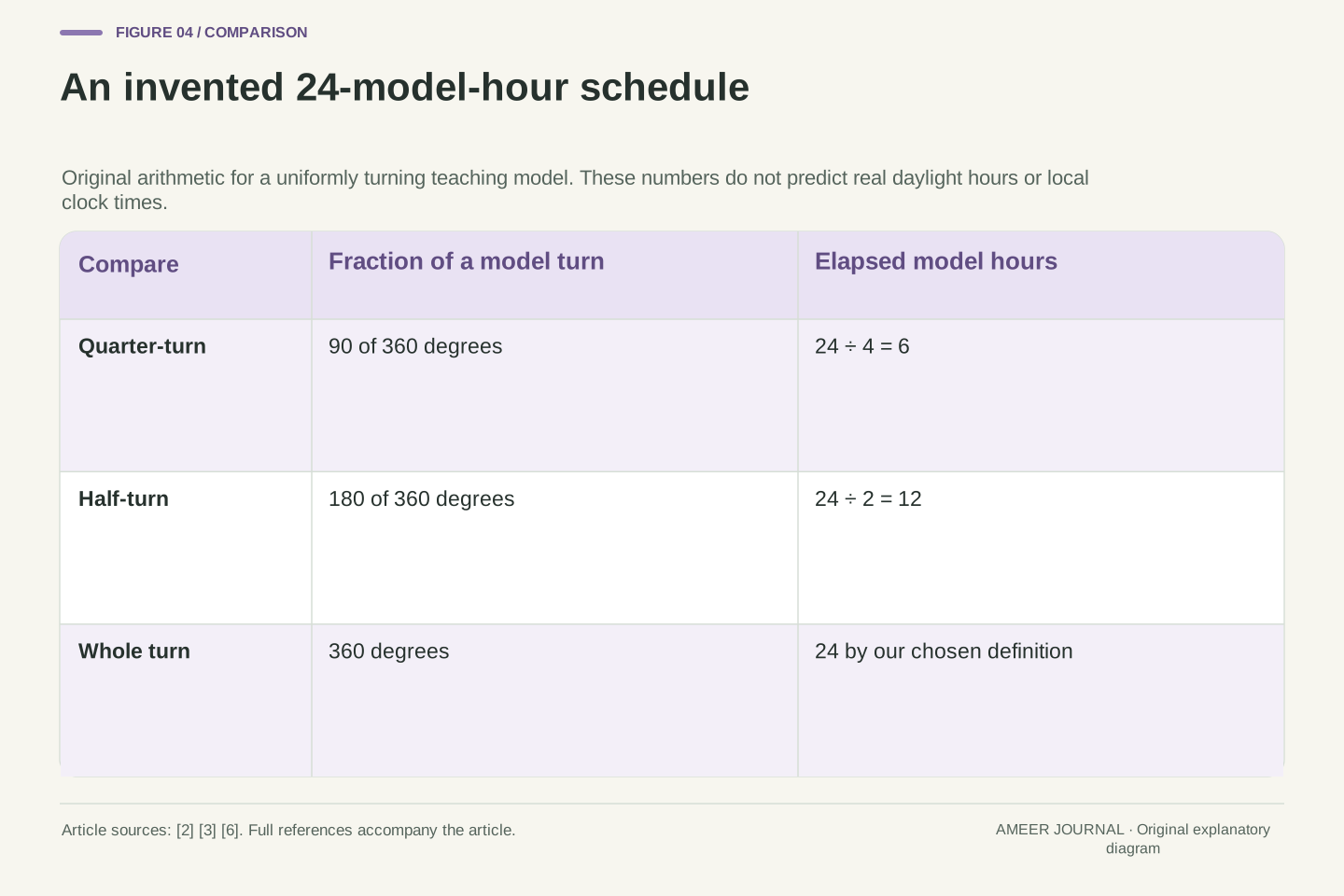
We can give our imaginary model an invented schedule: one complete turn takes exactly 24 model hours. Four equal quarter-turns then take six model hours each, because 24 divided by four is six. A half-turn takes twelve. These are chosen teaching numbers, not measurements from a town. They do not promise sunrise at six o'clock or exactly twelve daylight hours everywhere. The real daytime share changes with place and season [3][6]. Keep the phrase model hours beside the calculation so the useful number does not become a mistaken forecast.
Specify the reference when assigning a period. NASA Space Place distinguishes a solar day, approximately 24 hours for Earth, from the sidereal rotation period, approximately 23 hours 56 minutes [2]. The manuscript uses the rounded solar-day idea for everyday explanation and does not assert that one exact inertial rotation always lasts 24 clock hours. The numerical model below is deliberately separate: it defines its own uniform 24-unit rotation to practice fractions of a cycle.
For that stipulated model, the rate is 360 degrees divided by 24 model hours, or 15 degrees per model hour. A 90-degree quarter-turn takes six model hours, and a 180-degree half-turn takes twelve. The arithmetic is exact under the stated uniform-rate assumption. It is not a calculation of local daylight duration, which depends on illumination geometry and seasonal conditions [3][6]. Nor does it assign civil clock times to sunrise or sunset. Keeping the toy schedule separate from astronomical time definitions preserves both the mathematical lesson and the physical limitation.
Why the daylight part changes through the year
Our first ball model left out Earth's tilt. The real planet's axis is tilted, and it keeps pointing in nearly the same direction during its trip around the Sun. NASA explains that this changes how sunlight reaches the two halves of Earth through the year [3]. When the Northern Hemisphere is tilted toward the Sun, it has its summer season, while the Southern Hemisphere has winter. The seasons are opposite, so one part of Earth cannot explain the whole planet's experience.
The Royal Observatory connects that tilt with longer daylight in summer and shorter daylight in winter [6]. Earth has not stopped turning during the longer evening. The marked place simply spends a different share of the daily cycle on the sunlit side. This adds a new question to our model: not just whether the mark enters sunlight, but how much of its turning path lies there. We are not using the small ball to predict exact daylight hours. A real answer needs the place and date, and the first untipped model deliberately leaves those details out.
Restore axial tilt only after establishing rotation as the daily mechanism. NASA describes the axis retaining approximately the same direction over an orbit, which changes the hemispheres' orientation toward sunlight through the year [3]. The Royal Observatory connects this geometry with the varying duration and angle of daylight [6]. The manuscript does not use changing Earth-Sun distance as the explanation for the seasonal cycle, and it keeps the opposite seasonal timing of the hemispheres explicit.
For a surface location, the relevant geometrical question is what fraction of its rotation path lies in the directly illuminated region. The first equatorial, untilted model was chosen for simplicity; it is not a universal daylight prescription. Latitude and solar direction must be specified for a quantitative treatment. This article does not calculate a real site's day length or give solstice dates. Its narrower teaching purpose is to show that a longer daylight interval can coexist with the continuing daily rotation, so daylight duration and the complete day must remain separate quantities.
Evening fades instead of switching off
A simple drawing often has a sharp line between a bright half and a dark half. Real evening is gentler. The air around Earth scatters sunlight, so some light remains before sunrise and after sunset. This in-between time is called twilight. ESO and the National Weather Service both explain the role of the atmosphere [4][5]. The Sun can be below the horizon while the sky still has light. You do not need to look toward the Sun to notice a room or familiar landscape gradually becoming dimmer.
This is a good moment to ask what a model misses. Our ball has no deep layer of air wrapped around it like Earth's atmosphere. Its edge of direct light can therefore look much sharper than the change outside a window. Weather also changes how bright a scene looks. A dull-looking afternoon is not, by itself, evidence that Earth has turned that place into night. Record what you see separately from your explanation: the room became dim is an observation; Earth's turn carried our place away from sunlight is a scientific explanation of the daily cycle [1][4].
The geometric terminator is not identical to an abrupt change from a bright sky to complete darkness. ESO attributes the softened day-night transition to atmospheric scattering, and the National Weather Service describes twilight as the partially illuminated interval before sunrise and after sunset [4][5]. A precise astronomical treatment distinguishes several twilight categories, but their angular thresholds are unnecessary for the introductory question. The meaningful addition is that indirect illumination persists beyond the local interval of direct sunlight.
A classroom sphere normally lacks an atmospheric scattering layer, while a real observation includes weather, terrain and artificial light. The model therefore predicts the changing geometry more directly than it predicts measured brightness. An adult can help separate a statement about direct sunlight from a statement about how visible an object is in a particular scene. This also prevents a cloudy afternoon or a lit room at night from being treated as a contradiction of rotation. The explanatory model concerns source direction; the observation contains other contributions that should be acknowledged.
Notice the pattern without looking at the Sun
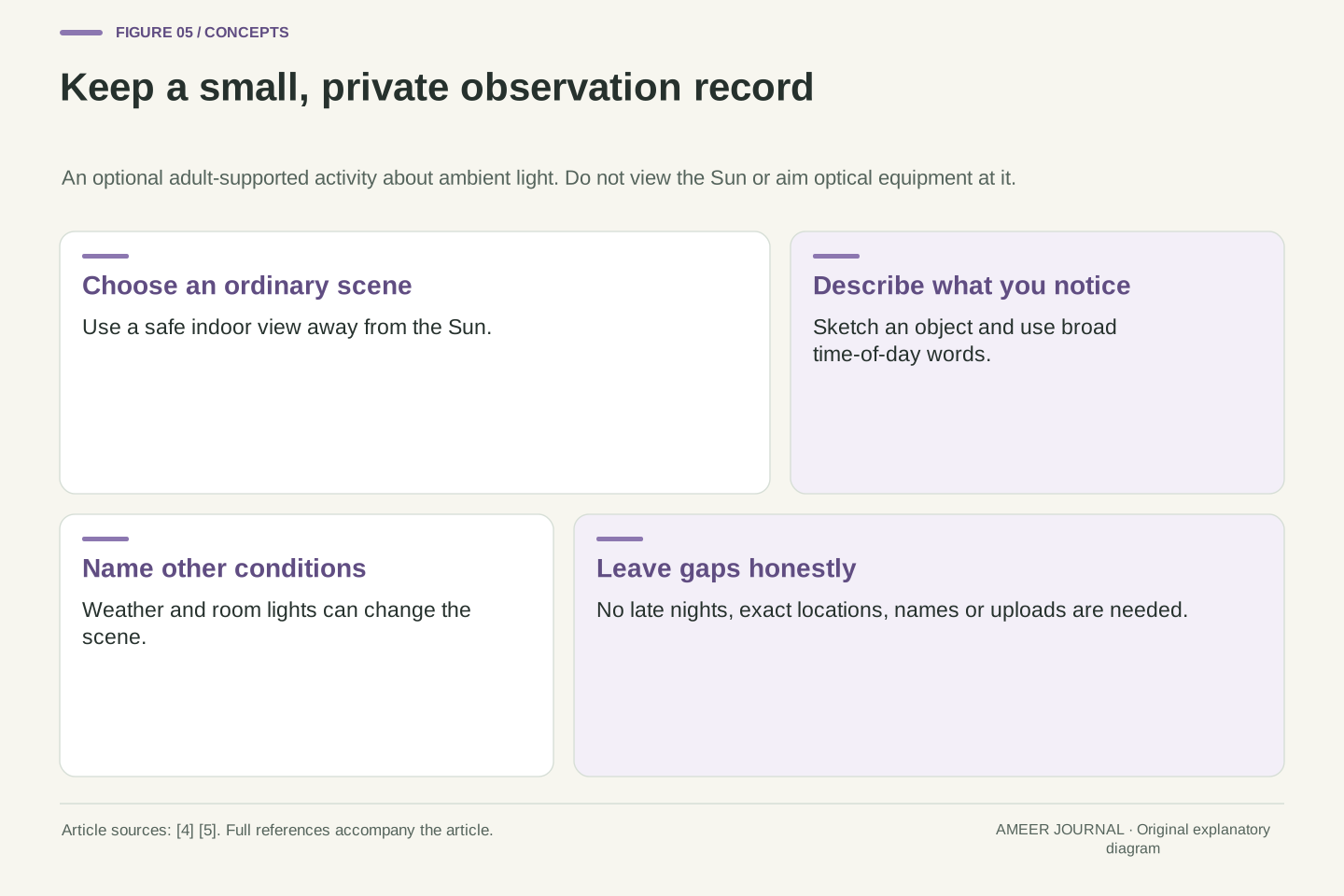
If you want to notice the daily change, a grown-up can help choose a safe indoor place and an ordinary object to describe. You might notice a wall, a table or a familiar view well away from the Sun. Say whether the surrounding light seems brighter or dimmer at a few convenient times. Never stare at the Sun, and never point binoculars, a telescope, a magnifying glass or a camera toward it for this activity. Staying indoors with the diagrams is a complete way to learn the idea too.
A private notebook can use simple words such as morning, afternoon and evening, with a small sketch of the chosen object. You do not need to post your name, address, exact location or daily routine anywhere. Do not stay awake late or get up early to fill a missing space. Write not observed if you missed a time. Your notes are a record of what you actually noticed, not a test you must finish perfectly. Compare them with the broad rotation and twilight explanations, while remembering that weather and indoor lights can affect the scene [4][5].
Any optional observation should keep the task on ambient illumination rather than direct solar viewing. An adult chooses a safe indoor vantage and an ordinary scene away from the Sun. No lenses or camera are aimed at the Sun, and the learner need not go outside, stay awake or alter a routine. The model and diagrams can serve as the entire activity. If observations are made, describe the actual conditions, including room lighting and visible weather, instead of treating brightness as a direct measurement of solar position.
The record is local and private: broad time-of-day labels and sketches are sufficient, with no child identifiers, coordinates, contact details or uploads. Missing entries remain missing rather than being invented. This distinction supports an elementary evidence habit: record observations honestly, then ask how well the mechanism accounts for them. Rotation and atmospheric scattering explain different aspects of the daily pattern [4][5]. A small household record cannot establish a precise sunrise time, quantify Earth's rotation or isolate every contribution to scene brightness, and should not be described as doing so.
Choose an explanation and give your reason
Try a gentle talking game with a grown-up. They can say, It is night here, so the Sun must have gone out. You can answer by pointing to Blue Hill and Red Harbour: one place can face away while the other faces the light. Next they might say, The ball must travel all the way around the lamp to make the red mark dark. Show that a turn in place can do it. These are imaginary claims to discuss, using NASA's distinction between rotation and orbit [1]. No timer or score is needed.
For a third question, ask whether twelve model hours of darkness prove that every real night lasts twelve hours. The answer is no: that number belonged to our deliberately simple model. Tilt and season change the daylight share [3][6]. If an answer feels confusing, pause, turn the ball again or return to a diagram. A useful explanation names what moved, what stayed fixed and which place you followed. You are building a story with reasons, not trying to win by remembering the biggest word.
Use the discussion to distinguish mechanisms rather than reward memorized labels. The first claim tests whether the learner understands simultaneous day and night on different parts of Earth. The second tests whether rotation can change a fixed location's illumination without an orbital revolution. Both are grounded in the same source-supported geometry [1][4]. Ask for the relevant model action or prediction, so an answer has an observable basis instead of depending only on the word rotation.
The third claim probes the limits of an idealization. The 24-model-hour schedule gives a half-turn duration of twelve units, but that does not establish a universal twelve-hour night on Earth. Seasonal illumination geometry is an omitted variable in the first setup [3][6]. An adult can invite revision without competitive ranking or embarrassment: identify the assumption, change the picture, and try the explanation again. This makes model criticism part of the activity rather than a sign of failure. The exercise remains qualitative and should not be presented as a standardized assessment of a child's ability.
Tell the story from the ground and from space
From a place on the ground, daylight seems to arrive, change and fade. From an imaginary view above Earth, you can explain that pattern by following the same place as the planet turns. Both descriptions concern the same event. NASA describes the facing-toward and facing-away parts, while ESO connects the turning planet with the cycle we experience [1][4]. Try a short explanation in your own words: our place moves with Earth; Earth turns; sometimes our place faces sunlight and sometimes it faces away.
Then add one detail that makes your explanation better. You might say that another place can have daytime at the same moment, that a whole day includes night, or that twilight involves the atmosphere. You can also name something your model leaves out, such as tilt or weather. The goal is a connected explanation you can revisit. A round ball, a marked place and a fixed light helped answer one question; they did not become a miniature Earth in every way. Keep asking what each part of the picture represents.
The completed explanation connects two reference perspectives. A ground-based observer describes the daily lighting sequence; the external model explains that sequence through the changing orientation of an Earth-fixed location relative to the source [1][4]. The causal chain should remain explicit: approximately spherical Earth, directional sunlight, rotation, and changing direct illumination at the chosen location. The orbit and axial tilt then account for additional differences without replacing rotation as the central daily mechanism.
A useful endpoint is the learner's ability to state both a prediction and a limitation. The marked location should change its relation to the fixed light when the model turns; the model alone cannot give a real site's daylight length, civil clock time or atmospheric brightness. The distinction between the solar-day cycle and daylight duration remains essential [2][6]. Retaining that boundary lets future lessons on seasons, timekeeping or lunar illumination build on a clear foundation without pretending that this introductory demonstration already establishes all of those subjects.
Sources & further reading
Explore the references behind this guide. External pages may change after our review.
- What Is Earth? (Grades K-4) - NASANASA · Accessed 6 Nov 2026
- How Long Is One Day on Other Planets? | NASA Space Place – NASA Science for KidsNASA Space Place · Accessed 6 Nov 2026
- What Causes the Seasons? | NASA Space Place – NASA Science for KidsNASA Space Place · Accessed 6 Nov 2026
- ESO Supernova Exhibition — What causes day and night?European Southern Observatory · Accessed 6 Nov 2026
- Definitions of TwilightNOAA National Weather Service · Accessed 6 Nov 2026
- Summer solstice | Royal ObservatoryRoyal Museums Greenwich · Accessed 6 Nov 2026
Article updated 6 Nov 2026.