What you’ll take away
- An apple seed can start a new individual; its fruit of origin does not guarantee the same named variety.
- Seed-parent and pollen-parent records explain ancestry, while a scion record describes continuation of a selected fruiting line.
- A grafted tree combines a scion and a rootstock with different roles.
- The six-pair drawing puzzle illustrates combinations only; it does not predict real apple genetics.
- Read and draw with an adult. No real seeds, cutting tools, tasting or online submission are part of the activity.
Would a seed make the same favourite apple?
Imagine a child in a story who loves a particular kind of apple. The child has a clever-sounding plan: grow a tree from one of its seeds, then collect exactly the same apples from the new tree. There is a surprise in that plan. An apple seed can grow into an apple tree, but it is not a reliable way to copy the named variety that produced the apple. Iowa State University explains that apple seedlings are genetically different from the parent tree [2]. A seed begins a new individual, not a photocopy.
We can explore that surprise with pictures and a pencil. Read with an adult who can help with unfamiliar words. You will not need a real apple, loose seeds, cutting tools or a planting experiment. Keep the whole activity on paper. The question is about where a young tree's inherited information comes from, and how growers keep a chosen apple variety going. By the end, you should be able to explain why 'a seed from this apple' and 'another tree of this same variety' are two different descriptions.
A seed taken from a named apple cultivar does not reliably reproduce that cultivar. Iowa State University's explanation uses a familiar example: a seed from a Red Delicious apple does not produce another Red Delicious tree through true-to-type seed propagation [2]. The seedling is a new genetic individual. This distinguishes sexual reproduction, which generates offspring, from vegetative propagation, which can preserve a selected cultivar's genetic identity. The distinction is useful without making any claim about whether an untested seedling will eventually have desirable fruit.
This article is an adult-supported reading and drawing activity. Both modes explain the same biological question, while Technical supplies more precise terms for older readers and the adult reading with them. There are no instructions for cutting fruit, handling loose seeds, germinating plants, grafting branches or tasting specimens. The diagrams illustrate inheritance and propagation conceptually. They do not identify an unknown plant or establish what fruit an individual seedling will produce. All numbered puzzle examples are invented learning materials, separate from the university research described below.
A fruit label is not a promise about its seeds
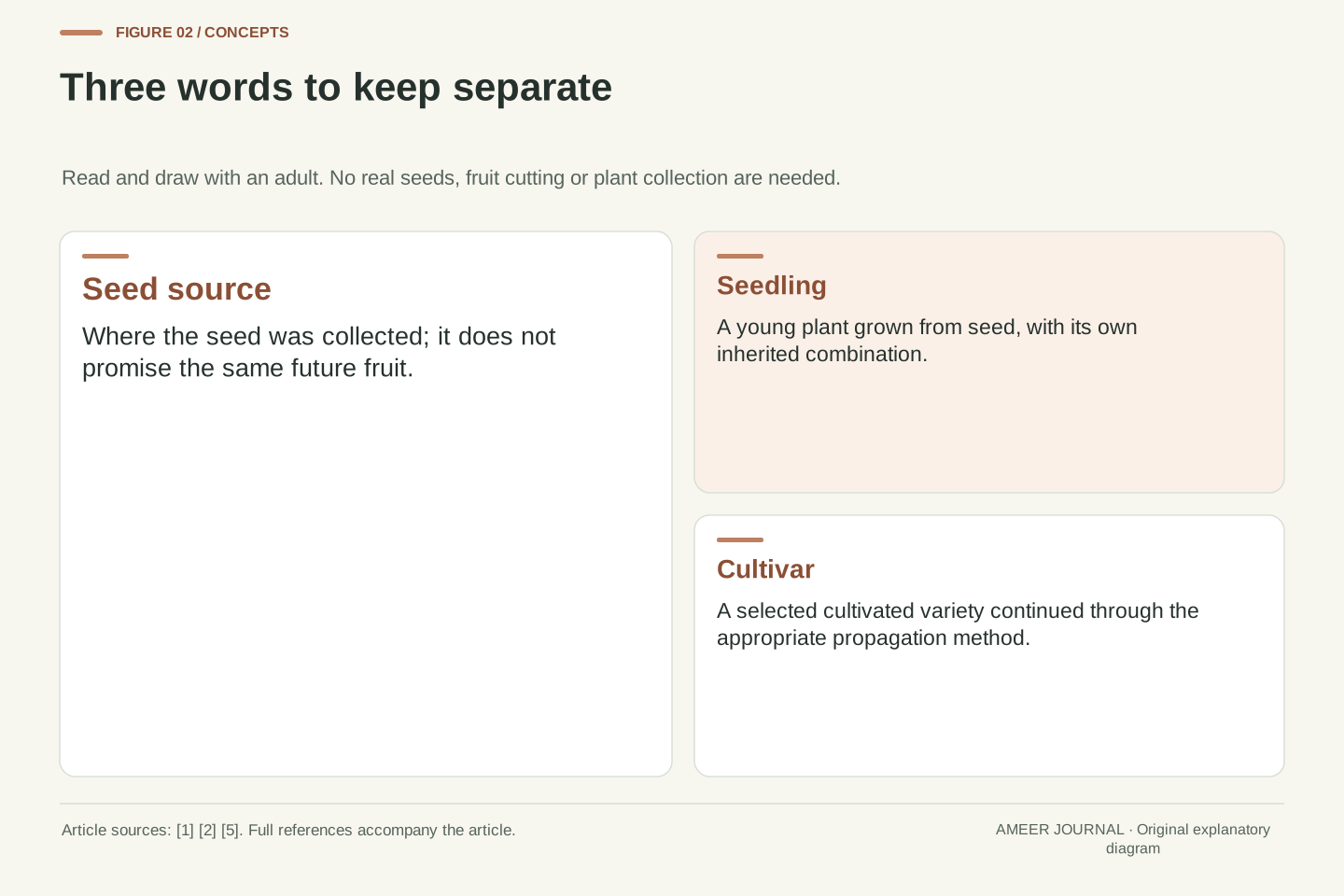
The name on a familiar apple tells you which fruiting variety produced that apple. It does not label every future tree that might grow from the seeds inside it. Think of two different questions: 'Where did this seed come from?' and 'What kind of tree will this seed become?' The first question can have a clear answer even when the second still has many unknowns. University of Minnesota Extension describes each apple seed as a genetically different individual when discussing seedling rootstocks [1].
A seedling is simply a young plant that has grown from a seed. Seeing an apple seedling grow leaves would show that growth is happening. It would not prove that the seedling is a copy of the fruiting variety from which its seed came. Likewise, two young trees that look similar are not automatically the same named variety. The information in a seed's history and the information in its appearance answer different questions. Keep those questions separate as we follow our imaginary apple's family story.
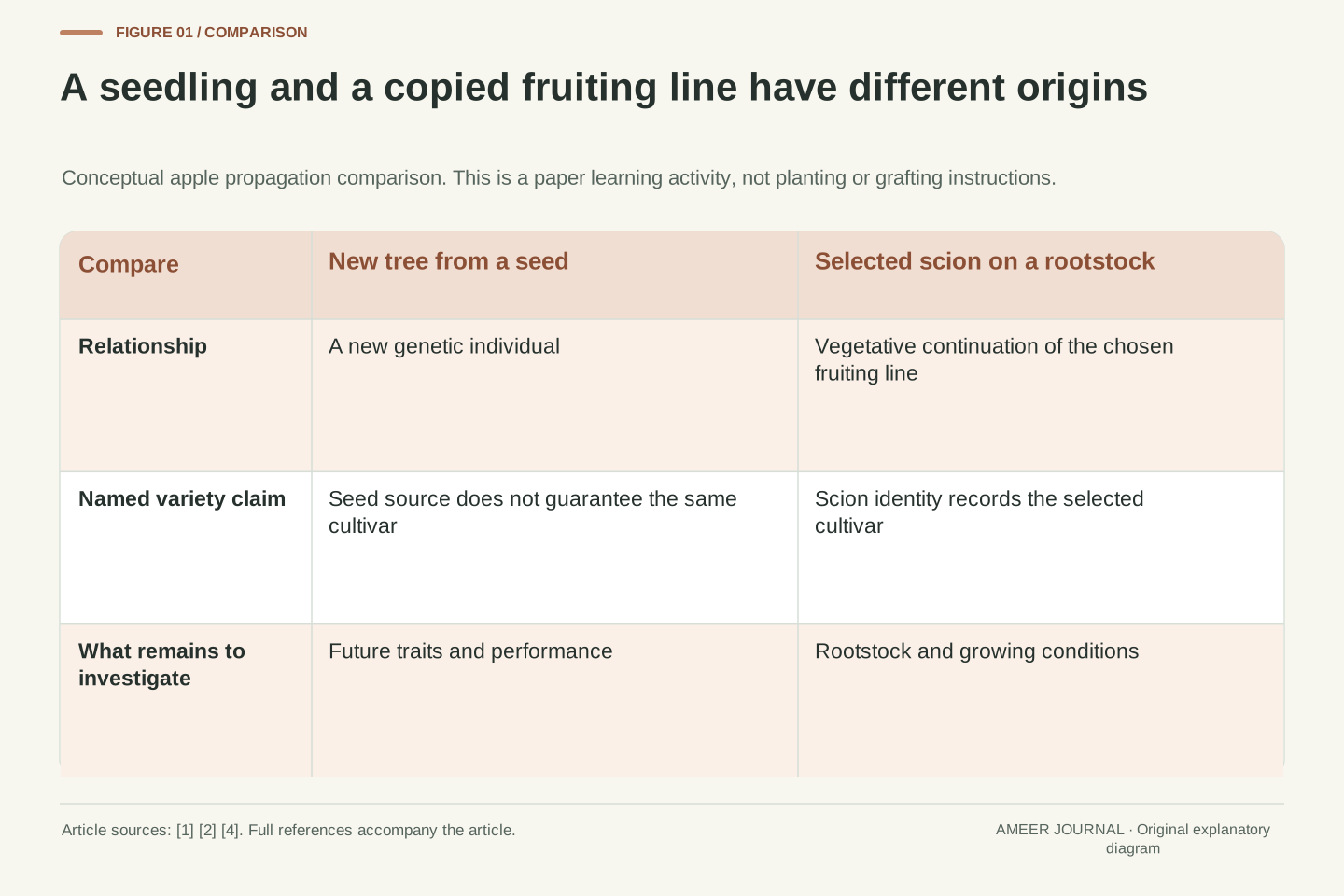
A cultivar label identifies the selected cultivated variety associated with the fruiting tree. Seed provenance records where a seed was collected; it does not independently establish the seedling's cultivar identity. University of Minnesota Extension explicitly notes genetic individuality among seed-derived apple rootstocks [1]. This is the important inference boundary: knowing the maternal fruiting source is useful provenance, but it does not make a sexually produced offspring genetically equivalent to that source cultivar.
Seedling is a developmental description, meaning a plant grown from seed. It should not be treated as evidence that the plant will reproduce a parent's complete collection of traits. Leaf emergence, height or a shared outward resemblance cannot by themselves establish genetic identity or future fruit quality. The university breeding program uses records, DNA information and later evaluations precisely because different questions require different evidence [3]. For this activity, we can recognize a seedling's origin while leaving its unobserved future characteristics unresolved. No visual identification test for a real specimen is proposed.
Pollen helps explain the new combination
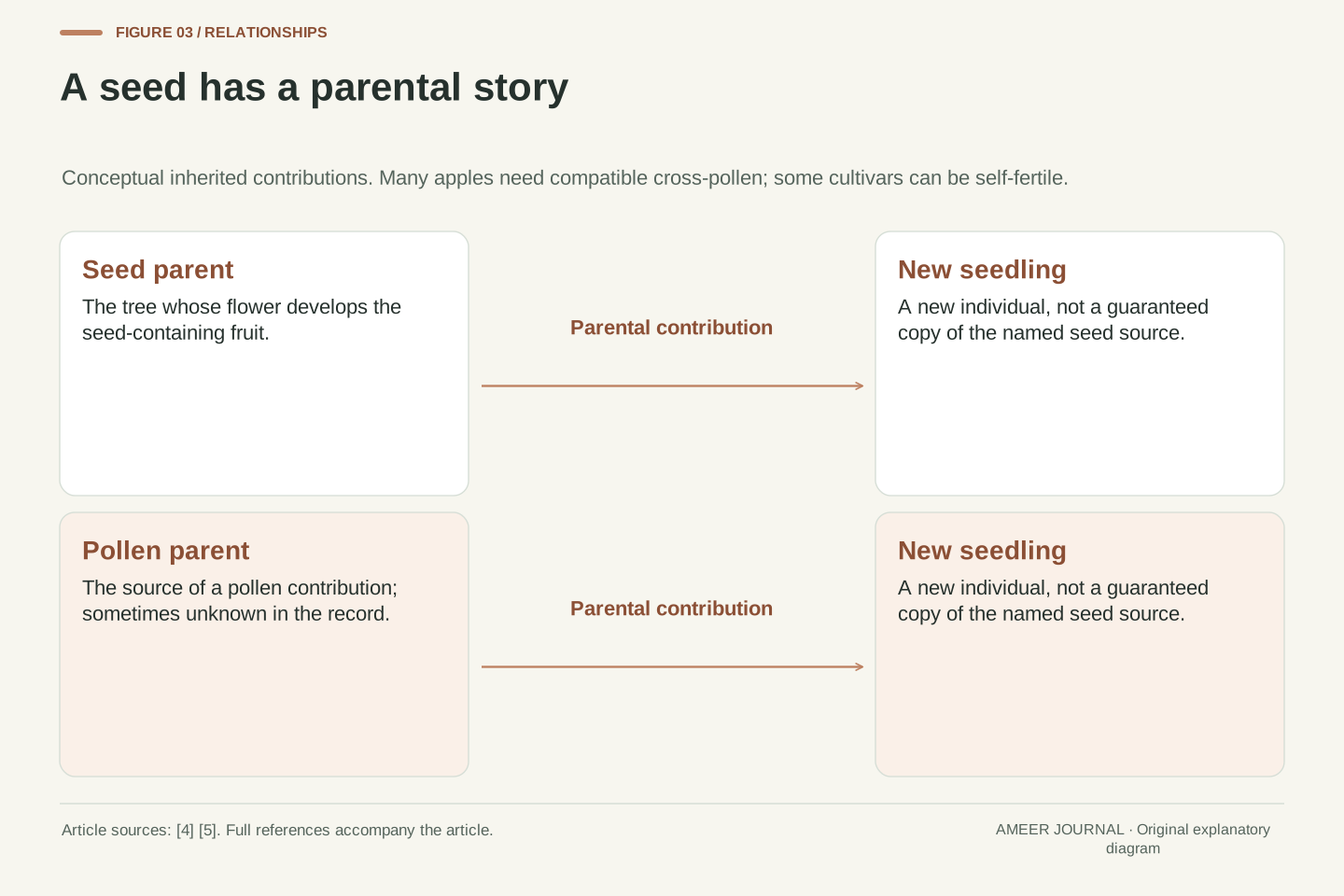
Apple flowers are part of the story before an apple develops. Pollen can carry inherited information from a pollen-producing parent, while the flower on the fruiting tree supplies the other parental contribution to a seed. The Cooperative Extension apple resource describes the seed parent and pollen parent separately [4]. In many apples, successful seed formation depends on compatible pollen from a different variety. A visiting insect can move pollen; it is not choosing which future apple will be sweetest or crunchiest.
There are exceptions to a simple rule that every apple always needs a second variety. The University of Vermont notes that some varieties can be self-fertile [5]. That does not turn seed production into a copying machine. The useful rule for our question is that growing from a seed does not reliably preserve a named apple variety [2]. If a story only tells you which tree held the apple, you may not know the pollen parent. Write 'not known' for that missing information instead of inventing a second tree.
Apple seed formation involves a maternal or seed parent and a paternal or pollen parent. The Cooperative Extension account describes the self-incompatibility system common in apples, which often prevents self-fertilization and promotes crossing between compatible cultivars [4]. The terminology identifies reproductive contributions, not a guarantee that one parent supplies one visible trait and the other supplies another. Knowing the seed parent does not necessarily identify the pollen parent in an open-pollinated situation.
The account needs a qualifier: some cultivars can be self-fertile, as the University of Vermont explains [5]. Therefore, 'every apple seed always has two different cultivar parents' would be too broad. Seed reproduction and clonal propagation remain different processes even when self-fertilization is possible; seed origin alone does not establish true-to-type cultivar reproduction [2]. Our drawing uses explicitly named fictional parent roles only to make the distinction understandable. It does not prescribe pollination arrangements, distances, orchard planting or reproductive procedures for children.
Try a six-combination drawing puzzle
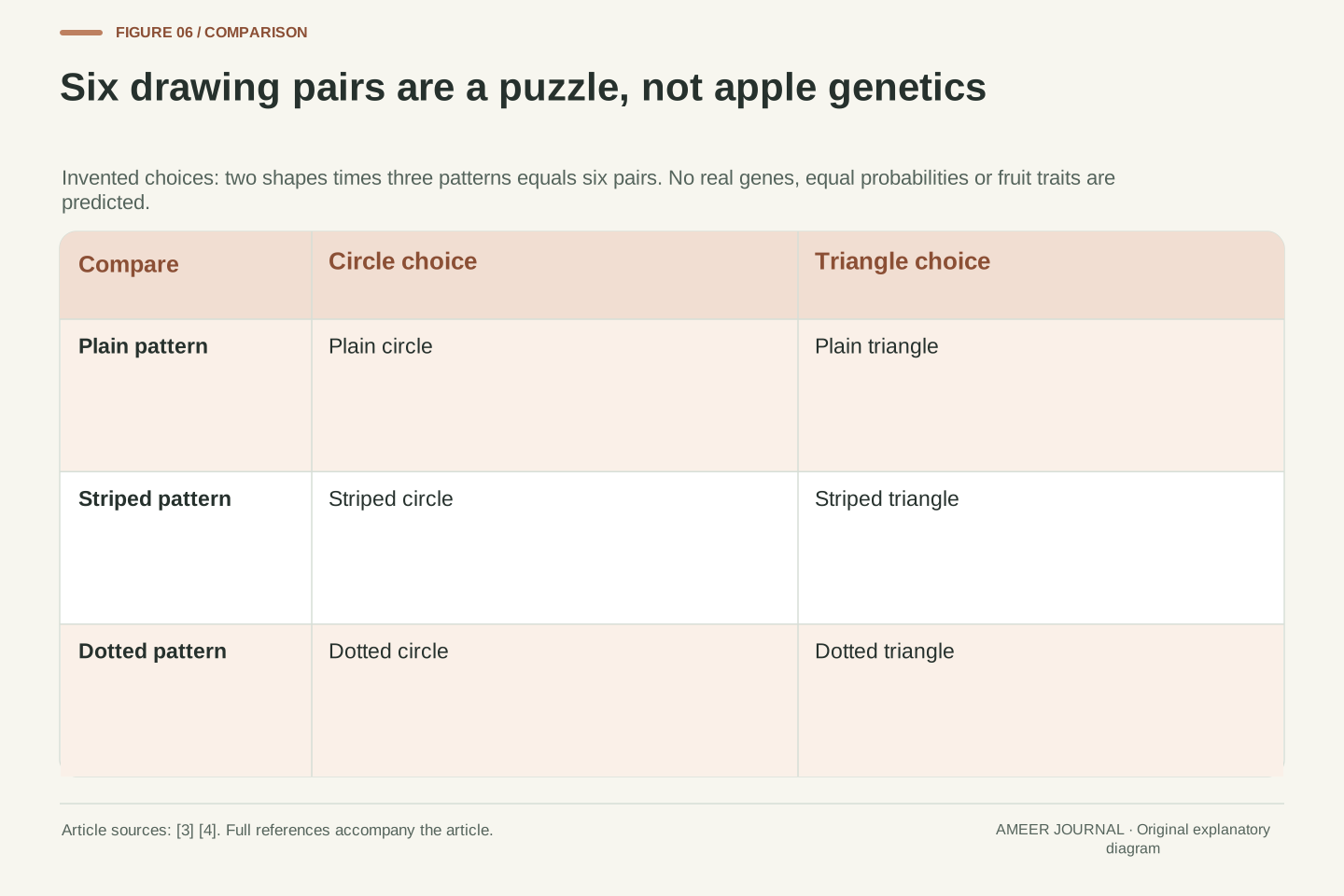
Here is a paper puzzle about combinations. It is not a model of real apple genes. Draw two choices in a first group: a circle and a triangle. In a second group, draw three choices: plain, striped and dotted. Ask an adult to help you draw a simple grid. Pair one shape from the first group with one pattern from the second. A circle can be plain, striped or dotted. A triangle can also be plain, striped or dotted. You can do all of this on one sheet without cutting anything out.
There are two shape choices and three pattern choices, so there are six possible pairs: 2 × 3 = 6. Point to each drawing and check that none has been counted twice. The puzzle shows that combining contributions can produce more than one result. Real apple inheritance is much more complicated than these two small groups. The six drawings do not predict six apple types, equal chances, fruit colours or flavours. Their job is to challenge the idea that a new combination must be an exact copy of one starting choice.
Use an explicitly artificial combinatorial model with two independent choice sets: S = {circle, triangle} and P = {plain, striped, dotted}. Form ordered pairs containing one member of each set. The Cartesian product contains |S| × |P| = 2 × 3 = 6 distinct pairs. This is a drawing task on one sheet of paper, with adult assistance if needed; physical cards, scissors and loose plant material are unnecessary. The complete six-pair set can be checked by systematic enumeration.
The example illustrates combinatorial possibility only. It is not a two-gene apple inheritance model, and neither set represents measured alleles, chromosomes or parental gametes. No probability distribution has been specified, so six possible pairs does not imply that outcomes are equally likely. It also does not predict how many phenotypes a real cross would produce. Apple breeders consider multiple fruit and production traits and evaluate offspring over time [3]. Keeping the puzzle's narrow scope explicit helps a young reader use a model without mistaking its convenient symbols for biological measurements.
A named variety is a selected plant line
People use the word variety for a named kind of apple. A more precise word in this setting is cultivar, meaning a cultivated variety. A grower who wants to keep producing a chosen apple does not normally rely on planting that apple's seeds and hoping every seedling matches. Grafting is a common way to preserve the selected fruiting variety [2][5]. We will explain what grafting means with a drawing, without trying to do it.
Try this label-detective question with your adult helper. One label says, 'Seed collected from a Honeycrisp apple.' Another says, 'Honeycrisp scion on a named rootstock.' Which label actually describes propagation of the selected fruiting variety? It is the second, because the scion is material from the chosen variety. The first label records where a seed came from. It does not promise that the seedling will produce Honeycrisp apples. This is a comparison of what the labels claim, not a way to certify a real nursery tree from a photograph [1][2].
Cultivar is the useful term for a selected cultivated variety. In the propagation context discussed here, preserving an apple cultivar normally means continuing its selected fruiting genotype through vegetative material, rather than assuming seed progeny will remain true to type. Iowa State describes grafting as the common propagation method for genetically matching apple trees, and Vermont identifies the scion as the part taken from the desired parent variety [2][5]. The word clone refers to that propagation relationship, not to identical conditions for every tree.
Compare two hypothetical records: seed collected from a Honeycrisp apple, and Honeycrisp scion grafted onto an identified rootstock. The first is seed provenance. The second describes intended clonal continuation of the fruiting cultivar, together with a separate rootstock identity [1]. Correct labeling still depends on trustworthy nursery or research records; the sentence alone is not an authentication test. The exercise asks which type of evidence addresses cultivar preservation. It does not make claims about purchasing, plant ownership, intellectual-property permission or how to perform grafting.
A grafted tree has two important parts
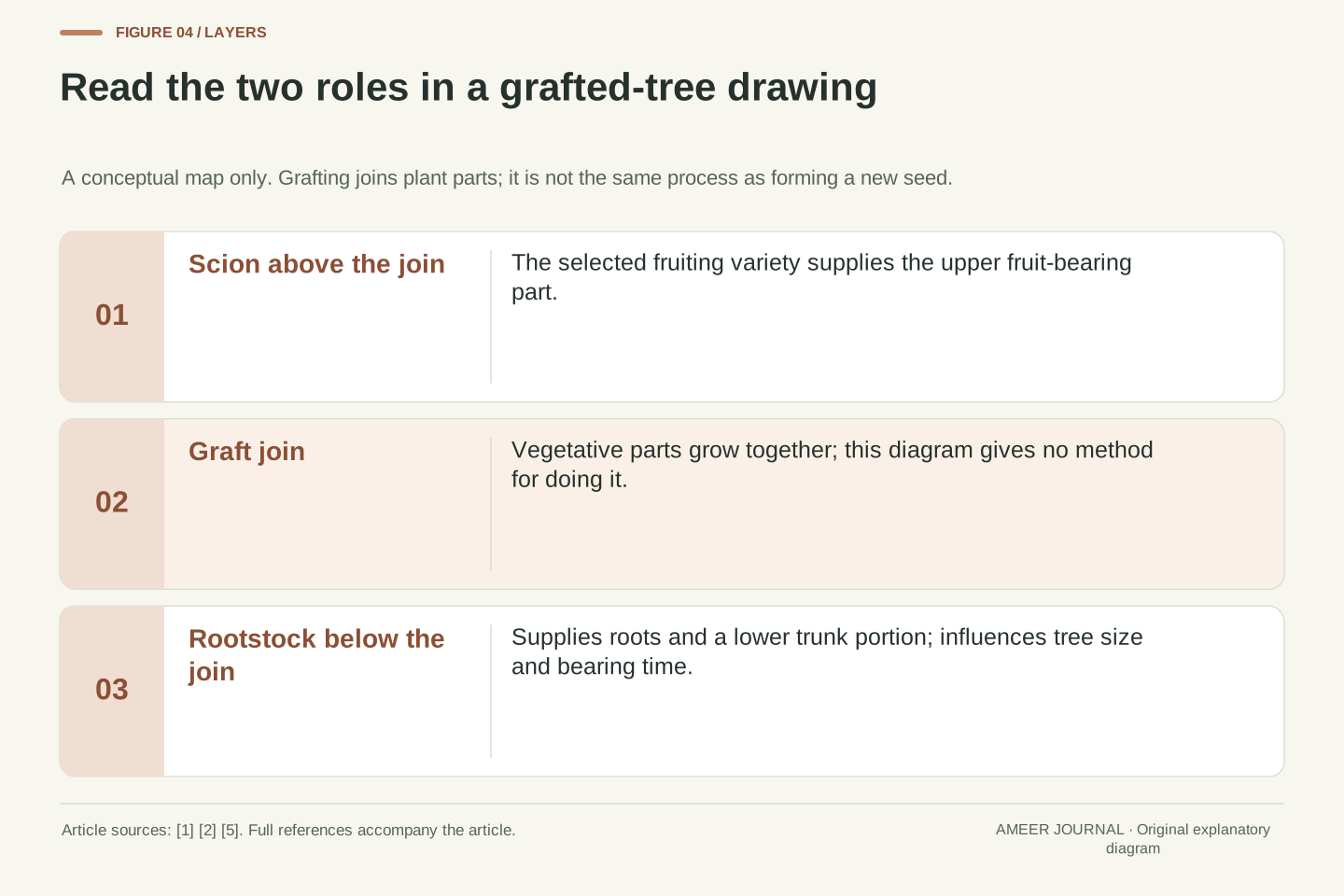
In a simple drawing of a grafted apple tree, show an upper fruiting part and a lower root-bearing part. The upper part is called the scion. The lower part is called the rootstock. University of Minnesota Extension explains that the scion produces the wanted fruiting variety, while the rootstock contributes the roots and part of the trunk [1]. The two parts can come from genetically different plants. They grow together as one working tree, but that is not the same event as forming a new seed.
Label your drawing before adding any apple pictures. Put 'scion: fruiting variety' above the join and 'rootstock: roots and growth influence' below it. The rootstock can strongly affect how large the tree grows and when it starts bearing fruit [1]. That gives growers reasons to care about both names. The drawing is only a map of roles. Do not cut, join, tie or alter a real plant for this activity. Learning the difference between a scion and a rootstock does not require using a grafting tool.
A commonly grafted apple tree is a composite plant containing a scion genotype and a rootstock genotype. Minnesota Extension identifies the scion as the upper portion, including most of the trunk and canopy, that bears the selected fruiting variety. The rootstock supplies the roots and a lower trunk portion, and substantially influences ultimate tree size and time to bearing [1]. These roles explain why a useful propagation record identifies both components rather than treating the entire composite plant as one seed-derived genotype.
Grafting joins vegetative plant material; it does not itself create the sexually recombined embryo that develops within a seed. The conceptual drawing therefore uses a join between scion and rootstock, while the inheritance drawing uses arrows toward an offspring. Those different diagram structures represent different biological relationships. This description is intentionally nonprocedural: no cuts, tools, binding method or plant-care instructions are provided. The child's task is to label the two roles on paper and distinguish continuing a selected fruiting line from creating a new individual through seed reproduction.
Same variety does not mean every observation is identical
Suppose two drawings show trees with the same fruiting variety on different rootstocks. One is drawn taller than the other. That difference does not prove that the scion labels are wrong. The rootstock can affect tree size [1]. A named fruiting variety and the size of the whole tree are not the same kind of information. A careful observer asks which part of the tree is being described before deciding that two labels disagree.
Growers and researchers also care about conditions and performance, not just a name. The University of Minnesota describes evaluating promising apples in different orchards and research settings before release [3]. That is a useful reminder to avoid promises such as 'every apple on every tree will be exactly identical.' For our picture exercise, keep three spaces: fruiting variety, rootstock and growing conditions. A drawing may not tell you all three. Leave unknown spaces blank or write 'not given.' Scientists do not make a record stronger by filling its gaps with guesses.
Genetic identity of a selected scion and the observed performance of a whole grafted tree are different levels of description. The rootstock can affect tree size and bearing age even when the named fruiting cultivar is retained [1]. Therefore, a difference in overall tree height is not, by itself, evidence of a changed scion cultivar. Conversely, similar height does not prove genetic identity. A sound comparison records which biological component and which observed trait are actually being compared.
The Minnesota breeding program evaluates selections in multiple orchard and research settings [3]. Its procedure supports treating cultivar identity and performance evidence as separate records, rather than claiming that a name guarantees identical observations in every environment. This article does not quantify rootstock effects, climate adaptation or fruit-quality differences. The paper task records the scion label, rootstock label and stated conditions independently, using unknown where evidence is missing. It is a lesson in interpreting records, not a horticultural recommendation for a particular region or growing site.
New combinations give breeders something to investigate
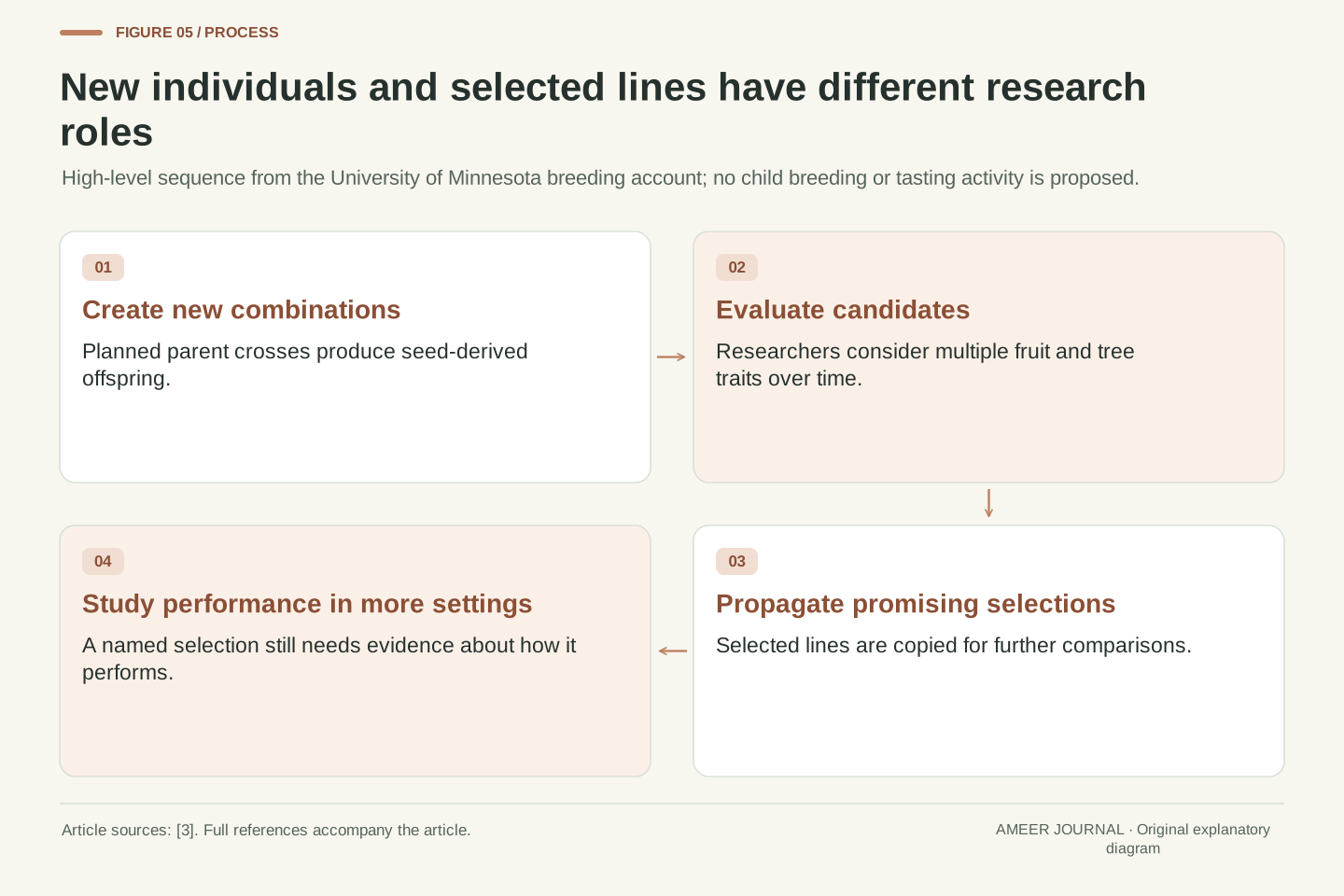
If seeds do not copy a favourite apple exactly, why do researchers use them? New combinations can be useful. The University of Minnesota's apple breeding team describes planning crosses between parent varieties, growing the resulting offspring, and examining their qualities [3]. The team considers features such as flavour, texture, appearance and storage ability. A new seedling is a possibility to investigate. It is not automatically a better apple, a worse apple or the same apple as its parent.
This investigation takes patience. The Minnesota program reports an average of 20 to 30 years from an initial cross to a new variety reaching the market [3]. That is the program's reported development process, not a countdown promised for every apple seed or every orchard. Researchers may study genetic information early, then examine fruit and performance later. Promising selections can be copied for further comparisons. The two activities work together: seeds create new individuals, while propagation of a selected line allows researchers to examine that line in more places.
Imagine a research card that says, "Selection S: three copied fruiting trees in three places." That means researchers are following the same selected fruiting line in three settings. It does not mean they made three new seed combinations. A different card saying "three seedlings from a cross" describes three seed-derived offspring. These are invented cards, with no results attached. Count the trees if you like, but also ask how they were produced; the same count can describe different kinds of comparison.
Apple breeding uses variation rather than treating it only as an obstacle to cultivar copying. The University of Minnesota describes planned crosses, early DNA-based assessment, later fruit evaluation and further testing of selected material. Its priorities include flavour, texture, appearance, storage characteristics and production concerns [3]. These are several selection criteria, not a single visible trait that a child can infer from a seed coat or a seedling leaf. An untested offspring remains a candidate with uncertain characteristics.
The program reports an average 20–30-year interval from initial cross to market release, within its own breeding and evaluation process [3]. That number is not a universal juvenile period or a prediction for a home-grown seed. The program also describes cloning promising selections by grafting or budding for further testing. This sequence separates generating variation, selecting a candidate and propagating that candidate for comparison. Our explanation reports the research stages at a high level without reproducing pollination, grafting, disease-testing or tasting procedures as child activities.
A fictional record, "Selection S: three propagated trees at three sites," describes replicated physical trees associated with one selected scion line. It does not establish three independent new crosses or three seed-derived scion genotypes. Conversely, "three seedlings from a cross" describes offspring rather than clonal replication of a selected offspring. Neither invented record includes performance results. This comparison shows why a tree count needs its propagation history: the same number of plants can serve different research questions about new variation and the performance of a selected line.
Sort what the story tells you from what it does not
Try three short story cards drawn on the same page. Card one says, 'A seed came from a named apple variety.' You know the recorded source, but you do not know that the future tree is the same variety. Card two says, 'A nursery record identifies a scion and a rootstock.' You know what the record claims about the two plant parts; you still have not checked a real tree. Card three says, 'A young tree has green leaves.' You know an observation in the story, but not its future fruit flavour.
For each card, ask your adult helper to draw two columns: 'We can say' and 'We cannot say yet.' Speak your answers before writing them. There is no prize for making the biggest prediction. The useful move is choosing a statement that fits the evidence. Researchers sometimes need to correct recorded parentage when better information becomes available; the Cooperative Extension resource describes DNA methods helping check those records [4]. Revising an answer after learning more is part of careful investigation, not a reason to hide the earlier uncertainty.
The three fictional records test different inference boundaries. Seed provenance identifies a collection source, not clonal equivalence. A scion/rootstock record describes a claimed propagation combination, not an independently verified specimen. A leaf observation describes a present feature, not an eventual fruit-quality assessment. Categorizing these as provenance, identity record and observation helps prevent one kind of evidence from silently substituting for another. None of the cards supplies measurements or identification evidence from a real child, orchard or plant.
The Cooperative Extension parentage account notes that pedigree records can require correction and that DNA fingerprinting can help verify cultivar parentage [4]. This supports an appropriately modest lesson: a record can be useful while remaining open to checking. The paper activity asks readers to distinguish supported statements from unresolved ones, not to perform genetic testing or certify nursery stock. An adult can discuss why a stronger claim needs additional evidence. The answer sheet remains a private learning page; no account, photograph, location, personal information or online submission is needed.
Tell the apple story in your own words
Point to three parts of your drawing: the seed's parental story, the young seedling, and the separate picture of a scion joined to a rootstock. Explain them to the adult reading with you. A seed can begin a new apple tree with its own inherited combination. A seed from a favourite named variety does not reliably recreate that variety. Continuing a selected scion by grafting is a different way of carrying the fruiting line forward [1][2][4]. You can understand all of this without handling a seed or changing a plant.
Finish with one sentence that leaves room for what you do not know: 'We know where this imaginary seed came from, but we have not discovered what its future fruit would be like.' Then check the six shape-and-pattern pairs again. Remember that the drawing puzzle explains possible combinations, not actual apple genes. Keep your page for another conversation, or put it away when you have had enough. The success of the activity is an explanation you can defend, with clear boundaries between a picture, a source record and a real observation.
An accurate explanation distinguishes three relationships: reproductive parentage of a seed, development of a new seedling, and vegetative continuation of a selected scion on a rootstock. The first two do not establish cultivar cloning. The third preserves the selected fruiting line through a different propagation process, while the rootstock remains a separate component with important growth effects [1][2][4]. A child can demonstrate understanding by explaining those distinctions in a labeled drawing rather than by carrying out horticultural procedures.
The final statement should preserve uncertainty about an untested offspring. Known seed provenance is compatible with unknown future fruit traits; six combinations in an invented symbol puzzle do not become a biological prediction. Both reading modes therefore end with the same evidence boundary: describe what the sources and story actually establish, and leave unsupported identity or performance claims unresolved. The activity is complete on paper with adult support. No seed handling, food tasting, tools, field collection, account creation or sharing of personal data is necessary to learn the distinction.
Sources & further reading
Explore the references behind this guide. External pages may change after our review.
- Growing apples in the home garden | UMN ExtensionUniversity of Minnesota Extension · Accessed 6 Nov 2026
- Can I grow an apple tree from a seed? | Yard and GardenIowa State University Extension and Outreach · Accessed 6 Nov 2026
- Apple breeding at the University of Minnesota | Minnesota HardyUniversity of Minnesota · Accessed 6 Nov 2026
- Parentage of Apple CultivarsCooperative Extension / Apples · Accessed 6 Nov 2026
- All About Apples | University of Vermont ExtensionUniversity of Vermont Extension · Accessed 6 Nov 2026
Article updated 6 Nov 2026.