What you’ll take away
- Keep code, weights, tokenizer and examples attached to their own applicability evidence.
- A licence identifier or download approval does not describe every artifact and intended operation.
- AND, OR, WITH and parentheses carry information that a flat list of licence names loses.
- Model and dataset lineage links identify relationships to investigate, not automatically complete permission records.
- Retain exact versions, relevant notices and unresolved questions without treating a documentation count as a legal verdict.
A licence label starts the reading process
A model page displays a familiar licence name. You download a package containing a program, model weights, a tokenizer and sample prompts. What exactly does that label tell you about each item? The useful next step is to connect the label to actual terms and the material those terms cover, rather than stretching one short field into an answer about everything in the package.
Hugging Face documents licence information in repository-card metadata and uses model-card fields to display licences and support filtering [1][2]. That makes the label useful for discovery. The same documentation provides ways to identify and link custom terms. Following those links is part of understanding the record, not an optional substitute for reading the badge.
This guide uses an invented four-item bundle and two short licence expressions. We will track which documents refer to which artifacts, what an expression combines, and which intended action still needs assessment. No real model receives a legal verdict here, and the fictional document labels contain no usable licence grant.
Treat a displayed licence identifier as one element in an artifact-specific evidence record. The Hub documents licence metadata in a repository README and exposes model licence fields for display and filtering [1][2]. Those functions do not, by themselves, resolve the scope of every file, upstream contribution or contemplated use.
The record proposed here separates artifact identity and revision, the document declaring applicability, exact terms, upstream references, access conditions and the intended operation. These fields can agree or remain incomplete independently. A successfully parsed identifier establishes a recognized notation; it is not an independent verification of licensor authority or complete permission coverage.
Our examples concern documentation and expression structure. We stipulate a four-artifact inventory with explicit scope references for three items and a missing reference for the fourth. Separately, we expand two AND/OR expressions into their referenced term sets. Neither construction evaluates real licensing compatibility, classifies model weights as a legal category or determines permission for a deployment.
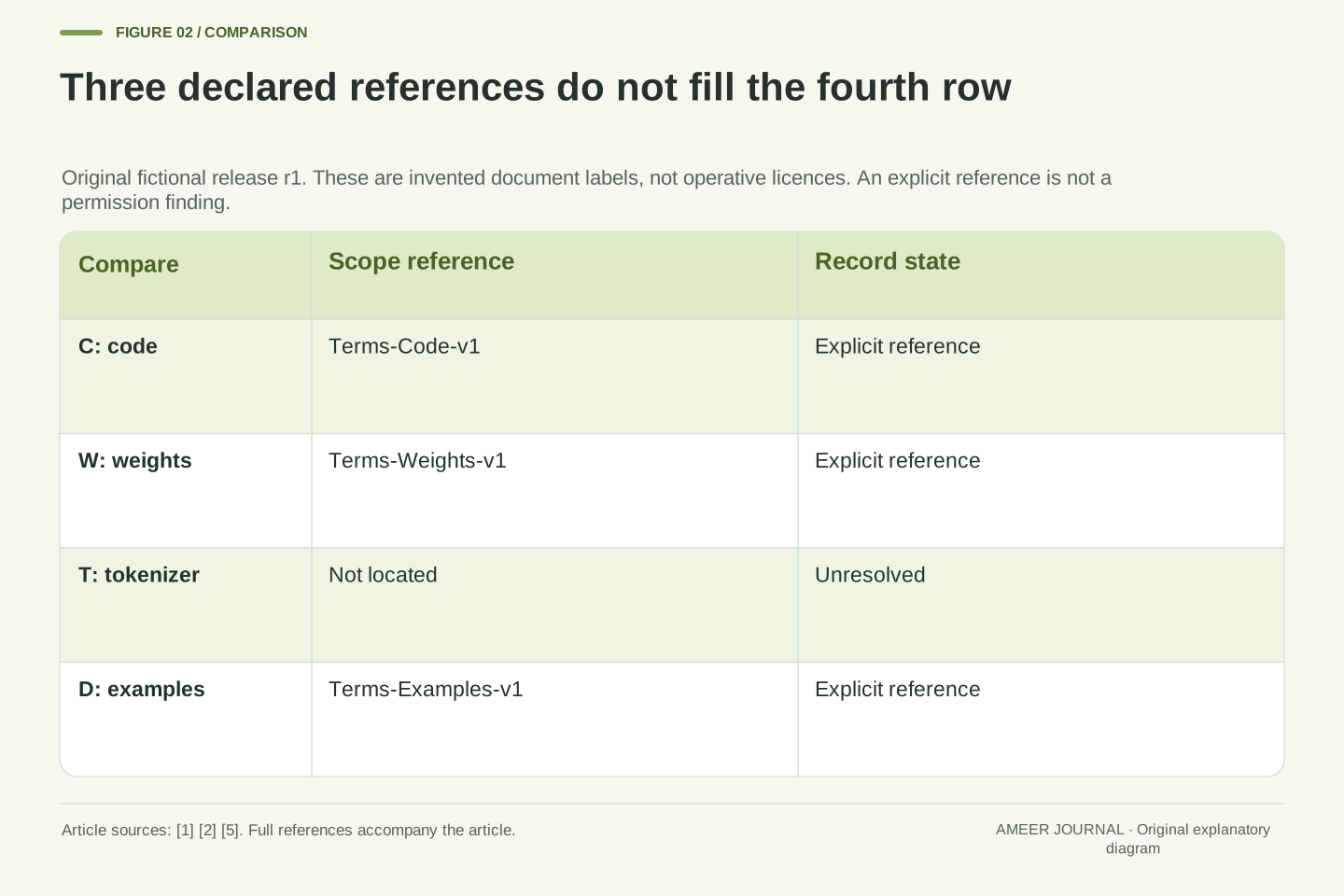
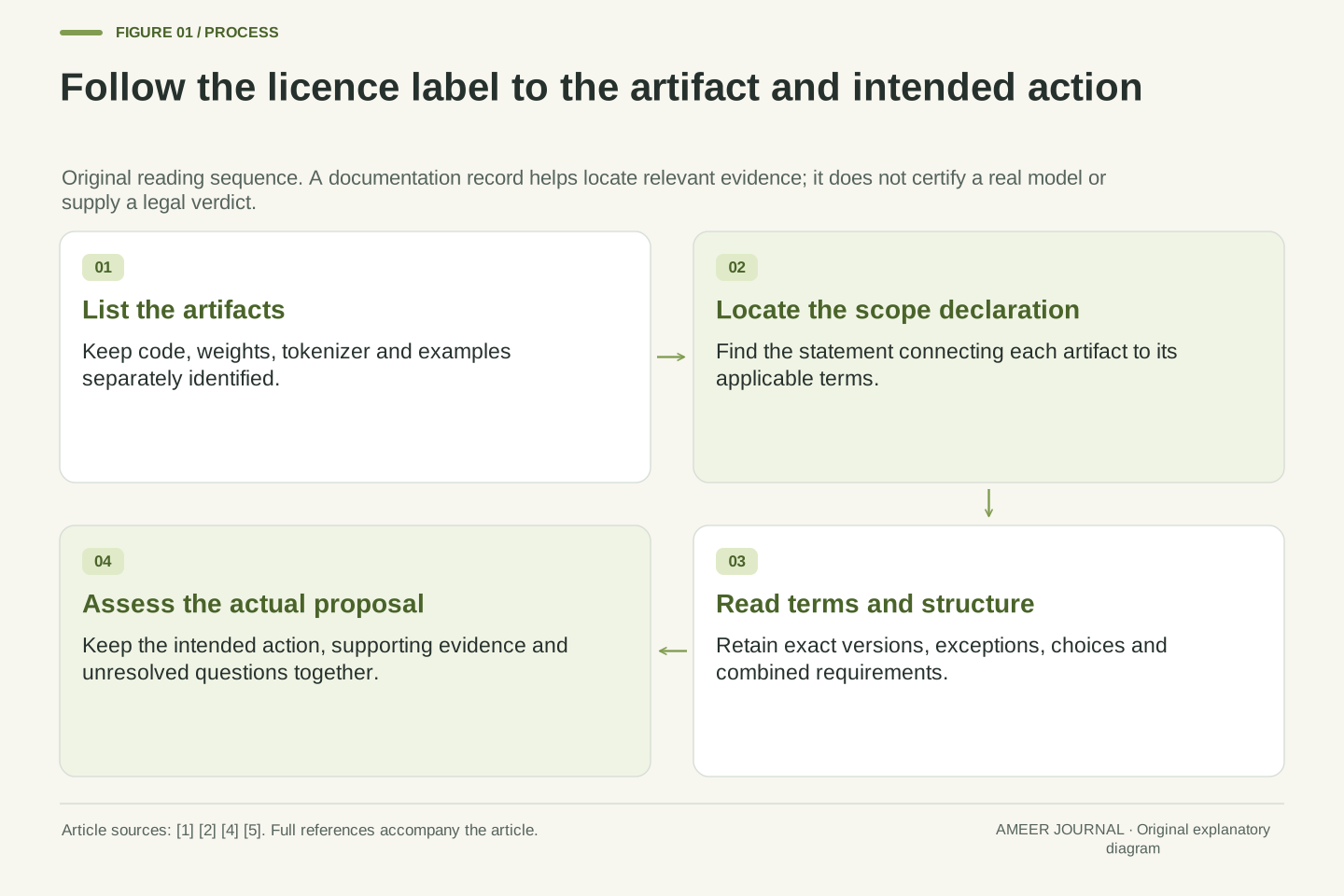
Give code, weights, tokenizer and examples their own rows
Our fictional release r1 has four items. C is code/runner.py, the program. W is weights/model.safetensors, the weights. T is tokenizer/tokenizer.json. D is examples/prompts.json. Their contents are not real software or training data; the names help us keep four different documentation questions apart.
The invented scope declarations connect C to Terms-Code-v1, W to Terms-Weights-v1 and D to Terms-Examples-v1. We have not located a scope document for T. The page displays Terms-Code-v1 as its short label. That display does not change the three separate declarations, and it does not fill the tokenizer’s missing entry.
We have three explicit references and one unresolved reference. Calling that “75 percent permitted” would be a mistake: the count measures completed mappings in this exercise, not legal permission. A referenced document still needs its actual conditions read against the intended use. The missing fourth entry should remain visible instead of receiving a copied label just to make the table look complete.
Define artifact identifiers C, W, T and D for the four named paths at release r1. Their individual revision labels are c1, w1, t1 and d1. The stipulated mapping is C→Terms-Code-v1, W→Terms-Weights-v1, T→unresolved and D→Terms-Examples-v1. These are invented document names, not SPDX identifiers or operative licences.
An explicit mapping means only that this exercise supplies a declaration connecting an artifact to a document. It does not encode the contents of that document, a rights-holder verification or an action-specific conclusion. The mapping count is three; the unresolved count is one. Neither fraction is a probability or percentage of lawful use.
Preserving the rows prevents the repository-level display from overwriting artifact-level evidence. The principle is compatible with the Apache text’s definition of the licensed Work and its guidance on applying notices to specific files [5], but the fictional bundle is not asserted to use Apache terms. Its labels deliberately keep the accounting demonstration separate from any actual licence interpretation.
A nearby licence file needs an applicability connection
Suppose someone copies Terms-Code-v1 into all four rows. The table now has no blanks, but its evidence has become worse. In our declared example, that document’s scope points to C. The weights and prompts already point to different documents, while the tokenizer remains unresolved. Copying a label supplies none of the missing connections.
For a real package, look for the statement that identifies what the terms cover: a file notice, a repository explanation, a distribution document or another applicable declaration. Read any exclusions and separately attributed components. This is a way to find the relevant evidence, not a rule that a top-level licence can never cover an entire distribution.
Apache 2.0 defines its Work through material made available under the licence and an included or attached notice; it also defines the Licensor in relation to the copyright owner’s authority [5]. Those definitions illustrate two different questions: which material is covered, and who can make the grant. A familiar filename alone does not answer both.
The applicability relationship is data worth preserving. In the invented inventory, replacing the explicit W and D references with the C reference contradicts the stipulated declarations. Filling T with the same reference invents a relationship for which the exercise supplies no evidence. Completeness of a spreadsheet is not completeness of the underlying record.
A real scope statement may cover a whole distribution, particular paths, specified components or material subject to exceptions. Its actual language and context determine the relevant inquiry. The proposed record therefore stores the applicability locator alongside the referenced terms, rather than deciding scope solely from directory proximity or a filename convention.
Apache 2.0 supplies a concrete textual example: section 1 defines both Work and Licensor, and the appendix discusses notices for specific files [5]. These definitions support distinguishing object scope from granting authority. They do not establish that an arbitrary model uploader owns every included item, nor do they classify a particular weight transformation as a derivative work. Those conclusions would require their own evidence and assessment.
Describe the intended action before asking what is allowed
“Can I use this model?” can hide several different plans. One person wants to run a local experiment. Another wants to modify the weights. A third wants to give customers a downloadable bundle. A fourth wants to operate an online service. Writing the actual plan makes it possible to look for terms that address the relevant activity and material.
For our invented bundle, a proposed download might include C, W and T but omit the sample prompts D. That changes the list of items being distributed. It does not settle the terms for the remaining three. Likewise, a service description should say which components it uses and what recipients receive; it should not quietly substitute a file-sharing answer for a different activity.
Apache 2.0 itself separates definitions, grants and redistribution conditions [5]. Other terms must be read on their own wording. The practical benefit of an action record is precision: it helps a later reviewer connect a clause to the actual proposal without treating a broad word such as use as a complete description.
Specify the operation as well as the artifact. Relevant descriptions can distinguish running a particular copy, modifying material, redistributing identified files and operating a service with defined inputs and outputs. This is a documentation taxonomy, not an assertion that the legal consequences of those operations are identical or universally different under every licence.
In the fictional example, distribution set {C,W,T} differs from {C,W,T,D}. Removing D narrows the proposed package but neither changes the W declaration nor resolves T. Record the complete applicable context, including upstream material and the terms attached to the selected components. Avoid interpreting an omitted file as proof that every other obligation disappears.
The Apache text demonstrates why action and condition matter: its copyright grant is subject to the licence’s terms, and section 4 expressly addresses redistribution [5]. The example does not import those conditions into the fictional documents. It establishes a reading discipline: retain the intended operation and the clause being assessed together, and leave unassessed operations outside the conclusion.
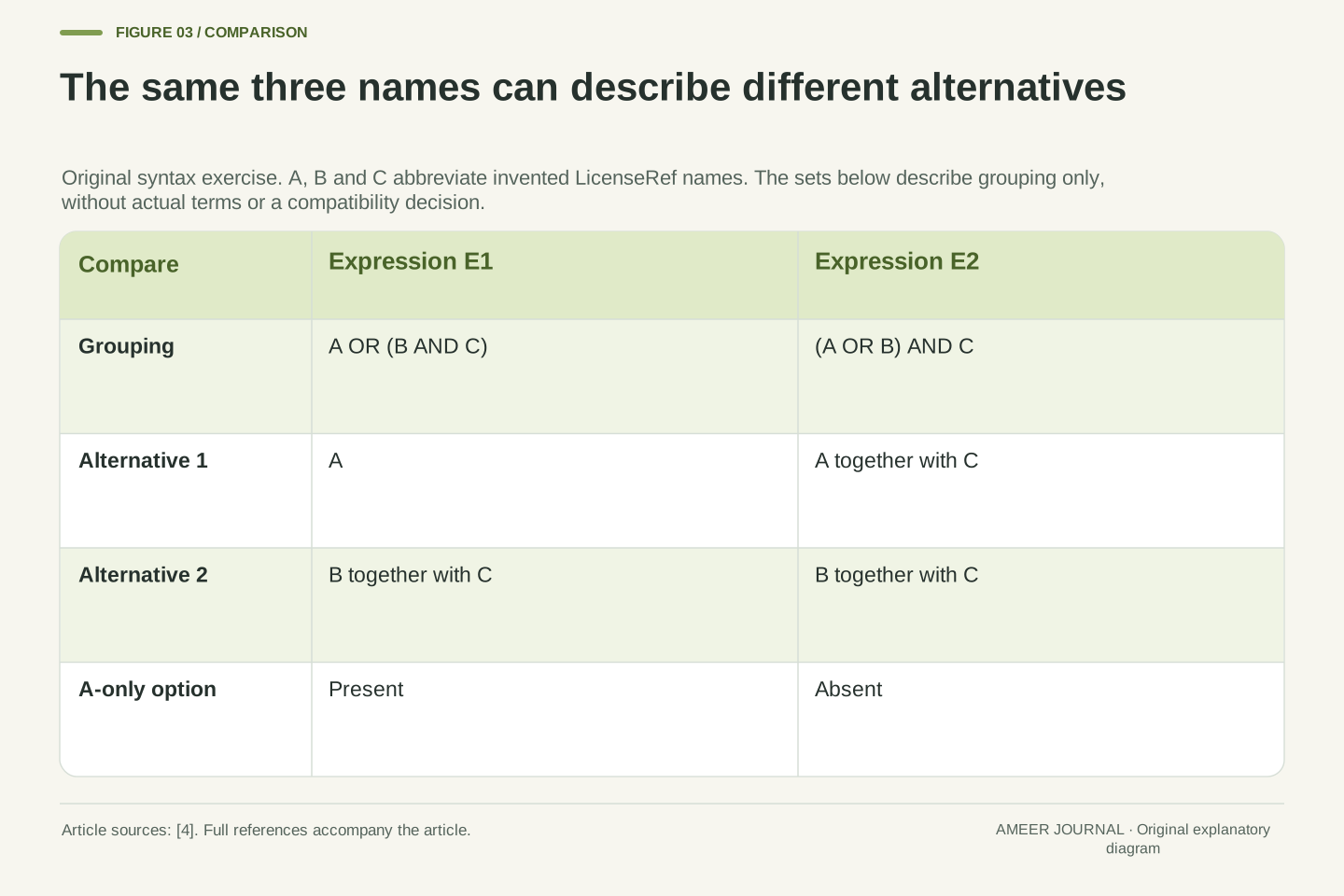
AND and OR describe different combinations
SPDX provides a notation for licence expressions. In the inspected version 2.3.1 specification, OR represents a choice, while AND represents terms with which one must comply together [4]. Replacing one word with the other changes the statement even when every licence name stays the same.
Use three invented reference names: LicenseRef-A, LicenseRef-B and LicenseRef-C. The expression “LicenseRef-A OR (LicenseRef-B AND LicenseRef-C)” describes two alternatives: A by itself, or B together with C. It does not offer C alone, and it does not say that A must always accompany B. We are reading the grouping, not supplying the contents of any of those references.
The distinction matters when a page compresses several names into a list. A list of A, B and C does not tell you whether the relationship is a choice, a simultaneous requirement or separate terms attached to different files. Keep the expression and its artifact scope. Otherwise the information removed by the summary is exactly what a reader needs to interpret the names.
SPDX v2.3.1 Annex D defines OR as disjunction over licence expressions and AND as conjunction requiring simultaneous compliance [4]. Our symbolic example E₁ is LicenseRef-A OR (LicenseRef-B AND LicenseRef-C). Its two minimal referenced-term sets are {A} and {B,C}. These sets summarize the expression’s syntax; they are not assessed permission pathways for a real activity.
The decomposition can be constructed recursively: an atomic reference supplies one singleton set; OR collects alternatives; AND combines one alternative from each operand. Applying that rule to E₁ yields the two sets above. Our retained calculation enumerates the corresponding Boolean structure, without implementing a complete SPDX parser or evaluating any licence text.
A flat collection {A,B,C} loses this relationship. It also loses which artifact an expression describes. A package containing differently licensed files therefore needs scope information in addition to any aggregate expression. Successful tokenization or a syntactically recognized identifier cannot establish the truth, applicability or compatibility of the licensing declaration it represents.
Moving parentheses can add a term to an alternative
Now move the parentheses: “(LicenseRef-A OR LicenseRef-B) AND LicenseRef-C.” The reader first has the A-or-B choice, and C accompanies either choice. Its alternatives are A together with C, or B together with C. A alone was an alternative in the first expression; it is not one in this second expression.
Both expressions contain exactly the same three names, one AND and one OR. A search result or spreadsheet that keeps only those ingredients would make them look identical. Preserving their structure shows the difference immediately. The SPDX specification gives AND precedence over OR by default and allows parentheses to change the grouping [4]. Explicit parentheses also make the intended reading easier to inspect.
Nothing in this exercise tells us whether the underlying terms can actually be satisfied together. The reference names are placeholders without legal text. The calculation answers which terms the written expression combines; applying those terms to a particular artifact and intended action remains a separate task.
Define E₂=(LicenseRef-A OR LicenseRef-B) AND LicenseRef-C. Its minimal referenced-term sets are {A,C} and {B,C}, whereas E₁ produced {A} and {B,C}. The first expression contains an A-only alternative; the second has C in every alternative. Counting identifiers and operators cannot distinguish these structures because their token inventories are the same.
Annex D.4.5 states the relevant precedence and parentheses rules [4]. Thus the unparenthesized A OR B AND C has the E₁ grouping, provided these symbols stand for valid references in the declared notation. Our full displayed examples use LicenseRef names and parentheses rather than relying on a reader to reconstruct shorthand or a different specification version.
The original symbolic enumeration checks these identities over all eight assignments of three Boolean flags. Those flags are mathematical inputs, not findings that a licence is applicable or complied with. The exercise verifies the expression decomposition only. It cannot detect missing upstream rights, contradictory conditions, an incorrect scope declaration or an unsupported legal conclusion about a model.
An exception and a custom reference need their own text
SPDX’s WITH operator has a different role from OR. It associates a licence expression with a specified exception; it does not offer the exception as a separate licence you can choose instead [4]. Removing that association can change the description of the applicable terms. Keep the full expression rather than saving only its first familiar name.
A custom LicenseRef also needs more than a reassuring label. In our examples, A, B and C intentionally have no underlying terms, so we can explain their arrangement without claiming permission. In a real record, locate the text that the custom reference identifies and the evidence connecting it to the artifact. Hugging Face similarly documents custom licence names and links, including links to a repository LICENSE file [1][2].
Version information belongs in that record too. The inspected SPDX specification describes a notation for a licence version or later versions [4]; that is different from assuming that every newer document automatically replaces an older grant. Read the actual version and applicable terms instead of silently updating an identifier to something that looks more current.
Annex D.4.4 defines WITH using a simple-expression operand and a licence-exception identifier [4]. The expression represents the licence together with the specified exception, rather than a disjunctive choice between two licences. Our AND/OR enumerator deliberately does not implement this operator, so it must not flatten a WITH expression into its existing alternative-set routine.
The inspected v2.3.1 text also explains custom LicenseRef values and states how to represent an exception absent from its exception list [4]. A custom identifier is a reference, not a self-contained statement of permissions. Preserve the referenced text, version and scope declaration. Hub custom-licence fields offer a corresponding documentation mechanism through a name and link [1][2].
Distinguish explicit later-version notation from an arbitrary version substitution. The standard’s plus suffix has defined placement and meaning; it is not an instruction to choose whatever terms are newest. This guide neither selects a licence version for a real model nor interprets a particular exception. Its narrower point is that deleting syntax or losing the referenced text changes what a record can establish.
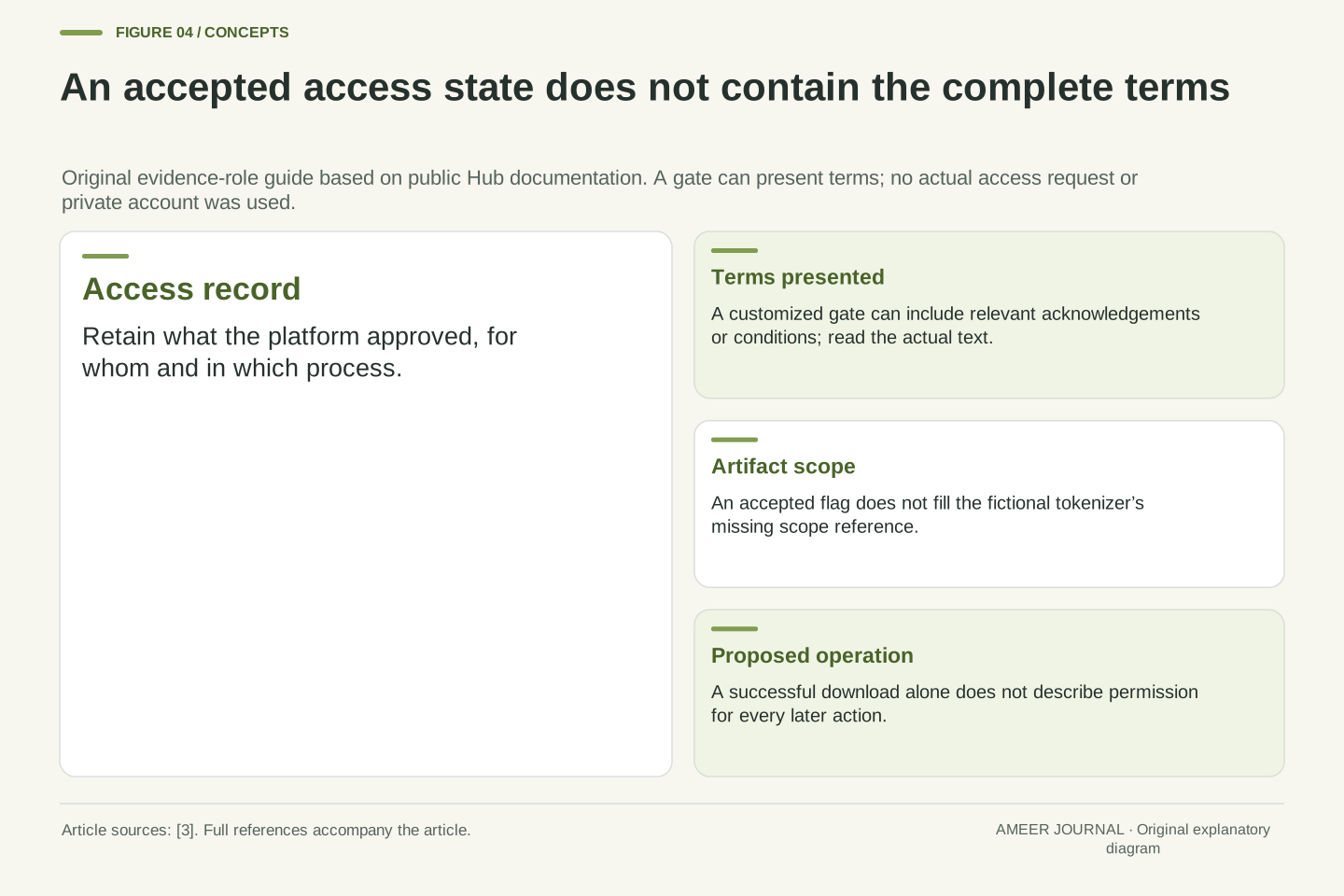
An accepted download request is only part of the record
A model may require an access request before its files can be downloaded. Hugging Face documents automatic and manual approval, and allows authors to customize the request text and fields [3]. A gate can therefore present terms that matter. Read and retain what was actually presented, rather than recording only that a button was clicked.
An accepted access status tells you about access under that system’s process. By itself, the status does not spell out permission to redistribute the weights, modify them or include them in another product. Those questions depend on the applicable terms and proposal. Conversely, the presence of a gate does not, by itself, establish that every commercial activity is prohibited.
In our fictional inventory, adding a field saying “download accepted” would leave the tokenizer’s missing scope reference unresolved. It would also leave the content of Terms-Weights-v1 unread. Access evidence is useful, but it belongs beside the terms and their scope. It cannot fill unrelated empty columns merely because the download succeeded.
Separate the access-state record from the substantive terms and their applicability. The Hub’s public documentation describes automatic/manual approvals and customizable gating prompts, including an illustrative request with a use restriction [3]. It therefore would be inaccurate to claim that a gating interaction can never involve licence acknowledgement or additional contractual terms.
The narrower inference is that an accepted status alone does not encode the full agreement. Preserve the actual terms, relevant version, covered user or entity and intended action before forming a broader conclusion. Likewise, a gated flag alone supplies neither a universal commercial-use prohibition nor a complete description of redistribution rights.
Our four-artifact exercise does not submit an access request or inspect any private account. A stipulated accepted flag would be an additional observation, not an automatic mapping from Terms-Code-v1 to T or from Terms-Weights-v1 to every operation. The distinction prevents a technical access event from being used as a substitute for the textual evidence that the broader claim requires.
A base-model link identifies a relationship to investigate
Model-card metadata can identify a base model for a fine-tune, adapter, quantized model or merged model. It can also identify datasets used in training [2]. These links help a reader follow where a release says it came from. They do not replace the linked material’s own documentation.
Imagine that our fictional weights row W adds a base-model reference. That new link gives the reader another place to investigate; it does not automatically tell us what terms apply to the base, the modification or the tokenizer. Nor does it establish that every linked dataset can be copied into a new downloadable package. Keep those questions separate from the technical claim that a relationship exists.
The same care applies when a release contains several dependencies. Record each relevant upstream component and the declaration being relied upon. A missing link should remain missing, while a supplied link should be followed and checked. Calling the result a fine-tune or a merge is a useful technical description, but it is not a complete assessment of the rights and conditions involved.
Hub documentation permits base_model metadata for fine-tunes, adapters, quantized versions and merges, including multiple base identifiers; dataset metadata separately records training-data references [2]. These fields describe claimed lineage. A licence assessment still needs the actual upstream terms, relevant versions and the relationship between those terms and the proposed operation.
Adding a base reference to W in the fictional inventory does not change its scope mapping automatically. It creates another evidence requirement whose resolution may affect the eventual assessment. The technical lineage field alone does not classify the resulting weights under a legal derivative-work definition or establish rights to redistribute source datasets.
Keep the dependency graph and the terms graph related but distinct. A component can be technically required while its documentation is incomplete; a training-data reference can describe historical use without describing the files included in a later distribution. The proposed record stores both relationships rather than deriving one from the other. This article supplies no universal rule about rights in fine-tuned weights or generated outputs.
Permission language and required notices should be read together
A licence can grant useful permissions while attaching conditions to their exercise. Apache 2.0 makes its copyright grant subject to the licence’s terms and sets out redistribution conditions [5]. Reading only a sentence that lists permitted activities would miss the conditions elsewhere in the same document.
For the covered circumstances, section 4 addresses giving recipients the licence, marking modified files, retaining specified notices, and handling attribution information when the Work includes a NOTICE file [5]. The exact qualifications matter. This is not a claim that every repository must invent a NOTICE file, or that our fictional weights are covered by Apache 2.0.
The same section says that NOTICE contents are informational and do not modify the licence. That gives the documents different roles: one states terms, while another can carry relevant attribution information. A useful release record preserves both roles when applicable. Copying an attribution line cannot stand in for reading the licence, and finding the licence does not justify discarding the notices it requires.
Apache 2.0 section 2 is a conditional copyright grant; section 4 specifies redistribution requirements [5]. The retained primary text includes the complete list, including its source-form qualification and the conditional NOTICE provision. This article describes those textual relationships without determining that any actual model artifact is the licensed Work or a Derivative Work.
The NOTICE provision is particularly useful for documentation design. Where its stated conditions apply, attribution notices must be supplied in one of the permitted forms, with exclusions for notices unrelated to the distributed material. The text also states that NOTICE contents do not modify the licence [5]. A record should therefore avoid combining terms and attribution into one undifferentiated field.
Section 6 separately limits trademark permission, and section 7 states the warranty disclaimer with its qualifications [5]. Those provisions show why a copyright licence label is not an unlimited assurance about every right or product claim. No endorsement, fitness guarantee or real-model legal conclusion follows from the presence of the Apache identifier in a search filter.
Keep old evidence when the release or terms change
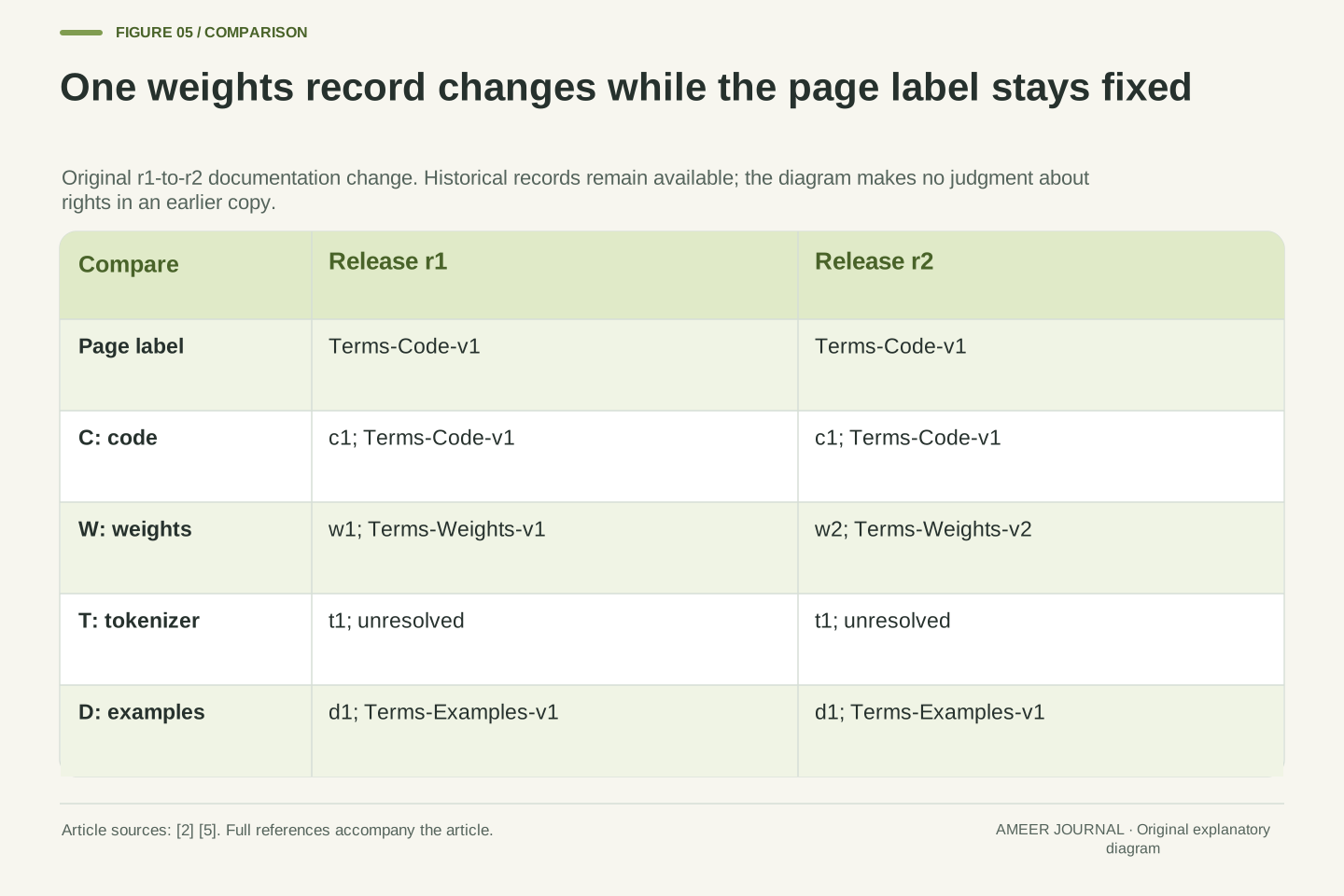
Our fictional release r2 keeps the same page label as r1. Only W changes: its artifact revision becomes w2 and its scope reference becomes Terms-Weights-v2. C, T and D keep their previous records. Looking only at the unchanged page label would miss the item that needs a new reading.
Keep the r1 record as well as r2. A later page edit does not, by itself, answer which terms applied to an earlier copy or what an earlier grant allowed. The point of retaining the documents is to make that question answerable from evidence, not to assume that every edit retroactively replaces everything. Hub model cards can also contain a new-version pointer, which is another reason to identify the actual release being described [2].
The unresolved T entry remains unresolved in both releases. It is neither an affirmative permission nor proof of a prohibition. State the gap precisely: the applicable scope document has not been located in this exercise. A clear unresolved entry gives the next reviewer a concrete question instead of hiding uncertainty behind an unchanged badge.
Version the artifact-to-terms mapping independently of the display label. In the original r1→r2 transition, only W changes, from artifact w1 and Terms-Weights-v1 to w2 and Terms-Weights-v2. The unchanged repository label therefore underdetermines the release’s relevant documentation state. The retained machine-readable example verifies this single-row change without evaluating either invented document.
Preserve historical evidence rather than overwriting it with a current URL. A document revision is an observed change; its legal effect on an earlier copy is a separate question. The Hub’s new_version field can direct readers onward to a newer model [2], but a navigation pointer does not establish which terms govern a previously obtained artifact.
Treat unresolved as an epistemic state: a required fact or document has not been established in the record. It must not silently collapse into permission granted, permission denied or evidence that no terms exist. Contradictory declarations likewise need both versions and their scope retained. An attractive single label cannot resolve an evidence conflict merely by being easier to display.
Build a record that another reader can follow
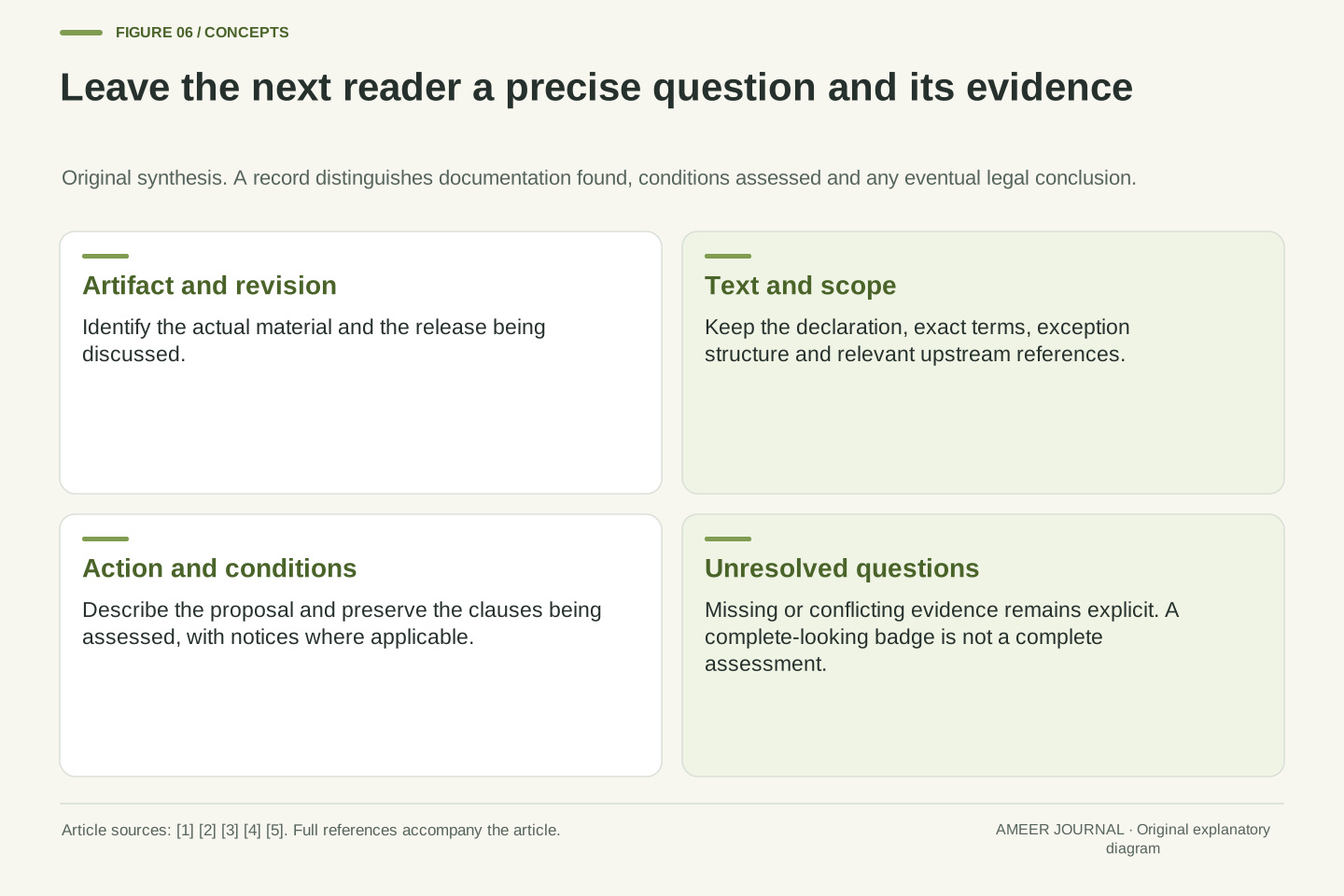
A useful record begins with the actual proposal and its components. For each relevant artifact, retain its source and revision, the statement identifying applicable terms, the exact terms or reference, any relevant upstream material, and the condition or question being assessed. Keep access evidence and attribution information in their appropriate places. These are practical reading steps drawn from the distinctions above, not a universal legal checklist.
For our fictional release, the honest result is modest but useful: three declared scope references, one unresolved item, two different expression structures, and one weights-document change between releases. None of those findings certifies permission to launch a product. They explain what is known and what a later assessment would need to examine.
For a real deployment or redistribution decision, unresolved applicability, conflicting terms or important legal questions belong with a qualified adviser who can examine the actual materials and intended use. The goal of this guide is to make that review clearer. A licence badge is a good starting pointer; a readable, versioned record gives the pointer somewhere concrete to lead.
Retain the operation, artifact inventory, exact revisions, applicability declarations, referenced texts, dependency relationships and unresolved questions. Preserve full SPDX expression structure where used, with the specification context appropriate to the record. Distinguish documentation found from conditions assessed and from any eventual legal conclusion. The cited Hub, SPDX and Apache documents support different parts of this framework [1][2][3][4][5].
Our original evidence exercise yields three explicit artifact mappings and one unresolved mapping. The two expression trees have different minimal term sets despite identical atomic names. Release r2 changes one weights row while preserving the display label. These are reproducible documentation and syntax results, not a rights audit, an SPDX conformance certification or a compatibility opinion.
A specific deployment needs assessment of its actual terms and circumstances; qualified legal advice may be necessary for material uncertainty. No general article can infer those missing facts from a repository tag. The contribution here is a precise handoff: another reader can locate each claim’s object, version, textual basis and remaining question without reconstructing the entire investigation from a single badge.
Sources & further reading
Explore the references behind this guide. External pages may change after our review.
- Licenses · Hugging FaceHugging Face · Accessed 7 Nov 2026
- Model Cards · Hugging FaceHugging Face · Accessed 7 Nov 2026
- Gated models · Hugging FaceHugging Face · Accessed 7 Nov 2026
- Annex D: SPDX license expressions - SPDX Specification v2.3.1SPDX Project / Linux Foundation · Accessed 7 Nov 2026
- Apache License, Version 2.0 | Apache Software FoundationApache Software Foundation · Accessed 7 Nov 2026
Article updated 7 Nov 2026.
Found something we should revisit?
Good explanations get better with thoughtful feedback.