What you’ll take away
- Active parameters describe the selected token path; total parameters describe the full model.
- An expert is a learned component inside the architecture, not automatically a separate subject-specialist chatbot.
- Routing, capacity, batching and device placement affect execution beyond the selected-expert count.
- Hypothetical parameter arithmetic is useful for checking boundaries, but it is not a speed benchmark.
What does an expert replace?
A model can use only a few experts for a token while still needing the weights of many experts available. That sounds contradictory until we separate two questions: which calculations happen now, and which learned numbers the model may need later? A sparse mixture-of-experts model, often shortened to MoE, makes those answers different. Its router chooses a small part of the expert bank for each token's processing. The other experts are not erased from the model when they are skipped for that particular operation. [1]
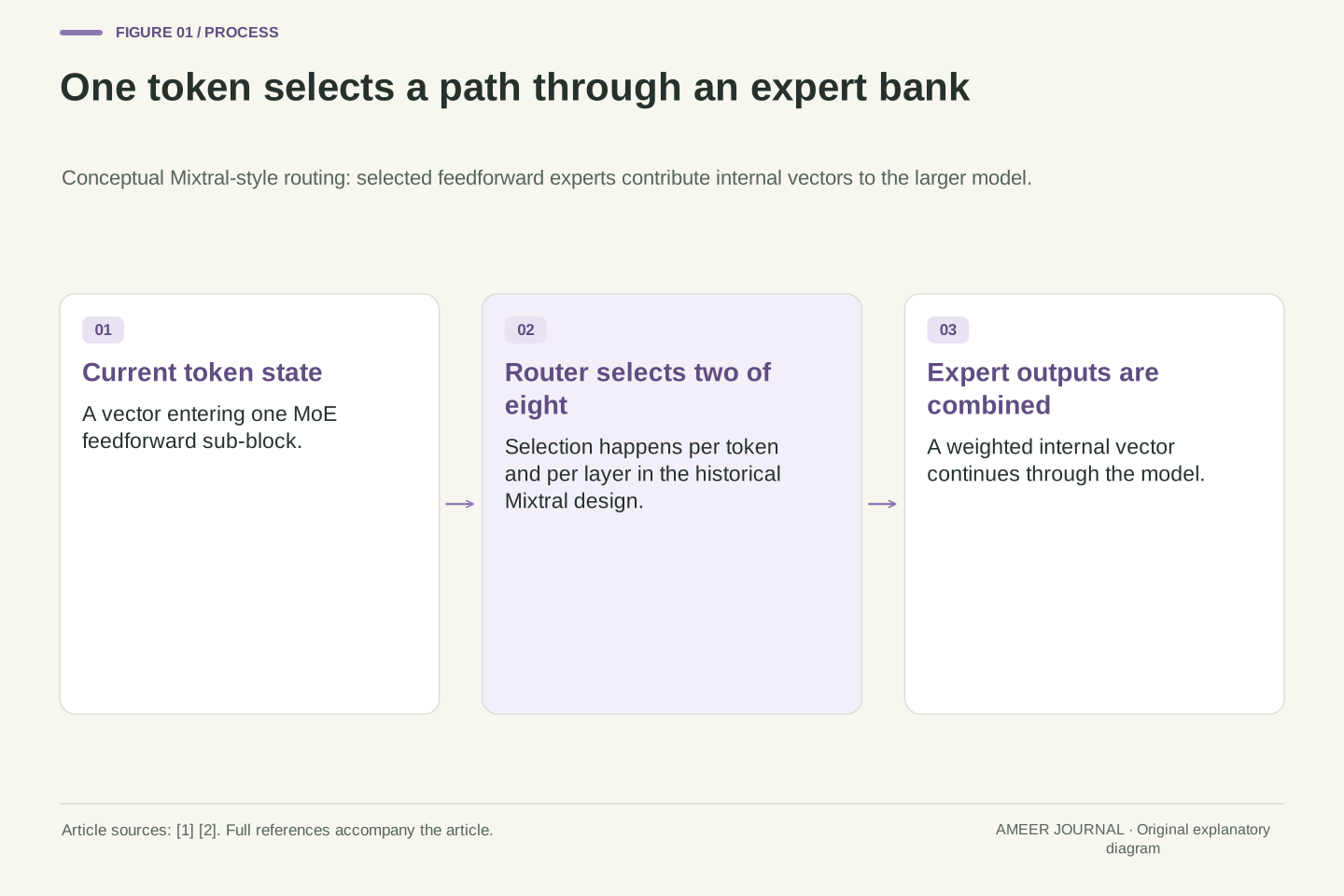
An expert is usually a small neural-network component inside a larger model, rather than an independent chatbot with its own complete answer. In the historical Mixtral 8x7B architecture, experts replace the feedforward part of each transformer layer. Attention and other shared components still do their jobs. The router selects two feedforward experts from eight for a token at that layer. Understanding this boundary matters: eight expert blocks do not mean eight complete copies of the same chatbot, and selecting two does not switch off every other kind of computation. [1][2]
Sparse mixture-of-experts architectures separate parameter capacity from the parameters activated for a particular input. In a token-choice MoE layer, a learned gate maps the current token representation to a subset of expert networks. The layer can therefore store many expert parameter sets while evaluating only a subset per token. This describes conditional execution, not a storage format that removes all unselected weights from the model definition. The distinction is essential when interpreting active-parameter numbers as a compute proxy rather than a complete inference-resource budget. [1]
Mixtral 8x7B provides a concrete historical example. Its January 2024 paper describes replacing transformer feedforward sub-blocks with eight expert feedforward networks, with two selected for each token at each layer. The experts use the SwiGLU feedforward architecture; the surrounding shared transformer computation remains. The paper also distinguishes this placement from designs that replace only some feedforward blocks. These architectural boundaries prevent two common counting errors: treating every expert as an entire language model, and assuming that expert sparsity makes attention, routing, normalization or other shared operations disappear. [1][2]
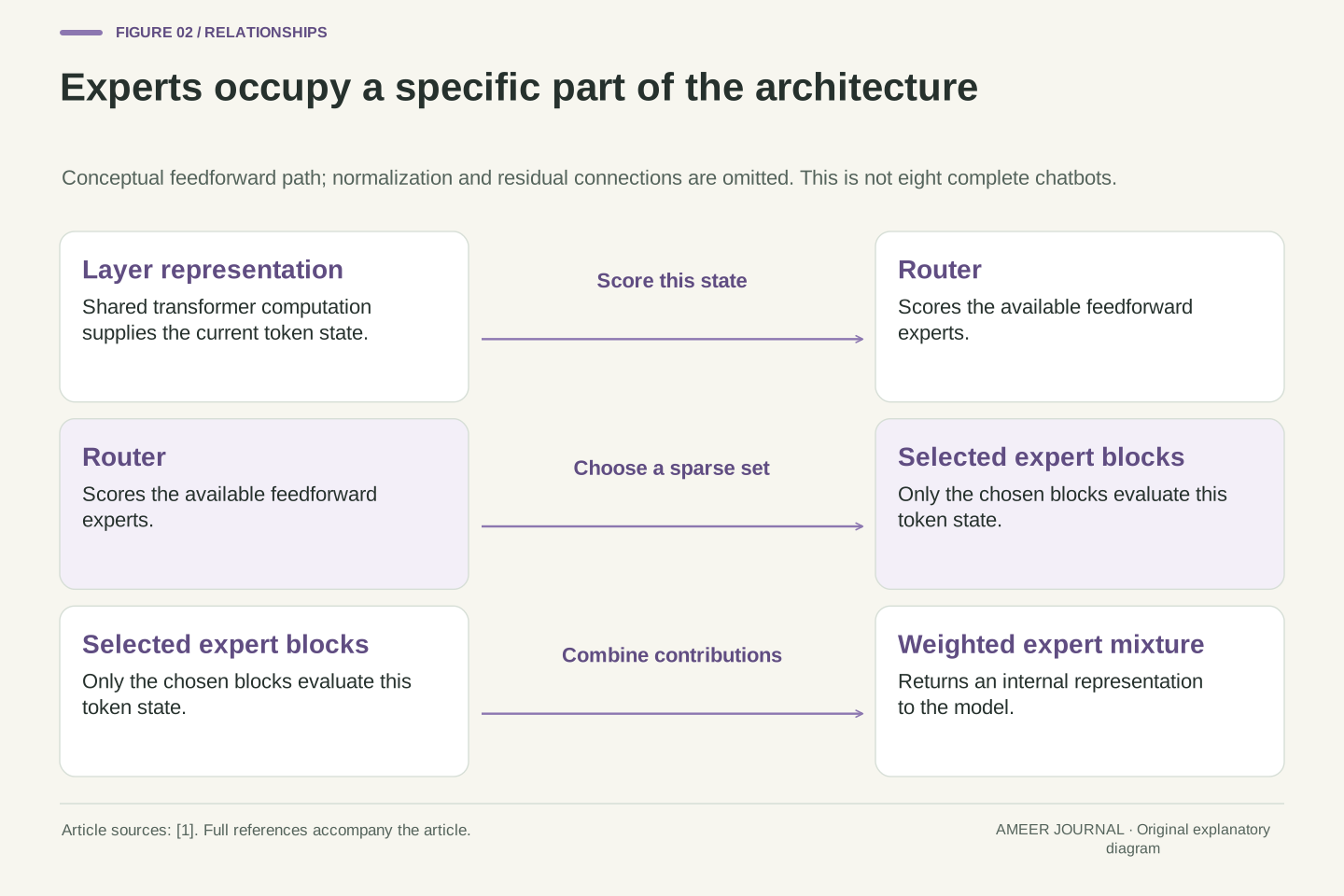
A router works on the token’s current state
The token entering a layer has a representation: a collection of numbers describing its current state after earlier processing. The router uses that state to assign scores to the available experts. A top-two rule means keeping the two highest-scoring choices for this operation. It does not mean reading the finished answers of all eight experts and then choosing the best two. The gate makes the selection that determines which expert calculations are performed. Different layers and different tokens can make different selections. [1]
This is why a simple picture of eight specialists permanently sharing a conversation can mislead. One token may go to experts A and C at one layer, then to B and F farther through the network. Another token can follow a different pattern. The names are identifiers for learned components, not job descriptions assigned by the person using the chatbot. The selection is an internal computation repeated through the model. A user normally sees the resulting generated text, not a separate reply from each expert involved in producing it. [1][2]
Let x denote the hidden-state vector entering a particular MoE feedforward sub-block. A router produces expert scores from x and constructs a sparse gating vector. In the Mixtral formulation, a linear projection produces logits, the top-k entries are retained, and the selected entries are normalized with softmax. Unselected entries contribute zero to the expert mixture. Thus evaluating the router does not require evaluating every expert network first; routing and expert evaluation are separate computations with different parameter sets. [1]
The routing decision is local to a token representation at a particular layer. It is not necessarily fixed for the whole sequence, nor must an expert index identify the same semantic behavior at every depth. A decoder's representations change as they pass through attention and feedforward computation, so the same token position can receive different assignments in different MoE layers. Across a batch, many or all expert networks can be exercised even though each individual token has sparse assignments. Per-token sparsity must therefore be distinguished from the set of weights touched by an entire scheduled batch. [1]
Walk one token through two experts
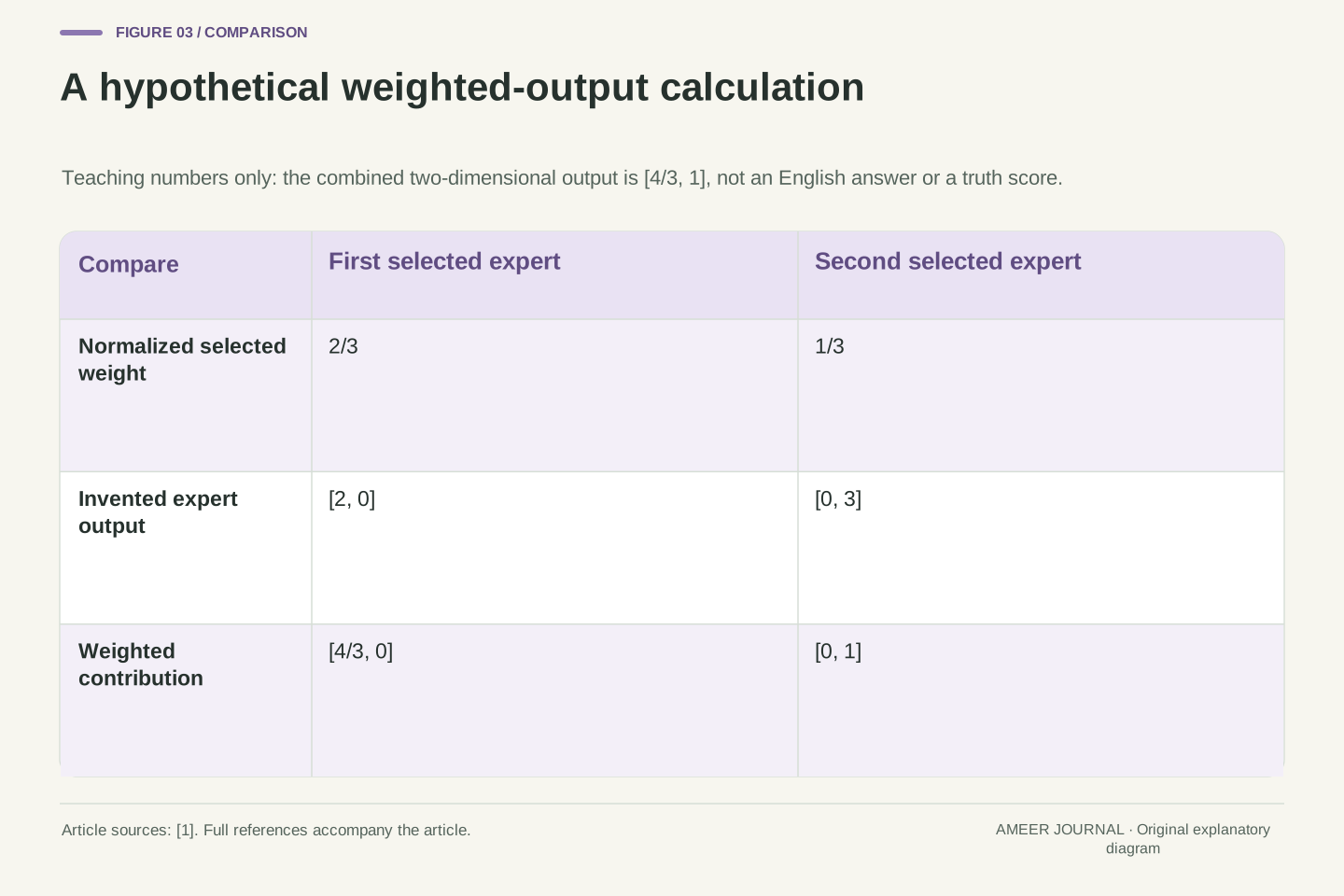
Consider a deliberately tiny, hypothetical example with three experts. Suppose the router gives them normalized scores of 0.6, 0.3 and 0.1, and the rule selects the highest two. After ignoring the third choice, the selected scores need to add to one: the first becomes 0.6 divided by 0.9, or two-thirds, and the second becomes one-third. These fractions describe how the selected expert outputs are combined. They are not probabilities that a final sentence is true, or scores from a fact-checking system. [1]
Now give the first selected expert an invented two-number output of [2, 0], and the second an output of [0, 3]. Weighting and adding them gives [4/3, 1]. Neither expert has written an English answer in this example; the combined numbers continue through the larger model. Real hidden-state vectors are much larger, but the small calculation exposes the key operation without hiding it behind a diagram. Its values are teaching assumptions, not measurements from Mixtral or evidence that a particular router will choose these experts. [1]
For an original numerical example, assume three router probabilities p = [0.6, 0.3, 0.1] and top-two selection. Renormalizing over the selected entries gives g = [2/3, 1/3, 0]. This illustrates the selected-logit softmax convention used in the Mixtral description: renormalizing already normalized probabilities over the selected set produces the same selected proportions. A different architecture may define gating or output scaling differently, so this calculation should not be treated as a universal MoE interface. All values here are hypothetical. [1]
Set E1(x) = [2, 0] and E2(x) = [0, 3]. The expert mixture is y = (2/3)E1(x) + (1/3)E2(x) = [4/3, 1]. This is the output of the illustrative expert sub-block, not a full transformer layer with every residual and normalization operation shown. The arithmetic also separates a router score from semantic confidence: a mixing coefficient weights a learned feature transformation. It does not estimate the probability that a factual claim is correct. The example intentionally uses vectors rather than complete answers to preserve that distinction. [1]
Count stored weights and active weights separately
Imagine another hypothetical system with eight equal expert components, each containing one million learned numbers, plus two million shared learned numbers. Its total is ten million: eight million in the experts and two million shared. If each token uses two experts, the simplified active count is four million: two million shared plus two million in the selected experts. Both numbers can be correct. One describes the complete collection of parameters; the other describes the part used along this simplified token path. [1]
The word simplified matters. We have deliberately ignored small routing details and other accounting complications so that the example can be checked on paper. At two bytes per parameter, ten million parameters occupy twenty million bytes of weight values, before other memory is counted. The four-million active figure does not turn the entire weight collection into eight million bytes. It identifies which part participates in this token's path. Changing the storage precision, distributing the weights or moving them between memory locations raises additional questions that this count alone cannot answer. [1]
Use a deliberately abstract parameter budget: P_shared = 2 million, E = 8 equal experts, P_expert = 1 million, and k = 2 selected experts. Then P_total = P_shared + E × P_expert = 10 million, while the simplified per-token active count is P_active = P_shared + k × P_expert = 4 million. Router parameters are omitted explicitly in this teaching budget. Neither number is a specification of an actual released model; the purpose is to make the counting boundary inspectable. [1]
With an assumed two-byte representation for every stored parameter, raw weight storage is 10 million × 2 = 20 million bytes. That is a decimal-byte calculation, not a claim about an allocator's resident memory or a device's usable capacity. The active fraction is 4/10 = 40 percent in this constructed system. It is a parameter-count ratio, not a measured latency ratio. Different operations have different execution and memory costs, and caches, temporary tensors and runtime overhead sit outside this raw-weight calculation. The Mixtral paper explicitly separates its active-parameter comparison from memory cost and hardware utilization. [1]
Why the other experts still belong to the model
A future token may need experts that the present token did not select. Keeping those possibilities available is part of serving the complete model. A system might hold the weights on one device, spread them across devices, or use another supported memory arrangement. None of those choices follows automatically from seeing a small active-parameter number. Before judging whether a model fits, establish where its full weights are stored and what the serving software actually keeps resident during the intended workload. [1]
The original Mixtral announcement reported 46.7 billion total parameters and 12.9 billion used per token. Its paper rounds those figures to roughly 47 billion and 13 billion when explaining the architecture. These are historical descriptions of that model, not the specifications of every sparse model available today. The useful lesson is the relationship between the two counts. A headline about thirteen billion active parameters cannot, by itself, establish a thirteen-billion-parameter total weight-storage requirement or guarantee the same speed as an unrelated dense model. [1][2]
Skipping an expert evaluation for one token does not eliminate that expert's trained parameters from the model being served. Expert parallelism can partition expert networks across devices, but then token representations must reach the selected experts and their outputs must return to the appropriate token locations. The Mixtral paper describes this distribution explicitly and notes the associated load-balancing challenges. The memory required on one device depends on the partition and runtime; the model-wide parameter total remains a different quantity from local residency. [1]
For the original Mixtral 8x7B release, Mistral reported 46.7B total parameters and 12.9B active parameters per token. The paper uses rounded 47B and 13B figures in its discussion. Its efficiency analysis specifically warns that active-parameter comparisons exclude memory costs and hardware utilization, and notes routing and memory-load overhead. Consequently, a deployment assessment should retain both exact model identity and counting conventions. The sparse name does not justify replacing measured memory requirements with active-weight bytes, or converting a reported active-parameter ratio into a hardware-independent speed prediction. [1][2]
Follow a batch, not just one token
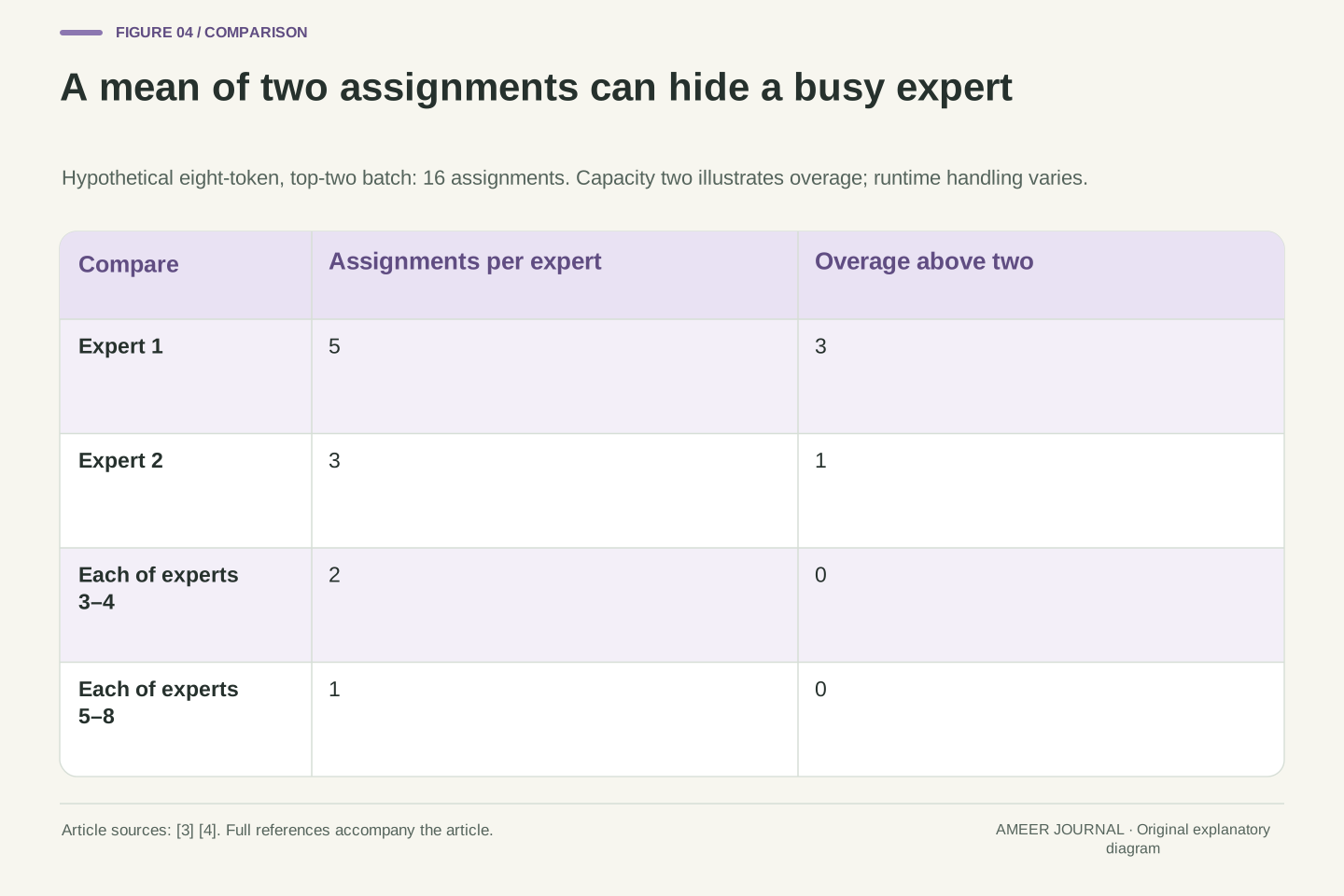
Suppose a hypothetical batch contains eight tokens and each receives two expert assignments. That creates sixteen assignments in total. They do not have to divide evenly. Imagine eight experts receiving 5, 3, 2, 2, 1, 1, 1 and 1 assignments. The sum is still sixteen, but the busiest expert receives five times as many as the least busy. An average of two assignments per expert hides that imbalance. Counting the average is useful; treating it as a description of every expert is not. [4]
If experts are placed on different devices, unequal work can leave one device busy while another finishes early. Moving token representations to their selected experts also takes work. The precise effect depends on the hardware, batch and implementation, but these mechanisms explain why a sparse model's speed cannot be read from its selected-expert count alone. Our sixteen-assignment example is only an illustration of uneven demand. It is not a routing trace from a real model and does not establish how any particular serving system schedules its tasks. [1][4]
A batch-level accounting example makes load imbalance explicit. Assume T = 8 token representations, k = 2 assignments each, and E = 8 experts. Total assignments are T × k = 16, so the arithmetic mean is two per expert. A hypothetical count vector [5, 3, 2, 2, 1, 1, 1, 1] satisfies that total while distributing work unevenly. The vector counts assignments, not unique tokens per entire network; each token contributes two assignments at this illustrative MoE layer. [4]
Expert parallel execution adds placement and communication to this distribution. The Mixtral description routes representations to devices hosting the selected experts and returns the expert results to their originating token locations. An overloaded expert or device can become a limiting stage even when the mean workload looks modest. Batch size and routing locality also affect how much useful matrix work can be grouped. These considerations explain why sparse arithmetic capacity, achieved device utilization and end-to-end latency are separate measurements. The toy histogram establishes the imbalance calculation only; it does not model a complete scheduling algorithm. [1][4]
Capacity is a routing-policy choice
A system may set a limit on how many token assignments an expert handles in a batch. Apply a purely hypothetical limit of two to the previous counts. The expert receiving five has three assignments above that limit; the expert receiving three has one above it. There are four over-limit assignments. That count does not tell us what happens next. Dropping expert work, changing routing or using a different scheduling design are implementation questions, not consequences that can be read from our arithmetic alone. [3][4]
The documented Switch implementation in Transformers version 4.49.0 uses top-one routing and an expert-capacity setting. Its documentation warns that there is no guarantee every token receives expert processing or every expert receives a token. Google Research's separate expert-choice method instead lets experts select tokens within a predetermined capacity, allowing different tokens to receive different numbers of experts. These examples show why two-selected-experts is not a definition of all MoE systems. Read the actual routing policy before interpreting what a capacity limit means. [3][4]
In the toy count vector, an assumed capacity C = 2 gives aggregate overage sum(max(n_i − C, 0)) = 3 + 1 = 4 assignments. This is a bookkeeping result under the stated assumption, not a claim that Mixtral drops four tokens or that all capacity-constrained implementations share the same overflow behavior. The relevant unit is an expert assignment; two overages could potentially concern different assignments of one token. A complete implementation specifies capacity grouping, selection, dispatch and the treatment of unserved assignments. [3][4]
The Transformers v4.49.0 Switch documentation describes a top-one router that dispatches according to router probabilities until expert capacity is reached, with no guarantee that each token is processed by an expert. Google Research's 2022 expert-choice work changes the direction of selection: experts with predetermined capacity select tokens, and a token can receive a variable number of experts. These are distinct designs. Combining Switch's top-one behavior, Mixtral's top-two rule and expert-choice capacity into one supposed universal algorithm would produce an architecture none of these sources actually describes. [3][4]
Training creates routes, not job titles
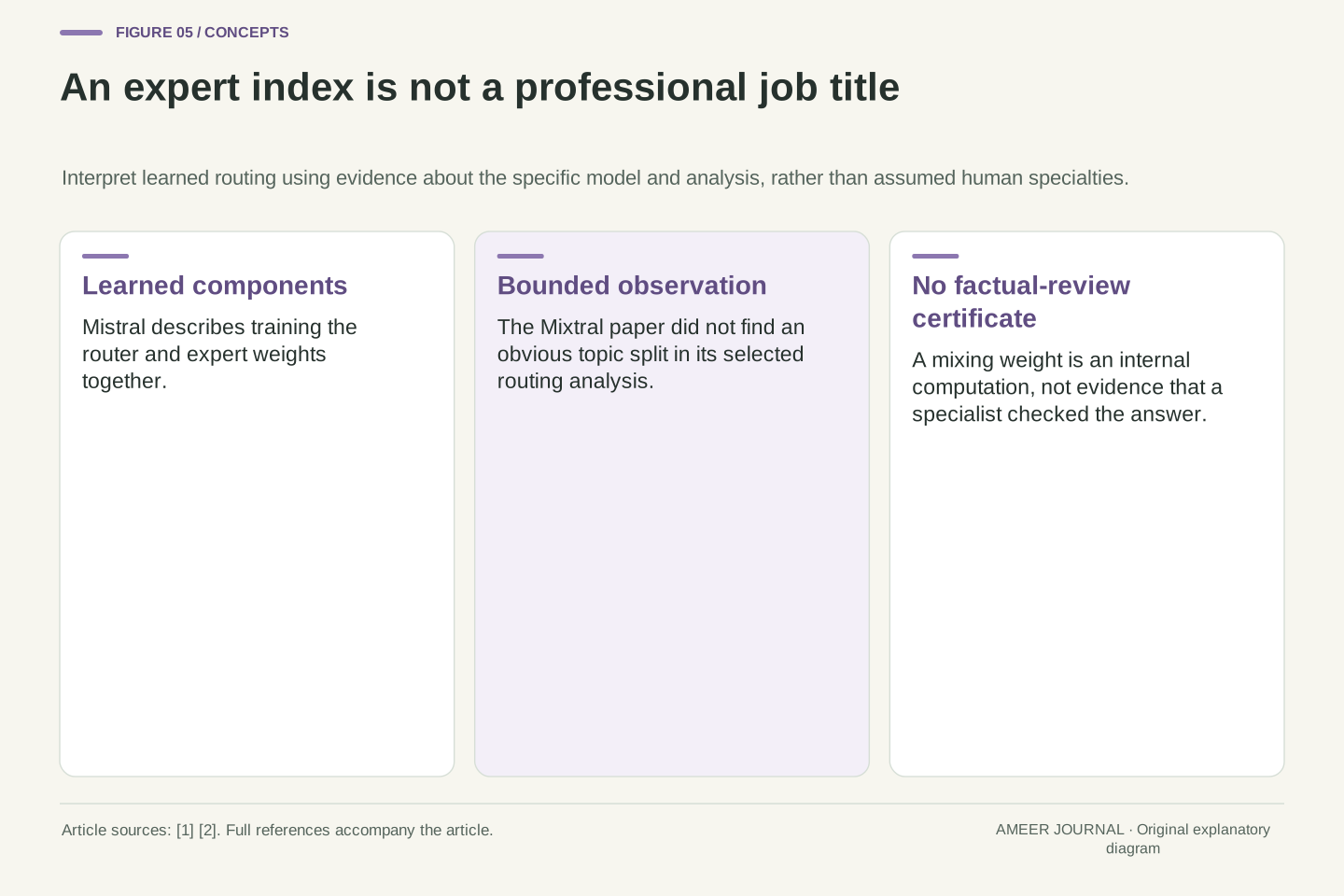
Calling a component an expert invites a human analogy: perhaps one knows chemistry and another knows grammar. The architecture alone does not establish those labels. Mistral's original announcement says the experts and routers were trained together. Their roles arise through learning, rather than a user assigning one expert to each school subject. A routing score is therefore not a certificate that a named specialist has checked a response. This matters whenever a product description suggests that more experts automatically mean more independent factual reviewers. [2]
The Mixtral paper investigated whether expert assignments followed topics such as mathematics, biology and philosophy. In the particular datasets and layers it examined, the authors did not observe an obvious topic-based assignment pattern; they reported examples more aligned with syntax. That is a bounded observation about one model and analysis. It does not prove that specialization never occurs in MoE systems. It does show why a diagram with fixed labels like doctor, lawyer and engineer needs evidence beyond the word expert in the architecture's name. [1]
An expert index identifies a learned feedforward parameter set. It does not, by itself, specify a human-interpretable domain or an independently trained specialist with verified credentials. Mistral's release description states that experts and routers were trained simultaneously. Routing behavior should therefore be investigated empirically rather than inferred from anthropomorphic labels. In particular, a weighted feature mixture does not implement independent factual verification merely because several parameter sets contribute to the output. The router's learned affinity is a computational signal, not an epistemic assurance. [1][2]
Section 5 of the Mixtral paper analyzes expert selection across selected Pile validation subsets and layers. The authors report no obvious topic-based assignment pattern for their compared domains, while examples suggest syntactic structure, especially near initial and final layers. Retain the scope: this is one reported analysis of a historical model, not a theorem about all expert specialization. The practical documentation rule is to name a component by its architectural role unless a specific experiment supports a stronger interpretation, and to preserve that experiment's dataset and layer boundaries when describing the finding. [1]
Find the actual performance bottleneck
A sparse design can reduce the expert calculations performed for a token while still facing slow memory transfers, uneven work or routing overhead. The Mixtral paper discusses these costs alongside its active-parameter comparisons. That gives a practical way to read a performance claim: first ask what was measured. Time until the first response appears, time between later output tokens and total completed work across many requests are different observations. A result for one workload does not automatically answer the others. [1]
For your own comparison, write down the exact model, serving software, hardware, input lengths and number of simultaneous requests. Separate an observed measurement from a calculation based on parameter counts. If the weights fit but performance is poor, the next useful question may concern batching or data movement rather than adding more expert names to a diagram. Conversely, a fast small experiment does not establish behavior for a much longer or busier workload. These are measurement-planning questions; this article has not benchmarked a deployment or recommended a particular device. [1]
Active parameters are an informative architectural quantity, but achieved performance also depends on routing overhead, memory access, communication, batching and hardware utilization. The Mixtral paper explicitly excludes memory and utilization from its simple active-parameter efficiency comparison, and discusses specialized sparse kernels and expert parallelism as execution strategies. A parameter count should therefore remain one field in a benchmark description rather than replacing the benchmark. An implementation can preserve the same mathematical routing rule while changing the cost of dispatch and expert evaluation substantially. [1]
A useful evaluation separates latency and throughput observables and controls the workload. Record prompt and generated lengths, concurrency or batch policy, model and runtime versions, numerical representation and device arrangement. Then inspect the measured stage that limits the desired outcome. The hypothetical 40-percent active-parameter fraction above cannot predict 40-percent latency, and the sixteen-assignment histogram cannot predict a token rate without an execution model. These examples are analytical teaching tools. No runtime measurements were performed for this article, and no historical paper result is being presented as a current hardware guarantee. [1]
Read a sparse-model specification in the right order
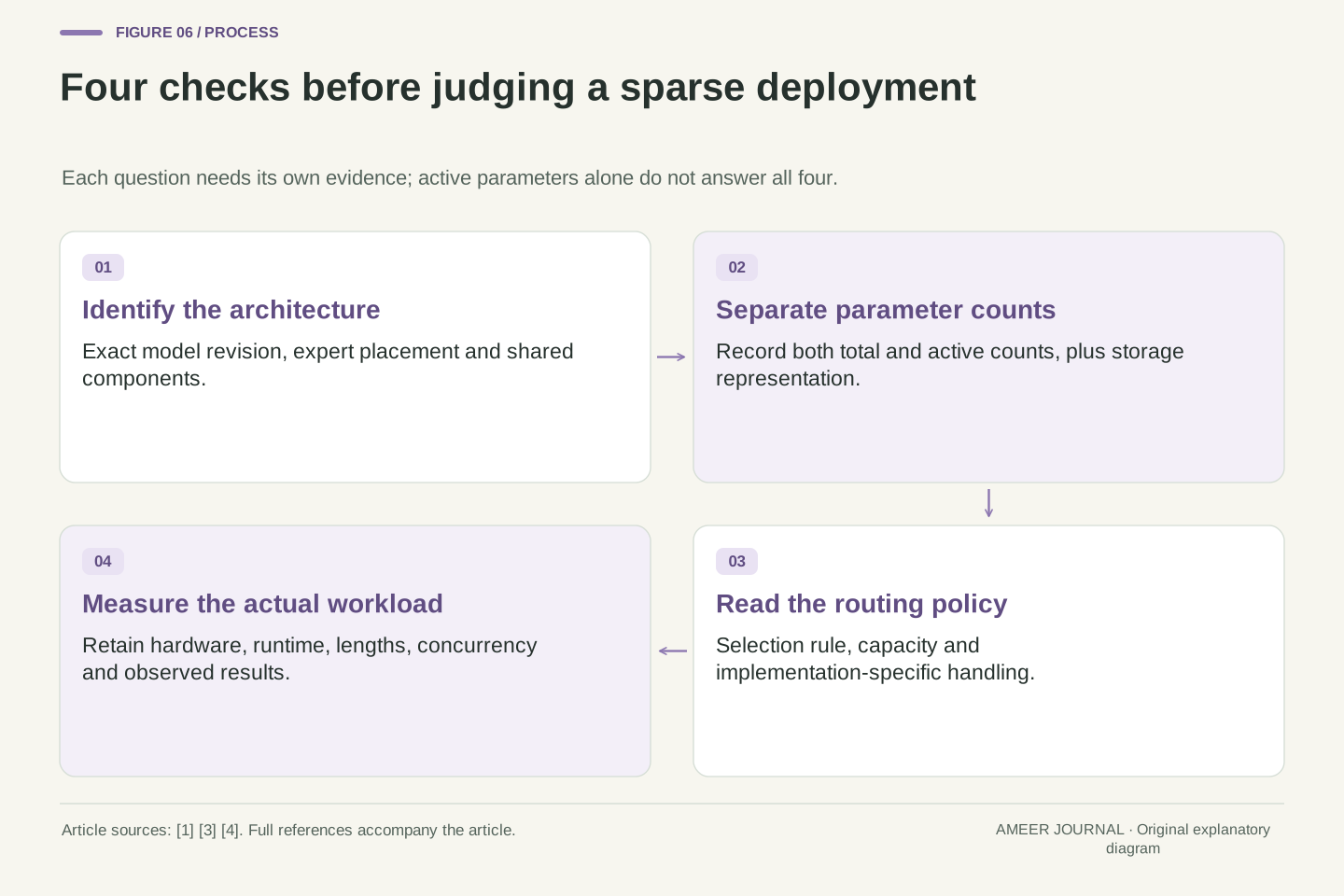
Start with the exact model and the parts of its architecture that use experts. Then record the total parameter count and the active count, keeping the two labels separate. Next, ask how routing works: which representation is scored, how many experts can be chosen, and whether any capacity or overflow policy matters. Finally, look for the actual deployment arrangement and measurements for the workload you care about. This sequence turns an attractive model label into questions that documentation and evidence can answer. [1][3][4]
You can test your understanding with the toy model. Ten million parameters are stored, four million participate along the simplified token path, and a batch can still touch all eight experts. Two experts are chosen for each toy token, yet their combined outputs remain internal numbers rather than two finished replies. If a specification leaves the storage boundary, routing rule or measurement conditions unclear, keep that part unresolved. The useful outcome is a clear account of what the sparse model is doing and what additional evidence is needed to judge the proposed deployment. [1]
A concise specification review should retain four independent records. First is architectural identity: model revision, expert placement and shared components. Second is parameter accounting: total, active and the precision or representation used for storage. Third is routing behavior: token choice or expert choice, selected-expert count, capacity grouping and applicable overflow handling. Fourth is execution evidence: device placement, communication arrangement, workload and measured performance. The cited Mixtral, Switch and expert-choice sources illustrate why these records cannot be inferred from one another. [1][3][4]
For the hypothetical system, verify P_total = 10 million, P_active = 4 million and sixteen assignments for an eight-token, top-two batch. Verify separately that [2, 0] weighted by two-thirds plus [0, 3] weighted by one-third gives [4/3, 1]. None of these checks proves factual accuracy of generated text or predicts end-to-end latency. They establish that the explanation's own quantities are consistent. A sound sparse-model assessment preserves that distinction between an internally valid calculation, a documented architectural mechanism and a measurement that still needs to be made. [1]
Sources & further reading
Explore the references behind this guide. External pages may change after our review.
- Mixtral of ExpertsMistral AI research authors · Accessed 6 Nov 2026
- Mixtral of experts | Mistral AIMistral AI · Accessed 6 Nov 2026
- SwitchTransformers · Hugging FaceHugging Face · Accessed 6 Nov 2026
- Mixture-of-Experts with Expert Choice RoutingGoogle Research · Accessed 6 Nov 2026
Article updated 6 Nov 2026.
Found something we should revisit?
Good explanations get better with thoughtful feedback.