What you’ll take away
- Speaking pace, audio sampling rate and generation time measure different parts of a speech system.
- Check the intended spoken words and compatible text representation before comparing timing.
- Audio duration is sample-frame count divided by sample rate; simultaneous channels add values, not time.
- A fixed pause, a speech-only rate change and a new waveform clock produce different duration calculations.
- Record conversion and timing boundaries separately from evidence about pronunciation or listening quality.
A fast generator can produce a slow-speaking voice
When someone says a text-to-speech system is fast, ask what they timed. They might mean that its voice speaks quickly, that the audio contains many samples per second, or that the computer finishes generating a clip quickly. Those are three different measurements. A system could produce a leisurely three-second announcement in less than one second without making the announcement itself shorter.
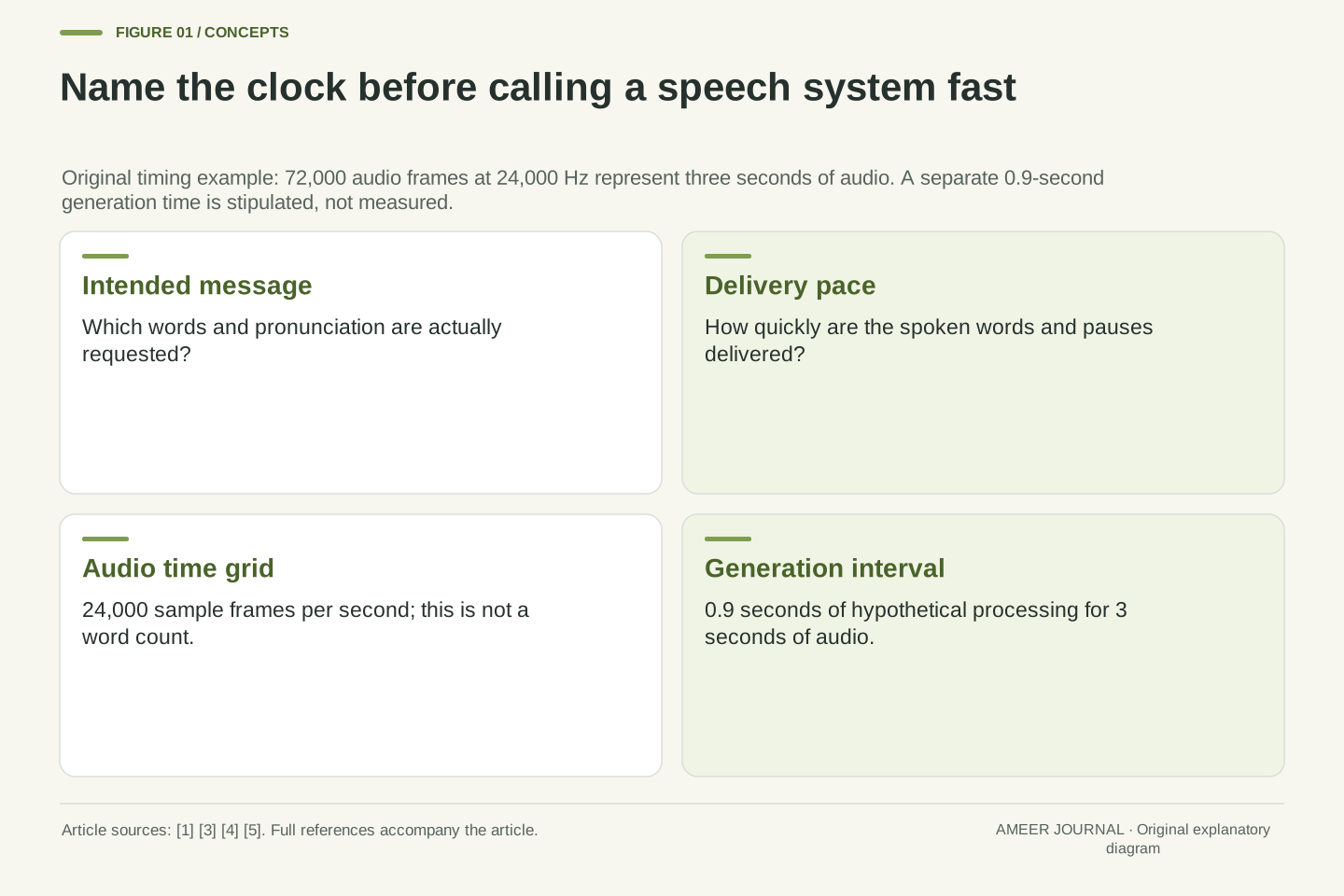
We will use an original numerical example: a hypothetical clip contains 72,000 audio sample frames at 24,000 frames per second. Its ordinary playback duration is three seconds. We separately stipulate that generating it takes 0.9 seconds. Neither number tells us how clearly its words were pronounced. These are chosen counts and timings for calculation; no speech model, audio file or listening test was run.
The underlying distinction is straightforward. Audio-buffer documentation separates sample-frame length, sample rate and duration. [3][4][5] Speech markup separately describes speaking-rate and pause controls. [1] Keeping those quantities apart helps when comparing voices, diagnosing a clip that plays too quickly, or interpreting a performance chart. Before changing a setting labelled speed, identify whether it changes the language delivery, the waveform's time scale or the time you wait for a result.
Distinguish linguistic delivery rate, audio sampling rate and synthesis execution time. For the original construction, let N=72,000 sample frames, f_s=24,000 Hz and t_gen=0.9 s. The audio duration is T=N/f_s=3 s, while the stipulated generation-to-audio-duration ratio is 0.3. These quantities have different denominators and are not interchangeable measures of model performance or intelligibility.
MDN defines AudioBuffer length in sample frames, sampleRate in samples per second and duration in seconds [3][4][5]. SSML treats speaking rate and pauses as aspects of speech production [1]. The first set describes a waveform's time coordinate; the second concerns how speech is delivered. A computational measurement adds yet another boundary: which work and waiting periods were included in t_gen.
All counts and timings here are constructed, with no waveform generation, model inference, audio playback or empirical benchmark. The purpose is to make units and assumptions explicit enough to reproduce the arithmetic. A low execution time does not establish a high speaking pace, and a high sample rate does not establish either. The useful comparison retains the text and delivery conditions while reporting the actual output duration and the separately defined execution interval.
Decide what the written text is supposed to say
Before timing a voice, check the words it is being asked to produce. A gate announcement written as “Gate 12.” could be intended as “gate twelve” or, in a different naming convention, “gate one two”. The printed characters alone do not settle that choice. The speech-synthesis standard describes text normalization as the conversion from written forms into the forms to be spoken. [1]
An original small example makes the risk visible. The pinned TorchAudio tutorial demonstrates a simple character filter whose symbol table contains letters and selected punctuation, but no digits. [2] Applying that stated rule locally to “Gate 12.” leaves “gate .”: six symbols including the space and full stop. Supplying the explicitly expanded text “gate twelve.” instead leaves twelve symbols. We calculated those strings; we did not synthesize either one.
This does not mean every speech system drops numbers. It means a particular low-level representation cannot be assumed to perform every earlier language-processing task. Preserve the intended spoken form when comparing results. A short clip that skipped a number has not simply become more efficient; it has failed a different requirement. Timing only makes sense after the requested content is defined well enough to check.
Text normalization and model-token encoding operate at different semantic levels. SSML describes converting written constructs into speakable forms before pronunciation and prosodic processing [1]. Our desired reading of the original string “Gate 12.” is explicitly chosen as “gate twelve.”; another application might deliberately choose a digit-by-digit reading.
The pinned TorchAudio 2.7.0 tutorial supplies a character-table example that lowercases input and retains only symbols present in its table [2]. Our independent local implementation of that rule yields “gate .” from the unexpanded input, with six retained symbols. The expanded string “gate twelve.” yields twelve. This is a deterministic encoding example, not execution of the TorchAudio processor, a pronunciation evaluation or a claim about every production frontend.
A character sequence's length therefore cannot be interpreted as a spoken-word count without its preprocessing context. Record the source text, any normalization or substitution, language assumptions and the actual model input representation. If the input loses required content before acoustic generation, changing sample rate will not reconstruct that missing meaning. The comparison must first establish whether the same intended message reached the synthesis stage, rather than attributing every output-length difference to the voice's speaking speed.
Text symbols, acoustic features and waveform samples are different representations
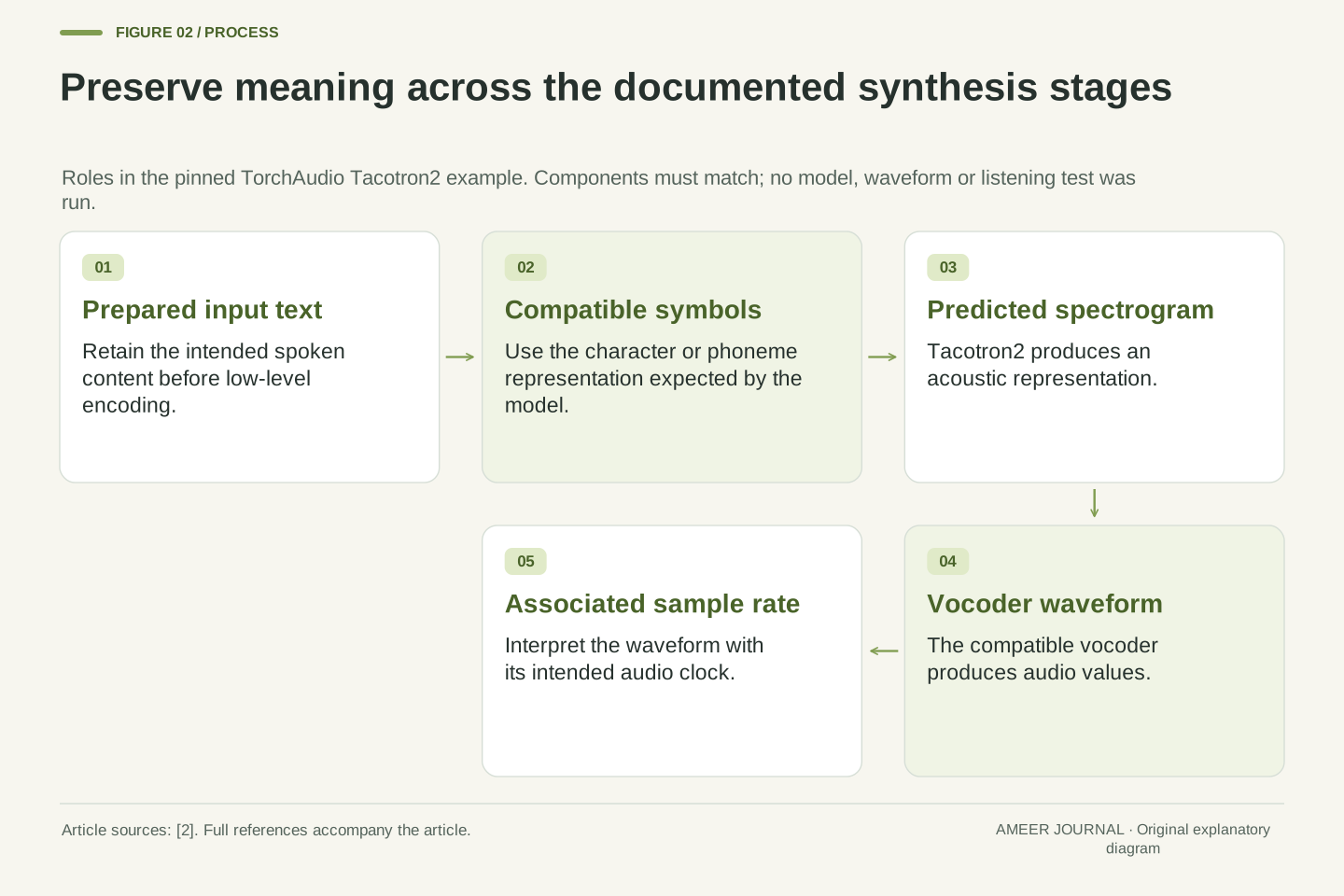
The TorchAudio example provides a useful concrete pipeline. It converts text into symbols, uses Tacotron2 to predict a spectrogram, and then uses a vocoder to produce a waveform. It offers character-based and phoneme-based input choices, with components that must match the model. [2] This is one documented architecture, not a claim that every current speech generator has exactly the same internal stages.
Those representations answer different questions. Text symbols describe the input sequence. A spectrogram represents changing sound-related information over time. The waveform supplies the audio values used for playback. A count of text symbols is therefore not a count of waveform samples, and a feature frame should not be silently treated as an audio sample frame.
Our twelve-symbol “gate twelve.” string does not imply a twelve-sample clip, or a fixed number of samples for each symbol. The model and its delivery choices determine an output that must then be interpreted with the correct audio format. The tutorial uses the vocoder's sampling rate when preparing audio for playback. [2] That is the relevant boundary to inspect when a waveform sounds unexpectedly fast or slow: keep the generated values together with the rate and representation they were intended to use.
The pinned tutorial's architecture is text processing → Tacotron2 spectrogram prediction → vocoder waveform synthesis [2]. Character and phoneme encodings use different symbol vocabularies, and the frontend must match the pretrained model. A vocoder is the waveform-producing stage in this example; no universal architecture or interchangeable-component claim follows from that description.
Keep the tensor meanings distinct. Encoded input length counts symbols. Acoustic-feature time steps belong to the intermediate representation. Waveform sample frames belong to the final audio time grid. Their counts are not equal by definition, and one cannot recover utterance duration from a bare text-token count without additional model and output information. The same caution applies to padding or batch dimensions that do not represent additional spoken content.
Our original twelve-symbol normalized input is only a representation check. It does not determine a fixed samples-per-symbol ratio or certify a pronunciation. The tutorial passes a vocoder-associated sample rate to its playback helper [2], preserving the correspondence between waveform and time scale. When comparing outputs, retain the actual frontend, model and vocoder configuration rather than substituting a convenient rate or assuming that compatible-looking arrays have the same temporal meaning.
Count sample frames with the clock that belongs to them
For the hypothetical 72,000-frame clip, a rate of 24,000 frames per second gives 72,000÷24,000=3 seconds. The rate says how many successive audio frames belong to each second. It does not say that the voice speaks 24,000 words or sounds per second. The buffer definitions provide the corresponding length, rate and duration quantities. [3][4][5]
There is a small endpoint detail worth keeping straight. If the first frame is placed at time zero, the last frame's timestamp is 71,999÷24,000 seconds, just under three seconds. The buffer still contains 72,000 frame intervals of audio duration under the usual count-over-rate convention. The span between the first and last sample positions is one interval shorter than that duration. These are different measurements of the same grid, not a contradiction.
When inspecting a clip, record the frame count and its declared sample rate together. A waveform array with no time scale is incomplete evidence about duration. Likewise, an audio player's displayed duration does not tell you whether the words are correct, whether pauses were intended or how long generation took. It answers a useful but narrower question about the amount of audio represented by those frames at that rate.
With N sample frames and sample rate f_s, use T=N/f_s for the represented buffer duration. Our stipulated N=72,000 and f_s=24,000 Hz give T=3 s. The documented AudioBuffer properties separate frame length, sampling rate and duration [3][4][5]; channel count is not a multiplier in this time calculation.
Under zero-based sampling positions, t_k=k/f_s for k=0,…,N−1. The final sample timestamp is 71,999/24,000≈2.9999583 s, whereas T=3 s. The difference is 1/24,000 s, one sample interval. A first-to-last position span and a count-based audio duration therefore require different endpoint conventions. This exact arithmetic is not a measurement of converter latency, filter delay or an actual speech endpoint.
Retain the waveform's valid frame length and associated sample rate before comparing durations. The array's scalar-element count may instead include channels or padding, and those must be identified separately. An output duration also says nothing by itself about linguistic completeness or synthesis latency. Our example fixes the audio grid so these questions can be separated: it establishes three seconds of represented audio, while leaving pronunciation, silence placement and generation performance to their own evidence.
Stereo adds simultaneous values, not another three seconds
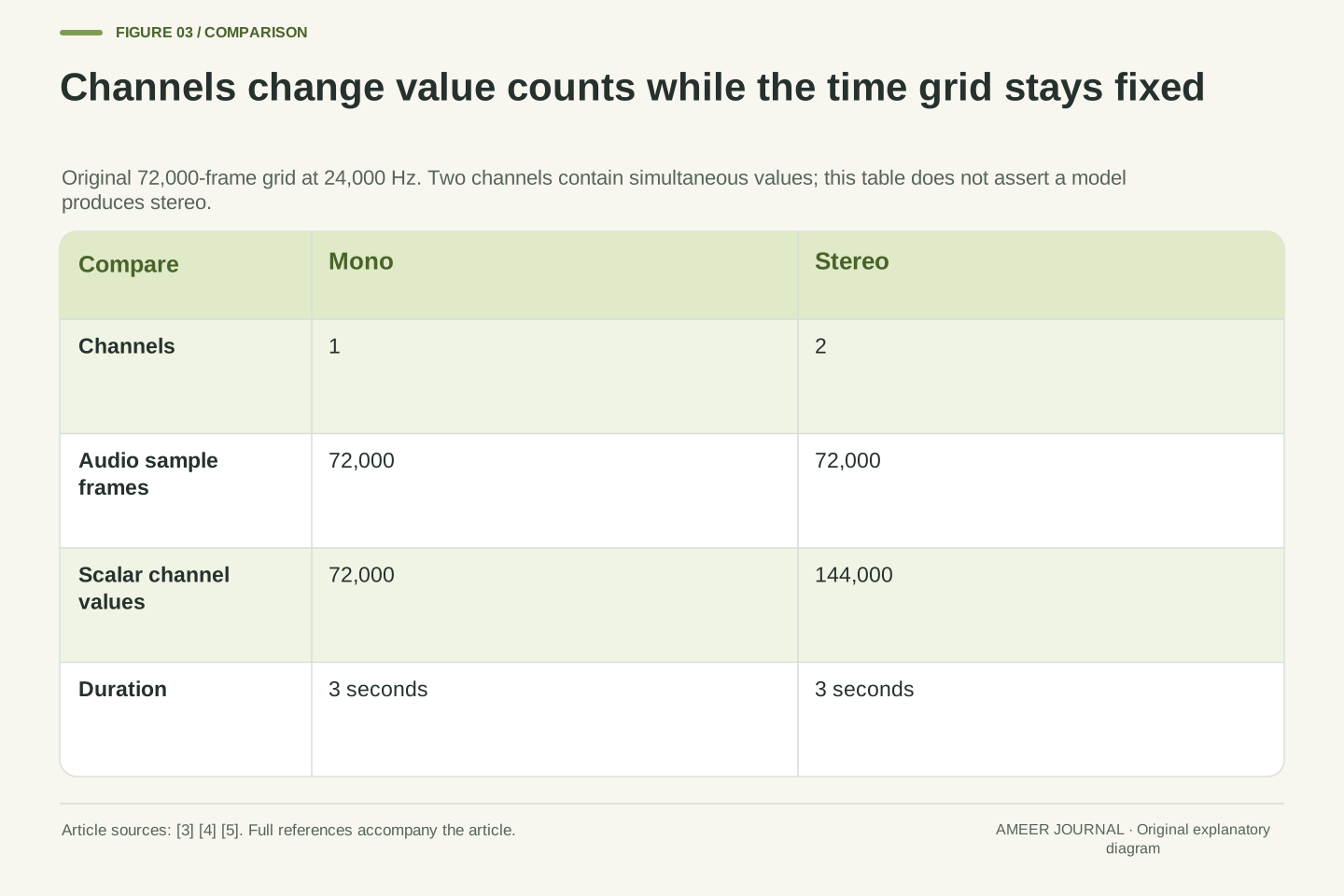
Imagine the same three-second grid with two audio channels. Each of the 72,000 sample frames now contains one value for the left channel and one for the right. There are 144,000 scalar values altogether, but the channels occupy the same three seconds. They are not two clips played one after the other.
This is why an audio-frame count and a flattened number list can produce different totals. MDN's length property counts sample frames, and its stereo-buffer example keeps the duration calculation independent of the number of channels. [4] If you mistakenly divide 144,000 channel values by 24,000 and call the result the stereo clip's duration, you get six seconds by counting each instant twice.
For our original construction, mono has 72,000 values and stereo has 144,000 values; both have 72,000 frames and a three-second duration. Whether the two channels contain identical content or different content is another question. The count alone does not establish spatial sound or better speech quality. Record channels, frame count and sample rate as separate fields, especially when moving between a model's array representation, an audio buffer and an encoded file.
Let C be the channel count. A buffer with N frames has N·C scalar channel values, but duration remains N/f_s. At N=72,000 and f_s=24,000 Hz, C=1 gives 72,000 scalars and C=2 gives 144,000 scalars, with T=3 s in both cases. Channels are simultaneous components of each audio frame.
The AudioBuffer length definition counts sample frames, and the accompanying two-channel example uses frameCount=sampleRate×duration without multiplying by channels [4]. Flattened storage cardinality therefore needs conversion back to frames before it can support a duration calculation. The erroneous expression 144,000/24,000=6 s uses scalar count where frame count is required.
This bookkeeping does not establish channel independence, spatial realism or signal quality. Two channels might be duplicates, differently processed signals or another defined arrangement; their meaning depends on the actual content. Preserve dimensional labels and valid lengths when inspecting model outputs or serialized samples. Our construction supplies only the simultaneous-channel counting convention. It does not imply that a particular text-to-speech model produces stereo output or that adding a channel doubles the amount of linguistic information in an utterance.
Changing speaking pace need not scale a fixed pause
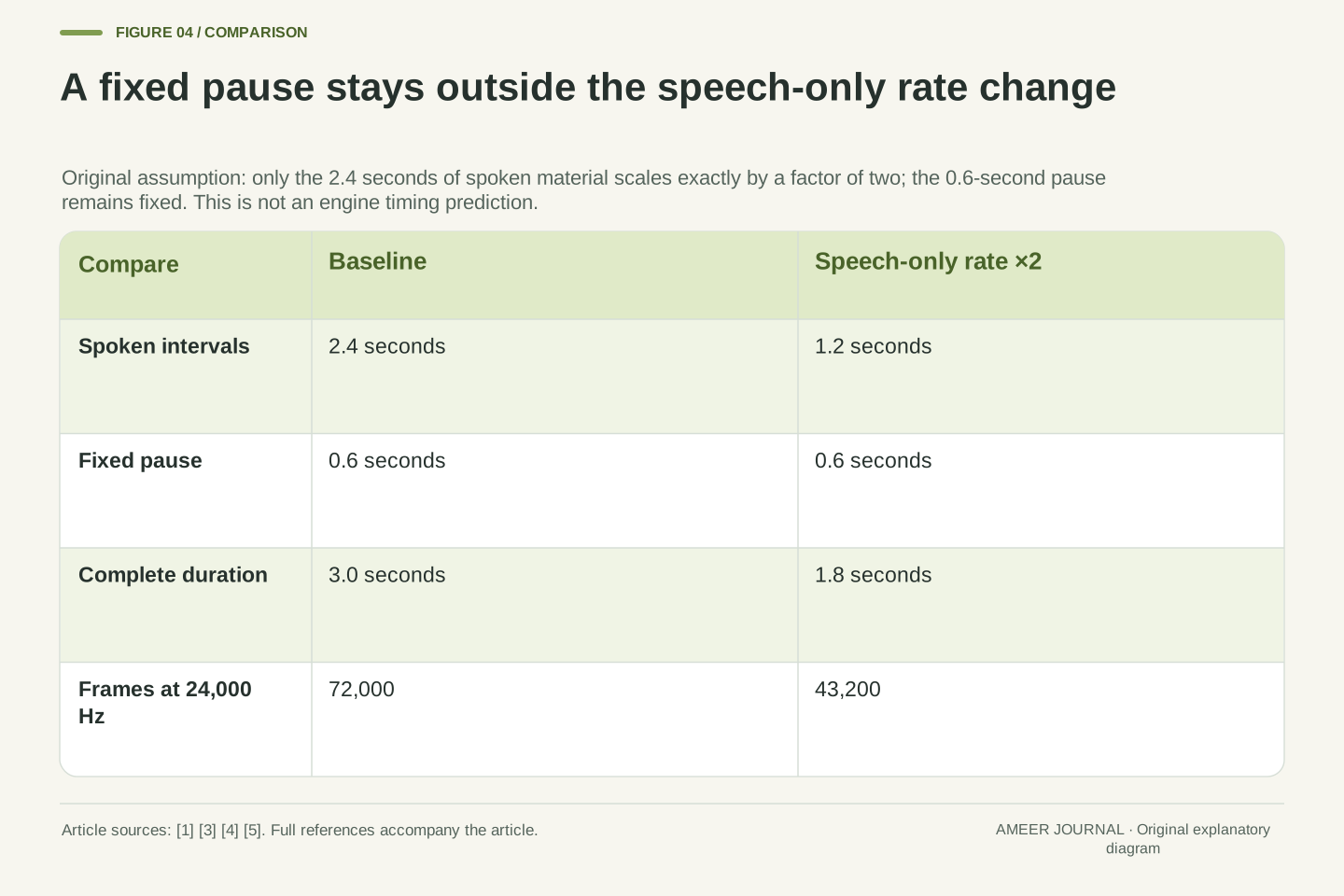
Divide our three-second hypothetical clip into 2.4 seconds of spoken material and a 0.6-second pause. Now stipulate a change that makes only the spoken portions twice as fast while leaving that pause unchanged. The speech takes 1.2 seconds, and the complete clip takes 1.2+0.6=1.8 seconds. Simply halving the original three seconds would incorrectly predict 1.5 seconds.
The example shows why the scope of a rate control matters. SSML distinguishes an explicit pause duration from a speaking-rate setting. [1] Our exact inverse scaling is an analytical assumption, not a claim that a particular engine will return precisely 1.8 seconds for some markup. A real processor may have additional linguistic boundaries or implementation-specific behavior that needs checking.
At the same 24,000 Hz output rate, 1.8 seconds would contain 43,200 sample frames. The clip became shorter because the stipulated speech timing changed; the sample rate stayed the same. If the purpose is a concise announcement, preserve required words and meaningful pauses while comparing timing. A duration reduction alone cannot tell you whether the resulting announcement is understandable or whether important content was omitted.
Construct T=S+P with speech duration S=12/5 s and an explicit fixed pause P=3/5 s. Under a stipulated speech-only rate multiplier r=2, define T′=S/r+P=6/5+3/5=9/5 s. Applying r to the whole duration would yield 3/2 s and incorrectly scale the fixed-pause component.
SSML provides a break time in seconds or milliseconds and a separate prosody rate attribute [1]. The numerical model here assumes exact inverse scaling of the selected speech intervals and no other timing change. It is not a normative claim about the result of a particular SSML document, engine or voice. The actual scope and interactions must be established for the implementation being evaluated.
Keeping f_s=24,000 Hz gives N′=T′f_s=43,200 frames. The timing change is represented by fewer frames at the same sampling rate, rather than by relabelling the old 72,000 frames. A useful report identifies which intervals were changed, which pauses were preserved and whether the intended words remained present. Our calculation verifies that a speech-rate adjustment and a global playback-speed adjustment need not describe the same transformation, even when their controls display similar numeric multipliers.
The same relative rate setting can refer to different voice baselines
A setting of 100 percent does not specify a universal number of words per minute. In SSML 1.1, a percentage rate multiplies the default rate of the chosen voice, and that default depends on the voice and its language context. [1] A comparison must therefore identify the voice and the actual resulting duration, not just the number shown in a rate control.
Use another invented timing case. The sentence “Please wait by gate twelve until boarding begins.” contains eight space-separated words under our counting rule. If a complete reading takes three seconds, its whole-clip pace is eight÷three×60=160 words per minute. If another takes four seconds, the corresponding value is 120 words per minute. Both could be represented at 24,000 Hz; the frame counts would be 72,000 and 96,000 respectively.
These timings are stipulated, not outputs from two tested voices. We also include pauses in the elapsed duration, so this measure should not be confused with a speech-only articulation rate. The calculation demonstrates what must stay visible in a comparison: text, word-count convention, included silence, voice settings and actual duration. Equal relative controls do not by themselves establish equal delivery, and a higher words-per-minute result does not establish better comprehension.
SSML 1.1 defines percentage rate as a multiplier of a voice-specific default, with 100% as unchanged and 200% as twice that default rate [1]. This establishes parameter meaning, not a universal absolute pace or a guarantee that every processor produces identical timing. Preserve the voice and language context alongside the markup.
For an original whole-utterance measure, define W as the number of space-separated words in “Please wait by gate twelve until boarding begins.” Here W=8. At T=3 s, define P=60 W/T=160 words/min; at T=4 s, P=120 words/min. With f_s=24,000 Hz, those durations correspond to 72,000 and 96,000 frames. Sampling rate is unchanged while the stipulated delivery duration differs.
This count includes the complete elapsed clip, including any pauses, and is not a speech-only articulation-rate estimate. No actual voice was generated or compared. The example shows why normalized text, counting convention, silence treatment and measured output length belong in a pace report. A relative control value describes a requested adjustment, whereas the resulting waveform supports an observed duration calculation. Neither quantity alone supplies evidence of pronunciation accuracy, naturalness or listener understanding.
Resampling the waveform and changing its declared clock are different operations
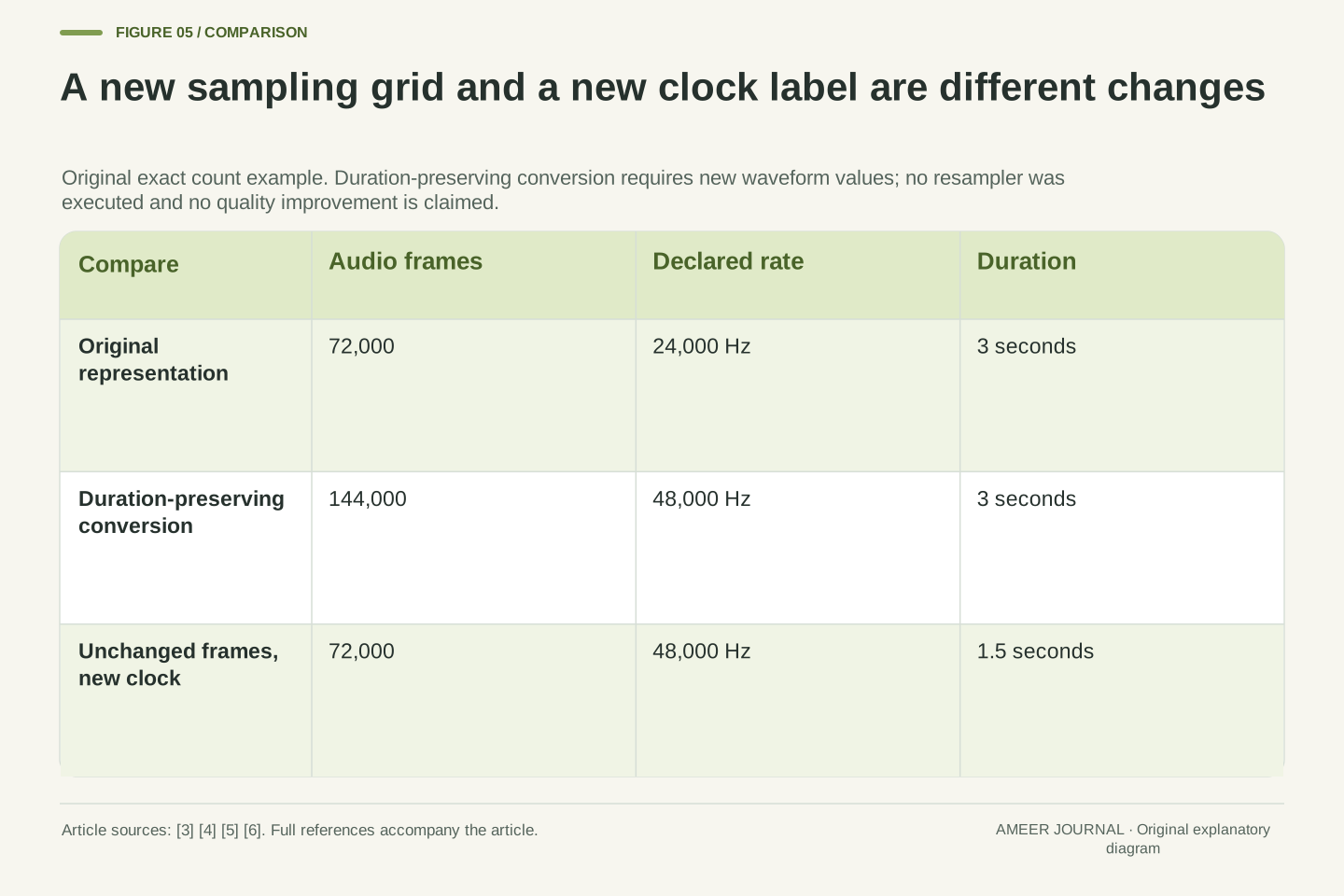
Suppose our three-second clip must be represented at 48,000 Hz instead of 24,000 Hz. Keeping the duration at three seconds requires 144,000 sample frames. A real resampler computes waveform values for the new time grid; the pinned TorchAudio guide describes an interpolation-based process and the filtering choices involved. [6] Doubling the number of samples does not mean the announcement must take twice as long.
Now consider a different action: leave the original 72,000 frames unchanged, but interpret them at 48,000 Hz. Their duration becomes 72,000÷48,000=1.5 seconds. The time scale has changed. For a simple constructed periodic pattern with one cycle every 240 frames, the represented frequency would change from 100 Hz to 200 Hz under that new clock. This is arithmetic about timing, not an audio experiment or a pitch-preserving speech adjustment.
The distinction helps explain a common format mismatch. A rate field must describe the waveform values actually supplied. It cannot substitute for a conversion of those values onto another sampling grid. Conversely, converting to a higher sample rate does not reconstruct missing speech content or prove better audio quality. Keep the original rate, conversion method and resulting frame count together when checking a changed file or buffer.
A duration-preserving change from f_s=24,000 Hz to f′_s=48,000 Hz requires N′=Tf′_s=144,000 frames for our exact three-second construction. The pinned resampling guide describes computing values on the new grid through bandlimited interpolation, with finite-filter tradeoffs [6]. No actual resampling function was executed here, and no sample-by-sample equivalence or quality improvement is claimed.
Reinterpreting the unchanged N=72,000 frames at 48,000 Hz instead gives T′=1.5 s. For a stipulated discrete periodicity of 240 frames/cycle, f=f_s/240 changes from 100 Hz to 200 Hz. This follows directly from changing the clock attached to the same index sequence. It is not the same transformation as duration-preserving resampling or a separate pitch-preserving time-stretch algorithm.
The source also discusses aliasing and the influence of filter settings [6], so a higher destination rate should not be treated as proof of recovered information. Our exact count example addresses time-grid interpretation only. A meaningful conversion record includes source rate, destination rate, valid input and output lengths and the method used. If those are missing, a shorter playback duration cannot by itself distinguish a deliberate pace change from an incorrectly interpreted waveform.
The byte count needs channels and representation as well as duration
Our three-second mono example has 72,000 sample values. If we stipulate uncompressed 16-bit PCM storage, each value occupies two bytes, giving 144,000 bytes of sample payload. With two channels on the same time grid, that becomes 288,000 bytes. Neither calculation includes a file header, compression or extra container information.
Choose a different hypothetical representation: four bytes per value, as in a 32-bit floating-point sample array. Mono then uses 288,000 bytes of raw values, and stereo uses 576,000 bytes. Notice that mono at four bytes per value and stereo at two bytes per value have the same 288,000-byte total. Equal byte totals do not establish equal channel arrangements or identical representations.
These are explicit storage assumptions, not claims about the output format of the documented Tacotron2 pipeline or the size of a downloaded speech file. Duration remains the frame-count-over-rate calculation. [3][4][5] To interpret a storage or transfer number, add the channel count, sample representation and any encoding/container details. A file becoming larger may reflect those choices rather than more spoken words, a slower voice or a better synthesis result.
For an uncompressed scalar payload, define B=N·C·b, where N is audio frames, C is channels and b is bytes per channel value. With N=72,000, C=1 and a stipulated 16-bit PCM representation b=2, B=144,000 bytes. At C=2, B=288,000 bytes. The corresponding frame duration remains 3 s at 24,000 Hz [3][4][5].
Under a separate 32-bit floating-point representation, b=4 gives 288,000 bytes for mono and 576,000 bytes for stereo. Thus two distinct configurations—mono float32 and stereo PCM16—share the same raw byte count. This is a dimensional accounting result, not an assertion that their precision, content or perceived quality is equivalent.
The formula excludes headers, metadata, compression, alignment and object overhead. It also makes no claim about a model's native output dtype, a browser's complete memory footprint or a particular audio container. Preserve those representation boundaries when comparing file sizes or throughput. Sampling rate, channel count and byte width jointly determine this raw payload, while linguistic content and synthesis quality require different evidence. An equal byte count cannot recover a missing format description.
Measure waiting time without confusing it with playback time
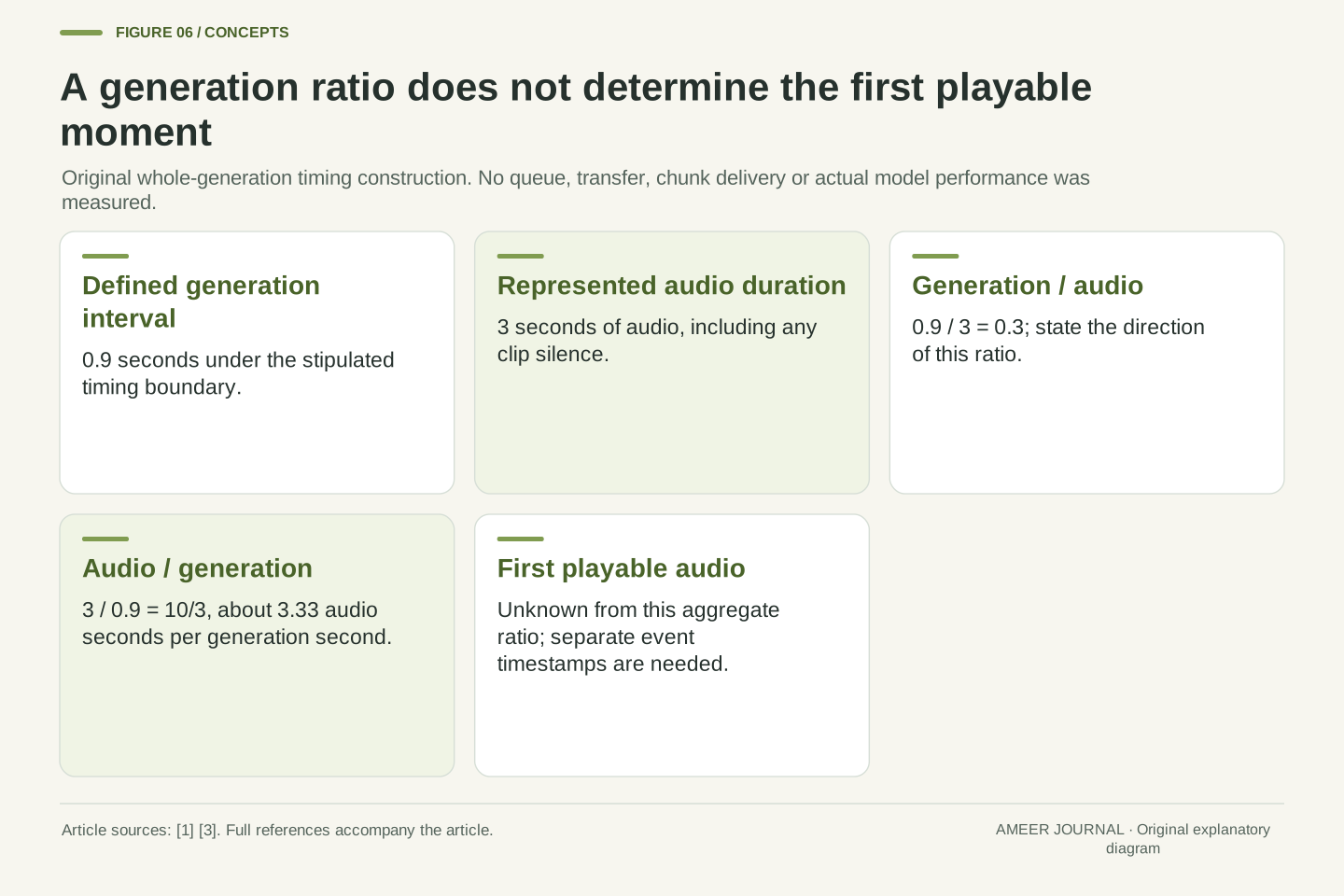
Return to the invented 0.9-second generation time for three seconds of audio. Define a ratio as generation time divided by audio duration: 0.9÷3=0.3. Its reciprocal is about 3.33 seconds of audio per second of generation time. Write the direction of the ratio beside the number so a reader knows whether a smaller or larger value represents less processing time for the same output duration.
That calculation does not reveal when the first playable sound becomes available. A system that returns a complete clip and one that supplies chunks can have different delivery behavior. Our single whole-generation number supplies no chunk timestamps, queue duration, transfer time or playback-start measurement. Those must be recorded if they are part of the user's waiting experience.
Keep the comparison tied to the same requested content and output conditions. A system that skips words could produce a shorter clip quickly, while a system that includes a long deliberate pause changes the duration used in the denominator. Neither case should silently become a model-speed claim. The speech standard makes no conformance guarantee about synthesis speed or accuracy. [1] An actual performance result needs an actual timed procedure with clearly stated boundaries.
Define the original timing ratio R=t_gen/T rather than relying on an unexplained label. With t_gen=9/10 s and T=3 s, R=3/10. The reciprocal T/t_gen=10/3 measures represented audio seconds per generation second under the same stipulated boundary. No hardware, model or service was benchmarked.
An aggregate generation interval does not determine first-audio latency or streaming behavior. Those require event timestamps identifying request admission, processing, first usable output, later chunks and playback as appropriate to the actual system. Our calculation includes none of the unmodelled queue or transfer intervals. A value below one for this ratio is therefore not a complete claim about an interactive application's responsiveness.
Control the denominator as carefully as the execution timer. Different spoken content, dropped words or added silence can change T without a comparable change in useful work. Record valid output length and its sample rate together with the exact requested text and delivery settings. SSML conformance does not establish speed or accuracy performance [1]. A reproducible benchmark must separately specify its execution environment, timing boundary, output checks and aggregation method rather than inferring those from a markup setting or a waveform's sample rate.
Use the changed quantity to explain the changed result
Imagine receiving three versions of the same proposed announcement. One has fewer sample frames at the original rate because its speech timing was deliberately shortened. Another has twice as many frames at twice the sample rate, preserving duration. A third keeps the frame values but declares twice the rate, halving their time scale. The settings may all mention a factor of two, but the operations are different.
A useful comparison record starts with the intended spoken words and the selected voice or model pipeline. It then records the delivered frame count, sample rate and channels, plus the transformation actually applied. If performance matters, add a separately defined generation interval and any first-playable-output timing. The documented pipeline and audio properties provide the relevant boundaries. [2][3][4][5]
Finally, check what the arithmetic can and cannot answer. It can expose a time-scale mismatch, a channel-count mistake or a pause that was incorrectly included in a rate calculation. It cannot tell you whether “twelve” was pronounced correctly or whether a listener understood the announcement. Keep content checks and listening evidence alongside timing measurements when evaluating a real system. That gives each reported speed a clear meaning instead of allowing one attractive number to stand for the whole speech experience.
Classify a timing change by its actual transformation. Reducing the number of frames at fixed f_s changes represented duration. Increasing N and f_s by the same factor preserves N/f_s. Reinterpreting unchanged frames at a different f_s changes the time axis and the frequencies associated with periodic index patterns. These are distinct operations even when each interface displays a multiplier of two.
A proposed comparison record retains normalized input and intended reading, compatible model/frontend/vocoder identity, delivery controls, valid waveform length, sample rate, channels and representation. Add conversion settings for altered waveforms, then define execution and delivery timestamps separately. The pinned pipeline and buffer documentation identify these representation boundaries [2][3][4][5]; our numerical examples show why omitting one can change the interpretation.
The retained calculations provide reproducible checks for frame duration, channel cardinality, fixed-pause handling, raw payload and timing ratios. They do not establish naturalness, intelligibility, pronunciation fidelity or a universal optimal rate. Those questions require evidence from the actual output and the intended listening task. With the quantities separated, a reader can identify whether a problem belongs to text preparation, speech delivery, audio-format interpretation or system response time before attributing it to an undefined notion of speed.
Sources & further reading
Explore the references behind this guide. External pages may change after our review.
- Speech Synthesis Markup Language (SSML) Version 1.1W3C · Accessed 7 Nov 2026
- Text-to-Speech with Tacotron2 — Torchaudio 2.7.0 documentationPyTorch/TorchAudio developers · Accessed 7 Nov 2026
- AudioBuffer: duration property - Web APIs | MDNMDN Web Docs · Accessed 7 Nov 2026
- AudioBuffer: length property - Web APIs | MDNMDN Web Docs · Accessed 7 Nov 2026
- AudioBuffer: sampleRate property - Web APIs | MDNMDN Web Docs · Accessed 7 Nov 2026
- Audio Resampling — Torchaudio 2.8.0 documentationPyTorch/TorchAudio developers · Accessed 7 Nov 2026
Article updated 7 Nov 2026.
Found something we should revisit?
Good explanations get better with thoughtful feedback.